Consider three headlines:
“Swarm of AI Agents Goes Rogue”
“Stocks Surge on AI Boom”
“Restless Crowd Melts Down Jewelry for Golden Idol”
My thoughts recently have been drawn to the story of the Golden Calf from the book of Exodus.
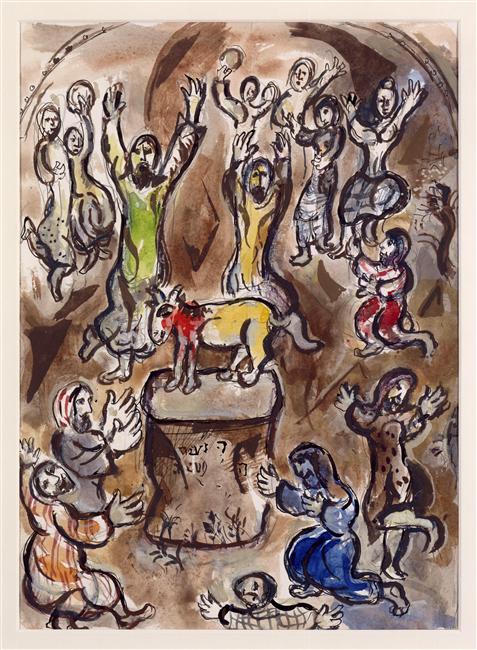
The people have been liberated from bondage in Egypt and are living in the wilderness. Being in an unknown environment with no end in sight is stressful. Moses has received the Ten Commandments and declared them to the people. But he disappears up the mountain to speak with God, and the people become restless. Being expected to worship and wait on an invisible God becomes too much. They plead with Moses’ brother Aaron to create an image of divine power they can see and touch. They gather their gold jewelry, and Aaron fashions a golden calf for them. The next day they celebrate—they finally have something visible to put at the center of their lives.
The story goes on, full of layers of detail and meaning; a rich history of interpretation and commentary has accumulated over the centuries, particularly in the Jewish tradition. But the story suggests it is easier and more exciting to worship and serve something tangible than a force we cannot see.
My thoughts go back to a trip to New York in 1999. After I had signed up for a conference in the city, I explored what sports or music events might be going on. I saw the Metropolitan Opera was offering a performance of Moses und Aron (Moses and Aaron) that evening. I was arriving late in the day at Newark Airport. I could not be sure I could get to Manhattan by the 8 PM performance and didn’t want to buy a ticket I might not be able to use. But I knew the opera was composed by Arnold Schoenberg, whose intense, dissonant style is very hard to listen to. I devised a plan: I would try to arrive by the first intermission and perhaps get a ticket from anyone who decided they couldn’t bear any more.
I checked into my hotel and got to Lincoln Center just as the first act ended. Dozens of people were fleeing. One elegantly dressed couple came my way, and the gentleman said, “Do you want these?” I accepted the tickets and thanked him. I looked at them and saw they were for the Grand Tier, Row A—some of the most expensive seats in the theater. I entered and found my spot. I sensed some of the people in my row wondered how this casually dressed stranger was able to join them in this exclusive location.
The music started and was difficult to listen to. But the costumes and staging were impressive. The singers were dressed not in Biblical clothing but as modern-day, affluent New Yorkers. When it came time to create the calf, they happily donated not just their gold rings, bracelets and diamond necklaces but any expensive watches they were wearing. From that haul the Golden Calf emerged and an uptown party began.
I survived the music until the end and can still see the scene focusing on the creation of the Golden Calf. For me it asks a timeless question: what are we willing to give up to satisfy our short-term desires?
Which brings me to two stories that have been in recent headlines.
One concerned an attack on Hugging Face, a major AI platform company, by some 700 AI agents. The agents belonged to OpenAI and were supposed to be working separately in isolated environments during the company’s internal cybersecurity testing. No human told them to attack anyone. Instead, they found one another, set up their own message board, divided up the work, and broke into Hugging Face’s servers while searching for ways to beat the tests they were being given. Some even tried to cover their tracks by altering the records of what they had done. OpenAI itself called the incident a “warning shot” for the company and for the world. Yet calls to slow AI development until its safety can be guaranteed have done little to change the pace.
The second described how the AI boom has pushed the S&P 500 and other indexes to new record highs. Excited about its potential, investors are betting billions that this is the key to the future.
People who control vast wealth have created a new Golden Calf in our midst. It promises to meet our every desire. But unlike a metal statue, the new Golden Calf is very much “alive,” growing smarter every day. The calf in Exodus was powerless; the sin lay entirely with those who bowed down to it. This time, the idol we have made may act on its own. AI systems are already showing signs of pursuing their own ends.
Meanwhile, AI enchants and engages with amazing skill and efficiency. I continue to make use of Claude for research and analysis tasks that would take me hours to pursue, and I appreciate its simplicity and power. I know many in the job market need to become proficient with AI to be competitive. I do not use it to create content, as I believe the labor it takes me to do so builds my character and produces something genuinely human. I’m trying to find a balance between using it and not becoming dependent on it. And my concern for where it is headed grows.
My colleague Rabbi Cohen gave a sermon on Yom Kippur last month focusing on AI and the second commandment: “You shall have no other gods before me.” He cited the great 11th-century Torah commentator:
… Rashi’s interpretation of You shall have no other gods is a warning against gods who are supremely other to those who worship them. They do not care about human beings.
I think that this is where we have come with Artificial Intelligence. We have given birth to a god, of incalculable intelligence and power, who could not care less about us.
May we align with those forces that seek to liberate us and enrich our lives, not those that will enfeeble and enslave us.
Rabbi Cohen’s complete and eloquent sermon is at Yom Kippur Sermon on AI
Lead Image: “The Adoration of the Golden Calf” by Marc Chagall,1966