“London Calling, Part 2: That Turbulent Priest”

There is no shortage of monuments to saints and martyrs in England.  This past week I joined the countless pilgrims who have gone to Canterbury Cathedral for 900 years to honor the memory and witness of Thomas Becket. I happened to be there when a top story in the news was “an exchange of perspective” between two powerful world leaders — one, the President of the United States, and the other, Pope Leo. 

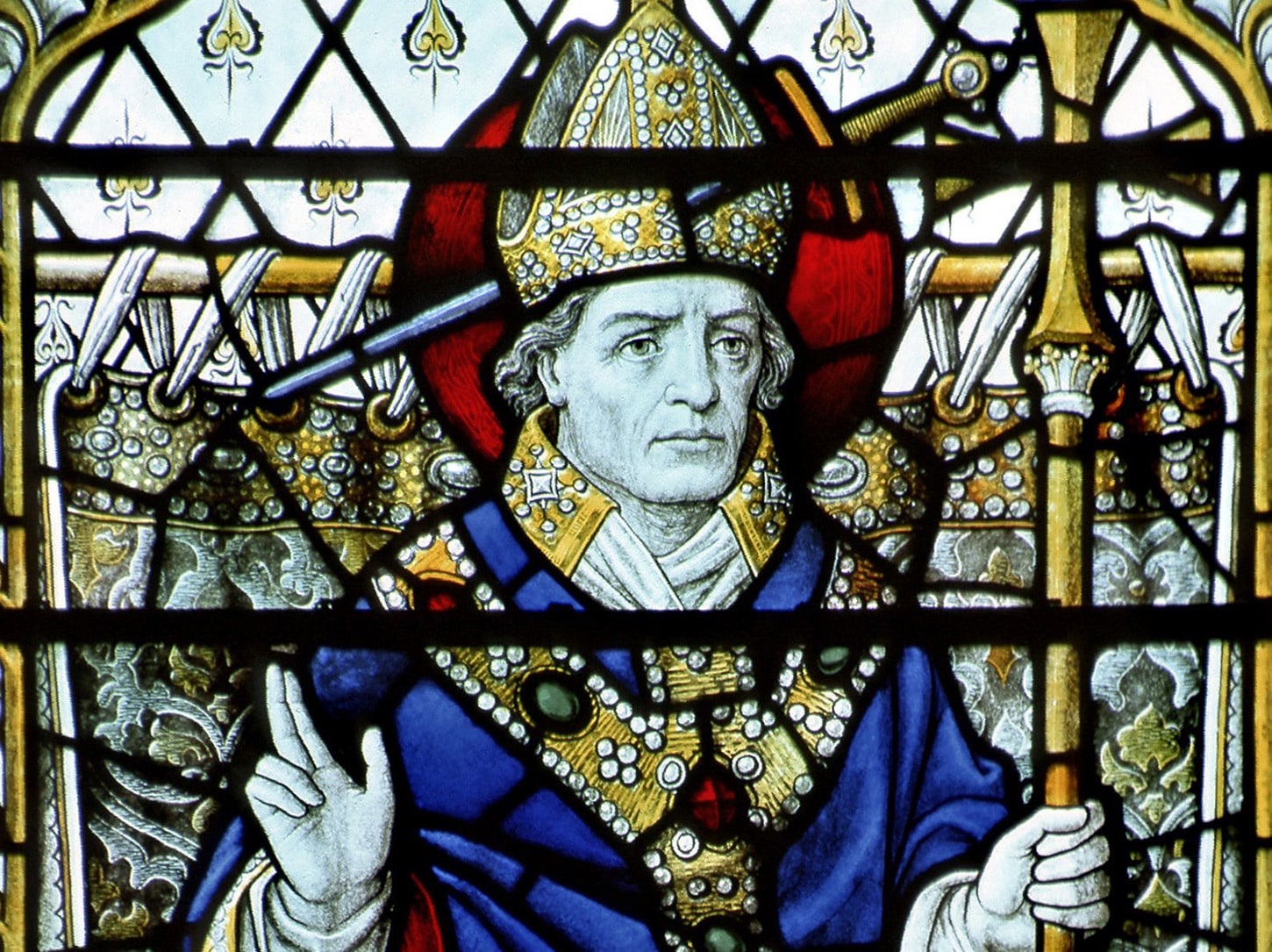
Thomas Becket had been a friend and advisor of Henry II.  Henry appointed him to be Archbishop of Canterbury expecting Thomas would support whatever Henry wanted to do.  But Becket took his vows seriously, and spoke out whenever he felt Henry was going astray.  At one point, Henry expressed his frustration in the presence of four of his supporters and was heard to say: “Will no one rid me of this turbulent priest?”  On December 29, 1170, the four men rode to the Cathedral, entered the area where Thomas was alone at prayer, and murdered him with their swords.  Becket had stood firmly for spiritual principles in opposition to a willful ruler.  He was made a saint.

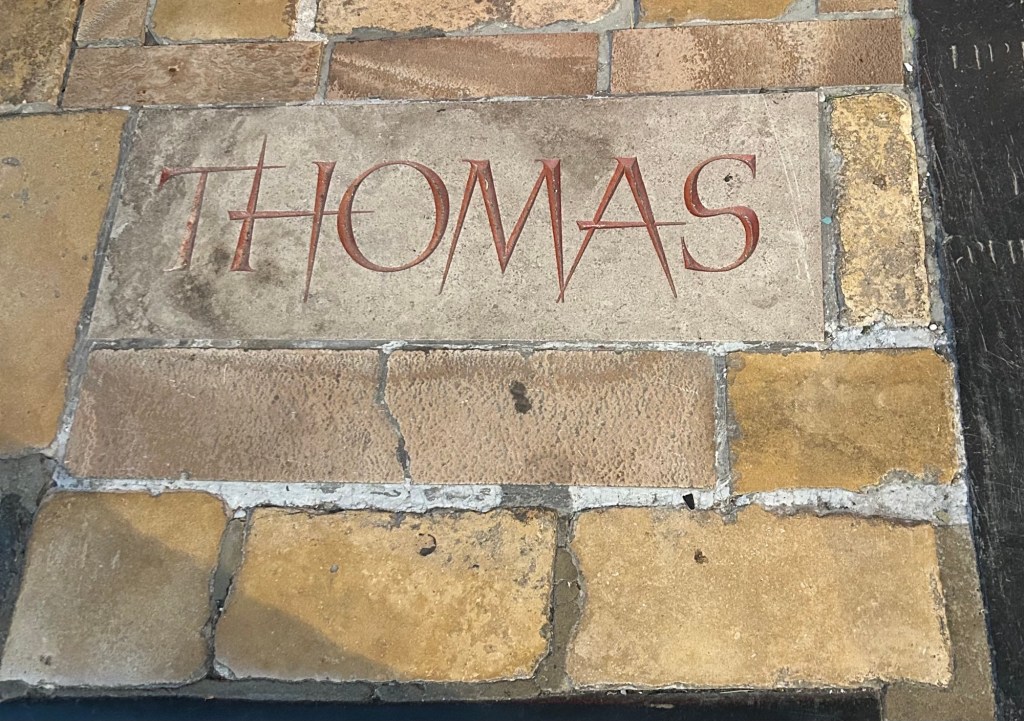
For centuries Becket’s tomb was on display at the end of the cathedral, where countless people came to pay their respects.  I first visited that part of the sanctuary. I then came to the small side room where the actual murder occurred; his name is written on the floor:

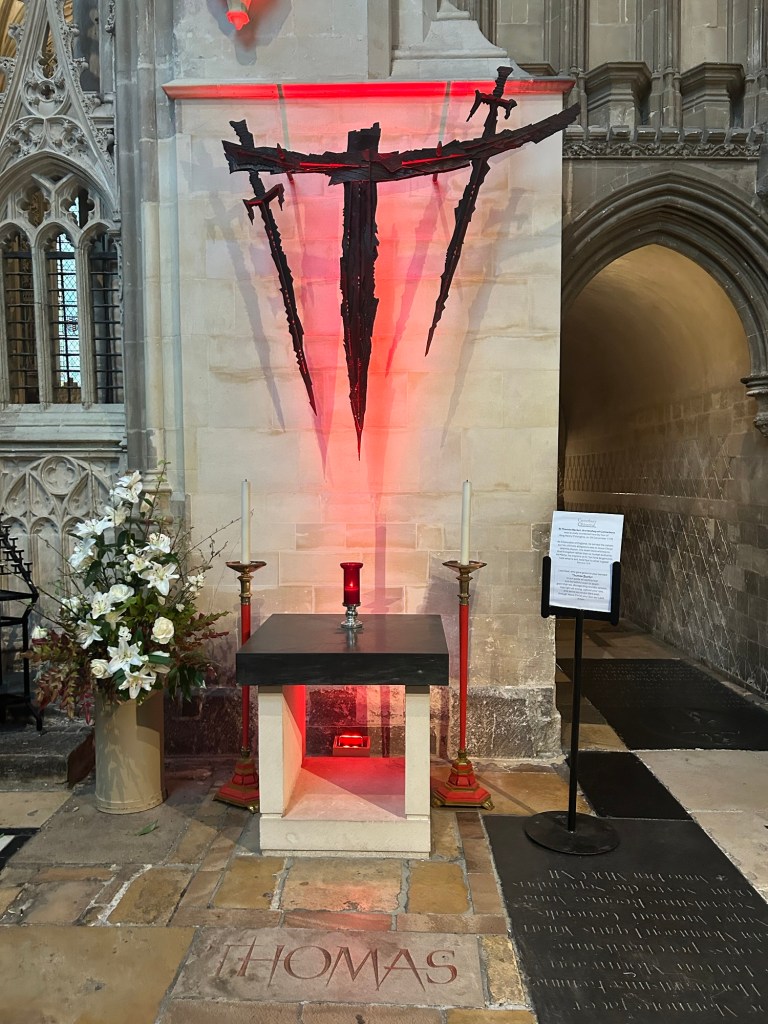
There is a sculpture above the spot consisting of a metal cross flanked by two swords with red tips representing blood.  Light descends from above in such a way that the two swords create four shadows, one for each murderer:

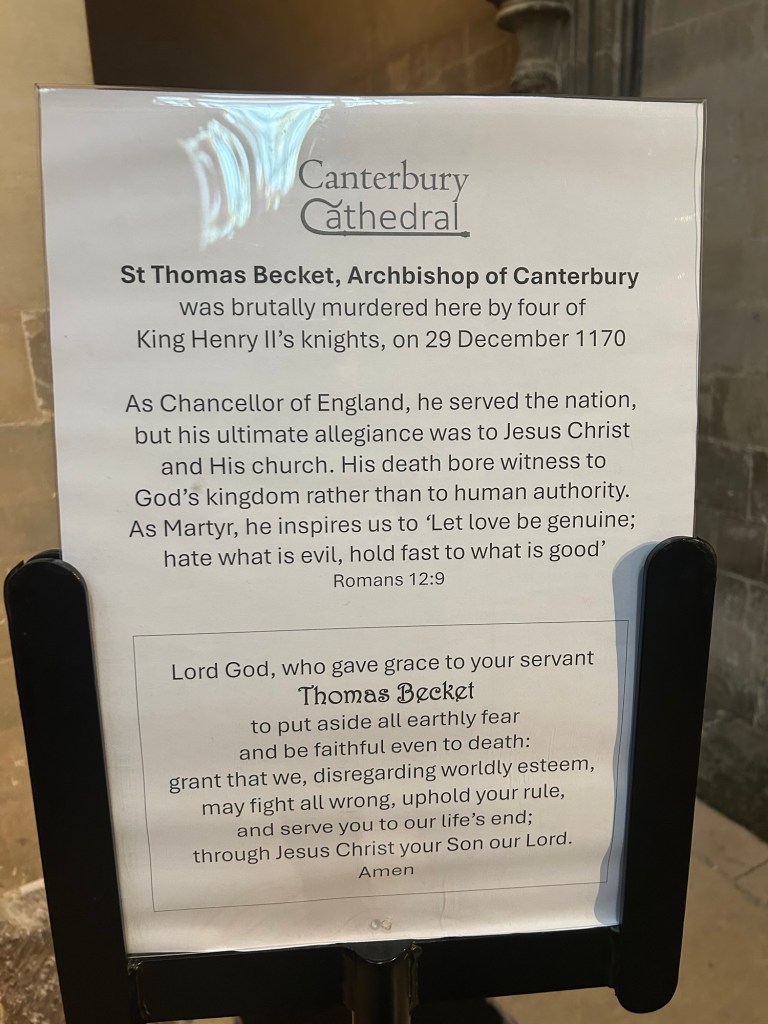
On the wall nearby is a plaque:

Speaking truth to power is a tradition that goes back 3,000 years to the prophets of Israel. Willful leaders don’t like it, and more than once have wanted those who speak up to be silenced. But it is an essential element of spiritual integrity and of democracy. It is inspiring to stand in this sacred place and know the tradition continues in our own time through the voice of Pope Leo and others.

Something to Rest On

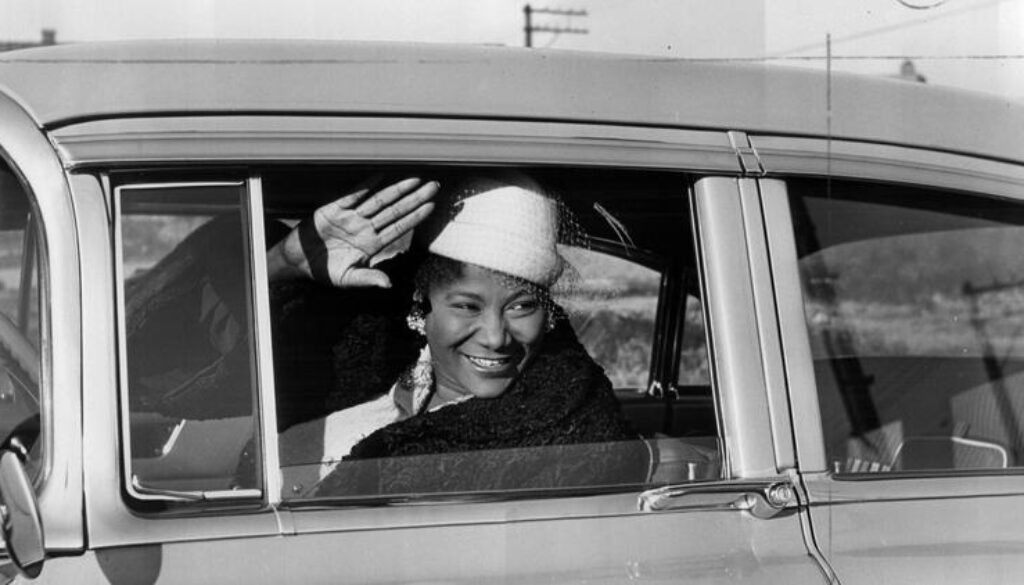
Gospel music was not something I heard in my home growing up.  But I did know of a singer named Mahalia Jackson, who appeared on television shows and sold millions of records.  She performed at many civil rights demonstrations and before European royalty.  President Kennedy chose her to sing “The Star-Spangled Banner” at his Inaugural Ball in 1961.  She sang “Precious Lord, Take My Hand” at Dr. King’s memorial in 1968. She died in 1972 at the age of 60 and left a legacy of inspired art.

Mahalia Jackson was orphaned at an early age.  She heard gospel music coming from the church next door; it drew her in and she embodied it the rest of her life. 

Many successful gospel singers began in church choirs and later made a career singing the blues, which had a broader audience.   But she never did. She once said, “When you sing gospel you have a feeling there is a cure for what’s wrong. But when you are through with the blues, you’ve got nothing to rest on.”

Ms. Jackson knew pain well and she could express it in her music.  But at the heart of every song was the conviction that reaching out in faith offered “a cure” – “something to rest on.”

Imagine coming upon an old-fashioned water well.  Leaning over the stone wall that surrounds it, we look down to see if there is water.  But the sunlight does not reach far enough for us to know. So we pick up a small stone and drop it down into the well.  If we hear nothing, we might conclude the well is dry.  But if we hear a plunk, we know water is there.

Spiritual belief is like that.  We wonder if there is something beyond us. We drop something down into our inner well — maybe a hope, a prayer, a question, or a plea for guidance.  Sometimes we get only silence. But sometimes we get a response; it may come as a word, a phrase, an image or a conviction.

When we do receive a response, we recognize it is not something we could create on our own — it feels fresh.  When we claim it, we find our life opening to new possibilities.  We have “something to rest on” as our journey continues.

A spiritual well is not a magic wishing well — it’s not about getting what we want every time.  Sometimes we receive prompts that invite us to face and bear challenges we would rather avoid. But the direction we receive always leads to embracing life.

Mahalia Jackson knew a great deal of personal suffering.  But in her faith and in her singing, she found something to “rest on.”  It didn’t make all the problems in the world miraculously disappear. But what she found within herself, in her music, and in her community gave her light, courage and the ability to endure, and she shared that with the world.

We are in the season of Passover and Easter.  The rituals and stories include times when people felt alone and without hope.  But then something happens that opens a way beyond the darkness into new life.  We are reminded we are not alone.  There is a living, divine presence down in that well. We are reminded we have “something to rest on.”


Getting a Peek at Heaven

Let’s say someone asks you, “Got any travel plans?”  Imagine saying, “Yeah… I’m going to the place where heaven and earth meet, poke my head through, and see what I can see.” This is how one artist imagined someone doing that:

(The caption reads: “A missionary of the Middle Ages recounts that he has found the point where heaven and earth meet.”)

For thousands of years, people looked to the skies and imagined what might lie beyond – and wondered if there’s a heaven out there.

Then science came with those telescopes, star charts, and rocket ships.

Years ago, I was teaching an adult class.  The passage we were studying mentioned heaven. One older lady raised her hand.

“You know,” she said, “I’m mad at those astronauts!”

“Why?” I asked.

“Well, when they got up there into outer space I thought they would see heaven.  But they didn’t find it.  Now I don’t know where it is. It makes me angry.”              

I have a friend who was a nun before becoming a doctoral student in mathematics at UCSB before becoming a Jungian therapist.  We used to go to public lectures at the Institute for Theoretical Physics on campus.  I appreciated having her with me because she could explain some of the concepts to me. I once asked her what she thought of the possibility of “worm holes” in space. She told me she thought it was an exciting theory, adding it might explain where heaven is hidden.

In spiritual traditions, “heaven” can be a reality beyond this one, but also accessible now.

In the book of Genesis, Jacob is alone in the middle of nowhere and lies down at night to sleep.  He has a dream in which he sees something like a ladder or staircase leading from earth to heaven with angels traveling back and forth.  He hears the voice of God promising that he will always be with Jacob.  Jacob wakes, remembers the dream and pours oil on the stone on which his head was resting and names it. He says, “This is the house of God, the gate of heaven.”  The story suggests that such an opening can exist in the most unlikely of places.

In the Gospels, Jesus speaks often of the “kingdom of heaven” and the “kingdom of God.”  And while some passages suggest a realm beyond this life, others suggest it’s a reality available to us now: “The kingdom of God is not coming with things that can be observed, nor will they say, ‘Look, here it is!’ or ‘There it is!’ For, in fact, the kingdom of God is among (or within) you…”

I once led a retreat with the theme of how paradise has been envisioned in different spiritual traditions and popular culture.  I showed a clip from the 1935 movie Top Hat in which Fred Astaire is wooing Ginger Rodgers.  In one scene, he invites her to dance with him as he sings the Irving Berlin song “Cheek to Cheek.” Here’s the chorus:

“Heaven, I’m in Heaven, And my heart beats so that I can hardly speak; And I seem to find the happiness I seek When we’re out together dancing, cheek to cheek.”

After seeing the clip, I asked the group to suggest how the scene expresses ideas of heaven.  People noticed that the set was full of light and beauty.  Ginger Rodgers had feather boas on the arms of her costume that floated like angel wings as she moved. We also saw both dancers moving effortlessly with each other, yet each retained their individuality.

And we watched the last scene of the 1989 movie “Field of Dreams.”  It’s a baseball fantasy in which Ray Kinsella has inherited a farm in Iowa and is raising his family.  Ray hears a voice in the corn field calling on him to build a baseball field. He does. Soon players from the past start walking out of the corn to play the sacred game one more time.  As one of them is leaving for the day, he asks Ray if this is heaven. “No,” Ray says, “This is Iowa.” As the story continues, the voice prompts Ray with new tasks, and he follows not knowing where it’s headed or what it means.  The last player to appear turns out to be John Kinsella, Ray’s father; they were estranged years before at the time John died. Ray introduces his father to his wife and daughter.  They begin playing catch.  They have this conversation:

John asks, “Is this heaven?”

Ray: “It’s Iowa.”

John: “Iowa? I could have sworn this was heaven.”


Ray: “Is there a heaven?”

John: “Oh yeah. It’s the place where dreams come true.”


Ray: “Maybe this is heaven.”

I’m not sure where heaven is to be found. Maybe it’s somewhere out there in outer space. Maybe it’s somewhere here in inner space.  Maybe it’s both. I welcome those moments when we seem to catch glimpses of it in our everyday lives, and remain open to the healing and beauty it might hold.

(Dear Reader: Not being satisfied with the way I ended this, two hours after posting I’m adding one more thought…)

I like to think of the fellow in the engraving and imagine what his life would be like when he came back from his journey. I’m guessing he’d be like most people who have had near-death experiences and profound spiritual encounters: he’d feel less fear, more peace, and a fresh committment to making each day matter.

(The lead image is an engraving from The Atmosphere: Popular Meterology, by Camille Flammarion, 1888; featured in Cosmigraphics: Picturing Space Through Time, by Michael Benson)

Maybe Prayers Are Like Snowflakes

One early spring afternoon years ago, I was making the three-hour drive on Interstate 90 from Seattle to our home in central Washington.  The highway passes through Snoqualmie Pass in the Cascade Mountains.  There had been plenty of snow that winter and there were only a few cars on the road as light flurries were falling. I was alone. I heard a loud crashing noise.  On the right side of the road ahead of me I watched a large snow-covered branch fall to the ground from a tall pine tree .  As I continued driving, I wondered how much weight it must take to break that branch off from the trunk of its tree.  How many snowflakes were required to make that happen? Did just one last snowflake tip the balance?

As I continued driving, I wondered if prayers might be like snowflakes.  Individually, they are virtually weightless.  But can they accumulate over time to make something tangible and unexpected happen?

There have been many theories over the centuries about how prayer might actually “work.”  There are many spiritual traditions encouraging people to pray. Many people share stories of how prayer has led to some remarkable outcomes. 

At the same time, many people can remember times when what they prayed for did not come to be.  Much has been written trying to understand “unanswered prayer.”

I have had colleagues in the medical profession recount experiences when they were working with families and individuals who were facing serious health challenges who put all their faith in prayer, sometimes to the exclusion of good science.  If the malady did not disappear, the family was faced not only with the loss of a loved one but questioning their faith as well.

I no longer expect to come up with a definitive answer to what prayer is and just how it “works.” But some stories come to mind. I’m going to share one this week and more in a future posting.

When I arrived to serve my congregation in Goleta, one man who became a friend and mentor was Hank Weaver.  Hank had recently retired after ten years at UCSB in the Education Abroad Program. He was a faithful Mennonite and a lifetime pacifist. Hank was a warm, engaging and brilliant man who walked with a slight limp.  I soon learned his story.  Just two years before, he had been diagnosed with a serious form of cancer in his lower spine.  The initial prognosis indicated he might not have long to live.  He decided to learn as much as he could about what he could do.  He had a PhD in chemistry and, as a dedicated scientist, worked carefully with his oncologist to begin the chemotherapy. 

At this time, people were beginning to use visualization as part of cancer treatment; the idea is you use your imagination in meditatation to visualize the chemo overcoming the cancer.   Hank was told one common example was to imagine cancer cells as small fish swimming in your bloodstream, and the chemo is a shark eating them up one by one.  Hank thought about it and said that wouldn’t work for him due to his belief in nonviolence.  He developed an alternative. He imagined a catfish swimming through his bloodstream, bottom feeding on things his body no longer wanted. 

Hank asked anyone who was willing to pray for his healing to do so, and many did.  One particularly dedicated member (in church speak, a “prayer warrior”) told me she had created an image in her mind of Hank entering the sanctuary fully healed, and many times prayerfully held that image in her mind and soul.  Hank also did all the right things in terms of diet and physical activity.

Months passed.  Slowly, the cancer began to disappear.  Eventually it went into remission.  The damage to his spine meant that his walk would always be impaired, but that was a small price to pay for the outcome.  (He did tell me one benefit of his impairment was the handicapped placard he had now had for his car – he began to get invitations from friends asking to go with him to Dodger games to take advantage of his hard-earned status for a premium parking place.)

Hank ended up self-publishing a book about his experience, Confronting the Big C.  Eventually he and his wife moved to Indiana where he served as interim President of Goshen College before retiring.  Hank had experienced a remarkable healing, and he believed it was the combination of good science and open-minded spirituality that led to his outcome.  He lived twenty-five more years until dying at the age of 93.

I believe Hank would say there are no guaranteed outcomes in this life.  None of us are getting out of here alive, and death will eventually take every one of us. But when facing serious challenges, we can choose to gather and employ all the best resources to increase our chances for a desired outcome.  We may never know how all these different forces – medical, spiritual, social, emotional – might interact with each other.  Some effects we can see and measure. But others, like prayer, may involve forces that are small and subtle.  But that doesn’t mean they can’t make things happen.

Image: Fineartamerica, Tera Fraley

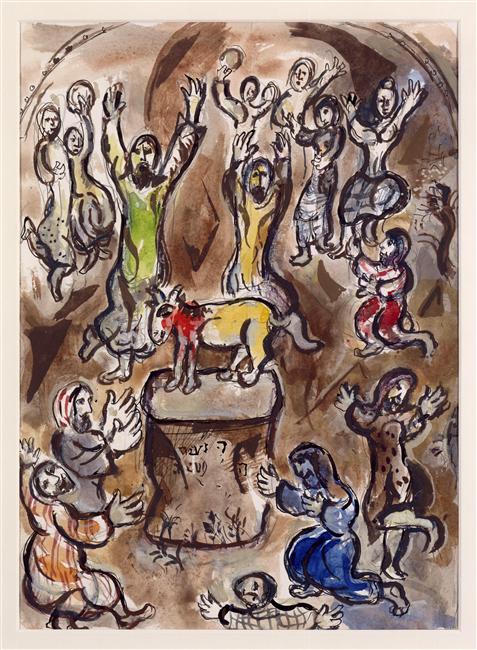
“Old Truth”

                  This past week, my wife and I went north to spend a few days in the presence of Mt. Shasta. While there, I thought often of a recent poem by my treasured friend and long-time colleague, Rabbi Steve Cohen. To me, these words are timeless — like the mountain. Given the state of our world, they are also timely. I’m sharing the poem with you this week.

“Old Truth”

Today we need Old Truth.

We thought it had died so we buried it.

The fact is that we tore down the Old Truth

because it seemed to be a rotten timber.

It had been twisted into a pillar of slavery and oppression

so we tore it down and buried it.

But today we need it again,

remembered and restored to its original sacred power.

When Old Truth goes silent, the Pharoah speaks:

“It is mine, this Nile; I made it for myself.”

Pharoah throws every boy that is born into the river

and says: “Who is God, that I should heed His voice?”

Who, indeed, is God?

How might He deliver us from this Pharoah,

this crocodile king, lying in the river,

certain that he is god, and that he will rule forever?

We need the Old Truth

Not some artificial intelligence, but our Old Human Intelligence.

We still remember that Voice, speaking to us from out of the fire:       

“I am the Lord your God Who brought you forth from the Land of Egypt”

“The voice of your brother’s blood cries out to Me from the earth””

“Do justice, love mercy, and walk humbly with your God.”

We used to stand in class and pledge to be

“One nation, under God, with liberty and justice for all.”

Many times in history, human hands have

“hurled Truth to the ground”

But always, with time, with courage and with help from God,

“Truth springs up from the earth,

and justice gazes down from Heaven.”

You can explore more of Rabbi Steve’s writings at https://www.rabbistevecohen.com.

(sources:  Ezekiel 29:9; Exodus 5:2; Exodus 20:2; Genesis 3:10; Micah 6:8; Daniel 8:12; Psalms 85:11)

“Have You Seen This Dog?” — Thoughts on Getting Away

(Dear Reader: I had a few tech challenges getting this posted…I hope this comes through now…)

Some years ago, we had a dog named Andy.  He was a feisty soul who lived 18 years.  One day, I had parked our car in the driveway and, for reasons I cannot remember, left him there for a few minutes.  I returned for him, saw him in this pose and took the photo.

Just for fun, the next day I made flyers with “Have You Seen This Dog?” in large print and the photo below it.  I added a comment that he was last seen driving a gray Honda Odyssey van on Patterson Avenue and included my contact info.  I posted the flyer a few on telephone poles in our neighborhood.  No one seemed to notice.  A few days later I took them down.

Earlier this week I happened to come across the photo again.  Something about it called to me — I thought about that impulse we can have to “get away.” 

Do you ever feel this desire?

Maybe it’s just taking a break from our daily tasks and getting outdoors to take a walk. Or going out to spend time with friends. Or engaging in a physical or creative practice that reminds us of our inner capacity to experience new things.  We often return from such activities with renewed energy and optimism.  

The desire may lead us to travel.   I am constantly thinking about trips I want to take to places I’ve never been. The travel industry offers us images and catalogues that stimulate that desire even more.  If we have traveled to a new country or culture, we may return with an increased knowledge of how other people live, what the world offers, and our own possibilities.

Sometimes we “get away” for distraction and entertainment. Sometimes we do so for something deeper.

From a spiritual perspective, many transformational figures have found new direction by “getting away” from what’s familiar to find something new – Buddha, Abraham and Sarah, Moses, Elijah, Jesus, Mohammed and countless others who have gone on vision quests and personal pilgrimages.

In my years of involvement at La Casa de Maria Retreat Center, I saw countless people arrive feeling burned out, sensing they needed a new direction.  They found an environment designed to encourage personal renewal.  They were free to wander the 26 acres of oak trees set alongside a running creek.  They could choose to rest, meditate or reflect at one of the spiritual gardens.  Wonderful food was provided.  Naps were encouraged. Unhurried conversations could take place.  There were no television screens to distract attention.  Time after time, people left feeling like their purpose in life was once again clear. They had found new hope and courage.

When we return from these kind of journeys, we may not feel the need to “get away” again any time soon.  Instead, we can face our life, responsibilities and opportunities with clarity and confidence.  We accept whatever limitations we may have, but now with a willingness to acknowledge them, making the best of the time and resources we have. 

It’s good to get away.  It’s also good to come home.

In my pastoral and hospice experiences, it was often instructive to see how many people at the end of life found purpose and meaning in simple things: personal relationships, a few treasured memories, and an awareness that life is a marvelous mystery and gift.  They didn’t feel a need to be anywhere other than where they were.

I could have asked Andy what led him to take the wheel and contemplate getting away that day.  Was it some deep spiritual calling? Or just a hope he could find a household with better food?  But Andy never wanted to talk about his deeper feelings, and I respected that.  I do know that as I opened the car door, picked him up, and brought him into the house he seemed glad to be home once again.

Visualizing the Christmas Stories

Over the years, I’ve grown in appreciation for the different ways artists imagine and portray traditional stories.  The Advent and Christmas season is a great example.  Here are a few of the works I have come to treasure over the years.

The Angel Visits Mary

A young peasant girl named Mary receives a surprise visit from the angel Gabriel, who announces she has been chosen to bear a child with a divine destiny. In 1485, Botticelli imagined it this way:

…the incoming of the divine Spirit seems to almost be knocking the angel over as it travels towards Mary.

In 1898, the English painter Tanner imagined it this way:

…the “angel” appears as a shaft of pure light; Mary seems to be contemplating what she is experiencing.

Joseph’s Dreams

Mary was engaged to Joseph, and when he discovers she is pregnant, he decides to break the engagement. But an angel appears in a dream and changes his mind. 

In 1645, the French painter Georges de La Tour imagined it this way:

Joseph has fallen asleep in a chair while reading, and the unseen messenger is near him with an unseen candel illuminating the space between them as the dream is transmitted.

After the child is born, the family must flee due to threats from the government.  In the process, Jospeph is twice more guided by dreams.  In 1645, Rembrandt imagined one of those times this way:

…the angel is in the room with Mary and Joseph as they sleep.  The angel extends the left hand to Mary while touching Joseph’s shoulder to impart the dream.

“The Visitation” — Mary Visits Her Older Cousin Elizabeth

In this episode, the newly pregnant Mary travels south to visit her older cousin Elizabeth, whom the angel Gabriel had told her has also become pregnant.  When Mary arrives and greets Elizabeth, the baby in Elizabeth’s womb senses Mary’s presence and “leaps” in response; the women share an intimate moment of mutual knowing.

In 1440, the sculptor Luca Della Robia created this scene:

…here’s a close-up of the two women looking into each other’s eyes:

In 1530, the Italian painter Pontormo envisioned it this way:

…this image also merits a close-up of the faces as they behold each other:

That woman between the two of them who is looking at us — what does she want us to understand?  No one knows for sure.  I was excited to view this in person recently when it was at the Getty Museum a few years ago.

The Birth of the Child

In 1500, Botticelli created this scene, which he called “Mystic Nativity:”

…the manger is in the center of the picture…Joseph is asleep…Mary and the child are gazing at each other…while above, below, and around them, angels dance in celebration.

In 1646, Rembrandt created this contrasting version:

Simple, earthy, quiet, intimate.

And in 1865, the pioneering British photographer Julia Margaret Cameron created a “Nativity” scene in her studio using working class people as her models:

Great spiritual stories can contain a “surplus of meaning” – there is not just one way they can be interpreted or portrayed.  Just as scientists use math to reveal important truths, artists engage our imagination.  Our souls welcome this.  Imagination allows us to see beyond the surface of life into the mysteries and wonder which surround us.

Merry Christmas, dear readers!

Lead image: “L’Annuncio” (The Annunciation), Salvado Dali, 1967

The Fragrance of a Christmas Tree

              The holiday season can be full of sensory experiences that call forth memories and emotions.  I recently came into a room that had been decorated with an advent wreath, pine tree cuttings, and a live Christmas tree. The fragrance was inspiring, and I’ve been thinking about why.  Do any of these associations resonate with you?

  • It reminds me of childhood.  Going to a Christmas tree lot which smelled amazing.  Bringing the tree home and letting it fill our home with that aroma.  The odor became the olfactory backdrop for all the joy of the season.
  • It calls to mind being in a forest. It could be the Sierra Nevada, the Cascades, or any other forest — places many of us have gone for vacation and renewal.  The trees could be pine, fir, cedar, or redwood, but the association is the same: we have left our distracted lives and are now in a natural cathedral of quiet and timeless living beings.  
  • Smelling the fragrance calls forth the color green – always a sign of life.
  • The fragrance smells clean. Maybe it’s the association with being in nature. I don’t know why but that comes to mind.
  • And the more I thought about it, another word that comes to mind is pure.  The fragrance of a live Christmas tree is evocative on its own; it doesn’t need anything added.  But the aroma at this time of year complements the visual experience of gazing at lit candles in a darkened room or quiet sanctuary: they both suggest the mysterious source of life is with us, fresh and full of promise.  Our eyes behold a symbol of that truth, and the fragrance of a Christmas tree, wreaths and cuttings confirm it. Light and life arise in darkness and the darkness will never overcome it.

Our Frames of Mind

              In the fifth game of the World Series, Toronto pitcher Trey Yesavage — a young man who has only been pitching in the major leagues for a few months — faced the most feared hitter in baseball, Shohei Ohtani:

Ohtani led off the bottom of the first inning with a comebacker. Yesavage bobbled the ball and then dropped it, but he had what you might call veteran poise, picking up the ball and throwing what Toronto manager John Schneider called “kind of a shovel pass” to first base for the out.  “The fact that he kind of shoveled it the way he did and kind of had a little smile on his face,” Schneider said, “it actually gives you a little bit of confidence that he’s in the right frame of mind.” (October 30, LA Times)

              What is the “right frame of mind” in this situation? It seems it’s being in a high-pressure situation, making a mistake, not losing your cool, remembering your purpose, and accomplishing your task – with “a little smile.”  Doing that demonstrated “veteran poise.”  Yesavage maintained that poise, set World Series pitching performance records that night, and helped his team win the game.

              This has got me thinking about the term, “frame of mind.”

              A picture frame is a structure we use to hold something we want to see well.  We choose a particular frame to highlight the photo or painting it will border. A good frame focuses our attention on what is important. 

A “frame of mind” is an attitude we use that helps us focus on who we want to be and what we want to accomplish.

              I’ve been thinking about “frames of mind” I have seen in action.

              I worked with a church custodian who always displayed a positive attitude no matter what the challenge might be.  One time I asked him how he did that.  He said he used to be a person who often complained.  But then he visited a pediatric oncology ward and saw children being treated for life-threatening illness. That day he decided he would never again let himself complain about everyday problems.  The experience helped shaped his frame of mind every day.

              Some years ago, I attended a special installation service for a new Catholic bishop. In his remarks, he said he had had polio when he was young, and though he had largely recovered, he was still falling occasionally.  “If you are with me when that happens,” he said, “…don’t become anxious… just extend your hand to me, help me to my feet, and we will go on.  And if, as your bishop, I make a mistake, don’t become anxious – just extend your hand to me, help me back to where I should be, and we will go on.” 

              At a conference last year at Westmont College, a group of staff members were interviewed about their jobs.  They were asked if they had any favorite Scripture verses to guide them in their work. A long-time student advisor cited 2 Corinthians 4:18: “…for we look not at what can be seen but at what cannot be seen, for what can be seen is temporary, but what cannot be seen is eternal.”  When she began working with a student, that verse helped her focus not on her initial impressions but on what the student’s deepest concerns and hopes might be.

              I recently heard a presentation from a colleague who had been the chair of an academic department.  One of his responsibilities was to interview people being considered for teaching positions. He established a practice of meeting each candidate for breakfast at a particular restaurant.  While they were talking, he observed how the candidate treated the waiter and employees who came to the table: did the candidate demonstrate courtesy and respect, or did they act as if the employees didn’t matter?  He came to believe that this behavior would predict how the person would treat students and anyone of “lesser status.”  He would only recommend the people who showed respect. 

              Spiritual traditions and practices can remind us of how we can find deeper meaning in life and how we can best serve others, offering us “frames” for doing that well.

              What frame of mind we choose as we go through our day will shape how we experience each day and our effect on other people.  A good frame can help us keep our poise, perspective, and purpose. And when we make mistakes, it can empower us to maintain our composure and do our best to still get the job done – with a little smile.

Lead Image: “Person Carrying a Big Empty Frame Outdoors,” freepik.com

Are You an “Everyday Mystic?”

For centuries, a “mystic” was someone who had a rare and unique spiritual experience, different from what most of us would ever know.

This is reflected in the word itself: The term mystic is derived from the Greek noun “mystes,” which originally designated an initiate of a secret cult or mystery religion.   In Classical Greece and during the Hellenistic Age, the rites of the mystery religions were largely or wholly secret. The term” mystes” is itself derived from the verb “myein” (“to close,” especially the eyes or mouth) and signified a person who kept a secret.[i]

But in recent years, the term “everyday mystic” has come into use. Here’s one description:

An “everyday mystic” is someone who seeks or experiences spiritual depth and transcendence within ordinary daily life, rather than through withdrawal from the world or extreme ascetic practices.

The concept suggests that mystical experience—that sense of connection to something greater, moments of profound awareness, or spiritual insight—doesn’t require monasteries, retreats, or renouncing worldly responsibilities. Instead, everyday mystics find the sacred in mundane activities: washing dishes, walking to work, caring for children, or sitting in traffic.[ii]

I have known quite a few “everyday mystics.” They don’t try to be different or better than anyone else — they are simply doing something they feel called to do and, in the process, find a deep connection beyond and within themselves.  They don’t do it for money, or to prove their worth, or to puff up their ego. 

Some examples came to my mind:

  1. A physical therapist who told me there were times working with patients when his mind would become quiet and he would feel as if light was passing through him to the person he was treating.
  2. Farmers, gardeners and hikers who sense a silent and limitless bond with the earth and the mysterious processes which underly all life.
  3. Musicians who feel as if the music is playing through them.
  4. Grandparents when they behold their grandchildren.  They had loved their own children from the moment each child was born, but so much of parenting is about being a manager, behavior coach and the one person responsible for everything to do with the child. But then a grandchild appears and seeing them evokes a sense of pure wonder.
  5. Artists who get immersed in their process and end up creating something far beyond what they could have imagined when they started and don’t know how it happened.
  6. Mechanics who have an innate sense of what is wrong with a car and how to fix it with the least cost and effort, working in harmony with all the moving parts instead of simply using their will to fix something that is wrong.
  7. A young man who told me he was pitching for his college team and for a few innings the ball seemed to go exactly where he intended every time.  The experience passed and he never had it again.  He could not explain how it happened but has never forgotten what it felt like.
  8. Golfers who watch a ball rise and fall through the air with a grace and purpose that feels as if something more is present than a little ball being struck.
  9. Ocean swimmers who love the mystery of being on the surface of the limitless sea, and who feel deeply at home in salt water—perhaps sensing an unbroken thread of experience going back to our pre-human ancestors as well as our personal life as it began in the womb.
  10. People who know they are dying and “descend into the heart,” losing their fear and becoming open and observant towards everything around them.

Richard Rohr said, “For me, “mysticism” simply means experiential knowledge of spiritual things, as opposed to book knowledge, secondhand knowledge, or even church knowledge.”[iii]

Huston Smith said, “Most mystics do not want to read religious wisdom; they want to be it. A postcard of a beautiful lake is not a beautiful lake, and Sufis may be defined as those who dance in the lake.”[iv]

We can always be grateful when such moments come to us.

“Hands Cradling a Child’s Head,” Kathe Kollwitz, 1920

[i] https://www.britannica.com/topic/mysticism

[ii] https://claude.ai/chat/468625b2-74aa-4984-ba6e-8eb7f17a257a

[iii] https://cac.org/daily-meditations/sidewalk-spirituality/

[iv] Huston Smith, Jeffery Paine (2012). “The Huston Smith Reader,” p.93, Univ of California Press

Lead Image: “Ocean Swimmer In Thick Fog Near Reykjaice,” storyblocks.com