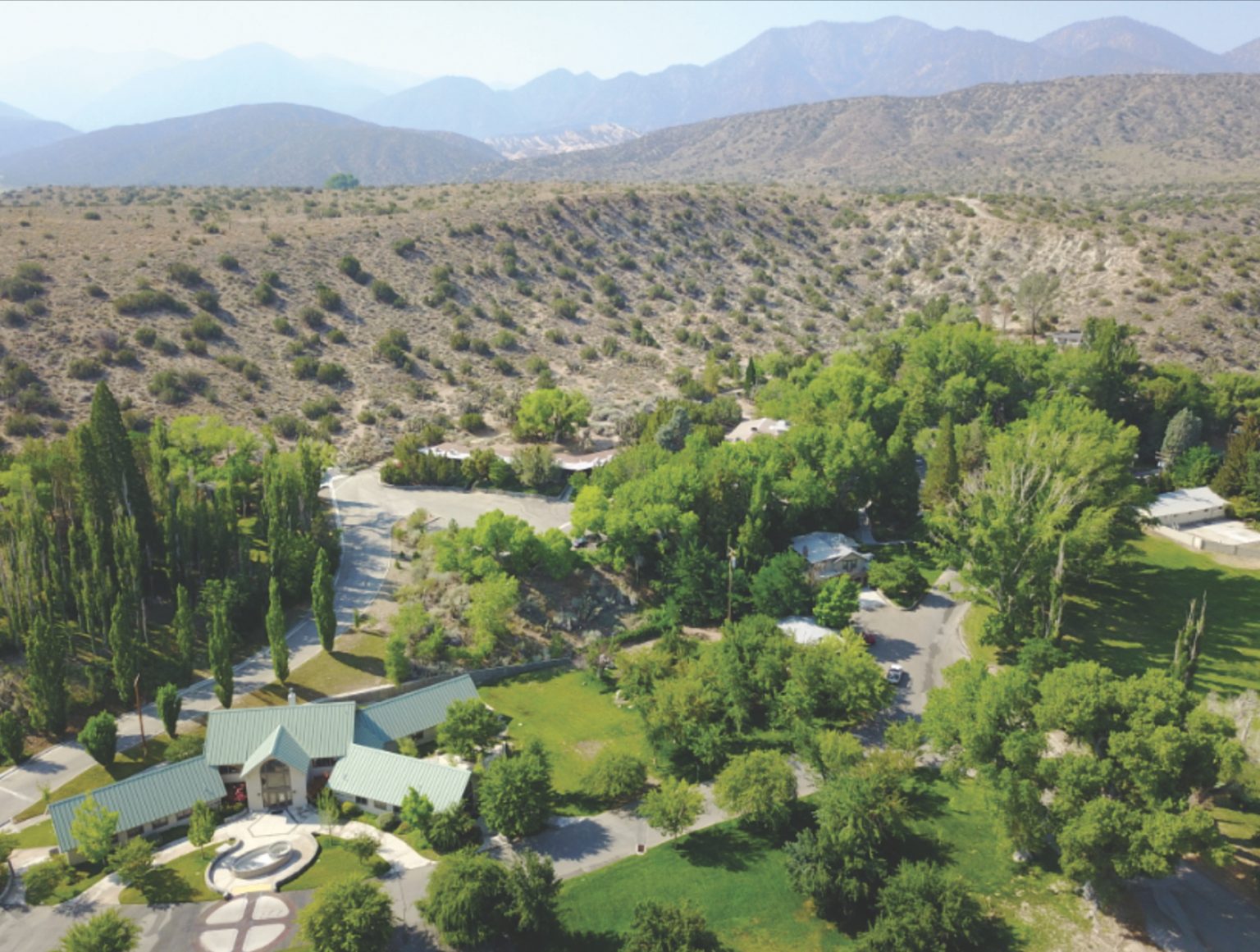
In 1982, I was beginning to explore contemplative practices: spending time in silence, journaling, paying attention to dreams, and reading classic works on prayer and meditation. I decided to make a private retreat at a monastery. I was living in Santa Paula at the time and heard about St. Andrew’s Priory, a Benedictine center in the desert north of Los Angeles. As I was making my reservation, I was told they were receiving a new monk into their community that evening and I was welcome to attend.
As I drove through the desert, I wondered what to expect. Do monks chant in low voices all the time? Are the guest room mattresses hard? What do they eat – gruel with weak tea?
I arrived as the service was ending in the chapel. Approximately 60 people began heading toward the dining room, a blend of monks in brown robes and lay people.
When I entered the dining room, I saw prime rib and roast turkeys being carved and a long buffet with colorful side dishes. At each dining table were bottles of wine, six-packs of Dos Equis, and jars with cigars.
I said to one of the monks, “This is not what I was expecting.”
“We don’t always eat like this,” he said. “One of the brothers used to be an executive chef for the Hyatt. When we have special occasions, he takes over.”
I filled my plate and walked to place at a table across from a monk who was already eating.
He motioned me to join him and said, “Welcome. I’m Father Vincent.” As we ate, I asked him how long he’d been at the Abbey. He told me he first came in the 1950s. I asked him where he had been before that. He said he’d been in China from the 1930s until 1948.
“You were in China in the 1930s?” I asked. “Did you ever meet Teilhard de Chardin?” (Chardin was a famous theologian and archaeologist I admired who had been on digs in China and whose writings integrated evolution and spirituality).
“I met with Teilhard Tuesday afternoons when I was in China,” Father Vincent said. “He was a brilliant man, but did not know the God of Abraham, Issac, and Jacob.”* I was fascinated and we continued our conversation.
That evening marked the beginning of a personal friendship I developed with Father Vincent. I returned several times during the next three years to spend time with him. I would bring spiritual questions to explore. We would sit on a bench or take long walks. He was always patient and gracious, speaking quietly and thoughtfully with his French accent.
Gradually I learned more about his life.
He was Belgian by birth and grew up speaking French. After entering the Benedictine order, he was sent in 1936 to China to establish a mission. He became fluent in Chinese. When the Japanese invaded, he joined the Chinese army to serve as a chaplain. He was captured, spent time in a Japanese POW camp and narrowly escaped being executed.
After the end of the war in 1945, he resumed his work in China until foreigners were expelled in 1948. He came to the US to attend Harvard, where he earned a PhD in sociology.
He once told me, “You know, I think in French, speak in English, and dream in Chinese.”
After Harvard, his order sent him to Los Angeles with $50,000 to find a location for a monastery. He told me he read the LA Times real estate section every Sunday. One day he saw an ad for a 720-acre turkey ranch near Pearblossom. He represented his order in the purchase and oversaw the construction.
After St. Andrew’s got established, he spent 10 years in Jerusalem studying Judaism and Hebrew. After he returned to California, he would often attend Jewish services in Los Angeles, putting on a prayer shawl and yarmulke and reciting the prayers in Hebrew. He was the first Catholic Chaplain at Cedars-Sinai hospital. Year after year he worked to strengthen the bond between Judaism and Christianity.
Father Vincent died in 1999 at age 87. I regret I did not spend more time with him.
I will always treasure the time I was in his presence. He was a brilliant man who sought to understand and appreciate the rich variety of human experience and for whom spirituality was an endless exploration.
After retiring in 2018, I felt a desire to go back to St. Andrew’s to reflect on my transition. I booked a three-night stay.
When I arrived, the grounds and buildings were familiar, but I felt Father Vincent’s absence.
On my last morning, I decided to visit his grave on the hillside overlooking the Abbey. I walked up the dirt road to the cemetery. I was alone. When I found his tombstone, I saw several bouquets of flowers scattered around it – clearly, after two decades, I was not the only one who wanted to honor him. I kneeled, closed my eyes, and began to offer a silent prayer of gratitude. I did not get very far into my prayer before I stopped. An awareness had arisen within me — or was given to me. I sensed I didn’t need to venerate him. Instead, I felt an abiding kinship. It was as if I was being told, “You, too, have lived a meaningful life.”
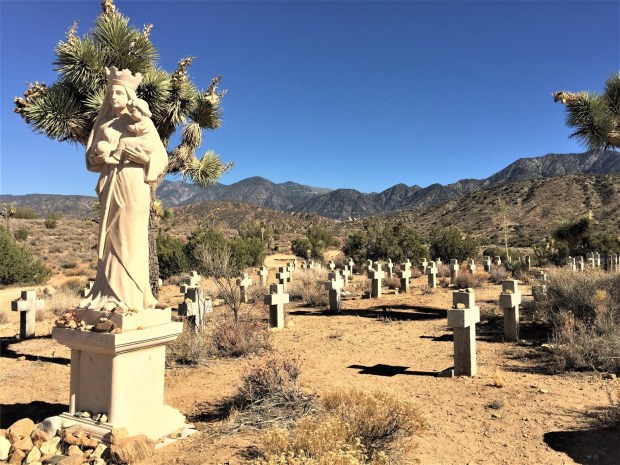
The Cemetery at the Abbey
*In regards to Father Vincent’s comment about Teilhard, I have wondered about it ever since. I think he meant was Teilhard was seeking to create a rational comprehensive system of understanding God in light of modern science. But Vincent and others have often pointed out that the God who appears from Genesis often defies human comprehension.
Lead Image: St. Andrew’s Priory, Valyermo, CA


