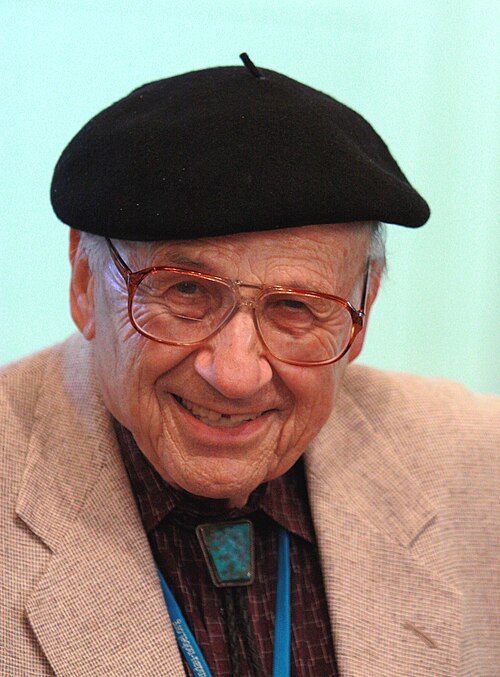
When we first came to Santa Barbara in the early 1990s, I was finishing a leadership program through Seattle University. One of our assignments was to interview leaders from different disciplines: the arts, education, business, and science. I didn’t know any scientists, so I asked one of my parishioners who worked at UCSB for suggestions. “You should interview Walter Kohn,” Hank said. “People say he may get the Nobel Prize someday.” It was also known that, despite his fame, he came to campus every day on the city bus.
I called Professor Kohn’s office and left a message. He called me back and agreed to meet. “I bring a brown bag lunch every day and eat in my office,” he said. “Why don’t you bring your own lunch and we can talk?” We set a date.
I don’t remember what food I prepared, but I made sure to bring it in a brown paper bag.
I found his office and knocked. He invited me in and offered me a chair.
What remains vivid in my memory is his description of growing up in Vienna in a close Jewish family in the 1920s and ’30s. He was also grateful for the excellent public education he received, including the study of Greek and Latin. He said he gained a lasting appreciation for how Roman civil society and traditions put a high value on personal integrity and public service, which he sought to embody in his life and career.
After the Nazis took control of Austria in 1938, he was separated from his parents, who were later killed in the Holocaust. He made it to England, then Canada, and finally the United States. Along the way, he took advantage of every educational opportunity that came to him. He eventually found his calling as a scientist and came to UCSB in 1979 to become the first director of the Institute for Theoretical Physics.
As is often the case, what we remember from meeting a person may not be the details of what they said but the feeling we gain for who they are. I was struck by Professor Kohn’s modesty, his graciousness, and his desire, born of the suffering he had seen as a young man, to make the world a more just, caring, and peaceful place.
Five years after our lunch, Professor Kohn was awarded the Nobel Prize in Chemistry for his work in quantum mechanics. He died in 2016 at the age of 93.
The memory of that lunch came back to me recently as I was reading a compelling account of the intellectual and cultural legacy of Vienna in the 1920s and ’30s, much of which was brought to America by émigrés after World War II.* I realized Professor Kohn was one of those remarkable people, and a living embodiment of that world.
Looking for more information about him, I found this quote:
“I am very much a scientist, and so I naturally have thought about religion also through the eyes of a scientist. When I do that, I see religion not denominationally, but in a more, let us say, deistic sense. I have been influenced in my thinking by the writing of Einstein who has made remarks to the effect that when he contemplated the world he sensed an underlying Force much greater than any human force. I feel very much the same. There is a sense of awe, a sense of reverence, and a sense of great mystery.” **
A few days later, I was having my morning quiet time in our backyard. When I first become still, my mind is flooded with thoughts and feelings about what happened yesterday and what I’m anticipating in the day to come. When that flow settles, I try to get out of myself and observe my surroundings. I want to notice anything new: Have the leaves of the sycamore tree changed color again? Are any agapanthus still blooming? Is that squirrel running across the top of the fence the same one I saw yesterday?
But this time all was still, and nothing stood out. Then I became aware that just because I don’t see anything dramatic doesn’t mean there isn’t a lot of life going on. Every tree and plant is quietly processing its life in response to the changing environment. Every spider is caring for its web or planning the next one. Every blade of grass is growing cell by cell. The children in our neighborhood, getting ready for school, are growing and changing every day. And as I am processing and planning and growing (and letting go), I am part of all that: “an underlying Force much greater than any human force,” as Professor Kohn said.
I want to remember what his family and so many like them went through. Like him, I want to be part of the ongoing effort to let the impact of our lives be rooted in reverence, not destruction.
Faith is not about having everything figured out. It is a signpost pointing in a direction we want to go, a direction that leads to discovery, delight, hard work, and service.

Professor Kohn wrote an eloquent account of his life story for the Nobel Prize award which you can read at Walter Kohn Life Summary for Nobel Prize
* Vienna, How the City of Ideas Created the Modern World, by Richard Cockett
**https://todayinsci.com/K/Kohn_Walter/KohnWalter-Quotations.htm#google_vignette

