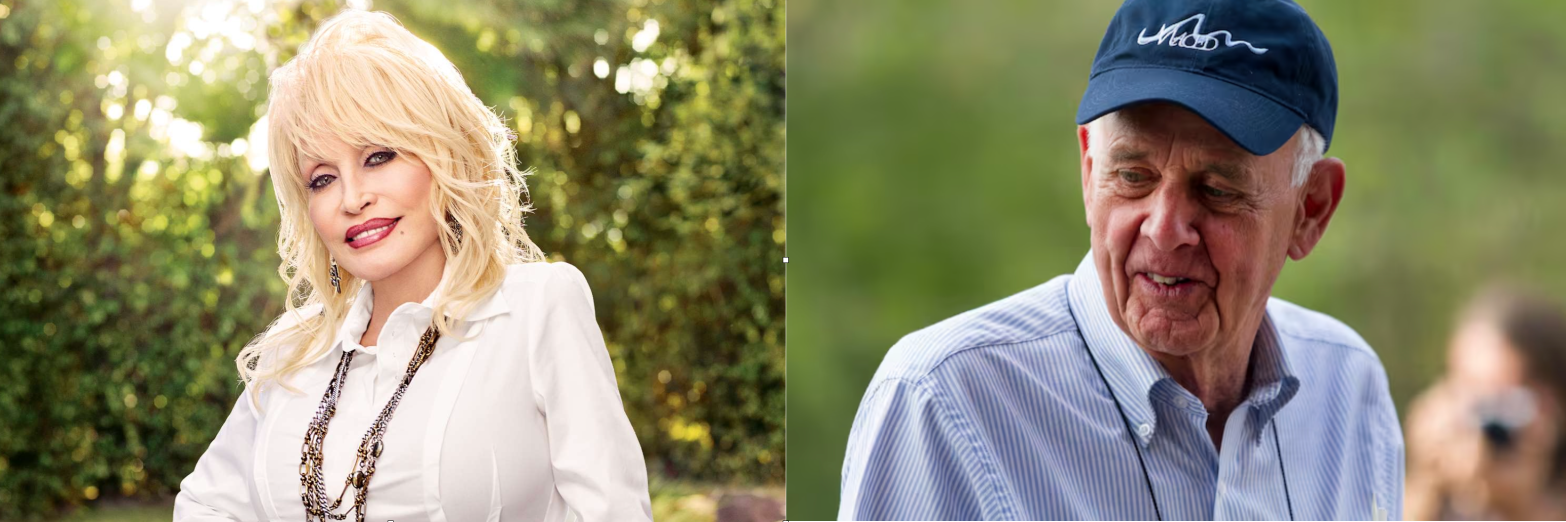
In the closing days of August, two great Americans died: Dolly Parton, age 80, and Wendell Berry, age 92.
In some ways, they had much in common. They were from the same part of the country — Dolly’s roots were in the “hollers” of Tennessee and Wendell’s in the hills of nearby Kentucky. They both carried with them an appreciation of rural values and a powerful blend of humility and pride. And they both expressed personal truths in a way that spoke to us all.
As best as I can determine, they never met.
I never saw Dolly in person, but like so many, grew to appreciate her art, her persona, and what she stood for. She honored her upbringing and used her fame and fortune to help others. She welcomed every person she encountered. She always took the stage with joy and purpose. As a music critic friend of mine noted this week, “The nation — nay, the universe — has lost one of its great lights and levelers.” [i]
In contrast, I knew Wendell Berry to be a shy man. I saw him in person on three occasions: in 1986 at the Campbell Farm in Washington where we were volunteers, in 1993 at the dedication of a local community-supported agriculture project, and several years later as part of an “Environmental Poetry” series at UCSB.
There have been many tributes to each of them in recent days. I have nothing to add to honor Dolly. But I do want to offer something to honor Wendell.
This week I looked back over my blog posts and discovered I’d written about him eight different times. I decided to share two selections.
What Young People Need
When he spoke at UCSB, he read from a novel he was working on, Jayber Crow. This was followed by a question-and-answer period. Someone asked if, given his dedication to family farms, gardening should be a required subject in high school. Berry paused for a minute, then said, “No, students should read Homer and the Bible, because they need to know the problems they are facing are not new.”
What Jayber Crow Understood
I bought the novel Wendell had read from soon after it came out in 2000. Jayber grows up in the small town of Port William. Early in life, he felt a possible calling to ministry and attended seminary but became disillusioned and left. He returns to Port William and becomes the town barber, gravedigger and church custodian. From these vantage points he witnesses people’s lives unfolding. In one passage, he’s sitting at the back of the church during a service. The young visiting preacher is a fire-and-brimstone kind of guy, and Jayber reflects on those he’s encountered who see the world from that perspective:
…They learned to have a very high opinion of God and a very low opinion of His works — although they could tell you that this world had been made by God Himself.
What they didn’t see was that it is beautiful, and that some of the greatest beauties are the briefest. They had imagined the church, which is an organization, but not the world which is an order and a mystery. To them the church did not exist in the world where people earn their living and have their being, but rather in the world where they fear death and Hell, which is not much of a world. To them, the soul was something dark and musty, stuck away for later. In their brief passage through or over it, most of the young preachers knew Port William only as it theoretically was (“lost”) and as it theoretically might be (“saved”) and they wanted us all to do our part to spread this bad news to others who had not heard it — the Catholics, the Hindus, the Muslims, the Buddhists, and others — or else they (and maybe we) would go to Hell. I did not believe it. They made me see how cut off I was. Even when I was sitting in the church, I was a man outside.
In Port William, more than any place I had ever been, this religion that scorned the beauty and goodness of this world was a puzzle to me. To begin with, I don’t think anybody believed it. I still don’t think so. Those world condemning sermons were preached to people who, on Sunday mornings, would be wearing their prettiest clothes. Even the old widows in their dark dresses would be pleasing to look at. By dressing up on the one day when most of them had leisure to do it, they signified their wish to present themselves to one another and to Heaven looking their best. The people who heard those sermons loved good crops, good gardens, good livestock and work animals and dogs; they loved flowers and the shade of trees, and laughter and music; most of them could make you a fair speech on the pleasures of a good drink of water or a patch of wild raspberries. While the wickedness of the flesh was preached from the pulpit, the young husbands and wives and the courting couple sat thigh to thigh, full of yearning and joy, and the old people thought of the beauty of the children. And when church was over they would go home to Heavenly dinners of fried chicken, it might be, and creamed new potatoes and creamed new peas and hot biscuits and butter and cherry pie and sweet milk and buttermilk…
…The people didn’t really want to be saints of self-deprivation and hatred of the world. They knew that sooner or later the world would deprive them of all it had given them, but they still liked it. What they came together for was to acknowledge, just by coming, their losses and failures and sorrows, their need for comfort, their faith always needing to be greater, their wish (in spite of all words and acts to the contrary) to love one another and to forgive and be forgiven, their need for one another’s help and company and divine gifts, their hope and experience of love surpassing death, and their gratitude. (162-163)[ii]
The first time I read this passage, it brought tears to my eyes. It captures why I have felt privileged to serve all my congregations. It’s never been about promoting any particular doctrine or instilling fear. Instead, it’s been about practicing a down-to-earth reverence for all of us “ordinary” people trying to live our “ordinary” lives with grace and care. Wendell described what I have always felt but did not have the words to express. I think Dolly would know exactly what he was talking about. I’m grateful to them both.
[i] “Goodbye, Dolly,” Joe Woodard, Santa Barbara Independent, September 3, 2026

