The Way of Nature and the Way of Grace

I’ve been ruminating over these words for fourteen years:

Τhe nuns taught us there are two ways through life- 

the way of nature… and the way of grace.

You have to choose which one you’ll follow.

Grace doesn’t try to please itself.

Accepts being slighted, forgotten, disliked.

Accepts insults and injuries.

Nature only wants to please itself…

– Get others to please it too.

Likes to lord it over them…

To have its own way.

It finds reasons to be unhappy… 

when all the world is shining around it, 

when love is smiling through all things.

Τhey taught us that no one who loves the way of grace

ever comes to a bad end.

We hear this in the voice the mother of the O’Brien family (Jessica Chastain) at the opening of The Tree of Life. As she recites the first six lines, we see dream-like images of her with her young sons in 1950s suburban Texas. At the line, “Nature only wants to please itself…” the camera shifts to the father (played by Brad Pitt) at their dinner table.  After several viewings, I realized the shift in focus suggests the mother embodies the grace the nuns talked about while the father embodies “the way of nature.”

“The way of grace:” self-less, tolerant, forgiving.  The “way of nature:” self-centered, willful, domineering.  Those living “the way of grace” experience a world shining with love; those living the way of nature are blind to all that shines, and instead “finds reasons to be unhappy.”

From the beginning of my spiritual awakening in my twenties, I wanted to “live in the way of grace.”

As a pastor, living “in the way of grace” felt like the ideal job requirement. I strived to lift that up and live that out with the people I was serving. It brought me joy.

As time has passed, I am less certain one can always live in the way of grace.

As Malick uses the phrase “way of nature,” it feels selfish, insensitive, and destructive.  But we can think of it another way. I am going to interpret it as our biological and evolutionary history.  We carry primal instincts within us that recognize our need to survive.  We can draw on a stubborn stamina that enables us to endure hard times with grit and determination.  If we lose at something and it hurts, we may resolve to recover instead of giving up. Winning and accomplishing a goal feels good. We find ourselves in a position of power and appreciate what that offers – not only for ourselves, but for others.  Are these moments we want to run from?

I once organized and participated in an Earth Day retreat at the La Casa de Maria Retreat Center.  We had invited a local trail guide to lead a tour of our property.  He had an interest in both the natural world and ways we can listen to our ancestors.  Our group took an hour to make a slow walk around the 26-acre property, stopping along the way.

We came to the organic garden and paused.  He reminded us human beings have been farming for several thousand years.  He asked us to close our eyes and visualize our own ancestors farming and what their life was like. Most of my ancestors came from Scandinavia. I found myself traveling back in time, watching them work in the cold climate and bare soil.

We came alongside the San Ysidro Creek.  Before agriculture, our ancestors were hunters and gatherers.  We closed our eyes and imagined their life.  I realized my ancestors survived by learning to fish the North Sea and hunt elk.  A hard life.

Living “the way of nature” involves cunning and a strong will.  That can get messy when it demeans other people.  But those instincts in themselves are not bad.

In 2008 I transitioned from parish work to leading nonprofit organizations.  I discovered I could not be, in the eyes of everyone, always “full of grace.” Sometimes I had to make unpopular decisions.  We had to let some people go, and as they left they didn’t feel like “love was smiling through all things.”  But these actions had to be done.  Looking back, I don’t regret them. It was part of my job.

The spiritual life is not an unending experience of grace and beauty.  Jesus was more a lion than a lamb.  Many of his conversations comforted, healed and renewed.  But other times he confronted people with their self-righteousness, and they walked away dejected or angry.  He told people what they needed to hear.

Trying to be gracious every moment doesn’t guarantee ideal outcomes. Sometimes things just go badly.  But we do the best we can.

Is it true — “…there are two ways through life – the way of nature… and the way of grace.  You have to choose which one you’ll follow?” I’m not so sure it’s that simple.  I believe there is a third way, one which draws on both nature and grace.  There are times when we need instincts for survival that nature has given us so we can protect ourselves and others and do the right thing.  But that doesn’t exclude “the way of grace.”  Grace is always worth striving for, and when it emerges it comes with a radiant awareness.

Images: The Tree of Life, Terrence Mallick


Last October I wrote another post inspired by Tree of Life: Where Were We?

Dreams and Realities: Thoughts on the LA Fires

In the aftermath of the recent Los Angeles fires, LA Times theater critic Charles McNulty shared his impressions in a column titled “Shakespeare’s ‘The Tempest’ illuminates an existential truth revealed by the Los Angeles fires.”[i]

McNulty writes from a neighborhood just east of the decimated neighborhoods. He’s been reassuring friends back East that he is OK as he tries to make sense of what he has witnessed. He says, Shakespeare helps me envisage the unimaginable, and a speech from “The Tempest” has been running through my mind since images of charred sections of Pacific Palisades and Altadena started circulating.” 

In the play, the exiled Duke Prospero has put on a “supernatural pageant” to entertain his daughter and her fiancé. But at one point Prospero realizes his enemies are plotting to take his life. He abruptly ends the performance.  Speaking of the imaginary world the play created which has suddenly disappeared, he says,

“And, like the baseless fabric of this vision,
The cloud-cappped towers, the gorgeous palaces,
The solemn temples, the great globe itself,
Yea, all which it inherit, shall dissolve,
And like this insubstantial pageant faded
Leave not a rack behind.[ii] We are such stuff
As dreams are made on; and our little life
Is rounded with a sleep.”

                  McNulty describes how the things that make up everyday life can seem so solid and permanent but are, in fact, subject to disappearing at any moment. “The grief of those bearing witness to the fires is more than sympathy. We’ve all been given a shocking lesson in the “baseless fabric of this vision” we call reality but which Prospero recognizes is no more solid than a dream.”

                  Have you ever had an experience in which something that seemed so “real” suddenly disappears like a dream?

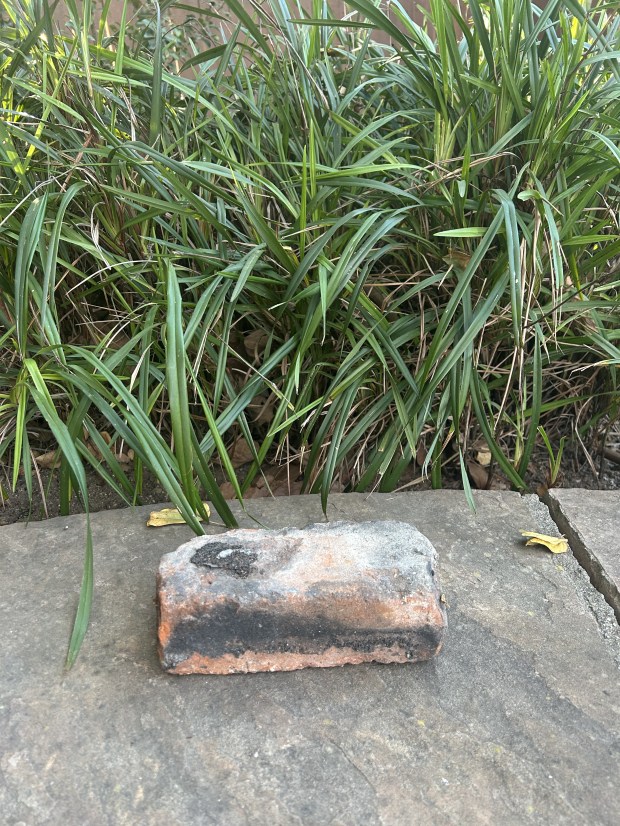
                  My parents built our home in San Bernardino in 1953. They stayed after my siblings and I moved away.  After mom died in 1993, dad lived there on his own there for more than a decade.  Eventually he sold it and moved to a retirement residence; at that point it had been our family home for fifty years.  A year later, the house burned down in a wildfire (after the new owners evacuated). Months later my sisters and I visited.  All that was left was the partially collapsed chimney. I took a charred brick as a memento.  Now I look at old family photos taken there and wonder: ‘Where did it go?”

I was Director at La Casa de Maria Retreat Center in 2018; our work was thriving and the future was bright. On January 9, the Montecito Debris Flow destroyed eight buildings and left half the property a barren field of mud.  La Casa has yet to reopen.  Sometimes when I can’t sleep, I imagine giving a tour of the property like I used to.  I can clearly see everything as it was.   It’s still hard to believe that all those structures, oak trees and our vital work could disappear in an instant.

                  How many of us have suddenly lost a loved one or treasured friend and find it hard to accept the person is really gone?

                  Is everything tangible in life nothing more than a dream?

                  Like Shakespeare, the spiritual traditions teach us that what seems so real one minute can be gone the next.

                  One of the foundational truths of Buddhism is the impermanence of all material reality. Much of our suffering arises from our tendency to ignore that.  The path to enlightenment begins with this understanding.

                  Jesus teaches a similar truth: “Do not store up for yourselves treasures on earth, where moth and rust consume and where thieves break in and steal, but store up for yourselves treasures in heaven, where neither moth nor rust consumes and where thieves do not break in and steal.  For where your treasure is, there your heart will be also.  (Matthew 6: 19-21)   

                  Are we to avoid being attached to anything that might perish? If so, how do we live?

                  For centuries, one path has been to become a monk or a nun.  You give up all your possessions and don’t own anything apart from the clothes on your back. You become celibate. Being unattached to long-term relationships and material goods means you can totally focus on the path to enlightenment and “treasures in heaven.”

                  But there is another path. This path does not forget how quickly things can vanish but does not shy away from embracing them .  This path means we remember that many things in life that seem permanent may disappear at any moment.  But we don’t turn away from them.  We invest ourselves in relationships that matter.  We obtain and care for basic material things, including the dwelling in which we live.  We plan for the future, knowing nothing is guaranteed.  We remember that everything material is subject to change.  But we appreciate what we have while we have it and are ready to share it with others.  We know the deepest meaning in life is found in pursuing spiritual values, yet we also allow ourselves to be grounded in the material world in which we live.

Life is like a dream.  But the people, dwellings, possessions, and commitments in our life are, at this moment, not a dream; they are real.  We hold both perspectives as true.  And we go on.


The brick from our home.

[i] https://www.latimes.com/entertainment-arts/story/2025-01-13/los-angeles-fires-shakespeare-tempest

[ii] McNulty notes the word “rack” meant “a wisp of a cloud’

Lead image: “Still Life with Ham and Fruit,” Jan Davidsz de Heem,1656

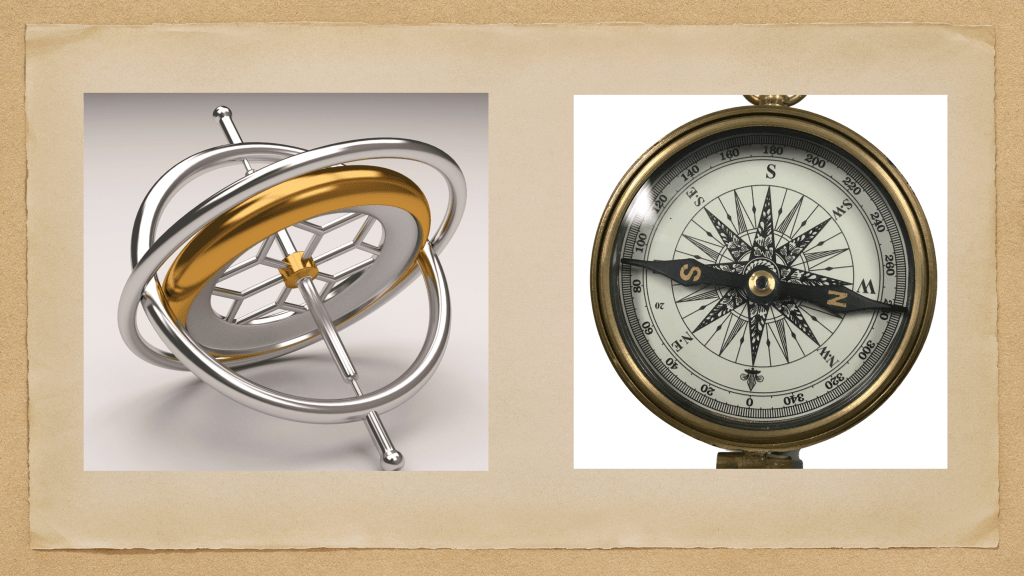
Taking Care of Your Gyroscope and Your Compass

I follow different weekly columnists looking for useful insights.  I recently saw a comment by Peggy Noonan giving advice to fellow commentators as we face what might be a chaotic year: “Keep your tools, compass and gyroscope, clean, dry and level.”[i]

I liked this statement.  The metaphors weren’t new, but I appreciated putting them together: “Keeping your…compass and gyroscope, clean, dry and level.”

I take our personal gyroscope to be what keeps us balanced when our life gets topsy-turvy – what keeps us in touch with our deepest values and best thinking.

A compass helps locate where we are at any one moment.  It gives us trustworthy information with which we can decide on the best direction to go.

It is common for us to start our day, our year and any new chapter in our life with certain assumptions about what’s going to happen and how we will respond. Sometimes things unfold like we expect. But often unforeseen events happen – events that we did not see coming — and we can feel like we’ve been knocked off balance and are lost. Time to check our navigational instruments.

I have previously written about a scene from the movie Lincoln. [ii] In the winter of 1865, Lincoln wants to have Congress pass the 13th amendment (abolishing slavery) before the Civil War ends.  He needs the support of Thaddeus Stevens, an abolitionist who wants an amendment that goes beyond just the abolition of slavery to declare the total equality of the races.  Lincoln and Stevens have the same inner conviction that equality is the ultimate goal – they share a similar gyroscope.  But Lincoln knows Steven’s amendment won’t pass. Lincoln grew up on the frontier and has been in wilderness. He says, “The compass points you true north but does not warn you of obstacles and swamps along the way.”  Where we want to end up may be clear but the way to get there may not be; we must forge ahead as best we can.  Stevens reluctantly agrees to compromise and with his support the amendment passes.

I’ve performed many weddings in my ministry. Early on, I wanted couples to have a good experience in premarital counseling, but knew I was not equipped to provide it. I found marriage and family counselors whom I trusted and arranged with them to see couples for three sessions.  I would tell the couples that an added benefit would be becoming familiar with someone in town they could always go back to for support and advice as time went on – people who could help them get in touch with their “compass and gyroscope” when needed.

One topic I did personally discussed with couples was the vows.  Sometimes people wanted to write their own vows, which I could support. But I would also have them consider the traditional vows:

I, ____, take you, ____, to be my lawfully wedded (husband/wife), to have and to hold, from this day forward, for better, for worse, for richer, for poorer, in sickness and in health, until death do us part.

I would tell them to consider the three couplets: “for better/for worse, for richer/for poorer, in sickness/in health.”  When events in life are going for the “better,” if we are feeling “richer,” and if we are in good health, loving another person is easy.  But consider what might happen when life events are becoming “worse.”  Or circumstances mean you are getting “poorer.”  Or one person becomes seriously ill.  These vows mean that you will not turn away in hard times but promise to dig in and deepen your commitment.  “Hollywood movies show how wonderful falling in love is,” I would say, “but over the years I’ve learned to look at the couples who hang together in hard times.  They develop a love deeper than just emotions – they create a bond that is lasting and profound.”

I would add that spiritual beliefs and practices become particularly valuable in disorienting times.  There is wisdom beyond just ourselves that can be found in prayer and contemplation, in timeless teachings about what makes life worth living, and what our ultimate purpose can be.  Calling on these resources is turning to our spiritual gyroscope.  Then we can check our compass to see if we are headed in the best direction and not get stuck in an egocentric wilderness.

Sometimes we need to find an environment which helps us tune in to our gyroscope and compass.  For three decades, I was involved at the La Casa de Maria Retreat Center as a board member and director.  Individuals and groups would come for a day or several days for retreats.  There were no televisions or newspapers, and we enjoyed limited cell phone service.  People were free to wander our 26-acre oak forest, orchard and spiritual gardens.  They could enjoy good food, leisure time and opportunities for meaningful contemplation and conversation.  This was our mission statement:

The mission of La Casa de Maria

is to be a sanctuary of peace

Where groups and individuals

Can renew their purpose

Strengthen their community

And increase their effectiveness in the world.

La Casa was a place where 12,000 people every year people could tune into their gyroscopes and compasses.  It was inspiring to see what a difference the right environment could make and what it means for people to find a direction in life they know to be right.

In the days to come, may we each make good use of our gyroscopes and compasses.


[i] https://www.wsj.com/opinion/what-is-your-attitude-toward-trump-2-0-f3f8532c

[ii] “Faith and Sight,” Dec 9, 2023,  https://wordpress.com/post/drjsb.com/2925

Lead image: La Casa de Maria, givinglistsantabarbara.com;

Waking The Dead

The documentary filmmaker Ken Burns was raised in a small, 2-bedroom home in Ann Arbor, Michigan.  A recent article[i] describes his personal journey, which began with a traumatic childhood:

Ken was 11 and his brother, Ric, was 10, when their mother was on her deathbed. Their father, Robert Kyle Burns Jr., an anthropologist, was mentally ill.

As his mother’s cancer metastasized, Ken overheard conversations — his mother pleading with relatives, asking for someone, anyone, to take her boys in the event of her death. “I remember being scared — scared all the time,” he said.

With their mother in the hospital, the boys were left to wait at home for the inevitable. On the night of April 28, 1965, Ken went to bed with one of the worst stomachaches he had ever had — his body registering what none of the adults would speak about.

The pain disappeared suddenly. The phone rang. His mother was gone.

Following his mother’s death, his father would disappear “for hours and then days at a time” and sometimes be gone for months.

There is a saying I learned when I was at Hospice of Santa Barbara: “Pain that is not transformed is often transferred” — meaning if we don’t’ find a way to channel personal hurt and anguish into something positive, we can end up inflicting that pain on ourselves or others.  In his grief and confusion, Burns found such a path:

The filmmaker remembers the exact moment when he decided what he wanted to do with his life: He had never seen his father cry — not in all the years his mother had fought an excruciating illness, not even at the funeral — until one night after her death. His family was in the living room in front of their black-and-white TV, watching a movie, and suddenly his father began weeping.

“I just understood that nothing gave him any safe harbor — nothing,” Ken Burns said, except the film, which had created the space for a bereaved widower to express the fraught emotions he had suppressed.

Burns began creating historical films that would present the past as something much more personal than just a series of facts. Through stories, letters, photographs, and music, he has been able to bring real people to life, whether the topic is baseball, music (jazz and country), war (World War 2 and Vietnam) or any other topic.

The article ends with this:

Years ago, a psychologist finally gave him an answer to the meaning of his work. “Look what you do for a living — you wake the dead,” the psychologist told him.

When I finished the article, I realized much of my life has been about “waking the dead.”   I’ve been reading history and biographies since grammar school, constantly looking for how real people endured hardship and crises.  I love listening to music that can seem to bring the composer’s lived experience accross time and directly into my heart and mind.  I gaze at works of art hoping to time-travel into someone else’s world and imagination. I turn to the great spiritual traditions to listen to their wisdom and insights. I never thought of it as “waking the dead” but maybe that’s what I’m seeking – and not just to “wake” them but to be in a living and learning relationship with them.

Some years ago, I heard the writer, activist and defender of rural values Wendell Berry speak at UCSB as part of a series on environmental poets.  In the question-and-answer period, someone asked if, given his dedication to family farms, gardening should be a required subject in high school.  Berry paused for a minute, then said, “No, students should read Homer and the Bible, because they need to know they problems they are facing are not new.”  Our world has changed a great deal in terms of technology and science, but the challenges of being a responsible and resilient human being have not. I’m grateful for those who can wake the dead so we can learn from them.

“As a baby, Ken Burns appeared in this photo showing his mother spoon feeding him.” (NY Times)


[i] “The Land That Allowed Ken Burns to Raise the Dead,” New York Times, Nov 27, 2024

Lead image: “Burns in the mid-1970s, just as he was starting to create his film studio”  (from the Times article.)

Wherever You Go, There You Are

                  “Wherever you go, there you are” is a quote that has been around for many years.[i] It’s been nudging me recently.

                  This past week I decided to go through some old files.  They included a selection of my academic papers, published articles, old sermons, early courtship letters from our marriage, and family Christmas letters we’d sent to friends over the years.  I was surprised at some things – I didn’t remember taking that particular class or having that specific experience. It felt like I was watching my life go by and also sensing I’m the same person as when it all began.  It’s like being on a train, passing through unknown places and having unexpected experiences, but realizing it’s an unchanged “me” looking out the window the entire trip. Wherever I went, there I was.

                  What I see now in the mirror looks different than what I’ve seen the past but it’s the same me that’s looking.

                  What will eventually happen to this “me” that seems to be the ongoing observer of my life?

A good friend of mine has been a hospice volunteer for many years and at the bedside of many dying people.  Given the right care and support, he tells me people coming close to having their “me” leave their body feel no fear but experience a calm trust in the unknown. 

                  Some say “dust to dust, ashes to ashes” … period.  We are made of eleven basic elements, mostly carbon, oxygen and hydrogen.  How amazing that eleven elements could come together in just the right way to create a space for a “me” that looks out at this world, tries to make sense of it, lives for decades, then dissipates and disappears. 

                  Some say, “dust to dust, ashes to ashes, yet in sure and certain hope of resurrection to eternal life.”  The me that was carried along by the material elements doesn’t disappear when those elements cease functioning but continues in some form, and it all comes as a gift.

                  I remember someone asking Huston Smith, the great scholar of world spiritual traditions, what happens when we die.  He said the spiritual traditions assume one of two possibilities.  The first possibility is that we keep our self-awareness and become witnesses of something awe-inspiring like an eternal sunrise.  The second possibility is our awareness simply dissolves into the sunrise.  Then he smiled and said, “I like to think I might have a choice. If so, I’d choose to first witness the divine sunrise. But after a while – maybe after a thousand years — I’d decide that was enough. Then I’d let go and become part of it all.”

                  Back to sorting files.  Happy New Year.


[i] There are numerous possible sources of this quote, but it gained popularity in 1994 as the title to a book by Jon Kabat-Zinn: Wherever You Go, There You Are: Mindfulness Meditation in Everyday Life.

A Restless Candle

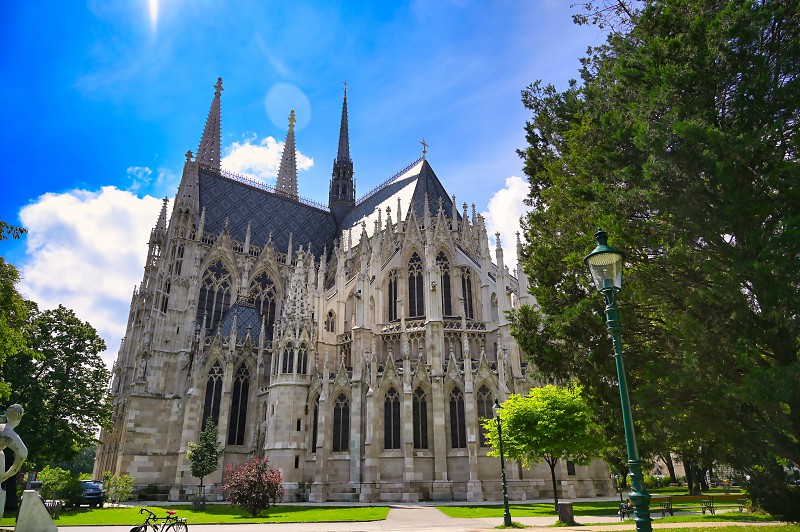
On our last day in Vienna this past September, we decided to visit an impressive sight we had been passing every day: the Votivkirche, or ”Votive Church.”[i] Seeing its tall spires and ornate towers, I assumed it was an ancient Gothic cathedral. Upon entering, we discovered it is less than 150 years old — a “neo-Gothic” structure completed in 1879. The building is 325 feet high (second highest peak in the city) and features 78 stained glass windows; when you enter, it feels vast, mysterious and intriguing.

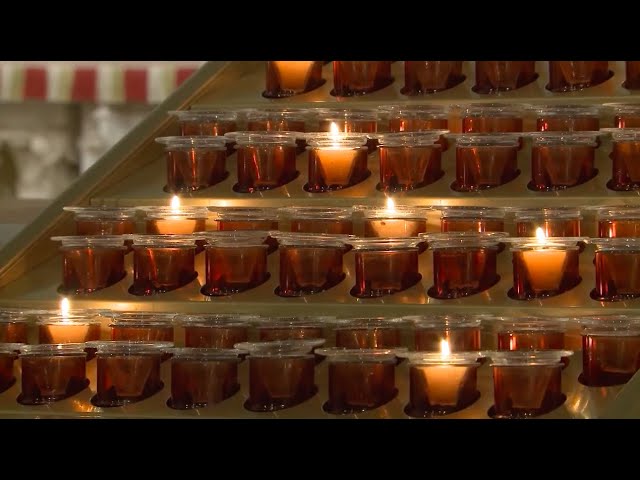
As we explored the interior, I noticed a small plaque on a stone pillar above a votive candle rack. No one else was nearby and only a few candles had been lit.  The words were in German, Italian and English.  Here is the English version:

God, there is a candle in front of me.

It burns restlessly, sometimes with a small flame, sometimes with a large flame.

God, I too am often restless.

May I become calm in you.

The candle gives me light and warmth.

God, may I also become a light for the world.

                  A simple prayer focusing on a single candle.

As we wandered and read more about the history of the building, we learned it was built as an expression of gratitude after the Austrian Emperor Franz Joseph survived an assassination attempt.  It was expected to be a place where Austrian monarchs would be buried for generations to come.  But history happened.

World War 1 began in 1914. The building was damaged, and the military was permitted to melt down parts of the organ and bells for the war effort.  The war also led to the collapse of the monarchy. In the 1930s, the Nazis took control of the city and renamed the square outside the church Göring Square after the Nazi General. Following World War 2, the square was renamed Roosevelt Square after FDR. The building was restored in the 1970s.

A recent addition is the Multhausen stained glass window, designed and installed to commemorate the 90,000 who died in the Multhausen Concentration Camp.  The window portrays prisoners helping each other up a stairway, supporting each other in their suffering; Christ is leading them at the top of the stairs.

Amid dramatic change and tragedy, the cathedral has been a sanctuary where anyone can enter, light a small candle, reflect, and pray.

I’ve been thinking how the life of a candle is like the life we live:

  • Both have a beginning and an end.
  • Both are vulnerable to being extinguished.
  • Neither needs to understand how it exists in order to exist.
  • Neither lights itself.  A flame is given to it, which it bears as long as it can.
  • Both experience the world from its own point of view, and both affect the world around it.

The winter season is a time when we become more aware of light. 

Christian communities observe Advent using a wreath with four candies in a circle and a single candle in the center.  On each Sunday before Christmas, one of the outer candles is lit.  On Christmas, the Christ candle at the center is lit.

Jewish communities celebrate Hannukah using a menorah of nine candles; the one at the center is always burning.  Night after night, that flame is used to light one more of the other eight until all are glowing. 

Both rituals assume there is a central flame.  Both invite us to behold each candle as it is lit.  In both, individuals become a community with the divine light at the center.   Both affirm light can endure darkness.

I am paying more attention to candles this season, curious about what they can teach me. I know there are many candles burning.  I know there are many people wondering.   And here I am.   This candle is me, burning as best I can, grateful to bear light as long as I can.

God, there is a candle in front of me.

It burns restlessly, sometimes with a small flame, sometimes with a large flame.

God, I too am often restless.

May I become calm in you.

The candle gives me light and warmth.

God, may I also become a light for the world.


[i] Votive: (adjective): consisting of or expressing a vow, wish, or desire.

Where’s Your Axis Mundi?

It’s a word I liked the first time I heard it:  axis mundi. 

I encountered it in graduate school reading The Sacred and Profane, a study of world religion and mythology by Mircea Eliade.  It means the “axis” around which the earth “turns” — not physically, but spiritually and psychologically.  It’s a place where people believe heaven and earth meet.

Jerusalem has long been seen as an axis mundi, a city sacred to Jews, Christians and Muslims.  For traditional Japan, it has been Mt. Fuji.   For Catholics it’s Rome.

Some indigenous tribes in Australia are always on the move, and they carry a sacred pole with them which they erect each place they stay – a portable axis mundi

In 2000, I had a 3-month sabbatical project that focused on how digital technology was beginning to affect everyday life.  I visited and conducted interviews in two locations.   

Silicon Valley was already becoming the axis mundi of the tech age. In my interviews and observations, one could already sense that digital tech was becoming something close to a religion.  In the Tech Museum in San Jose, I purchased a computer mouse pad made to look like a Muslim prayer rug.  I visited one of the largest Fry’s stores (in the pre-internet retail era, Fry’s was a “Mecca” for electronic parts and gadgets.)  Some were designed to look like Mayan temples:

One month later I went to India, which was becoming part of that revolution.  After interviewing tech professionals and academics in Bangalore, I spent time in the ancient city of Varanasi on the banks of the Ganges River.  In Hindu belief, there is no place on earth where heaven and earth come closer, and therefore no better place to bathe, die, be cremated and have your ashes scattered.

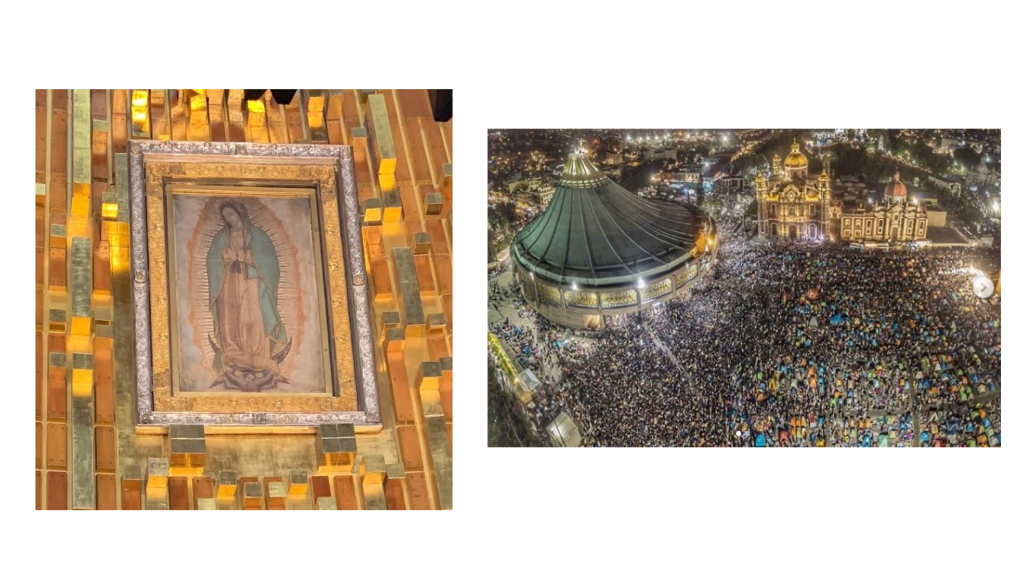
                  By 2006, I had realized the most sacred religious site in the Western Hemisphere was the Basilica of Our Lady of Guadalupe in Mexico City. Growing up in California, I had seen the Guadalupe image all my life but knew nothing about what it meant.  I learned that, in Catholic tradition, the Virgin Mary appeared to an indigenous peasant, Juan Diego, in December,1531.  She looked more like a native woman than a European and spoke to him in his own dialect: “Am I not here, I who am your mother?” She gave Juan Diego her robe or tilma.   When he took it to a skeptical archbishop and unfurled it, pink roses fell to the floor and her image had become imprinted on the garment.  The tilma is preserved in a glass case in the cathedral.  I spent a week in the city that summer, making several visits to the Basilica.   I watched thousands of faithful pilgrims arrive to worship and celebrate, and was moved by their joy and devotion.

Mt. Shasta is just south of the Oregon border. We’d driven by it many times over the years as we traveled between Washington state and California, but I hadn’t considered it anything more than an impressive volcanic formation. In 2009, we spent a week at a yoga/hiking retreat in the town of McCloud at the base of the mountain. We could see the peak every morning from our window.  As we hiked during the week, we saw it from many angles.   On the last day of the retreat, our group hiked to Squaw Meadows, an alpine meadow on the side of mountain at an elevation of 7,900 feet. I felt smaller and increasingly insignificant in the presence of the mountain’s mystery and majesty; I began to appreciate why both native people and contemporary spiritual seekers from around the world consider it an axis mundi.  We’ve returned to the area every summer for 15 years.

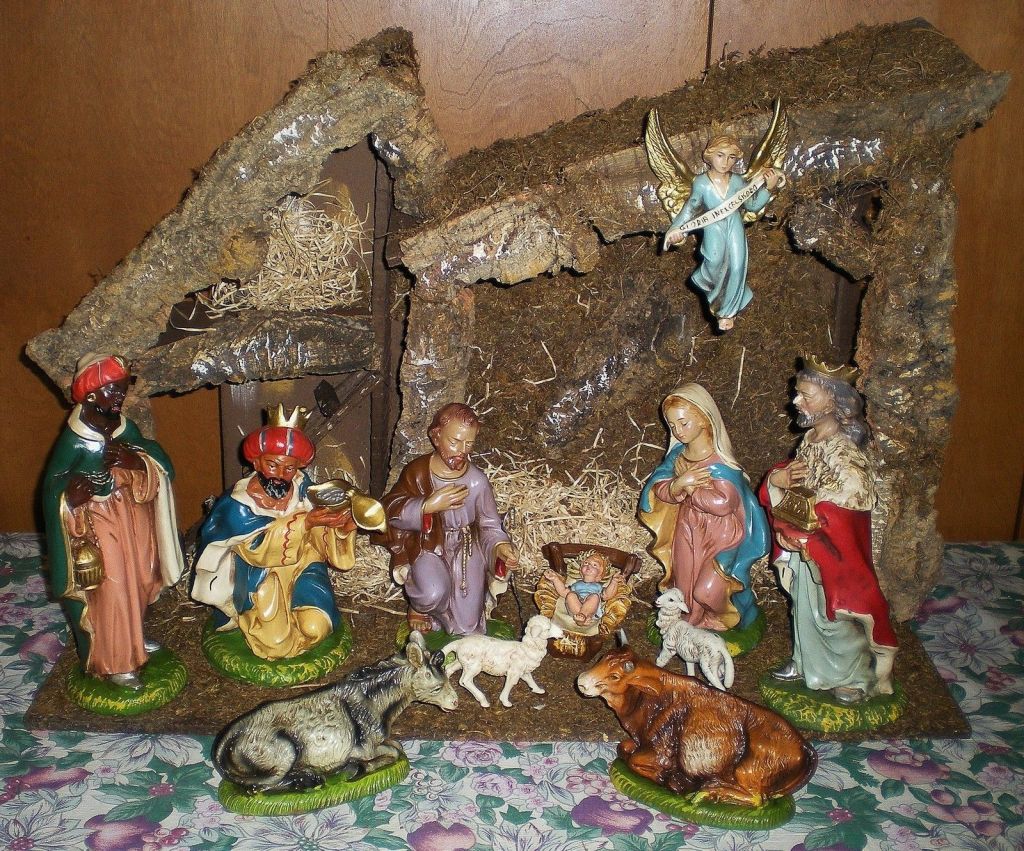
In 1233, St. Francis returned to Italy from the Holy Land where he had visited a cave that was the traditional site of Jesus’ birth. Wanting people to appreciate the setting of the Christmas story, he created the first outdoor nativity scene including live animals.  Nativity scenes have become a familiar axis mundi in countless households and sanctuaries ever since.  When viewed with reverence, candlelight and song, a nativity scene affirms that divine presence can be sensed not only on mountaintops, but also in the lives of humble people in unexpected places.

Some traditions have steered away from emphasizing any particular physical place where we encounter the divine and instead look within our individual awareness.  Quakers affirm that every person has within them an “inward light” or spark of divine energy.  By practicing silent introspection, we can access and experience that light and find guidance from it.

I have visited many sacred sites in my life.  I always try to understand and appreciate the beliefs and imagination of the faithful who are drawn there.

 At the same time, the purpose of visiting such places doesn’t end with the personal encounter. Recent studies have established a powerful connection between experiences of awe and an increased capacity to care for others.[i] Coming into the presence of axis mundi sites can have that effect.  The purpose of spiritual life is not to have a specific experience, but to discover within us a deep reverence for life and others and let that form our character.  As Huston Smith said, “Spirituality is not about altered states but altered traits.”


[i] https://drjsb.com/2022/09/03/starstruck-the-relationship-between-awe-and-caring/

Pocket Epiphanies #200: A Buffet of Past Posts

On December 17, 2020, I posted my first piece for this “PocketEpiphanies” blog. It’s hard to believe, but this week marks my 200th. I went back and picked out a dozen that may be worth reposting. Think of this as a “blog buffet” — see if any particular one interests you and put it on your plate. And thank you for being part of this project.

Narcissim of Small Differences  We prize attention to detail in many areas of life.  But we can easily fall prey to the “narcissism of small differences.”   We can make choices about things that have little relation to their actual value.

___________________________________________________

Silver Keys, Mean Moms and Compassion in the Workplace  The right thing to do was not to simply feel compassion for everyone involved, but to find a solution to the problem. That took “art and skill.”

___________________________________________________

Starstruck: The Relationship Between Awe and Caring Gazing at the heavens may help us make a better world on earth.”

___________________________________________________

Two Questions, Two Art Works, One Life to Live  Maybe the best way to find ourselves is to give ourselves away.

___________________________________________________

Seeing People Like Trees  And so I practice turning people into trees. Which means appreciating them just the way they are.

___________________________________________________

I Hope I’m Wrong  Dear friends, I hope I’m wrong about all this. I know there may be some very positive uses for AI, especially in medicine. But I’m worried. 

___________________________________________________

The Intrinsic Power of Veriditas What I saw was a glimpse of the viriditas that permeates and surrounds us, an inner force we share.

___________________________________________________

My Plan for Dementia Care  …one of my constant themes is my sense of awe at the miracle of life, and gratitude for all the opportunities and experiences I’ve had. But I don’t want to live “beyond my time,” and I don’t want my family to be emotionally or financially burdened caring for me when I don’t have a life I can appreciate. 

___________________________________________________

“Mind Proposes, Soul Disposes”  “This may be important. I need to be attentive.”

___________________________________________________

GRACE: A Focusing Practice   We are embodied human beings who have been gifted with this amazing multisensory life-form and a miraculous mind which, when they are working together, can open us to a rich awareness of where we are and what is possible.

___________________________________________________

Private Thoughts  I can’t believe a light that burned so brightly in my life has disappeared from my sight.

___________________________________________________

Letting Your Soul Catch Up With You  “Making good time” means you haven’t left your soul behind in the pursuit of speed and efficiency.  Your soul has a chance to be present with you as you travel.


Chatbots, Humans, and the Holiday Season

Generative A.I. took over my life. For one week, it told me what to eat, what to wear and what to do with my kids. It chose my haircut and what color to paint my office. It told my husband that it was OK to go golfing, in a lovey-dovey text that he immediately knew I had not written.”  This is the opening of “I Took a ‘Decision Holiday’ and Put A.I. in Charge of My Life,” from a recent article in the “Business” section of the New York Times[i]. The author, Kashmir Hill, is a working mom with a husband and two young daughters.  She decided to conduct an experiment by engaging more than 20 different A.I. bots to get advice on more than 100 decisions she faced in a week.  Here are some highlights:

  • After giving one chatbot details about her family, it gave her not only a detailed menu plan for the week but also a shopping list for everything she would need in a matter of seconds.  As she prepared meals, she could ask for cooking advice, like how to poach an egg.  The bot’s voice was casual, warm, friendly and patient.
  • She was given a daily schedule for her week that balanced work, personal care, and family time.
  • She took photos of a room she wanted to paint and color swatches at Lowe’s, then let a bot help her choose the ideal color.
  • “Halfway through the week, I found myself in a J. Crew dressing room because A.I. hated my clothes. I had uploaded photos of my wardrobe to StyleDNA.  Based on a scan of my face, it had determined my style and optimal color palette. Most of what I owned, including some of my favorite items, were not a good match for me, according to the A.I. stylist. The app fixated on two garments — a pair of light denim shorts and a fluorescent orange exercise shirt — encouraging me to incorporate them into almost every outfit.  She tried them on and shared the recommendations with some friends.  They thought she looked like a boring mannequin.
  • She wrote a personal greeting and made a video recording reading of it so a bot could use her image and voice to compose new messages to friends and family, as well as social media.  But when it digested one of my articles for a TikTok video, the script was wooden and some of my movements were exaggerated in a creepy way. When I used my avatar to send a loving, A.I.-composed message to my mom, she was horrified. “You seemed so phony!!! I thought you were mad at me!!” she replied.’ 
  • She also had the bot create an invitation to her mother-in-law that didn’t go over well: “The messages A.I. composed on my behalf were overly effusive. Even when they reflected my own thoughts and desires, they came across as inauthentic to others, such as when I let A.I. craft the message to my mother-in-law letting her know she was welcome to come over to our house. “I was really delighted by your response and I felt so loved,” she told me, “and then it struck me that it might be A.I.”

At the end of the week, she concluded that the bots had been very helpful in organizing tasks, diagnosing a child’s illnesses, showing her how to clean the grout in her shower, and researching possible vacation destinations.  “That efficiency allowed me to spend more time with my daughters, whom I found even more charming than usual. Their creativity and spontaneous dance performances stood in sharp contrast to algorithmic systems that, for all their wonder, often offered generic, unsurprising responses.”  She said she “was happy to take back control of my life.”

My thoughts…

In recent years, digital devices, the internet and Smartphones have changed the way we live and learn.  AI bots are accelerating this process rapidly, charming and amazing us along the way.  They are being constantly refined and improved.  We will be offered more and more opportunities to get what we want out of life in ways that we cannot now imagine.   The author found them useful in many ways.   

But if we allow ourselves to become increasing dependent on them, we are setting ourselves up for disillusionment. When the power grid goes out or when our digital systems fail or are hacked, we will be left with just each other and our own wits.  Other people, including family members, are not being “improved” by technological advances day after day.  They may not always act the way we want.  They will make mistakes, show up late, and have ideas we don’t agree with.  But they are real beings who have imagination and genuine feelings.              

Human effort matters to us, and anything secretly crafted, or decided, by machines feels like a deception.  Let’s treasure a handwritten note, a homemade pie, the sound of authentic human voices singing, and hand-made decorations.  The coming holidays are not a time to give thanks for AI or to celebrate the birth of a bot.  They are about human community and the fleeting moments of life.


[i] https://www.nytimes.com/interactive/2024/11/01/technology/generative-ai-decisions-experiment.html

Image: dreamstime.com

The Things We Do Without Thinking Too Much

              Are there actions you perform best without thinking about them?

              The legendary Dodger pitcher Fernando Valenzuela died last month.  He began his career in 1981 as an unknown 20-year-old from Etchohuaquilin, a small village in Mexico.  He had developed a unique way to pitch.  He’d begin his motion like most pitchers — by leaning forward to get a sign, then standing tall, then lifting his right leg and rotating his body to his left.  At this point, most pitchers are staring at the catcher’s mitt as the target.  But Fernando did something odd.  Balancing on his left leg, he’d look up to the sky and pause for a minute.  Then he’d focus on the catcher and throw.

              Hitters had never seen anything like it.  He won the first eight games he pitched, giving up an average of less than one run per game.  That year he won not only the Rookie of the Year Award, but also the award for the best pitcher in the league.  He became a sensation, a legend, a folk hero. 

              When someone asked what he was thinking when he went into his motion, he said wasn’t thinking about it at all; “I can’t do it if I think about it. I would fall down.”

              We spend a great deal of energy on planning, training for, and practicing many tasks in life.  But sometimes we learn to do something well without thinking too much about it. 

              My mother was not an accomplished cook.  But she could create amazing apple pies.  She didn’t use a recipe.  She had developed a sense of how much of each ingredient was needed, when the pie dough was ready to be rolled, and how many drops of lemon juice should top the filling beneath the crust.  If you asked her how she did it, she would say she simply did what seemed best; if she had thought too much about each step, it would have distracted her, and her better instincts would have been compromised.

              It was the same playing piano. She had taken a few lessons, but was mostly self-taught.  She could play Gershwin and Broadway tunes beautifully; the music began in her heart and the rest of her found a way to bring what she felt through the keyboard into the room.  It was wonderful to hear.

              I’ve led, participated in, and attended many memorial services over the last 40 years. The person’s accomplishments are often recited. But the most moving testimonials are people describing how the person lived, endured hardships, and treated other people.  My sense is that that behavior was not rehearsed or carefully planned.  If you could go back and ask the person, “How do did you do that?” many would say, “I don’t know. It just seemed right.”

              I want to celebrate the actions we take and the ways we live well that aren’t a product of formulas and mental concentration but arise from a desire to simply do the right thing.

              One of the widespread concerns following this election is the threat to the way we, as a democracy, have gone about the challenges of being an open society.  We have always shared an assumption that we will, despite our differences, respect established norms of decency, foster mutual respect, follow due process and assume personal responsibility.  If someone from another country would ask us, “How do you do that?” we might answer, “We don’t think about it too much. We have always assumed that’s the right way to do things in a democracy.”  I wonder if now what seemed a given is something we are going to have to “think about;” if we don’t recover that attitude, we may very well “fall over.”

              30 years after that first game when he was 51, Fernando was asked to throw out the first pitch to open the season at Dodger Stadium.  In the Los Angeles Times, Dylan Hernandez wrote:

When he winds up to throw the ball, Valenzuela won’t look skyward the way he used to. “I can’t do it if I think about it. I would fall down, especially if I’m wearing street shoes,” he said, laughing… “I didn’t even know I did that until someone showed me a video…”

He said he didn’t notice more Latinos in the seats at Dodger Stadium. Or that he was helping ease long-standing ethnic and cultural tensions in the city. Or that he was drawing the attention of businesses to the growing Latino market. Or that because of him teams were increasingly looking outside the country for players.”[i]

Fernando didn’t plan all that.  He simply found a way to perform a task exceptionally well.  And in the process benefited his teammates, his community and the game.


[i] https://www.latimes.com/sports/la-xpm-2011-mar-30-la-sp-0331-fernandomania-20110331-story.html