“Welcome to Freedom?”

                  As I’ve been watching Dodger baseball games recently, I have seen the same ad over and over.  The camera is behind a well-dressed woman in an elevator. We see her press the button for the “Casino” floor. The elevator doors open. She steps out into a vineyard. In the middle of the vineyard is a slot machine.  As she walks purposefully toward it, these words appear: “Welcome to Freedom. Chumash Casino Resort.”

                  The ad does not entice me to visit the casino.  It does make me wonder what “freedom” means in our current culture.

                  I recently attended a fascinating class at the local synagogue taught by my dear friend and colleague, Rabbi Steve Cohen.  The topic was the kosher laws.  We began by reading some of dietary restrictions recorded in the book of Leviticus, going back at least 2,500 years. These instructions clearly describe the animals a faithful person should not eat, including camels, rabbits, and pigs.   For the next hour, Rabbi Steve led the class through a survey of how scholars have interpreted these laws over time (including the 11th, 12th, 13th, 16th, and 17th centuries). Why these animals and not others?  Was it all about healthy eating, or something else?  It seemed to me each commentator had an interesting point of view.  I also learned that, in the last 150 years, leaders in the modern, Reformed tradition had decided the faithful did not need to continue strictly observe these guidelines as in earlier times. 

                  But I was intrigued by the comments of a 20th century British scholar, Dr. Isadore Grunfeld:

To the superficial observer it may seem that men who do not obey the law are freer than law-abiding men, because they can follow their own inclinations. In reality, however, such men are subject to the most cruel bondage: they are slaves of their own instincts, impulses, and desires. The first step towards emancipation from the tyranny of animal inclinations in man is, therefore, a voluntary submission to the moral law. The constraint of law is the beginning of human freedom…

The three strongest natural drives in man are for food, sex, and acquisition. Judaism does not aim at the destruction of these impulses, but at their control and sanctification. It is the law which ennobles these instincts and transfigures them into the legitimate joys of life. The first of the three impulses mentioned is the craving for food; it can easily lead to gluttony, and what is worse, to the fundamentally wrong conception that man “liveth by bread alone.” This natural, but dangerous food- instinct, is transformed by the dietary laws into self-discipline. It is no accident that the first law given to man – not to eat of the Tree of Knowledge of good and evil – was a dietary law.  … Self-control and self-conquest must start with the most primitive and most powerful of human instincts – the craving for food. Thus the Dietary Laws stand at the beginning of man’s long and arduous road to self-discipline and moral freedom.[i]

                  I had never thought of it this way.

                  From an evolutionary perspective, these impulses are part of our drive to survive.  But as we became more aware of our instincts, we can develop an ability to manage them instead of blindly following them.

                  In my late teens, I adopted a common cultural practice of the time: smoking cigarettes. I ended up using a pack a day for 5 years.  I finally decided to quit. It was not easy.  I began to realize that, up to that time, every time I reached for a cigarette, I thought I was making a “free choice.”  But the nicotine in my system was demanding the next one, cleverly disguising itself and instead convincing me I was making a free choice.  I am grateful I was able to break the habit.  I also developed empathy for anyone who becomes dependent on such substances and habits. 

                  I have good memories of playing poker with friends.  Many people go to casinos and have a good time.  But I also know that not everyone who walks into a casino is as “free” as they think they are. (That is why gambling ads, like cigarettes, include a message like “Always game responsibly. Call 1-800-GAMBLE.”)  What is true for gambling is true for other aspects of human behavior.  What looks like freedom can, in fact, be bondage.

                  For centuries, some religious traditions have told people they are inherently sinful because they experience such desires.  But what I like about Grunfeld’s perspective is the assumption that having such desires is not bad in itself, but simply part of our biological inheritance.  Spiritual practices, traditions and communities can help us manage them.  And in that mastery, we discover a freedom we did not realize we were missing.  As Huston Smith said, “We are free when we are not the slave of our impulses, but rather their master. Taking inward distance, we thus become the authors of our own dramas rather than characters in the them.” In the process, we can savor even more the simple pleasures of our lives.  It’s not about a slot machine or a ham sandwich – it’s about becoming wise in the ways of living.


[i] “The Dietary Laws: A Threefold Explanation,” https://traditiononline.org/wp-content/uploads/2018/10/The-Dietary-Laws.pdf

Dreams and Realities: Thoughts on the LA Fires

In the aftermath of the recent Los Angeles fires, LA Times theater critic Charles McNulty shared his impressions in a column titled “Shakespeare’s ‘The Tempest’ illuminates an existential truth revealed by the Los Angeles fires.”[i]

McNulty writes from a neighborhood just east of the decimated neighborhoods. He’s been reassuring friends back East that he is OK as he tries to make sense of what he has witnessed. He says, Shakespeare helps me envisage the unimaginable, and a speech from “The Tempest” has been running through my mind since images of charred sections of Pacific Palisades and Altadena started circulating.” 

In the play, the exiled Duke Prospero has put on a “supernatural pageant” to entertain his daughter and her fiancé. But at one point Prospero realizes his enemies are plotting to take his life. He abruptly ends the performance.  Speaking of the imaginary world the play created which has suddenly disappeared, he says,

“And, like the baseless fabric of this vision,
The cloud-cappped towers, the gorgeous palaces,
The solemn temples, the great globe itself,
Yea, all which it inherit, shall dissolve,
And like this insubstantial pageant faded
Leave not a rack behind.[ii] We are such stuff
As dreams are made on; and our little life
Is rounded with a sleep.”

                  McNulty describes how the things that make up everyday life can seem so solid and permanent but are, in fact, subject to disappearing at any moment. “The grief of those bearing witness to the fires is more than sympathy. We’ve all been given a shocking lesson in the “baseless fabric of this vision” we call reality but which Prospero recognizes is no more solid than a dream.”

                  Have you ever had an experience in which something that seemed so “real” suddenly disappears like a dream?

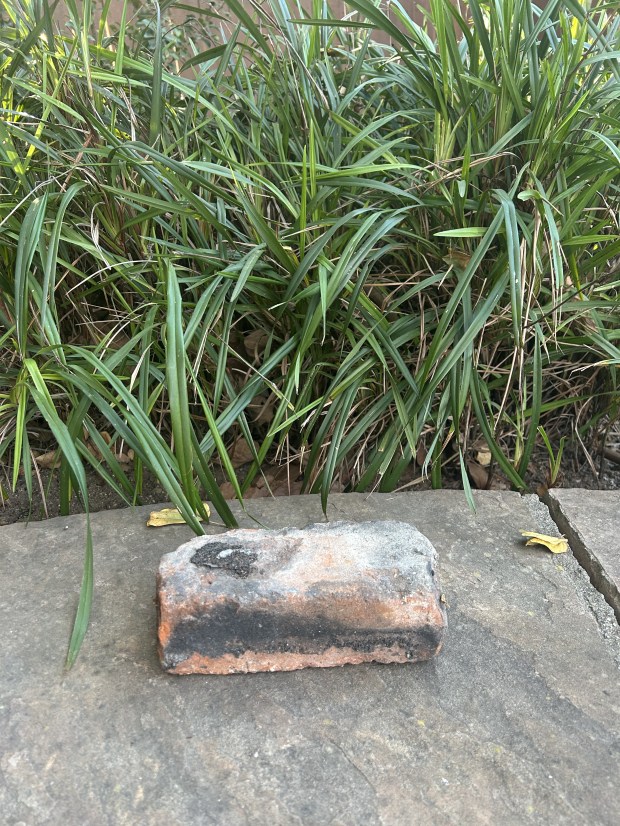
                  My parents built our home in San Bernardino in 1953. They stayed after my siblings and I moved away.  After mom died in 1993, dad lived there on his own there for more than a decade.  Eventually he sold it and moved to a retirement residence; at that point it had been our family home for fifty years.  A year later, the house burned down in a wildfire (after the new owners evacuated). Months later my sisters and I visited.  All that was left was the partially collapsed chimney. I took a charred brick as a memento.  Now I look at old family photos taken there and wonder: ‘Where did it go?”

I was Director at La Casa de Maria Retreat Center in 2018; our work was thriving and the future was bright. On January 9, the Montecito Debris Flow destroyed eight buildings and left half the property a barren field of mud.  La Casa has yet to reopen.  Sometimes when I can’t sleep, I imagine giving a tour of the property like I used to.  I can clearly see everything as it was.   It’s still hard to believe that all those structures, oak trees and our vital work could disappear in an instant.

                  How many of us have suddenly lost a loved one or treasured friend and find it hard to accept the person is really gone?

                  Is everything tangible in life nothing more than a dream?

                  Like Shakespeare, the spiritual traditions teach us that what seems so real one minute can be gone the next.

                  One of the foundational truths of Buddhism is the impermanence of all material reality. Much of our suffering arises from our tendency to ignore that.  The path to enlightenment begins with this understanding.

                  Jesus teaches a similar truth: “Do not store up for yourselves treasures on earth, where moth and rust consume and where thieves break in and steal, but store up for yourselves treasures in heaven, where neither moth nor rust consumes and where thieves do not break in and steal.  For where your treasure is, there your heart will be also.  (Matthew 6: 19-21)   

                  Are we to avoid being attached to anything that might perish? If so, how do we live?

                  For centuries, one path has been to become a monk or a nun.  You give up all your possessions and don’t own anything apart from the clothes on your back. You become celibate. Being unattached to long-term relationships and material goods means you can totally focus on the path to enlightenment and “treasures in heaven.”

                  But there is another path. This path does not forget how quickly things can vanish but does not shy away from embracing them .  This path means we remember that many things in life that seem permanent may disappear at any moment.  But we don’t turn away from them.  We invest ourselves in relationships that matter.  We obtain and care for basic material things, including the dwelling in which we live.  We plan for the future, knowing nothing is guaranteed.  We remember that everything material is subject to change.  But we appreciate what we have while we have it and are ready to share it with others.  We know the deepest meaning in life is found in pursuing spiritual values, yet we also allow ourselves to be grounded in the material world in which we live.

Life is like a dream.  But the people, dwellings, possessions, and commitments in our life are, at this moment, not a dream; they are real.  We hold both perspectives as true.  And we go on.


The brick from our home.

[i] https://www.latimes.com/entertainment-arts/story/2025-01-13/los-angeles-fires-shakespeare-tempest

[ii] McNulty notes the word “rack” meant “a wisp of a cloud’

Lead image: “Still Life with Ham and Fruit,” Jan Davidsz de Heem,1656

Facing the Challenges

This has been an historic week in the U.S., and we are facing uncertain times.  Like many people, I’ve been trying to understand what happened and what it will mean. 

My thoughts have gone back to a piece I wrote several years ago, describing what I learned following the 2018 debris flow in Santa Barbara.  We were put into a prolonged period of uncertainty.  This is one idea that helped me navigate the situation:

Several years ago, I read a book by a Navy Seal who helped other vets get through PTSD experiences. He believed we have an option when we face hardship. Do we ask, “How will this affect me?” and passively let circumstances determine whom we become?  Or do we say, “Facing these challenges, how can I respond in a way that will help me become the person I want to be?” 

Past generations have gone through great challenges, and this may be our turn.  I want to do what I can, where I am, with what I have to meet whatever lies ahead. In the meantime, I will invest in the relationships, activities and principles that bring out the best in us.

I also want to let beauty renew me.  Here is a painting that captured my attention when I saw it in Vienna in September: Dusk, by Carl Moll, painted in 1902.  I’m not sure why it calls me to now.  Perhaps it’s the presence of light in the shadows.

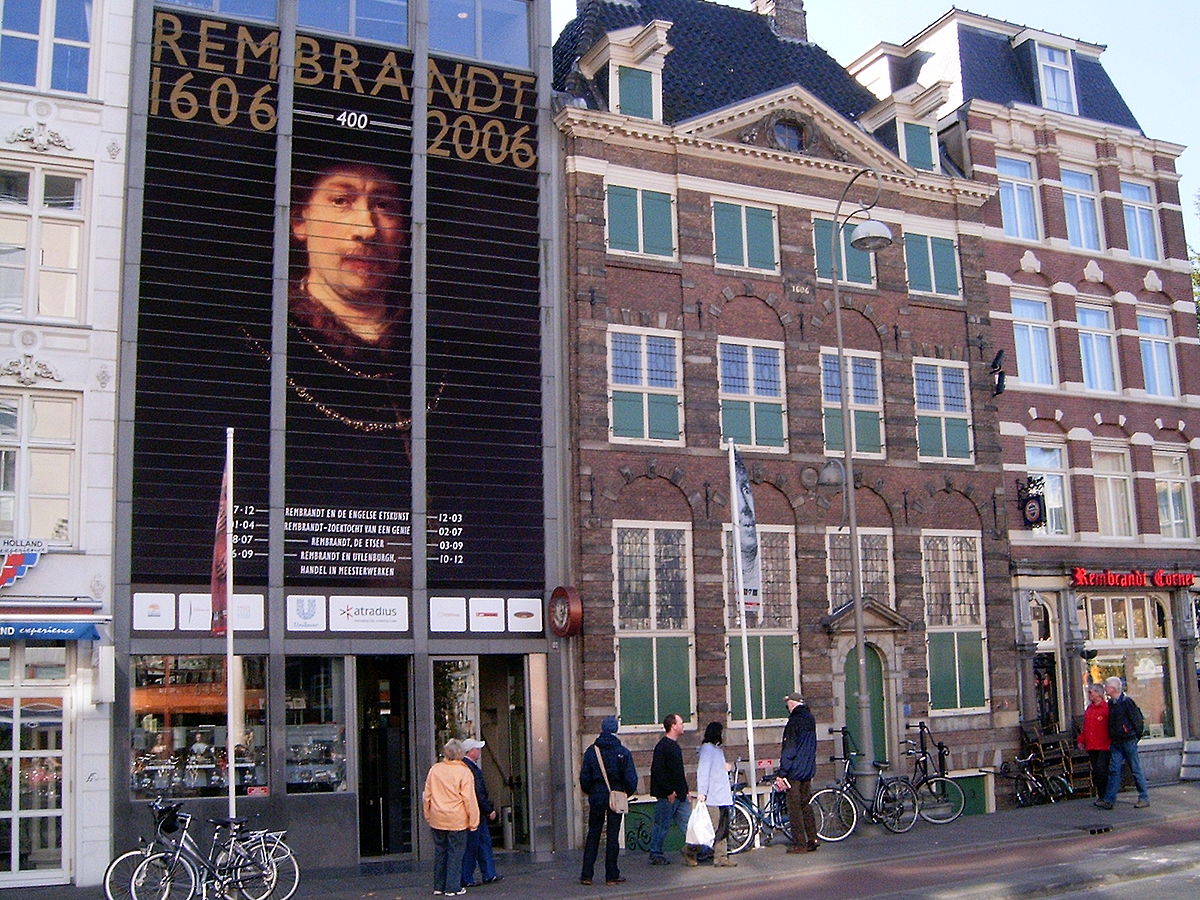
Lost in Thought: Visiting Rembrandt’s House

              Like many houses in the old section of Amsterdam, Rembrandt’s overlooks a canal. Not far from his doorstep, ships from all over the world were coming and going, bringing with them a great diversity of people at all stages of life.

              Entering on the first floor and progressing upward on narrow stairways, you see what his life was like – how the food was prepared, where his maid slept, where he received guests and where he worked.  Here is the room he lived in and his bed:

As you move through the house you relive the different stages of his career – from his early days making a name for himself to the period of his great success, both as an artist and art dealer.  But his last years were difficult. As we came towards the end, this sign intrigued me:

I became fascinated with this description:

A new style is taking shape. 

Rembrandt now paints many single figures lost in thought.

Movement gives way to rest.

There is inner tension though.

And he works more loosely, with broad brushstrokes.

              I was intrigued by the phrase, “lost in thought.” No matter what age we may be when we experience such a state, it doesn’t mean we aren’t thinking; we may in fact be thinking a great deal.  In our everyday, routine experience we direct our thoughts where we want them to go but, in these moments, we just aren’t sure where to go, or how the pieces of our life can fit together; it’s as if our thoughts don’t know where to land.  Some might say we are “spaced out” – but in fact we may be “reaching in.”

When I returned home, I read more about this period: Rembrandt’s last years were the most difficult of his life. He was effectively declared bankrupt in 1656; a picture commissioned for Amsterdam’s new Town Hall, the largest he ever painted, was installed and then replaced in 1662; his lover, Hendrickye Stoffels, died in 1663, and his son Titus, at the age of 27, in 1668. At one point he was so hard up that he had to raid his daughter Cornelia’s money box.[i]

A friend told me of a conversation he shared with a man who had been a wise spiritual mentor. This man was in his 80s at the time and had outlived his wife and many others.  My friend asked him, “Has anything surprised you as you reach this stage of life?”

              “I wasn’t prepared for the amount of loss,” he said.

              Over time, we lose people we love. Periods of success in our working life can seem far away.  We might remember times when life was going well, following a script we were writing in our imagination at the time.  But unexpected events occurred that we couldn’t change, and our script had to be rewritten.  How did this all happen?  Did it have to go that way?

              We can become “single figures lost in thought.”

              Rembrandt’s specific spiritual beliefs aren’t known.  We do know his personal life didn’t conform to the religious establishment of his time: “The artist’s eccentricities and irregular, unwed lifestyle may have put him beyond the pale of Amsterdam’s stuffier and more conservative circles… but his engagement with biblical themes was lifelong and his last years gave rise to some of his most thoughtful and unusual interpretations of them.”

              I’m drawn to two of the paintings from this period.

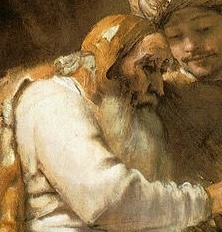
The first is “Jacob Blessing the Sons of Joseph,” created in the 1656, the year he declared bankruptcy. In the Biblical story, two of Jacob’s grandsons are brought to him for the family blessing with the expectation that he will bless the eldest with his right hand.  But instead, he blesses the younger:

Here is a close-up of Jacob’s face:

I don’t think he’s looking at the grandsons – he’s looking both beyond them and within himself.  What does it feel like to know your life is almost over, wanting to do what you think is right for your family, but realizing you will never know how it will turn out?

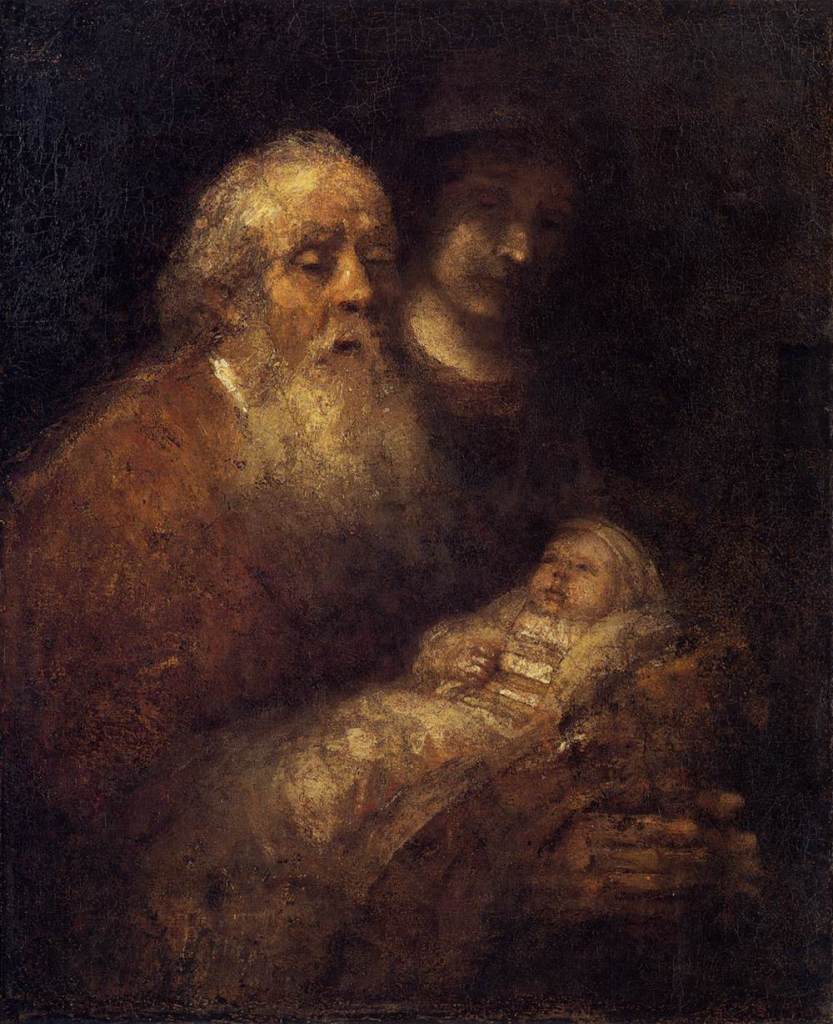
               “Simeon in the Temple” is his last painting, unfinished at his death in 1669.  It is another story of an old man blessing a child.  In Luke’s Gospel, Mary and Joseph bring the 8-day old Jesus to the temple for dedication.  Simeon believed he would be able to bless such a child before he dies:

The infant child is looking up at the old man and seems to truly “see him.” Simeon is holding the child with tenderness as he gives the blessing, but where is his attention? Like Jacob, he seems “lost in thought.”

               Rembrandt didn’t have life figured out.  Most likely he was “not prepared for the amount of loss” he had experienced.  But these late portraits convey a reverence for these people in their private moments, a tender love and respect.  That, to me, can be more “spiritual” than having simplistic answers to life’s challenges.

              When we see someone “lost in thought,” may we summon that same reverence for them as Rembrandt did.  And when we are in such moments ourselves, may we know that in some mysterious way we are not alone.


[i] https://www.nytimes.com/2014/12/04/arts/international/rembrandts-turbulent-final-years.html

Small Moments to Savor

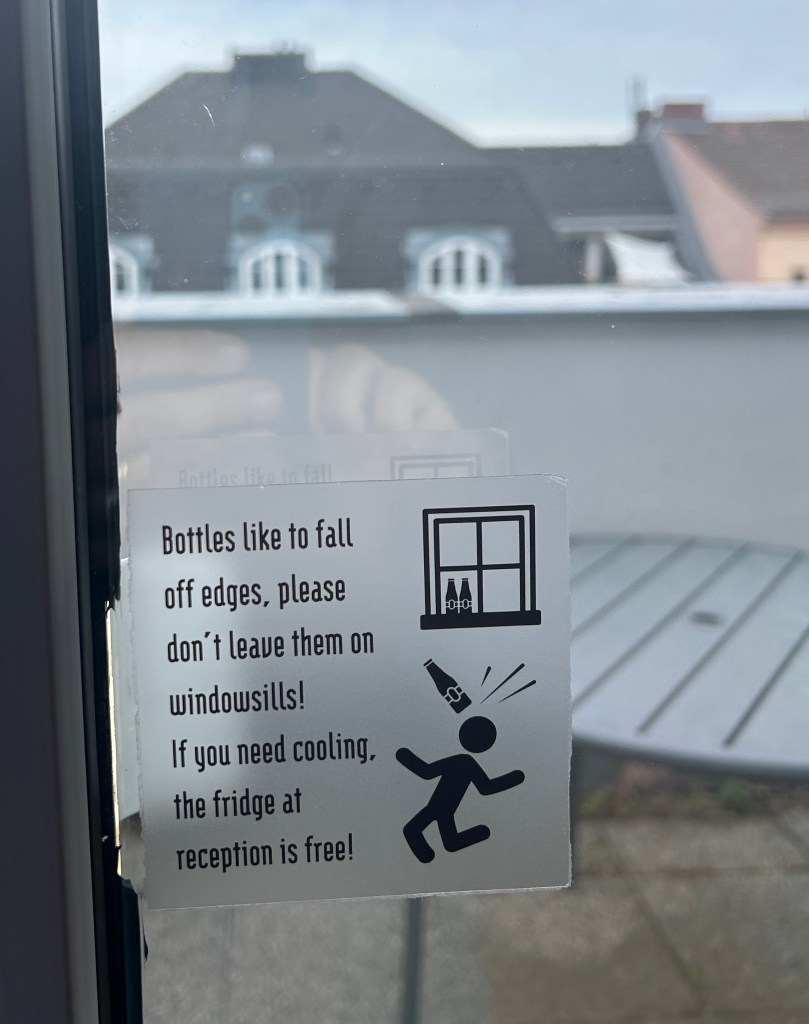
As I was planning our trip to Europe, I explored the possibility of staying in a hostel instead of a hotel. I knew I was too old to sleep in a dorm room but wanted to experience the open and hospitable spirit I had known as a young backpacker.  For the stay in Berlin, we booked a place at the “The Circus Hostel.”  It’s a five-story building in the “Mitte” (central) section of the city, close to many points of interest.  They had a 2-bedroom apartment on the top floor available. My sister agreed we should try it.

              In the basement they have their own pub and small brewery.  On the ground floor is a café and reception area.  Upper floors are for the bunk beds and apartments.  As we settled in, I began noticing the posted signs.  On the sliding glass door leading to the balcony:

The notice to set out when you want maid service:

On the wall next to the elevator call button:

A similar playful spirit was on display in nearby cafes.  French fries are very popular in Belin, and a busy place across the street had this window:

I didn’t go to Berlin expecting to eat Mexican food, but appreciated this sentiment:

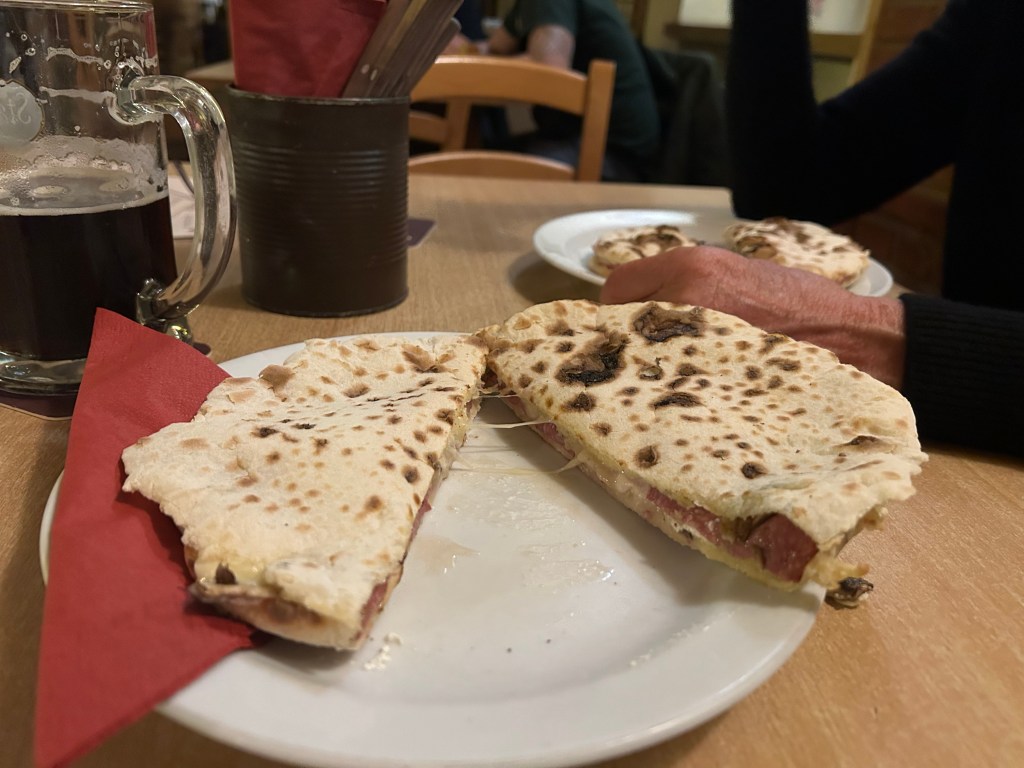
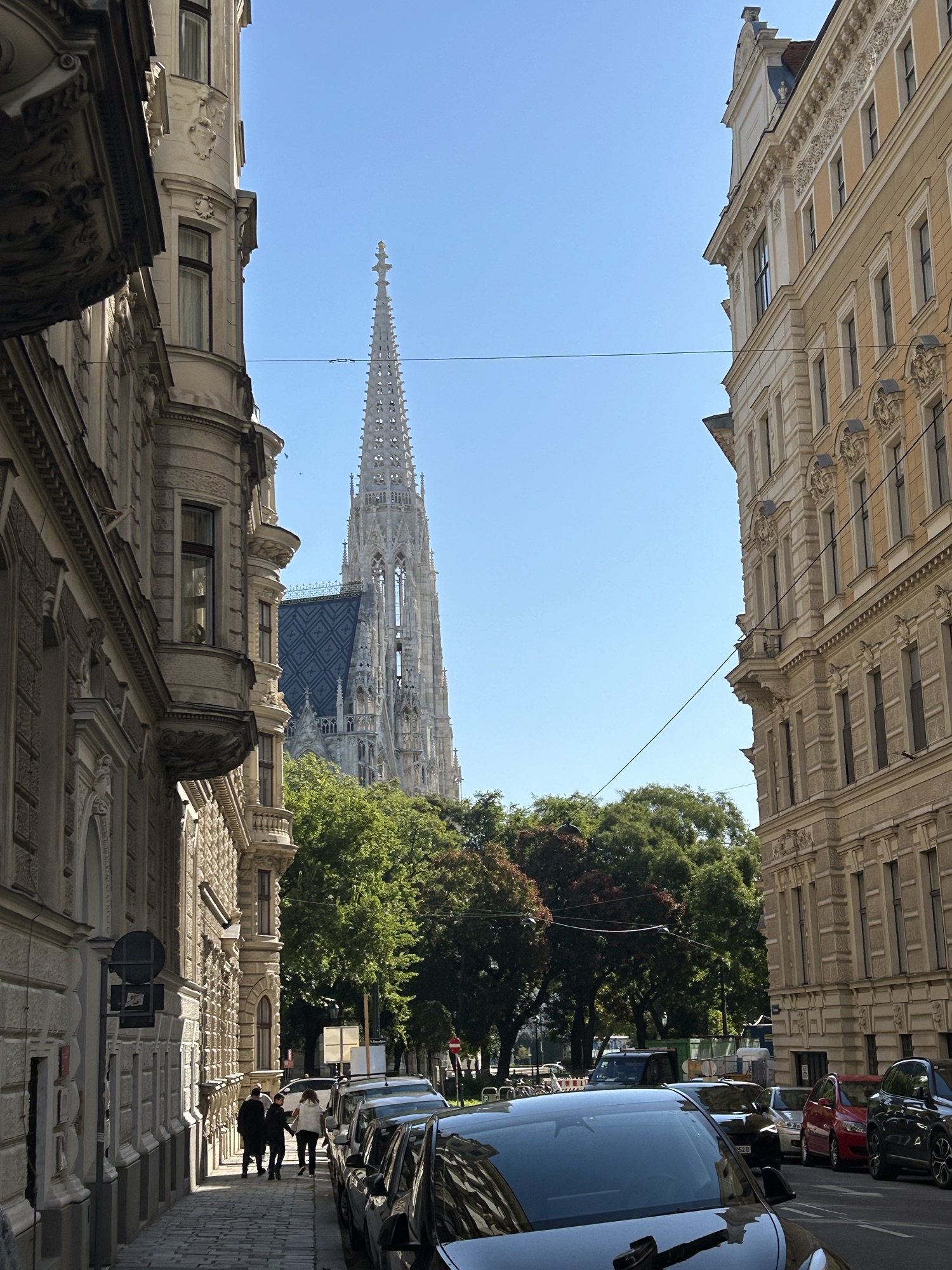
Not far from Sigmund Freud’s Vienna home and office where he probed the hidden recesses of the human psyche, we found a brewery/pub that offered more than two dozen pitas with your choice of pizza-like filings (including tuna, camembert, cranberry jam, turkey, olives, sour cream, onions, hardboiled egg, tomato sauce, etc., etc.).  On the wall was this timeless question:

I don’t know if Freud pondered that dilemma – for him a bigger question might have been about how many cigars were enough.  But after hours contemplating tragic historical events and staring at modern expressionist paintings, these were “welcome signs.” Small moments to savor along with new tastes and friendly places.

Making Sense of It All in Vienna

After five days in Berlin, we are completing our fifth in Vienna.  Yesterday I thought about a surprising thread of meaning.

Beethovens Bed In Baden:  One day we went out of the city to visit the famous spa town of Baden, where people have been coming to enjoy the natural sulfur water as a form of relaxation for centuries.  Baden was a favorite place for Beethoven to stay and composed in the summer; it was here that he composed his 9th Symphony in 182…I visited the house he had rented which is now a museum.  In addition to the dining rand composition room was his bedroom.  I was surpirsed the bed was only two feet or so off the ground and it was set in its own enclousure, like a closet.  I leadnred at this time in his life, he was not only deaf but suffering from frequent abdominal pains and other ailments that made sleeping difficult.  His best creative moments came from long walks in the surrounding countryside.  The music he composed when he lived in this house has become one of the most inspiring creations of the human spirit.  But I couldn’t help think about his sleepless nights he spent here as he was trying creating timeless music.

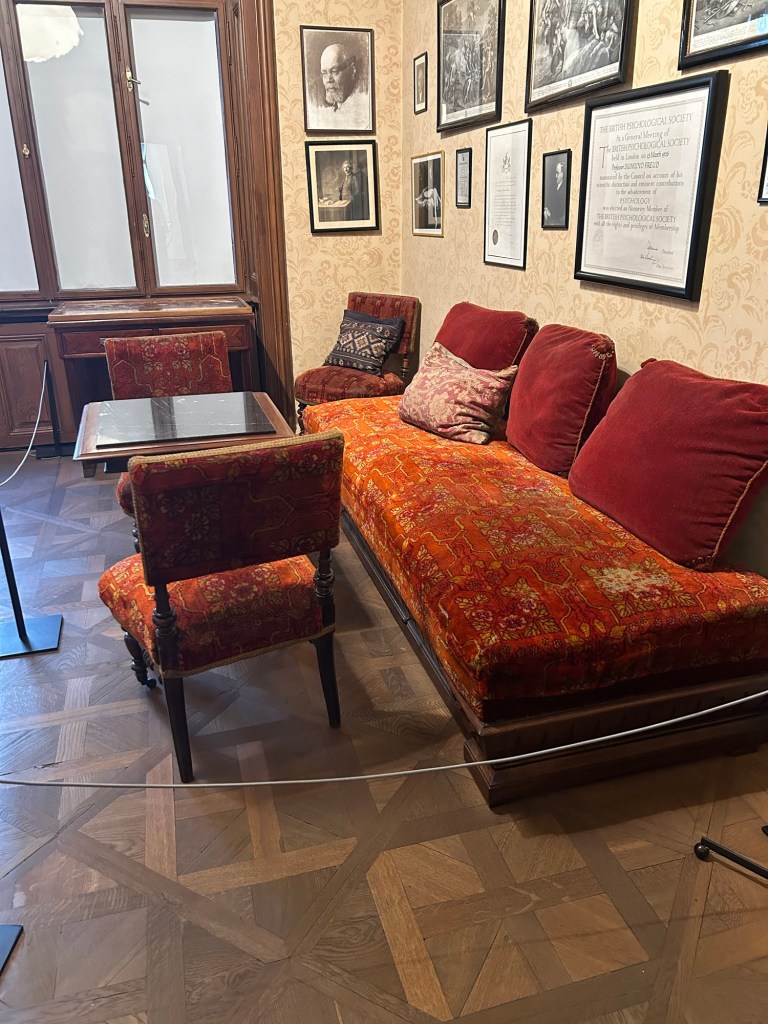
The next day I visited the Freud museum, which turns out to be a short walk from our Airbnb.  Freud lived here from 1891 – 1938, when he was able to go to London to evade the Nazis.  It was here he raised his family, did all his writing, and saw his patients:

Here’s a picture of what the waiting room looks like:

The actual couch where people laid back for analysis is in London, but here’s a photo of what the room looked like then: 

Obviously, this was a couch for reclining while you are awake,not for sleeping.  But just as Beethoven tossed and turned on his bed, I imagined all the many people who laid back here as Freud helped them explore their inner thoughts, hidden desires, and hope for living a meaningful life.

And here is the bed I’ve been sleeping in at our apartment in Vienna:

I do not think this humble space will have any historical significance.  But this is where I lie awake thinking about all the art I’ve seen (medieval to modern) and all the music I’ve heard (from Mozart to jazz to “The Sound of Music” performed in German). I try to integrate it all and what it means to me.  This is also where my dreaming has been taking place (though, bone-tired from the day, I’ve been sleeping so soundly that I would not have much to offer Dr. Freud).  I think of all the human beings in Vienna who are engaged in the same process every day and night, as are all our fellow humans around the world, including you.  How earnestly we are at work trying to live day by day! How grateful we are for the music that inspires us, the art that helps us see in new ways, and the relationships that nurture us.  What a grand and glorious mystery.

Today we head to Amsterdam.

Two Questions, Two Art Works, One Life to Live

         What’s going on inside you?

         What’s going on because of you?

         Last spring, I attended a leadership conference at Westmont College. The president said he often asks students these two questions.  They struck me as excellent questions to ask ourselves from time to time.

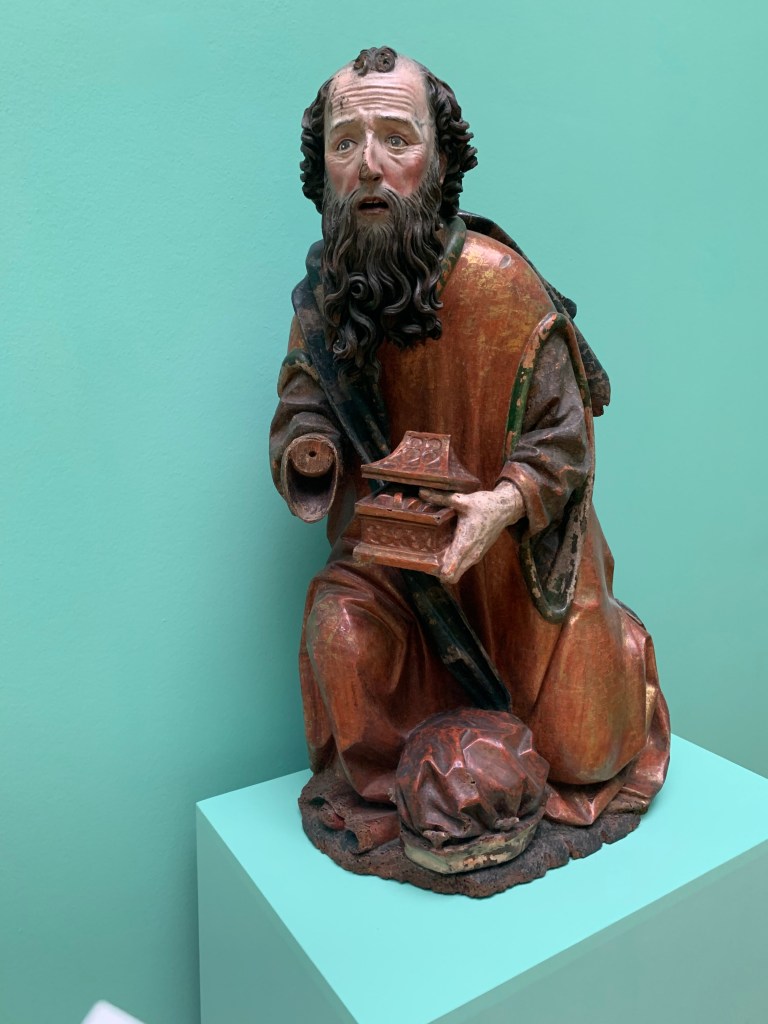
Reflecting on them this week brought to mind two art works I saw in Europe in January 2020.  In Leipzig it was “The Kneeling King,” a wooden sculpture from 1500.  In Vienna, it was “The Large Path” from 1962 by Friedensreich Hundertwasser.  Different eras, different artists, different media, different themes.  But somehow, they help me reflect on how we can view our life through these two questions.  I’m inviting you to look at them with me with the questions in mind.

         Let’s start with the older one, “The Kneeling King.”

Knieender Konig, Michel Erhart, c. 1500, Zentrum Museuem, Leipzig

This is piece of religious art, and the “King” with his opened treasure box is one of the Magi.  He has been on a long journey, led by signs and prophecies to a distant land. He’s come to pay homage to a newborn child who promises to bring peace to the world.  He’s arrived and is kneeling in humility and hope.  But as I look at his facial expression, I sense an inner weariness.  Grateful he got to this point, but not assured his longings will be fulfilled. In my imagination it seems likely he will return home and eventually die without knowing if his hopes will be realized.  But he’s done his best. He’s made the journey and offered something of his own that could be valuable to benefit others.

         What’s going on inside of him?  I sense a desire to help the world become a place of greater compassion and justice. At this late stage in his life, he wants to offer something of personal significance to benefit humanity. 

What is happening because of him?  A poor family is being given a gift to help them raise their child.  His inner journey leads to an outward journey — a giving away rather than just a gathering in.

         Let’s turn to the contemporary piece, “The Large Path” by Hundertwasser.

Der Grosse Weg, Friedensreich Hundterwasser,  1962, Belvedere Palace, Vienna. 

         I don’t know anything about theories of color and design, but this piece made me pause and study it with fascination and curiosity. 

I read the descriptive plaque next to it: Hundertwasser’s art combines Far Eastern philosophy and abstract art, the unconscious and the rational, nature and culture. He discovered Zen Buddhism in the 1950s and traveled subsequently to Japan. He sought to put an end to the lust for money and power and to find inner peace. The spiral represents the long road towards this goal. The center of the picture promises tranquility.

         Our current culture is often described as one in which we are searching for our “authentic self.”  For some, Western spirituality has become dry and dogmatic. Eastern paths offer an opportunity for finding inner peace.  Popular psychology and self-help also reflect this hunger.  Will I ever know who I really am?  Will I ever be able to find peace and tranquility? Like the subject in “The Kneeling King,” the artist went on a long journey.  Looking back, he felt his search had been like a long spiral coming closer and closer to a meaningful center, which he represents as a patch of blue — like a warm and welcoming window to deep inner space. 

What’s going on inside of this him? It seems the answer could be a long search for inner peace. And the painting suggests he found something at one point.

 What’s going because of him? I did not know until I read more about him. 

It turns out Hundertwasser became an early pioneer in environmental activism. He bought land in rural New Zealand and lived self-sufficiently using solar panels, a water wheel, and a biological water purification plant.  He made a trip to Washington, DC, to oppose the growth of nuclear weapons.  It seems his inner search didn’t end with him finding a state of personal illumination but became a path turning outward to make a difference in the world. 

There may have been times in my life when I hoped I’d find some permanent place of inner tranquility within myself. But the older I get, the less I feel a need to find such a place.  I am more curious about what I can offer to the world beyond myself, even if I don’t know how it will turn out.  Maybe the best way to find ourselves is to give ourselves away.

         What’s going on inside you?

         What’s going on because of you?

What do you see in these works of art?

The Nativity: A Hospital Epiphany and Three Works of Art

            In September of 2017, I went to Cottage Hospital to see our newborn grandson.  This was during the first year of our former President’s time in office.  I must have heard some distressing news item as I drove to the hospital — I remember walking down the hallway toward “Labor and Delivery”, feeling despondent.  I came to the nursery.  There were seven or eight newborns snug in their blankets, sleeping in basinets.  I took a moment to look at each one.  I remember hearing these words: “Steve, you may feel discouraged about the world right now, but get over it. These innocent children deserve a chance in this world.  Stop moping and do your part.”

            In a recent post I included a comment from a friend of David Brooks.  As she held her infant for the first time, she realized “I love this child more than evolution can explain.”
            Endless songs, carols, poems, sermons, Christmas cards and works of art have been inspired by the story of the birth of Jesus.  There are three images I want to share with you today – two photographs and a painting. 

            In 2009, the Guardian asked nine artists to reimagine the nativity in contemporary society. The photographer Tom Hunter submitted this piece.  The lighting and pose reflect classic manger scenes, especially from the Renaissance. But Jesus was born in a perilous time, and his parents had to flee their homeland to preserve his life.  Having the mother and child be Somali refugees makes the social context of the birth clear.

“Nativity,” Tom Hunter, 2009

            This “Nativity” was created in 1865 by Julia Margaret Cameron.  She began her artistic career at age 48 when her daughter gave her a camera; she became a pioneer in portrait photography.  Some critics thought she was overly sentimental, but I like her work.  This “Nativity” isn’t staged as a manger scene, but simply portrays a working-class family with an infant.  And who is the mother embracing?  A sibling? A cousin?  Or an angel?

“Nativity,” Julia Margaret Cameron

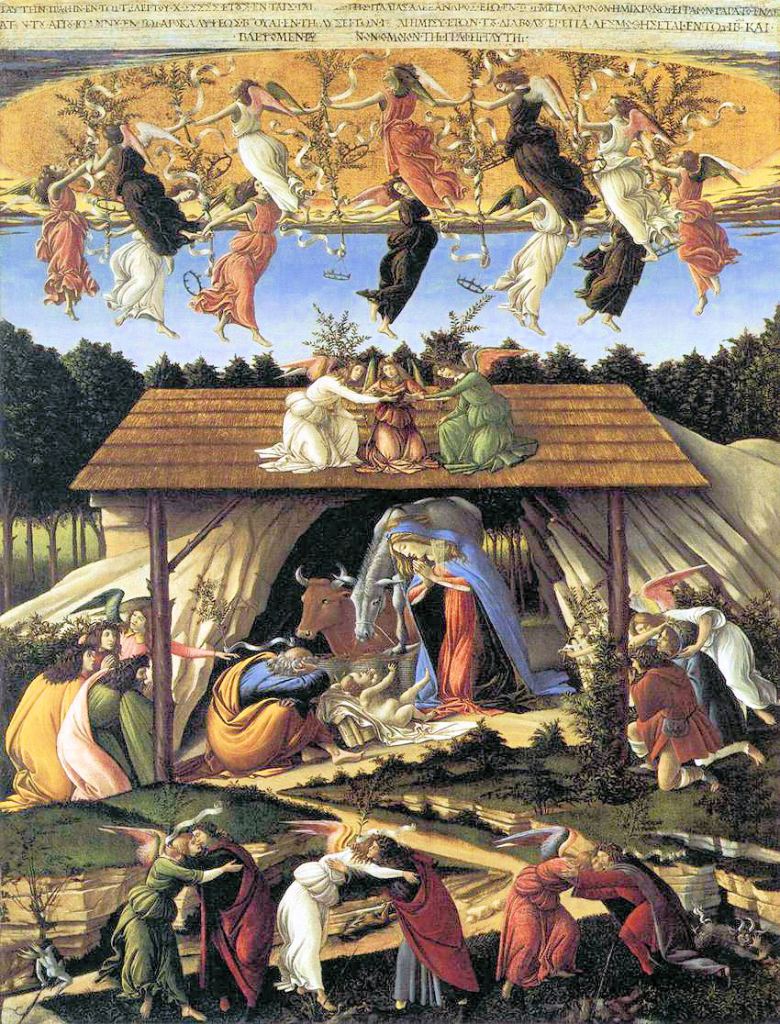
            We close with the visionary “Mystical Nativity” by Botticelli, created in 1501.  Here’s the scene at the center of the canvas:

Boticelli, “Mystical Nativity,” close-up, 1501

Joseph may be sleeping, the baby is reaching for his mother, and Mary is adoring her child as animals stand quietly in the rear.  But Botticelli imagined a scene beyond ordinary sight, where the meaning of the birth is celebrated:

Boticelli, “Mystical Nativity,” 1501

Angels are everywhere…embracing each other at the bottom, drawing close to the manger in the center, and joining hands in a circle dance at the top.  There’s no suggestion that Joseph and Mary can sense their presence in this moment, but, as viewers, we are invited to see it all.

            Botticelli apparently painted this at a time of great anxiety in Florence.  Political leadership was in an upheaval and some prophets proclaimed the end of the world was near.  Perhaps this is the message: no matter what challenges we face in the world, the birth of this child represents the appearance of light amid darkness, and is reason for great rejoicing.

            “The light shines in the darkness, and the darkness shall not overcome it.”

            May we honor the birth of every child as a sacred event, and accept the responsibility of creating a better world on their behalf.