The Fragrance of a Christmas Tree

              The holiday season can be full of sensory experiences that call forth memories and emotions.  I recently came into a room that had been decorated with an advent wreath, pine tree cuttings, and a live Christmas tree. The fragrance was inspiring, and I’ve been thinking about why.  Do any of these associations resonate with you?

  • It reminds me of childhood.  Going to a Christmas tree lot which smelled amazing.  Bringing the tree home and letting it fill our home with that aroma.  The odor became the olfactory backdrop for all the joy of the season.
  • It calls to mind being in a forest. It could be the Sierra Nevada, the Cascades, or any other forest — places many of us have gone for vacation and renewal.  The trees could be pine, fir, cedar, or redwood, but the association is the same: we have left our distracted lives and are now in a natural cathedral of quiet and timeless living beings.  
  • Smelling the fragrance calls forth the color green – always a sign of life.
  • The fragrance smells clean. Maybe it’s the association with being in nature. I don’t know why but that comes to mind.
  • And the more I thought about it, another word that comes to mind is pure.  The fragrance of a live Christmas tree is evocative on its own; it doesn’t need anything added.  But the aroma at this time of year complements the visual experience of gazing at lit candles in a darkened room or quiet sanctuary: they both suggest the mysterious source of life is with us, fresh and full of promise.  Our eyes behold a symbol of that truth, and the fragrance of a Christmas tree, wreaths and cuttings confirm it. Light and life arise in darkness and the darkness will never overcome it.

Romantic Fiction, Baseball Passions, and Spiritual Masterpieces

A high school friend once told me her mother had gotten a phone call from a neighbor:

“He died!” the neighbor said in tears, “He’s gone!  He’s really gone!”

My friend’s mother was shaken. “Who?? Who died?”

In between sobs, the friend named a character from her favorite television soap opera.  And continued to cry.

Why do we get invested in imaginary situations?

An anthropology professor I know once invited me to a day-long conference at UCSB focusing on the emerging field of evolutionary psychology.  Scholars were exploring how much human behavior could be explained by tracing it back to the adaptive needs of our ancestors.  While some of the presentations were over my head, one stuck with me. Many people spend a great deal of time reading “romance novels” and “pulp fiction”.  The presenter wondered: why would we be wired to spend our time this way?  It seems like such a waste. If life is all about survival, reading about fictional characters in melodramatic stories seems pointless – it doesn’t put any food on the table or make us physically stronger.  After exploring several alternatives, he concluded that this activity must be a way for us to exercise our capacity to understand and navigate our social relationships without any actual personal risk or vulnerability.  We human beings are social animals who live in groups and tribes: fiction allows us to explore how to do this in a way that doesn’t expose us to any real danger.

Puppies may romp, wrestle and bite each other but never actually hurt one another. Such play is a rehearsal and training for a time when, as adult dogs, they may encounter actual adversaries.   They’re safely rehearsing skills they may need in real life.

Which leads to a critical question someone asked me this week: “Why do you get so wrapped up following your baseball team?  It’s just a game, but you talk about it like its real life.”  I have been pondering this question. Why do I care so much about a made-up game?  When the season is over, nothing has changed in my life or the fate of the world.  I think being a sports fan is like reading compelling works of fiction: It’s a way to see how human beings behave under pressure over a long period of time.  In the process, we become emotionally and mentally invested in the drama and look for lessons to live by. Some examples…If you learn how to function well under high expectations and pressure, you will live a better life.  If you let one disappointing experience stay with you, your performance will suffer.  If you learn how to be a good teammate, you’ll go farther.

Baseball is like a novel with 162 chapters – plus up to 22 bonus episodes if you make the playoffs.  All the while, human drama is unfolding.

When I was a kid, I was short. So was Maury Wills, the Dodger shortstop. He didn’t hit many home runs. But he figured out how to get on first and steal bases. He showed how you could adapt and thrive even if you weren’t the biggest and strongest guy out there.

Or take Sandy Koufax. The greatest pitcher of his time, he declined to pitch the opening game of the 1965 World Series because it fell on Yom Kippur, the sacred Jewish holiday.  He showed everyone what personal integrity looks like.  (As an example of divine favor, he pitched and won the final game that clinched the Series.)

We human beings are story tellers and game players. From these activities we learn crucial lessons.

Our spiritual traditions are full of invaluable stories.

Buddhism has an abundance of tales, parables, and koans that elegantly convey great insight.

Judaism has a remarkable abundance of brilliant stories, passed down over the centuries to help us reflect on our assumptions and values.

An expert once asked Jesus what he needed to do to inherit eternal life.  Jesus affirmed the two most important commandments: love God and love your neighbor. The expert asked him, “Who is my neighbor?”  And Jesus told the story of the Good Samaritan.[i]

When he wanted to teach about the loving and merciful nature of God, he didn’t give a lecture on ethics, but said, “A man once had two sons…” and told the story of the Prodigal Son.[ii]

Many of us have heard these two stories countless times. But they never lose their power.

Both stories are total fictions. They never really happened. Jesus made them up. But they tell us profound truths about who we are and who we can be in simple and unforgettable ways.

Years ago I taught a class in religious studies at Heritage College in rural Washington. One of the required books was Black Elk Speaks, an account of teachings attributed to Black Elk, an Oglala Sioux Medicine Man.  I always have appreciated this statement attributed to him:

“This they tell, and whether it happened so or not I do not know; but if you think about it, you can see that it is true.”[iii]


[i] Luke 10: 25-37

[ii] Luke 15: 11-32

[iii] “The Offering of the Pipe,” Black Elk Speaks, John G. Niehardt, 1932

Lead Image: Sitting Around The Campfire; ar.inspiredpencil.com

Who Let the Dogs In? The Genius of Rembrandt’s Spiritual Imagination

Over the years, I’ve done a variety of presentations exploring the way Rembrandt portrays Biblical scenes.  Time and again, I’ve been fascinated by the surprising ways he imagines and creates visual details.  One example is his apparent fondness for dogs.

We can start with “The Hundred Guilder Print.”   This work captures in one scene the various encounters Jesus has with a crowd of people as described in Matthew 19.  Here’s the print:

If we read the text carefully and study the scene, we see how he includes all the important characters: people who are hoping to be healed, scholars who like to debate fine points of law, mothers bringing children to receive his blessing, etc.  Near the bottom left, we find something not mentioned in the text:

When I’ve seen dogs positioned like this, it is usually because they have determined they are near a spot where food scraps are likely to fall.  This is certainly not mentioned in the story – it’s something Rembrandt decided to add.

Here is his portrayal of “The Good Samaritan:”

In the story, a Samaritan sees a stranger who has been beaten and robbed, and no one is stopping to help.  But the Samaritan binds his wounds, puts him on his horse, takes him to an inn, and arranges for the man’s lodging and care. All that is in the story.  But in the lower right corner, we see an unexpected sight:

Suffice it to say, when we see dogs in this posture, we can guess what they are doing.  This is not a detail noted in any translations I am familiar with.

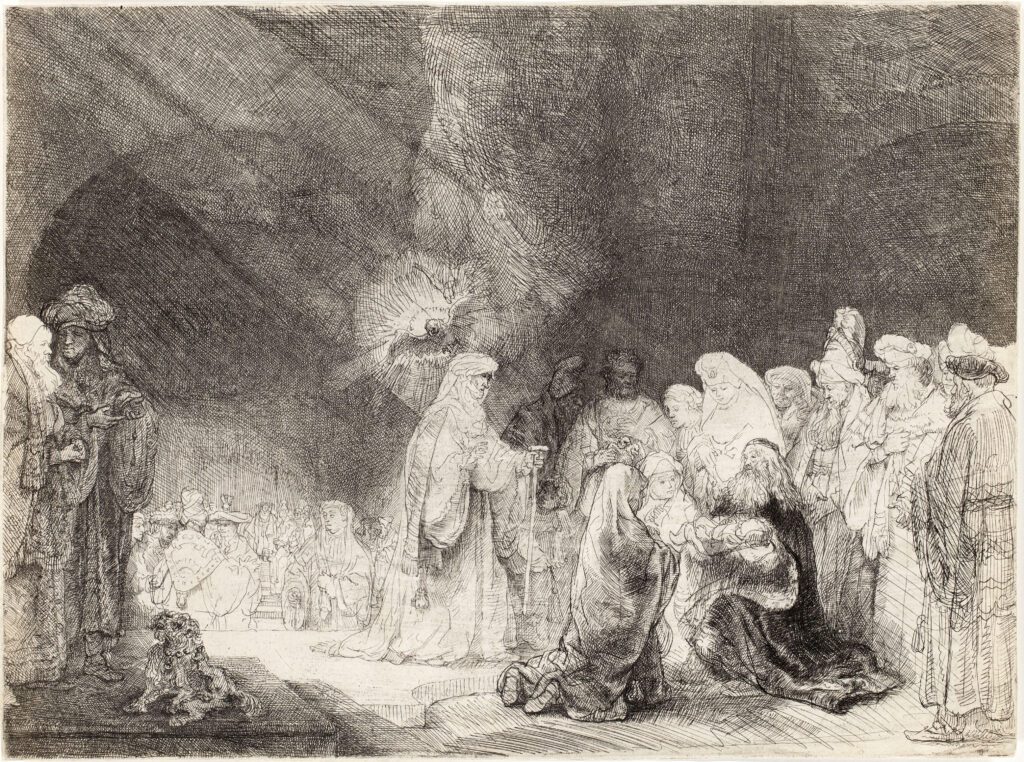
He doesn’t limit canines to outdoor scenes. In “The Presentation in the Temple,” Joseph and Mary bring their 8-day old infant to be dedicated.  Two elders, Simeon and Anna, express joy upon seeing the child.  Divine light streams down from the upper left highlighting the sacred moment:

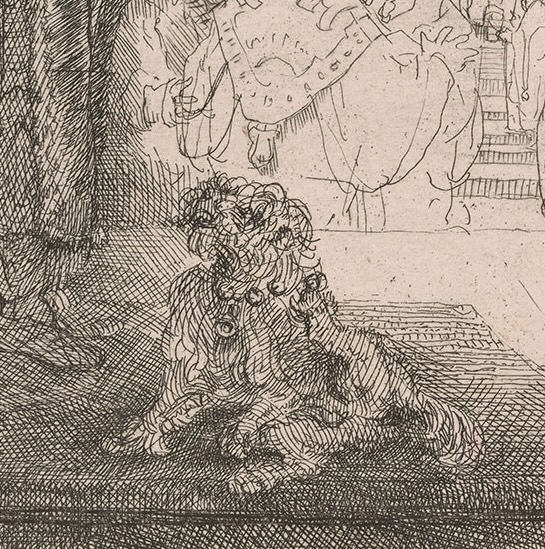
And there, in the bottom left corner, we see one of our four-legged friends:

This dog is scratching his left ear with his back foot.

I have not found any articles explaining why Rembrandt inserts oridnary dogs into scenes that portray profound spiritual experiences.  But my guess is he understood great spiritual moments in life don’t occur in situations where everything is perfectly staged, as if designed by Martha Stewart.  They happen in nitty-gritty, down-to-earth settings where ordinary human beings experience something profound.  And what is more down-to-earth than the presence of a dog in the midst of a human gathering doing what dogs do?

I have had memorable spiritual experiences in stunning cathedrals and in sanctuaries filled with glorious music.  But I have also had them in hospital rooms next to bedpans and beeping monitors, dusty home building sites in the barrios of Tijuana, and while changing irrigation lines in an alfalfa field. And, like many people, I have had experiences with a dog when I feel a deep bond of knowing and caring for each other in a way that’s hard to explain.  It’s all part of life, and there’s no limit to the ways and settings in which the Spirit can appear. Rembrandt shows us what that looks like.

Lead Image: “Sleeping Puppy,” Rembrandt, 1640; Victoria and Albert Museum

Life Among the Organisms

(Dear Reader: the following are my reflections on a recent personal experience. I know many of you have had similar and far more serious challenges in your journey — I would appreciate hearing your thoughts.)

What Happened

         On Tuesday, June 19, I woke up with a sore back.  The next day I was prescribed muscle relaxants which did not eliminate the problem.  Saturday I was running a fever and went to the ER at our nearby hospital.  Multiple tests confirmed something was amiss, but they were not sure what.  Monday, I went to the downtown hospital for an MRI, which revealed a bacterial infection in the area around my cervical spine; I was admitted to the hospital.  In the days that followed, ongoing blood tests and cultures identified the bacteria as Streptococcus anginosus which could be treated with daily injections of the antibiotic ceftriaxone. Friday,I had a PICC line inserted into my right arm and the treatment began. I was released to go home later that afternoon. Saturday a visiting nurse came to administer the medicine and teach my wife how to do it. We expect this to continue for six weeks. My energy is good, and I am not contagious.

What I Learned

         I have visited many people in hospitals and homes for more than 40 years.  I have seen countless situations more serious than what I experienced.  But in sleepless and idle moments, these personal reflections emerged. 

  1. Grateful for modern medicine and skilled doctors.  I asked what would have happened to me if I had this infection in the not-too distant past or was living in a Third World country. The doctor said the infection would spread to other parts of my body, probably my heart and brain, and eventually take my life.  I have a fresh appreciation for the medical training, experience and technology that has been focused on my diagnosis and recovery.
  2. It’s strange to be confined to one room for five days.  This was the first time in my adult life I was an inpatient more than one night.  At times it’s disorienting to be confined around the clock.  But I’m grateful I had a room in the old wing of the hospital that had a view of the mountains.  And I am also grateful I carry around with me a well-equipped inner sanctuary, where I go to recite prayers and meditations I have come to cherish over the years.  (My favorites are the 23rd Psalm and the Orthodox “Serene Light” prayer.[i])
  3. Renewed appreciation for everyday comforts at home.  My own bed with real sheets and pillows.  Our dog napping near me when I am resting. Coffee I can make anytime I want. Privacy. Freedom.
  4. Fresh appreciation for family caregivers.  My wife has had to track all that has happened and now is in the role of a nurse giving injections.  Caregivers carry a lot on their shoulders and in their mind.
  5. The bacteria and I are both biological organisms pursuing our own aims.  After the doctors described the bacteria to me, I tried to fathom the fact that this tiny organism had found a way to get into my blood stream and then decided to colonize the area around my cervical spine.  It seemed to me an insidious act – a personal affront! — and I felt anger.   But then I thought that this bacteria is just one more organism in the vast realm of living entities doing what they are designed to do: survive as best as best it can.  (The words from the Godfather came to mind: “It’s not personal, it’s strictly business.”)  But I also thought, “And I am an organism who wants to survive. And I’m going to do all I can to eradicate you from my body.  I’ve got lots of resources on my side.  We are going to get you.  It’s not personal, it’s strictly business.”
  6. Empathy for people whose challenges are far beyond mine.  My treatment may last as little as six weeks, and I am otherwise in good health. But I caught at least a glimpse of what something far more serious may be like.
  7. A new opportunity to appreciate the gift of life.  I have been around illness and mortality often.  I have often contemplated when and how my own life will end. But it’s one thing to think about mortality when we are healthy and another when our basic health is in question.  I’m grateful to be alive. 

[i] “Turning Towards the Serene Light”, PocketEpiphanies blog post, July 16, 2022

When Opportunity Whispers

Recently I became curious about the word “opportunity.”   I wondered where the word came from and if it might have application for spiritual life.

I was surprised to find it originated as a sailing term.  The root word in Latin contains the word “port,” meaning a harbor.  The word “ob” means “in front of” or “in the direction of.”  And the Latin word “veniens’ means “coming toward.” Put that together and you have:

…ob portunm veniens “coming toward a port,” in reference to the wind…

I like that: an opportunity is like sailing at sea and realizing a wind has arisen that can take you to a place you want to be.

The Biblical words for “wind” are evocative. In Hebrew, the word “ruah” can mean wind, breath, or spirit.  In Greek, the word “pneuma” also can mean wind, breath, or spirit. Our spiritual ancestors experienced the coming of the divine spirit like the awareness of a fresh breeze.  We don’t know where it comes from, but we sense it moving us in a new direction.    

Some personal stories come to mind.

When I was in seminary, we were in a couples’ group.  The leader asked us to describe how our spiritual journeys began.  One woman said her mother had been a heroin addict.   She was eight years old and had never been to a church.  But one Sunday morning, out of nowhere, she felt a desire to attend a nearby service. She walked down the street by herself.  When she arrived, she felt she had come home.  She began attending regularly, learning all she could about what faith meant.  Over the years, it not only gave her a sense of security and direction but also allowed her to care for her mother more effectively.

I have a friend who is a Catholic priest.  He was living in northwest Washington and planned to be in Seattle for the weekend.  But he got an inner prompting that he needed to go visit a friend who lived in Yakima.  He caught a plane that day. When he landed he called his friend’s house. His friend’s wife answered. She told him she was surprised to hear him, and he could not be showing up at a better time – her husband was dying and would love to see him. My friend went to the house, reunited with his friend, and was at the beside when he died.

More than once, I’ve heard people tell about having been part of a church that focused constantly on how unworthy people are, particularly any that don’t conform to traditional social standards.  Over time, they sensed something was not right.  They begin to feel a nudging to try someplace new and began exploring options.  They cautiously enter some new sanctuary, often sitting in the back row.  The primary message they hear is that the purpose of spiritual life is to not focus on outmoded ideas of divine judgement but instead become open to the power of love and grace.  Often, the person tells me tears of joy began to flow. 

An 8-year-old girl senses a breeze blowing gently towards a small church down the street and sets her sail in that direction.  With little to go on but the appearance of a feeling, a man changes his course for the weekend and heads to the home of a dying friend.  People who had been told they deserve to live on a stormy sea of doubt and condemnation spy an unfamiliar harbor on the horizon, turn their tiller in that direction, and arrive in a harbor that feels like heaven.

Not every hunch, intuition or idea that appears within us is born of the Spirit.  We need to be careful and discerning, remembering that the Spirit will always lead us toward personal responsibility, ethical actions, and service to others.  It can feel risky to follow such promptings.  But when we do, we can experience blessings we had not imagined.

I am reminded of the words of Tagore: “The winds of grace are always blowing, but it is you that must raise your sails.”

Sometimes in our daily life, opportunity knocks.  Sometimes in our spiritual life, opportunity whispers.

Photograph: “Sailing ships entering south harbor in Helsinki, Finland on October 12, 2019, when Traditional Sailing Day is being celebrated in the country.” dreamtime.com

I Like Bob

                  Fr. Virgil Cordano was a legend here in Santa Barbara.  He served as priest at the Mission for more than 50 years and was loved by people all over town for his warmth, wit, intelligence and community leadership.   People would ask him if wanted to be Pope.  “I would for 15 minutes,” he’d say. “I’d make all the changes that need to be made, then resign.  That job is too difficult.”

                  On May 8, we heard the announcement that the job was offered to Bob Prevost from the south side of Chicago.  He accepted and is now Pope Leo XIV,

                  There’s a lot to like about Bob.

                  Places a Premium on Friendship As a young man, he chose the small Augustinian order.  “Being an Augustinian means being pretty open,” Father Moral Antón said, adding that, compared to other orders, theirs does not have “very rigid norms.”  “It’s about eternal friendship, friends, wanting to walk with friends and find truth with friends,” he said. “Wanting to live in the world, to live life — but with friends, with people who love you, with whom you love…It is not always something you find,” he added, “but, well, that’s the ideal.”[i]

                  Does His Own Dishes: When he was a bishop in Chicago, he’d drop by the priests’ residence for dinner. When the meal was done, he would take his own dishes to the kitchen to wash them.  He continued that practice even when he was a cardinal in Rome.  “As a cardinal, he continued to live in an apartment near the Vatican by himself, forgoing the usual nuns who help. He shopped and cooked for himself, and lunched with the young priests, busing their plates.”[ii]

                  He’s a Baseball Fan.  Chicago’s baseball loyalties are famously divided between the two teams that have been there since the 1800s: the Cubs on the north side, and the White Sox on the south.  Bob grew up on the south side and is therefore a White Sox fan.  This is not about choosing a team because you want to be associated with a winner. (Since 1917, the White Sox have won one World Series championship while the New York Yankees have won 27.)  Bob is a White Sox fan because he is loyal to his neighborhood.

                  He Likes Road Trips He is known as someone who would turn down the option of flying to destinations in favor of driving, often by himself. As bishop in Chiclayo, he drove 12 hours down to the capital, Lima, to meet Cardinal Joseph W. Tobin, an old friend from the United States. “I have this image of him covered with dust in a beat-up baseball cap,” Cardinal Tobin said.”[iii]

                  He’s a Global Citizen Bob speaks English, Italian and Spanish. He’s lived with the poor in Peru and traveled in Africa and Asia.  He’s an American by birth but sees himself as serving all the people on the planet.

                  He Has the Courage to Face Complicated Issues Bob’s predecessor and friend, Pope Francis, took a leadership role focused on the challenge of climate change; he listened to experts from many disciplines and produced a terrific ecological encyclical, Laudato Si.  Pope Leo IV is making a similar focus:

…. In his inagural address to the College of Cardinals,  he said the church would address the risks that artificial intelligence poses to “human dignity, justice and labor.” And in his first speech to journalists, he cited the “immense potential” of A.I. while warning that it requires responsibility “to ensure that it can be used for the good of all.”

While it is far too early to say how Pope Leo will use his platform to address these concerns or whether he can have much effect, his focus on artificial intelligence shows he is a church leader who grasps the gravity of this modern issue.”[iv]

                  I appreciate these comments from one of his long-time colleagues: Father Banks said he texted his old boss after Francis died. “I think you’d make a great pope,” he said he wrote, “but I hope for your sake you’re not elected. The cardinal responded, Father Banks said, writing, “‘I’m an American, I can’t be elected.’” He still promptly responds to friends. The pope sometimes signs messages Leo XIV — sometimes Bob.[v]

                  I don’t envy all the challenges Pope Leo XIV faces.  But I’m grateful the world can see a gifted, compassionate leader from America who wants to make a difference for the entire human family.

                  I like Bob.  I wish him well.


[i] “The Small, Tight-Knit Religious Order That Molded Pope Leo XIV,” NY Times, May 13,2025

[ii] New York Times, May 9, 2025

[iii] “Long Drives and Short Homilies: How Father Bob Became Pope Leo,” NYTimes, May 17, 2025

[iv] “Top Priority for Pope Leo: Warn the World of the A.I. Threat,” NYTimes, May 15, 2025

[v] “Long Drives and Short Homilies: How Father Bob Became Pope Leo,” NYTimes, May 17, 2025

Lead image: “Then-Bishop Robert Prevost, now Pope Leo XIV, stands in floodwaters in the Chiclayo Diocese in the aftermath of heavy rains in northwestern Peru in March 2023, in this screenshot from a video by Caritas Chiclayo” (NCR screengrab/Caritas Chiclayo)

A Season of Awe

In recent weeks, I’ve been mulling over Dacher Keltner’s perspective on the different kinds of awe we can experience and how important these experiences are.[i]  I’ve also been aware we are in the season of Passover and Easter.  For more than 40 years, one of my responsibilities was to find fresh meaning in these stories; it’s a habit I have yet to break. I’ve been wondering: does Keltner’s work offer any insights to the spiritual meaning of the season?

At this point, I’m thinking of five specific points Keltner describes:

  • Awe-ful experiences.  While many experiences of awe are inspiring, we can also feel it when we witness something dark and harrowing, like the events of 9/11, contemplating the holocaust, or personal tragedies.
  • Awesome experiences: when we experience something beyond our understanding that is mysterious and fills us with wonder.
  • Moral courage: In Keltner’s research, this is the most frequently reported experience of awe.  We feel it when we see someone selflessly take on serious challenges for the good of others: social justice pioneers, foster parents, people navigating serious disabilities and hardships, etc.
  • Collective effervescence: The powerful feelings we can have when we are part of a group having a shared experience that takes us beyond our ordinary sense of life. This can be at athletic and musical events, moving purposefully in unison, worship services, etc.
  • Awe-inspired resolve: Witnessing or experiencing awe can give us courage to face difficult situations.

With these in mind, I thought of the Passover and Easter stories in a very basic way.  Do these familiar stories contain examples of awe?

Passover

(I am indebted to my Jewish friends and clergy for my understanding of Passover; I hope my comments are valid.)

                  The Hebrew people are suffering as exploited laborers in Egypt.  Moses has a personal divine encounter that directs him to lead them from bondage to freedom.  As he confronts Pharoah, seven disasters (“plagues”) fall upon Egypt, each reminders of how vulnerable human life is.  When the time is right, the people flee. They come to a body of water but have no way to cross.  They look back and see Pharoh’s army coming after them.  Death seems certain.

                  A way through the water appears. The people make their way to the other side, expecting Pharoah’s army to crush them. But the waters return, frustrating Pharoah’s intention. The time of oppression ends and a time of freedom begins.  Moses’ sister Miriam leads the people in celebration. 

                  Where are any elements of awe?

                  The experience of seeing an army approaching determined to destroy you when you are defenseless?  Awe-ful.

                  A mysterious force leads you to a liberated future?  Awesome.

                  Moses’ example, risking his life to lead the struggle?  Moral courage.

                  Joining Miriam in the dance of deliverance?  Collective effervescence.

Becoming a source of inspiration?  The story has been a constant source of inspiration from the early days of Israel up to the civil rights and liberation movements of our time.

Easter

                  Yeshua is a peasant who appears in first century Galilee, healing the sick and engaging people of every background.  He offers a vision of spiritual life embodied in what he calls “the kingdom of God.” In words and actions, he identifies with the poor and marginalized, assuring them of divine favor.  What he says and does threatens the social order.  He is arrested, convicted, and sentenced to death.  While in custody he is abused.  He is paraded through the streets and executed as a public display of the power of the state.  The men he chose to follow him flee. As he nears death, he feels even God abandons him. 

A few days later, several of his female followers come to his tomb.  They begin to have experiences that convince them his personal spirit lives and is present with them.  In the days to come, that experience is shared by a growing number of people.

                  Where are any elements of awe?

Imagining what it would be like to be dying in severe pain, separated from loved ones, and feeling total despair?  This is awe-ful.

Becoming convinced he survived the death of his body and is present with his followers — that darkness cannot extinguish divine light, and in the end, love is stronger than death? This is awesome.

                  Joining the circle of people who experience his risen presence celebrating what this means?  Collective effervescence.

                  Reflecting on his personal journey in those final days and hours, seeing his purpose was to serve and empower others? Moral courage.

                  Becoming a source of inspiration?  The story has inspired countless people, leading them to decide what is worth living for and how to approach death.

                  I believe both stories contain multiple elements of awe.  I have been in gatherings focused on both stories that uplift and inspire me and others. They remind us of what terrifies us.  They invite us to see life in a spiritual perspective, encouraging us to know there is light beyond the darkest of circumstances.  They teach us that our ancestors have overcome great hardship.  They encourage us to share the story, insights, and joy with others through celebration, community, and service. They give us hope and courage.

May we all welcome moments of awe in this season.


Featured image: “Italian Landscape,” Gustav Klimt, 1913

[i] Awe: The New Science of Everyday Wonder and How It Can Transform Your Life, Dacher Keltner, 2023

[iii] “The Offering of the Pipe,” Black Elk Speaks, John G. Neidhardt, ed., 1932

Letting Life Speak Through Us

Sitting quietly in my backyard early on a recent morning, I noticed the roses and shrubs near me.  They’d changed since the last time I had seen them.  For months they’ve been showing the same dark leaves. But now bright green growth is emerging.  They have been waiting for signs the season is changing and now sense the time is right.  I wondered: if plants have any level of self-awareness, what’s it like to be so calm and still for so long and then begin to make your move into spring?

Several months ago, I arrived early for mass at the Santa Barbara Mission. I appreciate the respect for privacy and silence which is the norm in Catholic churches. I found a seat in the middle of an empty pew near the rear. Seven or eight others were in solitude, some sitting, others kneeling. I closed my eyes and centered myself, then mentally named blessings and concerns, as well as my wish to be open to new possibilities. Then I opened my eyes and looked around. I thought about the others with whom I was sharing this space and time. I wondered what their own private thoughts and prayers were like.  Did their “inner voice” sound like mine?  What were they saying or asking for?  Here we were, this random group of human beings, each in our own private world of thoughts and feelings.  But all wanting to be open to something more.

Recently I gave a presentation to a local men’s group.  My topic was how spirituality can be expressed in our everyday work.  I shared stories about people who have found meaning in their labor.  Afterwards, one of the men came up and handed me a note. He told me it was a question he had used many times to help people find direction: “What is Life trying to express through you?” 

I believe the roses and shrubs know: “Our reason is to blossom, flourish and pass Life on.” 

At times in my life, I’ve felt clarity about what I am being called to do.  Now is a time when I’m not sure what season it is for me.  The seasons of our life don’t always follow a set calendar – we must figure them out as we go.

What is Life trying to express through you this season?

Our Motivations Don’t Have to Be Pure to Be Good

                  When I first began my spiritual journey, I was enthralled with the idea that I could escape the influence of my selfish ego and achieve some kind of saintly purity.  I’d seen what complete self-centeredness could do to my life, and like a prisoner for whom the jail door suddenly flew open, I couldn’t wait to find freedom.  I read accounts of saints and sages.  I experimented with meditation, recorded and analyzed my dreams, memorized Psalms, and sought spiritual guides. I read the Sermon on the Mount, which includes strong statements to discourage us from publicly displaying our spirituality when we are fasting, giving to charity, and praying. [i]

                  Fifteen years later I was driving downtown to volunteer at the local soup kitchen.  Two different voices within me began a conversation:

Inner Voice One: “I’ve been meaning to do this for some time. Glad I finally signed up and am on my way.” 

Inner Voice Two: “You know, be sure and tell your congregation you are doing this.  You’ll look good in their eyes.”

Inner Voice One: “What a selfish thing to think! I’m not doing this to show off. I’m doing it because it’s the right thing to do.”

Inner Voice Two: “Of course you are.  That’s great. But it won’t hurt your reputation to let people know you are doing this.”

I didn’t like Voice Two and could not silence it.  I was frustrated.

A few months later I was on a long drive north on Interstate 5. I thought again about the persistence of self-centered Voice Two.  I decided to try an experiment. I visualized Voice Two as a separate person standing in front of me.   I stared at him.  He looked uncomfortable and embarrassed being examined so carefully and kept looking downward. I began feeling compassion for Voice Two.  I realized it had never meant me any harm. It was there to speak up for me, protect me, always wanting to help me be somebody I could feel good about.  I stood in front of him.  I put my right hand on his shoulder.  “You know,” I said, “I now realize you work very hard on my behalf and always act with the best of intention.  I’m not going to get angry with you anymore.  I’m not going to try to get rid of you. Let’s be friends.  I’ll let you offer suggestions whenever you wish.  I just don’t want you to be in charge.”

It was a moment of inner reconciliation that brought me a sense of peace.  I gave up trying to be a saint. I accepted being someone who may often have mixed motivations that I need to sort through.  I would continue to engage in activities for a higher purpose but not get upset if I also hear Voice Two whispering to me how this might affect my reputation and self-esteem.  If I personally accomplish something that has been challenging for me, I am going to welcome feelings of pride and satisfaction.

Several years later, as part of my Hospice training, I attended a retreat at the Metta Institute which included Buddhist meditation practice. I learned one key principle: “Welcome everything, push away nothing.”[ii]  Rather than try to control everything our busy mind comes up with, we let all our thoughts arise; we then calmly examine them and choose which ones are worth engaging.   I have found that to be a practical way to manage all the different ideas, motivations and strategies that can arise within.

I do think there are saints in this world whose motives are always pure.  They don’t know they are saints.  They meet those Sermon on the Mount standards without thinking about it.  I know I’m not one of them.  But I don’t want my mixed motives to keep me from joining other people to get good things done and enjoy life along the way.


[i] Matthew 6: 1-8, 16-18

[ii] The Five Invitations: Discovering What Death Can Teach Us About Living Fully, Frank Ostateski

The Parable of the Poisoned Arrow

Several years ago, I was listening to a series of lectures on Buddhism and heard “The Parable of the Poisoned Arrow.” It exists in several versions.  Here’s a simple one:

“Suppose a man is struck by a poisoned arrow and the doctor wishes to take out the arrow immediately. Suppose the man does not want the arrow removed until he knows who shot it, his age, his parents, and why he shot it. What would happen? If he were to wait until all these questions have been answered, the man might die first.” The point: “Life is so short. It must not be spent in endless metaphysical speculation that does not bring us any closer to the truth.”

In some versions, the wounded man’s questions include the social class of the archer, his physical appearance, his hometown, what the bow was made of, what bird had supplied the feathers, etc.  The questions are endless — but our time is limited.

When we are suffering physical pain, it is reassuring if the doctors can confidently identify and treat it. But sometimes they can’t. Years ago, I had a parishioner whose lungs were thickening and the tissues becoming increasingly stiff.  After many tests, the doctors gave it a name: “Idiopathic pulmonary fibrosis.”  It took me a minute to grasp the meaning of that first word: “Idio-pathic.”  There is a pathology going on, but we are “idiots” in terms of knowing exactly why.  It’s a disease having no known cause.  Not having a definitive name for it made the situation more difficult.

Our predecessors have tried to understand the source of our suffering and came up with many explanations.  Maybe it’s karma – the mysterious burden of our ancestor’s behavior in past lives. Maybe it’s divine judgement – God does not let people get away with anything, so if we are suffering, we must have done something wrong.  St. Augustine came up with the idea of “Original Sin,” claiming that death and suffering are a result of some act of disobedience in our ancient past. 

In our modern age, we can seek the reasons for our emotional pain by exploring our family of origin: when you were a child, you adapted your behavior in response to what was going on in your family, and those behaviors have stuck with you ever since.  Sometimes the insights are illuminating and liberating.  Working with insightful counselors over the years, I can see how many of my behaviors are explainable based on my family’s dynamics. But I’ve also known families with six children, all of whom turn out very differently.  And sometimes knowing the source doesn’t improve our lives at all.

When we are suffering, do we need to know every reason behind our condition? Or is it enough to pull the arrow out as quickly as possible so we can move forward?

I know a woman who suffered from panic attacks.  She had seen counselors and talked to friends, but nothing helped. She went to see someone who specialized in anxiety.  At the first session, she was surprised that he did not delve very much into her past or her emotions. Instead, he focused on the thought processes she experienced when she began to feel anxious.  She came back for more sessions and soon she was experiencing some relief.  She was still “wired” as she’d always been, and the causes for that may never be known.  But he helped her focus on the runaway train of her thinking patterns and ways to redirect it; the aim was to get the arrow out, rather than knowing why it was there in the first place.

Buddhism does not focus on mystical speculation as to why our suffering is here.  It focuses on ways to alleviate it.

In many of the Gospel stories, someone comes to Jesus with a problem.  He seems to understand what they need in that moment and offers a shift in their focus. Maybe it’s being assured of divine forgiveness apart from social prejudices and self-doubt.  Maybe it’s with a healing touch.  Maybe it is by inspiring them to go beyond themselves to love and care for others.  There’s no interest in speculation – the focus is redirecting each person in ways they can live their life with grace and freedom in the here and now.

Looking back on my life, I see that many people who have died in peace have given up trying to understand the deep reasons for anything.  They just live life as best they can and help others as much as they are able.

The questions about the deeper causes of our suffering can be endless — but our time is limited.