I Still Think About a List I Made a Long Time Ago

                  In the early 1980s we were living in Santa Paula, California where I was an Assistant Pastor. There was a new movement emerging in America – hospice.  I was asked to be on the local board of directors that was forming.  I had little personal experience with death, dying or grief but was honored to be asked and curious to learn what I could.  I said yes.

                  On a Saturday afternoon a small group of us participated in a training event.  At one point we were given a sheet of paper with a numbered list of twenty blank spaces.  Without much of an introduction, we were asked to write down 20 things we value in life.  I don’t have my copy anymore, but I think it looked something like this:

20 Things I Value in Life

  1. Being with my family.
  2. Being with friends.
  3. My spiritual beliefs and community.
  4. Swimming in the ocean.
  5. Eating good food (doesn’t have to be fancy).
  6. Going to musical concerts.
  7. Going to baseball games.
  8. Watching movies.
  9. Traveling to Europe (or anywhere I haven’t been).
  10. Reading good books about history.
  11. Playing sports like softball and pick-up basketball.
  12. Learning about other cultures.
  13. Meeting new people.
  14. Volunteering in the community.
  15. Advocating for peace and justice.
  16. Taking naps.
  17. Spending a day at the beach.
  18. Fresh, ripe fruit.
  19. Learning new skills.
  20. Hearing people recount how they got through hard times.

When we finished, we turned to another person and shared our list.  It felt good to realize so many things brought us joy and meaning.

The facilitator then said, “Now I want you to cross ten items off your list.”

That sounded easy but wasn’t.  I thought, “I don’t want to give up any of these.”  Then, “I don’t like this exercise.” 

When we finished, she said: “Now I want everyone to cross off five more.”  This was almost frightening.  I tried to imagine what five things I could give up.  My life was becoming very limited.

“Now cross out three so you have only two left.”

This was painful.  What is life about when you can’t do so many things you have learned to enjoy?

When the last person finished, she led a discussion.   She didn’t ask us what our last two items were.  She did ask, “What did that feel like?”

We all agreed it was difficult.

She said, “For most people, the two last things they hold on to are family and faith.”  Those were my last two.

She then told us this is what having a terminal illness can be like.  Your life gets smaller and smaller as you are able to do less and less.

That day I learned two lessons I have carried with me.

The first lesson is to have empathy for people for whom this is not an exercise but reality.  I won’t know what it’s like until I get there, but I try to imagine.  I want to be supportive of anyone I encounter who is on this journey.

The second lesson is to appreciate the things I value while I can.  At this point in my life, I can’t participate in rigorous sports anymore but feel fortunate to still enjoy most of the items on my original list.  I’m grateful for whatever time I have left.

What’s on your list?

Remembering A Mentor: Gail Rink

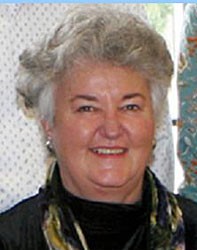
Sometimes we start thinking about someone and not know why. This week, Gail Rink, my mentor at Hospice of Santa Barbara began hovering in my awareness.  I became curious and searched my files. I discovered she died July 27, 2010 – fifteen years ago this weekend. I decided to use this space to honor her.

Gail was born in 1944 in Niagara Falls, New York.  As a young woman, she attended a Presbyterian church and felt a call to pursue ministry.  She spoke to her pastor about it. He told her that was not an option for a woman.  She chose social work instead.

She found her way to Santa Barbara and began a 30-year, ground-breaking career.

When the AIDS epidemic emerged, many people were reluctant to care for AIDS patients. Gail trained volunteers and clinicians how to do it; she showed the way, and many followed.  

She became a legendary educator at our local hospital, teaching young medical residents how to sensitively talk with patients and their families about death and dying.  And how to listen.  Dr. Fred Kass, a local oncologist who worked closely with Gail, said this: “She taught me to better understand where patients were coming from and appreciate things from their perspective — not only to say what I needed to say as a doctor, but hear what I had to say as they heard it,” Kass said. “If we could really empathize with them we could be better at helping them.”*

She was down-to-earth and practical, helping people find what they needed to be supported on their journey. She also had a “sixth sense” about people and situations.  “Gail knew when the spirit left the body, and I didn’t realize that you could know that or she had that intuition” one person who worked with her said. “She had access to a whole other world of knowing, a spirit level of knowing that she was privileged to know. She walked in the room and everyone knew it was all OK.” * More than once, I thought that in traditional cultures she would have been recognized as a born shaman.

I was a Hospice Board member when she announced she was going to retire.  I began to wonder if I might apply for her position.  My practical inner voice said, “No way I could follow Gail. I don’t have anywhere near the qualifications, background or experience.”  I put it out of my mind. 

A few weeks later, she called me and told me to meet her for coffee at the local Starbucks.  After we sat down with our drinks, she asked if I had considered applying for her position.  I told her I had decided I was not qualified.  She told me she had recently been sitting in her living room and noticed “dust bunnies” being gently blown by a breeze along the hardwood floor.  She said, “As I watched them it became clear you need to follow me.”  I repeated my concerns.  She said, “Look, Hospice of Santa Barbara is essentially a spiritual organization.  Even if you don’t realize it, you know what that means.  Many people don’t.  Other people will be doing the client work. You need to lead with what you know.”  This did not feel like a suggestion, but a summons.  I applied and was selected.  That was a great crossroads in my life, and I owe it all to Gail (and those dust bunnies).

She loved to cook, entertain and laugh.  She liked having a Manhattan with friends at Harry’s.  She was direct and irreverent in her conversations. She was a dedicated Willie Nelson fan.  She was unpredictable and delightful. She was one of a kind.

One day we were sitting by her pool and I decided it was my turn to speak truth.  I acknowledged her Presbyterian minister may have told her years ago that she should not think of ever becoming a pastor.  But, I said, look what an amazing “ministry” she had: loving and supporting people in their most difficult moments, educating doctors and the community on how to be present and compassionate with patients and families, instructing and inspiring countless volunteers and clinicians how to care.  I told her the world had plenty of Presbyterian ministers, but there was only one Gail Rink. 

The fruits of her labor continue to flourish in the lives of many people, including mine. I am grateful to have known her.

*https://www.noozhawk.com/080210_gail_rink

Learning From Each Other

Last week I shared my reflections after being diagnosed with a bacterial infection in my spine and spending five days in the hospital.  I appreciate the many good wishes that came my way and want everyone to know I am doing well. 

Knowing many people have similar stories to share – some challenges much more serious than mine – I asked people to share their own insights.  Here’s a sample of what I received:

  • “l have 2 takeaways from 4 days in the hospital last year for Covid/Pneumonia and dealing with subsequent complications for a couple of months after that. I find it’s a lot easier now to be present and stay in the moment and I no longer take anything for granted.”
  • “Steve so sorry to learn about your ordeal with those invasive organisms. We pray things will continue to go well with treatment. My favorite Psalm is P. 27:  The Lord is my light and salvation!”
  • “Crohn’s disease is a chronic illness, but I resonated with so much of what you shared.”
  • “Read your account of the nasty encounter with Streptococcus anginosus and so grateful that it’s treatable!  I also appreciated ‘What I’ve learned” because it echoes my experiences with my many joint replacements: such gratitude for the level of medical science that lets us walk back home with a good life waiting for us. I’ve been on the other side of the PICC line in the role your good wife has taken on when my sister had a wild ride with an abdominal surgery incision that took a long time to finally close and heal. A unique intimacy evolved in that process that deepened both of us.”  

These responses offer some wise guidelines for our day-to-day life.

  • Be present in the moment and stay in the moment” — Many years ago, I visited a parishioner who was in the hospital for a heart condition.  I asked her how she was doing.  She said the pain was getting better and she would be released soon.  Then she said, “But there’s been an unexpected blessing about being here. From my bed, I can see the ocean and the harbor.” (Her room was on the 5th floor of the old hospital.)  “The last two mornings I woke up before dawn and watched the sun slowly rise over the ocean.  In all my years living in Santa Barbara, I had not done that. All I could do to simply watch it.  It was beautiful.  I’m going to miss it.”  Opportunities for wonder are all around us.  We don’t have to wait until we are confined to a hospital bed to discover them.
  • “No longer take anything for granted.” — We don’t know what the future holds, so it’s important to be aware of the blessings we experience every day.  Once a day we can take time to recall and name seven moments or events that occurred in the last 24 hours that we are thankful for.  This practice can help us pay attention to such moments as they appear.
  • Have a Scripture, prayer, spiritual teaching or song you can turn to in times of uncertainty.  These can help ground and center us when we find ourselves in unexpected situations.  Hymns and spiritual songs harness the power of music to allow us to transcend our limitations.
  • Find common ground with others who share similar challenges.  None of us may fully know what someone else is going through, but sharing our own vulnerabilities and hopes can dissolve the feeling we are completely alone.
  • Be grateful for medical science.  It won’t solve all our problems, cure all our ailments, or allow us to live forever, but it is remarkable how much it can do.
  • Know that caring for someone or being cared for can lead to a “unique empathy.”   “Years ago, anthropologist Margaret Mead was asked by a student what she considered to be the first sign of civilization in a culture. The student expected Mead to talk about fishhooks or clay pots or grinding stones. But no. Mead said that the first sign of civilization in an ancient culture was a femur (thighbone) that had been broken and then healed. Mead explained that in the animal kingdom, if you break your leg, you die. You cannot run from danger, get to the river for a drink or hunt for food. You are meat for prowling beasts. No animal survives a broken leg long enough for the bone to heal. A broken femur that has healed is evidence that someone has taken time to stay with the one who fell, has bound up the wound, has carried the person to safety and has tended the person through recovery. Helping someone else through difficulty is where civilization starts, Mead said. We are at our best when we serve others.” (Ira Byock)

One way to think about life is to see it as a pilgrimage.  People on a pilgrimage are making the journey for their own personal reasons.  But they travel together.  They share stories and memories.  They enjoy each other.  They care for each other along the way.  Getting to the destination is important, but often it’s what they learned on the journey that is most valuable. 

I appreciate the responses I received. They remind us that no matter what challenges we may face, we can always look for opportunities to grow in our appreciation for life and each other.

Photo: Pilgrims on the Camino de Santiago, https://www.ncregister.com

Life Among the Organisms

(Dear Reader: the following are my reflections on a recent personal experience. I know many of you have had similar and far more serious challenges in your journey — I would appreciate hearing your thoughts.)

What Happened

         On Tuesday, June 19, I woke up with a sore back.  The next day I was prescribed muscle relaxants which did not eliminate the problem.  Saturday I was running a fever and went to the ER at our nearby hospital.  Multiple tests confirmed something was amiss, but they were not sure what.  Monday, I went to the downtown hospital for an MRI, which revealed a bacterial infection in the area around my cervical spine; I was admitted to the hospital.  In the days that followed, ongoing blood tests and cultures identified the bacteria as Streptococcus anginosus which could be treated with daily injections of the antibiotic ceftriaxone. Friday,I had a PICC line inserted into my right arm and the treatment began. I was released to go home later that afternoon. Saturday a visiting nurse came to administer the medicine and teach my wife how to do it. We expect this to continue for six weeks. My energy is good, and I am not contagious.

What I Learned

         I have visited many people in hospitals and homes for more than 40 years.  I have seen countless situations more serious than what I experienced.  But in sleepless and idle moments, these personal reflections emerged. 

  1. Grateful for modern medicine and skilled doctors.  I asked what would have happened to me if I had this infection in the not-too distant past or was living in a Third World country. The doctor said the infection would spread to other parts of my body, probably my heart and brain, and eventually take my life.  I have a fresh appreciation for the medical training, experience and technology that has been focused on my diagnosis and recovery.
  2. It’s strange to be confined to one room for five days.  This was the first time in my adult life I was an inpatient more than one night.  At times it’s disorienting to be confined around the clock.  But I’m grateful I had a room in the old wing of the hospital that had a view of the mountains.  And I am also grateful I carry around with me a well-equipped inner sanctuary, where I go to recite prayers and meditations I have come to cherish over the years.  (My favorites are the 23rd Psalm and the Orthodox “Serene Light” prayer.[i])
  3. Renewed appreciation for everyday comforts at home.  My own bed with real sheets and pillows.  Our dog napping near me when I am resting. Coffee I can make anytime I want. Privacy. Freedom.
  4. Fresh appreciation for family caregivers.  My wife has had to track all that has happened and now is in the role of a nurse giving injections.  Caregivers carry a lot on their shoulders and in their mind.
  5. The bacteria and I are both biological organisms pursuing our own aims.  After the doctors described the bacteria to me, I tried to fathom the fact that this tiny organism had found a way to get into my blood stream and then decided to colonize the area around my cervical spine.  It seemed to me an insidious act – a personal affront! — and I felt anger.   But then I thought that this bacteria is just one more organism in the vast realm of living entities doing what they are designed to do: survive as best as best it can.  (The words from the Godfather came to mind: “It’s not personal, it’s strictly business.”)  But I also thought, “And I am an organism who wants to survive. And I’m going to do all I can to eradicate you from my body.  I’ve got lots of resources on my side.  We are going to get you.  It’s not personal, it’s strictly business.”
  6. Empathy for people whose challenges are far beyond mine.  My treatment may last as little as six weeks, and I am otherwise in good health. But I caught at least a glimpse of what something far more serious may be like.
  7. A new opportunity to appreciate the gift of life.  I have been around illness and mortality often.  I have often contemplated when and how my own life will end. But it’s one thing to think about mortality when we are healthy and another when our basic health is in question.  I’m grateful to be alive. 

[i] “Turning Towards the Serene Light”, PocketEpiphanies blog post, July 16, 2022

“A Voice in My Mind Said: I Feel Awe”

Dacher Keltner is a psychology professor at UC Berkeley.  For more than 20 years, his research has focused on answering the question, “What makes a good life?”  At one point, he felt he had the answer.  To test it, he and his team conducted thousands of interviews with people around the world and analyzed the results.  What they discovered was also reflected in Keltner’s personal life experiences, including being at the bedside of his dying brother in 2019.

Rolf had been dealing with colon cancer for several years and had decided it was time to take the “cocktail” of prescribed medication that would peacefully bring about his death.  After receiving this news, Dacher drove from Berkeley with his wife and daughters, picked up his mother in Sacramento, and arrived at his brother’s house in the foothills of the Sierras at 10 PM, joining other family members at the bedside. Here are excerpts from his account:

Rolf’s face was full and flushed. The sunken eyes and gaunt cheeks caused by colon cancer were gone; the tightened, sagging skin around his mouth smoothed. His lips curled upward at the corners.

I rested my right hand on his left shoulder, a rounded protrusion of bone. I held it the way I would the smooth granite stones we used to find near the rivers we swam in as young brothers.

“Rolf this is Dach.”

“You are the best brother in the world.”

My daughter Natalie laid her hand lightly on his shoulder blades: “We love you Ralf.”

The cycle of his breathing slowed. He was listening.  Aware.

Listening to Rolf’s breath, I sensed the vast expense of 55 years of our brotherhood… (at this point, Dach’s mind fills with memories of their many shared adventures including skateboarding, playing on the same Little League team, traveling in Mexico, and being the best man at each other’s wedding) …

I sensed a light radiating from Rolf’s face. It pulsated in concentric circles, spreading outward, touching us as we leaned in with slightly bowed heads. The chatter in my mind, clasping words about the stages of colon cancer, new treatments, lymph nodes, and survival rates, faded. I could sense a force around his body pulling him away. And questions in my mind.

What is Rolf thinking?

What is he feeling?

What does it mean for him to die?

A voice in my mind said: I feel awe.

…Watching Rolf pass, I felt small. Quiet.  Humble. Pure. The boundaries that separated me from the outside world faded. I felt surrounded by something vast and warm. My mind was open, curious, aware, wondering.[i]

“A voice in my mind said: I feel awe.” The feeling of awe, Dacher believes, is the most important human emotion we can experience.  He and his team concluded there are eight primary ways we can encounter awe; one of them is being at the boundary of life and death.[ii] 

I experience awe attending memorial services.

This week I attended a celebration of the life of a legendary local building contractor, John Carter, who lived to be 96.  Family, friends and employees shared many stories of his ingenuity, accomplishments, innovations and integrity.  One story in particular has lingered in my mind. John was born on a farm in the San Fernando Valley. One day he and his brother decided to dig their way to China using an empty coffee can.  They dug for days; the hole became deep enough that they could stand in it.  Eventually they gave up. That was the early hint of a life filled with ambitious plans, determination and a love of moving earth and making things.  All those qualities were already present when he was a child and had a vision in his mind and a coffee can in his hand.  Where do such qualities come from?

A few months ago, I attended a private family graveside service for Joe Jowell, who died at 93. His children and grandchildren recounted highlights of his life. Joe was born and raised in Hawaii.  He was a ten-year-old riding his bike on Sunday morning, December 7 when he looked up and wondered why a large group of planes were flying overhead; moments later he saw them dropping bombs on Pearl Harbor.  After finishing high school, he moved to San Francisco.  He served in the Navy during the Korean War. He then spent five years preparing to become a priest in the Boston Maryknoll Brotherhood.  He decided to leave that order to marry and raise a family in Long Beach.  Joe became a certified Appliance Repair Technician and worked for Sears for many years.   He and his wife were raising five children when she died, leaving him on his own. Later one of his sons took his own life.  Joe learned to endure these losses and wanted to help others experiencing grief. He became a Hospice volunteer and served our community for 35 years. I met Joe when I became Director at Hospice of Santa Barbara in 2008 – I was told he was known by his colleagues as “St. Joe.” Sixteen years later I had privilege of hearing his family’s stories at his graveside.  If we had seen Joe at Costco or in a hospital hallway, could we have imagined all he’d experienced and how many people he had cared for?

Watching his brother take his last breath, Derik Keltner said: “My mind was open, curious, aware, wondering.”  He believes experiencing awe puts us in touch with the mysteries of life.  It both humbles and inspires us.

When someone’s life ends, we begin to see what mattered and what it meant.  Time and again, I have been filled with awe.


[i] Awe: The New Science of Everyday Wonder and How It Can Transform Your Life, Dacher Keltner, 2023, pages xxi-xxiii

[ii] The eight categories: moral beauty, collective effervescence, nature, music, visual design, spiritual and religious, awe, life and death, and epiphanies (moments in which a new and grand understanding dawns).

I first came across Keltner’s work as cited by Jonathan Haidt in his book, The Anxious Generation: How the Great Rewiring of Childhood is Causing an Epidemic of Mental Illness,  which was the subject of my recent post, Rising Above the Phone-Based CultureI expect to share more of Keltner’s findings in the weeks to come.

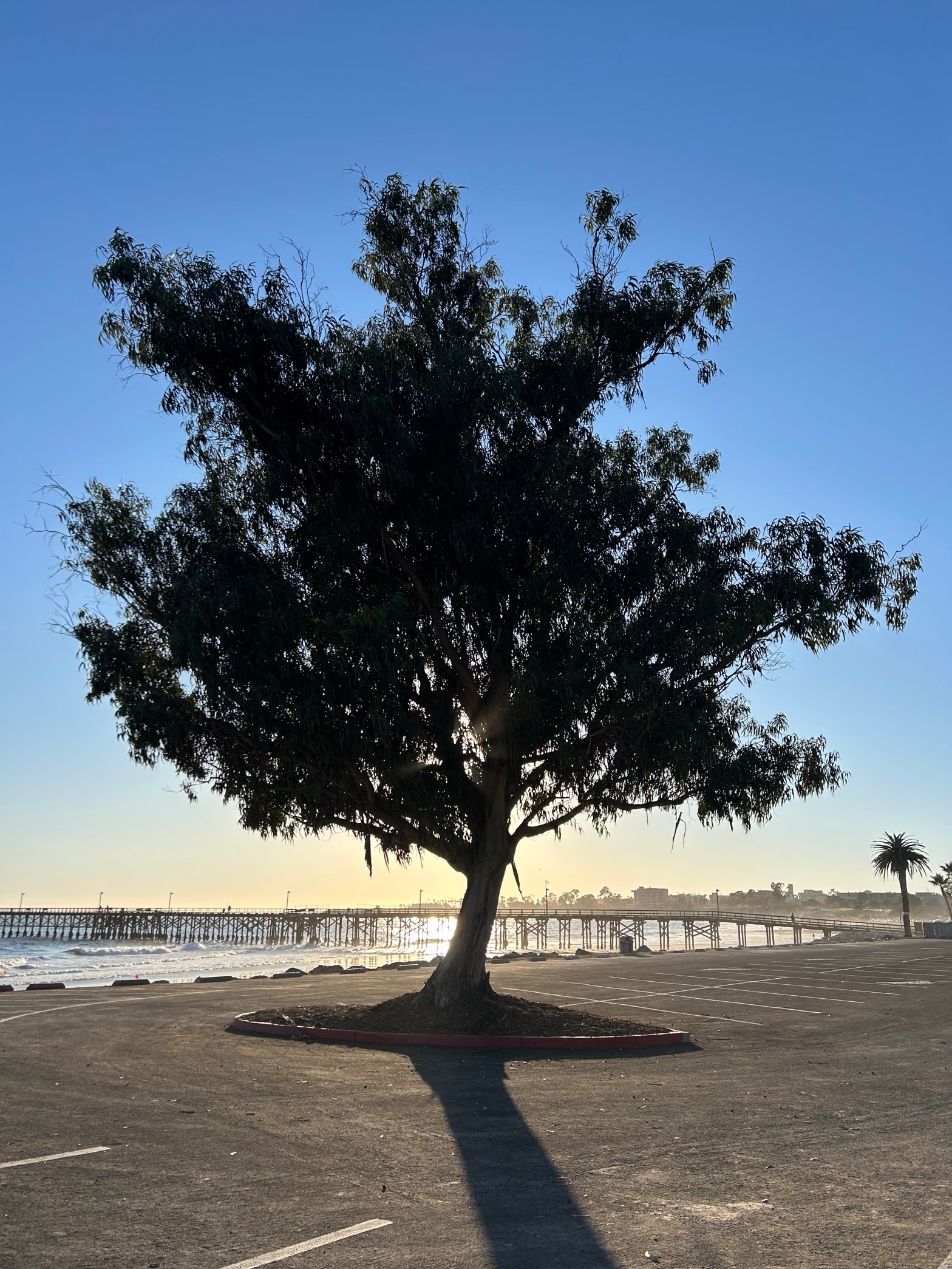
Photo: Late Afternoon, Goleta Beach, January, 2025

Our Motivations Don’t Have to Be Pure to Be Good

                  When I first began my spiritual journey, I was enthralled with the idea that I could escape the influence of my selfish ego and achieve some kind of saintly purity.  I’d seen what complete self-centeredness could do to my life, and like a prisoner for whom the jail door suddenly flew open, I couldn’t wait to find freedom.  I read accounts of saints and sages.  I experimented with meditation, recorded and analyzed my dreams, memorized Psalms, and sought spiritual guides. I read the Sermon on the Mount, which includes strong statements to discourage us from publicly displaying our spirituality when we are fasting, giving to charity, and praying. [i]

                  Fifteen years later I was driving downtown to volunteer at the local soup kitchen.  Two different voices within me began a conversation:

Inner Voice One: “I’ve been meaning to do this for some time. Glad I finally signed up and am on my way.” 

Inner Voice Two: “You know, be sure and tell your congregation you are doing this.  You’ll look good in their eyes.”

Inner Voice One: “What a selfish thing to think! I’m not doing this to show off. I’m doing it because it’s the right thing to do.”

Inner Voice Two: “Of course you are.  That’s great. But it won’t hurt your reputation to let people know you are doing this.”

I didn’t like Voice Two and could not silence it.  I was frustrated.

A few months later I was on a long drive north on Interstate 5. I thought again about the persistence of self-centered Voice Two.  I decided to try an experiment. I visualized Voice Two as a separate person standing in front of me.   I stared at him.  He looked uncomfortable and embarrassed being examined so carefully and kept looking downward. I began feeling compassion for Voice Two.  I realized it had never meant me any harm. It was there to speak up for me, protect me, always wanting to help me be somebody I could feel good about.  I stood in front of him.  I put my right hand on his shoulder.  “You know,” I said, “I now realize you work very hard on my behalf and always act with the best of intention.  I’m not going to get angry with you anymore.  I’m not going to try to get rid of you. Let’s be friends.  I’ll let you offer suggestions whenever you wish.  I just don’t want you to be in charge.”

It was a moment of inner reconciliation that brought me a sense of peace.  I gave up trying to be a saint. I accepted being someone who may often have mixed motivations that I need to sort through.  I would continue to engage in activities for a higher purpose but not get upset if I also hear Voice Two whispering to me how this might affect my reputation and self-esteem.  If I personally accomplish something that has been challenging for me, I am going to welcome feelings of pride and satisfaction.

Several years later, as part of my Hospice training, I attended a retreat at the Metta Institute which included Buddhist meditation practice. I learned one key principle: “Welcome everything, push away nothing.”[ii]  Rather than try to control everything our busy mind comes up with, we let all our thoughts arise; we then calmly examine them and choose which ones are worth engaging.   I have found that to be a practical way to manage all the different ideas, motivations and strategies that can arise within.

I do think there are saints in this world whose motives are always pure.  They don’t know they are saints.  They meet those Sermon on the Mount standards without thinking about it.  I know I’m not one of them.  But I don’t want my mixed motives to keep me from joining other people to get good things done and enjoy life along the way.


[i] Matthew 6: 1-8, 16-18

[ii] The Five Invitations: Discovering What Death Can Teach Us About Living Fully, Frank Ostateski

Waking The Dead

The documentary filmmaker Ken Burns was raised in a small, 2-bedroom home in Ann Arbor, Michigan.  A recent article[i] describes his personal journey, which began with a traumatic childhood:

Ken was 11 and his brother, Ric, was 10, when their mother was on her deathbed. Their father, Robert Kyle Burns Jr., an anthropologist, was mentally ill.

As his mother’s cancer metastasized, Ken overheard conversations — his mother pleading with relatives, asking for someone, anyone, to take her boys in the event of her death. “I remember being scared — scared all the time,” he said.

With their mother in the hospital, the boys were left to wait at home for the inevitable. On the night of April 28, 1965, Ken went to bed with one of the worst stomachaches he had ever had — his body registering what none of the adults would speak about.

The pain disappeared suddenly. The phone rang. His mother was gone.

Following his mother’s death, his father would disappear “for hours and then days at a time” and sometimes be gone for months.

There is a saying I learned when I was at Hospice of Santa Barbara: “Pain that is not transformed is often transferred” — meaning if we don’t’ find a way to channel personal hurt and anguish into something positive, we can end up inflicting that pain on ourselves or others.  In his grief and confusion, Burns found such a path:

The filmmaker remembers the exact moment when he decided what he wanted to do with his life: He had never seen his father cry — not in all the years his mother had fought an excruciating illness, not even at the funeral — until one night after her death. His family was in the living room in front of their black-and-white TV, watching a movie, and suddenly his father began weeping.

“I just understood that nothing gave him any safe harbor — nothing,” Ken Burns said, except the film, which had created the space for a bereaved widower to express the fraught emotions he had suppressed.

Burns began creating historical films that would present the past as something much more personal than just a series of facts. Through stories, letters, photographs, and music, he has been able to bring real people to life, whether the topic is baseball, music (jazz and country), war (World War 2 and Vietnam) or any other topic.

The article ends with this:

Years ago, a psychologist finally gave him an answer to the meaning of his work. “Look what you do for a living — you wake the dead,” the psychologist told him.

When I finished the article, I realized much of my life has been about “waking the dead.”   I’ve been reading history and biographies since grammar school, constantly looking for how real people endured hardship and crises.  I love listening to music that can seem to bring the composer’s lived experience accross time and directly into my heart and mind.  I gaze at works of art hoping to time-travel into someone else’s world and imagination. I turn to the great spiritual traditions to listen to their wisdom and insights. I never thought of it as “waking the dead” but maybe that’s what I’m seeking – and not just to “wake” them but to be in a living and learning relationship with them.

Some years ago, I heard the writer, activist and defender of rural values Wendell Berry speak at UCSB as part of a series on environmental poets.  In the question-and-answer period, someone asked if, given his dedication to family farms, gardening should be a required subject in high school.  Berry paused for a minute, then said, “No, students should read Homer and the Bible, because they need to know they problems they are facing are not new.”  Our world has changed a great deal in terms of technology and science, but the challenges of being a responsible and resilient human being have not. I’m grateful for those who can wake the dead so we can learn from them.

“As a baby, Ken Burns appeared in this photo showing his mother spoon feeding him.” (NY Times)


[i] “The Land That Allowed Ken Burns to Raise the Dead,” New York Times, Nov 27, 2024

Lead image: “Burns in the mid-1970s, just as he was starting to create his film studio”  (from the Times article.)

Wherever You Go, There You Are

                  “Wherever you go, there you are” is a quote that has been around for many years.[i] It’s been nudging me recently.

                  This past week I decided to go through some old files.  They included a selection of my academic papers, published articles, old sermons, early courtship letters from our marriage, and family Christmas letters we’d sent to friends over the years.  I was surprised at some things – I didn’t remember taking that particular class or having that specific experience. It felt like I was watching my life go by and also sensing I’m the same person as when it all began.  It’s like being on a train, passing through unknown places and having unexpected experiences, but realizing it’s an unchanged “me” looking out the window the entire trip. Wherever I went, there I was.

                  What I see now in the mirror looks different than what I’ve seen the past but it’s the same me that’s looking.

                  What will eventually happen to this “me” that seems to be the ongoing observer of my life?

A good friend of mine has been a hospice volunteer for many years and at the bedside of many dying people.  Given the right care and support, he tells me people coming close to having their “me” leave their body feel no fear but experience a calm trust in the unknown. 

                  Some say “dust to dust, ashes to ashes” … period.  We are made of eleven basic elements, mostly carbon, oxygen and hydrogen.  How amazing that eleven elements could come together in just the right way to create a space for a “me” that looks out at this world, tries to make sense of it, lives for decades, then dissipates and disappears. 

                  Some say, “dust to dust, ashes to ashes, yet in sure and certain hope of resurrection to eternal life.”  The me that was carried along by the material elements doesn’t disappear when those elements cease functioning but continues in some form, and it all comes as a gift.

                  I remember someone asking Huston Smith, the great scholar of world spiritual traditions, what happens when we die.  He said the spiritual traditions assume one of two possibilities.  The first possibility is that we keep our self-awareness and become witnesses of something awe-inspiring like an eternal sunrise.  The second possibility is our awareness simply dissolves into the sunrise.  Then he smiled and said, “I like to think I might have a choice. If so, I’d choose to first witness the divine sunrise. But after a while – maybe after a thousand years — I’d decide that was enough. Then I’d let go and become part of it all.”

                  Back to sorting files.  Happy New Year.


[i] There are numerous possible sources of this quote, but it gained popularity in 1994 as the title to a book by Jon Kabat-Zinn: Wherever You Go, There You Are: Mindfulness Meditation in Everyday Life.

Falling Leaves

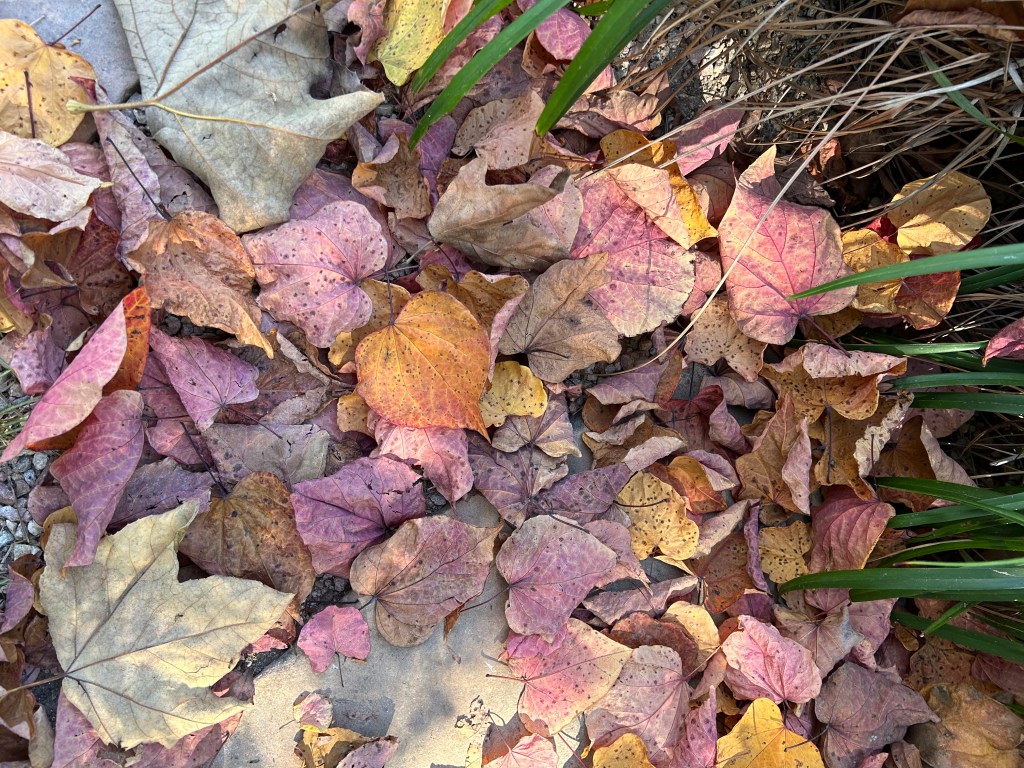
              Earlier this week, I was up early and sitting quietly in my backyard. I’d been asked to speak for a group on spirituality and “wilderness,” and was mentally reviewing what I was planning to say.  Then, ten feet away, a leaf from our Eastern Redbud tree floated to the ground.  It looked like this:

I had noticed this tree had been shedding its foliage, but I don’t remember being present to witness one leaf actually making the transition.

              My life isn’t as busy as it used to be, and I’m grateful I have more time to just observe events like this.

              As I thought about this moment, I remembered times when people found meaning in fallen leaves.

              In my time at Hospice of Santa Barbara, we had an extensive program dedicated to children and families following the death of a parent. I asked one of the counselors what she did with young ones.  In addition to drawing pictures, stories and conversation, a common activity was to go outdoors and observe the natural world. – noticing things that were alive and those were alive no longer.  Then they’d bring their treasures back to the room and talk about the fact that all things that live someday will die.

              At Hospice we had quarterly art shows.  We choose the work not solely on artistic merit, but primarily on the meaning of what the artist was focusing on and how that related to our mission; common themes were healing, transformation, and personal insights.

              One of our presenters was a local artist name Jan Clouse with a show called “Fallen Beauty.”  Here’s a description:

Clouse’s artwork honors the beauty that comes from aging and the natural cycle of loss. By focusing on leaves, twigs, branches and other bits of vegetation that have been shed or fallen to the ground, she concentrates on life cycles present in nature to draw connections to the regenerative cycle of life.

“While most botanical artists capture the beauties of living blooms, I concentrate on detritus, such as pods, seeds and leaves starting to lose living color and taking on a broad range of subtler shades,” said Clouse.

Clouse’s drawing helped her come to terms with the loss of her mother. After her mother’s death, Clouse found a spiritual connection to her mother through her artwork, as it made her focus on the larger picture of life. While visiting her mother, father and grandparents’ graves, Clouse gathered some oak leaves and other bits of vegetation that had fallen nearby. She began to paint these leaves, and found the experience to be meditative while she came to terms with the loss of her loved ones.*

              I am grateful that I am still in relatively good health and hope to be part of the Tree of Life for some years to come.  But the older I get, the more I realize what I have strived to accomplish in my life is becoming less and less visible to me or anyone else.  But I also understand that doesn’t diminish the value of our labors.  I like to think of our lives as having the honor of gradually becoming compost; the fruits of our labor still give us meaning, but it’s more and more about what we have contributed to the life that’s coming after us.

My leaf reunited with its companions.

*Press release: https://www.independent.com/2011/01/21/jan-clouse-featured-artist-hospice-santa-barbara/

Lead image: “Buckeye,” Jan Clouse

“Pain Passes, But the Beauty Remains”

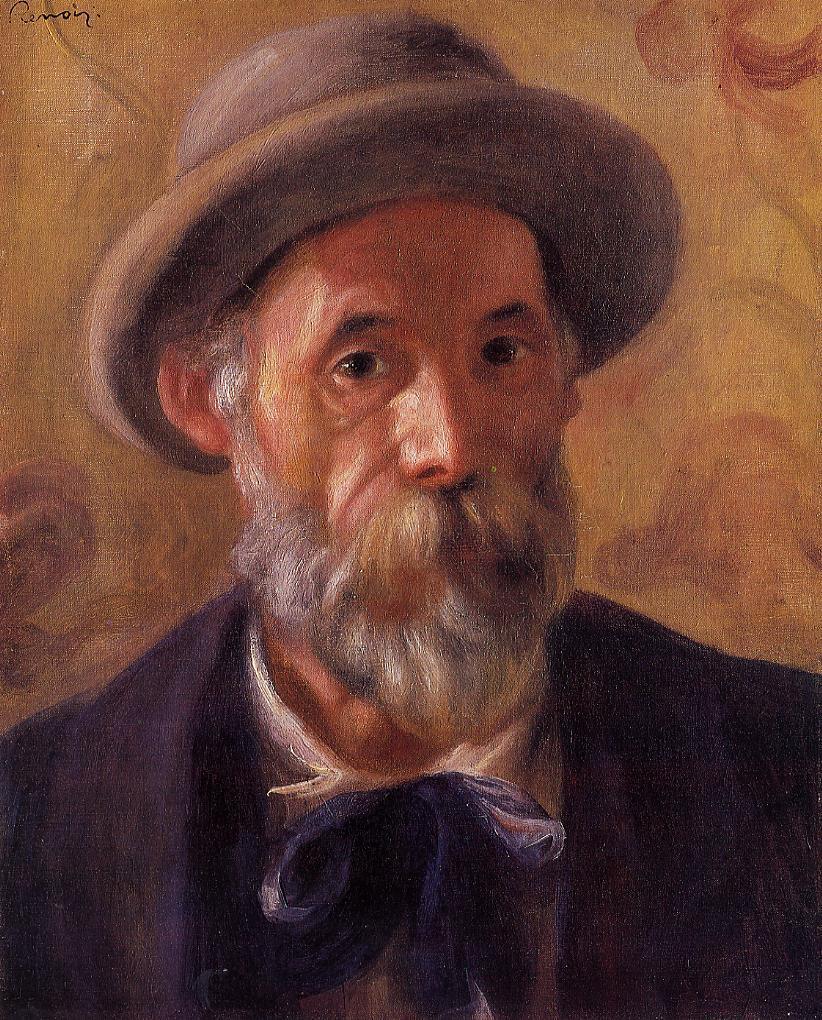
                  In the last years of his life, the French Impressionist painter Jean Renoir continued to paint despite intense pain and physical limitations from rheumatoid arthritis.  At one point he said: “Pain passes, but the beauty remains.”[i]

                  His pain ended with his death, but the beauty of his work lives.

                  I’ve participated in many memorial services in my life.  In such times we have a deep instinct to look for the best in someone’s life, which we hope will transcend whatever pain they endured.  If the person has been able to live a full and meaningful life, this can be easy.  But if the person’s life was marked by tragedy, the desire to focus only on the positive can feel inauthentic — perhaps a way to avoid our own pain and doubts.

                  This week I spoke at a memorial service for a man who died in his late 80s. He’d gone in for a heart procedure that was intended to give him several more years of vitality.  But things happen, and he died at the hospital.  Yet at the service, we reviewed the span of his life, the legacy of his love, and the many joys he knew; all this was far more important than the way he died.

                  This week I also knew a person whose life was drawing to its completion. She had a life of many adventures and much love, but this last year was marked by personal tragedy.  I don’t want to look away from the tragic elements, but I see even more clearly the splendor of her life.

                  From the pain, I want to learn empathy and compassion.

                  From the beauty, I want to practice awe and reverence.

                  Perhaps this drive for transcending suffering is ingrained in life.

A friend who is vacationing in the Caribbean posted some photos this week and commented: “I took a walk on the beach in Barbados tonight and found four turtles coming to shore to lay eggs. I spent about an hour watching one come out of the surf, on to shore and then digging a hole to lay eggs. Incredible.”

                  Patience.  Endurance. Hope. Don’t we all wish this for ourselves and for others: “Pain passes, but the beauty remains?”

Lead image: Pierre-Auguste Renoir, Self-portrait, 1899, Clark Art Institute, Williamstown, MA, USA.


[i] When Art Hurts”