“A Voice in My Mind Said: I Feel Awe”

Dacher Keltner is a psychology professor at UC Berkeley.  For more than 20 years, his research has focused on answering the question, “What makes a good life?”  At one point, he felt he had the answer.  To test it, he and his team conducted thousands of interviews with people around the world and analyzed the results.  What they discovered was also reflected in Keltner’s personal life experiences, including being at the bedside of his dying brother in 2019.

Rolf had been dealing with colon cancer for several years and had decided it was time to take the “cocktail” of prescribed medication that would peacefully bring about his death.  After receiving this news, Dacher drove from Berkeley with his wife and daughters, picked up his mother in Sacramento, and arrived at his brother’s house in the foothills of the Sierras at 10 PM, joining other family members at the bedside. Here are excerpts from his account:

Rolf’s face was full and flushed. The sunken eyes and gaunt cheeks caused by colon cancer were gone; the tightened, sagging skin around his mouth smoothed. His lips curled upward at the corners.

I rested my right hand on his left shoulder, a rounded protrusion of bone. I held it the way I would the smooth granite stones we used to find near the rivers we swam in as young brothers.

“Rolf this is Dach.”

“You are the best brother in the world.”

My daughter Natalie laid her hand lightly on his shoulder blades: “We love you Ralf.”

The cycle of his breathing slowed. He was listening.  Aware.

Listening to Rolf’s breath, I sensed the vast expense of 55 years of our brotherhood… (at this point, Dach’s mind fills with memories of their many shared adventures including skateboarding, playing on the same Little League team, traveling in Mexico, and being the best man at each other’s wedding) …

I sensed a light radiating from Rolf’s face. It pulsated in concentric circles, spreading outward, touching us as we leaned in with slightly bowed heads. The chatter in my mind, clasping words about the stages of colon cancer, new treatments, lymph nodes, and survival rates, faded. I could sense a force around his body pulling him away. And questions in my mind.

What is Rolf thinking?

What is he feeling?

What does it mean for him to die?

A voice in my mind said: I feel awe.

…Watching Rolf pass, I felt small. Quiet.  Humble. Pure. The boundaries that separated me from the outside world faded. I felt surrounded by something vast and warm. My mind was open, curious, aware, wondering.[i]

“A voice in my mind said: I feel awe.” The feeling of awe, Dacher believes, is the most important human emotion we can experience.  He and his team concluded there are eight primary ways we can encounter awe; one of them is being at the boundary of life and death.[ii] 

I experience awe attending memorial services.

This week I attended a celebration of the life of a legendary local building contractor, John Carter, who lived to be 96.  Family, friends and employees shared many stories of his ingenuity, accomplishments, innovations and integrity.  One story in particular has lingered in my mind. John was born on a farm in the San Fernando Valley. One day he and his brother decided to dig their way to China using an empty coffee can.  They dug for days; the hole became deep enough that they could stand in it.  Eventually they gave up. That was the early hint of a life filled with ambitious plans, determination and a love of moving earth and making things.  All those qualities were already present when he was a child and had a vision in his mind and a coffee can in his hand.  Where do such qualities come from?

A few months ago, I attended a private family graveside service for Joe Jowell, who died at 93. His children and grandchildren recounted highlights of his life. Joe was born and raised in Hawaii.  He was a ten-year-old riding his bike on Sunday morning, December 7 when he looked up and wondered why a large group of planes were flying overhead; moments later he saw them dropping bombs on Pearl Harbor.  After finishing high school, he moved to San Francisco.  He served in the Navy during the Korean War. He then spent five years preparing to become a priest in the Boston Maryknoll Brotherhood.  He decided to leave that order to marry and raise a family in Long Beach.  Joe became a certified Appliance Repair Technician and worked for Sears for many years.   He and his wife were raising five children when she died, leaving him on his own. Later one of his sons took his own life.  Joe learned to endure these losses and wanted to help others experiencing grief. He became a Hospice volunteer and served our community for 35 years. I met Joe when I became Director at Hospice of Santa Barbara in 2008 – I was told he was known by his colleagues as “St. Joe.” Sixteen years later I had privilege of hearing his family’s stories at his graveside.  If we had seen Joe at Costco or in a hospital hallway, could we have imagined all he’d experienced and how many people he had cared for?

Watching his brother take his last breath, Derik Keltner said: “My mind was open, curious, aware, wondering.”  He believes experiencing awe puts us in touch with the mysteries of life.  It both humbles and inspires us.

When someone’s life ends, we begin to see what mattered and what it meant.  Time and again, I have been filled with awe.


[i] Awe: The New Science of Everyday Wonder and How It Can Transform Your Life, Dacher Keltner, 2023, pages xxi-xxiii

[ii] The eight categories: moral beauty, collective effervescence, nature, music, visual design, spiritual and religious, awe, life and death, and epiphanies (moments in which a new and grand understanding dawns).

I first came across Keltner’s work as cited by Jonathan Haidt in his book, The Anxious Generation: How the Great Rewiring of Childhood is Causing an Epidemic of Mental Illness,  which was the subject of my recent post, Rising Above the Phone-Based CultureI expect to share more of Keltner’s findings in the weeks to come.

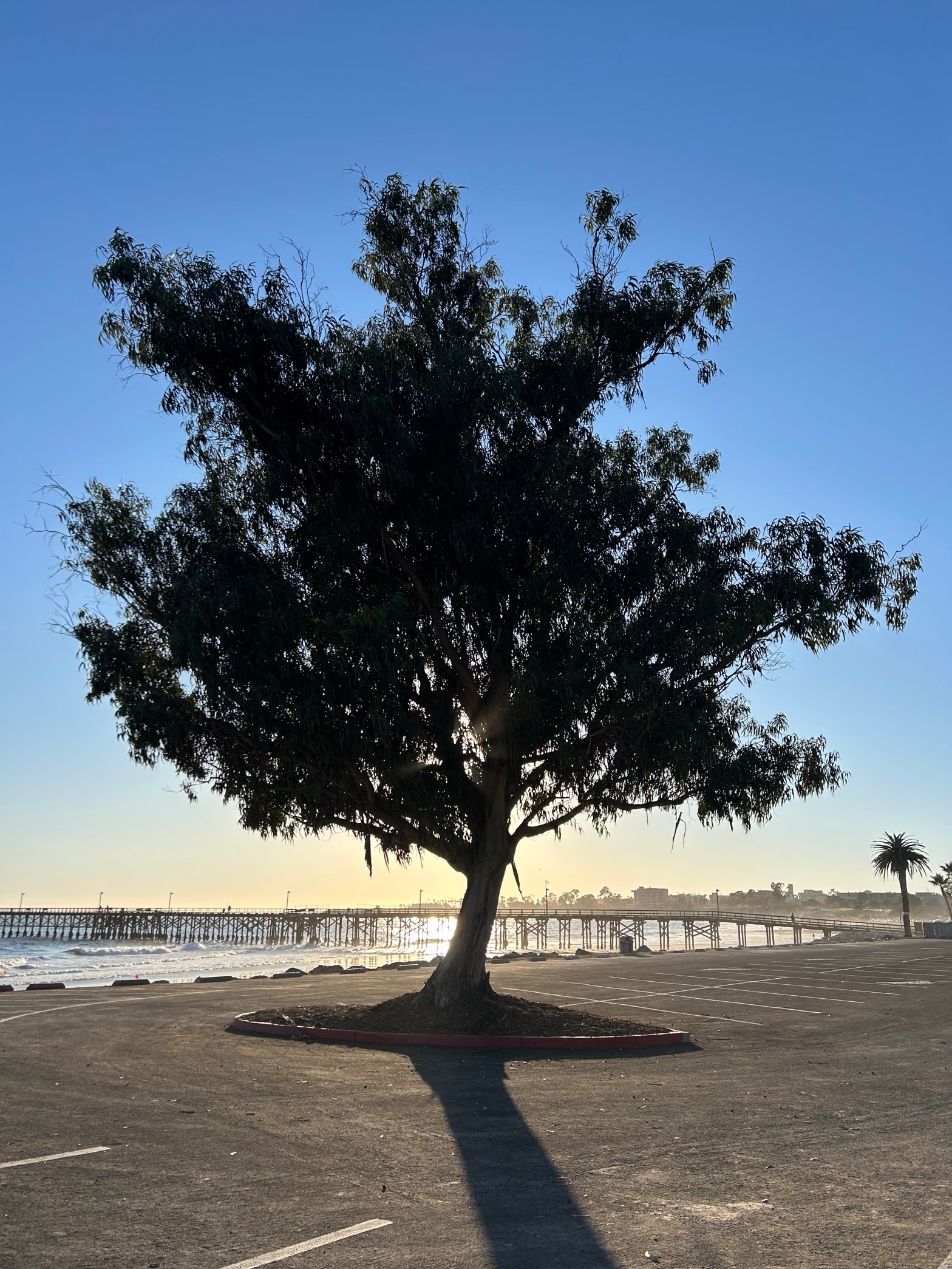
Photo: Late Afternoon, Goleta Beach, January, 2025

Where’s Your Axis Mundi?

It’s a word I liked the first time I heard it:  axis mundi. 

I encountered it in graduate school reading The Sacred and Profane, a study of world religion and mythology by Mircea Eliade.  It means the “axis” around which the earth “turns” — not physically, but spiritually and psychologically.  It’s a place where people believe heaven and earth meet.

Jerusalem has long been seen as an axis mundi, a city sacred to Jews, Christians and Muslims.  For traditional Japan, it has been Mt. Fuji.   For Catholics it’s Rome.

Some indigenous tribes in Australia are always on the move, and they carry a sacred pole with them which they erect each place they stay – a portable axis mundi

In 2000, I had a 3-month sabbatical project that focused on how digital technology was beginning to affect everyday life.  I visited and conducted interviews in two locations.   

Silicon Valley was already becoming the axis mundi of the tech age. In my interviews and observations, one could already sense that digital tech was becoming something close to a religion.  In the Tech Museum in San Jose, I purchased a computer mouse pad made to look like a Muslim prayer rug.  I visited one of the largest Fry’s stores (in the pre-internet retail era, Fry’s was a “Mecca” for electronic parts and gadgets.)  Some were designed to look like Mayan temples:

One month later I went to India, which was becoming part of that revolution.  After interviewing tech professionals and academics in Bangalore, I spent time in the ancient city of Varanasi on the banks of the Ganges River.  In Hindu belief, there is no place on earth where heaven and earth come closer, and therefore no better place to bathe, die, be cremated and have your ashes scattered.

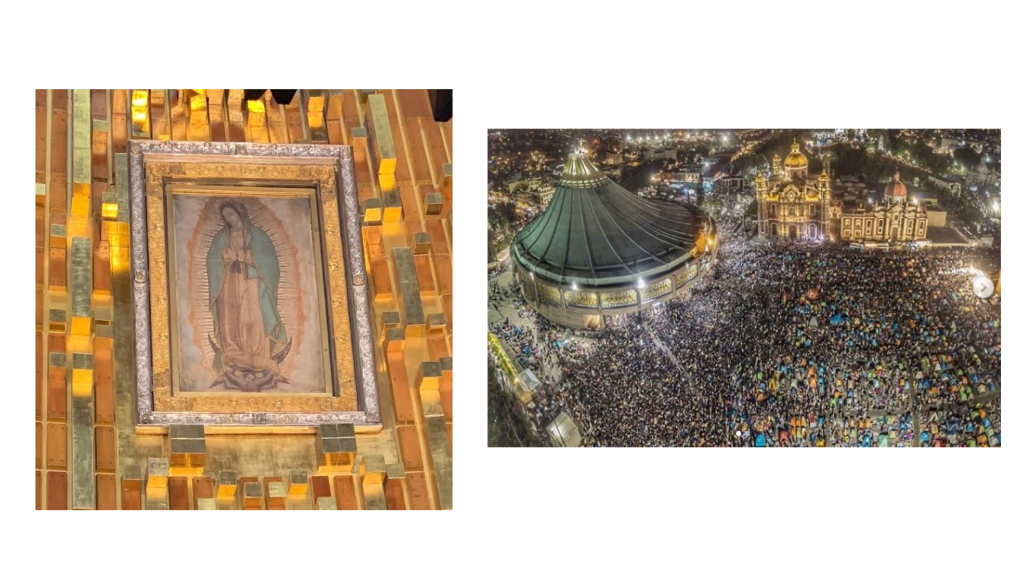
                  By 2006, I had realized the most sacred religious site in the Western Hemisphere was the Basilica of Our Lady of Guadalupe in Mexico City. Growing up in California, I had seen the Guadalupe image all my life but knew nothing about what it meant.  I learned that, in Catholic tradition, the Virgin Mary appeared to an indigenous peasant, Juan Diego, in December,1531.  She looked more like a native woman than a European and spoke to him in his own dialect: “Am I not here, I who am your mother?” She gave Juan Diego her robe or tilma.   When he took it to a skeptical archbishop and unfurled it, pink roses fell to the floor and her image had become imprinted on the garment.  The tilma is preserved in a glass case in the cathedral.  I spent a week in the city that summer, making several visits to the Basilica.   I watched thousands of faithful pilgrims arrive to worship and celebrate, and was moved by their joy and devotion.

Mt. Shasta is just south of the Oregon border. We’d driven by it many times over the years as we traveled between Washington state and California, but I hadn’t considered it anything more than an impressive volcanic formation. In 2009, we spent a week at a yoga/hiking retreat in the town of McCloud at the base of the mountain. We could see the peak every morning from our window.  As we hiked during the week, we saw it from many angles.   On the last day of the retreat, our group hiked to Squaw Meadows, an alpine meadow on the side of mountain at an elevation of 7,900 feet. I felt smaller and increasingly insignificant in the presence of the mountain’s mystery and majesty; I began to appreciate why both native people and contemporary spiritual seekers from around the world consider it an axis mundi.  We’ve returned to the area every summer for 15 years.

In 1233, St. Francis returned to Italy from the Holy Land where he had visited a cave that was the traditional site of Jesus’ birth. Wanting people to appreciate the setting of the Christmas story, he created the first outdoor nativity scene including live animals.  Nativity scenes have become a familiar axis mundi in countless households and sanctuaries ever since.  When viewed with reverence, candlelight and song, a nativity scene affirms that divine presence can be sensed not only on mountaintops, but also in the lives of humble people in unexpected places.

Some traditions have steered away from emphasizing any particular physical place where we encounter the divine and instead look within our individual awareness.  Quakers affirm that every person has within them an “inward light” or spark of divine energy.  By practicing silent introspection, we can access and experience that light and find guidance from it.

I have visited many sacred sites in my life.  I always try to understand and appreciate the beliefs and imagination of the faithful who are drawn there.

 At the same time, the purpose of visiting such places doesn’t end with the personal encounter. Recent studies have established a powerful connection between experiences of awe and an increased capacity to care for others.[i] Coming into the presence of axis mundi sites can have that effect.  The purpose of spiritual life is not to have a specific experience, but to discover within us a deep reverence for life and others and let that form our character.  As Huston Smith said, “Spirituality is not about altered states but altered traits.”


[i] https://drjsb.com/2022/09/03/starstruck-the-relationship-between-awe-and-caring/