Our Motivations Don’t Have to Be Pure to Be Good

                  When I first began my spiritual journey, I was enthralled with the idea that I could escape the influence of my selfish ego and achieve some kind of saintly purity.  I’d seen what complete self-centeredness could do to my life, and like a prisoner for whom the jail door suddenly flew open, I couldn’t wait to find freedom.  I read accounts of saints and sages.  I experimented with meditation, recorded and analyzed my dreams, memorized Psalms, and sought spiritual guides. I read the Sermon on the Mount, which includes strong statements to discourage us from publicly displaying our spirituality when we are fasting, giving to charity, and praying. [i]

                  Fifteen years later I was driving downtown to volunteer at the local soup kitchen.  Two different voices within me began a conversation:

Inner Voice One: “I’ve been meaning to do this for some time. Glad I finally signed up and am on my way.” 

Inner Voice Two: “You know, be sure and tell your congregation you are doing this.  You’ll look good in their eyes.”

Inner Voice One: “What a selfish thing to think! I’m not doing this to show off. I’m doing it because it’s the right thing to do.”

Inner Voice Two: “Of course you are.  That’s great. But it won’t hurt your reputation to let people know you are doing this.”

I didn’t like Voice Two and could not silence it.  I was frustrated.

A few months later I was on a long drive north on Interstate 5. I thought again about the persistence of self-centered Voice Two.  I decided to try an experiment. I visualized Voice Two as a separate person standing in front of me.   I stared at him.  He looked uncomfortable and embarrassed being examined so carefully and kept looking downward. I began feeling compassion for Voice Two.  I realized it had never meant me any harm. It was there to speak up for me, protect me, always wanting to help me be somebody I could feel good about.  I stood in front of him.  I put my right hand on his shoulder.  “You know,” I said, “I now realize you work very hard on my behalf and always act with the best of intention.  I’m not going to get angry with you anymore.  I’m not going to try to get rid of you. Let’s be friends.  I’ll let you offer suggestions whenever you wish.  I just don’t want you to be in charge.”

It was a moment of inner reconciliation that brought me a sense of peace.  I gave up trying to be a saint. I accepted being someone who may often have mixed motivations that I need to sort through.  I would continue to engage in activities for a higher purpose but not get upset if I also hear Voice Two whispering to me how this might affect my reputation and self-esteem.  If I personally accomplish something that has been challenging for me, I am going to welcome feelings of pride and satisfaction.

Several years later, as part of my Hospice training, I attended a retreat at the Metta Institute which included Buddhist meditation practice. I learned one key principle: “Welcome everything, push away nothing.”[ii]  Rather than try to control everything our busy mind comes up with, we let all our thoughts arise; we then calmly examine them and choose which ones are worth engaging.   I have found that to be a practical way to manage all the different ideas, motivations and strategies that can arise within.

I do think there are saints in this world whose motives are always pure.  They don’t know they are saints.  They meet those Sermon on the Mount standards without thinking about it.  I know I’m not one of them.  But I don’t want my mixed motives to keep me from joining other people to get good things done and enjoy life along the way.


[i] Matthew 6: 1-8, 16-18

[ii] The Five Invitations: Discovering What Death Can Teach Us About Living Fully, Frank Ostateski

Wherever You Go, There You Are

                  “Wherever you go, there you are” is a quote that has been around for many years.[i] It’s been nudging me recently.

                  This past week I decided to go through some old files.  They included a selection of my academic papers, published articles, old sermons, early courtship letters from our marriage, and family Christmas letters we’d sent to friends over the years.  I was surprised at some things – I didn’t remember taking that particular class or having that specific experience. It felt like I was watching my life go by and also sensing I’m the same person as when it all began.  It’s like being on a train, passing through unknown places and having unexpected experiences, but realizing it’s an unchanged “me” looking out the window the entire trip. Wherever I went, there I was.

                  What I see now in the mirror looks different than what I’ve seen the past but it’s the same me that’s looking.

                  What will eventually happen to this “me” that seems to be the ongoing observer of my life?

A good friend of mine has been a hospice volunteer for many years and at the bedside of many dying people.  Given the right care and support, he tells me people coming close to having their “me” leave their body feel no fear but experience a calm trust in the unknown. 

                  Some say “dust to dust, ashes to ashes” … period.  We are made of eleven basic elements, mostly carbon, oxygen and hydrogen.  How amazing that eleven elements could come together in just the right way to create a space for a “me” that looks out at this world, tries to make sense of it, lives for decades, then dissipates and disappears. 

                  Some say, “dust to dust, ashes to ashes, yet in sure and certain hope of resurrection to eternal life.”  The me that was carried along by the material elements doesn’t disappear when those elements cease functioning but continues in some form, and it all comes as a gift.

                  I remember someone asking Huston Smith, the great scholar of world spiritual traditions, what happens when we die.  He said the spiritual traditions assume one of two possibilities.  The first possibility is that we keep our self-awareness and become witnesses of something awe-inspiring like an eternal sunrise.  The second possibility is our awareness simply dissolves into the sunrise.  Then he smiled and said, “I like to think I might have a choice. If so, I’d choose to first witness the divine sunrise. But after a while – maybe after a thousand years — I’d decide that was enough. Then I’d let go and become part of it all.”

                  Back to sorting files.  Happy New Year.


[i] There are numerous possible sources of this quote, but it gained popularity in 1994 as the title to a book by Jon Kabat-Zinn: Wherever You Go, There You Are: Mindfulness Meditation in Everyday Life.

Where’s Your Axis Mundi?

It’s a word I liked the first time I heard it:  axis mundi. 

I encountered it in graduate school reading The Sacred and Profane, a study of world religion and mythology by Mircea Eliade.  It means the “axis” around which the earth “turns” — not physically, but spiritually and psychologically.  It’s a place where people believe heaven and earth meet.

Jerusalem has long been seen as an axis mundi, a city sacred to Jews, Christians and Muslims.  For traditional Japan, it has been Mt. Fuji.   For Catholics it’s Rome.

Some indigenous tribes in Australia are always on the move, and they carry a sacred pole with them which they erect each place they stay – a portable axis mundi

In 2000, I had a 3-month sabbatical project that focused on how digital technology was beginning to affect everyday life.  I visited and conducted interviews in two locations.   

Silicon Valley was already becoming the axis mundi of the tech age. In my interviews and observations, one could already sense that digital tech was becoming something close to a religion.  In the Tech Museum in San Jose, I purchased a computer mouse pad made to look like a Muslim prayer rug.  I visited one of the largest Fry’s stores (in the pre-internet retail era, Fry’s was a “Mecca” for electronic parts and gadgets.)  Some were designed to look like Mayan temples:

One month later I went to India, which was becoming part of that revolution.  After interviewing tech professionals and academics in Bangalore, I spent time in the ancient city of Varanasi on the banks of the Ganges River.  In Hindu belief, there is no place on earth where heaven and earth come closer, and therefore no better place to bathe, die, be cremated and have your ashes scattered.

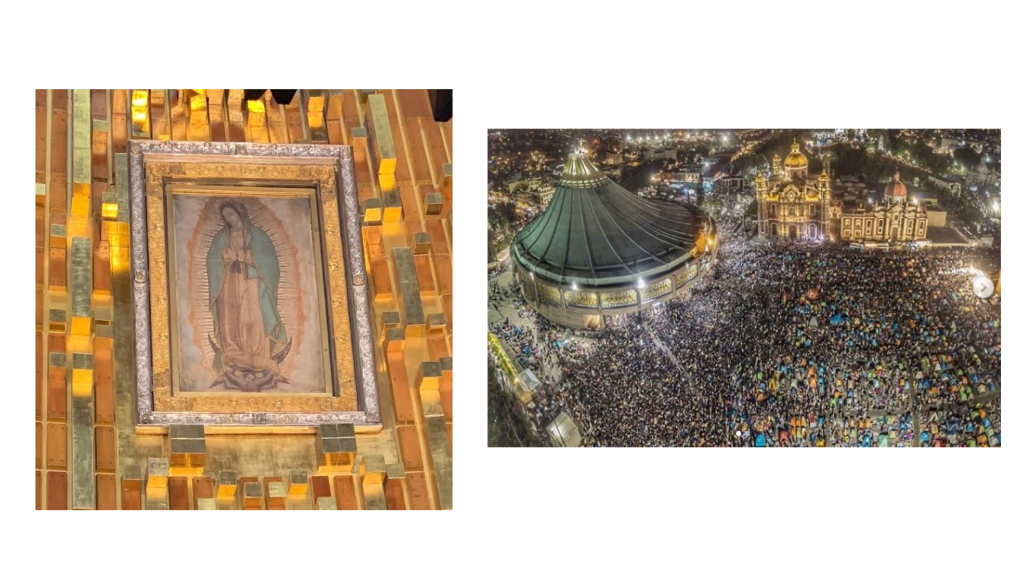
                  By 2006, I had realized the most sacred religious site in the Western Hemisphere was the Basilica of Our Lady of Guadalupe in Mexico City. Growing up in California, I had seen the Guadalupe image all my life but knew nothing about what it meant.  I learned that, in Catholic tradition, the Virgin Mary appeared to an indigenous peasant, Juan Diego, in December,1531.  She looked more like a native woman than a European and spoke to him in his own dialect: “Am I not here, I who am your mother?” She gave Juan Diego her robe or tilma.   When he took it to a skeptical archbishop and unfurled it, pink roses fell to the floor and her image had become imprinted on the garment.  The tilma is preserved in a glass case in the cathedral.  I spent a week in the city that summer, making several visits to the Basilica.   I watched thousands of faithful pilgrims arrive to worship and celebrate, and was moved by their joy and devotion.

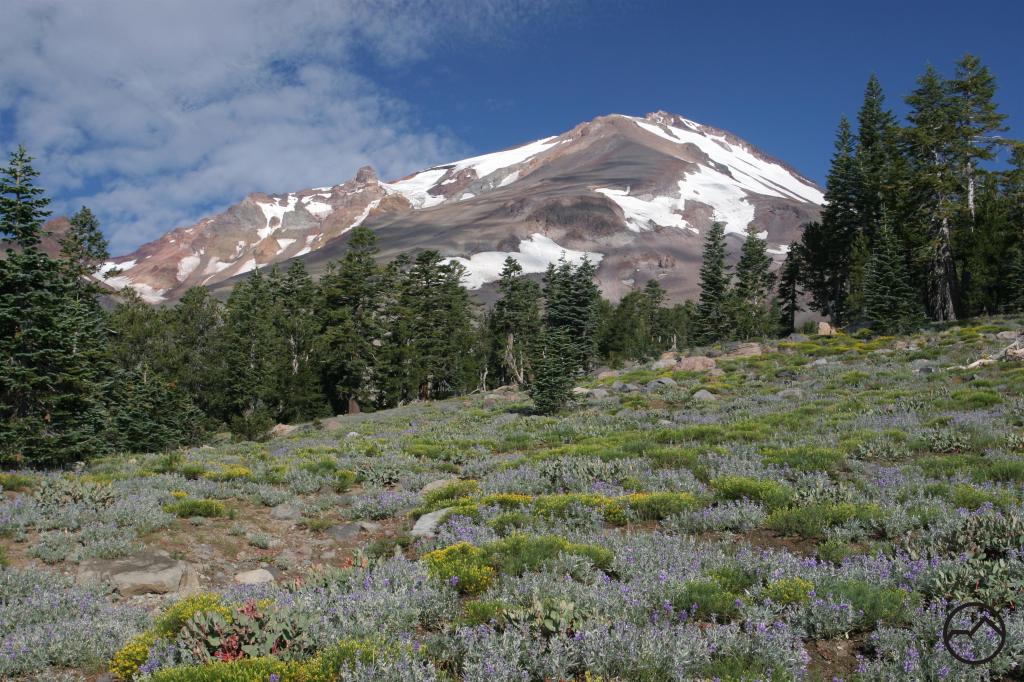
Mt. Shasta is just south of the Oregon border. We’d driven by it many times over the years as we traveled between Washington state and California, but I hadn’t considered it anything more than an impressive volcanic formation. In 2009, we spent a week at a yoga/hiking retreat in the town of McCloud at the base of the mountain. We could see the peak every morning from our window.  As we hiked during the week, we saw it from many angles.   On the last day of the retreat, our group hiked to Squaw Meadows, an alpine meadow on the side of mountain at an elevation of 7,900 feet. I felt smaller and increasingly insignificant in the presence of the mountain’s mystery and majesty; I began to appreciate why both native people and contemporary spiritual seekers from around the world consider it an axis mundi.  We’ve returned to the area every summer for 15 years.

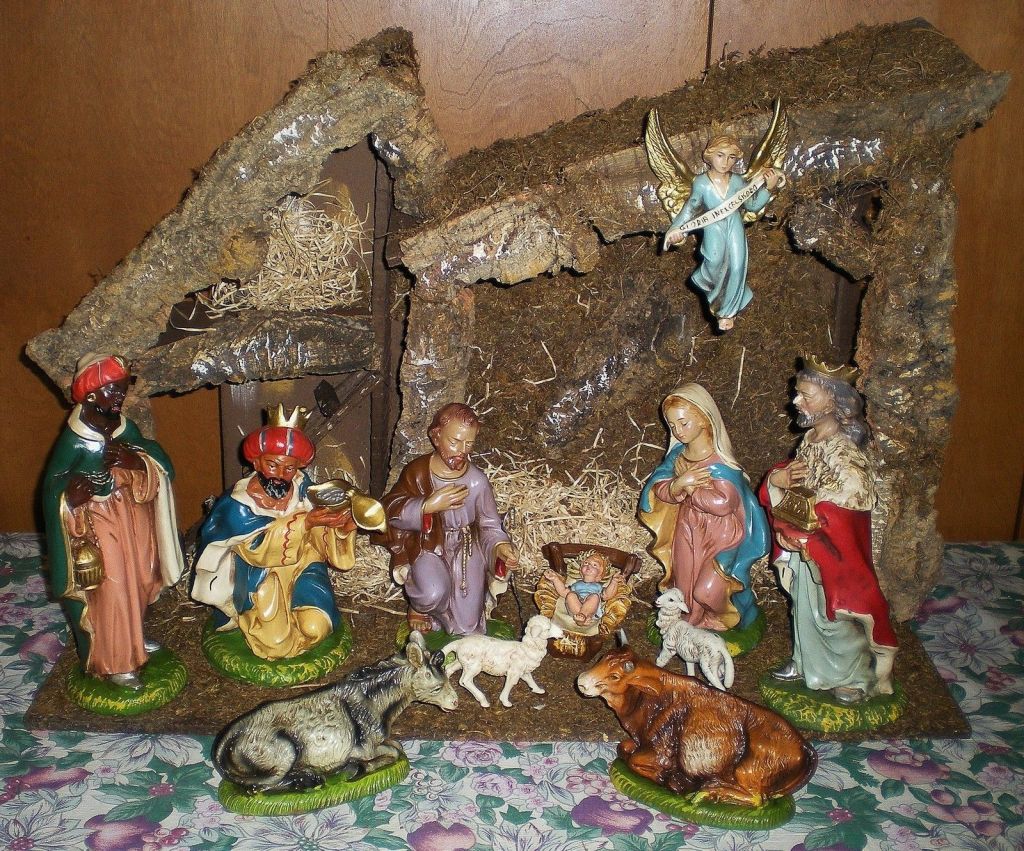
In 1233, St. Francis returned to Italy from the Holy Land where he had visited a cave that was the traditional site of Jesus’ birth. Wanting people to appreciate the setting of the Christmas story, he created the first outdoor nativity scene including live animals.  Nativity scenes have become a familiar axis mundi in countless households and sanctuaries ever since.  When viewed with reverence, candlelight and song, a nativity scene affirms that divine presence can be sensed not only on mountaintops, but also in the lives of humble people in unexpected places.

Some traditions have steered away from emphasizing any particular physical place where we encounter the divine and instead look within our individual awareness.  Quakers affirm that every person has within them an “inward light” or spark of divine energy.  By practicing silent introspection, we can access and experience that light and find guidance from it.

I have visited many sacred sites in my life.  I always try to understand and appreciate the beliefs and imagination of the faithful who are drawn there.

 At the same time, the purpose of visiting such places doesn’t end with the personal encounter. Recent studies have established a powerful connection between experiences of awe and an increased capacity to care for others.[i] Coming into the presence of axis mundi sites can have that effect.  The purpose of spiritual life is not to have a specific experience, but to discover within us a deep reverence for life and others and let that form our character.  As Huston Smith said, “Spirituality is not about altered states but altered traits.”


[i] https://drjsb.com/2022/09/03/starstruck-the-relationship-between-awe-and-caring/

The Things We Do Without Thinking Too Much

              Are there actions you perform best without thinking about them?

              The legendary Dodger pitcher Fernando Valenzuela died last month.  He began his career in 1981 as an unknown 20-year-old from Etchohuaquilin, a small village in Mexico.  He had developed a unique way to pitch.  He’d begin his motion like most pitchers — by leaning forward to get a sign, then standing tall, then lifting his right leg and rotating his body to his left.  At this point, most pitchers are staring at the catcher’s mitt as the target.  But Fernando did something odd.  Balancing on his left leg, he’d look up to the sky and pause for a minute.  Then he’d focus on the catcher and throw.

              Hitters had never seen anything like it.  He won the first eight games he pitched, giving up an average of less than one run per game.  That year he won not only the Rookie of the Year Award, but also the award for the best pitcher in the league.  He became a sensation, a legend, a folk hero. 

              When someone asked what he was thinking when he went into his motion, he said wasn’t thinking about it at all; “I can’t do it if I think about it. I would fall down.”

              We spend a great deal of energy on planning, training for, and practicing many tasks in life.  But sometimes we learn to do something well without thinking too much about it. 

              My mother was not an accomplished cook.  But she could create amazing apple pies.  She didn’t use a recipe.  She had developed a sense of how much of each ingredient was needed, when the pie dough was ready to be rolled, and how many drops of lemon juice should top the filling beneath the crust.  If you asked her how she did it, she would say she simply did what seemed best; if she had thought too much about each step, it would have distracted her, and her better instincts would have been compromised.

              It was the same playing piano. She had taken a few lessons, but was mostly self-taught.  She could play Gershwin and Broadway tunes beautifully; the music began in her heart and the rest of her found a way to bring what she felt through the keyboard into the room.  It was wonderful to hear.

              I’ve led, participated in, and attended many memorial services over the last 40 years. The person’s accomplishments are often recited. But the most moving testimonials are people describing how the person lived, endured hardships, and treated other people.  My sense is that that behavior was not rehearsed or carefully planned.  If you could go back and ask the person, “How do did you do that?” many would say, “I don’t know. It just seemed right.”

              I want to celebrate the actions we take and the ways we live well that aren’t a product of formulas and mental concentration but arise from a desire to simply do the right thing.

              One of the widespread concerns following this election is the threat to the way we, as a democracy, have gone about the challenges of being an open society.  We have always shared an assumption that we will, despite our differences, respect established norms of decency, foster mutual respect, follow due process and assume personal responsibility.  If someone from another country would ask us, “How do you do that?” we might answer, “We don’t think about it too much. We have always assumed that’s the right way to do things in a democracy.”  I wonder if now what seemed a given is something we are going to have to “think about;” if we don’t recover that attitude, we may very well “fall over.”

              30 years after that first game when he was 51, Fernando was asked to throw out the first pitch to open the season at Dodger Stadium.  In the Los Angeles Times, Dylan Hernandez wrote:

When he winds up to throw the ball, Valenzuela won’t look skyward the way he used to. “I can’t do it if I think about it. I would fall down, especially if I’m wearing street shoes,” he said, laughing… “I didn’t even know I did that until someone showed me a video…”

He said he didn’t notice more Latinos in the seats at Dodger Stadium. Or that he was helping ease long-standing ethnic and cultural tensions in the city. Or that he was drawing the attention of businesses to the growing Latino market. Or that because of him teams were increasingly looking outside the country for players.”[i]

Fernando didn’t plan all that.  He simply found a way to perform a task exceptionally well.  And in the process benefited his teammates, his community and the game.


[i] https://www.latimes.com/sports/la-xpm-2011-mar-30-la-sp-0331-fernandomania-20110331-story.html