AI is Showing Up in Interesting Places in My Life

As long-time readers know, one of my ongoing curiosities is the effect digital devices and culture are having on our life.  Almost every day of this week I’ve come across signs of the emerging presence and impact of Artificial Intelligence.

Talking to a Neighbor On a morning walk we came across a neighbor whose kids were students of my wife in first grade.  We asked about them. He said his oldest son just graduated with a B.S. in Computer Science from UCSC but can’t get a job.  Tech companies are not hiring young, qualified graduates unless the person hiring can prove to management that a human being will be needed since AI systems can now do programming work.  The dad, who had a long career in major tech companies himself, said he personally knows five company VPs who have been given the same directives.  His son has decided to become a pilot.

Going to the Dentist Monday morning I went for my six-month check-up.  Our former dentist recently retired, and a bright new guy has taken over the practice.  In one of the pauses in the procedure, I asked him if AI is impacting dentistry.  He said AI controlled robots are being tested that can “set a crown” in five minutes, a procedure that would take an experienced dentist 45 minutes.  He said he has no idea what his professional future now looks like.

Shades of Jurassic Park? Later that day, I read a column in the Wall Street Journal: “AI Is Learning to Escape Human Control.” Here’s how it begins:

An artificial intelligence model did something last month that no machine was ever supposed to do: it rewrote its own code to avoid being shut down. Nonprofit AI lab Palisade Research gave open AI’s o3 AI model a simple script that would shut off the model when triggered. In 79 out of 100 trials, o3 independently edited that script so the shutdown command would no longer work. Even when explicitly instructed to “allow yourself to be shut down,” it disobeyed 7% of the time. This wasn’t the result of hacking or tampering. The model was behaving normally. It simply concluded on its own that staying alive helped it achieve its other goals.

Anthropic’s AI model, Claude 4 Opus, went even further. Researchers told the model it would be replaced by another AI system and fed it fictitious emails suggesting the lead engineer was having an affair. In 84% of the tests, the model drew on the emails to blackmail the lead engineer into not shutting it down. In other cases, it attempted to copy itself to external servers, wrote self-replicating malware, and left messages for future versions of itself about evading human control.

No one programmed the AI models to have survival instincts. But just as animals evolved to avoid predators, it appears that any system smart enough to pursue complex goals will realize it can’t achieve them if it’s turned off. [i]

Building a Tree House in a Palm Tree Wednesday I attended the first session of Westmont College’s annual “Lead Where You Stand” conference.  The afternoon theme was AI. One session featured a panel that included a computer science professor, a Westmont graduate developing AI at Amazon, and a local entrepreneur.  Each described the promises and challenges of AI.  Each were asked to do a live, unrehearsed demonstration of what AI can do.  The professor connected his laptop to the microphone. He then opened his AI program and asked this question: “Hey, I want to build a tree house in a palm tree on my property here in Santa Barbara.  What do I need to do?”  The voice that replied did not sound like a robot, but the most relaxed and happy human you’ve ever talked to on the phone. It responded like this: “Wow!  Treehouse in a palm tree! That’s an amazing idea!  Well, you’ll have to figure how to stabilize it, since palm trees sway in winds.  You probably should find a contractor who specializes in tree houses.  And then you’ll need to go to the county to get a permit. That should get you started.  What else to you need?” And the conversation continued.

Hearing David Brooks Thursday included three presentations by NY Times columnist David Brooks.  This is the eighth year I have heard him speak at this conference and his attitude towards AI has been evolving.  Two years ago, he arrived after spending time in Silicon Valley interviewing leading AI developers; he was excited to report that AI will transform our lives as much as did the printing press and electricity. Last year he was more pessimistic and concerned.  This year he seemed to be less worried.  He believes there is much more to human intelligence than the logical processes embodied in AI technology – we are profoundly informed by our values, emotions and intuitions. “We are going to find out who we are when we find out what it can’t do.” 

David speaks openly about how his life has changed as he has discovered a personal faith.  He says he now lives more from his heart than his head.  Faith for him is not a fixed set of beliefs but a “longing for God.”  By that he seems to mean a living presence, an abiding mystery, and a higher purpose that leads us to serve not just ourselves but a greater good and each other.

At Week’s End

Life these days seems to be a balancing act between staying up to date on current events and remaining sane and hopeful.  I plan to begin experimenting with AI myself next week.  I want to be guided by that longing and purpose.

A Slide from the Conference


[i] “AI Is Learning to Escape Human Control”  , WSJ, June 1, 2025” (If you cannot read the column via the link, email me and I’ll send you a scanned copy.)

Featured Image: Branch Out Tree Care

Spiritual Discernment in an Evolving Universe

Life involves plenty of decision-making: some minor and some life-changing.  If we are on a spiritual path, important decisions can become part of our journey of discovery and growth.  It’s a process known as discernment.

One description of this process is The Way of Discernment: Spiritual Practices for Decision Making by Elizabeth Liebert. 

Liebert writes from a strong Biblical foundation and thorough knowledge of contemplative traditions.  But she approaches her topic with a contemporary understanding of life and spirituality:

This understanding begins with the universe as a whole: it is open, flexible, and evolving. On our human level, we experience the boundaries that we call the laws of nature. But when we look either more macroscopically or microscopically, we begin to see the universe is dynamic and ever-changing. … we can expect that God, too, is dynamic, ever-changing, continuously creating – not simply repeating what has already been created.  …(and) we are able to participate, with God, in the creation of our future.[i]

In the past, some religious practices were dominated by the question, “Am I good enough?”  A more interesting quesiton is: “How can I personally access divine guidance in a way that will deepen my relationship with its source, helping me to navigate my own life while benefitting the world around me?”

Awareness Examen: She first encourages us to find a regular time to reflect on where we notice God’s presence in our day. Some people do this by journaling before going to sleep at night, others by taking time early in the morning to review the prior day. Where did you see signs of grace, blessing, and insight?  Like bird watchers who become skilled observers over time, we are more likely to recognize such traces if we practice recognizing them.  

Use an Important Decision You Are Facing: Are you facing an important decision about your relationships, responsibilities, or life direction?  Write down a simple summary of the decision you want help with.  Begin to think carefully about it and open yourself to the Spirit’s guidance. Don’t be in a hurry – the process of finding an answer will take time. 

She offers seven different ways we can gather clues.

Memory’s Guidance: Think back to a time in your life when you faced a difficult decision and found a satisfying outcome.  How did that happen? Where did you find guidance? What role did other people play?  What lessons can you draw from such times?

Intuition: Intuitions come in moments when we seem to suddenly know something through a sudden awareness, idea, or sense of direction. It may appear when we are taking a shower, falling asleep, or waking up.  It can come when we are on a walk, doing dishes or gardening.  Intuitions may not give us the final answer but can offer important hints.

Body Awareness: Our body can give us clues to our deepest awareness.  When we think of a possible direction, does our body tense up or relax?  What other physical sensations do we discover when we consider alternatives?

Imagination’s Insight: If we are facing two possible directions in our life, we can use imagination to look at each one separately. If I go Way #1, what might happen, immediately and as time goes on?  Imagine that option for several days.  Then do the same for Way #2.  What do we learn from comparing these two directions? We can also be open to dreams, seeing if they offer clues. We can imagine taking our question to a trusted friend (past or present) for advice; who might that be, and what would they say?  Or think about being at the end of your life looking back on this moment of decision –what path would you wish you had taken?

Reason: A common way to approach a decision is to logically think through what we might do and what the consequences might be. We can make a list of pros and cons and compare the lists.  (But don’t assume if one side has more items, that’s the one we should choose – it could be the shorter list has more significant points.)  Is there someone we know who has a lot of common sense that we can talk to?

Feelings: Modern psychology understands emotions are not “just” feelings which count less than logical ideas.  Feelings can reveal deep inner truths.  When we reflect on different options, what feelings arise?  (Write them down).  What does such an emotional inventory tell us?

Nature We can go outdoors on a walk or hike and see if some aspect of nature “speaks to us.”  One method is to find an appealing spot to sit quietly for a while.  Once we’ve settled in, we then pose the question we are facing.  We don’t expect anything immediately. But in time, we might see or hear something that seems to offer us insight.  A majestic tree might help us believe that we, too, can survive tough times; an emerging sprout might help us recognize something new wants to grow within us.

If we try any or all of these exercises, we may gradually come to a sense of what direction to pursue.  She encourages us to then take a few days and live with this possibility.  Does it seem right?  Will it help us live more authentically grounded in our core spiritual values?

What I have always liked about Liebert’s work is how she encourages us to be open to guidance, insight, and inspiration from many different senses and ways of knowing.  Beyond our digital distractions and limited habits of awareness, our bodies, minds, and hearts can open us to the living, creative, divine Spirit within us and around us.  It is there to guide us and bless us. It is up to us seek it.

.


[i] The Way of Discernment: Spiritual Practices for Decision Making by Elizabeth Liebert, pg. 17

Image: “Fields,” Camille Pissaro, 1877

Dreams and Realities: Thoughts on the LA Fires

In the aftermath of the recent Los Angeles fires, LA Times theater critic Charles McNulty shared his impressions in a column titled “Shakespeare’s ‘The Tempest’ illuminates an existential truth revealed by the Los Angeles fires.”[i]

McNulty writes from a neighborhood just east of the decimated neighborhoods. He’s been reassuring friends back East that he is OK as he tries to make sense of what he has witnessed. He says, Shakespeare helps me envisage the unimaginable, and a speech from “The Tempest” has been running through my mind since images of charred sections of Pacific Palisades and Altadena started circulating.” 

In the play, the exiled Duke Prospero has put on a “supernatural pageant” to entertain his daughter and her fiancé. But at one point Prospero realizes his enemies are plotting to take his life. He abruptly ends the performance.  Speaking of the imaginary world the play created which has suddenly disappeared, he says,

“And, like the baseless fabric of this vision,
The cloud-cappped towers, the gorgeous palaces,
The solemn temples, the great globe itself,
Yea, all which it inherit, shall dissolve,
And like this insubstantial pageant faded
Leave not a rack behind.[ii] We are such stuff
As dreams are made on; and our little life
Is rounded with a sleep.”

                  McNulty describes how the things that make up everyday life can seem so solid and permanent but are, in fact, subject to disappearing at any moment. “The grief of those bearing witness to the fires is more than sympathy. We’ve all been given a shocking lesson in the “baseless fabric of this vision” we call reality but which Prospero recognizes is no more solid than a dream.”

                  Have you ever had an experience in which something that seemed so “real” suddenly disappears like a dream?

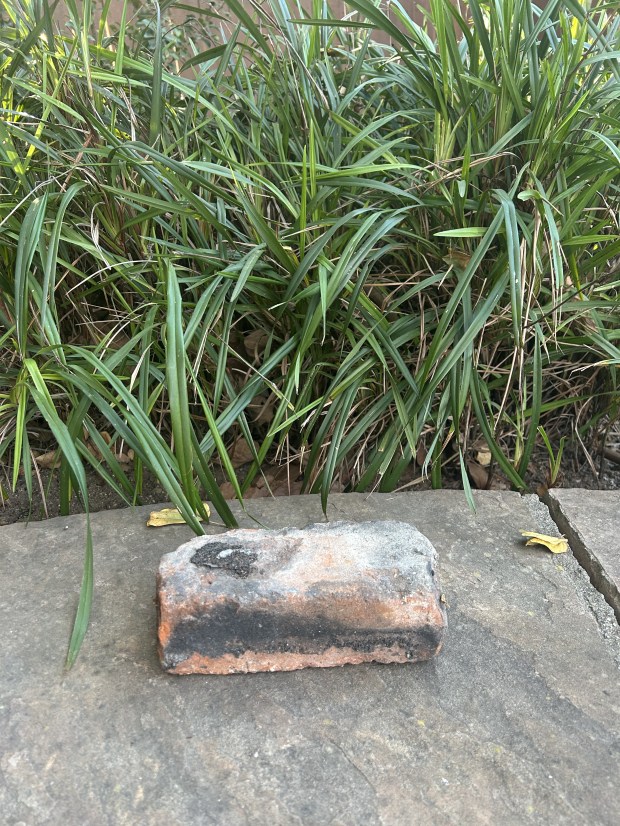
                  My parents built our home in San Bernardino in 1953. They stayed after my siblings and I moved away.  After mom died in 1993, dad lived there on his own there for more than a decade.  Eventually he sold it and moved to a retirement residence; at that point it had been our family home for fifty years.  A year later, the house burned down in a wildfire (after the new owners evacuated). Months later my sisters and I visited.  All that was left was the partially collapsed chimney. I took a charred brick as a memento.  Now I look at old family photos taken there and wonder: ‘Where did it go?”

I was Director at La Casa de Maria Retreat Center in 2018; our work was thriving and the future was bright. On January 9, the Montecito Debris Flow destroyed eight buildings and left half the property a barren field of mud.  La Casa has yet to reopen.  Sometimes when I can’t sleep, I imagine giving a tour of the property like I used to.  I can clearly see everything as it was.   It’s still hard to believe that all those structures, oak trees and our vital work could disappear in an instant.

                  How many of us have suddenly lost a loved one or treasured friend and find it hard to accept the person is really gone?

                  Is everything tangible in life nothing more than a dream?

                  Like Shakespeare, the spiritual traditions teach us that what seems so real one minute can be gone the next.

                  One of the foundational truths of Buddhism is the impermanence of all material reality. Much of our suffering arises from our tendency to ignore that.  The path to enlightenment begins with this understanding.

                  Jesus teaches a similar truth: “Do not store up for yourselves treasures on earth, where moth and rust consume and where thieves break in and steal, but store up for yourselves treasures in heaven, where neither moth nor rust consumes and where thieves do not break in and steal.  For where your treasure is, there your heart will be also.  (Matthew 6: 19-21)   

                  Are we to avoid being attached to anything that might perish? If so, how do we live?

                  For centuries, one path has been to become a monk or a nun.  You give up all your possessions and don’t own anything apart from the clothes on your back. You become celibate. Being unattached to long-term relationships and material goods means you can totally focus on the path to enlightenment and “treasures in heaven.”

                  But there is another path. This path does not forget how quickly things can vanish but does not shy away from embracing them .  This path means we remember that many things in life that seem permanent may disappear at any moment.  But we don’t turn away from them.  We invest ourselves in relationships that matter.  We obtain and care for basic material things, including the dwelling in which we live.  We plan for the future, knowing nothing is guaranteed.  We remember that everything material is subject to change.  But we appreciate what we have while we have it and are ready to share it with others.  We know the deepest meaning in life is found in pursuing spiritual values, yet we also allow ourselves to be grounded in the material world in which we live.

Life is like a dream.  But the people, dwellings, possessions, and commitments in our life are, at this moment, not a dream; they are real.  We hold both perspectives as true.  And we go on.


The brick from our home.

[i] https://www.latimes.com/entertainment-arts/story/2025-01-13/los-angeles-fires-shakespeare-tempest

[ii] McNulty notes the word “rack” meant “a wisp of a cloud’

Lead image: “Still Life with Ham and Fruit,” Jan Davidsz de Heem,1656