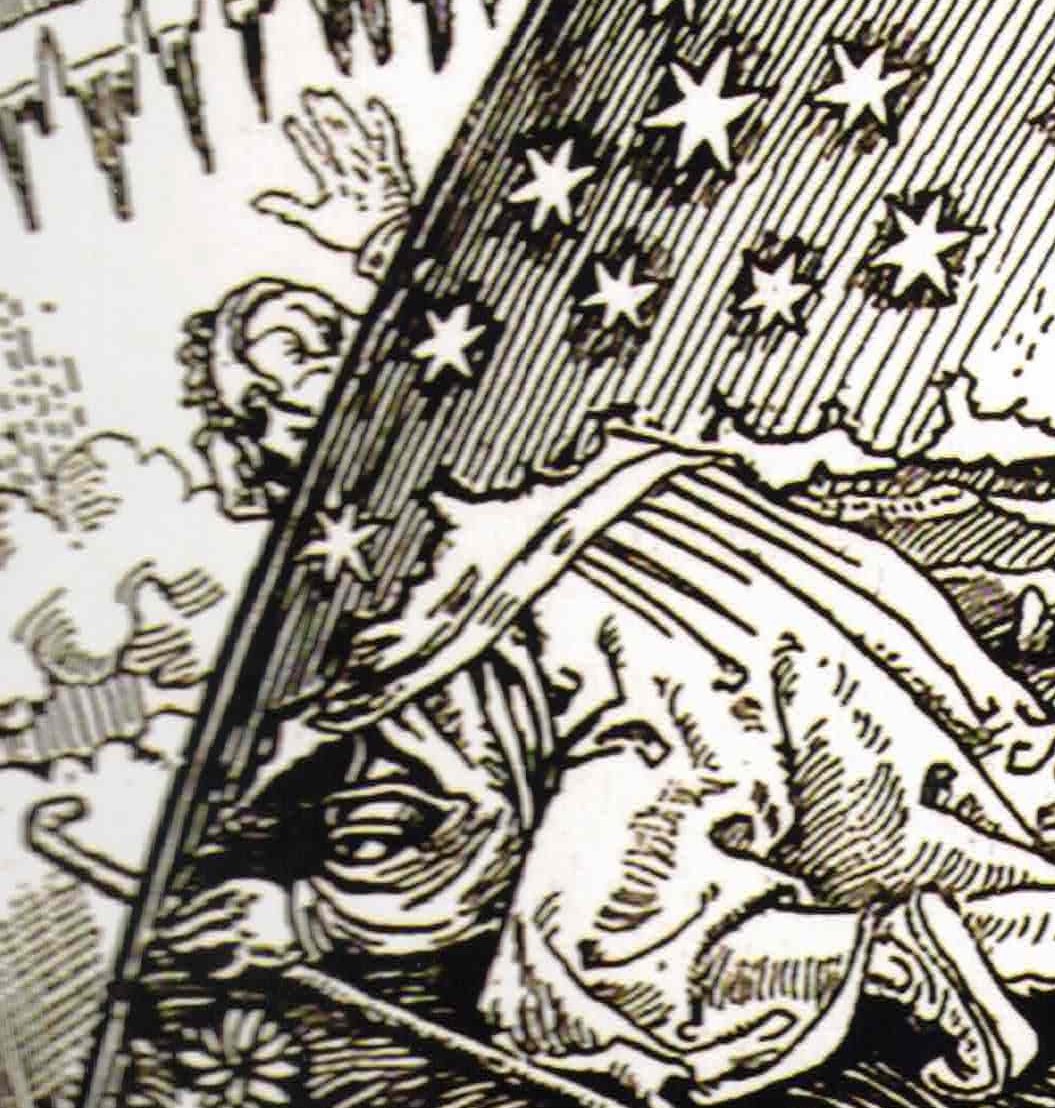
Let’s say someone asks you, “Got any travel plans?” Imagine saying, “Yeah… I’m going to the place where heaven and earth meet, poke my head through, and see what I can see.” This is how one artist imagined someone doing that:
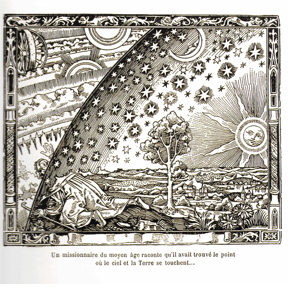
(The caption reads: “A missionary of the Middle Ages recounts that he has found the point where heaven and earth meet.”)
For thousands of years, people looked to the skies and imagined what might lie beyond – and wondered if there’s a heaven out there.
Then science came with those telescopes, star charts, and rocket ships.
Years ago, I was teaching an adult class. The passage we were studying mentioned heaven. One older lady raised her hand.
“You know,” she said, “I’m mad at those astronauts!”
“Why?” I asked.
“Well, when they got up there into outer space I thought they would see heaven. But they didn’t find it. Now I don’t know where it is. It makes me angry.”
I have a friend who was a nun before becoming a doctoral student in mathematics at UCSB before becoming a Jungian therapist. We used to go to public lectures at the Institute for Theoretical Physics on campus. I appreciated having her with me because she could explain some of the concepts to me. I once asked her what she thought of the possibility of “worm holes” in space. She told me she thought it was an exciting theory, adding it might explain where heaven is hidden.
In spiritual traditions, “heaven” can be a reality beyond this one, but also accessible now.
In the book of Genesis, Jacob is alone in the middle of nowhere and lies down at night to sleep. He has a dream in which he sees something like a ladder or staircase leading from earth to heaven with angels traveling back and forth. He hears the voice of God promising that he will always be with Jacob. Jacob wakes, remembers the dream and pours oil on the stone on which his head was resting and names it. He says, “This is the house of God, the gate of heaven.” The story suggests that such an opening can exist in the most unlikely of places.
In the Gospels, Jesus speaks often of the “kingdom of heaven” and the “kingdom of God.” And while some passages suggest a realm beyond this life, others suggest it’s a reality available to us now: “The kingdom of God is not coming with things that can be observed, nor will they say, ‘Look, here it is!’ or ‘There it is!’ For, in fact, the kingdom of God is among (or within) you…”
I once led a retreat with the theme of how paradise has been envisioned in different spiritual traditions and popular culture. I showed a clip from the 1935 movie Top Hat in which Fred Astaire is wooing Ginger Rodgers. In one scene, he invites her to dance with him as he sings the Irving Berlin song “Cheek to Cheek.” Here’s the chorus:
“Heaven, I’m in Heaven, And my heart beats so that I can hardly speak; And I seem to find the happiness I seek When we’re out together dancing, cheek to cheek.”
After seeing the clip, I asked the group to suggest how the scene expresses ideas of heaven. People noticed that the set was full of light and beauty. Ginger Rodgers had feather boas on the arms of her costume that floated like angel wings as she moved. We also saw both dancers moving effortlessly with each other, yet each retained their individuality.

And we watched the last scene of the 1989 movie “Field of Dreams.” It’s a baseball fantasy in which Ray Kinsella has inherited a farm in Iowa and is raising his family. Ray hears a voice in the corn field calling on him to build a baseball field. He does. Soon players from the past start walking out of the corn to play the sacred game one more time. As one of them is leaving for the day, he asks Ray if this is heaven. “No,” Ray says, “This is Iowa.” As the story continues, the voice prompts Ray with new tasks, and he follows not knowing where it’s headed or what it means. The last player to appear turns out to be John Kinsella, Ray’s father; they were estranged years before at the time John died. Ray introduces his father to his wife and daughter. They begin playing catch. They have this conversation:
John asks, “Is this heaven?”
Ray: “It’s Iowa.”
John: “Iowa? I could have sworn this was heaven.”
Ray: “Is there a heaven?”
John: “Oh yeah. It’s the place where dreams come true.”
Ray: “Maybe this is heaven.”

I’m not sure where heaven is to be found. Maybe it’s somewhere out there in outer space. Maybe it’s somewhere here in inner space. Maybe it’s both. I welcome those moments when we seem to catch glimpses of it in our everyday lives, and remain open to the healing and beauty it might hold.
(Dear Reader: Not being satisfied with the way I ended this, two hours after posting I’m adding one more thought…)
I like to think of the fellow in the engraving and imagine what his life would be like when he came back from his journey. I’m guessing he’d be like most people who have had near-death experiences and profound spiritual encounters: he’d feel less fear, more peace, and a fresh committment to making each day matter.
(The lead image is an engraving from The Atmosphere: Popular Meterology, by Camille Flammarion, 1888; featured in Cosmigraphics: Picturing Space Through Time, by Michael Benson)












 Steve Jacobsen, Ed.D