A Season of Awe

In recent weeks, I’ve been mulling over Dacher Keltner’s perspective on the different kinds of awe we can experience and how important these experiences are.[i]  I’ve also been aware we are in the season of Passover and Easter.  For more than 40 years, one of my responsibilities was to find fresh meaning in these stories; it’s a habit I have yet to break. I’ve been wondering: does Keltner’s work offer any insights to the spiritual meaning of the season?

At this point, I’m thinking of five specific points Keltner describes:

  • Awe-ful experiences.  While many experiences of awe are inspiring, we can also feel it when we witness something dark and harrowing, like the events of 9/11, contemplating the holocaust, or personal tragedies.
  • Awesome experiences: when we experience something beyond our understanding that is mysterious and fills us with wonder.
  • Moral courage: In Keltner’s research, this is the most frequently reported experience of awe.  We feel it when we see someone selflessly take on serious challenges for the good of others: social justice pioneers, foster parents, people navigating serious disabilities and hardships, etc.
  • Collective effervescence: The powerful feelings we can have when we are part of a group having a shared experience that takes us beyond our ordinary sense of life. This can be at athletic and musical events, moving purposefully in unison, worship services, etc.
  • Awe-inspired resolve: Witnessing or experiencing awe can give us courage to face difficult situations.

With these in mind, I thought of the Passover and Easter stories in a very basic way.  Do these familiar stories contain examples of awe?

Passover

(I am indebted to my Jewish friends and clergy for my understanding of Passover; I hope my comments are valid.)

                  The Hebrew people are suffering as exploited laborers in Egypt.  Moses has a personal divine encounter that directs him to lead them from bondage to freedom.  As he confronts Pharoah, seven disasters (“plagues”) fall upon Egypt, each reminders of how vulnerable human life is.  When the time is right, the people flee. They come to a body of water but have no way to cross.  They look back and see Pharoh’s army coming after them.  Death seems certain.

                  A way through the water appears. The people make their way to the other side, expecting Pharoah’s army to crush them. But the waters return, frustrating Pharoah’s intention. The time of oppression ends and a time of freedom begins.  Moses’ sister Miriam leads the people in celebration. 

                  Where are any elements of awe?

                  The experience of seeing an army approaching determined to destroy you when you are defenseless?  Awe-ful.

                  A mysterious force leads you to a liberated future?  Awesome.

                  Moses’ example, risking his life to lead the struggle?  Moral courage.

                  Joining Miriam in the dance of deliverance?  Collective effervescence.

Becoming a source of inspiration?  The story has been a constant source of inspiration from the early days of Israel up to the civil rights and liberation movements of our time.

Easter

                  Yeshua is a peasant who appears in first century Galilee, healing the sick and engaging people of every background.  He offers a vision of spiritual life embodied in what he calls “the kingdom of God.” In words and actions, he identifies with the poor and marginalized, assuring them of divine favor.  What he says and does threatens the social order.  He is arrested, convicted, and sentenced to death.  While in custody he is abused.  He is paraded through the streets and executed as a public display of the power of the state.  The men he chose to follow him flee. As he nears death, he feels even God abandons him. 

A few days later, several of his female followers come to his tomb.  They begin to have experiences that convince them his personal spirit lives and is present with them.  In the days to come, that experience is shared by a growing number of people.

                  Where are any elements of awe?

Imagining what it would be like to be dying in severe pain, separated from loved ones, and feeling total despair?  This is awe-ful.

Becoming convinced he survived the death of his body and is present with his followers — that darkness cannot extinguish divine light, and in the end, love is stronger than death? This is awesome.

                  Joining the circle of people who experience his risen presence celebrating what this means?  Collective effervescence.

                  Reflecting on his personal journey in those final days and hours, seeing his purpose was to serve and empower others? Moral courage.

                  Becoming a source of inspiration?  The story has inspired countless people, leading them to decide what is worth living for and how to approach death.

                  I believe both stories contain multiple elements of awe.  I have been in gatherings focused on both stories that uplift and inspire me and others. They remind us of what terrifies us.  They invite us to see life in a spiritual perspective, encouraging us to know there is light beyond the darkest of circumstances.  They teach us that our ancestors have overcome great hardship.  They encourage us to share the story, insights, and joy with others through celebration, community, and service. They give us hope and courage.

May we all welcome moments of awe in this season.


Featured image: “Italian Landscape,” Gustav Klimt, 1913

[i] Awe: The New Science of Everyday Wonder and How It Can Transform Your Life, Dacher Keltner, 2023

[iii] “The Offering of the Pipe,” Black Elk Speaks, John G. Neidhardt, ed., 1932
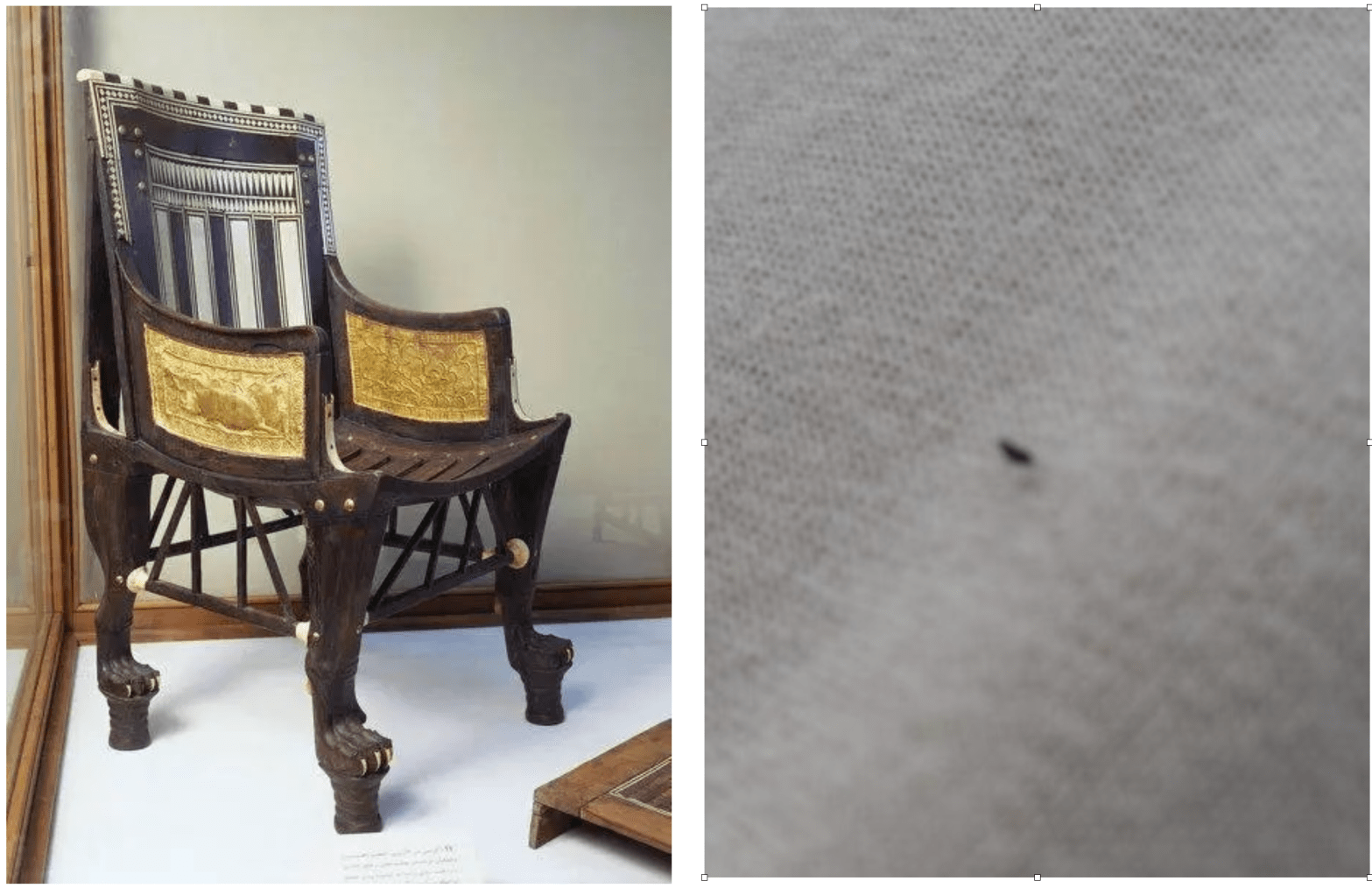
King Tut and The Early Morning Drop-ins

I am continuing to read and reflect on Awe: The New Science of Everyday Wonder and How It Can Transform Your Life, by Dacher Keltner.  Like many of us, I seek out and welcome experiences of awe wherever I can find them.  But I am only now realizing the different ways in which those moments can arise. This week I had two very different experiences that, thanks to Keltner’s work, add to my understanding.

The first was remembering a piece of furniture I saw in 2008 at the “King Tut” traveling exhibit in Los Angeles.  I vaguely recall studying Egypt in grammar school; a more vivid association is seeing Steve Martin’s perform “King Tut” (“Born in Arizona, moved to Babylonia… King Tut”).  We came into a room which had just one object: in the center, a child’s chair.   The description explained that this was the actual chair the 9-year-old Tut sat in when he was first crowned Pharoah.  I had to take time to absorb what I was seeing: “This is the exact chair the little guy sat in 1332 BC where he was hailed as a god and Egypt’s ruler? And here I am in Los Angeles in 2008 close enough to touch it?”  I tried to fathom how much time had passed between now and then. I tried to imagine what might have been going through the 9-year old’s mind as he sat here for the first time looking at all the people worshipping him.  I was in awe.

The next morning, I was sitting in my backyard, waiting for my first cup of coffee to take effect. The sun had just appeared on the horizon and light was coming through our neighbor’s sycamore tree. A few feet away I noticed a single spider web thread waving in the morning air currents; stretching from an oak tree branch to the ground, it must have been 7 feet long.  Two feet in front of me was a piece of patio furniture with a vinyl cover. Suddenly a small clump dropped onto it.  I wasn’t wearing my glasses — I leaned forward, squinted and wondered “What is that?”  A tiny little creature began scurrying away, no bigger than a pencil point.   The horizontal rays of the morning sun cast a shadow behind it three times larger than its actual body.  Then another little bug emerged from the fallen object and began running in another direction. Then three more.  They all took off in opposite directions, hurrying like they were late for work.  My best guess was this was a group of just-hatched gnats.  I thought about what I was seeing.  Until a few moments ago, these little specks of life were all huddled together is a gnat-clump. They all landed like a spaceship on the vinyl cover and now were rushing away from each other to begin their individual lives of adventure.  How small their busy brains must be.  How fast their mini-hearts must be beating.  How strong is their will.  I was in awe.

In Keltner’s research, beholding King Tut’s childhood chair in a museum is an example of cultural awe.  Being mesmerized by a group of newborn gnats rushing off to start their lives is an example of awe found in nature.

Keltner believes we can find awe in many places.  They don’t have to be dramatic events, but can be simple experiences in the midst of our daily life. What such experiences have in common is the emergence of a particular emotion in the face of mysteries we don’t understand.  That emotion liberates us from the constant absorption in ourselves and opens us to the fascinating world around us, which becomes a gateway to humility and gratitude.  Remembering that decorated little chair and those determined little bugs helped me see my own life in a new perspective.  That always feels like a gift.

Lead Image: King Tut’s chair and a solo gnat

This is my third post responding to Keltner’s work. The first was “Rising Above the Phone-Based Culture” (https://drjsb.com/2025/03/01/rising-above-the-phone-based-culture/ and the second was “A Voice in My Mind Said I Feel Awe” (https://drjsb.com/2025/03/29/a-voice-in-my-mind-said-i-feel-awe/

“A Voice in My Mind Said: I Feel Awe”

Dacher Keltner is a psychology professor at UC Berkeley.  For more than 20 years, his research has focused on answering the question, “What makes a good life?”  At one point, he felt he had the answer.  To test it, he and his team conducted thousands of interviews with people around the world and analyzed the results.  What they discovered was also reflected in Keltner’s personal life experiences, including being at the bedside of his dying brother in 2019.

Rolf had been dealing with colon cancer for several years and had decided it was time to take the “cocktail” of prescribed medication that would peacefully bring about his death.  After receiving this news, Dacher drove from Berkeley with his wife and daughters, picked up his mother in Sacramento, and arrived at his brother’s house in the foothills of the Sierras at 10 PM, joining other family members at the bedside. Here are excerpts from his account:

Rolf’s face was full and flushed. The sunken eyes and gaunt cheeks caused by colon cancer were gone; the tightened, sagging skin around his mouth smoothed. His lips curled upward at the corners.

I rested my right hand on his left shoulder, a rounded protrusion of bone. I held it the way I would the smooth granite stones we used to find near the rivers we swam in as young brothers.

“Rolf this is Dach.”

“You are the best brother in the world.”

My daughter Natalie laid her hand lightly on his shoulder blades: “We love you Ralf.”

The cycle of his breathing slowed. He was listening.  Aware.

Listening to Rolf’s breath, I sensed the vast expense of 55 years of our brotherhood… (at this point, Dach’s mind fills with memories of their many shared adventures including skateboarding, playing on the same Little League team, traveling in Mexico, and being the best man at each other’s wedding) …

I sensed a light radiating from Rolf’s face. It pulsated in concentric circles, spreading outward, touching us as we leaned in with slightly bowed heads. The chatter in my mind, clasping words about the stages of colon cancer, new treatments, lymph nodes, and survival rates, faded. I could sense a force around his body pulling him away. And questions in my mind.

What is Rolf thinking?

What is he feeling?

What does it mean for him to die?

A voice in my mind said: I feel awe.

…Watching Rolf pass, I felt small. Quiet.  Humble. Pure. The boundaries that separated me from the outside world faded. I felt surrounded by something vast and warm. My mind was open, curious, aware, wondering.[i]

“A voice in my mind said: I feel awe.” The feeling of awe, Dacher believes, is the most important human emotion we can experience.  He and his team concluded there are eight primary ways we can encounter awe; one of them is being at the boundary of life and death.[ii] 

I experience awe attending memorial services.

This week I attended a celebration of the life of a legendary local building contractor, John Carter, who lived to be 96.  Family, friends and employees shared many stories of his ingenuity, accomplishments, innovations and integrity.  One story in particular has lingered in my mind. John was born on a farm in the San Fernando Valley. One day he and his brother decided to dig their way to China using an empty coffee can.  They dug for days; the hole became deep enough that they could stand in it.  Eventually they gave up. That was the early hint of a life filled with ambitious plans, determination and a love of moving earth and making things.  All those qualities were already present when he was a child and had a vision in his mind and a coffee can in his hand.  Where do such qualities come from?

A few months ago, I attended a private family graveside service for Joe Jowell, who died at 93. His children and grandchildren recounted highlights of his life. Joe was born and raised in Hawaii.  He was a ten-year-old riding his bike on Sunday morning, December 7 when he looked up and wondered why a large group of planes were flying overhead; moments later he saw them dropping bombs on Pearl Harbor.  After finishing high school, he moved to San Francisco.  He served in the Navy during the Korean War. He then spent five years preparing to become a priest in the Boston Maryknoll Brotherhood.  He decided to leave that order to marry and raise a family in Long Beach.  Joe became a certified Appliance Repair Technician and worked for Sears for many years.   He and his wife were raising five children when she died, leaving him on his own. Later one of his sons took his own life.  Joe learned to endure these losses and wanted to help others experiencing grief. He became a Hospice volunteer and served our community for 35 years. I met Joe when I became Director at Hospice of Santa Barbara in 2008 – I was told he was known by his colleagues as “St. Joe.” Sixteen years later I had privilege of hearing his family’s stories at his graveside.  If we had seen Joe at Costco or in a hospital hallway, could we have imagined all he’d experienced and how many people he had cared for?

Watching his brother take his last breath, Derik Keltner said: “My mind was open, curious, aware, wondering.”  He believes experiencing awe puts us in touch with the mysteries of life.  It both humbles and inspires us.

When someone’s life ends, we begin to see what mattered and what it meant.  Time and again, I have been filled with awe.


[i] Awe: The New Science of Everyday Wonder and How It Can Transform Your Life, Dacher Keltner, 2023, pages xxi-xxiii

[ii] The eight categories: moral beauty, collective effervescence, nature, music, visual design, spiritual and religious, awe, life and death, and epiphanies (moments in which a new and grand understanding dawns).

I first came across Keltner’s work as cited by Jonathan Haidt in his book, The Anxious Generation: How the Great Rewiring of Childhood is Causing an Epidemic of Mental Illness,  which was the subject of my recent post, Rising Above the Phone-Based CultureI expect to share more of Keltner’s findings in the weeks to come.

Photo: Late Afternoon, Goleta Beach, January, 2025