The holiday season can be full of sensory experiences that call forth memories and emotions. I recently came into a room that had been decorated with an advent wreath, pine tree cuttings, and a live Christmas tree. The fragrance was inspiring, and I’ve been thinking about why. Do any of these associations resonate with you?
It reminds me of childhood. Going to a Christmas tree lot which smelled amazing. Bringing the tree home and letting it fill our home with that aroma. The odor became the olfactory backdrop for all the joy of the season.
It calls to mind being in a forest. It could be the Sierra Nevada, the Cascades, or any other forest — places many of us have gone for vacation and renewal. The trees could be pine, fir, cedar, or redwood, but the association is the same: we have left our distracted lives and are now in a natural cathedral of quiet and timeless living beings.
Smelling the fragrance calls forth the color green – always a sign of life.
The fragrance smells clean. Maybe it’s the association with being in nature. I don’t know why but that comes to mind.
And the more I thought about it, another word that comes to mind is pure. The fragrance of a live Christmas tree is evocative on its own; it doesn’t need anything added. But the aroma at this time of year complements the visual experience of gazing at lit candles in a darkened room or quiet sanctuary: they both suggest the mysterious source of life is with us, fresh and full of promise. Our eyes behold a symbol of that truth, and the fragrance of a Christmas tree, wreaths and cuttings confirm it. Light and life arise in darkness and the darkness will never overcome it.
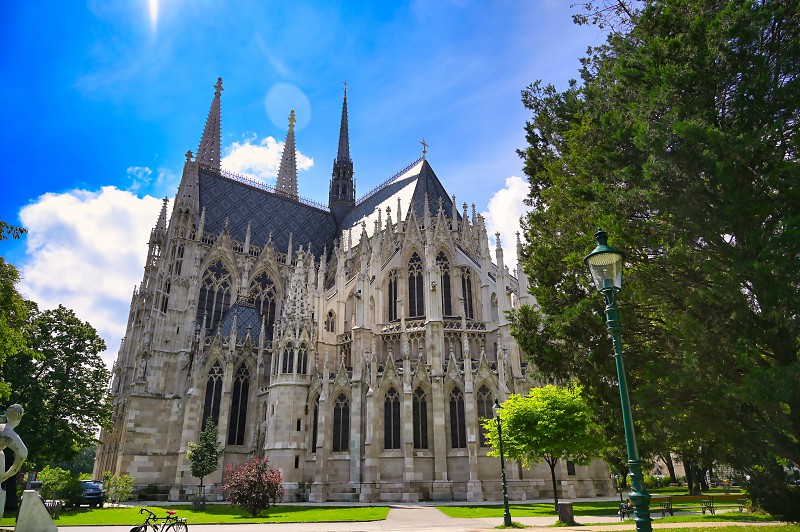
On our last day in Vienna this past September, we decided to visit an impressive sight we had been passing every day: the Votivkirche, or ”Votive Church.”[i] Seeing its tall spires and ornate towers, I assumed it was an ancient Gothic cathedral. Upon entering, we discovered it is less than 150 years old — a “neo-Gothic” structure completed in 1879. The building is 325 feet high (second highest peak in the city) and features 78 stained glass windows; when you enter, it feels vast, mysterious and intriguing.
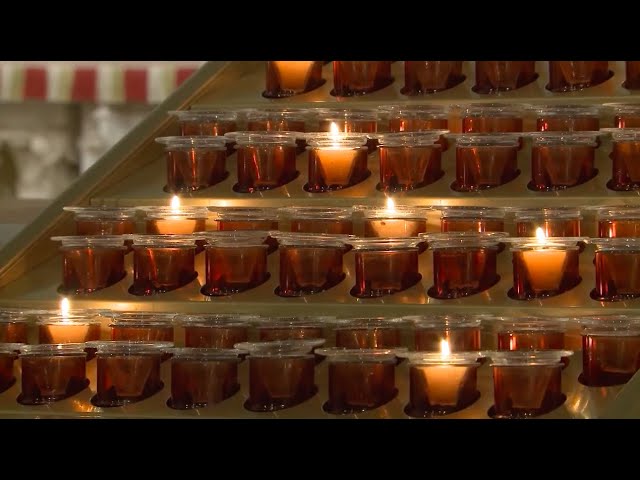
As we explored the interior, I noticed a small plaque on a stone pillar above a votive candle rack. No one else was nearby and only a few candles had been lit. The words were in German, Italian and English. Here is the English version:
God, there is a candle in front of me.
It burns restlessly, sometimes with a small flame, sometimes with a large flame.
God, I too am often restless.
May I become calm in you.
The candle gives me light and warmth.
God, may I also become a light for the world.
A simple prayer focusing on a single candle.
As we wandered and read more about the history of the building, we learned it was built as an expression of gratitude after the Austrian Emperor Franz Joseph survived an assassination attempt. It was expected to be a place where Austrian monarchs would be buried for generations to come. But history happened.
World War 1 began in 1914. The building was damaged, and the military was permitted to melt down parts of the organ and bells for the war effort. The war also led to the collapse of the monarchy. In the 1930s, the Nazis took control of the city and renamed the square outside the church Göring Square after the Nazi General. Following World War 2, the square was renamed Roosevelt Square after FDR. The building was restored in the 1970s.
A recent addition is the Multhausen stained glass window, designed and installed to commemorate the 90,000 who died in the Multhausen Concentration Camp. The window portrays prisoners helping each other up a stairway, supporting each other in their suffering; Christ is leading them at the top of the stairs.
Amid dramatic change and tragedy, the cathedral has been a sanctuary where anyone can enter, light a small candle, reflect, and pray.
I’ve been thinking how the life of a candle is like the life we live:
Both have a beginning and an end.
Both are vulnerable to being extinguished.
Neither needs to understand how it exists in order to exist.
Neither lights itself. A flame is given to it, which it bears as long as it can.
Both experience the world from its own point of view, and both affect the world around it.
The winter season is a time when we become more aware of light.
Christian communities observe Advent using a wreath with four candies in a circle and a single candle in the center. On each Sunday before Christmas, one of the outer candles is lit. On Christmas, the Christ candle at the center is lit.
Jewish communities celebrate Hannukah using a menorah of nine candles; the one at the center is always burning. Night after night, that flame is used to light one more of the other eight until all are glowing.
Both rituals assume there is a central flame. Both invite us to behold each candle as it is lit. In both, individuals become a community with the divine light at the center. Both affirm light can endure darkness.
I am paying more attention to candles this season, curious about what they can teach me. I know there are many candles burning. I know there are many people wondering. And here I am. This candle is me, burning as best I can, grateful to bear light as long as I can.
God, there is a candle in front of me.
It burns restlessly, sometimes with a small flame, sometimes with a large flame.
God, I too am often restless.
May I become calm in you.
The candle gives me light and warmth.
God, may I also become a light for the world.
[i]Votive: (adjective): consisting of or expressing a vow, wish, or desire.
A colleague once told of visiting an older writer in Paris whom she’d always admired. The woman welcomed her at the door and invited her in. The apartment was full of books, papers, and artwork and it was not clear where to sit. The woman gestured toward a chair that had some books and papers on it. “Oh, just put those anywhere.” My friend picked the items up and was about to place them on a small empty table nearby, but the woman said, “Oh, not there. I try to keep one space empty and open wherever I live.” And she indicated a different spot to lay the items.
My friend said she never forgot this idea: that even in the smallest of residences, it may be a worthwhile practice to have one place that is not covered with things, but always “empty and open.”
This time of year, it’s common to bring out all kinds of things that speak to us of the meaning and memories of the season – figurines, candles, ornaments, greens, lights, seasonal books, etc. I have several playlists of music I return to every year, which fills the air with music. It can be a busy and joyful time.
I’ve been thinking — What would it be like this year to create an “empty and open space’ in our living space? What if we choose a spot that we see throughout the day that will remind us to be inwardly open to silent truths, fresh inspirations, and the savoring of mystery?
In the Biblical story of the angel coming to Mary, she is essentially asked if she will be open to a new life coming into this world through her. She says yes, and the life arrives from a realm beyond her knowing.
Isn’t it the same with all children? We understand how the biology works, but the way children seem to each arrive with a unique soul and presence is surely a wonder. David Brooks tells of a friend whose spiritual journey began as she held her first child in her arms and thought, “I love this child more than evolution can explain.”
In the Mexican tradition of La Posada, Joseph and Mary travel from house to house, asking if they might stay for the night. Time after time they are told there is no room for them. In the end, the only ‘open space” they are offered is a manger. But it is enough.
I’m going to try this out. My desk sits next to a bookcase where every shelf is often full of books and CDs. But I decided to clear off one eye-level shelf and leave it bare for the month. When I’m tempted to place something there, I’m going to tell myself, “Oh, not there. I try to keep one empty and open space wherever I live.”
“How silently, how silently, the wondrous gift is given…” In silence and emptiness and openness gifts can appear that may surprise us.




 Steve Jacobsen, Ed.D