King Tut and The Early Morning Drop-ins

I am continuing to read and reflect on Awe: The New Science of Everyday Wonder and How It Can Transform Your Life, by Dacher Keltner.  Like many of us, I seek out and welcome experiences of awe wherever I can find them.  But I am only now realizing the different ways in which those moments can arise. This week I had two very different experiences that, thanks to Keltner’s work, add to my understanding.

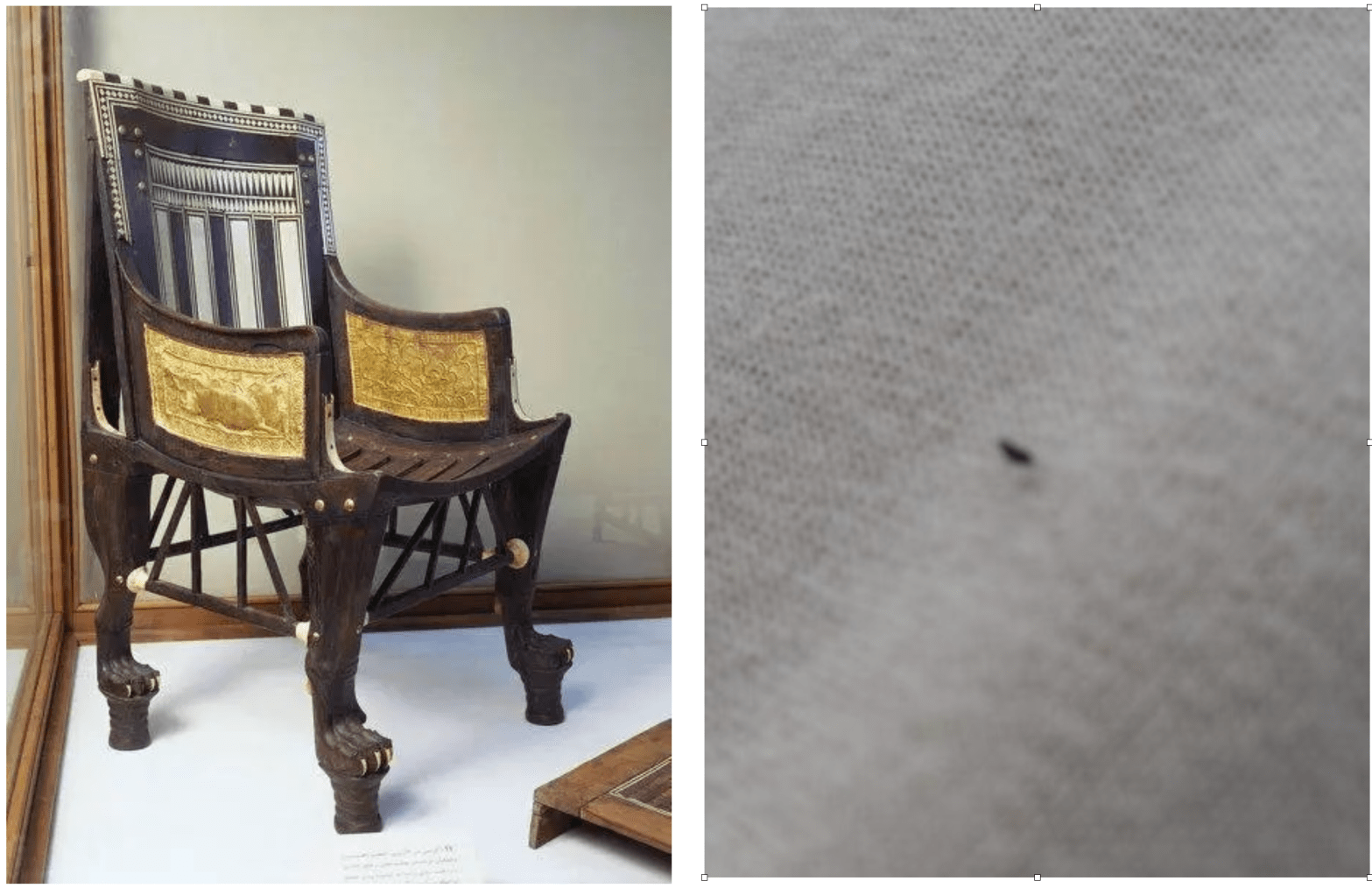
The first was remembering a piece of furniture I saw in 2008 at the “King Tut” traveling exhibit in Los Angeles.  I vaguely recall studying Egypt in grammar school; a more vivid association is seeing Steve Martin’s perform “King Tut” (“Born in Arizona, moved to Babylonia… King Tut”).  We came into a room which had just one object: in the center, a child’s chair.   The description explained that this was the actual chair the 9-year-old Tut sat in when he was first crowned Pharoah.  I had to take time to absorb what I was seeing: “This is the exact chair the little guy sat in 1332 BC where he was hailed as a god and Egypt’s ruler? And here I am in Los Angeles in 2008 close enough to touch it?”  I tried to fathom how much time had passed between now and then. I tried to imagine what might have been going through the 9-year old’s mind as he sat here for the first time looking at all the people worshipping him.  I was in awe.

The next morning, I was sitting in my backyard, waiting for my first cup of coffee to take effect. The sun had just appeared on the horizon and light was coming through our neighbor’s sycamore tree. A few feet away I noticed a single spider web thread waving in the morning air currents; stretching from an oak tree branch to the ground, it must have been 7 feet long.  Two feet in front of me was a piece of patio furniture with a vinyl cover. Suddenly a small clump dropped onto it.  I wasn’t wearing my glasses — I leaned forward, squinted and wondered “What is that?”  A tiny little creature began scurrying away, no bigger than a pencil point.   The horizontal rays of the morning sun cast a shadow behind it three times larger than its actual body.  Then another little bug emerged from the fallen object and began running in another direction. Then three more.  They all took off in opposite directions, hurrying like they were late for work.  My best guess was this was a group of just-hatched gnats.  I thought about what I was seeing.  Until a few moments ago, these little specks of life were all huddled together is a gnat-clump. They all landed like a spaceship on the vinyl cover and now were rushing away from each other to begin their individual lives of adventure.  How small their busy brains must be.  How fast their mini-hearts must be beating.  How strong is their will.  I was in awe.

In Keltner’s research, beholding King Tut’s childhood chair in a museum is an example of cultural awe.  Being mesmerized by a group of newborn gnats rushing off to start their lives is an example of awe found in nature.

Keltner believes we can find awe in many places.  They don’t have to be dramatic events, but can be simple experiences in the midst of our daily life. What such experiences have in common is the emergence of a particular emotion in the face of mysteries we don’t understand.  That emotion liberates us from the constant absorption in ourselves and opens us to the fascinating world around us, which becomes a gateway to humility and gratitude.  Remembering that decorated little chair and those determined little bugs helped me see my own life in a new perspective.  That always feels like a gift.

Lead Image: King Tut’s chair and a solo gnat

This is my third post responding to Keltner’s work. The first was “Rising Above the Phone-Based Culture” (https://drjsb.com/2025/03/01/rising-above-the-phone-based-culture/ and the second was “A Voice in My Mind Said I Feel Awe” (https://drjsb.com/2025/03/29/a-voice-in-my-mind-said-i-feel-awe/

Letting the Sea Speak

What is it about the sea that stirs our imaginations?

What is it about taking a walk on the beach that helps us see life more clearly?

Why is it many of us ask that our ashes be scattered on the ocean?

Many facets of nature can stir our imaginations, offering us metaphors for life and spirituality.  Recently I decided to turn my attention to the sea, searching for what it might teach me. Here’s my emerging list…

Like life, the sea is big, mysterious and wonderful.  The ocean covers 70% of the earth’s surface and holds 97% of the earth’s water.  More than 80% of it has yet to be mapped or seen by humans.  Just as a scientific reality, it’s amazing.  Isn’t life like that?  The millions of years of life evolving into so many forms including us?  Looking out on the sea, we are reminded of how small we are and how much we don’t know.

Both the ocean and the divine creating Spirit were here before us and will be here long after we are gone. But here we are in this moment.  In the big picture, we may be just “a drop in the ocean.” But here we are.  In the time we have we can learn what makes life worthwhile.  The Indian mystic Tagore said, “The butterfly counts not months but moments, yet has time enough.”

We walk on the edge.  When we take a walk on a beach, we can see what is close to us.  But beyond the horizon, the ocean reaches out far beyond our sight.  In our own lives, we “walk” through each day based on what is near us, what we can see and understand.  But at times we are reminded that so much more of life lies beyond our day-to-day living. 

It’s exciting to be on open water.  Two years ago, I took a beginning sailing class at the local harbor.  I remember the thrill the first time I steered the ship past the breakwater into the open water.  It was exhilarating.  Sometimes in life, we make a move or start a new chapter, and it feels like that.

In open water we navigate as best we can, but sometimes strong currents come upon us, pulling us in directions we do not want to go.  When I was a teenager, our family had a small house in San Clemente where we spent many summers.  Every chance I had, I would grab my Duckfeet fins to go bodysurfing.  I became confident enough that when distant storms in Mexican waters sent swells up the coast, I could join the veterans who went out to catch the large waves.  On one such occasion, I was with a group watching the horizon for the next set.  I happened to look back at the shore.  The beach looked like it was rapidly moving southward, which seemed strange since I was treading water.  Then I the realized the shore was not moving – I was.  A strong underwater current had developed and was taking me northward.  The next thing I knew a lifeguard came alongside and pulled me up into a boat, ferrying me and others to the pier. I was grateful someone was looking out for us.  Unforeseen events in life arise and take us with them; it’s not easy to regain control on our own.  It can be frightening.  It’s a gift to discover someone sees us and can help.

It’s vital to know how to find a safe harbor when we need it.  We can find a safe harbor in life in many ways, including having people we can turn to when we feel “out to sea,” confused or overwhelmed.  From a spiritual perspective, it’s a deep blessing to know we have a divine source of courage and wisdom that comes from beyond us.  We can access it in prayer, contemplation, Scripture, music, art and community.  Countless times I’ve seen a spiritual community reaching out and rescuing someone who’s being overwhelmed by life. It’s a beautiful process to see and reassuring to know.

Every time I ride my bike to the local beach, I feel renewed.  Every time we take our grandkids to the beach, they become lost in play.  Every time I’ve been part of a committal service which includes casting a loved one’s ashes on the sea, I feel a sense of peace. I’m grateful for all the ways the sea speaks to us.

“A Voice in My Mind Said: I Feel Awe”

Dacher Keltner is a psychology professor at UC Berkeley.  For more than 20 years, his research has focused on answering the question, “What makes a good life?”  At one point, he felt he had the answer.  To test it, he and his team conducted thousands of interviews with people around the world and analyzed the results.  What they discovered was also reflected in Keltner’s personal life experiences, including being at the bedside of his dying brother in 2019.

Rolf had been dealing with colon cancer for several years and had decided it was time to take the “cocktail” of prescribed medication that would peacefully bring about his death.  After receiving this news, Dacher drove from Berkeley with his wife and daughters, picked up his mother in Sacramento, and arrived at his brother’s house in the foothills of the Sierras at 10 PM, joining other family members at the bedside. Here are excerpts from his account:

Rolf’s face was full and flushed. The sunken eyes and gaunt cheeks caused by colon cancer were gone; the tightened, sagging skin around his mouth smoothed. His lips curled upward at the corners.

I rested my right hand on his left shoulder, a rounded protrusion of bone. I held it the way I would the smooth granite stones we used to find near the rivers we swam in as young brothers.

“Rolf this is Dach.”

“You are the best brother in the world.”

My daughter Natalie laid her hand lightly on his shoulder blades: “We love you Ralf.”

The cycle of his breathing slowed. He was listening.  Aware.

Listening to Rolf’s breath, I sensed the vast expense of 55 years of our brotherhood… (at this point, Dach’s mind fills with memories of their many shared adventures including skateboarding, playing on the same Little League team, traveling in Mexico, and being the best man at each other’s wedding) …

I sensed a light radiating from Rolf’s face. It pulsated in concentric circles, spreading outward, touching us as we leaned in with slightly bowed heads. The chatter in my mind, clasping words about the stages of colon cancer, new treatments, lymph nodes, and survival rates, faded. I could sense a force around his body pulling him away. And questions in my mind.

What is Rolf thinking?

What is he feeling?

What does it mean for him to die?

A voice in my mind said: I feel awe.

…Watching Rolf pass, I felt small. Quiet.  Humble. Pure. The boundaries that separated me from the outside world faded. I felt surrounded by something vast and warm. My mind was open, curious, aware, wondering.[i]

“A voice in my mind said: I feel awe.” The feeling of awe, Dacher believes, is the most important human emotion we can experience.  He and his team concluded there are eight primary ways we can encounter awe; one of them is being at the boundary of life and death.[ii] 

I experience awe attending memorial services.

This week I attended a celebration of the life of a legendary local building contractor, John Carter, who lived to be 96.  Family, friends and employees shared many stories of his ingenuity, accomplishments, innovations and integrity.  One story in particular has lingered in my mind. John was born on a farm in the San Fernando Valley. One day he and his brother decided to dig their way to China using an empty coffee can.  They dug for days; the hole became deep enough that they could stand in it.  Eventually they gave up. That was the early hint of a life filled with ambitious plans, determination and a love of moving earth and making things.  All those qualities were already present when he was a child and had a vision in his mind and a coffee can in his hand.  Where do such qualities come from?

A few months ago, I attended a private family graveside service for Joe Jowell, who died at 93. His children and grandchildren recounted highlights of his life. Joe was born and raised in Hawaii.  He was a ten-year-old riding his bike on Sunday morning, December 7 when he looked up and wondered why a large group of planes were flying overhead; moments later he saw them dropping bombs on Pearl Harbor.  After finishing high school, he moved to San Francisco.  He served in the Navy during the Korean War. He then spent five years preparing to become a priest in the Boston Maryknoll Brotherhood.  He decided to leave that order to marry and raise a family in Long Beach.  Joe became a certified Appliance Repair Technician and worked for Sears for many years.   He and his wife were raising five children when she died, leaving him on his own. Later one of his sons took his own life.  Joe learned to endure these losses and wanted to help others experiencing grief. He became a Hospice volunteer and served our community for 35 years. I met Joe when I became Director at Hospice of Santa Barbara in 2008 – I was told he was known by his colleagues as “St. Joe.” Sixteen years later I had privilege of hearing his family’s stories at his graveside.  If we had seen Joe at Costco or in a hospital hallway, could we have imagined all he’d experienced and how many people he had cared for?

Watching his brother take his last breath, Derik Keltner said: “My mind was open, curious, aware, wondering.”  He believes experiencing awe puts us in touch with the mysteries of life.  It both humbles and inspires us.

When someone’s life ends, we begin to see what mattered and what it meant.  Time and again, I have been filled with awe.


[i] Awe: The New Science of Everyday Wonder and How It Can Transform Your Life, Dacher Keltner, 2023, pages xxi-xxiii

[ii] The eight categories: moral beauty, collective effervescence, nature, music, visual design, spiritual and religious, awe, life and death, and epiphanies (moments in which a new and grand understanding dawns).

I first came across Keltner’s work as cited by Jonathan Haidt in his book, The Anxious Generation: How the Great Rewiring of Childhood is Causing an Epidemic of Mental Illness,  which was the subject of my recent post, Rising Above the Phone-Based CultureI expect to share more of Keltner’s findings in the weeks to come.

Photo: Late Afternoon, Goleta Beach, January, 2025

Letting Life Speak Through Us

Sitting quietly in my backyard early on a recent morning, I noticed the roses and shrubs near me.  They’d changed since the last time I had seen them.  For months they’ve been showing the same dark leaves. But now bright green growth is emerging.  They have been waiting for signs the season is changing and now sense the time is right.  I wondered: if plants have any level of self-awareness, what’s it like to be so calm and still for so long and then begin to make your move into spring?

Several months ago, I arrived early for mass at the Santa Barbara Mission. I appreciate the respect for privacy and silence which is the norm in Catholic churches. I found a seat in the middle of an empty pew near the rear. Seven or eight others were in solitude, some sitting, others kneeling. I closed my eyes and centered myself, then mentally named blessings and concerns, as well as my wish to be open to new possibilities. Then I opened my eyes and looked around. I thought about the others with whom I was sharing this space and time. I wondered what their own private thoughts and prayers were like.  Did their “inner voice” sound like mine?  What were they saying or asking for?  Here we were, this random group of human beings, each in our own private world of thoughts and feelings.  But all wanting to be open to something more.

Recently I gave a presentation to a local men’s group.  My topic was how spirituality can be expressed in our everyday work.  I shared stories about people who have found meaning in their labor.  Afterwards, one of the men came up and handed me a note. He told me it was a question he had used many times to help people find direction: “What is Life trying to express through you?” 

I believe the roses and shrubs know: “Our reason is to blossom, flourish and pass Life on.” 

At times in my life, I’ve felt clarity about what I am being called to do.  Now is a time when I’m not sure what season it is for me.  The seasons of our life don’t always follow a set calendar – we must figure them out as we go.

What is Life trying to express through you this season?

A Pie for All Reasons: Tangible Benefits of Doing Good

The small rural church I served in Wapato, Washington needed a new roof.  We did not have the money to pay for it. We decided to have a pie auction. 

The church was in the Yakima Valley, an ideal region for growing fruit including apples, peaches, nectarines and cherries.  Many in our congregation were expert pie-makers. We picked a date and encouraged everyone to bring their best offerings.  After the service, we would auction them one by one, hoping to reach our goal.

I got a call from a longtime member asking me to visit. She was no longer able to attend services personally but had heard about the auction. I met with her in her living room. She told me she wanted to contribute to the roof fund and have fun in the process.  She told me her plan.  I would let the auction get going while choosing a pie that appealed to me.  When that one came up, I was to let the bidding build until it felt like it was reaching its peak.  At that point, I was to stand and announce that, on her behalf, I was authorized to make a bid in the amount she told me. 

On that Sunday, I followed her instructions. I set my eye on a particular cherry pie (I knew the baker had her own backyard tart-cherry tree).  The bidding started at $20…went to $25…then $30…then $35…My moment had come.  I stood up. The auctioneer called on me.  I said, “On behalf of Mrs. –, I bid $2,000.”  The room was silent.  Then full of laughter and applause.  The next day I visited her and told her how it went. She was delighted.

Thanks to her generosity, we raised enough for the roof.  We had fun doing it.  I got to keep the pie.

You may have heard that if you want to do something for the greater good, there shouldn’t be any personal reward involved – that would be selfish. But it can be a great feeling to know you are doing something good for other people. 

Much of what’s best in America is the work of nonprofit organizations.  No matter what is happening in our national politics, individuals and communities make a difference.  We can help the Girl Scouts and enjoy the cookies.  We can support a friend running a marathon, honoring our friendship and the cause they represent.  We can support our local school, daycare center, congregation, neighborhood medical clinic, hospice organization, food bank, museum or other cause.  What we do can positively impact the lives of others.

When I donate my money or time, I’m proving to myself I’m not helpless.  I want to help other people and now I’m putting that desire into action. It feels good.  

Sometimes you can have your pie and eat it too.

(The spiritual power of pies seems to be a recurring theme for me…last year I posted The Sky Is In the Pie.)

Pride and Humility

                  It’s funny how a random comment made by a teacher more than 50 years ago can stick with us.

                  It was in the middle of a “Spanish 3” class in my sophomore year at UCSB. I don’t remember the teacher’s name, but I remember we all liked him.  I don’t remember what the topic was that day – how to conjugate verbs in the subjunctive tense? – or why he got off topic.  For some reason he paused and said, “You know, it’s really important to experience both pride and humility in life.  One or the other by itself isn’t enough.  You need both.”

                  I’ve never forgotten those words.

                  Sometimes we finish a difficult task or a creative project and take a minute to realize what we accomplished.  We feel pride. Pride helps us feel good about ourselves and builds our confidence for other challenges in life.  I believe one of the most important things we can say to our children is “I’m proud of you.”  I said that to our father in his last days, and I hope he heard me.

                  At the same time, we know that misguided pride can lead us astray. “Pride cometh before a fall,” was noted 2500 years ago in the Book of Proverbs.

So we want to keep pride in its place. But we don’t want to lose it.

                  How about humility? Humility can come when experiencing awe before something amazing in nature, or a work of art, or the moral courage someone displays.  Sometimes it comes to us after we realized we’ve made a mistake. Or realize we are not capable of doing something we’d like to do. Or seeing someone who has had a much harder life than us.  Being humble calms us down and puts our ego in place.  Humility opens us to compassion.

                  At the same time, we don’t want to let life or people humiliate us. That means we’ve lost touch with our dignity.

                  I’ve thought about how humility and pride appear in music.

                  Spiritual music expresses a reverent humility – we are grateful for the forces in life beyond our control that have blessed us – e.g., “Amazing Grace.”

                  I looked at one list of ten of the most popular songs in recent decades – it includes” Yesterday,” “Hey Jude,” “Bridge Over Troubled Water,” and “Let It Be.” They are songs of longing, sorrow, comfort, friendship, and acceptance – songs of tender humility.

                  What songs express pride? Patriotic songs do.  How about at the Olympics award ceremonies when a gold medalist steps to the top step during the award ceremony and their national anthem is played?  They’ve accomplished something rare for their homeland and are being recognized.  I find it moving.

A problematic song that comes to my mind is “I Did It My Way,” made famous by Frank Sinatra. Here are the lyrics:

And now, the end is near
And so I face the final curtain
My friend, I’ll say it clear
I’ll state my case, of which I’m certain

I’ve lived a life that’s full
I traveled each and every highway
And more, much more than this
I did it my way

Regrets, I’ve had a few
But then again, too few to mention
I did what I had to do
And saw it through without exemption

I planned each charted course
Each careful step along the byway
And more, much more than this
I did it my way

Yes, there were times, I’m sure you knew
When I bit off more than I could chew
But through it all, when there was doubt
I ate it up and spit it out

I faced it all and I stood tall
And did it my way

                  It’s a stirring song.  But I often felt it’s a bit much.  What about all the people that helped you along the way?  Didn’t you have family members, mentors, teachers, friends, coworkers and supporters?  To me it seemed to match Frank Sinatra’s personality and reputation — a big-time guy that got everything he wanted. 

                  But I was intrigued to discover its history.  Paul Anka came across it and realized it would be perfect for Sinatra — and it was. But years later, Frank’s daughter Tina said he got to hate the song: “He didn’t like it. That song stuck and he couldn’t get it off his shoe. He always thought that song was self-serving and self-indulgent.”

                  I misjudged Frank.  He knew it went too far. 

                  Is it possible to experience both pride and gratitude at the same time?  I think so.  I look back on my personal and professional life and am proud of certain accomplishments — but I’m also aware those didn’t happen without the participation and support of many other people.

When it comes to leadership, don’t we want people who can make us feel proud of lasting values we shared and also embody a level of humility that tells us they truly care about other people?

                  My Spanish teacher wanted us to know something important.  It is good to embrace those moments in which we can be proud of what we’ve done.  At the same time, we are wise to be humble in response to the blessings in life that come to us. We need both.

Lead Image: Lou Gehrig, known as “The Pride of the Yankees,” speaking at Yankee Stadium on July 4, 1938, as he was ending his career due to his advancing ALCS disease. He said, “Today, I consider myself, the luckiest man on the face of the earth.”

Rising Above the Phone-based Culture

                  If Jonathan Haidt was a traveling evangelist, I’d count myself a convert.

                  Last week I joined 2,000 people to hear him speak at the sold-out Arlington Theater here in Santa Barbara.  His message: the advent of the smartphone has radically changed the experience of childhood, and if we care about kids we need to do something about it. 

Much of what he shared is from his book, The Anxious Generation: How the Great Rewiring of Childhood is Causing an Epidemic of Mental Illness.  He cites countless studies showing the advent of smartphones has caused great damage to adolescents, creating widespread depression, anxiety, loneliness and isolation.  This is particularly true for girls, who by nature are sensitively attuned to how others view them.    

 Haidt doesn’t just analyze the problem but is a leader in the movement to have schools, communities and families put limits on how much children are immersed in their devices.

                  One such initiative is “Wait Until 8th” in which parents create networks of families that pledge to not let their kids have smartphones until 8th grade.  (Simpler devices limited to calling and texting are OK.)  I am grateful our school district has endorsed this initiative and our grandchildren’s family is one of the many that has signed on.

                  Another initiative is having schools collect smartphones at the beginning of each school day and returning them at the end of the day.  Our local schools are now doing this and LA Unified began last month.  Early results are strongly positive.

                  This movement involves more than just limiting digital devices. It’s also about giving kids more independence, real-life challenges, and responsibility. 

                  Haidt’s message isn’t limited to children.  We adults can also reclaim the kind of awareness and practices that make life worth living.

                  Daydreaming, for instance.  He cites studies that show when we are in between moments of focused activity — waiting for an elevator, at a stoplight, or in a line at the store — we may feel bored and instinctively check our phone to fill the time.  (One of his students admitted she is so attached to her phone she takes it into the shower.)  But such times can instead be opportunities when we might daydream, which in turn can lead to creative insights. 

                  The last part of his talk focused on spirituality.  He said he does not hold any personal religious beliefs but has discovered much of what spiritual traditions have taught and practiced over the centuries are antidotes to the problems created by modern digital life.

                  Key points are made in the chapter “Spiritual Elevation and Degradation.” “The phone-based life produces spiritual degradation, not just in adolescents, but in all of us.” (pg.199) Spirituality can “elevate” us out of a relentless occupation with our own impulses and habits.

He identifies seven specific beneficial activities:

  1. “Shared sacredness” – participating in experiences of “collective effervescence” and “energized communion” such as Sabbath keeping, communal worship, participatory music events, etc.  (203) 
  2. Embodiment: practices that are not just mental but engage the body: kneeling, singing, sharing meals and “breaking bread” with family and others. (I would add device-free walking, hiking, swimming, etc.)
  3. Stillness, Silence and Focus:  Taming our compulsion for impulsive scrolling through regular meditation practices.
  4. Transcending the Self:  We have a “default mode network” (DMN) in which our attention is focused entirely on our own needs, wants and fears.  That has always been a common concern of spiritual traditions; Taoism calls it “bedevilment.”  “Social media is a fountain of bedevilments. It trains people to think in ways that are exactly contrary to the world’s wisdom traditions: “Think about yourself first; be materialistic, judgmental, boastful, and petty: seek glory as quantified by likes and followers.” (209)
  5. Be Slow to Anger, Quick to Forgive.  Spiritual traditions encourage us to find ways to be calm and nonreactive. Social media often leads us to do the opposite: be quick to condemn other while taking no time to reflect on our own shortcomings. Quoting Martin Luther King: “We must develop and maintain the capacity to forgive. He who is devoid of the power to forgive is devoid of the power to love. There is some good in the worst of us and some evil in the best of us.  When we discover this, we are less prone to hate our enemies.” (211)
  6. Find Awe in Nature.  Haidt confessed he is an “awe junkie” who loves to experience the natural wonder of the world as often as he can.  He describes research on awe by Dacher Keltner.  Keltner and his students collected thousands of accounts of “awe experiences” of people around the world and “…sorted them into the eight most common categories, which he calls the “eight wonders of life.” They are moral beauty, collective effervescence, nature, music, visual design, spiritual and religious awe, life and death, and epiphanies (moments in which a new and grand understanding dawns).” (212)   Haidt taught a “Flourishing” class at NYU in which students were asked to take slow outdoor walks without their phones, carefully noticing their surrounding; many of them did this in nearby Central Park. “The written reflections they turned in for that week’s homework were among the most beautiful I’ve seen in my 30 years as a professor.”  Those opportunities for awe had been there every day, but students had missed them because they were absorbed in their phones. (213)
  7. The God-Shaped-Hole Religious or not, Haidt believes we yearn for something more than just our own selves: “…meaning, connection, and spiritual elevation.  A phone-based life often fills that void with trivial and degrading content. The ancients advised us to be more deliberate in choosing what we expose ourselves to.”  (218)

I’ve been concerned about the growing influence of digital culture for 25 years.  Jonathan Haidt’s work is exciting because it offers a thorough analysis of the problem and shows how we can do something about it – for the sake of our children, our grandchildren, and ourselves.

Haidt’s website: https://jonathanhaidt.com

“It Wasn’t on My Bingo Card” — How One Bite of Salad Can Change Your Perspective on Life

Baseball spring training is underway and schedules for the season are set.  As players prepare for the new season, the LA Times recently ran a story that illustrates how unexpected events can change our perspective on life:

Last year was supposed to go differently for Dodgers pitcher Dustin May.

Out since the middle of 2023 following a flexor tendon and Tommy John revision surgery, the hard-throwing right-hander was on track to return to action before the end of the season. By early July he was just a week away from a minor-league rehab stint, and a mere month or so from potentially rejoining the roster…. Even more encouraging was that as May neared the end of his recovery from his second major surgery… he finally was feeling like his old self, hopeful of returning to the shorthanded starting rotation and playing a key late-season role in the Dodgers’ push for a World Series title….’I was pretty close,’ May said.

Then, over the course of one frightening evening, everything changed.

On the night of July 10, while he still was rehabbing at the Dodgers’ Camelback Ranch facility in Arizona, May went to dinner and ordered a salad. After one bite, he felt lettuce stuck in his throat. Trying to wash it down, he took a quick swig of water.

Moments later he could tell something was wrong…In what May described as a “complete freak accident,” he unknowingly suffered a serious tear in his esophagus — one that required emergency surgery that night, dashed any hopes of him returning before the end of the season and left him with a new perspective on not only baseball but also the fragility of life…

 “It was definitely a life-altering event,” May said Friday, recounting the ordeal for the first time publicly. “It was definitely very serious. It’s not a very common surgery. It was definitely an emergency.  “So much so, he added, “I probably wouldn’t have made it through the night if I didn’t have it…”

“It was extremely frustrating,” May said. “You can’t plan for it. You can’t try to prevent it. It just happened.” With a shake of his head, he continued: “It wasn’t on my bingo card for 2024…”[i]

We’ll come back to Dustin’s experience, but first a few thoughts about bingo.

Bingo emerged as “lotto” in Italy 1539. By the 1940s, it had become standardized in the U.S.  I remember playing it in school and at home. It’s a popular game in church halls, Elks clubs and nursing homes.

The game itself is simple.  Everyone receives a card with a grid of 25 spaces. There is a “free space” in the center and random numbers assigned to the other 24.  A designated person draws a number and announces it. Anyone who has that number puts a marker (a bean in the early days) on the spot. If you get five occupied squares in a row, you announce “Bingo!” and receive a prize – cash, a toaster, or simply the personal thrill of victory.

Unlike poker, blackjack, bridge, Monopoly, and other games which involve strategy and choices, what happens in bingo is completely random.  Maybe that’s why the phrase made sense to Dustin May.  One moment he had a clear roadmap for his career and life.  In the next, a bite of salad changed everything.

For centuries, human beings have wondered: Why do events like this happen to us? Is it fate? Or chance? Or some combination?

Romans believed in the goddess Fortuna. She was blind. Without rhyme or reason, she created events that could make or break someone’s life. By the Middle Ages, the belief evolved into an all-powerful “Wheel of Fortune” that turned and turned, rewarding some and damaging others.

In the east, a strong belief in karma arose – everyone’s situation in life must be shaped by the actions of our ancestors.

Jesus taught that “the rain falls on the good and evil alike,” discouraging anyone from attributing someone’s condition in life to divine direction.

We can’t change the family we came from. We can’t change our DNA or many of our physical aspects.  We can’t control what cultural realities are shaping our environment. But we can do our best to navigate it all.  Some events will occur to us that may seem like strokes of “good fortune” and some that will seem totally unfair.

I can imagine bingo cards that include two new squares:  one labeled “U.B.” for “Unexpected Blessing” and the other labeled “U.C.” for “Unexpected Challenge.”  Every day we need to be prepared for one or the other to be called.  We don’t want to live in fear of the unexpected challenges we may face – but we do want to be mentally and spiritually ready when they come.

“It just kind of gives me a different viewpoint on a lot of things in life,” May said, still striking a tone of disbelief. “Just seeing how something so non-baseball-related can just be like — it can be gone in a second. And the stuff it put my wife through, it definitely gave me [a feeling] of, ‘Wow, stuff can change like that.’ It was definitely very scary.”

Next week we are taking the grandkids to Arizona for spring training.  If I see Dustin May, I will know how much it means to him to be present.  He’s a great ballplayer and now has a personal story for us all to remember.


[i] “One bite of salad derailed Dustin May’s return to Dodgers. He’s thankful to be back.

Note: When I worked at Hospcie of Santa Barbara, we developed a list of six statements we can use to let others know what they mean to us — not just at a bedside but in the midst of daily life. Here’s the post: “Six Things That Matter Most”

George Washington Died a Worried Man

How many times have we held a quarter in our hand and seen his profile? There he is: calm, strong and confident. 

Every February, teachers would tell us the story of how young George went to his father and confessed he could not tell a lie – he was the one who had chopped down the cherry tree.  We were encouraged to follow his example of honesty.

History books often include the painting of him standing in the middle of a rowboat full of soldiers crossing the icy Delaware River on a winter’s night.  They won a daring victory which became a turning point in the Revolutionary War.  We were encouraged to be inspired by his courageous leadership.

After winning the war, he was elected our first president, then reelected, then peacefully stepped down.  He was honored as “First in war, first in peace, and first in the hearts of his countrymen.” We were taught to revere his life and example.

But nobody told us he died a worried man.

After the 2016 election, the historian Thomas Hicks wrote First Principles: What American Founders Learned from the Greeks and Romans and How That Shaped Our Country.  He wanted to know what values guided and inspired our first four Presidents: Washington, Adams, Jefferson, and Madison. 

I learned Washington was not as well educated as the other three – they could read Greek and Latin and speak French; he spoke only English. They had spent extensive time in Europe, he never left America. They read books on philosophy and political theory while he preferred books on farming. 

He believed you can always learn from your mistakes, which served him well as a military commander.  He believed in the importance of personal and civic virtue, which he saw embodied in the great leaders of Classical Rome.  He sought to be honest in all his dealings and respected the opinions of those who didn’t agree with him, refusing to be dragged into political factions.  Personal integrity and selfless service to his country were of utmost importance. 

These ideals served him well in his 45 years of leadership.  But after he left office, he saw the rise of political parties which seemed to disregard all he stood for.

A month before he died, he wrote, “I have for some time past viewed the political concerns of the United States with an anxious and painful eye. They appear to me to be moving by hasty strides to some awful crisis…”[i] 

“He would die a worried man. On Thursday December 12th, 1799 and the following day, Friday the 13th, he did farm oversight work on horseback, even though the weather was an atrocious mix of rain snow and sleet. That evening he was hoarse. Between two and three in the morning of Saturday December 14th, he woke Martha to tell her he felt ill and that his throat was painfully sore. Doctors came and during the course of the day bled him four times, which probably sped him toward his demise that evening. His secretary Tobias Lear reported to President Adams that Washington went out like a Roman: ‘His last scene corresponded with the whole tenor of his life — not a groan nor a complaint escaped him in extreme distress — with perfect resignation and in full possession of his reason he closed his well spent life.’”[ii]

Hicks’ book gave me a new respect for the complexities of George Washington. It also cast a light on one of his closest followers, James Madison. 

Madison had a different view of humanity than his mentor. He did not believe you can count on political leaders being virtuous.  (“…it’s not saying that humans are wicked and have no virtue, just that virtue alone is not sufficient.”[iii]People will be motivated by self-interest and gravitate to others who share their interests, forming factions and parties to advance their aims. We need a system of government with checks and balances that assumes and sets boundaries on such behavior.  Madison became the primary architect of our Constitution.

The book was published in 2020, and in the closing chapter Hicks asks: “What would the founders say about the America of today? Is our nation what it was supposed to be, or what they hoped it would be?  He answers, “The picture is mixed.”[iv]  That was in 2020. I’m guessing he’d give the same answer this year.

George Washington has been called the “Father or Our Country.”  Many fathers and mothers come to their last days looking back and wondering what they could have done differently.  They are often deeply concerned about how life will go for the people and institutions they have loved and served.  They worry.  But they’ve done their best. What happens after them depends on the action of those who follow.

Washington Crossing the Delaware, Emanuel Leutze, 1851

Postscript: In light of recent debates regarding the history of American slavery, I found this worth noting: “In his will Washington tried to free as many of the enslaved people on his plantation as legally possible. Some were the property of Martha and her heirs. Others were married to those owned by Martha. He was the only founder involved in human bondage who tried to emancipate so many enslaved people.”[v]


[i] Hicks, pg. 243

[ii] Hicks, pg. 243

[iii] Hicks, pg. 207

[iv] Hicks, pg. 285

[v] Hicks, pg. 243

Our Motivations Don’t Have to Be Pure to Be Good

                  When I first began my spiritual journey, I was enthralled with the idea that I could escape the influence of my selfish ego and achieve some kind of saintly purity.  I’d seen what complete self-centeredness could do to my life, and like a prisoner for whom the jail door suddenly flew open, I couldn’t wait to find freedom.  I read accounts of saints and sages.  I experimented with meditation, recorded and analyzed my dreams, memorized Psalms, and sought spiritual guides. I read the Sermon on the Mount, which includes strong statements to discourage us from publicly displaying our spirituality when we are fasting, giving to charity, and praying. [i]

                  Fifteen years later I was driving downtown to volunteer at the local soup kitchen.  Two different voices within me began a conversation:

Inner Voice One: “I’ve been meaning to do this for some time. Glad I finally signed up and am on my way.” 

Inner Voice Two: “You know, be sure and tell your congregation you are doing this.  You’ll look good in their eyes.”

Inner Voice One: “What a selfish thing to think! I’m not doing this to show off. I’m doing it because it’s the right thing to do.”

Inner Voice Two: “Of course you are.  That’s great. But it won’t hurt your reputation to let people know you are doing this.”

I didn’t like Voice Two and could not silence it.  I was frustrated.

A few months later I was on a long drive north on Interstate 5. I thought again about the persistence of self-centered Voice Two.  I decided to try an experiment. I visualized Voice Two as a separate person standing in front of me.   I stared at him.  He looked uncomfortable and embarrassed being examined so carefully and kept looking downward. I began feeling compassion for Voice Two.  I realized it had never meant me any harm. It was there to speak up for me, protect me, always wanting to help me be somebody I could feel good about.  I stood in front of him.  I put my right hand on his shoulder.  “You know,” I said, “I now realize you work very hard on my behalf and always act with the best of intention.  I’m not going to get angry with you anymore.  I’m not going to try to get rid of you. Let’s be friends.  I’ll let you offer suggestions whenever you wish.  I just don’t want you to be in charge.”

It was a moment of inner reconciliation that brought me a sense of peace.  I gave up trying to be a saint. I accepted being someone who may often have mixed motivations that I need to sort through.  I would continue to engage in activities for a higher purpose but not get upset if I also hear Voice Two whispering to me how this might affect my reputation and self-esteem.  If I personally accomplish something that has been challenging for me, I am going to welcome feelings of pride and satisfaction.

Several years later, as part of my Hospice training, I attended a retreat at the Metta Institute which included Buddhist meditation practice. I learned one key principle: “Welcome everything, push away nothing.”[ii]  Rather than try to control everything our busy mind comes up with, we let all our thoughts arise; we then calmly examine them and choose which ones are worth engaging.   I have found that to be a practical way to manage all the different ideas, motivations and strategies that can arise within.

I do think there are saints in this world whose motives are always pure.  They don’t know they are saints.  They meet those Sermon on the Mount standards without thinking about it.  I know I’m not one of them.  But I don’t want my mixed motives to keep me from joining other people to get good things done and enjoy life along the way.


[i] Matthew 6: 1-8, 16-18

[ii] The Five Invitations: Discovering What Death Can Teach Us About Living Fully, Frank Ostateski