In January 2020 I was on a solo trip in Central Europe and spending two nights in Prague. I had a ticket for an opera on the second night but nothing planned for the first. I discovered there was a jazz concert at a nightclub on the other side of the city. Google Maps on my iPhone told me it would be a 30-minute walk. I left the hotel, crossed the medieval Charles Bridge, and followed a walkway along the river. Because it was a winter weeknight, very few people were out. After a while I realized I was the only person in sight and wondered if I was safe. I came to a place where the sidewalk was blocked for construction, something my phone’s map could not have known. I was now on my own. I looked around to get my bearings, remembering how I had come. I turned on my phone’s flashlight, retraced my steps, and cut down a narrow alley, alert to every sound. Eventually I found my way to a street where the map on my phone was useful again. I made it to the club and enjoyed both dinner and the music. I took an Uber back.
Life is complicated. We long to know with certainty how to get where we want to go. We value detailed maps we can follow: the foldable ones we used to keep in glove compartments, and the digital ones we now pull up on our devices. Usually they are reliable. But sometimes we encounter situations that don’t show up on the map.
Just as there are maps to help us find our way on trails and streets, there are also mental maps we use to navigate life.
There is an old story of a young man who wanted to become an expert on raising “successful” families. He earned a PhD focusing on the topic and became a professor. He published a book based on his research, Ten Rules for Successful Parenting. He got married and soon had children of his own. His next book was titled Five Suggestions for Parenting. A few years later there was a sign on his door: “Parent Support Group Meets Here at 7.”
Spiritual traditions offer us maps for finding our way through life, guided by the inspired wisdom of the past.
These great traditions often begin when a person appears teaching truths that challenge accepted assumptions; think of Moses, the Buddha, Jesus, and Muhammad. They offer an alternative to the maps people have grown used to. Some people dismiss and reject these new directions. Others are curious enough to follow, and they may find that the new approach has integrity and promise. If the new direction proves valuable over time, the followers create new maps. These become embodied in accepted beliefs, practices, and traditions. The ones that endure offer guidance for every stage of life.
Each major tradition provides a map for the year that includes times of self-reflection and celebration, like Passover and the High Holy Days, Advent and Christmas, and Ramadan. I am grateful we could raise our family in a tradition that offers such signposts, rest stops, and places to behold wondrous sights.
I also know that sometimes the maps we’ve been given just don’t seem to make sense anymore. They don’t accurately portray what we experience in real life and find to be true.
Years ago, I was leading a study group in a retirement home. One woman, Margaret, shared a story from her childhood. (I think she said she was in third or fourth grade at the time.) Her parents wanted her to receive some religious education. One Sunday morning they dropped her off at a nearby church, and she found her way to Sunday school. At one point in the lesson, the teacher said the Bible taught that Black people were inferior to white people. Margaret spoke up and said she didn’t think that was the way God really is. The teacher insisted Margaret was wrong. Margaret got up, walked out of the classroom, and went home, telling her parents she was not going back.
In recent years, I’ve known people who were deeply involved in congregations that offered detailed maps showing which human beings are acceptable to God and which are not. At first, the clarity of following these maps felt right. But then these folks came to know personally some of the people their church would not accept. In their hearts and consciences, excluding these people no longer felt spiritually or morally right. They made the very difficult decision to leave congregations that had meant so much to them. At first, they felt like they’d made themselves outcasts. But in time, they found their way to spiritual communities with bigger maps, ones that welcome people of all backgrounds. They found a new home and a new map, and they felt free.
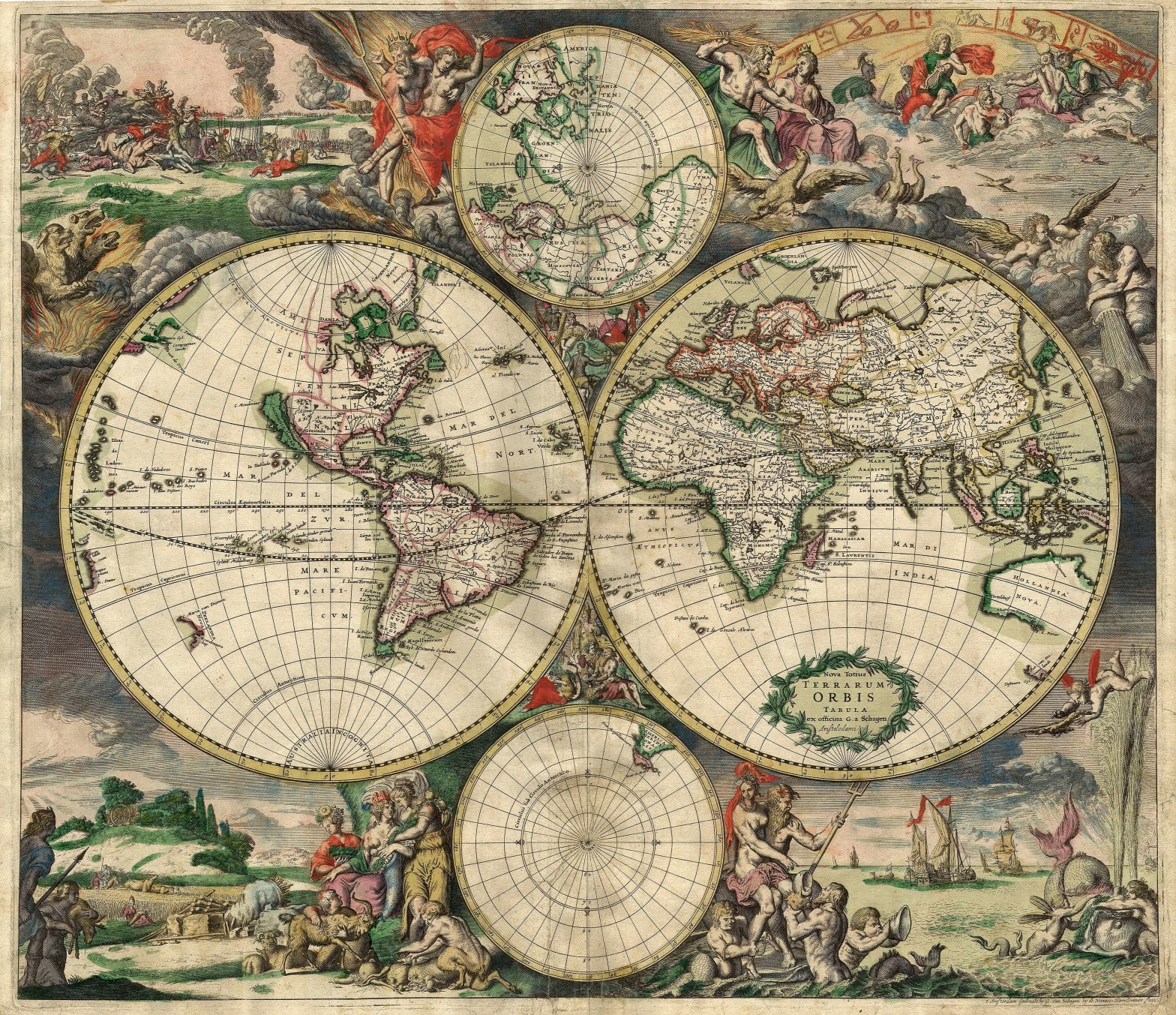
Lead Image: “World map – Produced in Amsterdam” First edition : 1689


