Two Kinds of Wisdom

There are at least two kinds of wisdom in this world: everyday and spiritual.

Everyday wisdom focuses on practical advice for tasks and responsibilities.  Here are some examples:

  • A penny saved is a penny earned.  Benjamin Franklin “coined” this phrase to encourage people to save money.
  • Measure twice, cut once. An oft-quoted bit of carpenter’s advice: you can’t “uncut” a piece of wood once it’s been sawed, so be doubly sure you’re beginning where you should.
  • Failing to plan is planning to fail.  A favorite from an engineer friend who was a long-time project manager with large teams and complex projects.
  • Protect your capital.  My father-in-law worked his way off a farm in Minnesota during the Depression and was a dedicated manager of his personal assets.  Whenever I’d ask him for financial advice, he reminded me not to take unnecessary risks with whatever funds we had. 
  • You can do hard things.  This was on a poster in my wife’s first-grade classroom. In those moments of discouragement or self-doubt, it’s a good way to reset our expectations to match what challenges we are facing. I’ve brought it to mind in critical situations, like when I’m cleaning out a bathroom sink drain.
  • Dance like no one is looking; text or email as if it will be read in court.  This is from an HR consultant and friend who has seen what can happen when people are careless with digital communications.

Every culture has such sayings.  These help us manage practical activities. They teach us how to be part of the social order and encourage personal responsibility. When we apply them and find success, we are grateful.  Such success can build self-confidence.

            But not all of life’s challenges are easy to anticipate, fix, manage, or repair.  Like feeling an inner emptiness.  Or being humbled.  Or deciding if we want to risk being kind. Or wondering why the world out there may seem lifeless.  Or trying to decide if it’s worth the effort to help people resolve their differences.

            This can be the time when spiritual wisdom offers us direction. 

            My mother had a framed plaque of “The Beatitudes” on a hook above our sink.  I remember her saying they meant a great to her, but I had no idea where they came from or what they meant until later in my life.  These teachings of Jesus are examples of spiritual wisdom.  

The words of the Beatitudes are profound, but they may sound overly familiar, idealistic, or outdated.  I have come to appreciate a contemporary translator – Eugene Peterson — who offers not only a new way to phrase these sentences but does so in a way that makes them seem less “religious” and more true-to-life.[i]  What follows is a sampling.  I’ll begin with the traditional wording, then follow with Peterson’s version in bold:

  • Blessed are the poor in spirit, for theirs is the kingdom of heaven. This points to that feeling of emptiness deep within we may feel.  “Kingdom of heaven” doesn’t mean a far-off magic land, but the divine presence within us, waiting to be discovered.  Peterson’s version:You’re blessed when you’re at the end of your rope. With less of you there is more of God and his rule.
  • Blessed is the meek, for they shall inherit the earth.  “Meek” sounds like “weak,” but it means something closer to humble.  Pride can blind us to anything beyond our own personal concerns;  humility can open our eyes to other people and the beauty of the natural world. When egos recede, souls can rise.  You’re blessed when you’re content with just who you are—no more, no less. That’s the moment you find yourselves proud owners of everything that can’t be bought.
  • Blessed are the merciful, for they shall receive mercy.  Becoming merciful to others may seem risky, but it can lead us into a relationship with others that goes deeper than feeling pity.  Instead, we enter a realm of compassion in which we discover our common humanity and mutual need.   You’re blessed when you care. At the moment of being ‘care-full,’ you find yourselves cared for.
  • Blessed are the pure in heart, they shall see God.  It’s hard to imagine being “pure,” without a trace of self-interest.  But how about this version: You’re blessed when you get your inside world—your mind and heart—put right. Then you can see God in the outside world
  • Blessed are the peacemakers, for they shall be called children of God.  Seeking ways to make peace benefits others but can be more than that – it’s one more way to find a richer identity beyond our selves: You’re blessed when you can show people how to cooperate instead of compete or fight. That’s when you discover who you really are, and your place in God’s family.

Everyday wisdom helps us manage our lives.  Spiritual wisdom can take us to a deeper place of connecting with our inner self, others, and the graciousness of life.

Over the years I’ve heard people say spiritual wisdom is better than everyday wisdom.  I don’t think we have to choose. Managing our everyday lives is pretty darn important, and I appreciate any advice that helps me do that. At the same time, it’s good to know that when our plans, expectations, and assumptions break down or lose their luster, we have another place to go.  We then find new ways of understanding that become a richer way of experieincing ourself and the world. When we find it, it feels like home.


[i]Peterson, Sermon on the Mount

Photo: “Custom Craftsmanship” – Dansk Wilton.

Richard Rohr’s has an insightful piece on Jung’s theory of spiritual discovery in adulthood at “Two Haves of Life”

Five Tips for Everyday Living

Last year, David Brooks wrote a column in which he shared a list of 38 “life hacks” created by a tech writer he admires, Kevin Kelly[i].  They may not be profound spiritual insights or revelations – they’re more like practical suggestions on how to manage everyday situations.  Here are five that spoke to me:

  1. … over the last few years I have embraced, almost as a religious mantra, the idea that if you’re not sure you can carry it all, take two trips.  Many times in my life I’ve parked my car… looked at the various items I want to take in… recognized it was going to be a challenge to get them all in one trip…, and then heard a voice saying “Yeah, it’s a lot, but you can do it!”  I awkwardly fill up my arms with all the items…try to shut the car door with a foot…and something spills on the sidewalk. Or maybe I get as far as the front door, discover it’s locked, and as I try to get my keys out of my pocket, disaster strikes.  Since reading this, I am catching myself in that moment of decision between foolish optimism and sober realism.  Choosing the Calm-and-Practical-Me in such moments makes me feel like a Zen master.  Less spillage, less embarrassment, and a glimmer of maturity.  Low-cost liberation!
  2. Something does not need to be perfect to be wonderful, especially weddings.  I’ve participated in many weddings over the years, and, to tell you the truth, they often make me nervous.  Expectations can be high in terms of the flowers, the decorations, the timing, the participants, the food, the guest list, and the schedule of events.  The most expensive formal wedding I ever presided at started late because the bride and groom were arguing with lawyers about the prenuptial agreement; the marriage itself lasted only a few years.  I contrast that experience with the ceremonies I’ve been part of that have had a mood of ease, quiet joy, humor, reverence, and genuine affection.  These ceremonies may not reach Martha Stewart’s standards, but they are experiences where love and wonder met.
  3. The biggest lie we tell ourselves is, “I don’t need to write this down because I will remember it.”  It’s amazing how many things we think we will remember but forget. Of course, the older we get, the more this occurs. I’m trying to be more intentional about writing things down on notecards or with the memo app on my phone.
  4. If you can’t make up your mind between two options, flip a coin. Don’t decide based on which side of the coin came up. Decide based on your emotional reaction to which side came up.  I’ve often quoted David Brooks’ comment “Our culture assumes we are brains on a stick.”  The truth is we have many ways of knowing including feeling, intuition, and “somatic intelligence” – the idea that our bodies sometimes know truths hidden from our conscious thinking. I have a variety of different routes I walk in our neighborhood. In the last year or two, if I get to a familiar intersection and receive a prompting like, “How about turning left today instead of right and going down a street you rarely go?” I follow it.  I like to think it’s helping me tune in to that hidden way of knowing, which may better access our natural creativity.
  5. Don’t try to figure out what your life is about. It’s too big a question. Just figure out what the next three years are about.  I’ve been trying to figure out what life is about since I was a teenager and I am not giving up.  I intend to stay curious about spiritual insights, new scientific knowledge, and the practical wisdom conveyed by people I meet.  But I like this idea of making a three-year plan for the practical things in life.  It’s manageable.

The original article included 38 such suggestions. That’s way too many for me.  I’m thinking I can hold five at a time without dropping any. I also hope writing them down like this will help – if I remember where I put the list.

Here’s my summary:


[i] David Brooks, The Greatest Life Hacks in the World (for Now); June 2, 2022

Top image: “Monk Writing,” Carl Schleicher, 1903

Learning from the Redwoods

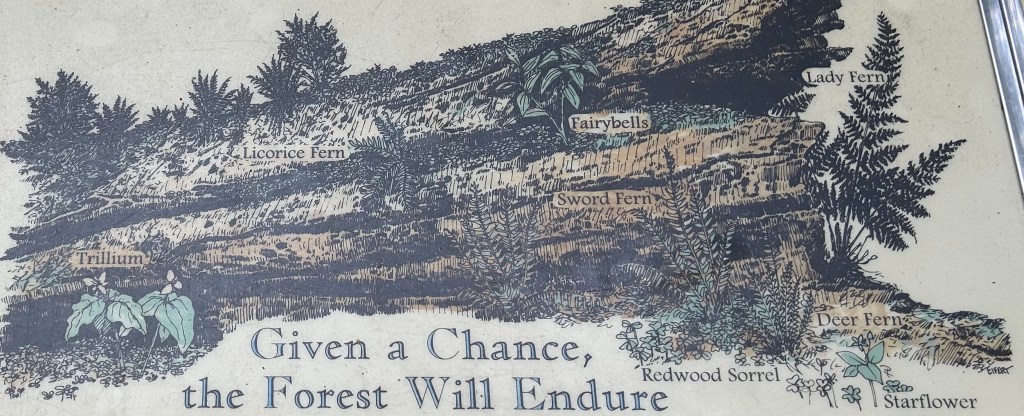
This summer we were driving south on the 101 along the coast of Oregon and Northern California. We were passing through the “Avenue of the Giants” in the Humboldt Redwoods State Park and decided to stop for a break and view the trees.  We came across this plaque:

Given a Chance, the Forest Will Endure

A natural coast Redwood forest is preserving itself through a nearly perfect recycling system. Most of the nutrients in the forest consist of living, then decaying plant and animal material.

As this material decomposes it provides nutrients for other living organisms.

Fallen trees account for as much as 40% of all organic material on the forest floor and many plants benefit from growing on these decaying nurse logs. Because redwood is an extremely long-lasting wood, the decay process may take centuries before all of a nurse log’s nutrients have re-entered the forest system.

Today this enduring forest will continue only if we as good land stewards allow it to.

Being uneducated in the way of forests, I never knew that fallen trees are a critical part of the redwood “nursery,” and that some trees may take centuries to patiently pass on the organic material that made their lives possible.  The more I thought about it, the more I thought of parallels to our own human life cycle.

 When we are young, we are nourished by those who are caring for us in the way of food, shelter, love, and guidance.  We are unaware of our dependence on the “nursery” that supports us.

 We grow into our teen years.  We may find ourselves looking up at the adult trees around us and become determined to find our own way upward.  We may think it will be easy to do. 

We launch out on our own, finding a path to the sunlight that’s not blocked by the older trees. There’s lots of sap flowing, and we can be fearless in our ambitions and expectations.

Adulthood comes.  We find times of satisfaction and accomplishment.  We also experience storms or fires; we learn life is not without risk.  At some point, we may begin to be as concerned about the younger saplings below us as the unconquered space above us.

Years pass.  We realize we are approaching the age and height of our ancestors.  We appreciate for the first time the hard work of becoming an elder.  We now identify with all those older trees that were invisible to us when we were young.  We are now one of them.

Maybe we survive and thrive for a long time.  But at some point, we will fall to the forest floor.  We’ve lost the lofty, open-sky perspective that we took for granted and now lie close to the ground where our life began.  We realize we are part of a life cycle and our role is shifting – now it’s more about releasing our energy to the next generations than holding it just for ourselves.  We may wonder: Will the saplings remember what we are doing for them, or will they, like us when we were young, take it all for granted?

A long period of time has passed, but it can seem like an instant.  Did we appreciate it while we were living it?

We worry about the future of the forest.  Will it survive the challenges to come?

Older redwoods pass on their organic material.  Humans don’t have much carbon and nitrogen to offer.  We can be nurtured by the lives and stories of our parents, mentors, and ancestors. We in turn try to pass on our awareness, hard-learned lessons, and love to the emerging generations.  We want the best for the forest and are grateful to play our part, yet we also realize we are not masters of its fate.

            “For everything, there is a season, and a time for every matter under heaven…” (Ecclesiastes 3:1)

Photo from Dreamstime.com

The “Barbie” Movie and Our Search for Meaning in Life

            When I first heard there was a “Barbie” movie coming this summer, I had zero interest in seeing it. But then I started reading reviews and heard positive reports from friends. My wife and I saw it yesterday.

We raised three daughters with a 13-year span between the oldest and the youngest.  We experienced different fads in toys: Beanie Babies, My Little Pony, and Cabbage Patch dolls among others.  Each of these had a season of popularity.  But one doll held pride of place over time: Barbie.  Our oldest daughter passed down her collection to the younger two, and they added to it.  We ended up with an extensive collection.  As our youngest went off to college, we stored the “Barbie Box” in the garage.  Several times we debated giving them away.  But hearing the news we were going to have a granddaughter led us to keep it.  

            When we got home from the theater, I went to the garage to retrieve the Barbie Box.  I brought it in, dusted it off, and opened it.  Then I arranged the full cast of characters for a group reunion portrait.  I sent it to our daughters — now 45, 36, and 33 years old.  A string of text messages sharing memories followed.

            While our girls enjoyed dressing the dolls, having Barbies was more than that. They would spend hours improvising stories involving the characters, and sometimes I would eavesdrop.  I was struck by how therapeutic it was. These plastic figures became actors in real-life situations.  They would say something like, “Barbie got mad at Ken and they divorced,” then pop Ken’s head off of his beach-ready body and toss it across the room. (“When I used to ask Dad to put Ken’s head back on his body, Dad would say, ‘Did Ken lose his head over Barbie again?’” one of our girls recalled.) One day I was doing yard work and unearthed a Ken-head beneath a hedge.  I took a picture and reunited him with his body and friends, much to the acclaim of his former caretakers.

            Which brings me back to the movie.

            I hope I’m not revealing too much to say it is about Barbies and Kens becoming aware that they are something more than their surface identities. They embark on a journey of enlightenment to discover who they really are.

            Watching the movie, I was struck with how its theme resonates with some daily meditations I happened to be reading this week from Richard Rohr’s The Immortal Diamond: The Search for Our True Self:

“Various false selves (temporary costumes) are necessary to get us all started, and they show their limitations when they stay around too long. If a person keeps growing, their various false selves usually die in exposure to greater light.

Our false self, which we might also call our “small self” or “separate self,” is our launching pad: our body image, our job, our education, our clothes, our money, our car, our success, and so on. These are the functional trappings of ego that we all use to get through an ordinary day. They are largely projections of our self-image and our attachment to it.

When we are able to move beyond our separate or false self—as we are invited to do over the course of our lives – it will eventually feel as if we have lost nothing. In fact, it will feel like freedom and liberation. When we are connected to the Whole, we no longer need to protect or defend the mere part. We no longer need to compare and compete. We are now connected to something inexhaustible.”[i]

Can it be that Barbie has a spiritual message?

            A recent article about the movie and its creator, Greta Gerwig, ends with this:

It’s a testament to Gerwig’s singular earnestness — a level of sincerity unavailable to many of us — that using Barbie to affirm the worth of ordinary women feels, to her, quasi religious. She told me that when she was growing up, her Christian family’s closest friends were observant Jews; they vacationed together and constantly tore around each other’s homes. She would also eat with them on Friday nights for Shabbat dinner, where blessings were sung in Hebrew, including over the children at the table. May God bless you and protect you. May God show you favor and be gracious to you. May God show you kindness and grant you peace. Every Friday the family’s father would rest his hand on Gerwig’s head, just as he did on his own children’s, and bless her too.

“I remember feeling the sense of, ‘Whatever your wins and losses were for the week, whatever you did or you didn’t do, when you come to this table, your value has nothing to do with that,’” Gerwig told me. “‘You are a child of God. I put my hand over you, and I bless you as a child of God at this table. And that’s your value.” I remember feeling so safe in that and feeling so, like, enough.” She imagines people going to the temple of the movies to see “Barbie” on a hot summer day, sitting in the air-conditioned dark, feeling transported, laughing, maybe crying, and then coming out into the bright heat. “I want people to feel like I did at Shabbat dinner,” she said. “I want them to get blessed.”[ii]

Today I stood before our recently liberated collection of Barbies and Kens on our couch. I expressed gratitude for what they had endured.  I encourage all of us to find the blessing that arises from being connected to something “inexhaustible.”


[i] Richard Rohr, Letting Go of the False Self

[ii] Greta Gerwig’s ‘Barbie’ Dream Job, New York Times Magazine, July 11, 2023

Making Good Time

“We want to make good time, but for us now this is measured with the emphasis on “good” rather than on “time”….”
― Robert M. Pirsig, Zen and the Art of Motorcycle Maintenance: An Inquiry Into Values

            We are just finishing a two-week road trip through Northern California and Oregon, which brings to mind the term, “making good time.”

            When I first saw people reading Zen and the Art of Motorcycle Maintenance in the 70s, I wasn’t interested.  Zen meant little to me, and I was not born to be a motorcycle enthusiast, let alone a mechanic. But eventually I decided to read it and found it to be insightful.  The author sets out on a cross-country motorcycle trip with a friend and their adventures provide a setting for reflections on how we live our life.

            One instance is his sense of how we use the term “good time.”  If we ask someone who has just completed a trip how long it took and they give us a number — e.g., “Four hours” — and if we think that suggests they completed the trip in a relatively short   amount of time, we might say, “Oh, so you made good time.”

I remember a Dutch farmer I knew as a parishioner. His wife once told me that the family dreaded going on long car trips with him, because he was often unwilling to make rest room stops when asked — he was determined to get to the destination as fast as possible. Things became worse when he announced he had installed a reserve gas tank on the vehicle so he would be able to make even fewer stops. The family did not share his enthusiasm.

Pirsig has his own take for the word “good time.” We may have reached our destination quickly, but did we enjoy it? Did we experience something new? Did we find ourselves being grateful for something we saw? Or did we become completely focused on our goal, put the pedal to the metal, and rush to our destination?

That, to Pirsig, sounds like time used poorly.

As a result, he would avoid the freeways and interstates. Instead he looked for older highways, country roads, and routes that would still get him to his destination. On these byways he’d be attentive to his surroundings and appreciative of passing through communities and open land he had not experienced before. This may take longer, but it was “good time” because he was present and open as he traveled, instead of narrowly focused on the beating the clock.

May we find which mindset opens us to the valuable experiences of life.


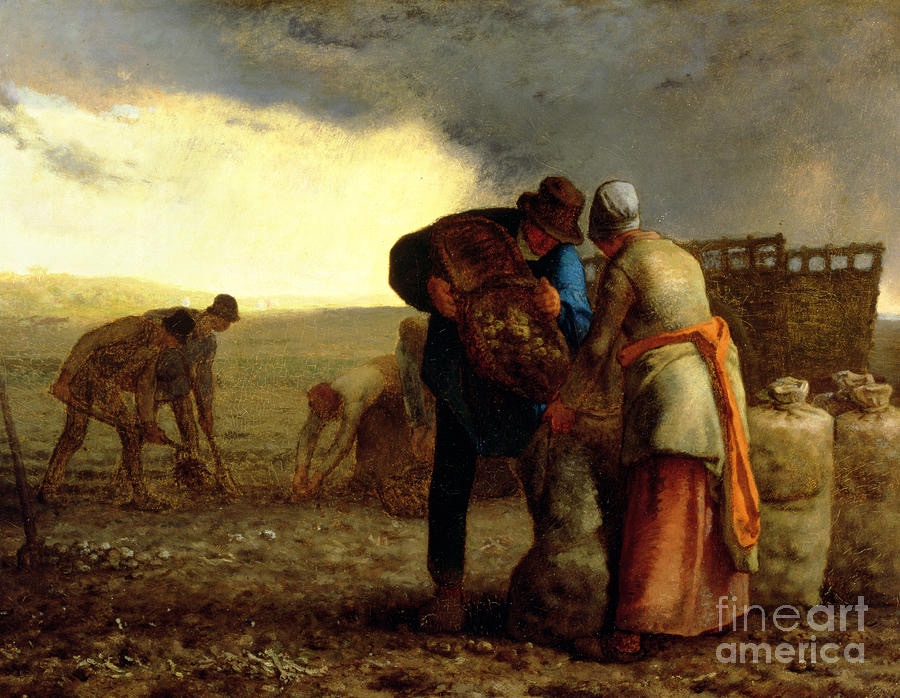
“The Field Is Tilled and Left to Grace


The Potato Harvest, Millet

A poem by Wendell Berry, “Whatever Is Forseen In Joy”:

Whatever is foreseen in joy
Must be lived out from day to day.
Vision held open in the dark
By our ten thousand days of work.
Harvest will fill the barn; for that
The hand must ache, the face must sweat.
And yet no leaf or grain is filled
By work of ours; the field is tilled
And left to grace. That we may reap,
Great work is done while we’re asleep.

When we work well, a Sabbath mood
Rests on our day, and finds it good.

Wendell Berry works his own plot of land in a community that has sustained his family and neighbors for generations. They know the weariness that comes from “ten thousand days of work” but are sustained by having the vision of a plentiful harvest that has been “forseen in joy.”

I have known farmers and their families and have come to appreciate the skill and tenacity they bring to their labors. After all their best efforts, they are always subject to unexpected events, severe weather, and price fluctuations.

            But most of the people I know are not farmers — we are people who have worked in education, health care, businesses and religious organizations.  For us, it can be hard to see or measure the harvest of our labors that we hope will “fill our barns.”

            Over the 30 years of being a parish pastor, I worked hard to develop healthy spiritual communities.  Of the 3 congregations I served, every one has declined in membership in recent years.  I sometimes have asked myself, “What was it all for?”

            I once attended a clergy retreat where the leader said he has found many pastors will privately acknowledge that they experience depression.  He felt it arose from the feeling that you have failed to achieve what you had envisioned when you started.  But, he said, clergy accomplish more good than they realize — the results are not easily measured, but are present in peoples’ lives.

            So I look back at the “fields” I have labored in and can see how many relationships were nurtured, how much hope, joy and mutual support was shared, and how much grace was experienced. The buildings may have emptied, but not the lives of those of the people who were part of it all.

And what of your work? Does it feel as if your “ten thousand days of work” filled the barn?

            And what of our personal lives — our families and relationships?  Lives we have been responsible for may or may not have met our expectations when we began parenting. We may have planted and watered as best we can, but we are not the ones who create the growth.

            My mother used to say, “I want to live until I’m a hundred and see how it all turns out.” But she died suddenly at age 75, and all our stories were still unfolding.  Thirty years later, they still are.  I would love to know what happens to our kids and grandkids in the years to come, but I know my time will be completed when their lives are still being made.

So “the field is tilled and left to grace.” All the people we love and care for are seeking to do their best in this life. We may not know what the ultimate harvest will be of our life’s work, but “when we work well, a Sabbath mood rests on our day, and finds it good.”

            May we be grateful for the opportunity to labor in the fields of our lives, as well as the grace that will outlive us.


Water and Life

            Eleven years ago, we went to visit friends on the “Big Island” of Hawaii. One afternoon we visited a black sand beach; only a handful of other people were there. I went in for a swim.  The water was warm. I was floating about 100 yards out, looking back at the beach, when a soft rain began to fall.  The raindrops were also warm and made a barely audible sound as they met the surface of the ocean before dissolving. My body was in the ocean and my head was just above the surface, so I was floating on the boundary between the sea and sky.  I was also on a boundary of awareness – focusing not on any immediate concerns but simply being aware.  I’ll never forget the feeling.

Moments of awe and wonder are a common human experience, and the words we use to describe such experiences include “magical,” “mystical,” and “timeless.”

I was at a conference recently where a speaker shared a passage about floating in a river. It was written by Loren Eisley, a popular science writer in the mid-20th Century.  He grew up in Nebraska and spent much of his childhood wandering the countryside.  One day he was at the bank of the wide and shallow Platte River and followed an impulse to not just observe the river but become part of it. His experience integrates his scientific knowledge, physical sensations, and receptive imagination:

I thought of all this, standing quietly in the water, feeling the sand shifting away under my toes. Then I lay back in the floating position that left my face to the sky, and shoved off. The sky wheeled over me. For an instant, as I bobbed into the main channel, I had the sensation of sliding down the vast tilted face of the continent.  It was then that I felt the cold needles of the alpine springs at my fingertips, and the warmth of the Gulf pulling me southward.

Moving with me, leaving its taste upon my mouth and spouting under me in dancing springs of sand, was the immense body of the continent itself, flowing like the river was flowing, grain by grain, mountain by mountain, down to the sea. I was streaming over ancient seabeds thrust aloft where giant reptiles had once sported; I was wearing down the face of time and trundling cloud-wreathed ranges into oblivion. I touched my margins with the delicacy of a crayfish’s antennae, and felt great fishes glide about their work.

I drifted by stranded timber cut by beaver in mountain fastnesses; I slid over shallows that had buried the broken axles of prairie schooners and the mired bones of mammoth.

I was streaming alive through the hot and working ferment of the sun, or oozing secretively through shady thickets. I was water and the unspeakable alchemies that gestate and take shape in water, the slimy jellies that under the enormous magnification of the sun writhe and whip upward as great barbeled fish mouths, or sink indistinctly back into the murk out of which they arose.

Turtle and fish and the pinpoint chirpings of individual frogs are all watery projections, concentrations–as man himself is a concentration–of that indescribable and liquid brew which is compounded in varying proportions of salt and sun and time.

It has appearances, but at its heart lies water, and as I was finally edged gently against a sand bar and dropped like any log, I tottered as I rose.

I knew once more the body’s revolt against emergence into the harsh and unsupporting air, its reluctance to break contact with that mother element which still, at this late point in time, shelters and brings into being nine-tenths of everything alive[i].

Spirituality has a great deal to do with how we live our day-to-day life, but it also includes an underlying sense that there is a seamless unity in the natural world, and we are only a small part of it. Eisley was an evolutionary scientist who did not consider himself religious but  had a profound reverence for the mystery and wonder of life.

2500 years ago, an anonymous observer composed a poem known as Psalm 104. It would be centuries before science would begin to comprehend evolution and the biological basis for life.  But the writer had seen, felt, and intuitively understood what is important.  It’s 35 verses long, and only five of those verses refer to human beings.  The rest focus on the interplay of water, oceans, streams, clouds, and the many life forms with whom we share the earth.

Psalm 104 found new relevance in the 1970s during the dawn of the environmental and eco-spirituality movements.  It describes a world in which humanity’s task is not to dominate the natural world but to revere it.

I was once on a hike with my friend Rabbi Cohen. I mentioned how I had recently been reading Psalm 104 with new appreciation. He told me a great poet and philosopher, Johann Gottfried Herder, wrote “It is worth studying the Hebrew language for ten years in order to read Psalm 104 in the original.”

Water is something more than what comes out of a tap.

“If there is magic in this planet, it is contained in water.”[ii]


[i] Loren Eisley, The Immense Journey: An Imaginative Naturalist Explores the Mysteries of Man and Nature,” pgs. 18-20, 1957.

[ii] Eisley, pg. 15

Photo credits: “Black Sand Beach Along the Road to Hana, Nancy Schretter;  “Platte River:” Platte River Resilience Fund, Nebraska Community Foundation

My Plan for Dementia Care

In my years of ministry, hospice work, and living life, I’ve seen individuals and families go through all kinds of challenges and heartaches, including serious illnesses and aging.  I’ve witnessed people face these challenges with love and grace.  I’ve also seen some situations create tension, stress, and suffering that go on for a very long time. 

Modern medicine can keep us alive, but sometimes beyond a point where there is any real quality of life remaining.  I’ve visited many people in nursing homes in their 90s who have told me they are “ready to go” and don’t want to “just exist.” And I’ve seen many people in wheelchairs placed in front of televisions looking as if any reason to live has long gone, and they are stuck in a stagnant existence.  With dementia, things can get particularly difficult; families ask, “What would Dad want us to do if he was able to tell us?”

I’ve often thought, “I don’t want to go through that myself.  And I don’t my family to go through that.”

Recently I met with a colleague to update my own “Advanced Health Care Directives” and define how I want to be cared for as I age.  She has worked for years with local hospices, hospitals, medical clinics, and retirement homes to help people define what their wishes are for the last years of their life.  When I told her one of my great concerns is what would happen if I should develop serious dementia or Alzheimer’s, she told me about an article in the New York Times that discusses a new option: “One Day Your Mind May Fade. At Least You’ll Have a Plan.” [i] Then she referred me to a new document discussed in the article that would allow me to put my wishes in writing.

You can find the document on the website  Dementia Directive.  It’s very simple.  It defines three stages:

Stage One — Mild: With mild dementia, people may often lose the ability to remember what just happened to them. Routine tasks become difficult, such as cooking. Some tasks can become more dangerous, such as driving.

Stage Two — Moderate: In moderate dementia, communication becomes very limited. People lose the ability to understand what is going on around them. People require daily full-time assistance with dressing and often toileting. They can sometimes become quite confused and agitated and paranoid. Some people appear to be content much of the time.

Stage ThreeSevere: In severe dementia, people are no longer able to recognize loved ones and family members. Some people with severe dementia may be calm and serene much of the time, but many go through periods of agitation. They can be awake through the night. They can be angry, disruptive, and yelling. People need 24-hour help with all daily activities, including bathing and assistance with all basic body functions.

For each stage, you can mark which of the three levels of care you want:

Care goals (choose one for each stage)

  • To live for as long as I can. I would want full efforts to prolong my life, including efforts to restart my heart if it stops beating.
  •  To receive treatments to prolong my life, but if my heart stops beating or I can’t breathe on my own then do not shock my heart to restart it (DNR) and do not place me on a breathing machine. Instead, if either of these happens, allow me to die peacefully. Reason why: if I took such a sudden turn for the worse then my dementia would likely be worse if I survived, and this would not be an acceptable quality of life for me.
  • To receive comfort-focused care only. (Including DNR and Do Not Intubate) I would only want medical care to relieve symptoms such as pain, anxiety, or breathlessness. I would not want care to keep me alive longer. It would be important to me to avoid sending me to a hospital or ER, unless that was the only way to keep me more comfortable, because trips to the hospital when someone has dementia can be quite traumatic.

After discussing my wishes with my friend, I took the form to my doctor during my annual checkup.  When I showed him the form, he asked how he could get his own copy.  Then we discussed my wishes.  We agreed that if I was in the first stage – Mild Dementia – I’d choose the second Care Goal: don’t allow CPR or put me on a breathing machine, but if there are some simple treatments that may help me live a bit longer, that may be OK.[ii]  My guess is that if I can still recognize family and friends and putter around enjoying daily tasks, then it may be worth some modest interventions. But for the other two stages, “Moderate” and “Severe,” I marked the third option.  Keep me comfortable, but don’t take dramatic steps to prolong my life.  For example, if I get pneumonia, don’t give me antibiotics – let me die of natural causes.

Each of us may make different choices. But it’s a real gift to have these options spelled out.

Next month we will be with our children and grandchildren. I’ll be sharing this with them, so they know what I want, and I’m adding this form to my records with my physician and attorney.

If you read my blog, you know one of my constant themes is my sense of awe at the miracle of life, and gratitude for all the opportunities and experiences I’ve had. But I don’t want to live “beyond my time,” and I don’t want my family to be emotionally or financially burdened caring for me when I don’t have a life I can appreciate. 

I am grateful for my friend’s counsel and this new directive.

Photograph: “Starry Night Over the Pacific Ocean,” Michael Shainblum


[i] https://www.nytimes.com/2018/01/19/health/dementia-advance-directive.html

[ii] If your heart stops and you are young, medical personnel can often use CPR to revive you. But with people over 80, only 3% of people who receive CPR are ever able to leave the hospital. (https://pubmed.ncbi.nlm.nih.gov/31840239/)

Where Are You Going? Oregon? Or Yogurtland?

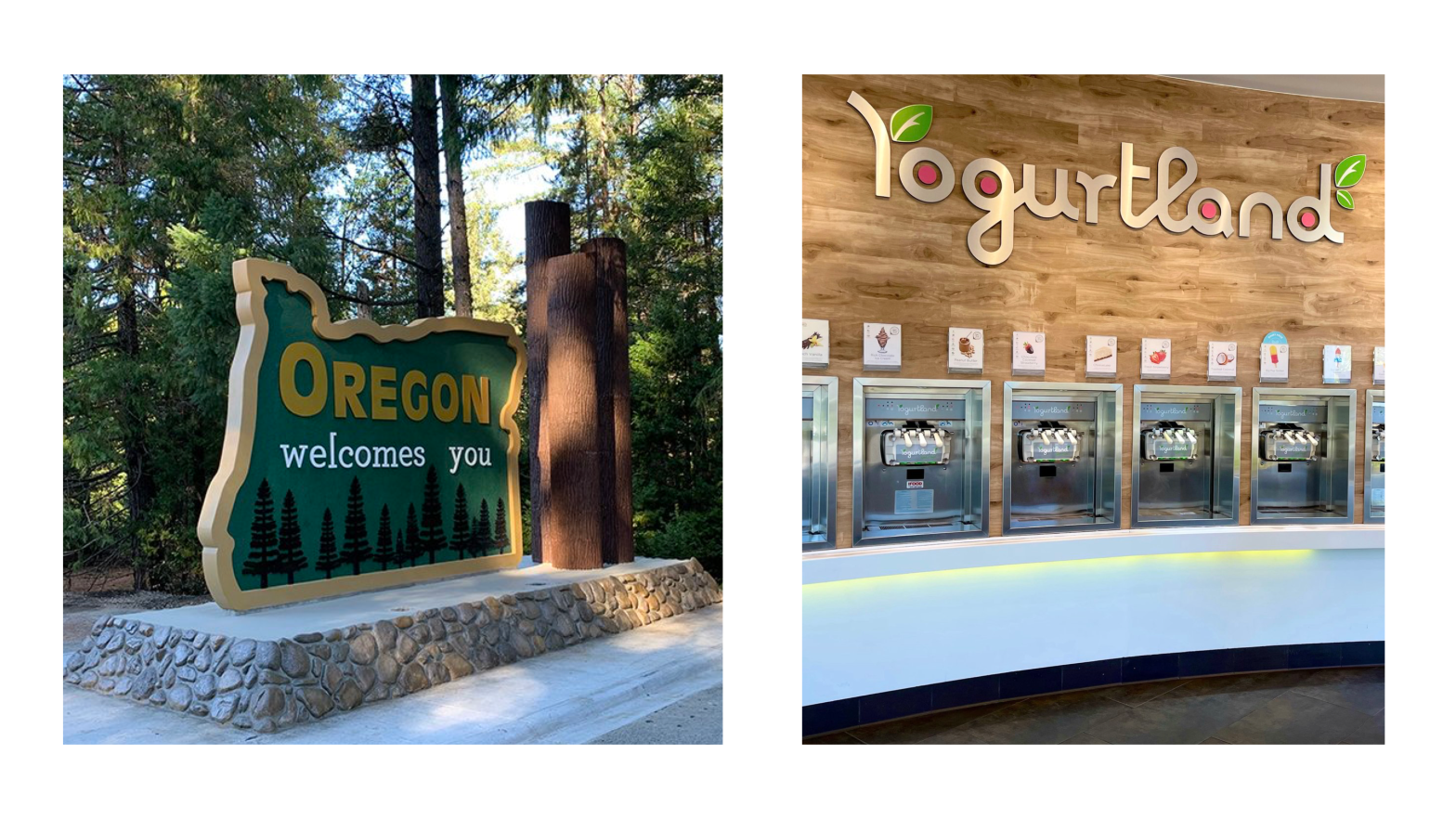
            I once picked up our 4-year-old grandson at his preschool near the end of the school year.  As I stepped into his classroom, several children came up to me. The first one said, “We’re going to Oregon!”  A second said, “We’re going to Yogurtland!”

            Those are two different horizons.

            We’ve had several friends who have relocated to Oregon, and they’ve found much to like.  Not as hot!  More water!  Not as crowded!  We enjoy visiting them.  Other people we know have moved out of California to other states – Texas, North Carolina, Arizona, and Washington state.  It’s a big decision.

            Yogurtland is not the same level of commitment, but it’s still pretty exciting.  Our grandkids have shown me how to do it. You make the 5-minute drive to the local shop. You go in, step up to the serving line, take a bowl, and enter the area where you choose from twelve soft-serve yogurt flavors.  When you see one you like, you hold your bowl under the dispenser, pull the handle, and out comes as much yogurt as you want. It’s hard to decide between options like “Birthday Cake Batter,” “Rocket Pop Sorbet” and “Sumatra Coffee Blend.”  But you don’t have to choose just one – you can fill your cup with several different flavors – all in the same bowl.

            Then you enter the “Toppings” section. There is so much to choose from! Gummy Bears…chocolate chips…diced almonds… miniature marshmallows…crumbled Oreo cookies…M & Ms…to name a few (of the ones I can remember).  Again, you can mix and match as much as you want.  And, you can say to yourself: it’s not like I’m indulging in ice cream – this is good-for-me-pro-biotic-yogurt.  When you’ve completed your masterpiece, you hand it to the clerk who weighs it. You pay, find a seat, and enjoy.

            Life is full of decisions.  Big ones, like moving to Oregon. Or less dramatic ones, like going to Yogurtland.

Recently I saw a comment from the writer David Brooks: “Instead of trying to understand the meaning of life, just make a 3-year plan.” 

That caught my attention — another set of two choices.  I’ve been trying to understand the meaning of life for as long as I can remember.  That’s why I studied philosophy in college, went to seminary, listen to the personal reflections of all kinds of people, and study spiritual traditions. I feel I’m getting closer to some basic conclusions.  But will something happen to me that interrupts my search, taking me out of the game before I’ve figured it out?  Or do I have another five, ten, or twenty years to keep searching?  There’s no way to know.

Jesus tells a parable of a person who had finally accumulated everything he wanted in life and figured he had plenty of time to enjoy it.   But God said to him, ‘Fool! This night your soul will be required of you; then whose will those things be which you have provided?’ So is he who lays up treasure for himself, and is not rich toward God.” (Luke 12:20-21)

I could go anytime.  Maybe I should go to Yogurtland more often.

But if I’ve got more years in my future, I’ve got to plan ahead – watch what I eat, exercise, keep up on my medical appointments, and manage our money the best I can.

I like the idea of making a 3-year plan. That seems doable.  Maybe visit other states and evaluate moving versus staying, setting a goal of making a decision in the next three years. Meanwhile, go to places like Yogurtland — but not too often.

And what is “rich toward God?”  I think it’s being aware every day of what a miracle this life is, no matter where you are.  And enjoying the simple blessings of life, no matter what you have for dessert.  And being useful to other people, including family, but also beyond family.  And being a responsible citizen.  And taking care of the earth.

Photo credits: Credits: Oregon Dept of Transportation, Yogurtland Los Angeles

Taking Control of Your Life in the Age of A.I.

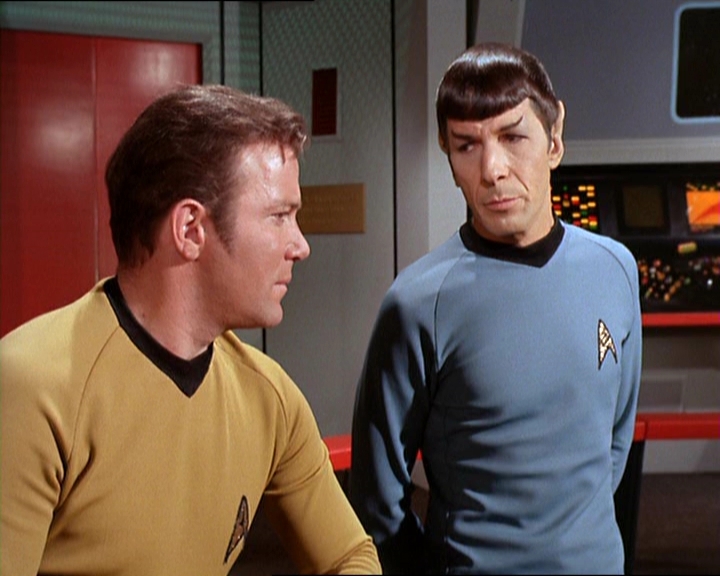
Captain Kirk: “Evaluation of M-5 performance. It’ll be necessary for the log.”

Mr. Spock: “The ship reacted more rapidly than human control could have maneuvered her. Tactics, deployment of weapons, all indicate an immense sophistication in computer control.”

Captain Kirk: “Machine over man, Spock? It was impressive. Might even be practical.”

Mr. Spock: “Practical, Captain? Perhaps. But not desirable. Computers make excellent and efficient servants; but I have no wish to serve under them.”

Star Trek (original 1968 television series), Episode 24: “The Ultimate Computer,”

This will be my third post on the topic of Artificial Intelligence, or AI.  In my first, I included part of a transcript of a two-hour “conversation” between New York Times tech columnist Kevin Roose and the Bing AI chatbot “Sydney.” I was curious about what else Roose has written and bought his 2021 book Futureproof: 9 Rules for Humans in the Age of Automation.  I want to share a few of his recommendations on how we can try to stay in control of our lives. 

A major theme of the book is that many jobs now done by humans that will soon be done by A.I.  For example, a central concern of the current writers’ strike in Hollywood is the writers’ fear that AI will be used to create scripts and stories that will put human writers out of work.  They want assurances from the studios that they won’t let that happen.  But studios, knowing how cost-effective such a change would be, are so far reluctant to make such a commitment.  Many other jobs, even in law and finance, will soon no longer need human beings as they do now.

So what can we do? His first rule is “Be Surprising, Social and Scarce.” AI-assisted computers are used effectively in performing rational tasks in stable environments, like playing chess, operating a complex warehouse, linking an Uber driver with a customer, and analyzing massive amounts of data.  But, so far, they aren’t yet good at operating in unstable environments that require subtle human perceptions, adaptability, and responding to unexpected situations. Roose thinks there are some jobs in which humans will have an advantage, at least in the near future: teachers, bartenders, nurses, occupational therapists, police detectives, hairstylists, flight attendants, and mental health workers, to name a few. 

Another rule is “Resist Machine Drift.” By this Roose means “… a kind of internalized automation taking place inside many of us that, in some ways, is much more dangerous.  This kind of automation burrows into our brains and affects our internal lives – changing how we think, what we desire, whom we trust.”[i]  As our activity on our devices and social media is tracked, analyzed, and sold, AI systems on platforms like Facebook and YouTube offer us links, ads, and information that we are tempted to follow.  This can “… lure users into personalized niches filled exactly the content that is most likely to keep their attention – and how, often, that means showing them a version of reality that is more extreme, more divisive, and less fact-based than the world outside their screen.” [ii] We don’t realize what’s happening – we just keep getting presented with interesting links to click on and enjoy the ride.  But we can, over time, find ourselves down a rabbit hole.  

These options and prompts sometimes simply appear in our feed or are presented to us as “recommendations.” Recommendations can feel like a helpful, personal invitation offered to make our life easier and more pleasurable. But the real purpose of the recommendations is to keep us engaged and to keep clicking. Over time, Roose believes our preferences are no longer our own, but become intentionally shaped, crafted, and utilized by AI to capture our attention and profit from it.  (For example, he notes that 70% of YouTube views are “recommendations” generated by AI, not what viewers originally went looking for; as long as we stay engaged, YouTube can sell our attention to advertisers.)

To resist “Machine Drift,” Roose encourages us to not let our time, attention, and money follow every recommendation we are given and instead take time to consider what we really want and what sources we can trust.

 Leave Handprints is another theme.  We can go online and buy inexpensive items from anywhere in the world. But machine-designed and manufactured objects reflect a very different reality from a handmade ceramic pot or artwork made by a real person who used skill and patience to create something unique; we instinctively value it more. When it’s someone’s birthday on Facebook and we see all the “Happy birthday!” responses, we know that those come from a convenient, one-click option Facebook offers us, taking almost no effort. But when we see a message that somebody took time to compose and post, it feels very different.  And if we find in our mailbox a real birthday card with a meaningful, personal message, we know that took time, focus, and care — and it means so much more.  

I would add the importance of patronizing businesses which reflect local neighborhoods and cultures.  You can feel the difference when you go into a business where its identity and practices are determined by a large, remote, data-driven corporation, in contrast to a local pub, coffee house, market, or retail store that is owned, operated, and managed by real people.

Roose says instead of buying a drill on Amazon, he now takes a little more time to go to the local hardware store and talk to a real person.  He suggests we occasionally turn off the Google map directions when we are driving and rely on our own brain – maybe even choosing a route that will take more time but is more scenic or interesting.  We can regularly take time to meditate and reconnect with our bodies.  We can set aside a “human hour” every day in which all devices in our household are off, and instead do activities (a sport, cooking, conversations, or taking the dog for a walk) that are personal, pleasurable, and restorative. (And, as far as we know, no AI system is tracking our activity if our devices are turned off.)

 I was particularly taken by Roose’s account of how he was able to significantly change his addictive relationship with his Smartphone. But I’m going to save that story for a future post.

The challenges of AI go far beyond our individual lives, but I appreciate Roose’s efforts to help us claim as much independence, freedom, and integrity as we can in this rapidly changing world.

I do think AI will have uses that will benefit us.  But all these years later, I still want to remember the wisdom of Mr. Spock: “Computers make excellent and efficient servants; but I have no wish to serve under them.”

Photo of Kirk and Spock: Photo 8158024, fanpop.com


[i] Roose, page 80

[ii] Ibid, page 80