Who Are We?

Human beings are animals. They are sometimes monsters, sometimes magnificent, but always animals. They may prefer to think of themselves as fallen angels, but in reality they are risen apes.”  — Desmond Morris, The Naked Ape [i]

“We are not human beings having a spiritual experience. We are spiritual beings having a human experience.” – attributed to the priest and paleontologist Teilhard de Chardin

Well, which is it?  Are we apes fooling ourselves that we are angels? Or are we spiritual beings inhabiting a body provided for us by our biological cousins?

My favorite movie when I was kid was Tarzan and my favorite character was the chimpanzee, Cheetah.  Cheetah was Tarzan’s best friend. They talked to each other in a special language.  If Tarzan was in trouble, Cheetah might dash through the jungle and summon a herd of elephants. Or find some lions and persuade them to save his friend.  I formed the Monkey Club in second grade and was its first (and only) president.  I would have traded all my baseball cards to have a friend like Cheetah. 

         I was a teenager in 1967 when The Naked Ape came out.  It was a popular bestseller describing how similar we are to apes.  I loved it.  I wanted to be a filmmaker at that time. I took our Kodak Super 8 movie camera to the San Diego Zoo and filmed chimpanzees grooming each other. Then I went back home to San Bernardino and planned to secretly film customers at our local barber shop getting similar treatment.  I planned to cleverly edit the clips so the movie would alternate between the human and primate footage, showing how similar we are. But I never did have the chutzpah to secretly film at the barbershop.  And I didn’t know the first thing about film editing.  Unlike the Steven Spielberg character in The Fabelmans, my cinematic career ended early.

  Growing up and going to college, I did not believe in “spiritual” or “religious” experiences. I believed everything could be explained through science.

         Then I had a spiritual experience.  In a time of personal desperation, I prayed without believing in prayer because I had nowhere else to turn.  Three days later, I realized something like a quiet light was now present at the center of my inner emptiness.  It was an unexpected and vivid experience that opened my mind to the possibility that there is a divine presence surrounding us, and it means us good.  Maybe we are “spiritual beings having a human (or biological) experience.”

         I had heard some folks say science and religion were incompatible — you either believe God created the world in seven days or you are a heretic. But that never made sense to me.  Science was not shutting out wonder but uncovering more and more for it.  What’s wrong with “descending” from apes? I considered that a compliment.

         This is not to say everything in nature is pleasant.

         In 2015 I attended the Parliament of World Religions in Salt Lake. There were many interesting speakers from around the world, but no one drew as large a crowd as Jane Goodall. I was thrilled to listen to her – she has come as close to any of us as having friends like Cheetah! She said she first wanted to study chimpanzees because she was disillusioned with human behavior and felt that chimps in the wild must have greater nobility. But after living with them, she realized they could become vicious and violent when attacking a rival tribe. Her idealism ended, but not her reverence for our fellow primates.

         In 1912, Aldo Leopold was working for the Forest Service in New Mexico.  His duties included hunting wolves.  One day he shot a wolf on a rimrock canyon: “He reached the still breathing wolf and saw something that forever changed him. In his classic text, A Sand County Almanac, Leopold describes the experience, “We reached the old wolf in time to watch a fierce green fire dying in her eyes. I realized then, and have known ever since, that there was something new to me in those eyes—something known only to her and to the mountain. I was young then, and full of trigger-itch; I thought that because fewer wolves meant more deer, that no wolves would mean hunters’ paradise. But after seeing the green fire die, I sensed that neither the wolf nor the mountain agreed with such a view.”[ii]

   Leopold had sensed something profound in the wolf’s eyes and her being – something that inspired reverence.  He became an early prophet of the environmental movement.

         Have you ever looked into the eyes of an animal and felt a deep kinship?

         Would Native and indigenous people believe you must choose between the natural world and spiritual beliefs?

         I look at myself and my fellow human beings: we “are sometimes monsters, sometimes magnificent.”  And I look at life all around us: it can be messy at the same time it is permeated with the miraculous mystery of life.

         So which is it?  Are we “just” animals or are we essentially spiritual creatures? I’m not choosing sides.  I vote for both.


[i] The Naked Ape: A Zoologist’s Study of the Human Animal, 1967

[ii] http://www.nationalforests.org/our-forests/light-and-seed-magazine/aldo-leopold-in-the-gila-wilderness

The Platinum Rule

         One spiritual principle our mother taught us was the Golden Rule: “Do unto others as you would have them do unto you.”  It’s a simple concept, and some say it’s an almost universal teaching in global spiritual traditions.

But I once took a leadership class where the professor encouraged us to think of a variation, the “Platinum Rule:” “Treat others the way they want to be treated.”

         I don’t know who first coined the phrase.  Searching around, it seems to be a common notion in psychology and leadership material.  Whatever its origin, the point is easy to grasp: if I follow the Golden Rule, I may assume someone else would want the same thing I would want.  In broad terms that may be true: all people would like to be treated with respect, for example.  But when it comes down to specifics, what someone else prefers may be very different than me.

         When I was Director at La Casa de Maria, our much-loved gardener Francisco was going to retire after years of faithful service. I asked our Office Manager to come up with some ideas for a special staff event. She suggested a luncheon in the dining room, followed by playing some games we could all enjoy.  We announced that plan to the staff. Later that day, the Landscape Supervisor asked to speak to me.  He politely suggested that what we were planning may not be the ideal event for Francisco.  He offered to organize an outdoor bar-b-q by the pool with some of Francisco’s favorite dishes.  He also wanted to schedule a mariachi band to make a surprise appearance.  That’s what we did.  We were all visiting with each other as the meal was being prepared, and an amazing mariachi band suddenly appeared, singing a popular song in Spanish that referred to someone retiring.  It was wonderful.  I am grateful that we had changed our plans.

         Two stories come to mind from my days at Hospice.

         I was at a national conference and one of the breakout sessions was on the spiritual care of the dying.  While the presenter reviewed some of the common principles in helping people share their spiritual concerns, he said the topic isn’t for everybody.  When his dad was in his last days, he had no interest in talking about spiritual issues. He just wanted to have his son come so they could read the daily newspaper together and discuss sports and the news.  That’s what he did. His father died in peace.

         Our staff was very creative finding ways to do whatever was meaningful for the patients.  One man said he had always enjoyed driving around town in an open convertible smoking a cigar.  We had a volunteer who was happy to do that.  Once a once a week the volunteer picked him up and they cruised around town puffing.  The man was very grateful.

         There are endless stories of how different cultures show respect in different ways. 

In 2000 I was in India on a sabbatical project, interviewing tech people and academics about how digital technology was beginning to reshape personal lives.  I was careful to call ahead to make appointments with whoever I was going to interview, which I took for granted was the proper thing to do. But one of my hosts took me aside and said that was not necessary.  He said calling ahead to make an appointment suggested that the person would not welcome me if just showed up, when in fact, welcoming an unannounced visitor was an honored practice of a good host.

         My congregation established a partnership with a congregation in Ghana. Five of us traveled there first and were warmly welcomed wherever we went.  The next year a group of Ghanaians came to Santa Barbara.  We had arranged for members to host guests in their houses.  One of our hosts had two spare bedrooms, and she welcomed two women to her house, showing each of them the room they would be staying in. After a while, one of the women approached the hostess and – very respectfully – asked if she and her friend could share a room instead of being alone.  Not everyone wants to be by themselves like Americans often do.

         I think of relationships. A colleague recently gave a sermon on marriage. He said that marriages often begin following the idea that “opposites attract.”  We fall in love with someone different than us and make our commitment. Then we spend the rest of our marriage trying to make the person like us.  An alternative, he said, was to ask, “How can I support my partner in becoming not who I want them to be, but who God wants them to be?”  Relationships are often an endless journey in finding the balance between meeting our own needs and that of our partner. I have great respect for my therapist friends who help couples negotiate that journey.

         Applying the Platinum Rule begins with our desire to serve, honor, or support someone else. It requires an open mind and careful attention to discover what the other person truly values.  When someone treats us that way, we feel both valued and respected.

Is the Sky in the Pie?

            In the eighties, a seminary friend underwent a kind of conversion.  He’d been raised with an older form of theology which held that this life is full of sin and suffering, and our best response is to focus on the hope of heaven.  But he became convinced that this perspective was misguided.  It had led our culture into an attitude of disregarding the integrity and sanctity of creation, which in turn contributed to the degradation of the environment; it also kept us from appreciating the blessings present in everyday life. He began to see divine life embedded in the natural world and became an early supporter of the “eco-spirituality” movement.  “Faith isn’t just about the pie in the sky,” he’d say, “the sky is in the pie.”  In other words, the divine presence surrounds us, and a primary spiritual calling in our time is to protect and nurture the earth and appreciate all that it offers.

            A turning point for me was reading Original Blessing, by the feisty priest and scholar, Matthew Fox.  Fox pointed out that Western theology had mistakenly become fixated on the doctrine of “original sin” in the fourth century and has never let it go.  But the Hebrew Scriptures – and Jesus’ teaching — are pervaded with the theme of life being a miraculous gift, not a curse.

            I appreciate the times in human history when peoples’ lives were full of suffering and focusing on future life in heaven – “pie in the sky” – made sense. There are many great spirituals with that theme, and no doubt they were powerful medicine.  I honor and appreciate that experience. But if that is the sole focus of our spiritual life, we are missing so much.

            I confess I come to this theme with a formidable bias – since the time I was a kid, I’ve loved pies.  It started with Mom’s apple pie.  Then it expanded to lemon meringue pies at Denny’s.  It grew further with a masterpiece made with home-grown pie cherries from the baker’s tree in her backyard. These all tasted “heavenly” to me; literal affirmations that “the sky” can be experienced “in the pie.”

            I remember the first time I stayed at a monastery — St. Andrew’s Priory near Pearblossom.  I was expecting to be served some kind of thin gruel.  But when I came into the dining room, a great, multicourse feast was laid out.  It turned out they were welcoming a new novice to their community, so it was my good fortune to be there as they celebrated with this banquet.  I later learned that the monk who cooked that night had been a chef with the Hyatt Regency before taking his vows. 

Several years later I was spending a day at Mt. Calvary Monastery here in Santa Barbara. Before lunch was served, the host said, “We don’t know if God has taste buds, so we consider it a spiritual duty to enjoy what we eat.”

            I’m hoping I can have it both ways. If there is “pie in the sky” after this life is over, I’m all for it.  But I’m not missing any opportunities on this side of the great mystery.  I’m hoping to have my pie and eat it too.

            What’s for dessert?

Time to Get Real? Searching for What Is Authentic

You may have seen this:

Merriam-Webster’s Word of the Year for 2023 is authentic — the term for something we’re thinking about, writing about, aspiring to, and judging more than ever.

A high-volume lookup most years, authentic saw a substantial increase in 2023, driven by stories and conversations about AI, celebrity culture, identity, and social media.

Authentic has a number of meanings including “not false or imitation,” a synonym of real and actual; and also “true to one’s own personality, spirit, or character.” Although clearly a desirable quality, authentic is hard to define and subject to debate—two reasons it sends many people to the dictionary.[i]

When I think of the word authentic,” I think first of food: “That place serves authentic Mexican food” someone will say; “If you want to know what an authentic bagel tastes like, you’ve got to go to New York.”

Occasionally we have pizza delivered from one of the popular places in town. But recently we got some from Ca’Dario’s, a wonderful Italian restaurant in town.  The crust was quite thin, as it is in Italy.  My 8-year-old grandson picked up a piece and said, “This isn’t real pizza.”  I asked why. He said, “It has a floppy crust.” Authenticity can be in the eye of the beholder.

I think of art.  Occasionally we will read of some expert declaring that someone paid a lot of money for a work is fake.

We can debate what makes food or art authentic, but how about people? It’s hard to say how we know someone is “authentic.”  Maybe we could start with what must be the opposite trait — “phony.” 

Sometimes we encounter people who say and do all the right things, but after we are around them, we get the feeling they aren’t authentic.  We say things like “They’re just putting on an act.”  We can resonate with that 1971 soul classic, “Smiling Faces:”

Smiling faces, Smiling Faces, Sometimes they don’t tell the truth.

Smiling faces, Smiling faces tell lies and I got proof.

Beware. Beware of the handshake that hides the snake, 

I’m tellin’ you beware of the pat on the back it just might hold you back.

Jealousy, (Jealousy)  misery, (misery) envy.

I tell you you can’t see behind.[ii]

So, we might sense when someone is not authentic, but how do we know if they are?

Since the sixties, we have often heard that we each need to find our true ‘authentic” selves.  That can mean uncovering some gifts, talents, or creativity we didn’t know we had – a wonderful thing.  But I think it can also become a guise for being selfish – we decide we will act however we please and expect the world and other people to adapt to our needs.  Spirituality in that realm can be finding a set of beliefs that fit perfectly with what my ego wants.

From the point of view of the established spiritual traditions, the best way to find our “authentic self” is to experience and serve a purpose and presence greater than ourselves.  “Whosoever shall seek to save his life shall lose it, and whosoever shall lose his life shall preserve it.”  (Luke 17:33) This is an invitation to imagine there is a way of being beyond my little self and to discover the wonder of being part of it.

I think of the Prodigal Son story.  The younger brother takes half of his inheritance, leaves home, and spends it all on himself. The money runs out and he finds himself in a moment of despair which leads to a discovery – “he came to himself.”   He returns to rejoin his family where he finds love and belonging.

I had a parishioner who is very quiet and prefers to be in the background in any situation.  She is always thinking of others, visiting them when they are sick or sad or alone.  She’s now 102 years old.  If you asked her if she’d found her “authentic self,” she would be mystified by the question. Her “real self” doesn’t exist in isolation as a trophy to display; it lies deeply in her connection with other people.  Her authenticity is a product of her humility.

I went on quite a few trips with teenagers to build homes in Mexico.  In the beginning, many kids were concerned they wouldn’t have the daily conveniences they were used to.  But when the work started, they forgot about their devices.  At evening campfires, as they reflected on their lives, it seemed to me they were finding their “authentic selves” by experiencing a bigger world – one that is challenging and engaging, but also includes a core element of serving others.

            As the announcement noted, one reason there has been so much interest in what is authentic is the advance of Artificial Intelligence.  This week I was making a hospital visit and saw a woman I know.  She told me of a sermon her assistant rabbi had recently given on the topic of AI.  She said it was an impressive presentation, but along the way, she and others felt somehow, something was off.  At the end, he told everyone the sermon had been entirely written by an AI Chatbot – then offered some thoughts about what that means.  “You just knew something wasn’t right,” she said, “But you couldn’t put a finger on it.”

            AI is rapidly becoming more and more capable of creating materials and relationships that will seem more and more “authentic.”  What will life be like?

Although clearly a desirable quality, authentic is hard to define and subject to debate—two reasons it sends many people to the dictionary.  Pondering the word sends me not only to the dictionary but more and more into a new appreciation of being with real, down-to-earth people in my life who aren’t trying to be authentic — but are.  What a blessing.


[i] https://www.merriam-webster.com/wordplay/word-of-the-year#:~:text=Merriam%2DWebster’s%20Word%20of%20the,and%20judging%20more%20than%20ever.

[ii] “Smiling Faces,” Undisputed Truth, 1971: https://youtu.be/g0WPPAN9JyM?si=imeqsAs6Eehn8ZYt

Time for a Break

Dear Subscribers and Friends,

On December 15, 2020, I posted my first “PocketEpiphanies” article.  My goal was to share some of the insights, memories, and stories that have been meaningful to me over my life and career that might also be of interest to others.

I did not know how long I would keep at it.

As of last week, I’ve written 150 articles now have 169 subscribers.  I’m surprised I’ve gotten this far.

From time to time, I’ll receive a message from someone that a particular post was helpful to them in their journey. When I’m out and about in town, I’ll meet one of you and you’ll tell me you look forward to seeing what I come up with each week.  This makes it worth it.

I have decided that reaching the 150-post milestone is a good time for a break. Over the next few weeks, I’m going to let my mind and imagination lie fallow.  I plan to resume on January 6. Until then, please know that being connected with all of you means a great deal to me.  In these fractured times, I feel this is one way to stay in touch with one another about what matters in life without trying to “monetize,” advertise, or become an “influencer.” Thank you for being part of this journey.

Steve

P.S.: If you haven’t been with me since the beginning, you may want to see what I posted two years ago– pieces written to reflect themes of the season.

The Spiritual Point of Conception: Reflections and Images https://wordpress.com/post/drjsb.com/872

The Power of Spiritual Friendships: Thoughts and Images https://wordpress.com/post/drjsb.com/897

Spiritual Guardians: Carpenters, Mentors and Drummers https://drjsb.com/2021/12/18/spiritual-guardians-carpenters-mentors-and-drummers/

The Nativity: A Hospital Epiphany and Three Works of Art: https://drjsb.com/2021/12/24/the-nativity-a-message-at-the-hospital-and-three-works-of-art/

Image: a photo I took of my parked bike at Goleta Beach, 2020

Faith and Sight

I am fond of each of these three statements and think they are saying the same thing in different ways:

         “We walk by faith and by sight.” – world religion scholar Huston Smith.

         “Pray for a good harvest and hoe like hell.” – a saying I heard once from a farmer.

         “The compass points you true north but does not warn you of obstacles and swamps along the way.” – Abraham Lincoln in Steven Spielberg’s film, Lincoln.

         I found the Huston Smith statement as I was reviewing my notes from my time with him at Esalen in 2010.  I don’t have a record of what led him to quote this or what comments he made about it.  But I believe it’s worth exploring.

         If you have been nurtured in the Christian tradition, it may sound as if he was misquoting a famous passage from St. Paul: “We walk by faith and not by sight.”  (2 Cor 5:7). Over the years, I have heard this read and sung to remind the faithful to trust in divine guidance and providence even when we can’t see how things are going to work out.  We can become over-reliant on “sight” — our current understanding of whatever situation we are facing.  This can lead to despair if we don’t “see” a way through a situation. But reminding us to not be limited by what we see, and instead trust that God is at work in our lives can ease our anxiety and give us courage.

         But Huston must have liked turning the phrase into “We walk by faith AND by sight.”

         As a scholar of global spirituality, he knew every tradition assumes a certain amount of faith and trust in a greater reality beyond our everyday knowing.  Throughout his life, he was plumbing the depths of mystical experience and spiritual ways of understanding life. But he was always in dialogue with scientists, psychologists, and philosophers as they described what they see as real. Rather than make it either/or, he encouraged people to use both faith and reason to navigate life’s challenges.

         The quote about farming can at first sound a bit cynical. For some devout folks, praying for a desired outcome should be enough…isn’t it a bit disrespectful to imply one needs to “hoe like hell?”  Praying for a desired outcome can open us to forces beyond our sight that can bring unexpected blessings.  But we can’t just pray and sit back.  We’ve got to do our part – put in all the necessary hard work as we go along.

         In the Lincoln movie, the President is in a conversation with Senator Thaddeus Stevens, an abolitionist who is focused on establishing complete equality for African Americans.  While Lincoln agrees with him in principle, he knows it’s not possible in the politics of their historical moment.  Complete equality is the “true north” they both seek, but there are many swamps along the way; better to get as far as you can towards the goal than be so high-minded that nothing changes.  Stevens eventually conceded and Congress passed the 13th Amendment.

         I believe in the power of faith and believe we must keep our eyes open as we make our way through life.  I believe in praying for good outcomes and know we need to be ready to work hard to realize them.  I think we must know where true north is in our lives and accept the fact that there may be many swamps that must be negotiated as we head that direction.

         I think of this when I see people face serious medical issues.  Some people of good faith want to trust that faith or positive thinking alone will lead to healing, with little need for medical knowledge. But the wiser people I’ve known blend both.  They find the best doctors and learn all they can.  They also know there are “unseen” forces that can contribute to healing, like meditation, prayer, social support, and guided imagery.  They walk by faith and by sight.

         I think about this with marriage and family.  Over the years as I’ve met with couples as they prepare for making the commitment. I affirm the power of the love, hope, and faith that is leading them. I also encourage them to remember that much work will be required to honor their highest hopes.

         And I think of this with the many great nonprofits I’ve been associated with over the years – Isla Vista Youth Projects, Hospice of Santa Barbara, La Casa de Maria Retreat Center, and the Neighborhood Clinics. They all start with an inspiring vision and faith in what they can accomplish.  But to survive and thrive requires endless hard work, strategic decision-making, and survival skills.  Faith and sight need each other.

Photo credit: abrokenbackpack.com

The Key May Be Waiting in the Shadows

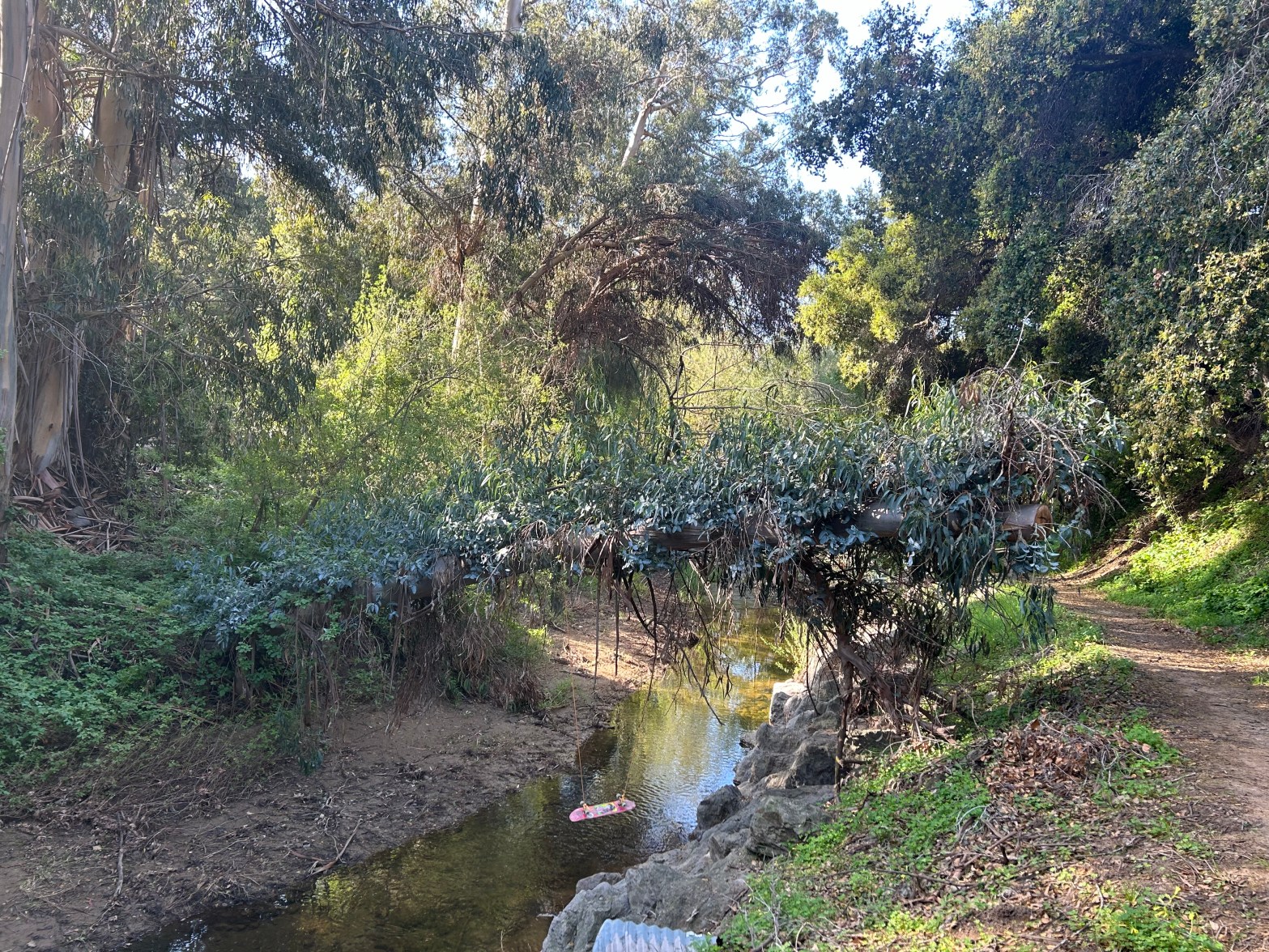
One recent afternoon my wife and I hiked up a local canyon. On our way back, the sun was beginning to set, and shafts of life were cutting through the oak trees. We stopped to take a few pictures. Here’s one:

As we resumed walking, I began thinking about how our awareness is naturally attracted to whatever in our environment is illuminated.  For example, in this photo, I find myself looking at the lower half where the light is brightest.

This can be a kind of bias — to the tree itself, the parts that I don’t notice because they are in the shadows are just as important as the parts reflecting the sunlight.  I was reminded of a timeless Sufi tale about a man looking for a lost key: 

The great Sufi master Mullah Nasruddin was on his hands and knees searching for something under a streetlamp. A man saw him and asked, “What are you looking for?” “My house key,” Nasruddin replied. “I lost it.” The man joined him in looking for the key, and after a period of fruitless searching, the man asked, “Are you sure you lost it around here?” Nasruddin replied, “Oh, I didn’t lose it around here. I lost it over there, by my house.” “Then why,” the man asked, “are you looking for it over here?” “Because,” Nasruddin said, “The light is so much better over here.”

            This tendency has since become known as the “streetlight effect: “a type of observational bias that occurs when people only search for something where it is easiest to look.”[i]

A psychology professor once described how our unconscious mind is often working to solve problems without our awareness, and sometimes we need to give it some space to help us.  He gave the example of trying to remember someone’s name.  We may stop and try harder and harder to concentrate on locating the fact — like turning up the power on our flashlight to maximum power – but that doesn’t seem to help.  He suggested we try letting our focused search go for a minute and shift our attention to something else, like looking out a window.  When we do that, the name we are looking for will often appear in our awareness like a gift out of the blue.   Turning our attention elsewhere allows the answer to come to us from “the shadows” of our mind.

            I’ve applied this often in conversations.  Someone is telling me a story and gets stuck trying to remember a name.  They get frustrated when they can’t come up with it.  I’ve learned to say, “Just keep telling your story and it will come back to you.”  Almost always, when they resume their story, the fact will come to them and they’ll say, “Oh, now I remember…”

            During COVID, I took some Zoom writing classes from Marilyn McEntyre.  One of them was called, “Writing Into The Unknown.” Marilyn told of being in graduate school and meeting with a professor to receive a paper he had graded. He told her it was flawlessly done. “But,” he said, “it’s boring.” He encouraged her to take more chances.  She realized she had always depended on using outlines, knowing exactly where she was going when she started to write.  This can be useful in some situations. But it can be an impediment in creative and personal writing.  She encouraged us to start with a hunch or a feeling and see where it goes. Often, we surprise ourselves by discovering insights we didn’t know were “in” us.   Moving away from the lamppost can lead us to the key.

This resonates with the book In Praise of Walking,[ii] which I wrote about some months ago. If we have been working on a problem at our desk and feeling stuck, it’s well worth our time to get up and go for a walk.  As our attention shifts away from the problem, interesting ideas often bubble up to the surface of our awareness.  What we’ve done is give the unconscious/shadow part of our mind a chance to share what it’s quietly been working on all along, and it rarely disappoints.

In recent years, I’ve become more aware of “somatic intelligence” – the capacity of our body to know things that our conscious mind hasn’t figured out yet.  Sometimes we “get a feeling” about someone or something and we’re not sure where that comes from, but the feeling/thought turns out to be valid.  We use our rational mind to evaluate what we are feeling, but we do so while recognizing we may know more than we can say and be open to the unseen within us.

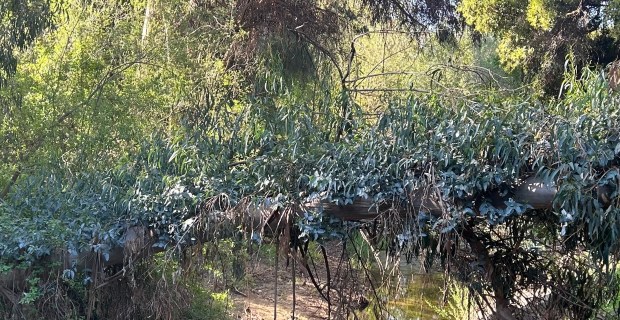
Let’s go back to the photo of the tree.  At first, all my attention was drawn to the lower half.  Here’s what the upper section shows:

A very different look from the lower half.  And the more I look at it, the more mysterious and interesting it becomes – so dense with intertwined growth representing years of making its way in this canyon.

            Here’s the original photo, with the illuminated parts of the tree integrated with the shadow side.  Together, they form a whole:

May we appreciate the different aspects of our personal awareness as we navigate the wonders of this life.


[i] https://en.wikipedia.org/wiki/Streetlight_effect#cite_note-1

[ii] https://drjsb.com/2022/04/16/the-gift-of-walking-everyday-problems-electric-toothbrushes-and-an-easter-surprise/

“Mind Proposes, Soul Disposes”

         I remember Huston Smith describing his first meeting with the Dalai Lama in Tibet. In 1964 the Dalai Lama was in his twenties and not well-known.  Huston was a young scholar in India studying Buddhism and had been told he should meet this new spiritual leader. After they greeted each other and he agreed to be interviewed, the Dalai Lama turned to escort Huston to the next room; Huston overheard the Dalai Lama say softly to himself, “This may be important. I need to be attentive.” 

Fifty-six years later, I was spending five days with Huston Smith and two dozen others at the Esalen Retreat Center in Big Sur.  I’d followed his writings for many years and heard him speak in Santa Barbara several times. He’d grown up in China where his parents were Methodist missionaries; the essence of what they taught him was “Be thankful for what you have and bear one another’s burdens.” He grew up speaking English and Mandarin and delighted in Chinese folk culture. He came to the U.S. for college and then spent his life traveling the world learning all he could about the great spiritual traditions. He summarized what he’d learned by writing The World’s Religions, which has sold over 3 million copies.  

Huston was not only a learned man but also a humble pilgrim; he wasn’t just smart, he was wise.  When he spoke, his face would often break into a wide smile and a bright light shined from his eyes.  The chance to be with him for five days of conversation was a dream come true.  My notebook is filled with things he said I wanted to remember.  This week one phrase came to me: “Mind Proposes, Soul Disposes.”

I take this to describe an experience we all are familiar with.  A thought arises within our mental awareness that seems like a suggestion or an impression. It can appear like words on our inner screen or maybe our personal voice speaking to us from within.  This is the “mind proposing.”  What do we do with this “proposal?”  A different kind of awareness comes into play as we consider the suggestion.  We ask ourselves: “Is this the way I want to feel?” “Is this suggestion something I really want to do?”  “Is this a path I want to follow?” As we decide, it is the “Soul Disposing” – our inner, “Higher self” coming into play, indicating a possible direction like a compass.  Then it’s up to us to decide if we go that way or not.

Much of our daily life can be spent without the “soul disposing.”  An idea occurs to us, and we act on it without much thought: “Time to get up.” “I’m going to make some coffee.” “I’m going to get the mail.”  Such actions don’t require a great deal of careful reflection.  But sometimes there are important crossroads we come to when our mind is proposing an action or direction, and we recognize we need to “think about it.”  To put it another way, we need our “soul” to help us – we want to make a good choice, the “right” choice.  Our soul draws on our deepest values and aspirations.  I think this is what the Dalai Lama was reminding himself to do before he sat down for the interview: “I need to be attentive.”

         The psychologist and holocaust survivor Victor Frankl famously said it this way: “Between stimulus and response there is a space. In that space is our power to choose our response. In our response lies our growth and our freedom.”

         For some of us, this is where spirituality comes into play.

         I’ve been reflecting on what “spirituality” means for a long time.  One way to define it is a personal sense that there is something greater than us in this world. On the one hand, this humbles us. On the other hand, this inspires us.  The great traditions tell us stories that can amaze us with their insight.  They teach us to see our life as a divine gift and to embrace the call to serve others. They give us practices to develop and stay in touch with our “souls” – through worship, prayer, music, study, community, time in nature, and acts of service.  When we reach moments when our “mind” has “proposed” an important action, we can call on what we’ve learned to “dispose” of the options, helping us recognize which one we want to pursue. 

Three weeks ago, a friend called to tell me a wise mentor and treasured friend to both of us had suffered a stroke and was in the ICU. He was 92. When I visited the next day, we had a brief but meaningful conversation.  I had recently written him a letter, telling him how much he had meant to me at different times in my career; now I was grateful I had not waited to do that.  He knew how much he meant to me.         

I asked him if he’d like me to pray with him, and he said yes. Over the years, I’ve learned to ask people what they want me to pray for, rather than assume I know.  I asked. He said, “Acceptance.”  We prayed for that. I visited him two days later and he died the next day.

Looking back, I realize he always listened to others carefully.  And when he spoke, you sensed it was his soul calmly speaking to you, often with a smile.

 “Mind Proposes, Soul disposes.” 

This may be important. I need to be attentive.”

Between stimulus and response there is a space. In that space is our power to choose our response. In our response lies our growth and our freedom.

Our Soul often wants to speak.  It’s up to us to take the time to listen.

Huston Smith and me, Esalen, 2010; he was 91 at time.

He lived six more years.

Finding Personal Clarity in Stressful Times

            Recently I’ve been trying to keep up with the unfolding nightmare in the Middle East, the ongoing threats to our democracy, and the growing effects of climate change.  I ask myself what I can do about these and other issues while I do my best to manage my own responsibilities.  As many of you know, it can be exhausting. 

            This week my thoughts turned back to a book that was a bestseller for many years: The Seven Habits of Highly Successful People by Steven Covey.[i]  I’m often skeptical about self-help books that seem to oversimplify the complexities of life. However, I found Seven Habits to be useful.

The first habit he called, “Be Proactive,” and a simple diagram can illustrate it:

Covey said we may be investing our attention in many things during the day and it can leave us feeling overwhelmed.  But what if we separate what concerns us from what we can influence?  To fret about things that concern us when we can’t do anything about them can drain and dissipate our energy. But if we focus on things we can actually do something about, we will discover we are not helpless.  Instead, we will gain an improved focus that allows us to be clear, strong, and effective.

            Many people have expanded on this concept, distinguishing what we can control from what we can’t.  Here’s one example[ii]:

            When you think about the situations and challenges that have occupied your attention today, which circle would you place them in?

            This perspective is like the famous “Serenity” prayer:

God, grant me the serenity to accept the things I cannot change, 
the courage to change the things I can, 
and the wisdom to know the difference.

Deciding to let go of some concerns we can do nothing about and instead focus on those we can influence and control can be empowering. 

But I will confess that sometimes a curious feeling arises in me when I try to see my life through this kind of lens: guilt.  “I should always be concerned about events beyond myself;” I say to myself.  “If I don’t, I’m just being selfish.”     

            But that’s not how it works.

            As 2018 began, I was Director of the La Casa de Maria Retreat and Conference Center.  Our staff of 45 managed 26 acres and hosted 12,000 guests a year. On January 9, a mud and debris flow wiped out eight of our buildings and filled almost half of the property with boulders, crushed oak trees, and silt.  In the time that followed, we had to lay off 2/3 of our staff, some of whom had worked there for more than 30 years.  Day and night I was trying to comprehend what had happened, how this was personally impacting the laid-off employees, how and when we might reopen, and what it would take to rebuild.

At one point I attended a social event at a friend’s house.  I greeted one of our friend’s relatives who had been a wise and caring psychiatrist during her career; in prior years I had enjoyed meaningful conversations with her. She asked how I was. I said I was OK but was constantly thinking about the disaster.  She looked me in the eye and said, “Make denial your friend.”  I was shocked.  Isn’t “denial” something we should never do?  But as we talked, I could see what she meant. Thinking about heavy, complex things all the time can paralyze us.  We need to take time to block out those concerns and engage in activities that replenish us. Then we can return to our responsibilities with fresh vision and energy.

It’s important to discover what renews us when we are trying to sort it all out.

            I recently watched Ken Burns’ documentary “The Roosevelts” for the third time.  It follows the tragedies and challenges Theodore, Eleanor, and Franklin each faced. They not only endured a great deal but became more skilled in leading and serving others.  I was intrigued to discover that in the darkest days of World War 2, when the fate of the “Free World” was hanging in the balance, FDR would regularly take time to go sailing or bird watching.  Then he’d come home and insist on mixing the martinis for his guests at 5 PM and enjoy their company.   These times of “denial” were times of replenishment.  Such practices help us to find the focus we need to make a difference.

            I take my responsibilities in the world seriously and am actively engaged in organizations and activities that address the larger issues.  But I find I need to manage my emotional and mental energy so I don’t become despondent or overwhelmed.  Taking time to separate my concerns from things I can influence — then finding “the courage to change the things I can” – is a liberating and encouraging practice.


[i] The 7 Habits of Highly Effective People, by Steven Covey, 1989.

[ii] Lemonkind.co.uk

What Do We See?

         A neighbor recently posted this photo and commented: “On my morning walk……after seeing houses decorated with fake webs, I came across this, the real thing. Made me happy.”     

When we stop to behold something like this, we can’t help but be amazed at the miracle of it all – how do these little creatures manufacture such extraordinary threads within their tiny body, and then weave them into this marvel of design and engineering?

         A moment like this brings to my mind a popular image in perceptual psychology:

What do we see?  A candlestick? Or the profile of two faces?  We can’t see both at the same time…our mind must decide which one is the object we focus on while the other acts as background.

         When I am taking a walk, I am often immersed in my private thoughts.  My concerns are like the candlestick and the world is the background.  But if I see something like these spider webs, my attention shifts:  my “I” drops into the background and the web becomes the focus. I am, as we say, “outside myself” in an experience of awe and wonder. 

         I recently read this by the astrophysicist, Neil deGrasse Tyson:

 “Humans want to think that they’re the center of the world. Children think this way. Then you come into adulthood and it’s a little disappointing to learn that’s not the case. We still think of events happening locally, in our lifetimes, as significant in a way that is out of proportion with reality. This can be depressing to some people, if you come into it with a high ego. If you go into it with no ego at all, you realize that you can be special not for being different, but for being a participant in life on Earth. That participation, if you’re open to it, can be quite illuminating, even sort of spiritually uplifting. You’re a part of all of life on Earth. Earth is part of all the planets that exist in the galaxy. The galaxy is part of an entire system of the universe.”[i]

         Beholding the spider web, which exists entirely independent of me, “…can be quite illuminating, even sort of spiritually uplifting.”

         For some of us, it’s more than “sort of” – it really is spiritually uplifting.

         When I was in my early 20’s, I was immersed in my own personal world of ambition and desire which led to a personal crisis.  One night I was trying to fall asleep and began to feel like my sanity was slipping away.  At the time, I didn’t believe there was any spiritual presence or power in the world.  But I was desperate.  I prayed (I don’t remember what words I used.)  Three days later, I was painting an apartment ceiling, and in an instant, the memory of that night came back to me…how afraid and desperate I was.  Then I remembered I had prayed for help.  Then I realized something had changed within me.  Where my inner world had seemed so dark and empty, now there was a small, quiet point of light at the center and I felt a sense of inner peace.  I did not hear any voices or get any messages. I did not in any way connect this with organized religion.  But I was totally surprised.  And grateful. And hopeful. The problems that had led me to my despair were not solved in that moment, but somehow, I knew I would be able to begin repairing and redirecting my life.

         Several years later, I found myself skeptically stepping into a church. There it began to dawn on me that my private, mystical experience was like that of many people over the centuries.  When this happens, we no longer feel as if we are at the center of the universe.  Instead, we become a witness to something greater.

         In seminary teacher once used the candlestick/faces image to describe the nature of spiritual awakening: we start out in life assuming we are the candle in the foreground and the world is our background.  But then it reverses — we feel like we are in the background beholding a much greater reality.  Our ego may not like being displaced.  But realizing we are no longer at the center doesn’t feel disappointing; instead, it comes with a sense of liberation.

          There is a 3,000-year-old story that has become a favorite of mine. Jacob is traveling through the desert amid his own complicated life.  At an uninhabited place of no importance, he lays down to sleep for the night, taking a stone for a pillow. He has a dream in which he sees a stairway leading up to the heavens, and the voice of God speaks to him.  In the morning he wakes up, remembers the dream, and says, “Surely the Lord is in this place and I did not know it.” (Genesis 28:16) An environment that had seemed ordinary has become enchanted.  He pours oil on the stone to mark the place of his divine encounter.

…you realize that you can be special not for being different, but for being a participant in life on Earth. That participation, if you’re open to it, can be quite illuminating, even sort of spiritually uplifting.”

It’s a wonderful thing to know we are not the center.  Being a participant is a gift beyond measure.


[i] https://www.garrisonkeillor.com/radio/the-writers-almanac-for-thursday-october-5-2023/