Three Strikes and You’re Back in the Car

                  Our annual trek to the Mt. Shasta area was a month later this year, so we arrived as summer was ending and fall arriving.  The forecast was for a chance of rain and thunderstorms on and off during the week. 

                  We spent the first few days exploring favorite lakes and rivers. Our fourth day was going to be our last, and we decided to see how far we could venture up Mount Shasta itself.

                  We drove to a spot known as Panther Meadows.  Half a dozen cars were parked at the trailhead.  The sky was overcast.  We got out and began to follow the trail. Within a few minutes, the sky got dark and an intense hailstorm began.  We joined several other hikers laughing and scurrying back to our cars. Strike One.

                  We drove down the road and within a few minutes had left the hailstorm behind.  We parked at “Bunny Flat” (6,950 feet) a popular staging area.  More than a dozen times we’ve hiked an hour up the trail to Horse Camp and a stone cabin built by the Sierra Club.  We decided to see how far we might go.  We were walking two or three minutes when an intense lightning flash lit up the area around us, and, in the same instant, the loudest and sharpest thunderclap I’ve ever heard roared over and through us. We hurried back to the car, as did the other nearby hikers. Strike Two.

                  We drove down the mountain and thirty minutes later were regrouping at our hotel in the town of McCloud (elevation 3,271 feet, population 945).  After lunch, we decided to try a nearby trail known as Cabin Creek.  We drove several miles down the road that leads south out of town, then turned onto the unpaved road that leads to the trailhead.  Ten minutes later we arrived; one other vehicle was there.  Just as we were parking there was a flash and thunder close to us like what we had experienced on the mountain.  Strike Three. 

  “We are getting a message. Let’s accept it.”  We drove back to our hotel.

                  We talked about how our ancestors could interpret these moments as divine messages.

                  I thought about the story of Moses confronting Pharoah in the book of Exodus, using frightening events to convince Pharoah to let the people go.  As the story has come down to us, Moses “struck” the Nile and turned it into blood; his brother Aaron “struck” the earth with his staff and gnats overwhelmed the land, hail “struck down” plants, trees and animals, and on it goes. After the tenth plague, Pharoah released the people.

                  I once read a biography of the great Puritan theologian Cotton Mather. For Mather and his community, every dramatic natural act was a message meant to be decoded by faithful people. Once he was in a meeting upstairs in his home with one of his church elders when lightning struck close to the room they were in. They both fell to the floor, praying for forgiveness as they tried to determine what terrible act or thought of theirs must have warranted this divine display of displeasure.

                  In our own time, we are experiencing increasingly intense natural disasters that shock and humble us. In my own community, we’ve been “struck” by increasingly intense wildland fires, unusual weather patterns, and the 2018 debris flow.  I don’t see these as divine messages. But isn’t it reasonable to interpret these as nature’s warnings and wake-up calls, summoning us to turn back from the many practices that have contributed to climate change?

                  As life goes on, many people experience unexpected medical challenges.  I hear some say, “I took that as a wakeup call to change my behavior.”  Many find the determination to make changes and, looking back, are grateful for the event that woke them up.

                  Later in the afternoon of “The Day of the Three Strikes,” the threat of thunderstorms had diminished. From our hotel, I went for a walk in the town of McCloud.  Being from Southern California, I was amazed at how green the trees and lawns are. I went to Hoo-Hoo Park, where we’ve often gone for the annual “Lumberjack Fiesta” in late July.  The park and softball fields were empty of people; everywhere the grass was plentiful, thick and rich. The town, surrounded by forest, seemed particularly quiet.  The logging industry has faded over the years, taking with it economic opportunity and prosperity. But the people love and honor the land they live on and respect the mountain that rises above them.   They watch out for each other and do the best they can.

                  As I walked, I had a new appreciation for how vulnerable we are. But the point of life is not to hide in fear. The point is to find wisdom and flourish. I felt I could take three life lessons with me: Be Alert.  Be Careful. And, when the time is right, Be Grateful.
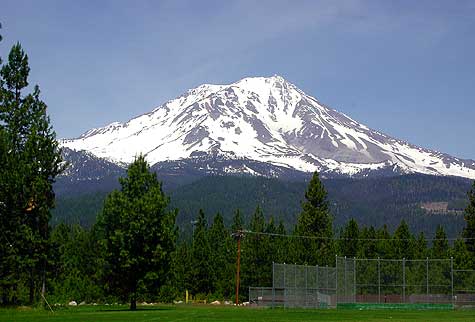
Hoo Hoo Park

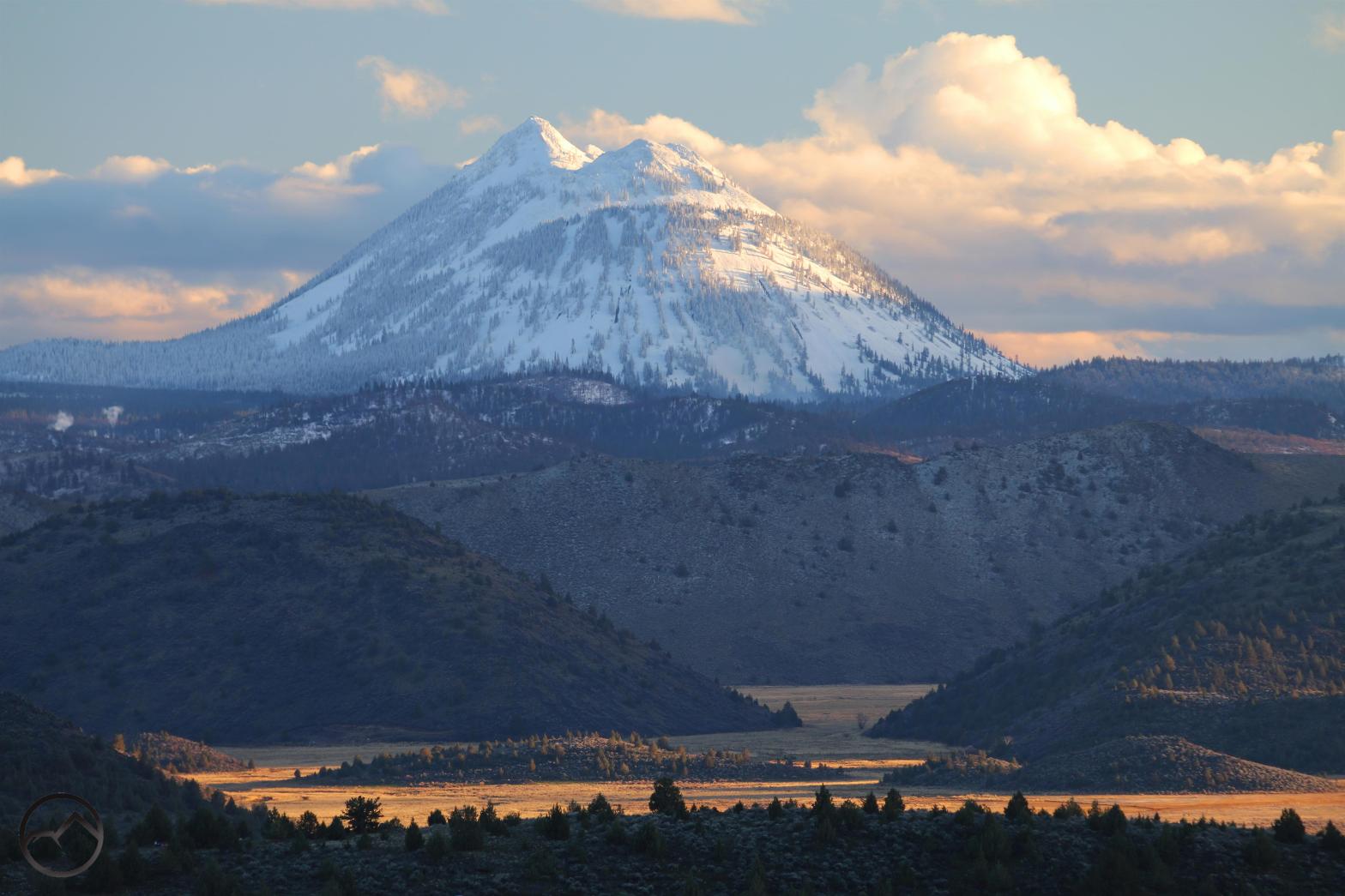
Lead Image: Hikemtshasta.org

Red Light, Green Light: Lessons from the Copenhagen Bicycle Commuters

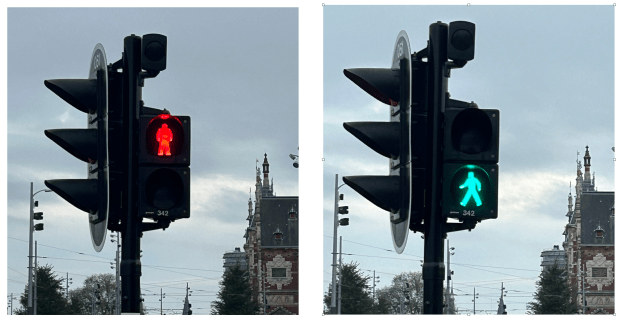
In February 2020, I was in Copenhagen having my early morning coffee in a corner café adjacent to my hotel.  It was raining, and I was watching Danes going to work on their bicycles.  The traffic light turned red and a dozen commuters stopped their bikes and waited.  I looked up and down the intersection and could see there were no cars coming from any direction. I expected they would do what many Americans would do – seeing it was safe, resume their pedaling through the red light.  But the cyclists patiently waited for the light to change. In the rain.  At peace.  The light changed to green, and off they went.

Four years later I was in Berlin and observed the same phenomenon: pedestrians obeying the red crosswalk signal, even when it was safe to cross.  My impatient American-self pleaded with me to cross, but not wanting to reveal my tourist identity, I waited.  Instead of being in a hurry, I became more aware of where I was; “present in the moment,” as the saying goes.

For the rest of my trip, I did my best to practice this discipline at crosswalks: welcoming the red light as an invitation to pause and reflect.  I grew to appreciate it.

Last spring, I shared a story about a group of indigenous porters who had been hired by Westerners on a journey.  After three days of relentless trekking, the Westerners had a sense of pride that they could cover so much ground in just three days. But that night around the campfire, the porters said they would not go any further the next day.  The Westerner asked why.  The response: “…we went so quickly yesterday that we must wait here for our souls to catch up with us.”

In the years I was involved at La Casa de Maria Retreat Center, I saw countless people arrive who had been allowing themselves to work nonstop; even as their body and spirit had been flashing a red light that it was time to slow down, they had pressed on. Now they were burned out. They’d leave their car in the parking lot and, eventually, leave their cell phone in their room. They would begin to slow down. Avoid the news. Nap. Walk.  Hike.   Meditate.  Read. Contemplate. Enjoy the food. Sleep in.  After a few days, you could see the difference in their faces: they were calm, alert and optimistic. Their personal sense of identity and purpose had returned.  As they packed their cars and drove away, they were ready for the green light of re-engagement.

In the last two weeks, I shared my experience of spending five days in the hospital in late June followed by six weeks of daily antibiotic injections.  I am free to do many activities, but there are others I cannot do — swim, play golf, and travel out of town (I had to bow out of three trips we had planned). It’s as if I was charging into summer, looked up, saw a red light, and came to a stop.  A familiar voice within me has been restless, looking for reasons I could charge ahead.  But another voice is inviting me to see this as an invitation to pause and take stock of my life.  I am working on a personal reset and curious to see what I discover. I also look forward to the day when the light turns green.

“Mindfulness Invitations:” Berlin, September, 2024

Lead image: “Copenhagen Bicycle,” ar.inspiredpencil.com

Letting the Sea Speak

What is it about the sea that stirs our imaginations?

What is it about taking a walk on the beach that helps us see life more clearly?

Why is it many of us ask that our ashes be scattered on the ocean?

Many facets of nature can stir our imaginations, offering us metaphors for life and spirituality.  Recently I decided to turn my attention to the sea, searching for what it might teach me. Here’s my emerging list…

Like life, the sea is big, mysterious and wonderful.  The ocean covers 70% of the earth’s surface and holds 97% of the earth’s water.  More than 80% of it has yet to be mapped or seen by humans.  Just as a scientific reality, it’s amazing.  Isn’t life like that?  The millions of years of life evolving into so many forms including us?  Looking out on the sea, we are reminded of how small we are and how much we don’t know.

Both the ocean and the divine creating Spirit were here before us and will be here long after we are gone. But here we are in this moment.  In the big picture, we may be just “a drop in the ocean.” But here we are.  In the time we have we can learn what makes life worthwhile.  The Indian mystic Tagore said, “The butterfly counts not months but moments, yet has time enough.”

We walk on the edge.  When we take a walk on a beach, we can see what is close to us.  But beyond the horizon, the ocean reaches out far beyond our sight.  In our own lives, we “walk” through each day based on what is near us, what we can see and understand.  But at times we are reminded that so much more of life lies beyond our day-to-day living. 

It’s exciting to be on open water.  Two years ago, I took a beginning sailing class at the local harbor.  I remember the thrill the first time I steered the ship past the breakwater into the open water.  It was exhilarating.  Sometimes in life, we make a move or start a new chapter, and it feels like that.

In open water we navigate as best we can, but sometimes strong currents come upon us, pulling us in directions we do not want to go.  When I was a teenager, our family had a small house in San Clemente where we spent many summers.  Every chance I had, I would grab my Duckfeet fins to go bodysurfing.  I became confident enough that when distant storms in Mexican waters sent swells up the coast, I could join the veterans who went out to catch the large waves.  On one such occasion, I was with a group watching the horizon for the next set.  I happened to look back at the shore.  The beach looked like it was rapidly moving southward, which seemed strange since I was treading water.  Then I the realized the shore was not moving – I was.  A strong underwater current had developed and was taking me northward.  The next thing I knew a lifeguard came alongside and pulled me up into a boat, ferrying me and others to the pier. I was grateful someone was looking out for us.  Unforeseen events in life arise and take us with them; it’s not easy to regain control on our own.  It can be frightening.  It’s a gift to discover someone sees us and can help.

It’s vital to know how to find a safe harbor when we need it.  We can find a safe harbor in life in many ways, including having people we can turn to when we feel “out to sea,” confused or overwhelmed.  From a spiritual perspective, it’s a deep blessing to know we have a divine source of courage and wisdom that comes from beyond us.  We can access it in prayer, contemplation, Scripture, music, art and community.  Countless times I’ve seen a spiritual community reaching out and rescuing someone who’s being overwhelmed by life. It’s a beautiful process to see and reassuring to know.

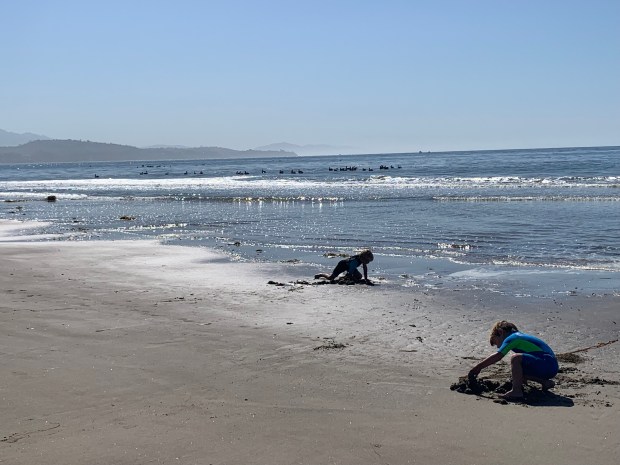
Every time I ride my bike to the local beach, I feel renewed.  Every time we take our grandkids to the beach, they become lost in play.  Every time I’ve been part of a committal service which includes casting a loved one’s ashes on the sea, I feel a sense of peace. I’m grateful for all the ways the sea speaks to us.

Small Moments to Savor

As I was planning our trip to Europe, I explored the possibility of staying in a hostel instead of a hotel. I knew I was too old to sleep in a dorm room but wanted to experience the open and hospitable spirit I had known as a young backpacker.  For the stay in Berlin, we booked a place at the “The Circus Hostel.”  It’s a five-story building in the “Mitte” (central) section of the city, close to many points of interest.  They had a 2-bedroom apartment on the top floor available. My sister agreed we should try it.

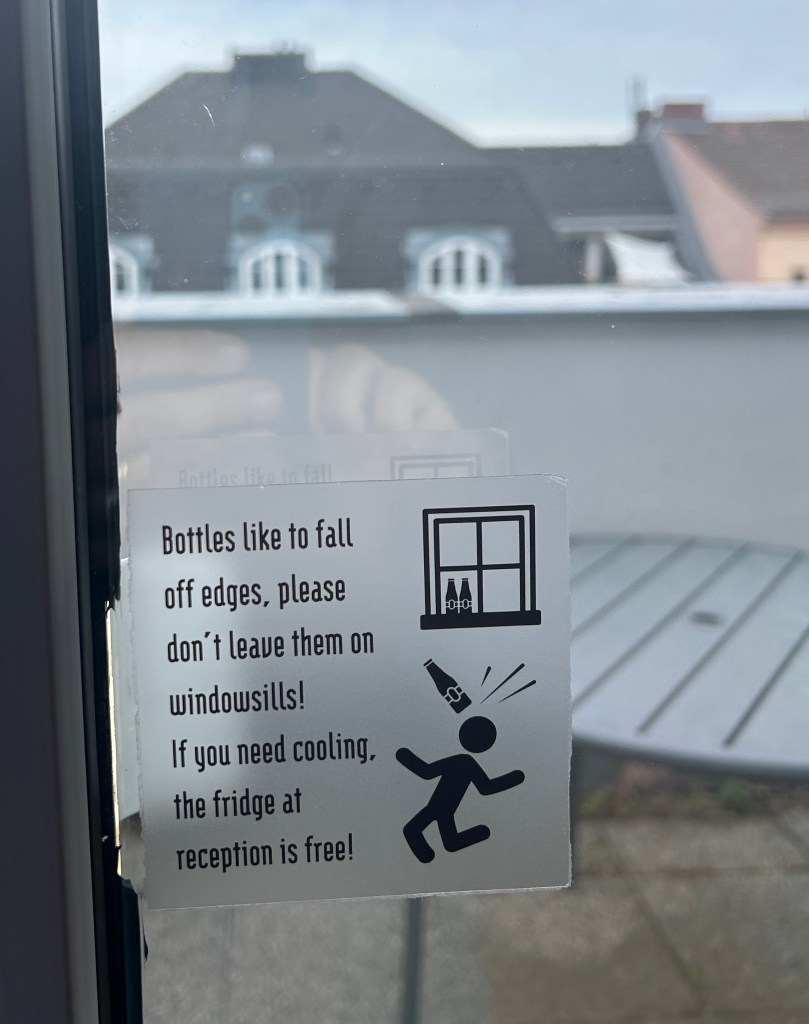
              In the basement they have their own pub and small brewery.  On the ground floor is a café and reception area.  Upper floors are for the bunk beds and apartments.  As we settled in, I began noticing the posted signs.  On the sliding glass door leading to the balcony:

The notice to set out when you want maid service:

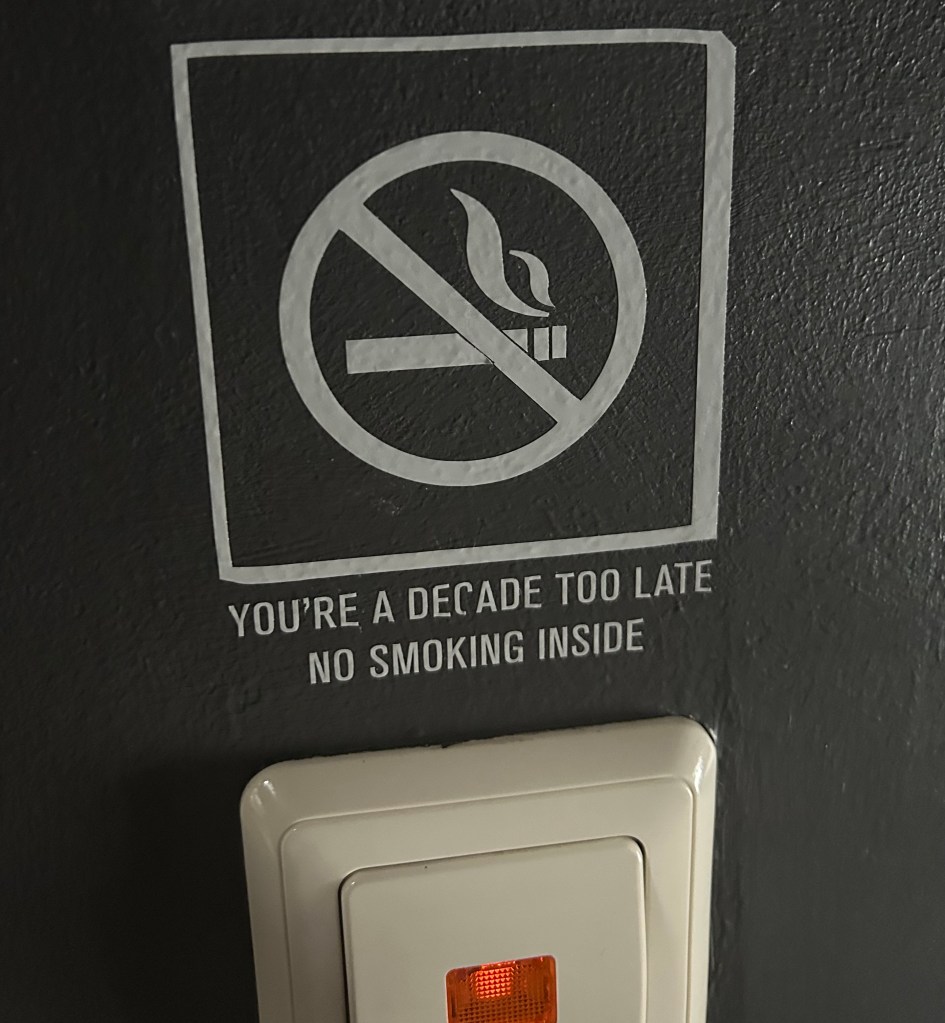
On the wall next to the elevator call button:

A similar playful spirit was on display in nearby cafes.  French fries are very popular in Belin, and a busy place across the street had this window:

I didn’t go to Berlin expecting to eat Mexican food, but appreciated this sentiment:

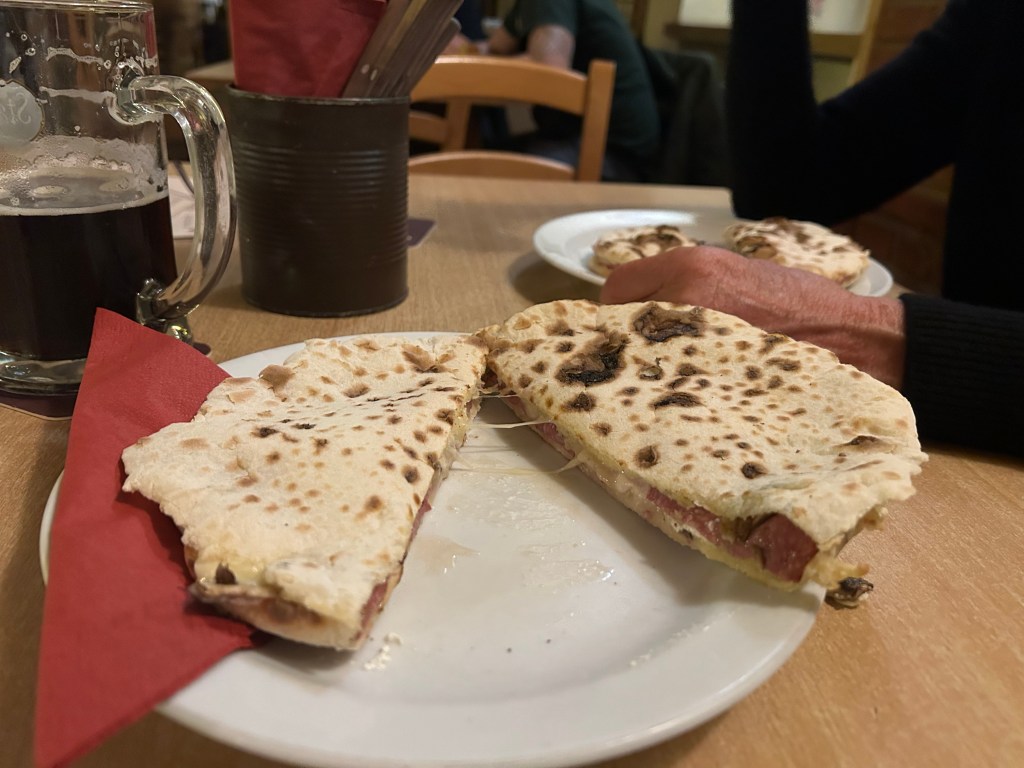
Not far from Sigmund Freud’s Vienna home and office where he probed the hidden recesses of the human psyche, we found a brewery/pub that offered more than two dozen pitas with your choice of pizza-like filings (including tuna, camembert, cranberry jam, turkey, olives, sour cream, onions, hardboiled egg, tomato sauce, etc., etc.).  On the wall was this timeless question:

I don’t know if Freud pondered that dilemma – for him a bigger question might have been about how many cigars were enough.  But after hours contemplating tragic historical events and staring at modern expressionist paintings, these were “welcome signs.” Small moments to savor along with new tastes and friendly places.

“Eyes Wide Roaming”

Dear Reader: 

This week I want to introduce you to a new blog: “Eyes Wide Roaming.”  It’s written by a friend, Brad McCarter.  Brad is a commercial airline pilot who flies internationally.  When he has a 24-hour layover, he finds a spot like a coffee house or a pub and settles in.  He studies the environment, the people, and his own thoughts and feelings as they arise.  He then captures the essence of his experience in some beautifully crafted words and verses.  Every two weeks he shares a new piece from somewhere in the world.

I enjoy seeing how Brad expresses his experience so succinctly.  And after I read his posts, I feel like I’ve inhabited that space and time with him. This isn’t Lonely Planet or Rick Steves (both of which I enjoy.) This is soulful, personal, and fascinating.  For me, reading his posts is a way to “travel” to places I hope to visit someday.  It’s also about the inward journey we can experience when traveling. You can subscribe if you wish. (Like me, Brad isn’t out to “monetize” his work; it comes from a personal desire to observe the world and then share what one finds.)

I encourage you to take a look at his page and sample one of his pieces. Where would you like to go — Hong Kong, Munich, the Lower East Side of New York, London, or Tel Aviv (as it was before October 7?) Think about it — you don’t have to fasten your seatbelt, straighten your seat, or put the tray table back.

Here’s the link: “Eyes Wide Roaming”

Steve

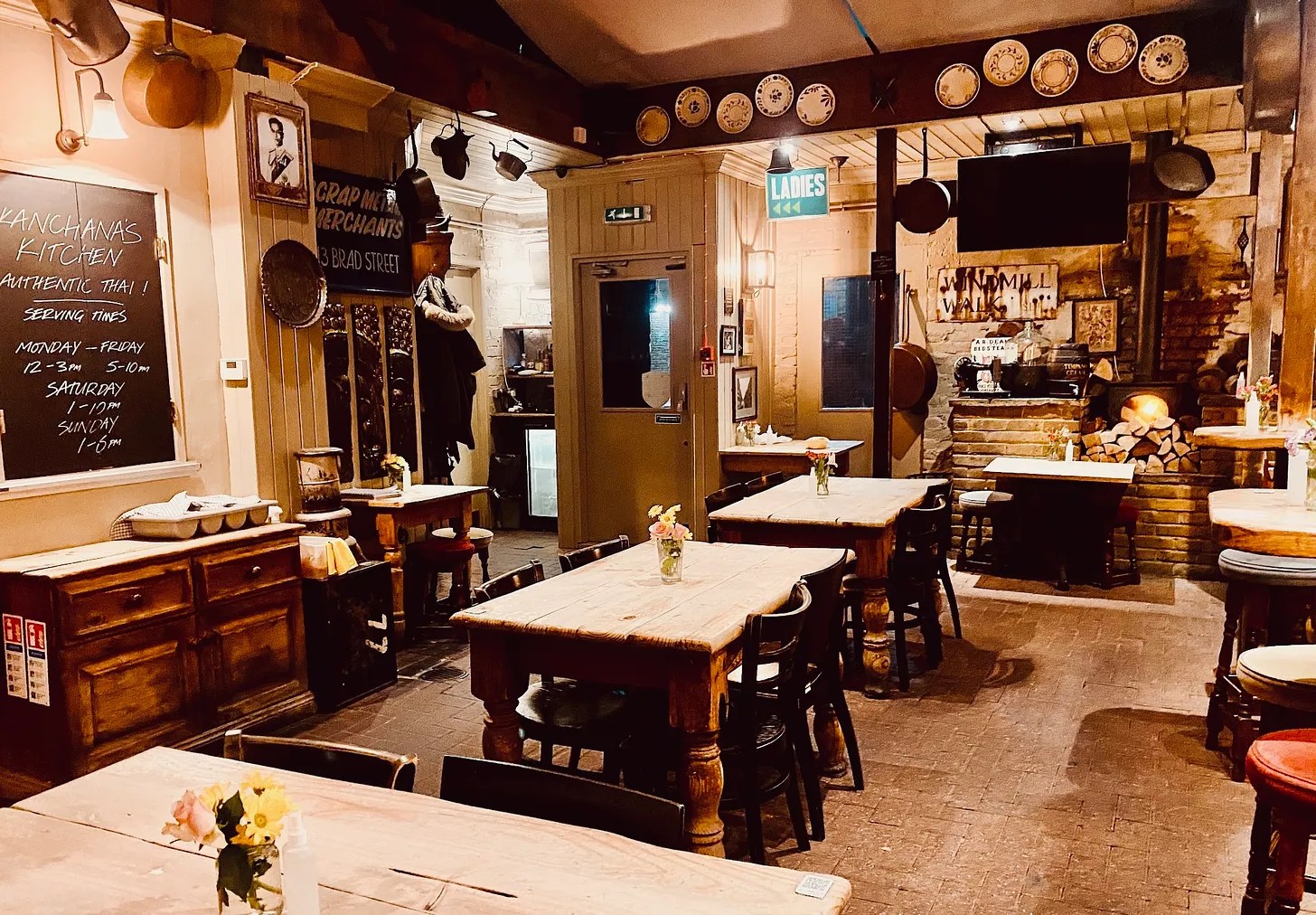
(The top image is a pub in London, the lower a street in Hong Kong.)