Are You an “Everyday Mystic?”

For centuries, a “mystic” was someone who had a rare and unique spiritual experience, different from what most of us would ever know.

This is reflected in the word itself: The term mystic is derived from the Greek noun “mystes,” which originally designated an initiate of a secret cult or mystery religion.   In Classical Greece and during the Hellenistic Age, the rites of the mystery religions were largely or wholly secret. The term” mystes” is itself derived from the verb “myein” (“to close,” especially the eyes or mouth) and signified a person who kept a secret.[i]

But in recent years, the term “everyday mystic” has come into use. Here’s one description:

An “everyday mystic” is someone who seeks or experiences spiritual depth and transcendence within ordinary daily life, rather than through withdrawal from the world or extreme ascetic practices.

The concept suggests that mystical experience—that sense of connection to something greater, moments of profound awareness, or spiritual insight—doesn’t require monasteries, retreats, or renouncing worldly responsibilities. Instead, everyday mystics find the sacred in mundane activities: washing dishes, walking to work, caring for children, or sitting in traffic.[ii]

I have known quite a few “everyday mystics.” They don’t try to be different or better than anyone else — they are simply doing something they feel called to do and, in the process, find a deep connection beyond and within themselves.  They don’t do it for money, or to prove their worth, or to puff up their ego. 

Some examples came to my mind:

  1. A physical therapist who told me there were times working with patients when his mind would become quiet and he would feel as if light was passing through him to the person he was treating.
  2. Farmers, gardeners and hikers who sense a silent and limitless bond with the earth and the mysterious processes which underly all life.
  3. Musicians who feel as if the music is playing through them.
  4. Grandparents when they behold their grandchildren.  They had loved their own children from the moment each child was born, but so much of parenting is about being a manager, behavior coach and the one person responsible for everything to do with the child. But then a grandchild appears and seeing them evokes a sense of pure wonder.
  5. Artists who get immersed in their process and end up creating something far beyond what they could have imagined when they started and don’t know how it happened.
  6. Mechanics who have an innate sense of what is wrong with a car and how to fix it with the least cost and effort, working in harmony with all the moving parts instead of simply using their will to fix something that is wrong.
  7. A young man who told me he was pitching for his college team and for a few innings the ball seemed to go exactly where he intended every time.  The experience passed and he never had it again.  He could not explain how it happened but has never forgotten what it felt like.
  8. Golfers who watch a ball rise and fall through the air with a grace and purpose that feels as if something more is present than a little ball being struck.
  9. Ocean swimmers who love the mystery of being on the surface of the limitless sea, and who feel deeply at home in salt water—perhaps sensing an unbroken thread of experience going back to our pre-human ancestors as well as our personal life as it began in the womb.
  10. People who know they are dying and “descend into the heart,” losing their fear and becoming open and observant towards everything around them.

Richard Rohr said, “For me, “mysticism” simply means experiential knowledge of spiritual things, as opposed to book knowledge, secondhand knowledge, or even church knowledge.”[iii]

Huston Smith said, “Most mystics do not want to read religious wisdom; they want to be it. A postcard of a beautiful lake is not a beautiful lake, and Sufis may be defined as those who dance in the lake.”[iv]

We can always be grateful when such moments come to us.

“Hands Cradling a Child’s Head,” Kathe Kollwitz, 1920

[i] https://www.britannica.com/topic/mysticism

[ii] https://claude.ai/chat/468625b2-74aa-4984-ba6e-8eb7f17a257a

[iii] https://cac.org/daily-meditations/sidewalk-spirituality/

[iv] Huston Smith, Jeffery Paine (2012). “The Huston Smith Reader,” p.93, Univ of California Press

Lead Image: “Ocean Swimmer In Thick Fog Near Reykjaice,” storyblocks.com

Cat Stevens Went Away — and Came Back

“When he was a child in Catholic school in London, (he) asked a nun, Sister Anthony, what might have been his first existentialist question: “When do the angels start writing down your sins?”

After a pause, she told him the scorecard began when children turn 8, a relief since he was still a year or two away. 

“Religion constantly made me feel guilty about nice-looking things,” he writes in his book. “But balancing those kind of fearful images with what was going on outside the doors of the church after school, I felt the pull of the world mighty overpowering.”[i] 

The boy to whom Sister Anthony was speaking to was Steven Georgiou.  The call to find some beauty in the outside world led him to become a musician and a songwriter. He had gifts which he developed and shared. He changed his name to Cat Stevens.

I remember well the impact he made on my generation. In 1970 much of the music of the time reflected angst and outrage.  But then albums came out that carried with them a softer tone.  James Taylor’s Sweet Baby James was one.  Another was Cat Stevens’ Tea for the Tillerman, with songs like “Where Do the Children Play?” and “Wild World.” Then came his biggest selling album, “Teaser and the Firecat.”  We heard songs like “Moonshadow,” “Peace Train,” and the English hymn, “Morning Has Broken.” There was still social concern, but the mood was more poignant, reflective and hopeful.

Several years later, Cat Stevens disappeared.  Word came he had given up music and become a Muslim, taking the name Yusuf Islam.  Only recently has he seemed to resurface. In a recent interview in the New York Times, he shared highlights of his spiritual journey which includes three close encounters with death. 

The first came when he was a teenager.  He and some friends were jumping between rooftops when he slipped and one of his buddies saved him from falling at the last second.  The second came when he was 20 and discovered he had tuberculosis.  Then there was the third:

Late in 1975, soon after Islam turned 27, his career seemed to be flagging. While he waited for lunch with his manager and label boss in Malibu, Calif., he decided to swim in the Pacific. After 15 minutes in the cold water, he tried to head back, only to find that the current was sweeping him to sea.

“I thought I could swim well, but I could not fight or beat the ocean. I had only seconds left,” Islam, 77, said recently during a video interview from a rented London apartment. So he prayed, insisting that, if he lived, he would work for God. A wave pushed him forward. “When I realized my vulnerability, what else could I do? My body was disappearing. I had only my soul left.”[ii] He began an earnest spiritual journey which led to his conversion to Islam in 1977.

Recently I’ve been in group discussions where a key concept of Richard Rohr’s has kept surfacing.  According to Rohr, our spiritual journeys can often go through three phases: order, disorder, and reorder.  In the “order” stage, we have clear ideas about who we are and what we believe.  But times can come when it’s not making sense anymore – we experience things that challenge that clear sense of order.  We enter “disorder,” a kind of spiritual wilderness where we are not sure what we can trust and believe. But eventually, we can form a new sense of direction and place – our world has been reordered.  And the process can keep repeating.

Looking back on Cat Stevens’ life, it seems he went from the order of his Catholic upbringing, to the disorder of seeking a new identity “outside the doors of the church,” to finding a new reorder as a rock star, to finding that was not enough and entering a new time of disorder as a spiritual seeker.  Eventually he found a new reorder as a devout Muslim which included giving up music.  In recent years, he’s looked for yet a new reorder in his life, integrating his faith with his musical gifts.  He has gone away and come back more than once – something he needed to do to adapt to life while also honoring his soul.

I find many of us go through similar journeys.  We’ve gone through phases of being settled, then unsettled. Then settled again. Then unsettled.  We may not come close to drowning in the ocean like he did at age 27, but we experience our “vulnerability” as we deal with changes and challenges in our personal life, relationships and world; as years go on, we may even feel our bodies are slowly “disappearing.”  But the spiritual life is a pilgrimage in which we are constantly learning and adapting.  Along the way, it’s a beautiful thing to realize we will always have our “soul left.”  And we can be grateful for those who are sharing the journey with us.

For an old, grainy video of Cat Stevens singing “Moonshadow” in 1971 before an adoring crowd of long-haired fans, click on https://www.youtube.com/watch?v=kGNxKnLmOH4

[i] “As Cat Stevens, He Knew That He Had to Go Away,” NYTimes, Sept 21, 2025

[ii] Ibid.

What We Run From Pursues Us

Last month I attended a hospice event featuring David Kessler, a leading educator and author specializing in grief work.  He shared one of his guiding principles: “What we run from pursues us.  What we face transforms us.”  

It resonated with a comment I recently read in The Tears of Things by Fr. Richard Rohr: “Remember, if you do not transform your pain and egoic anger, you will always transmit it in another form.  This transformation is the supreme work of all true spirituality and spiritual communities.”[i]

Rohr gave an example of this in a recent YouTube interview with Oprah Winfrey. Over the years, he has done a great deal of work with men’s groups.  Early on, he learned many of them had fathers who were often angry.  Midway through the retreat and when a sense of mutual trust had been established, Rohr would tell the men that the source of such anger is often unexpressed sorrow.  If we don’t express the sorrow, it builds up and becomes anger.  When the men at his retreat heard this, their feelings towards their fathers often shifted from resentment to compassion.

Sometimes we need to be in the right environment – like a retreat center or in the presence of a caring person — to let the pain surface.

When I was at Hospice of Santa Barbara, we obtained funding to initiate a community spiritual care program.  Believing there is a great deal of hidden pain and grief in nursing homes and retirement communities, we offered weekly visits from our staff to several nearby facilities.  One of our counselors was asked by the social services director at one facility to visit a new resident who had become reclusive since moving in.  He went for the first visit and was politely received.  She told him her adult children had wanted her to make the move from the East Coast so she would be closer to them. She appreciated their intent, but moving cross-country meant she had to leave her long-time community and friends.  After an hour of cordial conversation, he offered to come back the next week for a second visit, which she accepted. 

During the next visit, she talked more openly about her sense of dislocation and loss. 

He came back the next week, and after some brief conversation, she began weeping, then sobbing. Then, he said, emotion came out so strongly that she was physically shaking; he had rarely seen someone break down so intensely.  Eventually she became calm and composed. Their time was up, and she thanked him for the visit. 

When he returned the next week, she suggested instead of staying in her apartment she show him the nearby rose gardens.

When we can face and bear the pain that pursues us, we find not only a sense of release and relief but also greater awareness of the blessings around us.

I’m reminded of the last verse of the 23rd Psalm.  After alluding to times when the writer needed rest and renewal, as well having passed through the “valley of the shadow of death,” the imagery shifts to a sense of gratitude: “Surely goodness and mercy shall follow me all the days of my life…” Years ago I read a commentary on the Psalm by Rabbi Harold Kushner.  He posed the question: What does it mean that goodness and mercy follow me?  Aren’t they with me all the time?  They are, he says, but we are often too distracted and are running out ahead of them. But when we take time to stop and be present with our life, they can catch up with us and come sit in our lap.

[i] Rohr, The Tears of Things, pg.6

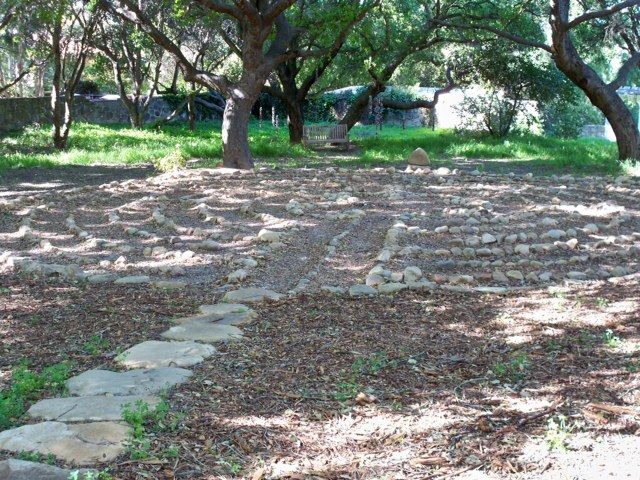
Lead Image: Outdoor labyrinth, La Casa de Maria          

Touching the Earth, Grounding Our Soul

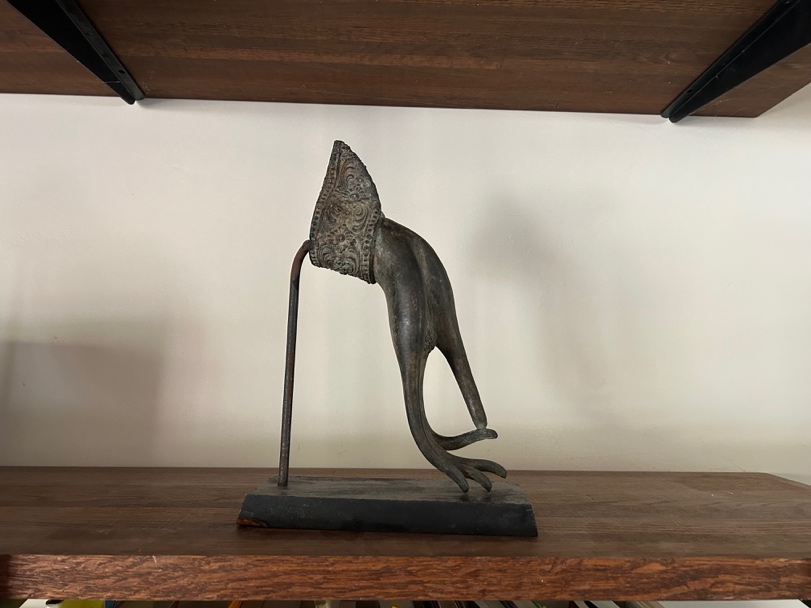
                  Some years ago, a friend brought this back from India as a gift, and it’s been sitting on my bookshelf ever since:


The hand gesture is based on a famous story in the life of the Buddha:

In one of Buddhism’s iconic images, Gautama Buddha sits in meditation with his left palm upright on his lap, while his right hand touches the earth. Demonic forces have tried to unseat him, because their king, Mara, claims that place under the bodhi tree. As they proclaim their leader’s powers, Mara demands that Gautama produce a witness to confirm his spiritual awakening. The Buddha simply touches the earth with his right hand, and the Earth itself immediately responds: “I am your witness.” Mara and his minions vanish. The morning star appears in the sky. This moment of supreme enlightenment is the central experience from which the whole of the Buddhist tradition unfolds.[i]

                  He is not just thinking about the earth and what it means, he’s physically connecting himself to the earth.  The action symbolizes that the spiritual teachings are not lofty ideas, but literally “grounded” in real life. 

                  This past week, one of Richard Rohr’s daily meditations noted the legacy of Brother Lawrence. Here’s an excerpt:

In the mid-17th century, a man named Nicolas Herman joined the Carmelite monastery in Paris, France. Wounded from fighting in the European Thirty Years’ war, and suffering a sustained leg injury, he took the monastic name “Brother Lawrence of the Resurrection.” He worked in the monastery kitchen and eventually became the head cook. Amid the chaos of food preparation and the clanging of pots and pans, Brother Lawrence began to practice a simple method of prayer that helped him return to an awareness of Divine presence. He called it the practice of the presence of God and described it as “the most sacred, the most robust, the easiest, and the most effective form of prayer.”  Brother Lawrence’s method of prayer is so simple that it might seem misleading. It is to cultivate and hand over one’s awareness to God in every moment, in whatever we are doing. Brother Lawrence recommends that newcomers to the prayer use a phrase to recollect their intention toward the Divine presence, such as “‘My God, I am all yours,’ or ‘God of love, I love you with all my heart,’ or ‘Love, create in me a new heart,’ or any other phrases love produces on the spot.”” [ii]

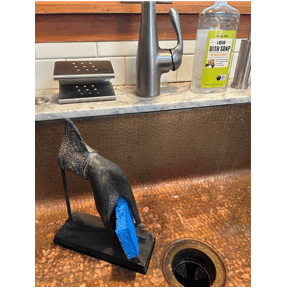
Brother Lawerence summarized what he learned in the little book, The Practice of the Presence of God.  I first read it early in my spiritual journey, and have — in my best moments — often remembered it when doing the dishes.  Instead of thinking, “This is such a bother – I’m going to finish this job as quickly as possible,” I try to take a Brother Lawerence attitude: “I’m going to slow down and be aware of the tangible experience of this chore: feel each dish in my hand as I pick it up, notice the warmth of the water, appreciate stacking the dishes in the rack one by one, be grateful in these moments of being alive…”  I tend to be easily distracted and lost in thought, but doing household chores in the spirit of Brother Lawerence can be a satisfying practice.

                  Recognizing the way in which daily tasks can “ground us” is a fundamental teaching in the Benedictine monastic tradition, summarized in the phrase “ora et labora.”  Every day, a monk spends time in prayer (“ora”) but also manual labor (“labora”); labora can mean cooking and cleaning, working in the garden or, in some pious communities, carefully brewing beer.[iii]

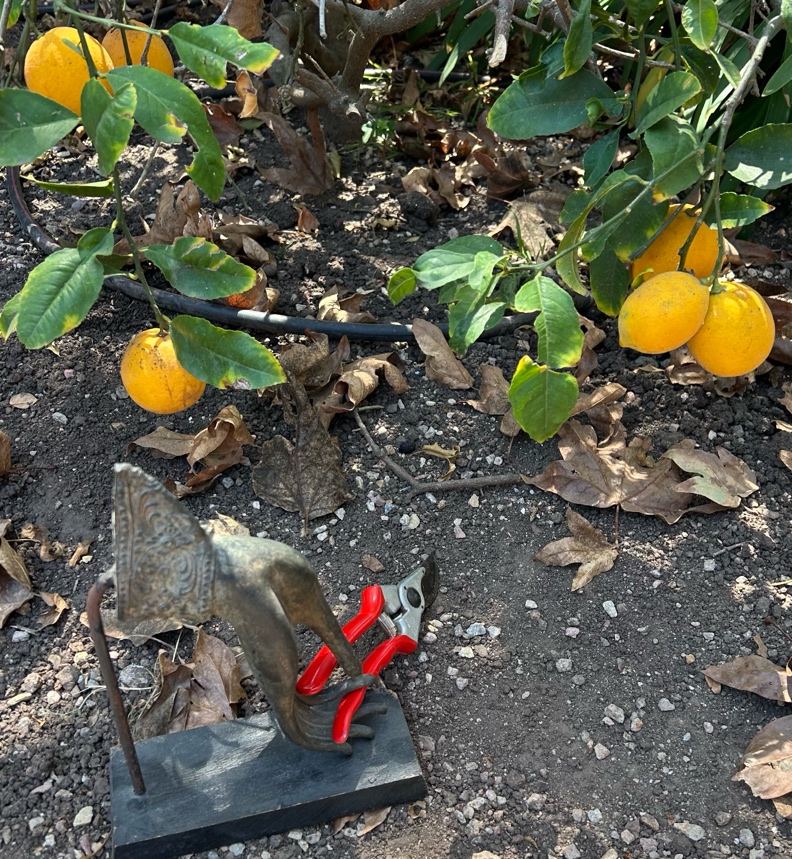
                  When I was working at La Casa de Maria retreat center, one of our most popular offerings was led by Cynthia Bourgeult, an Episcopal priest and writer.  Each person who came to the 5-day retreat could expect regular lectures by Cynthia, times of chanting and worship, and a daily period of physical labor performed in silence.  One of our staff responsibilities before the retreat was to come up with a list of manual tasks that retreatants could do, such as raking leaves, weeding gardens or caring for our citrus trees.  Sometimes we’d get a call from a person who wanted to register but said they did not see the point of doing any manual labor; Cynthia instructed us to tell the person this was not an option – if they weren’t willing to do it, they should not come at all.  She told us that some people who had initially not wanted to do the labor ended the week saying it became one of their most valuable experiences.

                  I think of the training I received during my hospice time that was based on Zen practices focused on “cultivating presence.” If we are with someone who is in physical or emotional pain, our thoughts and feelings can get tangled up in our concern for the person and we can lose our focus. We were taught to slow down our breathing and become aware of our rear ends in the chair and our feet on the ground, and to imagine the pain passsing through us into the earth. This can free our mind to be remain calm and open as we interact with the person — to be “present” and not distracted or anxious. I have found it to be a worthwhile technique.

Spiritual traditions include specific teachings, participation in community life and the practice of serving others in tangible ways.  As our culture becomes more fragmented and people more socially isolated, many studies have demonstrated that being part of spiritual communities leads to increased emotional and physical health.  The traditions ground us in what really matters, giving meaning to all we do.


[i] https://www.huffpost.com/entry/buddhism-and-climate-change_b_925651

[ii] https://cac.org/daily-meditations/brother-lawrence-of-the-resurrection/

[iii] Many monastic communities saw beer brewing as a particularly meaningful form of labor, and at one time there were a thousand monastic breweries in Europe.  For a current listing, see A List of the World’s Monastic Beers

The Weeds and Wheat Within

            Years ago, I was driving downtown to take my turn as a volunteer at the local soup kitchen.  On the way, I noticed the following thought appearing in my awareness: “You know, volunteering at the soup kitchen shows to you and everyone that you are a really good person.  People will notice and think highly of you.”

            Another voice spoke up, “What a tacky thing to think! You’re not going there today to show off.  You are going because you know in your heart this is simply the right thing to do.”

            Next thought: “What an amusing dialogue you are having, Steve.  Sounds like you got one voice that is selfish and another voice that might be decent.”

            I was tempted to think the second voice is the “real me” and the first is “not me.”  But, you know, I seem to have both voices within me all the time.  The first is always performing to impress my self with my self and hoping other people notice what a good guy I am. The second wants to just do the right thing for the right reason without any fanfare.

            41 years after being awarded a “Master of Divinity” degree, I am far from mastering the relentless and petty voice within.  

            I take heart from reading a recent “Daily Meditation” posting by Fr. Richard Rohr.[i]  He writes about the Gospel parable in which the field workers are concerned that weeds are growing in the same field as good grain.  The owner tells them not to worry – in the final harvest the weeds will be separated out, and the good grain will remain. Rohr says that, growing up, he felt the parable told him to be relentlessly looking for the “weeds” in his life and root them out.  But, over time, he sensed that was impossible and gave up. Then, as he matured, he saw the parable in a new way:

Jesus shows us an absolute realism. He says something that was never said to me when I was a young person: “Let the weeds and the wheat both grow together.” Wow! That’s risky. I can’t pretend to logically understand it, although I know it allows me to be compassionate with myself. After all, I’m also a field of weeds and wheat, just like you are, and just like everything is. Everything is a mixed bag, a combination of good and bad. We are not all weeds, but we are not all wheat, either. We have to learn, even now, to accept and forgive this mixed bag of reality in ourselves and in everybody else. If we don’t, we normally become very angry people. Our world is filled with a lot of angry people because they cannot accept their own weeds.

To accept this teaching doesn’t mean we can say, “It’s okay to be selfish, violent, and evil.” It simply means that we have some realism about ourselves and each other. We have to name the weed as a weed. We can’t just pretend it’s all wheat, all good, because it isn’t. We’re not perfect. Our countries are not perfect…. The project of learning how to love—which is our only life project—is quite simply learning to accept this. If you really love anybody, and I hope you all do, then you have learned to accept a person despite, and sometimes even because of, their faults.

            This has strong parallels with Buddhism, in which we avoid the folly of thinking we can block thoughts we don’t want to have. Instead, we learn to let them come into the open, and to observe and assess them. In that freedom, we become more compassionate with ourselves as “complicated” creatures, as well as more compassionate with our fellow human beings who live the same inner complexity.

            This perspective doesn’t mean we passively accept disappointing behavior in ourselves or others. But it does invite us to be realistic that to be human is to be a mixture of wheat and weeds. Constantly sorting out the inner voices is hard work and, like the peasants in the Brueghel painting, sometimes it’s OK to take a break. But it’s vital work, and I’m grateful to Father Richard for this liberating insight.

Image: The Harvesters, Brueghel, 1656


[i] https://cac.org/daily-meditations/the-weeds-and-the-wheat-2022-08-28/