Arrivals and Departures

A friend and fellow blogger dropped his daughter off at college in Eastern Washington state, then boarded a plane going home to southern California. He recently described how it felt as the plane rose into the air:

Casting a shadow moving away from there. That’s us down there, pointing back toward where the 18 years happened. Watching the long-planned departure take place. Mulling that our part in her life is getting smaller. This is what we hoped for, right?  That’s us down there, shrinking.[i]

Brad’s imagery lingered with me.  I began imagining how some life experiences are like being on an airplane as we arrive or depart.         

Arrivals

The birth of a baby: I remember the moment when the doctor lifted our first daughter from the womb. She looked my way, our eyes met, and she seemed to be thinking, “Where in the world am I?” 

A child’s first laugh:  My nephew and his wife recently shared an enchanting video of the first time their infant son looked at them and smiled.  That week my wife and I had been watching “Dark Winds,” a detective series set in a Navajo community.  In one episode, an infant laughs for the first time, which, in Navajo culture, signifies the infant has become a person.  The family holds a traditional ceremony to mark that moment.

First personal memory: I was probably 4 years old. I was standing in a bedroom in our house.  I had taken three eggs from the refrigerator, snuck into the room, and was carefully dropping them one by one onto the linoleum floor.  Just as I dropped the second one, my mother came down the hall, saw me, and said, “What in the world are you doing!?!”  I said, “I wanted to see what it looked like when they cracked.” She took the third egg away from me.  I can still see the yellow yolks floating in the puddle of egg white on the floor.  That is the first time I remember being self-aware. I was watching myself; that same observer is me now, thinking about the words I am typing.

First spiritual awareness:  In 1991, the child psychologist Robert Coles published The Spiritual Life of Children, in which he described how children in different cultures wonder about God and the meaning of life.  Many of these experiences happen before a child is eight years old.  Perhaps you have such a memory.

Landing in a far away country:  In 1975, I flew to Europe on Icelandic Airlines.  I remember looking out the window as the plane descended from the clouds; we were crossing the English Channel, then suddenly were over the green French countryside.  It seemed like a dream.

First day on a new job: My most memorable first day of work was the day I began to serve as Executive Director at Hospice of Santa Barbara in September 2008.  I had never imagined being in that role, but there I was.  I sat down at my desk feeling both exhilarated and anxious. For months after, I felt like an impostor, as people expected me to know things I had yet to learn. I was a stranger finding his way in a new land.

Departures

Dropping kids off at Junior High: More than once, I drove away remembering what a hormonal and emotional roller coaster that time in life had been for me — and hoping for the best for our offspring.

Sending kids off to college:  We did it twice by car, once at an airport. Like Brad says, after so many years it’s a curious feeling to realize you’ll no longer be providing daily oversight.  They are on their own, come what may.  “That’s us…shrinking.”

Retirement: My last full-time job was Director at La Casa de Maria Retreat Center. I had planned to retire in the fall of 2018.  But on January 8, the Montecito Debris Flow swept away eight buildings on our property, including my office where I had posted my diplomas and favorite photographs; it all disappeared and was never found. In the months that followed, we worked on the recovery until the decision was made to shut the Center down indefinitely.  I left in June of that year. After saying goodbye to the staff, I drove out the back gate, thinking about how some chapters in our life end so much differently than we had imagined.

Last Call:  I don’t know where I will be for my final “departure” – at home, in a hospital, or in a facility.   Some hospice nurses have told me that, when someone is in their final days, they suggest the family leaves a window partly open so the spirit will be able to ascend freely when it’s time.  I have asked for that.  The lyrics of an American folk hymn come to mind:

When the shadows of this life have gone — I’ll fly away
Like a bird from prison bars has flown — I’ll fly away (I’ll fly away)

I’ll fly away, oh glory — I’ll fly away (In the morning)
When I die, Hallelujah, by and by — I’ll fly away (I’ll fly away)

Life for me hasn’t felt like being a bird behind bars, but more like being a pilgrim in a land of mystery and wonder.  Until that final boarding, may we appreciate all the arrivals and departures we have witnessed and those still to come.


“Shadow of an airplane on a field,” freepik.com

[i]Brad McCarter, “Departing: College Dropoff #3,” Eyes Wide Roaming” blog; https://bradmccarter.substack.com/p/departing

Four Stages of Life: Thoughts While Doing Physical Therapy

The other day I was doing my physical therapy exercises. I was bored.  My restless brain began looking for something to distract itself.  I thought about the different stages of life we can go through and came up with my own scheme. 

Stage 1: I want to be amazing.  This stage begins in infancy when we start to walk, entertain adults and throw tantrums.  It continues in school when we try to figure out what we might be good at so other kids and adults respect us: Sports?  Academics?  Flirting? Gossip? Making money? This stage can continue for a long time.

Stage 2: I seem to be losing ground – but I bet I can be as good as I used to be if I put my mind to it!  This stage can begin in our 40s, 50s, or 60s.  There are some activities we realize we cannot do, but we believe we can reverse this process if we put our mind to it.  We buy self-help books, lots of supplements and find encouraging podcasts. Maybe we join a gym or try online fitness classes.  In the beginning, we feel great and become optimistic.  We imagine a whole new chapter in our life — we will be one of those people who are told, “Wow, you look great for your age!”  Maybe that fantasy comes true. But for most people, not much changes.  One day we realize our youthful ship has sailed.

Stage 3: I’ll never be as good as I used to be, but maybe I can slow the decline. We stay active not to become “Comeback Player of the Year” but to adapt as well as we can.  At first it may feel like a defeat, but it can also bring a sense of relief.  We look at younger people and are amazed at how effortlessly they go through their day.  We look at our own body and our thoughts can change from “Why have you failed me?” to “I’m going to do what I can to honor you in the time we have left.”

Stage 4: Loss and Wonder.  We grieve what we’ve lost and are losing.  But we realize it’s amazing we’ve made it this far, seen what we’ve seen, and done what we’ve done.  We don’t know how much time we have left but we’re not dead yet. We try to be useful to others and enjoy simple pleasures. In quiet moments, we witness the mystery and miracle of being alive. 

Being Grateful for Our “Inner Savings Account”

“As a lifelong traveler, I felt in my bones how home is not where you happen to live so much as what lives inside you…my inner savings account…the Sufis say that you truly possess only what you cannot lose in a shipwreck.”[i]

I spent five months backpacking in Europe in 1975.  One summer day I was hitchhiking in Bavaria from the mountain village of Lindenberg towards Munich. There were few cars on the country road, so I was walking more than riding.  I saw a thunderstorm approaching.  I noticed a 2-story farmhouse up ahead and realized it might offer some shelter. I got there and huddled under the eaves as the rain began to fall.  A few minutes later, the door opened. A woman stepped out and offered me a black umbrella with a wooden handle.  I could not speak German well enough to converse with her, but we nodded and smiled at each other. She went back inside.  I opened the umbrella and stood under it. Fifteen minutes later, the rain stopped.  I shook it off, folded it, fastened the fabric strap around it, and knocked on the door to return it.  She opened the door and I handed it to her, bowing my head in gratitude.  But she smiled and motioned to me to keep it.  Surprised, I thanked her and resumed my trek.

I kept that umbrella with me for the rest of my trip.  I took it with me on the flight home. I kept it for years afterward, even as it got frayed.  Every time I would pick it up, I was taken back to that moment and the gracious kindness the woman had shown me.  I’ve kept the memory all these years.  It’s part of my “inner savings account.”

What lives inside us?  Memories of many kinds.

How often do you hear a song that takes you back to a time when you first heard it as it was “deposited” into your memory account? How often does a food remind you of your childhood?   How valuable are our spiritual expereinces and beliefs? How vividly do we remember the unexpected kindness of strangers?

Isn’t it the case that, the older we get, the more likely we are to draw something from that account and share it with others while we still can?  Unlike monetary bank accounts, withdrawing a memory doesn’t mean you lose it; instead, you are keeping it alive.

I have always appreciated listening to peoples’ stories and keen to know what those experiences have taught them about life.  I add them to my storehouse of significant experiences, even though they did not happen to me.  Learning from the memoires of others is like investing in a communal “mutual fund.”  Sharing stories with family, long-time friends, and in spiritual communities is like having shares in “Mutual Memory Funds” from which we all benefit.

As years go on, our ability to access memories in our own personal account may diminish, which is all the more reason to claim them while we can.

Our “Inner Savings Accounts” and “Mutual Memory Funds” are lifetime investments that don’t get lost in shipwrecks, wildfires, floods or fluctuations in the stock market. They are “high yield accounts.”   They live with us and with those with whom we share them.  I no longer have that umbrella, but what it means to me will never be lost.


[i] My notes tell me this is attributable to the writer and world traveler Emily Hahn.

Letting Life Speak Through Us

Sitting quietly in my backyard early on a recent morning, I noticed the roses and shrubs near me.  They’d changed since the last time I had seen them.  For months they’ve been showing the same dark leaves. But now bright green growth is emerging.  They have been waiting for signs the season is changing and now sense the time is right.  I wondered: if plants have any level of self-awareness, what’s it like to be so calm and still for so long and then begin to make your move into spring?

Several months ago, I arrived early for mass at the Santa Barbara Mission. I appreciate the respect for privacy and silence which is the norm in Catholic churches. I found a seat in the middle of an empty pew near the rear. Seven or eight others were in solitude, some sitting, others kneeling. I closed my eyes and centered myself, then mentally named blessings and concerns, as well as my wish to be open to new possibilities. Then I opened my eyes and looked around. I thought about the others with whom I was sharing this space and time. I wondered what their own private thoughts and prayers were like.  Did their “inner voice” sound like mine?  What were they saying or asking for?  Here we were, this random group of human beings, each in our own private world of thoughts and feelings.  But all wanting to be open to something more.

Recently I gave a presentation to a local men’s group.  My topic was how spirituality can be expressed in our everyday work.  I shared stories about people who have found meaning in their labor.  Afterwards, one of the men came up and handed me a note. He told me it was a question he had used many times to help people find direction: “What is Life trying to express through you?” 

I believe the roses and shrubs know: “Our reason is to blossom, flourish and pass Life on.” 

At times in my life, I’ve felt clarity about what I am being called to do.  Now is a time when I’m not sure what season it is for me.  The seasons of our life don’t always follow a set calendar – we must figure them out as we go.

What is Life trying to express through you this season?

A Pie for All Reasons: Tangible Benefits of Doing Good

The small rural church I served in Wapato, Washington needed a new roof.  We did not have the money to pay for it. We decided to have a pie auction. 

The church was in the Yakima Valley, an ideal region for growing fruit including apples, peaches, nectarines and cherries.  Many in our congregation were expert pie-makers. We picked a date and encouraged everyone to bring their best offerings.  After the service, we would auction them one by one, hoping to reach our goal.

I got a call from a longtime member asking me to visit. She was no longer able to attend services personally but had heard about the auction. I met with her in her living room. She told me she wanted to contribute to the roof fund and have fun in the process.  She told me her plan.  I would let the auction get going while choosing a pie that appealed to me.  When that one came up, I was to let the bidding build until it felt like it was reaching its peak.  At that point, I was to stand and announce that, on her behalf, I was authorized to make a bid in the amount she told me. 

On that Sunday, I followed her instructions. I set my eye on a particular cherry pie (I knew the baker had her own backyard tart-cherry tree).  The bidding started at $20…went to $25…then $30…then $35…My moment had come.  I stood up. The auctioneer called on me.  I said, “On behalf of Mrs. –, I bid $2,000.”  The room was silent.  Then full of laughter and applause.  The next day I visited her and told her how it went. She was delighted.

Thanks to her generosity, we raised enough for the roof.  We had fun doing it.  I got to keep the pie.

You may have heard that if you want to do something for the greater good, there shouldn’t be any personal reward involved – that would be selfish. But it can be a great feeling to know you are doing something good for other people. 

Much of what’s best in America is the work of nonprofit organizations.  No matter what is happening in our national politics, individuals and communities make a difference.  We can help the Girl Scouts and enjoy the cookies.  We can support a friend running a marathon, honoring our friendship and the cause they represent.  We can support our local school, daycare center, congregation, neighborhood medical clinic, hospice organization, food bank, museum or other cause.  What we do can positively impact the lives of others.

When I donate my money or time, I’m proving to myself I’m not helpless.  I want to help other people and now I’m putting that desire into action. It feels good.  

Sometimes you can have your pie and eat it too.

(The spiritual power of pies seems to be a recurring theme for me…last year I posted The Sky Is In the Pie.)

Dreams and Realities: Thoughts on the LA Fires

In the aftermath of the recent Los Angeles fires, LA Times theater critic Charles McNulty shared his impressions in a column titled “Shakespeare’s ‘The Tempest’ illuminates an existential truth revealed by the Los Angeles fires.”[i]

McNulty writes from a neighborhood just east of the decimated neighborhoods. He’s been reassuring friends back East that he is OK as he tries to make sense of what he has witnessed. He says, Shakespeare helps me envisage the unimaginable, and a speech from “The Tempest” has been running through my mind since images of charred sections of Pacific Palisades and Altadena started circulating.” 

In the play, the exiled Duke Prospero has put on a “supernatural pageant” to entertain his daughter and her fiancé. But at one point Prospero realizes his enemies are plotting to take his life. He abruptly ends the performance.  Speaking of the imaginary world the play created which has suddenly disappeared, he says,

“And, like the baseless fabric of this vision,
The cloud-cappped towers, the gorgeous palaces,
The solemn temples, the great globe itself,
Yea, all which it inherit, shall dissolve,
And like this insubstantial pageant faded
Leave not a rack behind.[ii] We are such stuff
As dreams are made on; and our little life
Is rounded with a sleep.”

                  McNulty describes how the things that make up everyday life can seem so solid and permanent but are, in fact, subject to disappearing at any moment. “The grief of those bearing witness to the fires is more than sympathy. We’ve all been given a shocking lesson in the “baseless fabric of this vision” we call reality but which Prospero recognizes is no more solid than a dream.”

                  Have you ever had an experience in which something that seemed so “real” suddenly disappears like a dream?

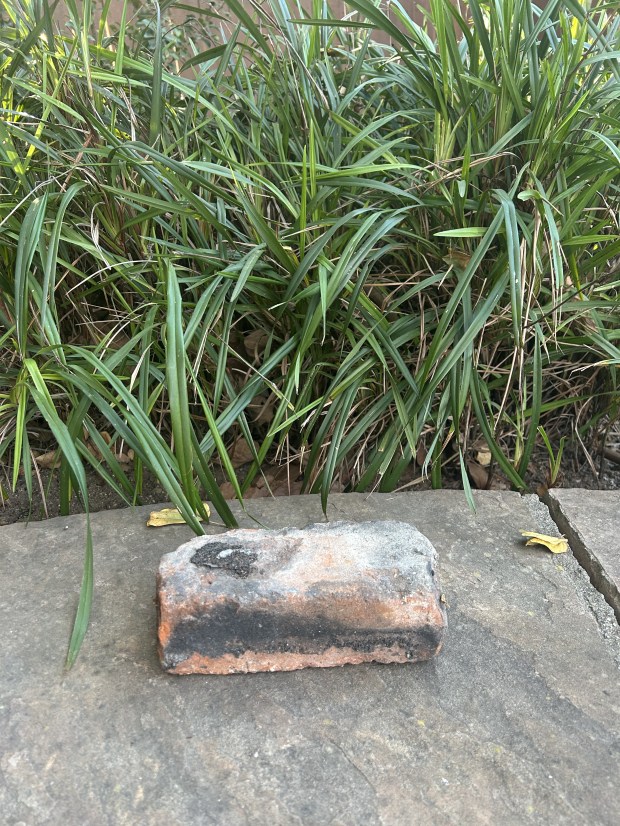
                  My parents built our home in San Bernardino in 1953. They stayed after my siblings and I moved away.  After mom died in 1993, dad lived there on his own there for more than a decade.  Eventually he sold it and moved to a retirement residence; at that point it had been our family home for fifty years.  A year later, the house burned down in a wildfire (after the new owners evacuated). Months later my sisters and I visited.  All that was left was the partially collapsed chimney. I took a charred brick as a memento.  Now I look at old family photos taken there and wonder: ‘Where did it go?”

I was Director at La Casa de Maria Retreat Center in 2018; our work was thriving and the future was bright. On January 9, the Montecito Debris Flow destroyed eight buildings and left half the property a barren field of mud.  La Casa has yet to reopen.  Sometimes when I can’t sleep, I imagine giving a tour of the property like I used to.  I can clearly see everything as it was.   It’s still hard to believe that all those structures, oak trees and our vital work could disappear in an instant.

                  How many of us have suddenly lost a loved one or treasured friend and find it hard to accept the person is really gone?

                  Is everything tangible in life nothing more than a dream?

                  Like Shakespeare, the spiritual traditions teach us that what seems so real one minute can be gone the next.

                  One of the foundational truths of Buddhism is the impermanence of all material reality. Much of our suffering arises from our tendency to ignore that.  The path to enlightenment begins with this understanding.

                  Jesus teaches a similar truth: “Do not store up for yourselves treasures on earth, where moth and rust consume and where thieves break in and steal, but store up for yourselves treasures in heaven, where neither moth nor rust consumes and where thieves do not break in and steal.  For where your treasure is, there your heart will be also.  (Matthew 6: 19-21)   

                  Are we to avoid being attached to anything that might perish? If so, how do we live?

                  For centuries, one path has been to become a monk or a nun.  You give up all your possessions and don’t own anything apart from the clothes on your back. You become celibate. Being unattached to long-term relationships and material goods means you can totally focus on the path to enlightenment and “treasures in heaven.”

                  But there is another path. This path does not forget how quickly things can vanish but does not shy away from embracing them .  This path means we remember that many things in life that seem permanent may disappear at any moment.  But we don’t turn away from them.  We invest ourselves in relationships that matter.  We obtain and care for basic material things, including the dwelling in which we live.  We plan for the future, knowing nothing is guaranteed.  We remember that everything material is subject to change.  But we appreciate what we have while we have it and are ready to share it with others.  We know the deepest meaning in life is found in pursuing spiritual values, yet we also allow ourselves to be grounded in the material world in which we live.

Life is like a dream.  But the people, dwellings, possessions, and commitments in our life are, at this moment, not a dream; they are real.  We hold both perspectives as true.  And we go on.


The brick from our home.

[i] https://www.latimes.com/entertainment-arts/story/2025-01-13/los-angeles-fires-shakespeare-tempest

[ii] McNulty notes the word “rack” meant “a wisp of a cloud’

Lead image: “Still Life with Ham and Fruit,” Jan Davidsz de Heem,1656