Some friends offered us their condo in Coronado for this past week. The unit is on the 9th floor with impressive views of the Pacific, and one night I took this photo of the sunset.
Seeing our environment from a higher vantage point helps us see beyond our up-close, on-the-ground view of life. We see where we are and what’s around us more clearly.
While here, we celebrated Thanksgiving with some of our own family and my wife’s sister’s family. Altogether there were 14 adults and 9 children.
I’ve heard that all photographs have three levels: bottom, middle and top. In my photograph, the bottom is the pool and shoreline; the middle is the ocean; and the top is the sky. As I looked at our gathering, I realized there were three groups: the 9 kids all under the age of 10 who are coming up in the world; the group of adults and parents who are in the middle of their journeys; and the four of us grandparents. I also became aware of who was not there…parents, grandparents, and friends with whom I’ve shared holidays over the years who now live only in my memory.
I recognized that I was the oldest person present. I’m in the top third of that photo — I am approaching my sunset. But I am also beholding the sun rising and shining in the lives and faces of the children and younger adults we were with.
It again brings to mind a talk I once heard at the local Lobero Theater given by my beloved mentor and scholar of world spirituality, Huston Smith. Someone asked him what he thinks will happen when we die. He said there are two common ideas. One is that we will be able to forever experience something like the sun rising. The other is that we will be absorbed into the sunlight. He smiled and said if he was given a choice, he’d watch the sunrise. But after a few thousand years, he assumes he will have had enough. At that point he’d be ready to merge into it.
For centuries, a “mystic” was someone who had a rare and unique spiritual experience, different from what most of us would ever know.
This is reflected in the word itself: The term mystic is derived from the Greek noun “mystes,” which originally designated an initiate of a secret cult or mystery religion. In Classical Greece and during the Hellenistic Age, the rites of the mystery religions were largely or wholly secret. The term” mystes” is itself derived from the verb “myein” (“to close,” especially the eyes or mouth) and signified a person who kept a secret.[i]
But in recent years, the term “everyday mystic” has come into use. Here’s one description:
An “everyday mystic” is someone who seeks or experiences spiritual depth and transcendence within ordinary daily life, rather than through withdrawal from the world or extreme ascetic practices.
The concept suggests that mystical experience—that sense of connection to something greater, moments of profound awareness, or spiritual insight—doesn’t require monasteries, retreats, or renouncing worldly responsibilities. Instead, everyday mystics find the sacred in mundane activities: washing dishes, walking to work, caring for children, or sitting in traffic.[ii]
I have known quite a few “everyday mystics.” They don’t try to be different or better than anyone else — they are simply doing something they feel called to do and, in the process, find a deep connection beyond and within themselves. They don’t do it for money, or to prove their worth, or to puff up their ego.
Some examples came to my mind:
A physical therapist who told me there were times working with patients when his mind would become quiet and he would feel as if light was passing through him to the person he was treating.
Farmers, gardeners and hikers who sense a silent and limitless bond with the earth and the mysterious processes which underly all life.
Musicians who feel as if the music is playing through them.
Grandparents when they behold their grandchildren. They had loved their own children from the moment each child was born, but so much of parenting is about being a manager, behavior coach and the one person responsible for everything to do with the child. But then a grandchild appears and seeing them evokes a sense of pure wonder.
Artists who get immersed in their process and end up creating something far beyond what they could have imagined when they started and don’t know how it happened.
Mechanics who have an innate sense of what is wrong with a car and how to fix it with the least cost and effort, working in harmony with all the moving parts instead of simply using their will to fix something that is wrong.
A young man who told me he was pitching for his college team and for a few innings the ball seemed to go exactly where he intended every time. The experience passed and he never had it again. He could not explain how it happened but has never forgotten what it felt like.
Golfers who watch a ball rise and fall through the air with a grace and purpose that feels as if something more is present than a little ball being struck.
Ocean swimmers who love the mystery of being on the surface of the limitless sea, and who feel deeply at home in salt water—perhaps sensing an unbroken thread of experience going back to our pre-human ancestors as well as our personal life as it began in the womb.
People who know they are dying and “descend into the heart,” losing their fear and becoming open and observant towards everything around them.
Richard Rohr said, “For me, “mysticism” simply means experiential knowledge of spiritual things, as opposed to book knowledge, secondhand knowledge, or even church knowledge.”[iii]
Huston Smith said, “Most mystics do not want to read religious wisdom; they want to be it. A postcard of a beautiful lake is not a beautiful lake, and Sufis may be defined as those who dance in the lake.”[iv]
We can always be grateful when such moments come to us.
“Hands Cradling a Child’s Head,” Kathe Kollwitz, 1920
As I’ve been watching Dodger baseball games recently, I have seen the same ad over and over. The camera is behind a well-dressed woman in an elevator. We see her press the button for the “Casino” floor. The elevator doors open. She steps out into a vineyard. In the middle of the vineyard is a slot machine. As she walks purposefully toward it, these words appear: “Welcome to Freedom. Chumash Casino Resort.”
The ad does not entice me to visit the casino. It does make me wonder what “freedom” means in our current culture.
I recently attended a fascinating class at the local synagogue taught by my dear friend and colleague, Rabbi Steve Cohen. The topic was the kosher laws. We began by reading some of dietary restrictions recorded in the book of Leviticus, going back at least 2,500 years. These instructions clearly describe the animals a faithful person should not eat, including camels, rabbits, and pigs. For the next hour, Rabbi Steve led the class through a survey of how scholars have interpreted these laws over time (including the 11th, 12th, 13th, 16th, and 17th centuries). Why these animals and not others? Was it all about healthy eating, or something else? It seemed to me each commentator had an interesting point of view. I also learned that, in the last 150 years, leaders in the modern, Reformed tradition had decided the faithful did not need to continue strictly observe these guidelines as in earlier times.
But I was intrigued by the comments of a 20th century British scholar, Dr. Isadore Grunfeld:
To the superficial observer it may seem that men who do not obey the law are freer than law-abiding men, because they can follow their own inclinations. In reality, however, such men are subject to the most cruel bondage: they are slaves of their own instincts, impulses, and desires. The first step towards emancipation from the tyranny of animal inclinations in man is, therefore, a voluntary submission to the moral law. The constraint of law is the beginning of human freedom…
The three strongest natural drives in man are for food, sex, and acquisition. Judaism does not aim at the destruction of these impulses, but at their control and sanctification. It is the law which ennobles these instincts and transfigures them into the legitimate joys of life. The first of the three impulses mentioned is the craving for food; it can easily lead to gluttony, and what is worse, to the fundamentally wrong conception that man “liveth by bread alone.” This natural, but dangerous food- instinct, is transformed by the dietary laws into self-discipline. It is no accident that the first law given to man – not to eat of the Tree of Knowledge of good and evil – was a dietary law. … Self-control and self-conquest must start with the most primitive and most powerful of human instincts – the craving for food. Thus the Dietary Laws stand at the beginning of man’s long and arduous road to self-discipline and moral freedom.[i]
I had never thought of it this way.
From an evolutionary perspective, these impulses are part of our drive to survive. But as we became more aware of our instincts, we can develop an ability to manage them instead of blindly following them.
In my late teens, I adopted a common cultural practice of the time: smoking cigarettes. I ended up using a pack a day for 5 years. I finally decided to quit. It was not easy. I began to realize that, up to that time, every time I reached for a cigarette, I thought I was making a “free choice.” But the nicotine in my system was demanding the next one, cleverly disguising itself and instead convincing me I was making a free choice. I am grateful I was able to break the habit. I also developed empathy for anyone who becomes dependent on such substances and habits.
I have good memories of playing poker with friends. Many people go to casinos and have a good time. But I also know that not everyone who walks into a casino is as “free” as they think they are. (That is why gambling ads, like cigarettes, include a message like “Always game responsibly. Call 1-800-GAMBLE.”) What is true for gambling is true for other aspects of human behavior. What looks like freedom can, in fact, be bondage.
For centuries, some religious traditions have told people they are inherently sinful because they experience such desires. But what I like about Grunfeld’s perspective is the assumption that having such desires is not bad in itself, but simply part of our biological inheritance. Spiritual practices, traditions and communities can help us manage them. And in that mastery, we discover a freedom we did not realize we were missing. As Huston Smith said, “We are free when we are not the slave of our impulses, but rather their master. Taking inward distance, we thus become the authors of our own dramas rather than characters in the them.” In the process, we can savor even more the simple pleasures of our lives. It’s not about a slot machine or a ham sandwich – it’s about becoming wise in the ways of living.
(Dear Friends: I did not have the time this week to create a new piece, but went back a few yeas and found this, which I have edited.)
My dear friend Father Larry Gosselin recently posted a quote from Francis Ward Weller, a therapist and grief counselor. I want to share it and a few reflections.
The work of the mature person
Is to carry grief in one hand
And gratitude in the other
And to be stretched large by them.
How much sorrow can I hold?
That’s how much gratitude I can give.
If I carry only grief, I’ll bend toward cynicism and despair.
If I have only gratitude, I’ll become saccharine
And won’t develop much compassion for other people’s suffering.
Grief keeps the heart fluid and soft,
Which makes compassion possible.
At times in my life, I’ve been asked who my “spiritual heroes” are. My response: the many older people I’ve known in my congregations. They’ve lived through hard times and personal tragedies, but somehow have become calm, thoughtful, and caring.
To this I’d add Hospice volunteers who’ve experienced the loss of people they loved, then followed a calling to simply be present with others living in times of fear and unknowing.
Of course, maturity doesn’t always come with the accumulation of age; some young people have unusual wisdom and insight. We call them “old souls.”
I’m wary of simplistic formulas for life. I distrust promises that we can be happy all the time if we just make the right effort.
I’ve known people who have lost loved ones in ways that will always haunt me, and I don’t know how they bear it.
I do not believe there is a divine pain manager who sends suffering our way to improve our character. But something is here that can hold us.
____
Image: Close-up of “Return of the Prodigal” by Rembrandt
“Wherever you go, there you are” is a quote that has been around for many years.[i] It’s been nudging me recently.
This past week I decided to go through some old files. They included a selection of my academic papers, published articles, old sermons, early courtship letters from our marriage, and family Christmas letters we’d sent to friends over the years. I was surprised at some things – I didn’t remember taking that particular class or having that specific experience. It felt like I was watching my life go by and also sensing I’m the same person as when it all began. It’s like being on a train, passing through unknown places and having unexpected experiences, but realizing it’s an unchanged “me” looking out the window the entire trip. Wherever I went, there I was.
What I see now in the mirror looks different than what I’ve seen the past but it’s the same me that’s looking.
What will eventually happen to this “me” that seems to be the ongoing observer of my life?
A good friend of mine has been a hospice volunteer for many years and at the bedside of many dying people. Given the right care and support, he tells me people coming close to having their “me” leave their body feel no fear but experience a calm trust in the unknown.
Some say “dust to dust, ashes to ashes” … period. We are made of eleven basic elements, mostly carbon, oxygen and hydrogen. How amazing that eleven elements could come together in just the right way to create a space for a “me” that looks out at this world, tries to make sense of it, lives for decades, then dissipates and disappears.
Some say, “dust to dust, ashes to ashes, yet in sure and certain hope of resurrection to eternal life.” The me that was carried along by the material elements doesn’t disappear when those elements cease functioning but continues in some form, and it all comes as a gift.
I remember someone asking Huston Smith, the great scholar of world spiritual traditions, what happens when we die. He said the spiritual traditions assume one of two possibilities. The first possibility is that we keep our self-awareness and become witnesses of something awe-inspiring like an eternal sunrise. The second possibility is our awareness simply dissolves into the sunrise. Then he smiled and said, “I like to think I might have a choice. If so, I’d choose to first witness the divine sunrise. But after a while – maybe after a thousand years — I’d decide that was enough. Then I’d let go and become part of it all.”
Back to sorting files. Happy New Year.
[i] There are numerous possible sources of this quote, but it gained popularity in 1994 as the title to a book by Jon Kabat-Zinn:Wherever You Go, There You Are: Mindfulness Meditation in Everyday Life.
It’s a word I liked the first time I heard it: axis mundi.
I encountered it in graduate school reading The Sacred and Profane, a study of world religion and mythology by Mircea Eliade. It means the “axis” around which the earth “turns” — not physically, but spiritually and psychologically. It’s a place where people believe heaven and earth meet.
Jerusalem has long been seen as an axis mundi, a city sacred to Jews, Christians and Muslims. For traditional Japan, it has been Mt. Fuji. For Catholics it’s Rome.
Some indigenous tribes in Australia are always on the move, and they carry a sacred pole with them which they erect each place they stay – a portable axis mundi.
In 2000, I had a 3-month sabbatical project that focused on how digital technology was beginning to affect everyday life. I visited and conducted interviews in two locations.
Silicon Valley was already becoming the axis mundi of the tech age. In my interviews and observations, one could already sense that digital tech was becoming something close to a religion. In the Tech Museum in San Jose, I purchased a computer mouse pad made to look like a Muslim prayer rug. I visited one of the largest Fry’s stores (in the pre-internet retail era, Fry’s was a “Mecca” for electronic parts and gadgets.) Some were designed to look like Mayan temples:
One month later I went to India, which was becoming part of that revolution. After interviewing tech professionals and academics in Bangalore, I spent time in the ancient city of Varanasi on the banks of the Ganges River. In Hindu belief, there is no place on earth where heaven and earth come closer, and therefore no better place to bathe, die, be cremated and have your ashes scattered.
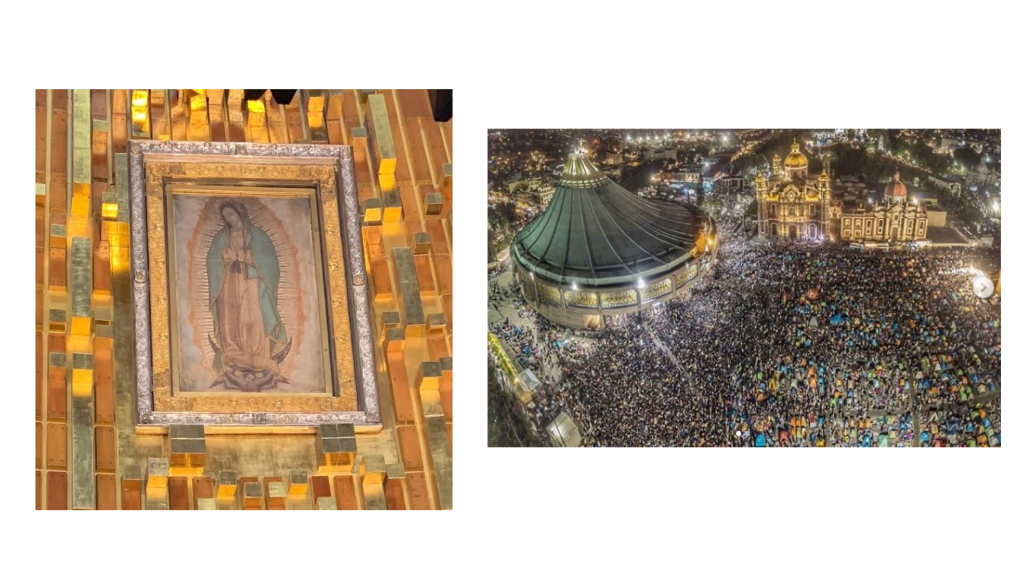
By 2006, I had realized the most sacred religious site in the Western Hemisphere was the Basilica of Our Lady of Guadalupe in Mexico City. Growing up in California, I had seen the Guadalupe image all my life but knew nothing about what it meant. I learned that, in Catholic tradition, the Virgin Mary appeared to an indigenous peasant, Juan Diego, in December,1531. She looked more like a native woman than a European and spoke to him in his own dialect: “Am I not here, I who am your mother?” She gave Juan Diego her robe or tilma. When he took it to a skeptical archbishop and unfurled it, pink roses fell to the floor and her image had become imprinted on the garment. The tilma is preserved in a glass case in the cathedral. I spent a week in the city that summer, making several visits to the Basilica. I watched thousands of faithful pilgrims arrive to worship and celebrate, and was moved by their joy and devotion.
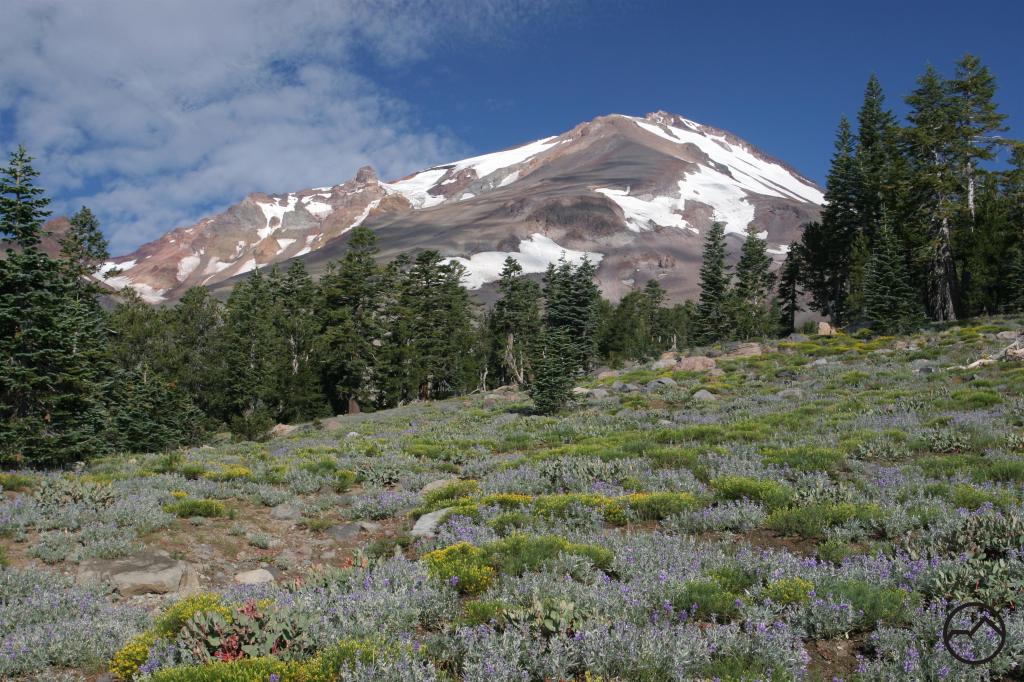
Mt. Shasta is just south of the Oregon border. We’d driven by it many times over the years as we traveled between Washington state and California, but I hadn’t considered it anything more than an impressive volcanic formation. In 2009, we spent a week at a yoga/hiking retreat in the town of McCloud at the base of the mountain. We could see the peak every morning from our window. As we hiked during the week, we saw it from many angles. On the last day of the retreat, our group hiked to Squaw Meadows, an alpine meadow on the side of mountain at an elevation of 7,900 feet. I felt smaller and increasingly insignificant in the presence of the mountain’s mystery and majesty; I began to appreciate why both native people and contemporary spiritual seekers from around the world consider it an axis mundi. We’ve returned to the area every summer for 15 years.
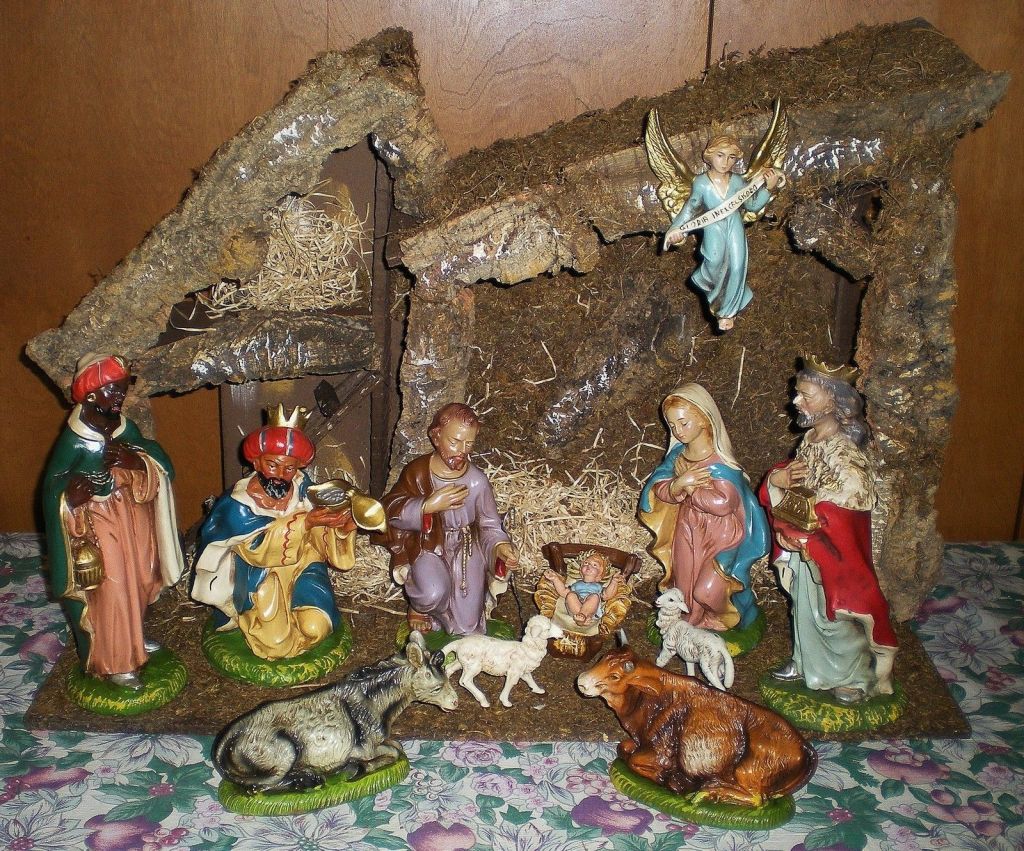
In 1233, St. Francis returned to Italy from the Holy Land where he had visited a cave that was the traditional site of Jesus’ birth. Wanting people to appreciate the setting of the Christmas story, he created the first outdoor nativity scene including live animals. Nativity scenes have become a familiar axis mundi in countless households and sanctuaries ever since. When viewed with reverence, candlelight and song, a nativity scene affirms that divine presence can be sensed not only on mountaintops, but also in the lives of humble people in unexpected places.
Some traditions have steered away from emphasizing any particular physical place where we encounter the divine and instead look within our individual awareness. Quakers affirm that every person has within them an “inward light” or spark of divine energy. By practicing silent introspection, we can access and experience that light and find guidance from it.
I have visited many sacred sites in my life. I always try to understand and appreciate the beliefs and imagination of the faithful who are drawn there.
At the same time, the purpose of visiting such places doesn’t end with the personal encounter. Recent studies have established a powerful connection between experiences of awe and an increased capacity to care for others.[i] Coming into the presence of axis mundi sites can have that effect. The purpose of spiritual life is not to have a specific experience, but to discover within us a deep reverence for life and others and let that form our character. As Huston Smith said, “Spirituality is not about altered states but altered traits.”
This past Monday I woke up before sunrise. After coffee, I went into our backyard for my morning quiet time. The days are becoming shorter, and it had been a while since I was outside before daybreak. Ten years ago, I could see most of the night sky from my favorite spot. But our oak tree and our neighbor’s sycamore have flourished in recent years, and now only a small section of the heavens is visible. As I settled in and looked up to see beyond the trees, the sky was dark; the moon was half-full and next to it was a bright star. I was captivated.
Ten minutes later, the sun rose in the east, the sky began to brighten, and the star disappeared. But the fascination with seeing light in darkness remained.
I remembered being in a downtown theater in 2011 watching the opening scenes in Terrance Mallick’s film, The Tree of Life. It begins in darkness. Then there’s sound in the background, almost like what you might hear if you are underwater listening to the ocean. These words appear:
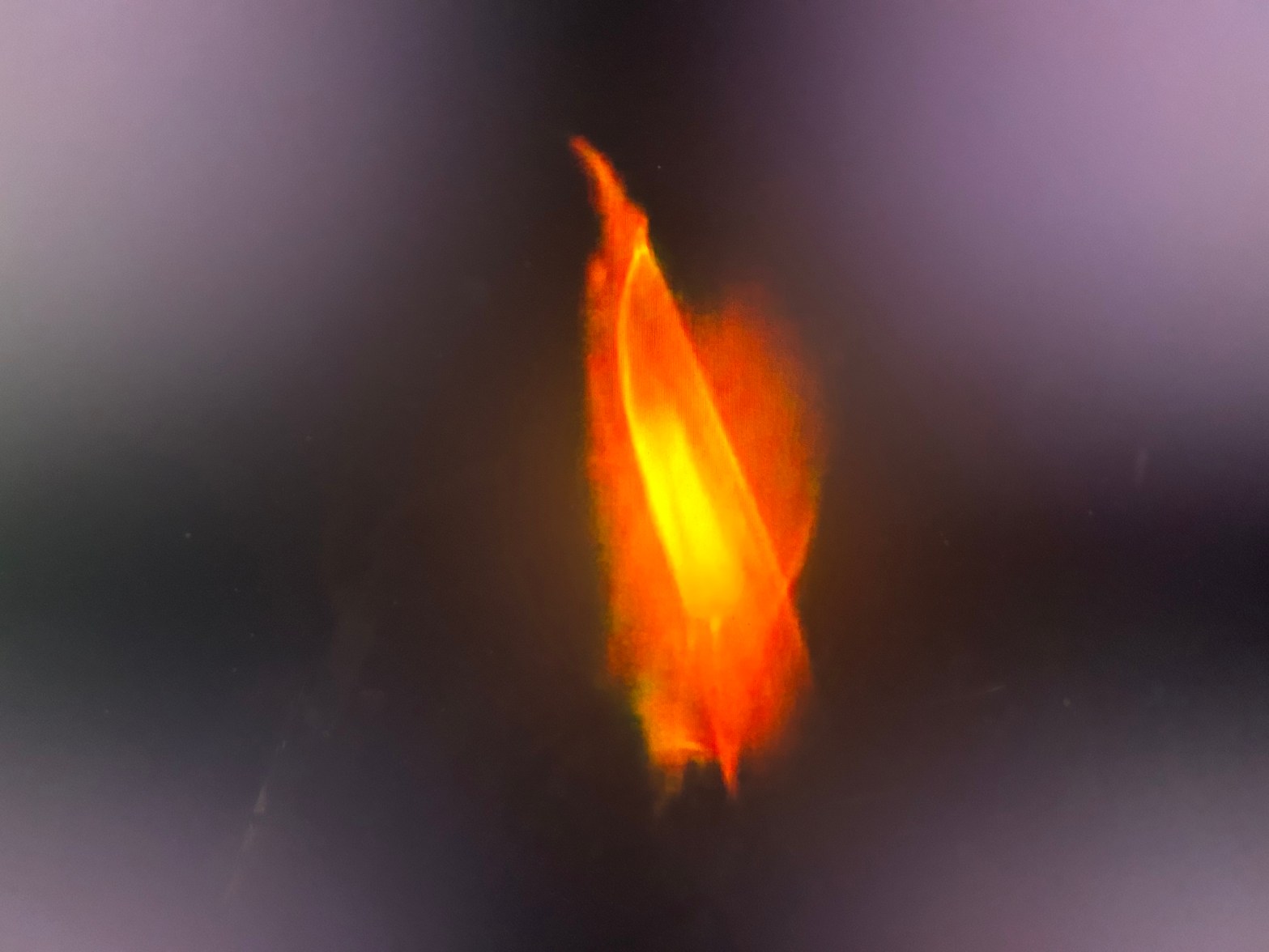
A mysterious image appears – like a flame, but not a flame; it moves and grows:
And then a voice whispers: “Brother, mother…it was they who led me to your door.” The image fades.
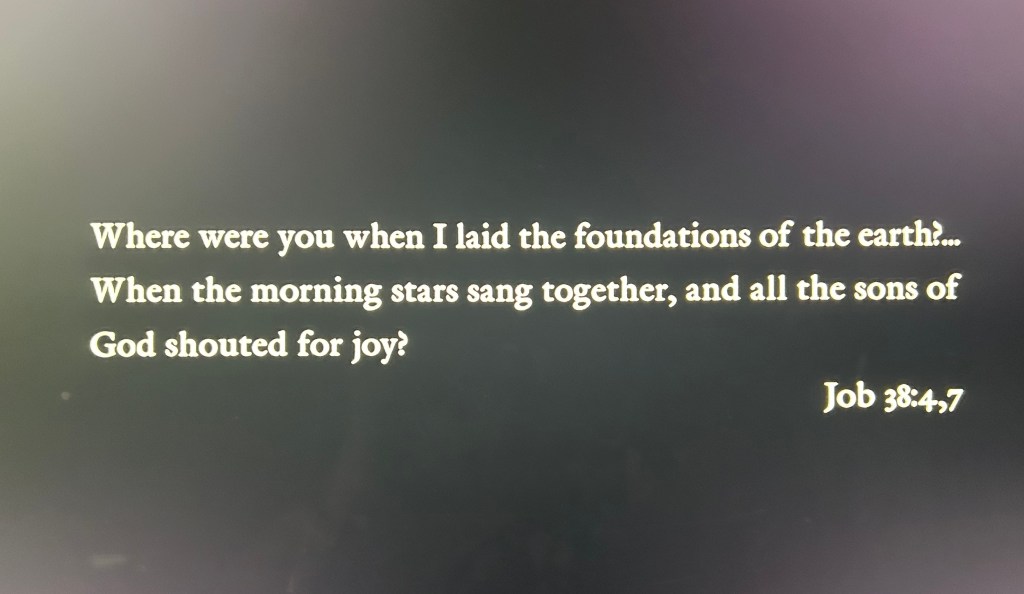
We see a young red-haired girl looking out a window on a farm, enchanted by what she sees. We hear her voice: “The nuns taught us there are two ways through life…the way of nature, and the way of grace….” The girl becomes a mother (played by Jessica Chastain), and her life unfolds. Over the next two hours, we witness the innocence, joys, struggles, heartbreaks and spiritual searching of her family; interspersed are dreamlike images of nature, evolution, and the mysteries of life. (Given Mallick’s impressionistic style, there are some sequences which make it hard to follow — but it is always entrancing.) What set the stage for it all is the passage from the book of Job. After Job questions God why life is the way it is, the divine voice speaks out of a whirlwind: “Where were you when I laid the foundations of the earth? When the morning stars sang together, and all the sons of God shouted for joy?”
Huston Smith once described an important difference between scientific and spiritual knowledge. Both seek to explain truth in everyday terms we can understand, but sometimes that language is not sufficient. With science, when the focus is the smallest scale of quantum reality or the immense scale of cosmology and ordinary language falls short, it turns to math – often very sophisticated math (which few of us can understand). Spirituality, on the other hand, also offers many insights in everyday terms, but when it needs to speak of the deepest realities, it turns not to math but to story, metaphor and imagination.
Some scientists say the Big Bang began with a “disturbance of the quantum field. ”One spiritual story says that in the beginning a divine force moved like wind over a dark void, and said “Let there be light, and there was light.”
I choose to listen to both. I want to understand the science of life as much as I can (though I’m limited by my knowledge of math.) But I also want to accept the gift of spiritual imagination with its stories and metaphors; they speak to my heart and resonate with the feeling of awe I feel when a star in the night sky shines before fading in the presence of a rising sun.
Where were we when that quantum field was disturbed and the universe emerged out of nothingness, bringing into being all the elements of the periodic table, time and space? Where were we when the foundations of the earth were set, and the morning stars sang together, and all the sons of God shouted with joy? I don’t know. But what we are began in those moments. As did our capacity for wonder and our desire to understand.
It was still and quiet when I watched the sky that morning. But in my imagination, I could almost hear the morning stars singing and the first living beings shouting for joy.
If you want to get a sense of the mood of the movie, here’s the official trailer
“The purpose of life is not to rival paradise but to be a vale of soul-making.”
Global religion scholar Huston Smith
I wrote these words in my journal over a decade ago while on retreat with Huston Smith. At the time, I wasn’t certain what this quote meant. I decided to explore it this week.
“The purpose of life is not to rival paradise…”
I thought about the earliest years of my spiritual journey. After a transformative mystical experience in my early twenties, I saw the world as something more than just physical matter — it was infused with divine presence. I found a spiritual community where people were truly caring for each other and seeking to align themselves with a higher purpose. I discovered sacred texts that can possess the power to reveal hidden thoughts and fascinating possibilities. I learned hymns and songs that filled me with joy. I went off to seminary keeping much of this early enthusiasm. Three years later I was ordained and began serving congregations. It felt like the world had become a “paradise.”
As my life and work unfolded, I encountered events that challenged this belief: a mother, standing on the porch of the family’s vacation cabin, watched the private plane carrying her husband and two teenage children crash and burn; a young mom was on her way to work at the local hospital when a semi-truck crossed over the center divider and killed her instantly; parents struggling every day with adult children living with mental illnesses or addiction issues. Life was no longer a “rival to paradise.”
“The purpose of life is not to rival paradise but to be a vale of soul-making.”
Since I first heard these words rather than saw them, I wondered if he meant “veil,” like a fabric that partially hides something. But this week, I realized he meant “vale” rather than “veil:”
Vale: river-land between two ranges of hills, early 14c., from Old French val “valley, vale” (12c.), from Latin vallem…”valley”… Now “little used except in poetry” [Century Dictionary].
So “vale of soul-making” means a “valley of soul-making.”
If you are making your way through a “vale” or valley, your path is bounded on both sides by mountains or hills. If the land formations are steep, you can’t go up or around…you must find a path through, bound by those limits. It’s hard, patient work.
How is navigating life like traveling through a “vale (or valley) of soul-making?”
There is a sense in which our “soul” can evolve as we go through life. We see the suffering of others, and instead of turning away, we grow in empathy. We discover there are situations we cannot fix, but that doesn’t mean we can’t care for the people involved. There is more ambiguity in life, less black-and-white.
As a pastor, I was sometimes asked, “Who are your favorite theologians?” In my early years, I would cite scholars who seemed to have everything figured out – as if they held maps to paradise. But in time I found myself offering a different answer; I would say “Rembrandt, Bach, Wendell Berry, and the older people I’ve known in my congregations.”
Rembrandt chose to paint portraits not of flawlessly attractive people (the kind displayed these days in fashion shows, on red carpets, and at Met Galas). He preferred ordinary people in whom he recognized a quiet integrity deep within; they had a beauty that transcended age, social status, and physical appearance.
“Johann Sebastian Bach lost both of his parents when he was nine and watched ten of his children die young. He was, in other words, well acquainted with death, and may have been uncommonly sensitive to the emotional chaos that it engenders. …Bach possessed a “consciousness of catastrophe”—a feeling for the suddenness and arbitrariness with which suffering descends on unsuspecting souls.”[i] But he took his grief and somehow transformed it into hundreds of pieces of music that miraculously express both the pain of shattered hearts and the joy of sacred knowing.
Wendell Berry left a high-status academic position in New York to return to his family farm in Kentucky. In his novels, poems, and essays, he brings to light the endless miracles hidden in the earth and the rugged dignity of people who work the land and revere it.
And the many older people in my congregations. As I got to know them, I gained great respect for all they had gone through — wars and hard times, hardships and heartaches, sacrifices and disappointments. They had given up on naïve illusions or easy answers. They didn’t have life figured out. Yet they seemed always ready to serve and care for others. These people spent decades finding their way through the “vale of soul-making,” their own possibilities bounded by the steep terrain they traveled through. But they endured. In the process, their souls somehow expanded to silently embrace life with all its tragedies and moments of wonder – moments that can feel like glimpses of paradise.
“Jacob Blessing the Sons of Joseph,” Rembrandt, 1656
[i] “The Book of Bach,” Alex Ross, The New Yorker, April 4, 2011
Perhaps many of you know this story, but I only heard it recently. Here is one version:
Westerners traveling in a foreign country hired indigenous people as porters to help carry supplies. The porters went at a slower pace than the Westerners desired, so after the first two days, they pushed them to go faster. On day three of the trek, the group went twice as far as day two. Around the campfire that evening, the Westerners congratulated themselves for their leadership abilities. But on day four, the workers would not budge.
“What’s wrong?” asked the Westerner.
“We cannot go any further today,” replied the lead porter.
“Why not? Everyone appears well.”
“Yes,” he said, “but we went so quickly yesterday that we must wait here for our souls to catch up with us.”
An easy place to begin is to affirm how busy we are and our need to slow down. We’ve heard that many times. What makes this story memorable is the spokesman’s reply.
Huston Smith said the difference between our soul and our ego is that our ego always feels a need to control our life, while our soul wants to experience it, whatever comes.
What happens when we slow down and let our soul catch up? Sometimes we become aware of an underlying sadness we’ve been evading. As Psalm 42 says, Why are you cast down, O my soul?And why are you disquieted within me? (Ps 42:5) The writer then recounts memories of when his life and faith seemed well-aligned and the hope that he will experience that sense of wholeness again. But the first step to a satisfied soul is to acknowledge when it is “disquieted.”
This goes against our culture’s relentless expectation to be “happy.” But who can be “happy” all the time? Sometimes we have experienced hardship, loss, and disappointment.
I once collaborated with an academic colleague who was a psychology professor. She had grown up in Ukraine during the Soviet era. The government was always pressuring people to feel optimistic, despite what they were enduring and the official falsehoods that surrounded them. She grew to resent that pressure. After coming to America, she was annoyed with popular schools of thought that encourage us to be happy all the time. Sometimes we feel “cast down” and our soul is “disquieted.” We do well to let our soul reveal what we need to know.
On the other hand, there are times when we take time to let our soul catch up and we find a fresh awareness of blessings we’ve been too busy to acknowledge. Rabbi Harold Kushner wrote a book on Psalm 23. About the phrase “…surely goodness and mercy shall follow me all the days of my life…,” he asked why the writer says goodness and mercy shall “follow” us? Because, he said, we are often so busy that we have run out ahead of them. When we take time to let our soul catch up, goodness and mercy can finally find us and climb into our lap.
A few days ago, I realized I did not know where I’d left my iPhone. After looking in the obvious places, I took my iPad and brought up the “Find My” app. From the menu, I touched the “Steve’s iPhone.” I then heard the phone chiming. It turned out it was ten feet away — in the same room as me— but in a place I had never put it before. I wondered if there could be a “Find My Soul” app that would alert us when we are spiritually lost. What tone would capture our attention?
I was in Vienna in 2020. Ubers and taxis were available to get around town, as was the subway system. But there was also an old-fashioned electric streetcar system. You’d often see the trams patiently making their way around the city in a large circle known as the Ringstrasse. A city guide told me that Viennese often prefer to use the streetcars even though it’s not as fast as the other options; she said it helps them slow down between destinations.
In Zen and the Art of Motorcycle Maintenance, the author and his friend are riding their motorcycles cross country. At one point he thinks about the term “making good time.” When we say, “You made good time!” we usually mean “You made the trip about as fast as possible!” But when we rush somewhere to make “good time” we often arrive stressed out, tired, and oblivious to where we’ve been. Instead of opting for freeways and interstates, he preferred taking country roads and older two-lane highways. That way he could appreciate unexpected vistas and new experiences along the way. That kind of traveling may take more time, but one can enjoy the time while you’re doing it. For Pirsig, this was “making good time.”
“Making good time” means you haven’t left your soul behind in the pursuit of speed and efficiency. Your soul has a chance to be present with you as you travel. And maybe goodness and mercy will join you instead of being left in the dust.
“Even though life is quite a sad business, you can have a good time in the middle of it. I like to laugh, and I think the unsung, real literary geniuses of the world are people who write jokes. Both the Irish and Jews are very fatalistic, but they laugh a lot. Only the Protestants think that every day in every way, life is getting better and better. What do they know? — American writer Mary Gordon (daughter of a Jewish father and Irish Catholic mother)
My beloved mentor Huston Smith once gave a talk at the Lobero Theater here in Santa Barbara. With a smile, he announced his theme: “Five Things You Won’t Agree With.” One theme was “There’s no such thing as progress.”[i]
Huston told the story of being a young American scholar in the 1960s when he was invited to speak on the future of society at a conference In Europe. He spoke glowingly of what he thought the century would bring. After he finished, the next speaker said, “Professor Smith has just spoken out of 200 years of American successes. I’m now going to speak from 1,000 years of European failures.” Huston listened and was humbled.
He went on to say that, to be sure, some things have improved in our modern life. Plumbing, for one. Public health, for another. And there has been some progress in human rights. But in many ways, our human nature has not changed. We have not outgrown the destructive impulses of our ancestors. No century in human history saw as many people die in war as the 20th – somewhere close to 50 million. Some things are better, but we are a long way from having the world we would like to have. Those “Protestants” who “think that every day in every way, life is getting better and better – what do they know?”
This perspective could lead to being “fatalistic” – why bother trying to make anything better? I don’t think that’s an option.
Social teachings of the Jewish, Catholic, Protestant, and many secular traditions have always included a strong emphasis on “trying to make the world a better place.” Basic compassion and a spiritual calling compel us to do all we can to confront hunger, poverty, injustice, violence, and threats to human dignity. Here and there, there are signs of “progress.”
We moved to Santa Barbara in 1992. With our daughters active in athletics, we became passionate supporters of the UC Santa Barbara women’s basketball team — along with many in my congregation. The team was having great success, making it to the “Sweet Sixteen” in 2004. One year we invited the outstanding center to speak at the beginning of our worship service. She was several inches over six feet tall, and it was striking to see her walk down the aisle and step to the pulpit with poise and ease. UCSB had just won a dramatic game against the University of Hawaii the night before, and someone asked her if she had prayed for a win. She said she did pray at halftime – but not to win. She simply prayed that she would do her best, whatever the outcome. Everyone sensed this young woman possessed great inner strength and character.
A few days later, I ran into Michelle, one of our members. I asked her what she thought of hearing the player speak. Michelle said she had wept. That surprised me and I asked her why. As a woman who was six feet tall herself, as a teenager she was constantly walking bent over with slumped shoulders so she wouldn’t seem as tall as she was. But on Sunday, when this tall, young woman entered to the delight and admiration of the congregation, she realized how much had changed in just one generation. Her tears that morning were tears of gratitude that maybe life for young women was improving.
On the other hand, I remember visiting the “Museum of Communism” in Prague in 2020. The museum was divided into three sections: “The Promise,” “The Reality,” and “The Nightmare.” “The Promise” told the story of the genuine idealism that had convinced many earnest people to support the revolutions in the early decades of the last century. “The Reality” displayed exhibits of how this social experiment was troubled from the start. “The Nightmare” showed how grim and heartless communist societies became. People hoped they could make society “better and better”, but it was not to be.
I believe we should never give up trying to make the world a better place. At the same time, we can recognize our human nature has a dark side that may resist and undo our best-laid plans and hopes. Along the way, we welcome the great artists in our midst who help us laugh:






 Steve Jacobsen, Ed.D