Touching the Earth, Grounding Our Soul

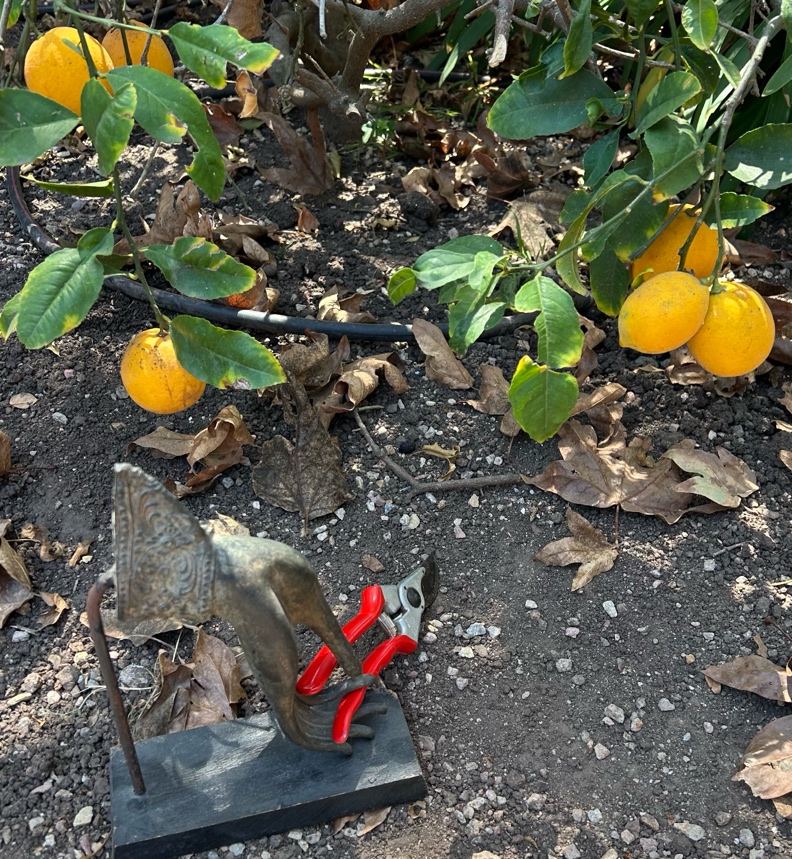
                  Some years ago, a friend brought this back from India as a gift, and it’s been sitting on my bookshelf ever since:
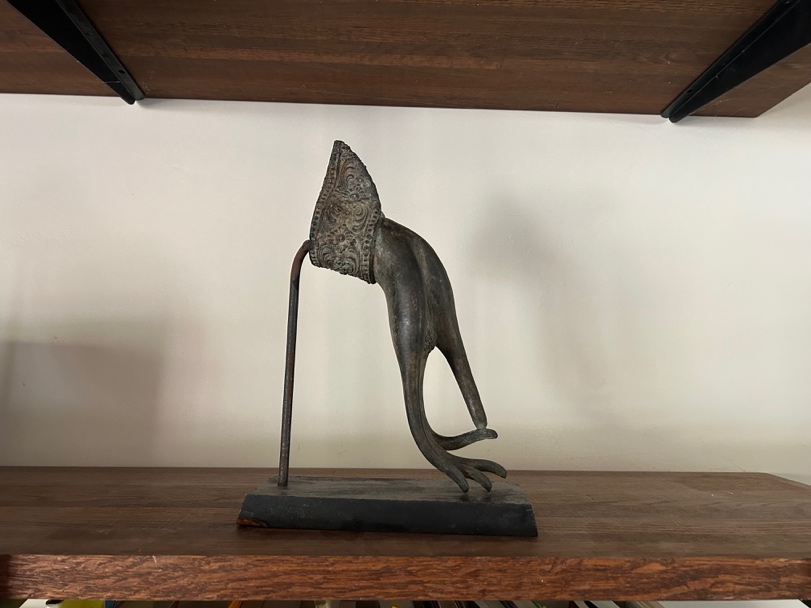
                 

The hand gesture is based on a famous story in the life of the Buddha:

In one of Buddhism’s iconic images, Gautama Buddha sits in meditation with his left palm upright on his lap, while his right hand touches the earth. Demonic forces have tried to unseat him, because their king, Mara, claims that place under the bodhi tree. As they proclaim their leader’s powers, Mara demands that Gautama produce a witness to confirm his spiritual awakening. The Buddha simply touches the earth with his right hand, and the Earth itself immediately responds: “I am your witness.” Mara and his minions vanish. The morning star appears in the sky. This moment of supreme enlightenment is the central experience from which the whole of the Buddhist tradition unfolds.[i]

                  He is not just thinking about the earth and what it means, he’s physically connecting himself to the earth.  The action symbolizes that the spiritual teachings are not lofty ideas, but literally “grounded” in real life. 

                  This past week, one of Richard Rohr’s daily meditations noted the legacy of Brother Lawrence. Here’s an excerpt:

In the mid-17th century, a man named Nicolas Herman joined the Carmelite monastery in Paris, France. Wounded from fighting in the European Thirty Years’ war, and suffering a sustained leg injury, he took the monastic name “Brother Lawrence of the Resurrection.” He worked in the monastery kitchen and eventually became the head cook. Amid the chaos of food preparation and the clanging of pots and pans, Brother Lawrence began to practice a simple method of prayer that helped him return to an awareness of Divine presence. He called it the practice of the presence of God and described it as “the most sacred, the most robust, the easiest, and the most effective form of prayer.”  Brother Lawrence’s method of prayer is so simple that it might seem misleading. It is to cultivate and hand over one’s awareness to God in every moment, in whatever we are doing. Brother Lawrence recommends that newcomers to the prayer use a phrase to recollect their intention toward the Divine presence, such as “‘My God, I am all yours,’ or ‘God of love, I love you with all my heart,’ or ‘Love, create in me a new heart,’ or any other phrases love produces on the spot.”” [ii]

Brother Lawerence summarized what he learned in the little book, The Practice of the Presence of God.  I first read it early in my spiritual journey, and have — in my best moments — often remembered it when doing the dishes.  Instead of thinking, “This is such a bother – I’m going to finish this job as quickly as possible,” I try to take a Brother Lawerence attitude: “I’m going to slow down and be aware of the tangible experience of this chore: feel each dish in my hand as I pick it up, notice the warmth of the water, appreciate stacking the dishes in the rack one by one, be grateful in these moments of being alive…”  I tend to be easily distracted and lost in thought, but doing household chores in the spirit of Brother Lawerence can be a satisfying practice.
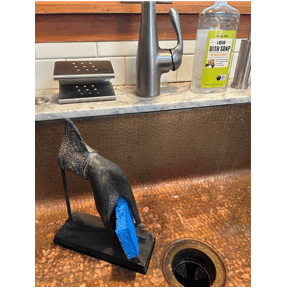
                  Recognizing the way in which daily tasks can “ground us” is a fundamental teaching in the Benedictine monastic tradition, summarized in the phrase “ora et labora.”  Every day, a monk spends time in prayer (“ora”) but also manual labor (“labora”); labora can mean cooking and cleaning, working in the garden or, in some pious communities, carefully brewing beer.[iii]

                  When I was working at La Casa de Maria retreat center, one of our most popular offerings was led by Cynthia Bourgeult, an Episcopal priest and writer.  Each person who came to the 5-day retreat could expect regular lectures by Cynthia, times of chanting and worship, and a daily period of physical labor performed in silence.  One of our staff responsibilities before the retreat was to come up with a list of manual tasks that retreatants could do, such as raking leaves, weeding gardens or caring for our citrus trees.  Sometimes we’d get a call from a person who wanted to register but said they did not see the point of doing any manual labor; Cynthia instructed us to tell the person this was not an option – if they weren’t willing to do it, they should not come at all.  She told us that some people who had initially not wanted to do the labor ended the week saying it became one of their most valuable experiences.
                  I think of the training I received during my hospice time that was based on Zen practices focused on “cultivating presence.” If we are with someone who is in physical or emotional pain, our thoughts and feelings can get tangled up in our concern for the person and we can lose our focus. We were taught to slow down our breathing and become aware of our rear ends in the chair and our feet on the ground, and to imagine the pain passsing through us into the earth. This can free our mind to be remain calm and open as we interact with the person — to be “present” and not distracted or anxious. I have found it to be a worthwhile technique.

Spiritual traditions include specific teachings, participation in community life and the practice of serving others in tangible ways.  As our culture becomes more fragmented and people more socially isolated, many studies have demonstrated that being part of spiritual communities leads to increased emotional and physical health.  The traditions ground us in what really matters, giving meaning to all we do.


[i] https://www.huffpost.com/entry/buddhism-and-climate-change_b_925651

[ii] https://cac.org/daily-meditations/brother-lawrence-of-the-resurrection/

[iii] Many monastic communities saw beer brewing as a particularly meaningful form of labor, and at one time there were a thousand monastic breweries in Europe.  For a current listing, see A List of the World’s Monastic Beers

Our Motivations Don’t Have to Be Pure to Be Good

                  When I first began my spiritual journey, I was enthralled with the idea that I could escape the influence of my selfish ego and achieve some kind of saintly purity.  I’d seen what complete self-centeredness could do to my life, and like a prisoner for whom the jail door suddenly flew open, I couldn’t wait to find freedom.  I read accounts of saints and sages.  I experimented with meditation, recorded and analyzed my dreams, memorized Psalms, and sought spiritual guides. I read the Sermon on the Mount, which includes strong statements to discourage us from publicly displaying our spirituality when we are fasting, giving to charity, and praying. [i]

                  Fifteen years later I was driving downtown to volunteer at the local soup kitchen.  Two different voices within me began a conversation:

Inner Voice One: “I’ve been meaning to do this for some time. Glad I finally signed up and am on my way.” 

Inner Voice Two: “You know, be sure and tell your congregation you are doing this.  You’ll look good in their eyes.”

Inner Voice One: “What a selfish thing to think! I’m not doing this to show off. I’m doing it because it’s the right thing to do.”

Inner Voice Two: “Of course you are.  That’s great. But it won’t hurt your reputation to let people know you are doing this.”

I didn’t like Voice Two and could not silence it.  I was frustrated.

A few months later I was on a long drive north on Interstate 5. I thought again about the persistence of self-centered Voice Two.  I decided to try an experiment. I visualized Voice Two as a separate person standing in front of me.   I stared at him.  He looked uncomfortable and embarrassed being examined so carefully and kept looking downward. I began feeling compassion for Voice Two.  I realized it had never meant me any harm. It was there to speak up for me, protect me, always wanting to help me be somebody I could feel good about.  I stood in front of him.  I put my right hand on his shoulder.  “You know,” I said, “I now realize you work very hard on my behalf and always act with the best of intention.  I’m not going to get angry with you anymore.  I’m not going to try to get rid of you. Let’s be friends.  I’ll let you offer suggestions whenever you wish.  I just don’t want you to be in charge.”

It was a moment of inner reconciliation that brought me a sense of peace.  I gave up trying to be a saint. I accepted being someone who may often have mixed motivations that I need to sort through.  I would continue to engage in activities for a higher purpose but not get upset if I also hear Voice Two whispering to me how this might affect my reputation and self-esteem.  If I personally accomplish something that has been challenging for me, I am going to welcome feelings of pride and satisfaction.

Several years later, as part of my Hospice training, I attended a retreat at the Metta Institute which included Buddhist meditation practice. I learned one key principle: “Welcome everything, push away nothing.”[ii]  Rather than try to control everything our busy mind comes up with, we let all our thoughts arise; we then calmly examine them and choose which ones are worth engaging.   I have found that to be a practical way to manage all the different ideas, motivations and strategies that can arise within.

I do think there are saints in this world whose motives are always pure.  They don’t know they are saints.  They meet those Sermon on the Mount standards without thinking about it.  I know I’m not one of them.  But I don’t want my mixed motives to keep me from joining other people to get good things done and enjoy life along the way.


[i] Matthew 6: 1-8, 16-18

[ii] The Five Invitations: Discovering What Death Can Teach Us About Living Fully, Frank Ostateski

The Parable of the Poisoned Arrow

Several years ago, I was listening to a series of lectures on Buddhism and heard “The Parable of the Poisoned Arrow.” It exists in several versions.  Here’s a simple one:

“Suppose a man is struck by a poisoned arrow and the doctor wishes to take out the arrow immediately. Suppose the man does not want the arrow removed until he knows who shot it, his age, his parents, and why he shot it. What would happen? If he were to wait until all these questions have been answered, the man might die first.” The point: “Life is so short. It must not be spent in endless metaphysical speculation that does not bring us any closer to the truth.”

In some versions, the wounded man’s questions include the social class of the archer, his physical appearance, his hometown, what the bow was made of, what bird had supplied the feathers, etc.  The questions are endless — but our time is limited.

When we are suffering physical pain, it is reassuring if the doctors can confidently identify and treat it. But sometimes they can’t. Years ago, I had a parishioner whose lungs were thickening and the tissues becoming increasingly stiff.  After many tests, the doctors gave it a name: “Idiopathic pulmonary fibrosis.”  It took me a minute to grasp the meaning of that first word: “Idio-pathic.”  There is a pathology going on, but we are “idiots” in terms of knowing exactly why.  It’s a disease having no known cause.  Not having a definitive name for it made the situation more difficult.

Our predecessors have tried to understand the source of our suffering and came up with many explanations.  Maybe it’s karma – the mysterious burden of our ancestor’s behavior in past lives. Maybe it’s divine judgement – God does not let people get away with anything, so if we are suffering, we must have done something wrong.  St. Augustine came up with the idea of “Original Sin,” claiming that death and suffering are a result of some act of disobedience in our ancient past. 

In our modern age, we can seek the reasons for our emotional pain by exploring our family of origin: when you were a child, you adapted your behavior in response to what was going on in your family, and those behaviors have stuck with you ever since.  Sometimes the insights are illuminating and liberating.  Working with insightful counselors over the years, I can see how many of my behaviors are explainable based on my family’s dynamics. But I’ve also known families with six children, all of whom turn out very differently.  And sometimes knowing the source doesn’t improve our lives at all.

When we are suffering, do we need to know every reason behind our condition? Or is it enough to pull the arrow out as quickly as possible so we can move forward?

I know a woman who suffered from panic attacks.  She had seen counselors and talked to friends, but nothing helped. She went to see someone who specialized in anxiety.  At the first session, she was surprised that he did not delve very much into her past or her emotions. Instead, he focused on the thought processes she experienced when she began to feel anxious.  She came back for more sessions and soon she was experiencing some relief.  She was still “wired” as she’d always been, and the causes for that may never be known.  But he helped her focus on the runaway train of her thinking patterns and ways to redirect it; the aim was to get the arrow out, rather than knowing why it was there in the first place.

Buddhism does not focus on mystical speculation as to why our suffering is here.  It focuses on ways to alleviate it.

In many of the Gospel stories, someone comes to Jesus with a problem.  He seems to understand what they need in that moment and offers a shift in their focus. Maybe it’s being assured of divine forgiveness apart from social prejudices and self-doubt.  Maybe it’s with a healing touch.  Maybe it is by inspiring them to go beyond themselves to love and care for others.  There’s no interest in speculation – the focus is redirecting each person in ways they can live their life with grace and freedom in the here and now.

Looking back on my life, I see that many people who have died in peace have given up trying to understand the deep reasons for anything.  They just live life as best they can and help others as much as they are able.

The questions about the deeper causes of our suffering can be endless — but our time is limited.

Where To Plant Your Tree

              I once attended a day-long retreat at La Casa de Maria, “Introduction to Meditation,” led by a well-respected teacher in the local Buddhist community. I’ve attended quite a few similar events over the years and I’m always curious to see how the leader presents the material.

              On this day, I was impressed by the leader’s ability to make the material simple, clear and practical: how to get in the best posture, why your hands can be open on your lap, how to align your spine, what to do with the mental chatter, what to expect over time, etc. 

              At one point in the afternoon, he spoke about why one would commit to making this an ongoing practice.  He noted the personal benefits to our health, both physical and emotional.  He then posed a classic question: if you think of your life like a small house with a fenced front yard, where do you plant your tree of spiritual practice?  Do you locate it close to the house and away from the street so the fruits will be harvested only by you? Or do you plant it just inside your front fence, so that some of the branches grow inward and the other half outward, beyond your property line, inviting neighbors to share in your harvest?  

After taking some time in silence for us to consider the question, he suggested that one of the most important measures of the value of our spiritual practice is how it impacts other people.  The more calm, thoughtful, clear-minded and compassionate we are, the more we can benefit the life of others, not just ourselves.

This seems important to me.  Our contemporary Western culture often focuses entirely on us as isolated individuals; many popular spiritual practices assume that our highest and sole purpose is to find personal peace and enlightenment.  I think that is short-sighted.  I believe spirituality can become a shiny word for narcissism.  We may begin our practice with a focus on ourselves, but true spirituality draws us beyond ourselves toward serving others and the world.

When I began my ministry, I was living in a low-income area.  A couple came to me wanting to get married but could not afford to pay the usual fees.  I offered an option: instead of paying me or the church, they could do ten hours of community service together for a nonprofit of their choice, then report back to me.  The couple chose to volunteer for Habitat for Humanity.  When we next met, they told me how rewarding the “assignment” was.  I encouraged them to remember that the purpose of marriage is not just to benefit the two making the commitment, but also to be of use to the broader community in which they lived.  Looking back on my career, I wish I would have encouraged that practice with many other couples.

The most fruitful lives I have seen are those that include a commitment to serving others; the paradox is we can find deeper personal fulfillment doing that just endlessly focusing on ourselves.

Clarifying Our Intentions: Fear or Curiosity? Worrying or Caring?

I’m skeptical about self-help books. They always sound like they are going to lead us to endless happiness if we just set the right goals and remember a few principles, but over time life turns out to be more complicated. 

I remember reading a bestseller in 1989: Do What You Love, The Money Will Follow.  I tried following the advice. It didn’t work.   I think many poets, musicians, athletes, spiritual seekers, and artists eventually realize they need to find a real job to pay the bills while making time to do the creative and imaginative things that bring joy and satisfaction.  I’m a skeptic when it comes to simplistic formulas for negotiating life.

            However, I have found two suggestions that seem to be worth sharing.

            The first comes from my hospice experience: “The opposite of fear is curiosity.”   When faced with unwelcome news or unwanted challenges, we may naturally respond with fear.  We may choose to be defiant or in denial about whatever is happening.  When we are fearful, our ability to think creatively shrinks.  (I have a friend and professional leadership coach who tells his clients and his teenagers, “Remember, when you get angry or emotional, your IQ shrinks.”) It’s interesting to consider choosing curiosity instead. Becoming curious feels different. We become calm.  Our mind is open.  Our mental state and awareness expand rather than contract.

            I remember Hank, a parishioner and mentor. He had a Ph.D. in chemistry and spent his career in higher ed and international education. He was also a strong Mennonite, a tradition that seeks to live out the Sermon on the Mount including the principle of nonviolence.   He contracted a serious form of cancer that began in his lower spine.  He decided to learn all he could and employ multiple approaches toward healing.  He worked with his oncologist in planning his chemotherapy and radiation treatments.  He asked people he knew who were gifted in prayer to visualize his healing.  He began to practice a form of meditation in which he saw the chemotherapy chemicals as bottom-feeding catfish, slowly gobbling up the unwanted cancer cells in his bloodstream.

            Hank’s cancer went into remission, and he lived another 25 years.  His spine was damaged, and his walking was impaired, but his spirit was not.  Even if he had not had such a good outcome, I believe he would have died with a calm mind and strong heart.  He chose curiosity over fear. 

            The second insight comes from a book on golf:

“Dave, an instructor at a golf school, asked me for advice about his own game. He wanted to know how to ‘putt without caring.’ He said, ‘How do I not care? I do care! Otherwise I wouldn’t be out there playing golf.’ I told him his problem was with the word ‘care.’ Of course you care about making the putt. The point is not to worry about whether you will make it or not. I then asked him to pay close attention to how each of the next sentences made him feel:‘Dave, I care about you.’…’Dave, I worry about you.’”

                   — Dr Joe Parent, Zen Golf: Mastering the Mental Game, 2002

            We don’t have to have any interest in golf to get the point.  So much of our time is spent wanting life to meet our expectations.  We press, fret, strategize, and — loaded with anxiety — act. If we don’t get what we want, we blame others or ourselves. 

            Joe’s point is instead of worrying about an upcoming action, we focus on caring about it.  That feels different.  He also believes shifting our approach to caring increases our chances of being effective.

Imagine standing in front of a mirror and making an expression that conveys worry.  Our brow wrinkles. Our eyes narrow.  Our breathing may become shorter. We tense up.  It’s a drag.

Then imagine shifting your expression to one expressing care.  Our face relaxes, our eyes open.  Our pulse probably slows down.  It’s a nice way to be in these bodies of ours. 

Would you rather have someone worry about you or care about you?

Would you rather be afraid or curious?

Spiritual traditions offer us alternatives to fear and worry.

Buddhism teaches we can live more compassionately and freely when we let go of rigid expectations.  We still formulate clear intentions with whatever we are facing – including being present and compassionate with ourselves and others – but that is different from giving into anxiety.

In the Sermon on the Mount, Jesus says, “Therefore do not worry about tomorrow, for tomorrow will worry about itself. Each day has enough trouble of its own.”  As an adult who’s personally and economically responsible for myself and others, I need to be vigilant, informed, and careful as I manage our resources and plan for the future. But I try to do so from a place of caring, not worry.

In 1999 I visited the “Tomb of the Patriarchs” mosque in Hebron, Israel. I remember seeing two people. One man was sitting on the floor with his back to a wall, reading.  Another was lying on the floor taking a nap.  While there was tension at the security checkpoints we passed through on our way there, the mood inside the mosque was spacious and peaceful. 

When we are in challenging situations, we may want to observe how we are approaching them. Are we being driven by fear or curiosity?  And do we want to be filled with worry, or instead, focus on simply caring for ourselves and others?

Image:

“Feeling Light Within, I Walk,” Navajo Night Chant/Native American sculpture, Vancouver, The Quiet Eye: A Way of Looking at Pictures

Note: in a prior post, I shared a similar reflection drawn from training sessions I used to lead, and included some points from a grief counselor about how “companioning” can be a distinct form of caring:  “Is Your Intention to Cure or to Care?”

The Weeds and Wheat Within

            Years ago, I was driving downtown to take my turn as a volunteer at the local soup kitchen.  On the way, I noticed the following thought appearing in my awareness: “You know, volunteering at the soup kitchen shows to you and everyone that you are a really good person.  People will notice and think highly of you.”

            Another voice spoke up, “What a tacky thing to think! You’re not going there today to show off.  You are going because you know in your heart this is simply the right thing to do.”

            Next thought: “What an amusing dialogue you are having, Steve.  Sounds like you got one voice that is selfish and another voice that might be decent.”

            I was tempted to think the second voice is the “real me” and the first is “not me.”  But, you know, I seem to have both voices within me all the time.  The first is always performing to impress my self with my self and hoping other people notice what a good guy I am. The second wants to just do the right thing for the right reason without any fanfare.

            41 years after being awarded a “Master of Divinity” degree, I am far from mastering the relentless and petty voice within.  

            I take heart from reading a recent “Daily Meditation” posting by Fr. Richard Rohr.[i]  He writes about the Gospel parable in which the field workers are concerned that weeds are growing in the same field as good grain.  The owner tells them not to worry – in the final harvest the weeds will be separated out, and the good grain will remain. Rohr says that, growing up, he felt the parable told him to be relentlessly looking for the “weeds” in his life and root them out.  But, over time, he sensed that was impossible and gave up. Then, as he matured, he saw the parable in a new way:

Jesus shows us an absolute realism. He says something that was never said to me when I was a young person: “Let the weeds and the wheat both grow together.” Wow! That’s risky. I can’t pretend to logically understand it, although I know it allows me to be compassionate with myself. After all, I’m also a field of weeds and wheat, just like you are, and just like everything is. Everything is a mixed bag, a combination of good and bad. We are not all weeds, but we are not all wheat, either. We have to learn, even now, to accept and forgive this mixed bag of reality in ourselves and in everybody else. If we don’t, we normally become very angry people. Our world is filled with a lot of angry people because they cannot accept their own weeds.

To accept this teaching doesn’t mean we can say, “It’s okay to be selfish, violent, and evil.” It simply means that we have some realism about ourselves and each other. We have to name the weed as a weed. We can’t just pretend it’s all wheat, all good, because it isn’t. We’re not perfect. Our countries are not perfect…. The project of learning how to love—which is our only life project—is quite simply learning to accept this. If you really love anybody, and I hope you all do, then you have learned to accept a person despite, and sometimes even because of, their faults.

            This has strong parallels with Buddhism, in which we avoid the folly of thinking we can block thoughts we don’t want to have. Instead, we learn to let them come into the open, and to observe and assess them. In that freedom, we become more compassionate with ourselves as “complicated” creatures, as well as more compassionate with our fellow human beings who live the same inner complexity.

            This perspective doesn’t mean we passively accept disappointing behavior in ourselves or others. But it does invite us to be realistic that to be human is to be a mixture of wheat and weeds. Constantly sorting out the inner voices is hard work and, like the peasants in the Brueghel painting, sometimes it’s OK to take a break. But it’s vital work, and I’m grateful to Father Richard for this liberating insight.

Image: The Harvesters, Brueghel, 1656


[i] https://cac.org/daily-meditations/the-weeds-and-the-wheat-2022-08-28/