
Years ago, I heard a presentation from a hospice physician who was also a student of Greek mythology. He said there will be times when we will have to choose between two paths. The first path is the path of Hercules, who used his strength to overcome major obstacles and defeat mighty opponents. The second path can be represented by Chiron, a figure I knew little about.
As the story goes, Chiron (pronounced Ki-ron) was a centaur (half-man, half-horse) and a revered teacher of many subjects, including medicine. Hercules had come to study with him. One day a poisoned arrow accidentally wounded Chiron. The pain was intense, and Chiron wanted to die. But because he was partly immortal, it was not possible. Out of devotion to his teacher, Hercules made a deal with Zeus that allowed Chiron to die, leaving the medical wisdom he had acquired for the benefit of humanity. His willingness to give up his immortality made him a noble and heroic figure:
Chiron embodies the spirit of compassion and selfless service that all good physicians must have to master and practice the medical art. Through his supreme sacrifice, willingly given, Chiron gave mankind the art of healing.
Chiron’s agonizing wound symbolizes the transformative power of illness and affliction. Through pain and suffering, our personal wounds, both psychic and physical, can transform themselves into sources of great moral and spiritual strength.[i]
These figures can represent two options we have when facing serious challenges: shall we be like Hercules and fight to overcome the obstacles? Or shall we be like Chiron, accepting that the obstacle cannot be defeated and instead adapting to it, integrating its meaning into our lives?
The presenter noted that, as a physician who deals with life-threatening illnesses, he sees people every day having to make such a choice. Do they gather up every resource available and fight like a Hercules to overcome the disease? Or do they accept the serious diagnosis, acknowledge that mortality is part of the human condition, and live their remaining time appreciating what they’ve been given?
I have seen many people making such choices. Some with serious medical challenges engage the fight with a determined will and, against great odds and the skepticism of medical professionals, triumph over the illness, living longer than anyone had expected. I have seen others with similar challenges summon a determination to “beat the odds” and are not successful, bringing great physical and emotional suffering to themselves and their loved ones. I have seen people worn out by chemotherapy elect to stop treatment so they can appreciate their last few months, then go on to enjoy two more years. And I have seen people decide they are done with the struggle, accept the fact of their death, and live their last days with peace, gratitude, and contentment.
You never know how it will turn out.
It’s like aging. Some obstacles we can overcome. We have a knee, shoulder, or hip that is worn out. Do we accept the challenges and uncertainties of surgery and physical therapy? Many take on that challenge and come through the ordeal with renewed optimism for life. I’ve also seen people who try anything and everything to deny or disguise the aging process.
I remember working out in a gym several years ago. As I looked around at the people of different ages working out, it seemed you could divide everyone into two groups. The younger people were on the Hercules Path, grunting and grinding to become fitter and fitter with no limits in sight. Then there were we older people who weren’t so much ascending the Mountain of Fitness as trying to slow the inevitable descent: “I’m not dead yet, and I’m going to be in as good a shape as possible” we seemed to be saying as we did our best.
In the summer of 2011, we began our vacation by driving all day from Southern California to McCloud, a small town at the foot of Mt. Shasta near the Oregon border. About 9 PM that night, I got up from bed and realized my left side was largely paralyzed and my speech was garbled. My wife called 911. The local volunteer fire department got me to the closest hospital, which had a small ER and 20 beds. They stabilized me, ran some tests, put me on oxygen and hoped for the best. That night I was awake wondering if I was going to die. I thought, “Well, you are a hospice guy…you should prepare yourself if that is what is going to happen.” I began silently reciting a favorite prayer, “Serene Light.”[ii] I was in the middle of the prayer, feeling quite peaceful, when suddenly the image of my three daughters thrust into my awareness, interrupting and putting an end to my meditation. I did not hear any voices, but I felt I got a message: “Stop it. You’re not dying.” I was ready to follow Chiron, but a wiser force tossed me into Hercules’ way. Or maybe it was some combination of the two. By noon the next day, most of my normal functioning had returned. My experience was labeled a TIA (transient ischemic attack). Since then, I’ve felt a deep and abiding gratitude for the fragility, mystery, and wonder of being alive, as well as a fascination with that voice within us that chooses our paths.
[i] http://www.greekmedicine.net/mythology/chiron.htmlhttps://wordpress.com/post/drjsb.com/1278
[ii] “Turning Toward the Serene Light,”









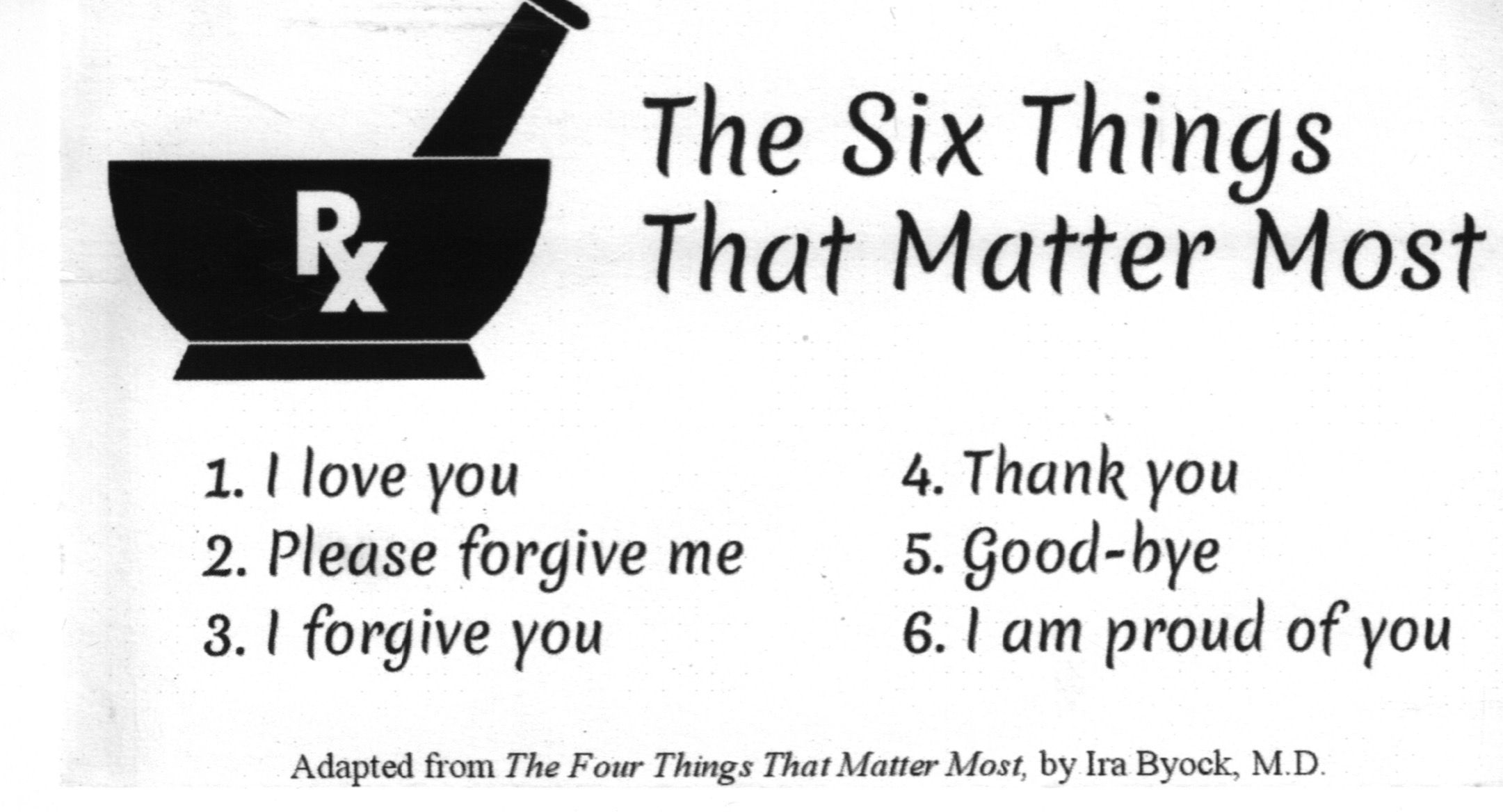 I was grateful to have the card when my father was dying.
He was in his last days at a nursing home. My two sisters and I used the list as a prompt for talking to him. He was no longer responsive, but it felt like the right thing to do. Maybe he heard us or maybe not. Maybe he could sense what we meant through tone or feeling. Or maybe it was just for us.
“Dad, please forgive me for the sleepless nights I gave you as a teenager.”
“There were times when I was growing up when I was afraid of your anger. I knew you were under a lot of pressure and loved us, but it was still scary. I forgive you.”
“Thank you for providing for us, encouraging us and believing in us.”
“For the way you worked so hard to honor mom and provide for us, for the integrity and honesty with which you lived your life, and for your service to our country during the war – we are proud of you.”
Dad wasn’t from a generation when many men would say “I love you.” But we knew he loved us. It was easy for each of us to say, “I love you, Dad.”
The “Goodbye” statement can be tricky. It can be tempting to say it to have some closure, but it may be too early. (I remember one family had asked a harpist to play in the room; the patient woke up and said, “Get that music out of here…I’m not ready for the angels yet!”) But if, say, a family member is leaving town or death is clearly imminent, then “Goodbye” can be fitting.
As I did presentations on hospice in the community, I would pass these cards out. People would later tell me how helpful they were.
But I also knew what everyone who works in hospice knows…the work is not just about the dying, but also about the living. Whether dad was fully aware of what we were saying, it gave us closure.
The list can also be helpful after a death when we didn’t have an opportunity to speak the words in person. We can write a letter to the person using the list as possible prompts. We can then save the letter just for ourselves. Or we can take it to a place we associate with the person, including a gravesite, and read it. When it’s served its purpose, we can keep it or create a simple ritual and burn it.
“Six Things” can also be valuable when death is not on the horizon. Roughly half of Americans die with some form of hospice care, which means there may be time for meaningful bedside moments. It also means the other half of us will die without such an opportunity – heart attacks, strokes, accidents, etc. If these are the six things that matter most, why wait for a moment that we may never have? Why not use them when we are alive and well?
As time went on, I’ve found the “Six Things” a good way to take inventory from time to time in my own life on occasions like anniversaries and birthdays. Is there someone I want to say these words to now since there’s no guarantee I’ll have a chance in the future? Or maybe take one each day, and say it to someone during the day if the time feels right? It doesn’t have to be a dramatic act, just a sincere one. What do we have to lose? Once we do it, we often experience a sense of freedom.
I was grateful to have the card when my father was dying.
He was in his last days at a nursing home. My two sisters and I used the list as a prompt for talking to him. He was no longer responsive, but it felt like the right thing to do. Maybe he heard us or maybe not. Maybe he could sense what we meant through tone or feeling. Or maybe it was just for us.
“Dad, please forgive me for the sleepless nights I gave you as a teenager.”
“There were times when I was growing up when I was afraid of your anger. I knew you were under a lot of pressure and loved us, but it was still scary. I forgive you.”
“Thank you for providing for us, encouraging us and believing in us.”
“For the way you worked so hard to honor mom and provide for us, for the integrity and honesty with which you lived your life, and for your service to our country during the war – we are proud of you.”
Dad wasn’t from a generation when many men would say “I love you.” But we knew he loved us. It was easy for each of us to say, “I love you, Dad.”
The “Goodbye” statement can be tricky. It can be tempting to say it to have some closure, but it may be too early. (I remember one family had asked a harpist to play in the room; the patient woke up and said, “Get that music out of here…I’m not ready for the angels yet!”) But if, say, a family member is leaving town or death is clearly imminent, then “Goodbye” can be fitting.
As I did presentations on hospice in the community, I would pass these cards out. People would later tell me how helpful they were.
But I also knew what everyone who works in hospice knows…the work is not just about the dying, but also about the living. Whether dad was fully aware of what we were saying, it gave us closure.
The list can also be helpful after a death when we didn’t have an opportunity to speak the words in person. We can write a letter to the person using the list as possible prompts. We can then save the letter just for ourselves. Or we can take it to a place we associate with the person, including a gravesite, and read it. When it’s served its purpose, we can keep it or create a simple ritual and burn it.
“Six Things” can also be valuable when death is not on the horizon. Roughly half of Americans die with some form of hospice care, which means there may be time for meaningful bedside moments. It also means the other half of us will die without such an opportunity – heart attacks, strokes, accidents, etc. If these are the six things that matter most, why wait for a moment that we may never have? Why not use them when we are alive and well?
As time went on, I’ve found the “Six Things” a good way to take inventory from time to time in my own life on occasions like anniversaries and birthdays. Is there someone I want to say these words to now since there’s no guarantee I’ll have a chance in the future? Or maybe take one each day, and say it to someone during the day if the time feels right? It doesn’t have to be a dramatic act, just a sincere one. What do we have to lose? Once we do it, we often experience a sense of freedom.




 Steve Jacobsen, Ed.D