The Mysteries of Prayer

Last year I visited the Getty Villa in Malibu. This is Mr. Getty’s effort to recreate his own lavish Roman residence on the California coast. I spent two hours there. I read about the effort and expense used to create the buildings, gardens, and galleries. But it left me feeling empty. I’ve lost interest in seeing monuments emperors and billionaires build to celebrate themselves and their accomplishments. 

But in one of the gardens, I came across this statue, “Woman Praying”:

I took note of the posture, then looked closely at the face:

I was fascinated.  And puzzled.  Why would this interest me?  There’s nothing remarkable in her expression – it seems almost blank. But after standing there a while, I realized I wasn’t drawn to the sculpture itself.  Instead, I found it raised questions for me: What would this anonymous Roman woman’s inner experience have been like?  What was she thinking? What was she feeling? Was she using a formula she had been taught or was she improvising?  Was her prayer about some critical decision, or just an ordinary part of her day?

            I could Google around and probably get specific answers to my questions.  But I didn’t want to answer the questions as much as tend them – letting them draw me into my own reflections on the experience of prayer.

            Some might think I should be an expert.  For over 40 years I have been studying, reading, reciting, hearing, and composing prayers drawn from 3,000 years of Western traditions.  I’ve been at Buddhist retreats focusing on meditation and “Metta” prayers. I’ve attended Native American ceremonies, where ancestors and the Creator are honored.  I had no clue as to what might have been in this woman’s mind and heart. Yet somehow, I felt a kinship.

            This statue came back to me recently after reading, “When I Prayed to Buddha, God was Listening,” an article by a woman named Sida Lei.  Ms. Lei was raised as a Buddhist in Cambodia. At age 10, the Khmer Rouge came into her city and expelled the residents. She writes, “When the Khmer Rouge split my family apart, sending me away to a child labor camp, my mother knelt over me and whispered, “If ever you are in trouble, Sida, pray to God. He will help you.” Of course, the god I pictured was the great stone statue of Buddha. There were no other gods I knew.” Her mother died of starvation and her father was taken away, never to be seen again.  She became responsible for her four siblings, and they were incarcerated in the countryside.

            Eventually, she and her siblings decided to attempt an escape. They fled into the jungle and came across an abandoned temple with a broken statue of Buddha. Drawn to the statue, she prayed for guidance. She felt prompted to flee to Vietnam with her siblings. So began a perilous journey. Eventually, they arrived at a refugee camp in Thailand and she was filled with gratitude. 

That first night she heard a song in the distance, “Amazing Grace.”  The next day she went into town to discover where the music had come from.  She was directed to a church.  She asked some women there if they had been the ones singing and they said they were.  They told her they sang praises to God daily. She began attending.  Eventually, she and her siblings were able to come to the U.S., sponsored by a Catholic church in upstate New York.  She is now a clinical microbiologist in Virginia.

            Sida Lei prayed for guidance to Buddha, who was the divine image her culture and mother had given her. Time and again she felt she received guidance.  The focus of her prayer changed when she found herself in another culture, [i]but she did not feel she had to disown one to embrace the other.  She had been in a time of desperate need, reached out as best as she could, and eventually experienced deliverance.

A deep tenet in Western traditions is a conviction that there is one God, and no other images or concepts should be worshipped.  One should be very careful to pray for appropriate things in an appropriate way.  I understand the context of this belief.  But if a human being of any culture is reaching out to an unseen presence with all their heart — might that be enough?

My spiritual awakening began in my early 20s in a time of crisis.  At that age, I didn’t believe in anything beyond what I could see and understand rationally. But I was desperate.  I decided to pray.  What did I pray? I don’t remember.   Maybe I made it up or maybe I tried to recite something I’d heard as a child.  Three days later I became aware that I wasn’t as desperately afraid as I had been that night, and something like a calm point of light had entered my darkness. No claims were made on me to take a specific action or adopt a particular belief – what I’d been given was a pure gift.  Several years later I began attending a church and learning all the different words, images, forms, and experiences one can use in praying.  I am aware of the countless questions raised over the centuries, like “Why are some prayers answered and some not?” And I understand why many people are skeptical about prayer.  But I don’t let my lack of understanding stop me from praying.

I don’t know what this Roman woman experienced, what forces were at play in Sida Lei’s escape, or what exactly happened to me many years ago.  It’s a mystery. But I have a feeling that it’s more about sincerity and an open heart than having the right form.  And I know the outcome can be amazing.

(Prior posts on prayer include Turning Toward the Serene Light and ACTS: A Simple Form for Personal Prayer)

NOTE: This piece was written without assistance from any Chatbots or A.I. programs. The author has been tempted by emails encouraging him to let a computer “write your blog for you,’ but so far, he has refused to accept such help. He’d rather do the work himself and create something flawed than have a “superior product” created by a sophisticated device.


[i] When I Prayed to Buddha, God was Listening

Ways to Greet the Morning

On a recent morning walk, I came upon a neighbor who was patiently waiting for his small dog to finish a thorough sniffing-inventory of a strip of ground cover along a popular sidewalk.

“There must be so much vital information there,” I said.

“They say it’s the equivalent of reading a morning newspaper,” he said.

Dogs know it’s wise to start your day by focusing on what’s important.

I’ve heard that generations ago, the Bible was the only book many people had in their house, which they would read every morning.  In time, that was replaced by newspapers.  Then television.  Then email. Now, for many of us, it’s social media.

As we’ve become more attached to our devices as our first focus of attention, some thoughtful people have encouraged us to consider alternatives.  “Sky before screens” is one suggested mantra…go outside and gaze at the stars before picking up a phone or tablet. 

Sometimes, before we arise, we can just say, “Thank you” for the miracle of being alive.

One colleague said if he wakes up while it is still dark, he listens for the first bird song outside his window.  Once some brave soul breaks the silence, others join in. He likes paying respects to the one who had the courage to start the concert.

I have a Jewish friend who begins each day doing yoga while reciting ancient morning prayers.

The first Muslim city I ever visited was Fez, Morocco.  I wasn’t used to hearing Arabic, so when the local muezzin called the faithful to morning prayers from the tower as the sun rose, it sounded a bit jarring. But I became fond of it. There’s a melancholy beauty in the recitation, a soulful invitation to begin our day with gratitude and focus.

I’ve attended numerous retreats at St. Andrew’s Abbey, a Benedictine monastery south of Lancaster.  The chapel bell rings at 6 AM to call everyone to the first service, known as Vigils (Type-A early risers like the Trappists begin at 3:15 AM). Sometimes I’ve heard the bell and gone back to sleep.  But other times I’ve gotten dressed and made my way out the door. Walking in silence to a chapel in the desert as evening gives way to daylight while being summoned by chanted praise is always worth the effort.

I knew a mother of young children so desperate to start her day with prayer that she would lock herself in the bathroom at 5 AM, leaving her husband to manage the chaos for just enough time so she could center herself.

Maybe the instinct to start the day with a meaningful focus lies deep within us.

I’ve always been fascinated by the Gelada Baboons in Africa.  They wake up before dawn and find a place to greet the sun in silence.  As described by photographer Simone Sbaraglia, they do it “just to wallow in the sun’s golden light.”

Photos: Simone Sbaraglia, Caters News Agency, https://www.slrlounge.com/golden-hour-worshipped-photographers-gelada-baboons-alike/

Seeing People Like Trees

Dr. Michael Kearney is a skilled hospice physician, gifted writer, former colleague, and treasured friend.[i]  He recently posted this:

“Answering a question about how we can judge ourselves less harshly, Ram Dass writes:  Part of it is observing oneself more impersonally… When you go into the woods and look at trees, you see all these different trees. And some of them are bent, and some are straight, and some of them are evergreens, and some of them are whatever. And you look at the tree and you allow it. You see why it is the way it is. You sort of understand that it didn’t get enough light, and so it turned that way. And you don’t get all emotional about it. You just allow it. You appreciate the tree.

The minute you get near humans, you lose all that. And you are constantly saying, “ You’re too this, or I’m too this.” That judging mind comes in.  And so I practice turning people into trees. Which means appreciating them just the way they are.”

I find this a helpful metaphor.  It is common to look at how someone appears, how they present themselves, and how they behave and put them in categories of good or bad, respectable or not.  We do this to ourselves as well. Our inner critic can be fierce in judging who we are, what we’ve done, and what we should have done.

Thinking of people like trees can give us an alternative.

Look at this Eastern Redbud tree in our backyard:

Somebody looking at it will assume that the trunk is curved to the right because that is the direction in which the sun shines into our yard.  That is correct. But I know more about its history.   

We planted it ten years ago and it had a hard time getting established. The top of the trunk was often bending so far following the sun that it was in danger of falling over and having its roots upended. We tried bracing with different methods — vertical stakes and ground anchors — but the growing center branch was always veering perilously to the right.  One day a gardener pointed out that the bracing was no longer helping. The tree had become dependent on external support and was not developing its own root system. We removed the bracing.  After one strong windstorm, the tree bent completely over, and the tip was touching the ground – we didn’t know if it would recover. But it did.  In time, the roots became established and created the strong support it needed. It now reaches in two directions: one continues orienting toward the sun while the other grows vertically, adding balance to the whole. It may not win “Best of Show” in a horticultural contest, but when I look at it, I see a living presence that has had to struggle to survive and has succeeded.

So it is with many of our fellow human beings.

Early in my ministry, I felt a calling to do memorial services, regardless of whether I had known the person or if they had any religious affiliation. 

We were living in the small, rural community of Wapato, Washington, when I got a call from the local mortician.  He asked me to do a graveside service for a man who had no known family and just a few friends.   I agreed.  I met with the friends to gain a sense of the man’s life, chose a few relevant Scripture passages, then led the service.  A half-dozen people were present.  No impressive obituaries were published, nor were any soaring eulogies given. But like a tree that had faced many challenges, this man had endured a great deal.  I remember feeling a sacred presence as we honored him.

We know trees benefit from skillful pruning.  A good arborist sees each tree in its unique environment and shapes it to help it flourish.  The same is true for loving parents, dedicated teachers, insightful mentors, and caring friends.

Following a spiritual path can be an act in which we open ourselves to being pruned by the wisdom and practices that a tradition gives us. As the saying goes, “God meets us where we are but doesn’t leave us there.” 

A friend of mine is a retired police captain.  He told me that a turning point in his career was when he began seeing people with compassion instead of judgment.  And his life was profoundly influenced by Father Gregory Boyle, the founder of Homeboy Industries, who has spent decades working with at-risk youth, convicted felons, gang members, and their families.[ii]  Father Boyle has said, “I choose to stand in awe at the burdens carried by the poor rather than standing in judgment about how they carry them.”

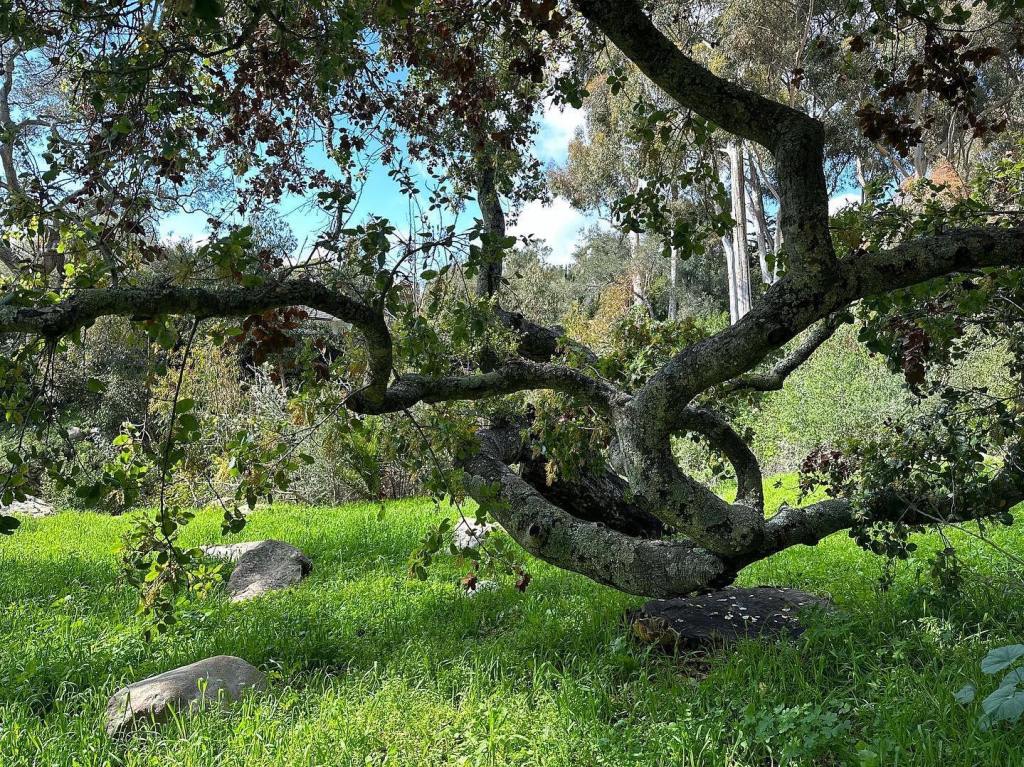
Take a close look at the oak that Michael photographed while hiking the San Ysidro Creek:

How many twists and turns has it made while seeking the life-giving sun?  What a story it could tell.

Oak Photo: Dr. Kearney


[i] To see Michael’s writings and meditations, go to https://www.michaelkearneymd.com  Michael’s wife, Radhule Weineger, is a popular mindfulness teacher whose work can be seen at https://www.radhuleweiningerphd.com

[ii] https://homeboyindustries.org

Do Your Best and Let It Go

            Let’s talk about pressure and responsibility.

            Last year I was listening to a baseball broadcast on the radio.  The announcer told a story about perhaps the greatest “closer” of all time, Mariano Rivera of the Yankees.  In baseball, the job of a “closer” is to come in to pitch toward the end of the game when his team is ahead by a narrow margin and not let the other team score, “saving” the game.  Between 1995 and 2013, Rivera was asked to do that 1,115 times. He succeeded 734 times and failed only 80.[i] He was selected for the All-Star team 13 times and elected to the Hall of Fame in an unanimous vote. Rivera was once asked how he could live with the intense pressure of being a closer day after day, year after year. He said he did everything he could to throw each pitch to the best of his ability, but once it left his hand, he assumed he’d done his part – what happened next was beyond his control.

            I find this perspective to be valuable when thinking about how we live our lives.

            Take parenting.  You want the best for your children.  You provide for them, guide them, lose sleep over them, and do all you can to prepare them for life.  You will always love them and be concerned for them. But once they go out the door, they face a world beyond your control. Free will, chance happenings, and unexpected events will shape them. 

            Or how about work?  Every time I’ve left a job I cared about, I hoped the organization and people would do well.  Sometimes that happened and sometimes it did not.  I felt sadness when things did not go well, but, taking Rivera’s advice, I remind myself I gave it my best when I was there and what happened after that is beyond my control.

            The same can be true for many decisions we make, including deciding to move to someplace new or what we do with our money.  As Kierkegaard said, we tend to evaluate our lives by looking backward at the decisions we have made – after we know how it all turned out. But we did not know then what we know now.  We have to live life forward, without knowing all the facts.

            In spiritual traditions, we can find similar stories.

            Moses takes his people from bondage to within sight of the promised land, yet dies before they cross over.  But he had done all he was asked to do.

            One of Jesus’ last recorded words was, “It is finished.” How could that be, a retreat leader once asked — if he came to feed the hungry, give sight to the blind, and liberate the oppressed, so much suffering was still present in the world when he died; how can he say, “It is finished?”  The leader concluded: because the specific task God had given him to do was finished. It would be up to his followers to take the work forward.

            One of the stories about the death of Buddha describes how, in his 80s, he fell ill after eating spoiled pork.  The man who cooked the food was overcome with sorrow. But Buddha told him not to feel that way.  What had happened was a gift, because Buddha was ready to die and move into the next realm.  He left behind a vast treasury of teaching, and that was enough.

            Let’s do our best with the responsibilities we’ve been given. But let’s also recognize there is only so much we can do.  Once the ball leaves our hand, we can be at peace.


[i] For folks who care about baseball statistics, Rivera had 652 saves and 82 wins for a total of 734.  He had 80 “blown saves” and the rest were no decisions.

Are Natural Disasters Sending Us a Message?

Earlier this week an intense storm moved through California. My community experienced historic levels of intense rainfall, much as it had five years ago; roads were closed, creeks overflowed, and thousands of people had to evacuate.  As I followed the news reports, I couldn’t help but notice a pattern in the language used to describe it. Here are some examples (italics added):

  • “Southern California faces another day of punishing rains…” (LA Times)[i]
  • “…the latest in a series of atmospheric rivers to pound the state…” (LA Times)[ii]
  • “The string of storms pummeling California has proved catastrophic…” (NYTimes)[iii]
  • “In Los Angeles, four people escaped after a sinkhole swallowed two cars on Monday night…” (NPR)[iv]
  • “We need to be nicer with Mother Nature, because Mother Nature is not happy with us…”  (Ellen de Generes’ tweet cited in NPR Online.)[v]

What does this language suggest?  Does rain “punish” people like an angry parent?  Does a storm “pound” an entire state as if it’s in a rage?  A boxer “pummels” an opponent to subdue, demoralize and defeat him – was that why this atmospheric river came our way?  Whales “swallow” people in the Pinocchio and Jonah stories — but does asphalt do that?  And does “Mother Nature” send an intense torrent of muddy water down a hillside to show us that she is “not happy”?

Of course, the rational answer to these questions is “no.”  The language expresses in dramatic terms what severe weather can feel like when we experience it – it’s our human imagination at work. Weather events are not personal acts of cosmic vengeance but are explainable by the laws of physics. 

And yet I understand why such language feels appropriate.

I vividly remember in January of 2018 when, for the first time, three of us were allowed to pass through police barricades and evacuated neighborhoods to view the impact of the debris flow on our 26-acre retreat center in Montecito just days before.  The mud was deep, viscous, and dangerous — it would pull your rubber knee boots off your leg if you stepped in the wrong spot.  Boulders, mud, crunched lumber and twisted oak trees were everywhere. Some of our large buildings had completely disappeared.  It was stunning, hard to fathom, and an unforgettable reminder of how fragile life is. Somewhere deep in my primal instincts, it felt personal – like a mighty, conscious force was displaying its power to make a point.

After returning home, I began thinking about stories our ancestors told to make sense of such destruction.  Noah’s ark came to mind.  I reread it. 

Now the earth was corrupt in God’s sight, and the earth was filled with violence. And God saw that the earth was corrupt; for all flesh had corrupted its ways upon the earth. And God said to Noah, “I have determined to make an end of all flesh, for the earth is filled with violence because of them; now I am going to destroy them along with the earth.[vi]

Sounds like the reason the flood happened is that the divine force felt a need to “punish,” “pound,” and “pummel” the corrupt and violent human race, letting the seas “swallow” them all up –because the Holy One was not exactly “happy with us.”

I thought about that.  I understood it made sense generations long ago in a prescientific world, but it doesn’t seem plausible to me today.  Indeed, the more we learned about debris flows, it became clear that these are routine geological occurrences that have been going on for thousands of years, long before people were living here.  Besides, I don’t believe in a punishing God. The storm was not a moral or spiritual event but a phenomenon explainable through the natural sciences. 

But I kept pondering the issue. I wondered: “Was human behavior a contributing cause to the severity of this event due to our complicity in global warming?”  We can’t blame a Creator or Mother Nature or physics for climate change – that’s on us, on our ignorance, willfulness, stubbornness, and greed.  The dramatic intensity of the storm was not an expression of divine judgment but, to some degree, a natural consequence of our past actions. So, if there is a moral lesson carried in the increasing intensity of severe weather events and fires, it’s not about divine intent or a weather system with emotional issues – it’s our selfish behavior coming back to haunt us.  We need to be humbled.  And we need to take responsibility for our mistakes.

Several weeks later, I was able to return to the property and walk it again.  Bulldozers, backhoes, trucks, and work crews were clearing the wreckage of the buildings and trees.  The magnitude of what had happened was still astounding.  But in many places, green shoots were coming up from the ground. Life was regenerating.  Let’s hope the lessons being offered us are not forgotten.

Art work: Noah and the Dove, 13th century, Monreale Cathedral, Sicily


[i] https://www.latimes.com/california/story/2023-01-10/storm-southern-california-los-angeles

[ii] https://www.latimes.com/california/story/2023-01-10/storm-southern-california-los-angeles

[iii] NY Times. Online, Jan 10, 2023

[iv] NPR Online, January 10, 2023

[v] Degeneres Tweet, NPR Online, January 10, 2023

[vi] Genesis 6: 11-13


Friction, Character and Home-Cooked Meals

            Some years ago, I heard of one family’s coming-of-age ritual for children on their 12th birthday: prepare and serve a multi-course dinner for the family. Not by micro-waving or Grub-hubbing but by doing it all from scratch.  Deciding on a menu. Making a list of ingredients and buying them.  Setting the table.  Prepping and cooking each dish. Planning it all so everything would be ready at the right time.  Announcing, “Dinner is ready” and calling everyone to the table.  Then doing the clean-up after everyone is done.

            This was expected of each child, regardless of gender.

            I doubt if I would have wanted to do that when I was a kid.  It would involve giving up highly productive activities I preferred – like watching cartoons and sitcoms.  It would require listening, observing, experimenting, and being patient.  I might very well experience what we can call “friction”– the discomfort we experience when we are doing something difficult.

            My use of the word “friction” comes from a philosopher of technology, Albert Borgmann.  I encountered him and his work twenty years ago when I did a sabbatical project exploring how digital technology was changing personal life and spiritual practices.  Borgmann observed how digital devices often reduce friction in our life.  Instead of getting up and having to do something that may take effort and skill, a device invites us to avoid the effort – the friction — and instead, we tap a button or give a voice command.   Borgmann’s point is that the more and more we expect a friction-free life as the way things are supposed to be, our capacity to deal with friction when we encounter it diminishes.  He also believes the way in which we handle friction in daily tasks carries over to the formation of our character and capacity for nurturing interpersonal relationships.

            I remember a time when our family was practicing having a “digital sabbath day” – one day a week when we would not turn the computer on.  (This was long long ago in a galaxy far far away — before smartphones and tablets competed with oxygen and water as essential for moment-by-moment survival.)  My six-year-old daughter was bored. She begged me to let her turn on the computer and play a game. I told her we were taking a day off from using the computer.  Why not, instead, play with a favorite neighborhood friend of hers?

“We had a fight on Friday”, she said.

“Well, you could call her and try to get over it,” I said.  She fumed.  But after minutes and minutes of misery, she decided to call.  They got together, cautiously at first. But soon they became lost in play which continued for two hours. They faced the friction of interpersonal issues and got through them.  It would have been easier to be digitally distracted — and alone.  But working through the friction led to a renewed relationship.

Whether it’s marriage, family, or the workplace, dealing with other people often involves some discomfort – some friction – and it takes patience and determination to see if things can be worked out. The more digital technology leads us to expect a friction-free life, the less and less able we will be to deal with other people — those pesky humans just don’t seem to respond to our desires as quickly and easily as our beloved devices.

            My wife spent many years teaching first graders, who can become frustrated learning a new skill. She would tell them to say to themselves: “I can do difficult things.”  In a sense, it’s saying, “I can bear the friction I experience as I learn to master something new or challenging.”  And developing our will and stamina to do that strengthens our character.

            Huston Smith said that one of the shortcomings of our contemporary culture’s understanding of “spirituality” is that we often make it too easy and self-serving.  Spirituality becomes something like a buffet table – we walk by displays of various ideas and practices and put on our plates what appeals to us at the moment.  In doing so, we may avoid anything that is difficult.  But the great global traditions include practices (Ramadan, High Holy Days, Lent, vision quests, etc.)  that ask us to take on difficult things, like fasting, repentance, and acts of service.  Our ego may resist, but our soul welcomes the challenges as the means to a more personal strength and maturity. The traditions, Smith said, “have traction.”   

            I’ve often thought of that family’s dinner preparation ritual. Imagine turning 12 and, for the rest of your life, having the confidence and skill to feed yourself and others. How strong and free you would feel.

Image: “Mickey Mouse and Goofy: Thanksgiving Dinner,” #776, Children’s Book Illustration, Whitman, c. 1970s (apparently the guest on the right is a turkey who’s been invited to share in a vegetarian banquet instead of being the main dish.)

Out With The Old, In With The New?

            I once was asked by my employer to attend a program on “Organizational Change.” There were six of us present, each responsible for a particular program.  Standing next to an easel holding a blank sheet of newsprint with Magic Marker in hand, the presenter posed a question: “Why might we resist change?”

            A few years ago, I would have been excited by this question.  As a young leader I wanted to be a “change agent” and a constant innovator. But maybe I’d been in too many of these kinds of seminars led by consultants or speakers who seemed to unequivocally assume every “change” is a good thing.  Or maybe I sensed she assumed the way we ran things needed improvement without first appreciating what we were doing.  Or maybe I was just feeling ornery.

            With nothing to lose, I raised my hand and said, “Well, one reason we might be resistant to change is that things that are working well don’t need to be changed. They should be respected and preserved.”

            She looked at me as if I said something incomprehensible. She didn’t ask me why I felt that way, or what examples I could give.  She ignored my comment and turned to the others to give the answers she wanted.

I confess from that point on I tuned her out.

            “Out with the old, in with the new” is a common phrase in our culture.  But there are times when we should question it.

To be clear, I’m all for new things – when they are necessary.  In the past year, I bought a new Ride1Up E-bike that is a delight to use.  We bought a new TV that’s far better than our old set.  In May I went to Los Angeles for the premiere of a bold new classical composition by Thomas Ades and it was thrilling.  I got a new pair of shoes that I really like — only $25 at Costco! I put a new coat of paint on the walls of my home office, and it looks a lot better.  I’m always on the lookout for a new way to grill fish, or an exciting new movie, streaming series, or book. I love meeting new people, asking where they’re from, and learning what’s been important in their life.  And I’ve led organizations where I’ve worked hard to envision and implement changes, and felt satisfied and gratified when things turned out well.  

            But some old things are worth hanging on to.

            I have a dining room table from my ancestors’ farm in Iowa that is 150 years old. My grandmother did her Latin homework on it in 1915.  It was old, worn, and in pieces when my father asked me if I wanted it when he was cleaning out his garage.  I almost left it for the landfill. But I decided to take it home and see if I could refinish it. I sanded it, shaped it, stained it and finished it with a coat of varnish. It turned out far better than I had expected.  When you put all the leaves in you can seat 12 people, and it’s a meaningful link to my family history.

            I treasure friends that have remained close over the years.

I have a special affection for old dogs.

            I don’t think I need to seek out a “new and improved” version of the Pacific. Or trade in the Sierras for a “new” mountain range.

            I was a history major in college because I wanted to understand how the world got to be the way it was.  One day I realized I had always assumed that the story of Western civilization was constantly moving forward toward something new and better, and that everything “old” needed to be discarded.  That may be true in some areas. But how about the arts and sports?  Would you say someone has finally gotten “better” than Bach, Gershwin, Lennon/McCartney, Bruce Springsteen, Willie Nelson, Aretha Franklin, or Michael Jackson?  Has painting “improved” since Botticelli, Monet, and Van Gogh?  Are athletes “better” than Babe Ruth, Pele, Serena Williams, or Steph Curry?  New composers, artists, and athletes come along, but that doesn’t mean they are “better” than those of the past…they are just new arrivals.

            Our economy is built on the assumption that we must be constantly expanding.  But look what it’s done to our “old,” dear earth.

            In the last year, I’ve been meeting with a group focused on the redesign and rebuilding of La Casa de Maria, the 26-acre retreat center that was damaged by the 2018 mud and debris flow while I was the Director.  We’ve been working hard to see how we can bring it back better than ever. But we also know there was a sense of “soul” and presence there that can’t be improved on but must be preserved.  After months of work, we believe we have found an optimal balance between innovation and preservation.

            I believe the divine Spirit is always fresh and creative, asking us to dream new dreams and be open to new approaches to life.  At the same time, have we found better values to live by than to seek justice, love kindness, and walk humbly on this earth with one another?

            So — out with the old, in with the new? It depends.  There comes a time when we need to let some things go. But other things need to be kept, held with deep affection, and revered.

Photograph: “Jedediah Smith Redwoods State Park,” amercianforests.org

Sunlight Finds the Opals

LODE

Even underground, sunlight

finds the opals and fills them.

So much beauty embedded

in cavern walls, needing no one

to find it, no human eye to see,

waiting in perfect patience,

in due time, to be revealed.    MCM

The painting is by John McEntyre and the poem by his wife, Marilyn.  John and Marilyn have been friends and colleagues for many years. Marilyn led several online writing classes during COVID which helped me change my writing process — she discourages using an outline or having an endpoint in mind when beginning, and instead “write into the unknown.” 

As I’ve followed this advice, I’ve found myself coming to surprising perspectives.  I don’t know if the insight is there before I start seeking it, or it is formed as the search progresses. But there is “sunlight” “embedded” in us, and often we need patience, curiosity, and courage to find it.  Maybe it’s through painting or writing.  Maybe it’s on a long walk or during an extended conversation with a trusted friend.  Or maybe it’s letting a sacred text or piece of music open our hearts and imagination to something new. 

I’ve seen many people walk through times of darkness and find such light.

I worked at Hospice of Santa Barbara for 5 ½ years. When I told people where I worked, it was common for them to say, “Oh, that must be depressing.” But I would say it was not. Seeing people work through their grief to find some authentic resolution and a way forward was inspiring.  One 15-year-old said: “Death is like a broken heart.  It hurts and is sad but you get through it.  Your heart is twice as strong.”

Solstice and the sacred stories of the season remind us that there are endless points of light waiting to be revealed in “due time.”  As we face periods of uncertainty, may we trust that the light is there, safely residing in “cavern walls,” “waiting in perfect patience, in due time, to be revealed.”

John’s painting and Marilyn’s poem are used by permission. More information about Marilyn, her publications, her classes, and retreats can be found at https://www.marilynmcentyre.com; John’s work can be seen at https://mcentyreart.com.

Empathy Means I Don’t Know How You Feel

             “Empathy is not ‘I know how you feel,’ but ‘I don’t know how you feel.’

I recently came across this quote in notes I’d kept from a retreat I attended some years ago. It was credited to Rowan Williams, Archbishop of Canterbury. 

            If we care for people, we want to know how they are feeling.  Making the effort to do so is a genuine act of compassion.  Sometimes we make the connection easily.  But sometimes our assumptions about what another person is feeling can lead us astray.  

            I remember an older woman I visited after she began attending our services. She always dressed more formally than was the norm in California and was always very gracious. When I came to her apartment, she invited me to have a seat in her living room. I noticed the many shelves which were carefully arranged with shiny porcelain figurines and elegant China dishes. It all suggested to me she’d probably led a proper and sheltered life.  I asked her to tell me about herself. She talked briefly about her life before coming to Santa Barbara.  Then she calmly described how her husband had recently died after ten years of dementia. She said for the first five years, she had cared for him by herself in the apartment, needing to be more and more vigilant as his condition deteriorated.  When she could no longer keep him safely, she transferred him to a facility and visited him every day for five years until he died. I was stunned.  Where do people find the strength for such devotion?  

            I once went on a mission trip with teenagers in Mexico.  We’d build homes during the day and return to the campground at night.  I had unconsciously brought with me an assumption – shared with many fellow parents of the time – that teens were becoming so obsessed with digital devices that they must be losing their ability to make genuine connections with others.  But as I sat with them at night around the fire and they talked about their lives, I realized I had misjudged them; they were much better listeners than many adults. 

            I got to know a woman in her 30s who’d been wheelchair-bound her whole life. Once she said something that made me think of Christopher Reeves, the Superman actor who had become paralyzed after a horse-riding accident. “He must be an inspiration,” I said.

            “Not really,” she said. “He’s rich and famous and can pay for 24-hour care and do what he wants. But most of us don’t have his resources. We experience a lot of loneliness and depression.  But no one wants to hear that. People like him because he’s always positive. If he’s feeling down, he can’t talk about it, or he won’t be popular.” 

How little we know about the inner life of others.

            When I began my work at Hospice of Santa Barbara, I attended a workshop focused on caring for families in which the death of a child or parent had occurred.  The speaker had worked for twenty years in hospitals dealing with such situations.  I was hoping for some handy guidelines for such situations. I was surprised when he said what he does before he walks into a room to meet a family: “I get in touch with my helplessness.” That confused me at first.  But the more I thought about it, the more I realized this is a way to set aside that anxious, earnest, “I-want-to -fix-it” impulse within us to become truly open to whatever is present.

            And I remember being at a conference where a prominent nursing educator from the City of Hope was speaking about how easy it is to misjudge people. She said she had once led a support group for women who were dealing with breast cancer.  Each person in the circle was taking a turn describing what emotions they were experiencing.  All the women in the group talked openly about how hard it was, and many shed tears.  One woman, however, seemed unmoved and opted not to share.  The speaker confessed thinking, “This woman is probably repressing her feelings; I’ll speak to her after the session.”  After the session was concluded and the others left, she approached the woman, who agreed to sit down and talk. The leader shared her concern that the woman was perhaps not being forthright and encouraged her to share.  The woman told her what she’d experienced in the last three years. First, her family had lost their home in Hurricane Katrina and couldn’t go back. Then a daughter died. Then she’d lost her husband. “This?” she said, motioning towards her body, “This is just breast cancer.”

            We never can assume we know what someone else is really feeling, or what it’s like to be “in their skin.”

            A seminary teacher once made a reference to a painting that was probably in every Sunday School building in America: “Jesus Blesses The Little Children.”  It’s very simple: Jesus is just sitting in the midst of a group of boys and girls. “You know,” the professor said, “People always assume that he is teaching them something. But maybe he’s just listening.”

Image: Portrait of a Peasant – Patience Escalier, Vincent van Gogh

Our Evolutionary Inheritance: Work, Sleep, and Campfire Wisdom

            Several years ago, I read about an African hunting/gathering community that had virtually no prior contact with “civilization.[i]” For two years an anthropologist recorded daily conversations, coded them, and analyzed them.  Some key findings:

  • Almost all the daytime conversations involved work, with approximately 37% consisting of people complaining others weren’t doing their fair share.
  • Tribal elders did not have much to say or contribute during the day. 
  • At night, everyone gathered around the fire. The focus changed from work to spiritual topics, tribal history, and “subtle psychological insights.”  Elders became central to these conversations. The conversations could last for hours, and the old ones might nod off.  But after a rest, they would often rejoin the circle.

At the time I read the article, I was leading a nonprofit with 30 employees, and these themes resonated with what I was experiencing: 

  • The hardest part of the job was dealing with “HR Issues” – people’s work performance and how people would fret about the performance of others (probably close to 37%).
  • Younger employees often had more energy and could work longer. They also had more skill and less anxiety dealing with IT issues and were invaluable for pointing out cultural changes that were occurring and how we might adapt.
  • While everyone might have insights into our work, it was the older ones who held the “tribal memory” of both the organization and the profession and were particularly helpful in offering long-range perspective.

Later I saw an article about how our evolutionary past might explain the way memory changes over time.[ii]  As we know, older people begin having difficulty with short-term memory (“Where are my glasses?” “What’s my password?”)  But even seniors with dementia can have remarkable recall of past events. When our ancestors were hunting or gathering during the day to survive, they had to rely on mental alertness and physical abilities. But as they became slow, creaky, and sore, their value to the community shifted – they were the ones who carried the valuable stories; short-term memory was less important.

Maybe evolution also explains our sleep patterns. During COVID, I read Why We Sleep[iii]. The author notes that some adults go to bed early and wake up early while a roughly equal number of people go to bed late and sleep late.  He theorizes this may be an inheritance from our past: it would be advantageous to have people awake at different times of the night to act as sentries for the tribe.  So maybe this is one reason older folks wake up more often at odd hours — they’re wired for sentry duty.  (Of course, the seriousness of the danger has changed; instead of “Is that a lion I hear in the forest”? it might be, “Does the dog need to go out?”)

These ideas comfort me.  I like to think some of the changes we experience as we age aren’t because there’s “something wrong” with us, but because of deeply engrained behaviors that were advantageous for our ancestors.

I’ve always been fascinated by how Rembrandt was able to document his aging process.  He portrayed himself close to 100 times, 40 of which are complete paintings.  Here is one from 1632:

This 26-year-old guy is on top of his game – no doubt staying up late, full of energy and confidence, and successfully adapting to the latest trends and techniques.

And here he is 31 years later at age 57:

He may not be not going out as much…probably frustrated with aches and pains…going to bed earlier than he used to and waking up at odd times during the night.  Maybe you wouldn’t ask him to help you move furniture across town. But look into his eyes: wouldn’t you like to hear some of his stories?


[i] I wish had the citation for the article, but I can’t seem to find it.

[ii] I can’t find this article either. Do you remember where I put it? Did you move it?  You didn’t throw it away, did you?

[iii] I found this one!  Why We Sleep: The New Science of Sleep and Dreams, by Matthew Walker.

Top image: “White Mountains Moonlit Campfire,” Getty Images