What We Take for Granted

This past Monday, I had surgery to repair a torn rotator cuff in my right shoulder. As a result, my right arm is in a sling for the time being.  This is a common procedure that many of you have gone through, and minor compared to the challenges so many people face. But, for the first time in my life, I am going through routine daily tasks without the use of my right arm to do things like sign a check, pick up a box, guide the computer mouse, or drive to the store.  I am finding an increased awareness of the things that I “take for granted.” And my curiosity has lingered on the word: “granted.“

         The word “grant” can mean: “to give or allow something, usually in an official way.”  We may receive something we desire, but it’s not something we have control over – like being granted a pardon or receiving a grant to fund a project.[i]

         The meaning expands when we “take something for granted:”

         Here is one definition: “To believe something to be the truth, without even thinking about it; for example, “I guess we all took it for granted that water would always be freely available.”[ii]

         I think of my right arm: How many millions of years of evolution did it take to create and engineer this arm?  How many of my biological ancestors helped develop its capacities, passing on what is advantageous to future generations and ultimately to me?  My right arm and its capabilities have all come in the form of a grant.  I have never thought of it that way – I have always taken it for granted.

         In 2010, we made a 12-hour journey to attend a week-long yoga retreat near Mount Shasta. That night, I got up out of bed and discovered my left side was partially paralyzed and my speech was impaired. I was taken to the local hospital where I spent the night, not knowing whether the damage would be permanent or temporary. As it turned out, it was a passing incident; my capacities returned by noon the next day and I was discharged. Two days later I went to the morning yoga class to see if I could manage some simple stretches. In one posture I was bending over my outstretched left leg when I suddenly realized that this left leg, which had not been functioning just two nights before, was now responding to my intention as if nothing had happened. For the first time in my life, I looked at my left leg with awe and appreciation; I began silently singing to myself an old Van Morrison song, “Have I told you lately that I love you?”

         This could have been the first time someone had sung that love song to their leg.  All my life, I had taken that leg “for granted.”  But for a while I lost it, and then it came back. I did not want to take it for granted again.

 The tangible experience of taking something for granted, having it taken away, and then having it restored, fills us with gratitude.

          Of course, many things that get taken away from us are never going to be replaced, including people we love. I remember a colleague telling me of his conversation with a person who was highly esteemed for both his spiritual depth and his leadership. The gentleman was a widower in his early 80s at the time.   My friend asked, “What’s it like to have made it so far?”

“Nobody prepared me for the amount of loss that comes,” he said.

Regularly reminding ourselves of all the blessings in our life helps ground us; it keeps us from rushing through our life day after day until suddenly we realize we’ve lost so much without ever appreciating it. But I can’t imagine trying to list all the gifts and blessings I “take for granted” – there are just too many.  Moment by moment, day after day, we move through life sustained and empowered by them without realizing it, the way a dolphin thrives as it swims through the sea.  I may not recognize how much they mean to me until I lose them. But I am thankful for all I’ve been granted nevertheless. 

[i] https://dictionary.cambridge.org/dictionary/english/grant

[ii] https://dictionary.cambridge.org/dictionary/english/take-for-granted

Photo: “Dolphin,” hdwalle.com

Sometimes There’s More than One Right Answer

         Two dogs are looking at the stars at night.  What might they be thinking?

         I have no idea.

         But in a recent New Yorker contest, three people came up with these possibilities:

         Aren’t those great?  Each is a delight…and a very different and original response to the same drawing.

         How about this one?

         Try taking just a minute before looking at the three responses….

…and here they are…

         My first thought: Isn’t it amazing what four people can do — the one who had the idea of the drawing and sketched it, and then the three people who each came up with a delightful range of ideas?

         My second thought: How often have we been taught – or assumed – that there is only one “right answer” to a question?

         Of course, everyday math problems have one right answer. You give a barista a $5 bill for a $3.25 cup of coffee, and you expect the change to be $1.75.

         But there are situations where there can be more than one “right” answer.

         I was in an organization development class where we were introduced to “equifinality.”  Here’s one definition: Equifinality is the principle that in open systems a given end state can be reached by many potential means.[i] The presenter said that it’s common to be on our own or in a group working on a problem, and when the first possible solution appears, we accept it and move on – assuming it is The Answer.   But remembering that there may be more than one solution can open us to more creativity.  He encouraged us to always look for at least three possibilities, and then decide which one is best.

         I think of this when people are looking for a life partner. The phrase used to be, “I’m looking for Mr. Right.” But there may be several potential mates that would work out well; one’s life may turn out differently depending on each person’s characteristics – each rewarding in different ways.

         This can be useful in hiring.  We can create a job description and have a clear idea of what “the ideal candidate” may offer.  But there could be several good candidates who would become excellent employees, each bringing a different set of gifts.

         This is true in the arts.  A great painting can mean different things to different people.  A song like “Amazing Grace” can be sung in many different styles and sound inspired each time.

         And this is exactly why I love dealing with the great stories of our spiritual traditions year after year.  Each time I turn to them, I work and walk and wonder as I seek an insight that feels fresh and relevant until I find one.  Five years later, I’ll come back to the same text and find something new.  That doesn’t mean the prior idea was “wrong;” it means great stories, poems, plays, and works of art have inexhaustible possibilities. They’re not dead things. They are portals into our imagination and experience.

         The French philosopher Paul Ricouer said that timeless stories, legal principles, and works of art can have a “surplus of meaning.” 

         I am reminded of this principle as we witness social and political conflicts.  There’s got to be more than one way to work things out.

         Let’s end with this image of two ears of corn discussing what it’s like to be popped:


[i] The term and concept is due to Hans Driesch, the developmental biologist, later applied by Ludwig von Bertalanffy, the founder of general systems theory, and by William T. Powers, the founder of perceptual control theoryDriesch and von Bertalanffy prefer this term, in contrast to “goal“, in describing complex systems‘ similar or convergent behavior. Powers simply emphasized the flexibility of response, since it emphasizes that the same end state may be achieved via many different paths or trajectories; https://en.wikipedia.org/wiki/Equifinality

Note: The cartoon with the dogs is from the September 25 issue and the ice cream cone cartoon is from the October 16 issue.  When I cut out the cartoon with the popping corn, I failed to note in which issue it appeared.  This is a case where there is One Right Answer, and I don’t have it.

Another Note: All honor goes to the New Yorker, where the genius of cartoon artists is reliably on display week after week after week.

What Do We See?

         A neighbor recently posted this photo and commented: “On my morning walk……after seeing houses decorated with fake webs, I came across this, the real thing. Made me happy.”     

When we stop to behold something like this, we can’t help but be amazed at the miracle of it all – how do these little creatures manufacture such extraordinary threads within their tiny body, and then weave them into this marvel of design and engineering?

         A moment like this brings to my mind a popular image in perceptual psychology:

What do we see?  A candlestick? Or the profile of two faces?  We can’t see both at the same time…our mind must decide which one is the object we focus on while the other acts as background.

         When I am taking a walk, I am often immersed in my private thoughts.  My concerns are like the candlestick and the world is the background.  But if I see something like these spider webs, my attention shifts:  my “I” drops into the background and the web becomes the focus. I am, as we say, “outside myself” in an experience of awe and wonder. 

         I recently read this by the astrophysicist, Neil deGrasse Tyson:

 “Humans want to think that they’re the center of the world. Children think this way. Then you come into adulthood and it’s a little disappointing to learn that’s not the case. We still think of events happening locally, in our lifetimes, as significant in a way that is out of proportion with reality. This can be depressing to some people, if you come into it with a high ego. If you go into it with no ego at all, you realize that you can be special not for being different, but for being a participant in life on Earth. That participation, if you’re open to it, can be quite illuminating, even sort of spiritually uplifting. You’re a part of all of life on Earth. Earth is part of all the planets that exist in the galaxy. The galaxy is part of an entire system of the universe.”[i]

         Beholding the spider web, which exists entirely independent of me, “…can be quite illuminating, even sort of spiritually uplifting.”

         For some of us, it’s more than “sort of” – it really is spiritually uplifting.

         When I was in my early 20’s, I was immersed in my own personal world of ambition and desire which led to a personal crisis.  One night I was trying to fall asleep and began to feel like my sanity was slipping away.  At the time, I didn’t believe there was any spiritual presence or power in the world.  But I was desperate.  I prayed (I don’t remember what words I used.)  Three days later, I was painting an apartment ceiling, and in an instant, the memory of that night came back to me…how afraid and desperate I was.  Then I remembered I had prayed for help.  Then I realized something had changed within me.  Where my inner world had seemed so dark and empty, now there was a small, quiet point of light at the center and I felt a sense of inner peace.  I did not hear any voices or get any messages. I did not in any way connect this with organized religion.  But I was totally surprised.  And grateful. And hopeful. The problems that had led me to my despair were not solved in that moment, but somehow, I knew I would be able to begin repairing and redirecting my life.

         Several years later, I found myself skeptically stepping into a church. There it began to dawn on me that my private, mystical experience was like that of many people over the centuries.  When this happens, we no longer feel as if we are at the center of the universe.  Instead, we become a witness to something greater.

         In seminary teacher once used the candlestick/faces image to describe the nature of spiritual awakening: we start out in life assuming we are the candle in the foreground and the world is our background.  But then it reverses — we feel like we are in the background beholding a much greater reality.  Our ego may not like being displaced.  But realizing we are no longer at the center doesn’t feel disappointing; instead, it comes with a sense of liberation.

          There is a 3,000-year-old story that has become a favorite of mine. Jacob is traveling through the desert amid his own complicated life.  At an uninhabited place of no importance, he lays down to sleep for the night, taking a stone for a pillow. He has a dream in which he sees a stairway leading up to the heavens, and the voice of God speaks to him.  In the morning he wakes up, remembers the dream, and says, “Surely the Lord is in this place and I did not know it.” (Genesis 28:16) An environment that had seemed ordinary has become enchanted.  He pours oil on the stone to mark the place of his divine encounter.

…you realize that you can be special not for being different, but for being a participant in life on Earth. That participation, if you’re open to it, can be quite illuminating, even sort of spiritually uplifting.”

It’s a wonderful thing to know we are not the center.  Being a participant is a gift beyond measure.


[i] https://www.garrisonkeillor.com/radio/the-writers-almanac-for-thursday-october-5-2023/

GRACE: A Focusing Practice

         Imagine you’re about to do something important and you want to be at your best.  Maybe you are going to visit a friend who is facing a personal challenge. Or maybe you are about to begin a creative activity you enjoy. Maybe it’s an action that requires skill and concentration.  In each of these situations, what can you do to prepare yourself?

         I recently was introduced to a simple practice that may help in these situations.  It uses the acronym G R A C E: Ground yourself, Relax, become Aware, focus on your Center, and Energize.

         I’m going to offer my own perspective on what each step means, drawing from the various classes, retreats, trainings, and readings I’ve done over the years. I don’t consider myself an expert, just an explorer.  Here it goes:

         Ground Yourself — I remember a meditation teacher beginning a session by saying our body is always in the present moment, but our mind is a “time machine” — it’s constantly moving backward into our past and forward into the future, chasing thoughts and feelings.  It’s helpful if we can slow it down and anchor it in the “here and now.”  We can pause and take three deep, slow breaths, noticing our inhales and exhales, inviting that busy mind to settle into the present.  We can pay attention to the sensation of our feet on whatever we are standing on – literally an act of “grounding.”

         Relax – Once we are grounded, we take a moment to put ourselves at ease.  We notice if there’s a part of our body that is tense and release it. 

         Aware — Grounding ourselves and relaxing, we now invite our senses to tell us more about where we are in this moment.  What sounds are we hearing?  Any sounds from nature, like a distant bird song?  What is our skin telling us – is the air warm or cool?  Is there a breeze blowing?  If so, do we want to turn and face that breeze the way cats and dogs do when they sit in a doorway, maybe closing our eyes to heighten that awareness?  Are there fragrances in the air?  What do we see if we look around at our surroundings?  Are there subtle and small details in our environment we did not notice at first?  We are patient with this process – even if we are taking just a few moments, we are not in a hurry.

         Center — When we’ve spent time to ground ourselves, relax, and become aware, our mind may have become more “present in the present.”  In that moment, we may imagine that our awareness is no longer being swept along in mental busyness and anxiety, but closer to the “center” of who we are.

         Energize is the final step.  This is when we calmly move from this time of focusing to engage in whatever activity is before us – knocking on the door of the person we are going to visit, beginning a physical or creative activity, or just consciously entering our day.

         I’ve been exposed to these techniques at different times in my life, but I think GRACE is an easy way to remember these practices in a sequence.

         Here’s the Big Reveal: I came across this practice not at a monastery or mindfulness retreat but at a recent golf event.  The event was organized by an international group that uses golf as a spiritual practice.  Doing this routine before making a shot has surprising results – the shot often goes better than expected.  If it doesn’t, we don’t get upset because we’ve become aware of the wonder of being alive in the moment.  This practice quite simply makes the game much more interesting and enjoyable, whatever the outcome.

         I once attended a hospice training retreat in Marin County led by a teacher who was a long-time friend of the popular spiritual writer Ram Dass. At one session we were able to Skype with him from his home in Maui.  Ram Dass was relaxed and shared some general comments about “presence” and was fielding questions.  Suddenly his expression changed. He became very serious and, addressing our group, said, “You are not a collection of your thoughts. You are loving awareness.”  I’ve heard many definitions of “soul” and “spirit” over the years, and I found this one intriguing.  Maybe at the deepest part within us, we are “loving awareness.”  If so, that is our center.

         By going through this process, we re-mind ourselves that we are more than just a busy brain loosely attached to a body.  We are embodied human beings who have been gifted with this amazing multisensory life-form and a miraculous mind which, when they are working together, can open us to a rich awareness of where we are and what is possible.

         GRACE brings together a variety of popular contemplative practices in a simple, memorable way.  No matter what situation we are facing, who doesn’t want to experience it with a tangible sense of grace?

Photo: UCSB Lagoon

Rewriting Our Life Stories

This from the 1984 film, The Natural:

         Iris: You know, I believe we have two lives.

         Roy: What do you mean?

         Iris: The life we learn with and the life we live with after that.

And this from David Brooks’ recent column in the New York Times:

         “I believe most of us tell a story about our lives and then come to live within that story. You can’t know who you are unless you know how to tell a coherent story about yourself. You can know what to do next only if you know what story you are a part of. “A man is always a teller of tales,” the philosopher Jean-Paul Sartre observed. “He lives surrounded by his stories and the stories of others, he sees everything that happens to him through them, and he tries to live his own life as if he were telling a story.”[i]

         When I was young, I imagined my life story would be a hero’s tale.  I was going to play shortstop for the Dodgers. After watching Star Trek episodes, I decided I’d be an astrophysicist. Later I knew I was destined to be a successful lawyer in San Francisco. 

         I loved sports but my career peaked in Little League.

         I loved the idea of being a space scientist but wasn’t good enough at math.

         I did do a year of law school.  Meanwhile, I fell in love, took a leave of absence, got married, became a father, had a spiritual awakening, and went in a career direction I would have never imagined.

         Life happens.

         I certainly have had some successes along the way.  I have also learned I could overestimate my abilities.  I learned that some experiences in life can almost break you.  I learned that some of life’s blessings must be gained through hard work, discipline and endurance.  At the same time, unearned and unexpected blessings can come out of the blue and become signs of grace.

         I have often thought of what Iris said: “We have two lives…the life we learn with and the life we live with after that.” 

         For years I’ve been privileged to listen to people share at what point they recognized that the heroic, storybook lives they envisioned when they were younger were no longer valid, and how they have been rewriting their life story ever since.  

         I have heard David Brooks speak about his own two-lives journey. In his 50s, he was at the peak of his professional career in journalism.  He had power and influence. But he went through a divorce and found himself feeling lost and empty.  He realized the life of the rich and powerful in New York and D.C., which had seemed so exciting for so long, now seemed empty and dull.  He began seeking a new direction and new narrative for his life story. He started going to small towns and neighborhoods throughout America, looking for people who have found meaning in life.  He met such people from all walks of life and all kinds of neighborhoods.  Their lives were modest by the standards of the rich and powerful. But these people had a humility that gave them a sense of peace. They had also found ways to serve other people – troubled teens, children caught in rough neighborhoods, and isolated neighbors.  He discovered these people have an inner light, something he did not have.  His “second life” began.

         Life keeps going and our stories keep evolving.

          When we are composing our life stories, we may be tempted to go back and erase what’s happened to us.  But there’s no “delete” key for our past.  We can, however, decide how to incorporate our past into the story we are creating every day.

         The Natural begins with Roy and Iris as naïve teenagers in Nebraska who expect to marry after he begins his baseball career.  He leaves for Chicago for his big chance.  But he misjudges the intentions of a woman on a train and never makes it to the tryout. Roy and Iris lose contact.  Years later they find each other.  He has returned to baseball for one last chance and becomes a star. She is a single mom.  The “two-lives’ conversation takes place in a hospital room where Roy is recovering from an injury, hoping to be strong enough to play in one last playoff game.  As it turns out, Roy does play and has his moment of glory. They reunite and return to Nebraska to raise their son and live happily ever after. 

         Some peoples’ stories turn out like that.  But often our lives become something more complicated, and don’t fit the pattern of story-book endings.  Instead, they become stories that are far richer.


[i] https://www.nytimes.com/2023/09/21/opinion/elon-musk-ambition.html

Lead image courtesy of originalfilmart.com

The scene can be viewed at https://youtu.be/2UpNJlx0EF0?feature=shared.

David Brooks created “Weavers,” a nonprofit dedicated to sharing the stories of the people who are living the kind of lives that inspired him:  https://weavers.org

Holding On

         Recently I have found trees and plants enticing me to behold them.  First it was an oak tree in my backyard … then a nasturtium on a golf course.  It happened again this week.

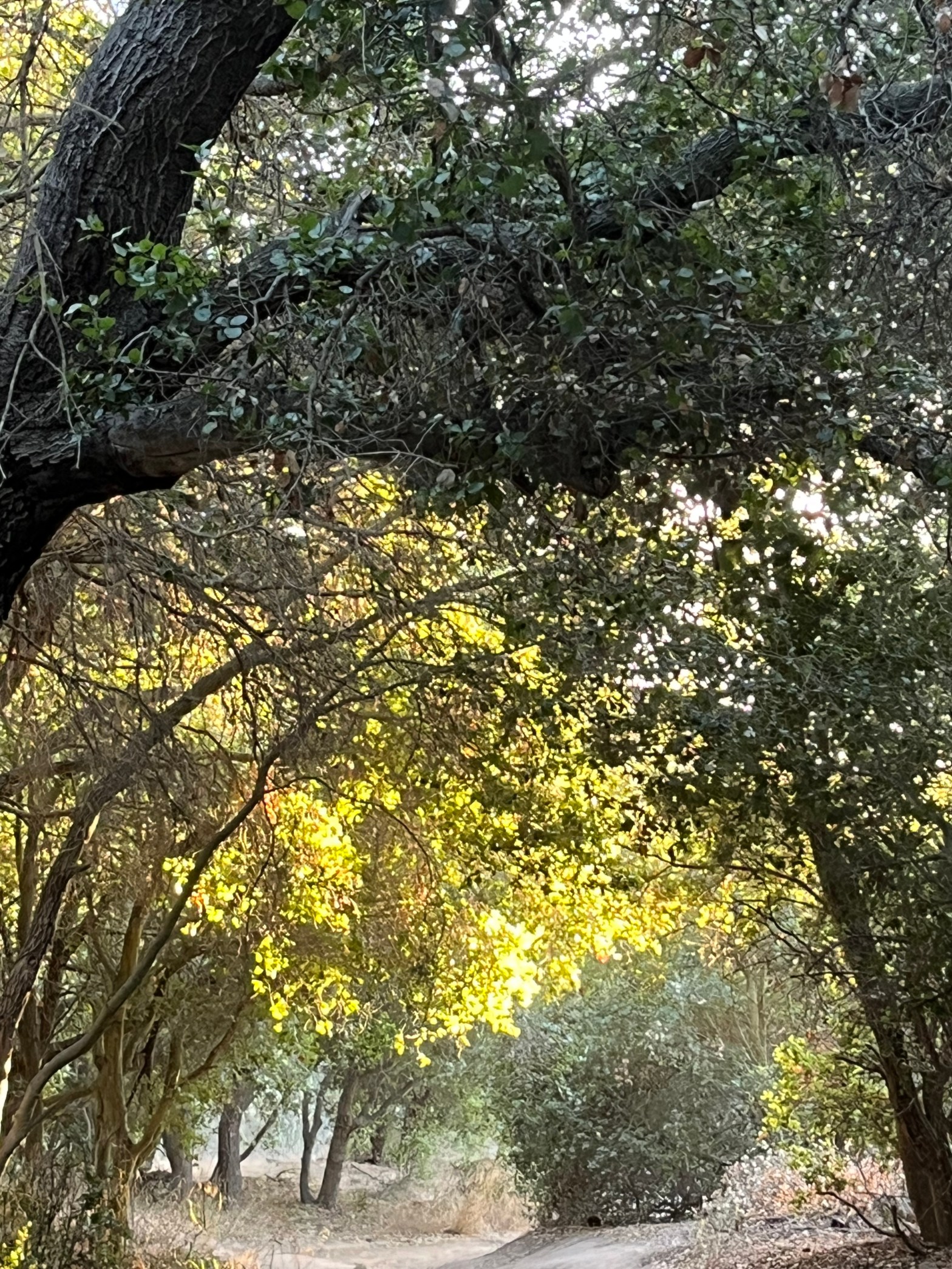
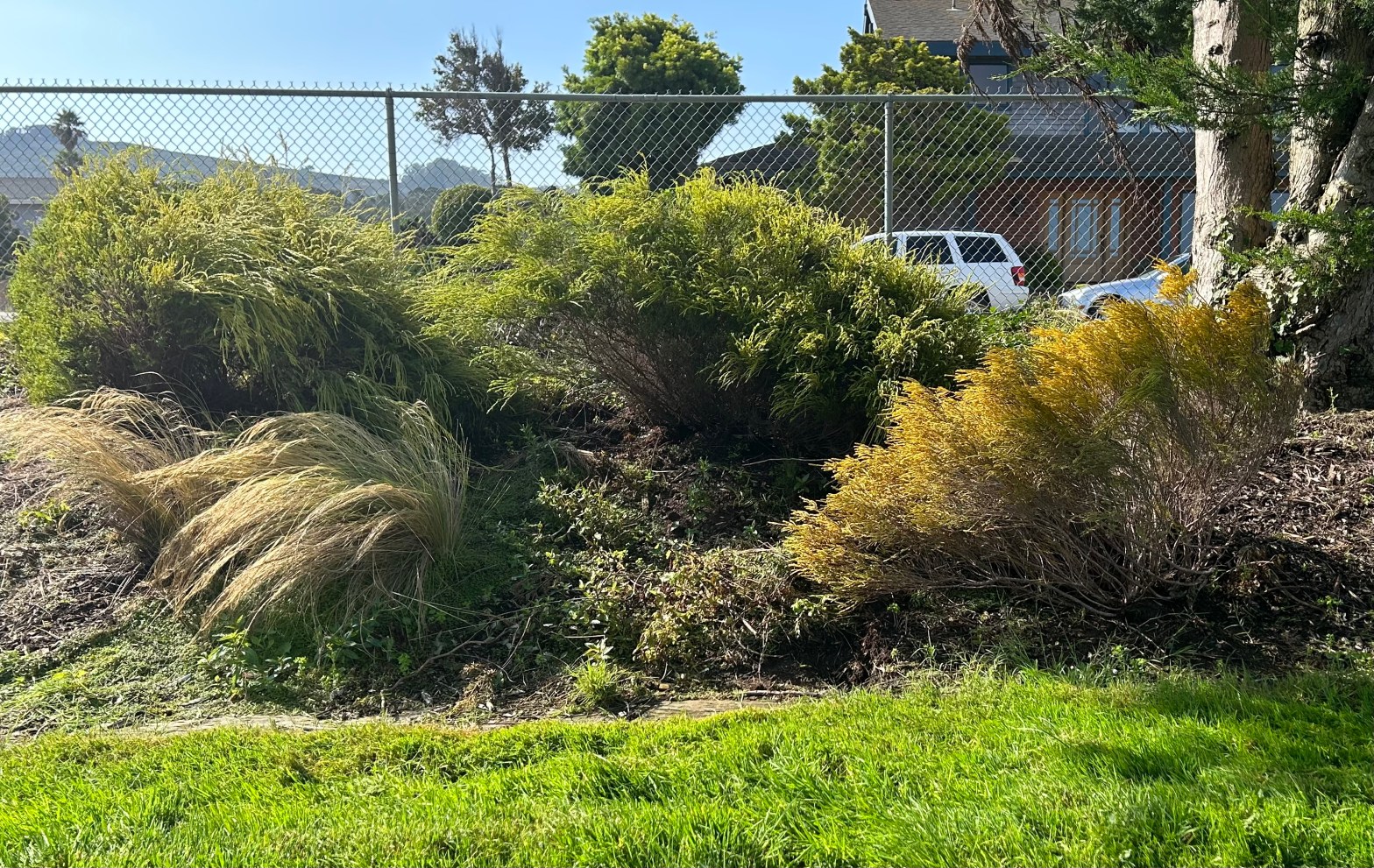
I was taking a stroll in Los Osos near Morro Bay and noticed these plants. I stopped to look.  What struck me is how they have had to adapt to what must be frequent, strong winds off the bay.  They have had to grow off-center, leaning inland; but they have endured.

         As I stood there, a memory arose.  More than thirty years ago I was in the living room of a parishioner in rural Washington.  She and her husband had come from Germany after World War 2 to make a new life in America.  They had purchased a farm and worked hard to make it productive.  Then tragedy struck – at age 12, their only son died in a tractor accident on their farm. This happened several years before I came to town.

         On the day I came for a routine visit, the Desert Storm campaign had begun in Iraq.  People across town were transfixed by news coverage which showed constant flashes of light and explosions over Bagdhad.  As I sat down in the living room and began to make conversation, I asked, “So what do you think about what’s going on in Iraq?”

         “Oh, Pastor Steve, when I tried to watch the news, I began to cry,” she said. “I was five years old in Germany when the bombing of our city began.  I remember the ground shaking and buildings falling and running through the streets holding my mother’s hand and crying… I know people are cheering…but…Pastor Steve…they don’t know what it’s like to be a child and have your city bombed.”

         I think this story came to me as a reminder that some people endure great hardship –  far beyond anything I’ve known; their life has been shaped by constant forces pushing them away from what they hoped their life would be.  But somehow they survive —  they hang on. 

Father Gregory Boyle, who has become a legend working in the barrios of East Los Angeles, has said, “I choose to stand in awe at the burdens carried by the poor rather than standing in judgment about how they carry them.”

         We never know what hardships people may be bearing.

Prior Posts:

Is Spiritual Discernment Like Listening to a Crystal Radio?

            Recently I was in our backyard taking some early morning quiet time.  In such moments, I try to be attentive to whatever may arise.  At one point a phrase appeared unexpectedly: “crystal radios.”  My first thought was images of ads from my childhood where someone is wearing antique headphones connected to a little device on a table — leaning forward and listening carefully.

            I turned to Wikipedia and found this description:

A crystal radio receiver, also called a crystal set, is a simple radio receiver, popular in the early days of radio. It uses only the power of the received radio signal to produce sound, needing no external power. It is named for its most important component, a crystal detector, originally made from a piece of crystalline mineral such as galena. This component is now called a diode.

Crystal radios are the simplest type of radio receiver and can be made with a few inexpensive parts, such as a wire for an antenna, a coil of wire, a capacitor, a crystal detector, and earphones (because a crystal set has insufficient power for a loudspeaker). However, they are passive receivers, while other radios use an amplifier powered by current from a battery or wall outlet to make the radio signal louder. Thus, crystal sets produce rather weak sound and must be listened to with sensitive earphones, and can receive stations only within a limited range of the transmitter.[4][i]

            As I pondered this, I wondered if listening to a crystal radio is a metaphor for spiritual discernment…times when we are hoping for some guidance in a situation we are facing.  I came up with some similarities:

  • You are seeking something that is present in the environment but invisible.
  • You don’t need external power.  A crystal radio doesn’t depend on batteries, electrical power in your house, or your Wi-Fi router.  With spiritual direction, it’s all within you and in your environment.
  • The most important element is the detector. When I am seeking inner guidance, I’m like a detective, searching for clues and hints.
  • A crystal radio doesn’t require expensive parts.  When we are seeking out spiritual direction, we don’t need anything but humility, curiosity and awareness.
  • You need to listen carefully because the sound is faint.  The nudges and hints we find when we are looking for answers in life require a calm and receptive mind.
  • In the beginning, you need instructions on how to build and use the radio.  In the spiritual journey, friends or guides help us learn how to listen and interpret what we may experience.

Other ideas came to mind…

I’ve always appreciated Parker Palmer’s idea that your soul is shy, like a wild animal.  If you want to encounter a deer in a forest and go crashing through the brush, the deer will flee. But if you find a place to be still where you can wait patiently, like sitting on the porch of a cabin in the woods, deer may come to you.  For most of us, everyday life can include a lot of noise and commotion – from our devices, or others, or our busy inner life with its impulses, anxieties, and chatter. We need to do something like waiting respectfully in a forest.

I thought of the story involving the prophet Elijah.  In a time of personal crisis, he retreated to a cave.  After 40 days, he sensed the divine voice would speak to him. His initial expectation was that he would hear it as part of some dramatic events: a great wind, an earthquake, a fire.  But instead, it came to him – as described by different translators — as “a still small voice,” “a sound of minute stillness,” “the sound of sheer silence,” or “a gentle and quiet whisper.”  I love each variation.  A voice that is small and still.  A sound that is very close to silence.  Silence all by itself that nevertheless communicates something.  Or a barely audible whisper.  I know many people who have experienced moments like this.[ii]

I also thought of my years at La Casa de Maria retreat center.  People would come looking for personal guidance.  But epiphanies and insights rarely came right away.  It often took several days of being unplugged, resting, relaxing, and seeking out contemplative settings — on a solo hike, browsing our library, sitting under an oak tree, or meditating in one of the chapels.

I was also reminded of Paul Simon’s new album Seven Psalms, which originated several years ago when he was awakened at 3:30 in the morning feeling as if he was being summoned.  He describes his creative process as more like receiving prompts from beyond his awareness than coming from his own intentions.[iii]

If our crystal set picks up a local radio station, we can expect it to identify itself from time to time.  With spiritual direction, how do we know any message we receive might have a divine origin?  We may never know for certain.  But a simple test is this: is it pointing us in a direction of ethical action, personal responsibility, and loving our neighbor?  That may be a positive indicator.

I recently went online and bought a crystal radio kit for $12. It’s being shipped to me. I’m uncertain whether I’ll be able to build it – concentrating carefully on building small mechanical things has never been my gift.  But I’ll give it a try.  In the meantime, I plan to keep taking that morning quiet time and listen carefully for any message that may be coming my way.

A devout seeker.

“A Family Listening to a Crystal Radio in the 20s”[iv] Possibly an early example of crystal aided group spiritual direction


[i] https://en.wikipedia.org/wiki/Crystal_radio

[ii] 1 Kings 19:12; translations from The King James Bible, Robert Alter’s The Prophets, the NRSV, and The Message

[iii] My blog post on his album is at https://drjsb.com/2023/07/08/paul-simons-seven-psalms/

[iv] https://en.wikipedia.org/wiki/Crystal_radio

The Intrinsic Power of Veriditas


Early this past Monday morning, I set out for a short round of golf. When I play on my own I use it as a form of walking meditation.

I went to ”Twin Lakes,” a modest 9-hole course five minutes from my house. Some private country clubs in Santa Barbara charge $250,000 to join and $1,000/monthly dues; Twin Lakes has no joining fee and I pay $59/month. Of course, it’s not quite the same feel. Where some local courses are set alongside coastal bluffs with stunning views of the Pacific Ocean, Twin Lakes is bounded by a tire store, a lumber yard, a drainage ditch, and railroad tracks. That may be why you do not see photos of Twin Lakes on Santa Barbara tourism websites.

            However, wherever we are, there can be wonders to behold.


            The 8th hole is bounded on the north by a rickety fence running parallel to the train tracks.  As I was walking down the fairway, I sensed something bright to my left.  I turned to see what it was. I was surprised to see the moist leaf of a nasturtium plant reflecting the morning sun more brightly than I have ever witnessed.  Like Moses at the burning bush, I turned aside to look more closely. I’ve always admired nasturtiums for their flowers, but had never appreciated how a leaf can hold and reflect sunlight like this one.

            As I stood there, an ancient word came to mind: “veriditas.”  This Latin word was a favorite of Hildegard of Bingen, the 12TH century abbess, mystic, prophet, philosopher, composer, and expert in the medical practices of her time.  In her last major writing, “Book of Divine Works,” she begins with a vision of divine love wearing a robe as bright as the sun, speaking with the voice of nature:

“I am the supreme and fiery force who sets all living sparks alight and breathes forth no mortal things, but judges them as they are.

Circling above the circumscribing circle with my superior wings, which is to say circling with wisdom, I have ordered the cosmos rightly.

But I am also the fiery life of divine essence: I blaze above the beauty of the fields, I shine in the waters, I burn in the sun and the moon and the stars. And with the airy wind I quicken all things to life, as with an invisible life that sustains them all.

For the air lives in viriditas and in the flowers, and the waters flow as if alive, and the sun lives within its own light, and when the moon has waned it is rekindled by the light of the sun and thereby lives anew, and the stars shine forth in their own light as though alive.

Exploring how “viriditas” is being newly appreciated in our time, I came across a reference to a 2003 dissertation by physician Victoria Sweet in the History of Health Sciences Department at UCSF:

“… Sweet draws special attention to Hildegard’s use of the word viriditas. It comes from the Latin word for “green,” and was used to refer to the color of plants, as well as meaning “vigor” and “youthfulness.” Sweet points out how Hildegard also used the word viriditas in the broader sense of the power of plants to put forth leaves and fruit, and the analogous intrinsic power of human beings to grow and to heal. Inspired by Hildegard, Sweet began to ask herself as she was treating her patients whether anything was interfering with the viriditas or the intrinsic power to heal—to relate to healing like being a gardener who removes impediments and nourishes, in a sanctuary-like setting.

All this may seem a long way from the illuminated nasturtium leaf that stopped me in my tracks on the 8th hole at Twin Lakes. But it’s not. What I saw was a glimpse of the viriditas that permeates and surrounds us, an inner force we share. “Veriditas” — it’s a great word — take it with you as you go through your day.


Paul Simon’s “Seven Psalms”

            When I saw a review of a new Paul Simon album in a recent New Yorker, I was mildly interested.  But then I began reading:

            “On January 15th, 2019, Paul Simon dreamed that he was working on a piece called “Seven Psalms.”  He got out of bed and scribbled the phrase — alliterative, ancient feeling — into a spiral notebook. From then on Simon periodically woke between 3:30 and 5:00 AM to jot down bits of language. Songwriters often speak about their work as a kind of channeling- the job is to be a steady antenna prepared to receive strange signals. Some messages are more urgent than others. Simon started trying to make sense of what he was being told.

This month, Simon, who is 81, released “Seven Psalms,” his 15th solo album. It’s a beautiful mysterious record composed of a single thirty-three-minute acoustic track divided into seven movements…”[i]

            The article itself is so well-written – and full of fascinating comments about Paul Simon’s lifelong spiritual journey – that I’ve reread it several times. (“Pleasant Sorrows’ review) I ordered the CD, and when it came, began listening. (Streaming options can be found on PaulSimon.com)  There is that unmistakable voice – a voice many of us have known for decades. At 81, it sounds strong and humble, quiet and clear; he’s not trying to get us up dancing or score a #1 hit, but simply sharing the evocative thoughts, phrases, and questions that have come to him.

            I alerted several friends.  After repeated listening, one described it as “mesmerizing.”  Another sent a link to a recent interview with Simon on CBS Sunday Morning.[ii]

It begins:

I’ve been thinking about the great migration
Noon and night, they leave the flock
And I imagine their destination
Nettle grass, jagged rock

He’s exploring this great mystery of life and death and what might lie beyond.

 He begins to sing about “the Lord:” 

The Lord is my engineer
The Lord is the earth I ride on
The Lord is a face in the atmosphere
The path I slip and I slide on

And a bit later:

The Lord is a virgin forest
The Lord is a forest ranger
The Lord is a meal for the poorest of the poor
A welcome door to the stranger

Some verses echo familiar religious images, while others are contemporary:

The Covid virus is The Lord
The Lord is the ocean rising
The Lord is a terrible swift sword
A simple truth, surviving

“The Lord” is one of the most common titles for God in English – it is used 6,753 times in the King James Bible.  There are dozens of names for God in Hebrew, and “the Lord” has been used to cover many of them; no doubt English translators wanted to convey a sense of higher authority, and “Lord” fit.  But the most evocative definition is found in Exodus 3.  Moses is alone in the wilderness and is addressed by a voice from a “bush that was blazing, but not consumed.”  A dialogue with this mysterious voice ensues, and at one point Moses asks what name he should use for this one who is speaking to him. He’s given a name that is also a riddle; it has been translated as “I am that I am,” or “I will be who I will be,” or “He who brings things into being.”[iii]  This sense of “the Lord” comes to my mind as I listen to Seven Psalms – the name for a presence that goes beyond everyday language and expectations; close enough to whisper to us, but forever elusive.

Simon describes a turning point in his own “migration:”

I lived a life of pleasant sorrows
Until the real deal came
Broke me like a twig in a winter gale
Call me by my name
And in that time of prayer and waiting
Where doubt and reason dwell
A jury sat deliberating
All is lost
Or all is well

He refers to one who, 3,000 years ago, also shaped feelings into sounds:

The sacred harp
That David played to make his songs of praise
We long to hear those strains
That set his heart ablaze

Toward the end, he sings:
Life is a meteor
Let your eyes roam
Heaven is beautiful
It’s almost like home
Children, get ready
It’s time to come home

When asked, Simon refuses to let his current perspective be defined by any particular religious tradition or spiritual identity. He is simply passing on what he was given.

As I listen to Seven Psalms, I keep thinking about that first dream that woke him, and the times before daybreak when he was “receiving” these prompts and words.  Where were they coming from? What is on the other side of our ordinary awareness?  Just our personal unconscious, always stirring and searching?  Or a shared, collective unconscious, where, like a grove of aspen trees, we are all connected in ways we can’t conceive and from which we create art for the benefit of one another?  What is that spiritual force that seems to exist within and beyond all of it, which, at unexpected times, offers us gifts of insight and mysteries to ponder? 


[i] “Pleasant Sorrows: The mysticism of Paul Simon,” Amanda Petrusich, New Yorker, June 5, 2023, (“Pleasant Sorrows’ review)

[ii] https://www.cbsnews.com/video/paul-simon-on-seven-psalms-and-dreams/

[iii] The JPS Torah Commentary: Exodus, Jewish Publication Society, pg. 17; The Hebrew Bible, Volume 1: The Five Books of Moses, pg. 222, translated and commentary by Robert Alter.

Lead image: Paul Simon, Seven Psalms

Lower image: David a la Harpe, Marc Chagall, 1stdibs.com

Water and Life

            Eleven years ago, we went to visit friends on the “Big Island” of Hawaii. One afternoon we visited a black sand beach; only a handful of other people were there. I went in for a swim.  The water was warm. I was floating about 100 yards out, looking back at the beach, when a soft rain began to fall.  The raindrops were also warm and made a barely audible sound as they met the surface of the ocean before dissolving. My body was in the ocean and my head was just above the surface, so I was floating on the boundary between the sea and sky.  I was also on a boundary of awareness – focusing not on any immediate concerns but simply being aware.  I’ll never forget the feeling.

Moments of awe and wonder are a common human experience, and the words we use to describe such experiences include “magical,” “mystical,” and “timeless.”

I was at a conference recently where a speaker shared a passage about floating in a river. It was written by Loren Eisley, a popular science writer in the mid-20th Century.  He grew up in Nebraska and spent much of his childhood wandering the countryside.  One day he was at the bank of the wide and shallow Platte River and followed an impulse to not just observe the river but become part of it. His experience integrates his scientific knowledge, physical sensations, and receptive imagination:

I thought of all this, standing quietly in the water, feeling the sand shifting away under my toes. Then I lay back in the floating position that left my face to the sky, and shoved off. The sky wheeled over me. For an instant, as I bobbed into the main channel, I had the sensation of sliding down the vast tilted face of the continent.  It was then that I felt the cold needles of the alpine springs at my fingertips, and the warmth of the Gulf pulling me southward.

Moving with me, leaving its taste upon my mouth and spouting under me in dancing springs of sand, was the immense body of the continent itself, flowing like the river was flowing, grain by grain, mountain by mountain, down to the sea. I was streaming over ancient seabeds thrust aloft where giant reptiles had once sported; I was wearing down the face of time and trundling cloud-wreathed ranges into oblivion. I touched my margins with the delicacy of a crayfish’s antennae, and felt great fishes glide about their work.

I drifted by stranded timber cut by beaver in mountain fastnesses; I slid over shallows that had buried the broken axles of prairie schooners and the mired bones of mammoth.

I was streaming alive through the hot and working ferment of the sun, or oozing secretively through shady thickets. I was water and the unspeakable alchemies that gestate and take shape in water, the slimy jellies that under the enormous magnification of the sun writhe and whip upward as great barbeled fish mouths, or sink indistinctly back into the murk out of which they arose.

Turtle and fish and the pinpoint chirpings of individual frogs are all watery projections, concentrations–as man himself is a concentration–of that indescribable and liquid brew which is compounded in varying proportions of salt and sun and time.

It has appearances, but at its heart lies water, and as I was finally edged gently against a sand bar and dropped like any log, I tottered as I rose.

I knew once more the body’s revolt against emergence into the harsh and unsupporting air, its reluctance to break contact with that mother element which still, at this late point in time, shelters and brings into being nine-tenths of everything alive[i].

Spirituality has a great deal to do with how we live our day-to-day life, but it also includes an underlying sense that there is a seamless unity in the natural world, and we are only a small part of it. Eisley was an evolutionary scientist who did not consider himself religious but  had a profound reverence for the mystery and wonder of life.

2500 years ago, an anonymous observer composed a poem known as Psalm 104. It would be centuries before science would begin to comprehend evolution and the biological basis for life.  But the writer had seen, felt, and intuitively understood what is important.  It’s 35 verses long, and only five of those verses refer to human beings.  The rest focus on the interplay of water, oceans, streams, clouds, and the many life forms with whom we share the earth.

Psalm 104 found new relevance in the 1970s during the dawn of the environmental and eco-spirituality movements.  It describes a world in which humanity’s task is not to dominate the natural world but to revere it.

I was once on a hike with my friend Rabbi Cohen. I mentioned how I had recently been reading Psalm 104 with new appreciation. He told me a great poet and philosopher, Johann Gottfried Herder, wrote “It is worth studying the Hebrew language for ten years in order to read Psalm 104 in the original.”

Water is something more than what comes out of a tap.

“If there is magic in this planet, it is contained in water.”[ii]


[i] Loren Eisley, The Immense Journey: An Imaginative Naturalist Explores the Mysteries of Man and Nature,” pgs. 18-20, 1957.

[ii] Eisley, pg. 15

Photo credits: “Black Sand Beach Along the Road to Hana, Nancy Schretter;  “Platte River:” Platte River Resilience Fund, Nebraska Community Foundation