
Two dogs are looking at the stars at night. What might they be thinking?
I have no idea.
But in a recent New Yorker contest, three people came up with these possibilities:

Aren’t those great? Each is a delight…and a very different and original response to the same drawing.
How about this one?

Try taking just a minute before looking at the three responses….
…and here they are…

My first thought: Isn’t it amazing what four people can do — the one who had the idea of the drawing and sketched it, and then the three people who each came up with a delightful range of ideas?
My second thought: How often have we been taught – or assumed – that there is only one “right answer” to a question?
Of course, everyday math problems have one right answer. You give a barista a $5 bill for a $3.25 cup of coffee, and you expect the change to be $1.75.
But there are situations where there can be more than one “right” answer.
I was in an organization development class where we were introduced to “equifinality.” Here’s one definition: Equifinality is the principle that in open systems a given end state can be reached by many potential means.[i] The presenter said that it’s common to be on our own or in a group working on a problem, and when the first possible solution appears, we accept it and move on – assuming it is The Answer. But remembering that there may be more than one solution can open us to more creativity. He encouraged us to always look for at least three possibilities, and then decide which one is best.
I think of this when people are looking for a life partner. The phrase used to be, “I’m looking for Mr. Right.” But there may be several potential mates that would work out well; one’s life may turn out differently depending on each person’s characteristics – each rewarding in different ways.
This can be useful in hiring. We can create a job description and have a clear idea of what “the ideal candidate” may offer. But there could be several good candidates who would become excellent employees, each bringing a different set of gifts.
This is true in the arts. A great painting can mean different things to different people. A song like “Amazing Grace” can be sung in many different styles and sound inspired each time.
And this is exactly why I love dealing with the great stories of our spiritual traditions year after year. Each time I turn to them, I work and walk and wonder as I seek an insight that feels fresh and relevant until I find one. Five years later, I’ll come back to the same text and find something new. That doesn’t mean the prior idea was “wrong;” it means great stories, poems, plays, and works of art have inexhaustible possibilities. They’re not dead things. They are portals into our imagination and experience.
The French philosopher Paul Ricouer said that timeless stories, legal principles, and works of art can have a “surplus of meaning.”
I am reminded of this principle as we witness social and political conflicts. There’s got to be more than one way to work things out.
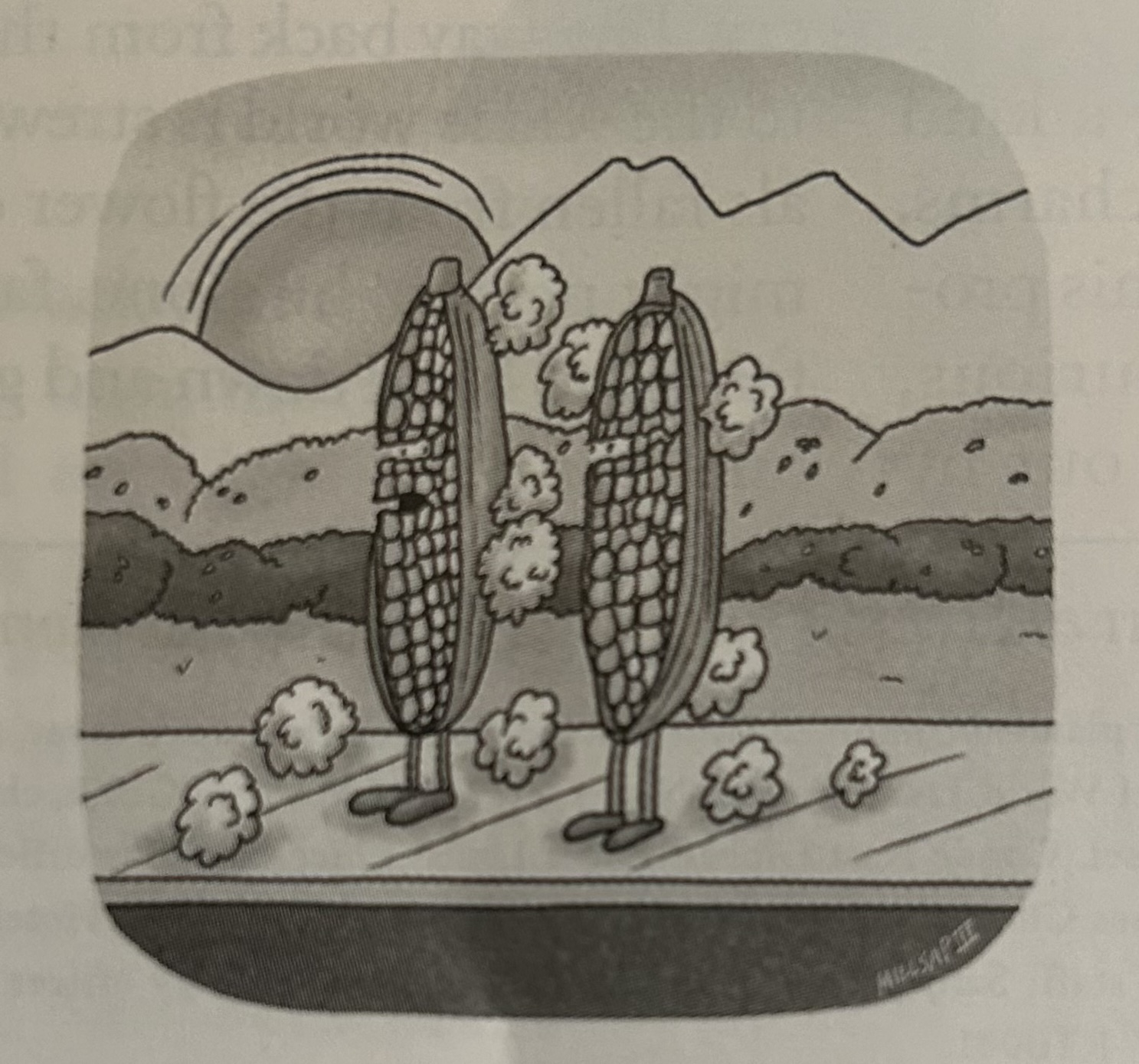
Let’s end with this image of two ears of corn discussing what it’s like to be popped:

[i] The term and concept is due to Hans Driesch, the developmental biologist, later applied by Ludwig von Bertalanffy, the founder of general systems theory, and by William T. Powers, the founder of perceptual control theory. Driesch and von Bertalanffy prefer this term, in contrast to “goal“, in describing complex systems‘ similar or convergent behavior. Powers simply emphasized the flexibility of response, since it emphasizes that the same end state may be achieved via many different paths or trajectories; https://en.wikipedia.org/wiki/Equifinality
Note: The cartoon with the dogs is from the September 25 issue and the ice cream cone cartoon is from the October 16 issue. When I cut out the cartoon with the popping corn, I failed to note in which issue it appeared. This is a case where there is One Right Answer, and I don’t have it.
Another Note: All honor goes to the New Yorker, where the genius of cartoon artists is reliably on display week after week after week.

 Steve Jacobsen, Ed.D