
“… when they study our civilization two thousand years from now, there will only be three things that Americans will be known for: the Constitution, baseball and jazz music. They’re the three most beautiful things Americans have ever created.” – writer and essayist Gerald Early, interviewed in Ken Burns’ documentary, Baseball
Having just endured an incredible World Series amid our current cultural and political climate, I will comment first on baseball.
Baseball may have roots in the English games of cricket and rounders, but by 1900 it had become 100% an American creation. 125 years later, it may not be a universal sport like soccer or basketball. But it has a passionate following in certain parts of Asia – particularly Japan and Korea – and in the Latin American countries that surround the Gulf of Mexico. At a time in our history in which “immigrants” are seen as “other,” the recent series included three superstars from Japan (Ohtani, Yamamoto, and Sasaki), a terrific first baseman from Tijuana (Alejandro Kirk), a Canadian playing for Los Angeles (Freddie Freeman), a star from the Dominican Republic (Vladimir Guerrero), a Puerto Rican (Kike Hernandez), a refugee from Cuba (Andy Pages), a Venezuelan (Miguel Rojas), and an African-American from Nashville (Mookie Betts), among others. The Dodger manager Dave Roberts was born in Okinawa to a Japanese mother and an active-duty African American Marine.
This American game has become a showcase for talented players from many backgrounds and cultures. It’s a game of opportunity, celebrating players no matter where they come from. It’s a game that can focus moment to moment on a particular individual player, but it’s a great team that wins and inspires. It’s a beautiful thing.
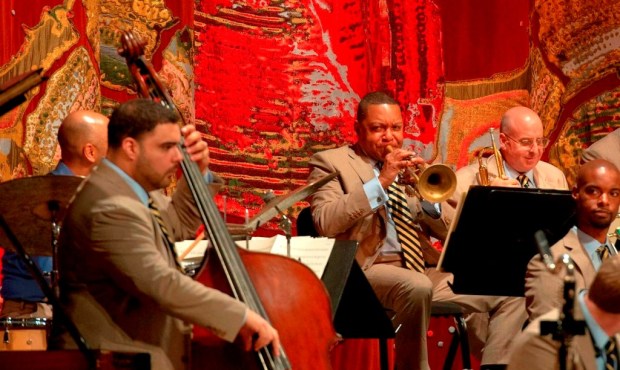
And then there’s jazz. One person who has helped me understand the deeper meaning of jazz is Wynton Marsalis. Ken Burns turned to Marsalis often in his Jazz documentary series, and everything he said struck me as revelatory. I saw him in concert several years ago and was again grateful for the insights he shared with the audience. Here is one of his observations:
As long as there is democracy, there will be people wanting to play jazz because nothing else will ever so perfectly capture the democratic process in sound. Jazz means working things out musically with other people. You have to listen to other musicians and play with them even if you don’t agree with what they’re playing. It teaches you the very opposite of racism and anti-Semitism. It teaches you that the world is big enough to accommodate us all.
Seeing and hearing gifted musicians express their individual gifts and voices while being a part of a larger group and delighting in the give and take with one another creates an experience in which the whole becomes greater than the parts. That’s jazz. When we experience it, it’s a beautiful thing.
And so is the Constitution.
Years ago, I was having lunch with a young Muslim grad student from Egypt as part of my community interfaith project. He told me he first learned about American culture while watching “Mighty Mouse” cartoons as a child. He shared favorite stories about growing up in Egypt, including how, during Ramadan, he and his childhood friends would wait for the signal that the time of daily fasting was over, then race from home to home enjoying the food set out by neighbors. He had come to appreciate all that America offers — particularly the constitution. “Do Americans realize how amazing it is that your country is ruled by a constitution instead of a dictator?” he once asked me.
The constitution was created by people who did not want to live in a political system like they had known in Europe – one in which some people would dominate others based on family ancestry, social position or a state-sponsored religion. The founders wanted to create a society in which people would experience a new level of freedom and opportunity. They worked long and hard to create the legal framework. It assumes people will let their deep passions be balanced by mutual respect and personal restraint. Like baseball, it assumes people will understand that to participate, everyone must follow established rules and customs until they are changed by due process. Like jazz, it teaches you this country is big enough to accommodate us all. When it is disrespected, it’s an offense to our ancestors who have given so much to honor and preserve it. When it is honored, it’s a beautiful thing.
America may leave the world more treasures – after all, there’s Broadway, rap, country music and Hollywood. But I will always celebrate baseball, jazz and the Constitution for what they offer and what they mean.
Lead image: “The raising of the American flag as the composer-conductor John Philip Sousa leads the Seventh (“Silk-Stocking”) Regiment Band in playing The Star-Spangled Banner during Opening Day of Yankee Stadium with the Boston Red Sox and New York Yankees on April 18, 1923 at Yankee Stadium in the Bronx, New York.“




 Steve Jacobsen, Ed.D