Arrivals and Departures

A friend and fellow blogger dropped his daughter off at college in Eastern Washington state, then boarded a plane going home to southern California. He recently described how it felt as the plane rose into the air:

Casting a shadow moving away from there. That’s us down there, pointing back toward where the 18 years happened. Watching the long-planned departure take place. Mulling that our part in her life is getting smaller. This is what we hoped for, right?  That’s us down there, shrinking.[i]

Brad’s imagery lingered with me.  I began imagining how some life experiences are like being on an airplane as we arrive or depart.         

Arrivals

The birth of a baby: I remember the moment when the doctor lifted our first daughter from the womb. She looked my way, our eyes met, and she seemed to be thinking, “Where in the world am I?” 

A child’s first laugh:  My nephew and his wife recently shared an enchanting video of the first time their infant son looked at them and smiled.  That week my wife and I had been watching “Dark Winds,” a detective series set in a Navajo community.  In one episode, an infant laughs for the first time, which, in Navajo culture, signifies the infant has become a person.  The family holds a traditional ceremony to mark that moment.

First personal memory: I was probably 4 years old. I was standing in a bedroom in our house.  I had taken three eggs from the refrigerator, snuck into the room, and was carefully dropping them one by one onto the linoleum floor.  Just as I dropped the second one, my mother came down the hall, saw me, and said, “What in the world are you doing!?!”  I said, “I wanted to see what it looked like when they cracked.” She took the third egg away from me.  I can still see the yellow yolks floating in the puddle of egg white on the floor.  That is the first time I remember being self-aware. I was watching myself; that same observer is me now, thinking about the words I am typing.

First spiritual awareness:  In 1991, the child psychologist Robert Coles published The Spiritual Life of Children, in which he described how children in different cultures wonder about God and the meaning of life.  Many of these experiences happen before a child is eight years old.  Perhaps you have such a memory.

Landing in a far away country:  In 1975, I flew to Europe on Icelandic Airlines.  I remember looking out the window as the plane descended from the clouds; we were crossing the English Channel, then suddenly were over the green French countryside.  It seemed like a dream.

First day on a new job: My most memorable first day of work was the day I began to serve as Executive Director at Hospice of Santa Barbara in September 2008.  I had never imagined being in that role, but there I was.  I sat down at my desk feeling both exhilarated and anxious. For months after, I felt like an impostor, as people expected me to know things I had yet to learn. I was a stranger finding his way in a new land.

Departures

Dropping kids off at Junior High: More than once, I drove away remembering what a hormonal and emotional roller coaster that time in life had been for me — and hoping for the best for our offspring.

Sending kids off to college:  We did it twice by car, once at an airport. Like Brad says, after so many years it’s a curious feeling to realize you’ll no longer be providing daily oversight.  They are on their own, come what may.  “That’s us…shrinking.”

Retirement: My last full-time job was Director at La Casa de Maria Retreat Center. I had planned to retire in the fall of 2018.  But on January 8, the Montecito Debris Flow swept away eight buildings on our property, including my office where I had posted my diplomas and favorite photographs; it all disappeared and was never found. In the months that followed, we worked on the recovery until the decision was made to shut the Center down indefinitely.  I left in June of that year. After saying goodbye to the staff, I drove out the back gate, thinking about how some chapters in our life end so much differently than we had imagined.

Last Call:  I don’t know where I will be for my final “departure” – at home, in a hospital, or in a facility.   Some hospice nurses have told me that, when someone is in their final days, they suggest the family leaves a window partly open so the spirit will be able to ascend freely when it’s time.  I have asked for that.  The lyrics of an American folk hymn come to mind:

When the shadows of this life have gone — I’ll fly away
Like a bird from prison bars has flown — I’ll fly away (I’ll fly away)

I’ll fly away, oh glory — I’ll fly away (In the morning)
When I die, Hallelujah, by and by — I’ll fly away (I’ll fly away)

Life for me hasn’t felt like being a bird behind bars, but more like being a pilgrim in a land of mystery and wonder.  Until that final boarding, may we appreciate all the arrivals and departures we have witnessed and those still to come.


“Shadow of an airplane on a field,” freepik.com

[i]Brad McCarter, “Departing: College Dropoff #3,” Eyes Wide Roaming” blog; https://bradmccarter.substack.com/p/departing

When Scales Fall From Our Eyes

“The phrase “the scales fall from your eyes” means to suddenly understand the truth about something that was previously unclear or hidden. It often refers to a moment of realization or enlightenment.”[i]

A friend once confided to me about an experience she had at a niece’s wedding.  She had not seen the young woman for some time and was excited to travel across country for the celebration.  When she first saw the bride and groom, she was struck by how “generously built” both were and couldn’t get that thought out of her mind.  The time came for the bridal dance. As the couple stepped toward each other, they looked into each other’s eyes, and my friend said their faces were full of love and happiness.  She said she was ashamed she had initially noticed only their outward appearance while being blind to their inner beauty.

Some years ago, I attended a five-day seminar in Berkeley with Marcus Borg, a prominent New Testament scholar.  Borg was a calm, gifted and insightful teacher who prized good thinking and careful reflection.  On the last day, one of the students asked him if he’d had any mystical experiences.  He acknowledged he had but was reluctant to share. The students pressed him, however, and he told us his story.

After spending time in Israel, he and his wife had boarded a plane home. He had settled in his seat and was quietly observing the other passengers as they boarded. One man caught his interest – Borg couldn’t help but note he was particularly awkward looking.  He also remembered looking at the back of the seat in front of him and thinking the vinyl upholstery seemed noticeably dull.  He settled in and the plane soon took off.

A little while later, Borg felt the presence of light growing in the cabin.  It seemed to illuminate everything around him with an unusual radiance; he was transfixed. He could tell no one else was seeing what he was seeing. The other passengers were immersed in this light, and each person seemed to be a wonder to behold; the gentleman who had looked awkward now seemed to bear a palpable dignity. Even the back of the seat in front of him now seemed fascinating.  Borg’s wife could tell something unusual was occurring to him and asked him if he was OK; he nodded to assure her he was, not wanting to break the spell.  

The mysterious light slowly began to dissipate, and soon everything in the cabin looked normal again.  But he could not forget how, in those moments, it seemed he was seeing “reality” as it “really is” – permeated with light.

(In the stories shared by hospice workers and volunteers, this is not an unusual experience as people come to the boundary of this life.)

The phrase “the scales fall from your eyes” means to suddenly understand the truth about something that was previously unclear or hidden. It often refers to a moment of realization or enlightenment.

We go along in life, living with routine assumptions about the people we see and believing we know what “reality” is like.  Then we have moments when “the scales fall from our eyes.”  Like my friend at the wedding, we may suddenly discover how easily we misjudge other people when we look only at their outward appearance and instead begin to appreciate them in new ways.  Like Professor Borg on the airplane, a sense of awe and wonder can come over us unexpectedly, suggesting there is a radiant presence within the everyday objects and people we encounter. 

It can be a shock to realize scales are falling from our eyes.  It can be liberating to discover what new truths are now revealed.


[i] Online version of the Cambridge Dictionary

Lead image: “Airplane window view with wing at sunrise;” Freepik.com

Being Grateful for Our “Inner Savings Account”

“As a lifelong traveler, I felt in my bones how home is not where you happen to live so much as what lives inside you…my inner savings account…the Sufis say that you truly possess only what you cannot lose in a shipwreck.”[i]

I spent five months backpacking in Europe in 1975.  One summer day I was hitchhiking in Bavaria from the mountain village of Lindenberg towards Munich. There were few cars on the country road, so I was walking more than riding.  I saw a thunderstorm approaching.  I noticed a 2-story farmhouse up ahead and realized it might offer some shelter. I got there and huddled under the eaves as the rain began to fall.  A few minutes later, the door opened. A woman stepped out and offered me a black umbrella with a wooden handle.  I could not speak German well enough to converse with her, but we nodded and smiled at each other. She went back inside.  I opened the umbrella and stood under it. Fifteen minutes later, the rain stopped.  I shook it off, folded it, fastened the fabric strap around it, and knocked on the door to return it.  She opened the door and I handed it to her, bowing my head in gratitude.  But she smiled and motioned to me to keep it.  Surprised, I thanked her and resumed my trek.

I kept that umbrella with me for the rest of my trip.  I took it with me on the flight home. I kept it for years afterward, even as it got frayed.  Every time I would pick it up, I was taken back to that moment and the gracious kindness the woman had shown me.  I’ve kept the memory all these years.  It’s part of my “inner savings account.”

What lives inside us?  Memories of many kinds.

How often do you hear a song that takes you back to a time when you first heard it as it was “deposited” into your memory account? How often does a food remind you of your childhood?   How valuable are our spiritual expereinces and beliefs? How vividly do we remember the unexpected kindness of strangers?

Isn’t it the case that, the older we get, the more likely we are to draw something from that account and share it with others while we still can?  Unlike monetary bank accounts, withdrawing a memory doesn’t mean you lose it; instead, you are keeping it alive.

I have always appreciated listening to peoples’ stories and keen to know what those experiences have taught them about life.  I add them to my storehouse of significant experiences, even though they did not happen to me.  Learning from the memoires of others is like investing in a communal “mutual fund.”  Sharing stories with family, long-time friends, and in spiritual communities is like having shares in “Mutual Memory Funds” from which we all benefit.

As years go on, our ability to access memories in our own personal account may diminish, which is all the more reason to claim them while we can.

Our “Inner Savings Accounts” and “Mutual Memory Funds” are lifetime investments that don’t get lost in shipwrecks, wildfires, floods or fluctuations in the stock market. They are “high yield accounts.”   They live with us and with those with whom we share them.  I no longer have that umbrella, but what it means to me will never be lost.


[i] My notes tell me this is attributable to the writer and world traveler Emily Hahn.

A Pie for All Reasons: Tangible Benefits of Doing Good

The small rural church I served in Wapato, Washington needed a new roof.  We did not have the money to pay for it. We decided to have a pie auction. 

The church was in the Yakima Valley, an ideal region for growing fruit including apples, peaches, nectarines and cherries.  Many in our congregation were expert pie-makers. We picked a date and encouraged everyone to bring their best offerings.  After the service, we would auction them one by one, hoping to reach our goal.

I got a call from a longtime member asking me to visit. She was no longer able to attend services personally but had heard about the auction. I met with her in her living room. She told me she wanted to contribute to the roof fund and have fun in the process.  She told me her plan.  I would let the auction get going while choosing a pie that appealed to me.  When that one came up, I was to let the bidding build until it felt like it was reaching its peak.  At that point, I was to stand and announce that, on her behalf, I was authorized to make a bid in the amount she told me. 

On that Sunday, I followed her instructions. I set my eye on a particular cherry pie (I knew the baker had her own backyard tart-cherry tree).  The bidding started at $20…went to $25…then $30…then $35…My moment had come.  I stood up. The auctioneer called on me.  I said, “On behalf of Mrs. –, I bid $2,000.”  The room was silent.  Then full of laughter and applause.  The next day I visited her and told her how it went. She was delighted.

Thanks to her generosity, we raised enough for the roof.  We had fun doing it.  I got to keep the pie.

You may have heard that if you want to do something for the greater good, there shouldn’t be any personal reward involved – that would be selfish. But it can be a great feeling to know you are doing something good for other people. 

Much of what’s best in America is the work of nonprofit organizations.  No matter what is happening in our national politics, individuals and communities make a difference.  We can help the Girl Scouts and enjoy the cookies.  We can support a friend running a marathon, honoring our friendship and the cause they represent.  We can support our local school, daycare center, congregation, neighborhood medical clinic, hospice organization, food bank, museum or other cause.  What we do can positively impact the lives of others.

When I donate my money or time, I’m proving to myself I’m not helpless.  I want to help other people and now I’m putting that desire into action. It feels good.  

Sometimes you can have your pie and eat it too.

(The spiritual power of pies seems to be a recurring theme for me…last year I posted The Sky Is In the Pie.)

The Way of Nature and the Way of Grace

I’ve been ruminating over these words for fourteen years:

Τhe nuns taught us there are two ways through life- 

the way of nature… and the way of grace.

You have to choose which one you’ll follow.

Grace doesn’t try to please itself.

Accepts being slighted, forgotten, disliked.

Accepts insults and injuries.

Nature only wants to please itself…

– Get others to please it too.

Likes to lord it over them…

To have its own way.

It finds reasons to be unhappy… 

when all the world is shining around it, 

when love is smiling through all things.

Τhey taught us that no one who loves the way of grace

ever comes to a bad end.

We hear this in the voice the mother of the O’Brien family (Jessica Chastain) at the opening of The Tree of Life. As she recites the first six lines, we see dream-like images of her with her young sons in 1950s suburban Texas. At the line, “Nature only wants to please itself…” the camera shifts to the father (played by Brad Pitt) at their dinner table.  After several viewings, I realized the shift in focus suggests the mother embodies the grace the nuns talked about while the father embodies “the way of nature.”

“The way of grace:” self-less, tolerant, forgiving.  The “way of nature:” self-centered, willful, domineering.  Those living “the way of grace” experience a world shining with love; those living the way of nature are blind to all that shines, and instead “finds reasons to be unhappy.”

From the beginning of my spiritual awakening in my twenties, I wanted to “live in the way of grace.”

As a pastor, living “in the way of grace” felt like the ideal job requirement. I strived to lift that up and live that out with the people I was serving. It brought me joy.

As time has passed, I am less certain one can always live in the way of grace.

As Malick uses the phrase “way of nature,” it feels selfish, insensitive, and destructive.  But we can think of it another way. I am going to interpret it as our biological and evolutionary history.  We carry primal instincts within us that recognize our need to survive.  We can draw on a stubborn stamina that enables us to endure hard times with grit and determination.  If we lose at something and it hurts, we may resolve to recover instead of giving up. Winning and accomplishing a goal feels good. We find ourselves in a position of power and appreciate what that offers – not only for ourselves, but for others.  Are these moments we want to run from?

I once organized and participated in an Earth Day retreat at the La Casa de Maria Retreat Center.  We had invited a local trail guide to lead a tour of our property.  He had an interest in both the natural world and ways we can listen to our ancestors.  Our group took an hour to make a slow walk around the 26-acre property, stopping along the way.

We came to the organic garden and paused.  He reminded us human beings have been farming for several thousand years.  He asked us to close our eyes and visualize our own ancestors farming and what their life was like. Most of my ancestors came from Scandinavia. I found myself traveling back in time, watching them work in the cold climate and bare soil.

We came alongside the San Ysidro Creek.  Before agriculture, our ancestors were hunters and gatherers.  We closed our eyes and imagined their life.  I realized my ancestors survived by learning to fish the North Sea and hunt elk.  A hard life.

Living “the way of nature” involves cunning and a strong will.  That can get messy when it demeans other people.  But those instincts in themselves are not bad.

In 2008 I transitioned from parish work to leading nonprofit organizations.  I discovered I could not be, in the eyes of everyone, always “full of grace.” Sometimes I had to make unpopular decisions.  We had to let some people go, and as they left they didn’t feel like “love was smiling through all things.”  But these actions had to be done.  Looking back, I don’t regret them. It was part of my job.

The spiritual life is not an unending experience of grace and beauty.  Jesus was more a lion than a lamb.  Many of his conversations comforted, healed and renewed.  But other times he confronted people with their self-righteousness, and they walked away dejected or angry.  He told people what they needed to hear.

Trying to be gracious every moment doesn’t guarantee ideal outcomes. Sometimes things just go badly.  But we do the best we can.

Is it true — “…there are two ways through life – the way of nature… and the way of grace.  You have to choose which one you’ll follow?” I’m not so sure it’s that simple.  I believe there is a third way, one which draws on both nature and grace.  There are times when we need instincts for survival that nature has given us so we can protect ourselves and others and do the right thing.  But that doesn’t exclude “the way of grace.”  Grace is always worth striving for, and when it emerges it comes with a radiant awareness.

Images: The Tree of Life, Terrence Mallick


Last October I wrote another post inspired by Tree of Life: Where Were We?

“Beholding” as a Spritual Practice

            Last week I attended a leadership conference featuring David Brooks, PBS commentator and columnist for the New York Times.  He covered many issues in his three talks, and one I want to share with you concerns the attention we give other people.

David said he recently was working alone at home one evening when his wife came in the front door. He looked up to see her and realized she hadn’t yet noticed him sitting at his desk in the adjacent room.  He decided to simply watch her for a minute.  After she closed the door behind her, she put her things down, and paused.  The house was quiet. She then turned and walked into the kitchen.  In that unplanned moment of simply observing her, he realized how much he loved her. He said the experience of seeing her this way was not just a visual act, but something more: he felt as if he was beholding her.

He contrasted this moment with what we experience often in modern life — looking at each other without really seeing each other.  When we meet someone, we quickly form assumptions about them before they even speak and filter whatever they say through our assumptions.  When someone we know is talking – even someone we know well – our busy mind often isn’t listening carefully to them, but instead preparing what we are going to say in response.  “We are not good at “reading” others,” he said, which has created “an epidemic of social blindness.”  The quality of attention we bring to someone else is a moral act.  If we are truly paying attention with humility and genuine respect, we are granting that person dignity.   We are beholding them.

I looked up the origin of the word.  In Old English, the word bihaldan meant “give regard to, hold in view.”  Modern definitions include, “To hold by, keep, observe, regard, look” and “To look upon, view, consider as (something); to consider or hold in a certain capacity.” If I was to add my own definition, it would be “to give reverent attention to a particular person or experience.” I kept turning the word around in my imagination and was intrigued with the possibility that to “behold” someone could be to “hold” that person’s “being” with a particular sense of awe and care.  We are not looking at them with our “busy mind” but opening ourselves to the mystery and wonder of their living presence.

            In Leaving Church: A Memoir of Faith, Episcopal priest Barbara Brown Taylor described the factors that led her to leave parish ministry. One reason was that she had become weary of people wanting her to tell them what they were supposed to believe.  She said her spiritual journey had not been so much about believing the right thing but inviting others into experiences of beholding —“beholding life on earth in all its glorious and terrible reality.”

            Being with someone when they die can often evoke a feeling there’s something sacred in the room. I remember my sisters and I spending time at our deceased father’s bedside before the mortuary arrived.  We weren’t just looking at dad, we were beholding him.

            And I recall what it’s like raising young children.  You’re busy all day long with them – talking, listening, dressing, negotiating, feeding, bathing, reading a story — and it’s a big accomplishment to finally get them into bed. A little while later you come back to their room to check on them.  You carefully, quietly open the door and see if they’ve fallen asleep. Seeing they are, you sometimes stand there and keep looking at them. You now “see” them for the miracles they are. You may even think, “When they are asleep they look like angels.” In those moments, you’re not just looking at them – you are beholding them

            Maybe we can try beholding one person today and see what we experience.

Imgage: Sleeping Child Covered With a Blanket, Henry Moore, 1942

Your Membership Card for the Spiritual Gymnasium

            Speaking at the Lobero Theater fifteen years ago was the great scholar of world religion, Huston Smith. Almost 90 years old, he had difficulty walking on stage. 

Once he reached the lectern and stabilized himself, he looked out at the audience, smiled, and said, “I’m going to make five statements tonight that I think you will disagree with.”  People shifted a bit in their seats. 

There’s no such thing as progress” was one of them. 

            He acknowledged that, of course, there have been significant improvements in our lives over the centuries.  Plumbing, for instance. Or scientific advances in many fields, including those that have improved health care, eliminated many deadly diseases, and reduced mortality rates.  Not many of us would argue with that.

            There’s been some progress in human rights, particularly regarding race and the status of women.

            But with all our material advances, have we resolved the problems that create human suffering?

            He finished by saying:

            “If you go through life feeling you must solve the problems facing humanity before you die, you are going to come to the end frustrated and discouraged.  But if instead you see life as a spiritual gymnasium – a place designed to learn timeless truths – you will find it’s perfectly equipped.”

In my twenties I realized how deeply embedded the illusion of progress is in our society – that every generation will make things “better.”   Clearly there’s been great material advances.  But would we say there has been “progress” in the arts? Has anyone “improved” on Bach, Mozart, Beethoven, Shakespeare, Ella Fitzgerald, Elvis, the Beatles, Van Gogh, Aretha, Bruce Springsteen, or Bob Marley?  New artists come along and delight us with their creativity, but that’s not “progress,” that’s just new expressions.  There is a timelessness to great art that is very different from a new washing machine model or a television with higher resolution.

            The same can be said about great spiritual teachings.  New insights and interpretations emerge, but core teachings endure. The importance of awe, wonder and gratitude.  The call to love and serve your neighbor and guard the inherent dignity of others.  To participate in a caring community. To treat the earth as a sacred gift.  These values are ageless, and life offers us endless opportunities to practice them.

I find this helpful to remember when events challenge my assumptions of how we should be able to “fix” things.

            When Barack Obama was elected in 2008, many of us thought America might be entering a “post-racial” America.  We were wrong.

            Until the 2020 election, we took it for granted that a president who had clearly lost an election would never call it a “big lie” and encourage a violent attack on the Capitol. We were mistaken.

            Europe has  not seen large-scale armed conflict in 77 years and it seemed we were beyond such events. But Russia attacked Ukraine in February and millions of people have become refugees.

            Ten years ago, after the Sandy Hook shootings, many Americans were determined to do whatever it would take to prevent further tragedies.  Now we have this unfathomable event in Texas just days after the shootings in Buffalo.

            Human behavior, it seems, is not as easy to upgrade as a cell phone.

            But do we give up and disengage?  Absolutely not.

            First, we realize not everything that comes to us can be permanently solved, particularly when it involves human behavior and motivation.  But everything can be addressed and engaged with a desire to make a difference and sometimes advances are made.  That’s how social progress happen.s And it’s always a chance for a work-out in the spiritual gym. 

            One year I worked in inner city Philadelphia with an African American pastor who had grown up in the neighborhood. I once asked her how she kept going.  “We just keep on keeping on,” she said.

            Maybe it’s like practicing medicine.  You can be a faithful physician or nurse without believing every disease will be eliminated in your lifetime.  You just keep bringing your best efforts to every patient while hoping for new advances and better treatments.

At La Casa de Maria Retreat Center, we regularly welcomed people who were striving to make the world a better place. They often arrived discouraged, depleted, and burnt out.  They unplugged and spent a few days resting and reflecting amid the 26-acre natural sanctuary. They’d leave renewed. Father Richard Rohr describes the dynamic:

One of the reasons I founded the Center for Action and Contemplation was to give activists some grounding in spirituality so they could continue working for social change, but from a stance much different than vengeance, ideology, or willpower pressing against willpower. Most activists I knew loved Gandhi’s and Martin Luther King, Jr.’s teachings on nonviolence. But it became clear to me that many of them had only an intellectual appreciation rather than a participation in the much deeper mystery. The ego was still in charge, and I often saw people creating victims of others who were not like them. It was still a power game, not the science of love as Jesus taught it.

            When we begin by connecting with our inner experience of communion rather than separation, our actions can become pure, clear, and firm. This kind of action, rooted in one’s True Self, comes from a deeper knowing of what is real, good, true, and beautiful, beyond labels and dualistic judgments of right or wrong. From this place, our energy is positive and has the most potential to create change for the good.[i]

Welcome to the spiritual gymnasium.  There’s no enrollment payment or monthly fees, and it’s open 24 hours, seven days a week. 

“Where do I get my membership card?” you might ask.

You’ve already got it – it was given to you at birth.

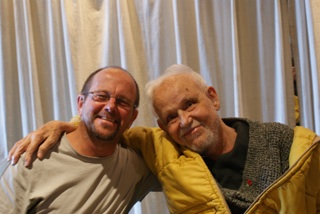
Photo: Huston Smith and me at Esalen, October 2010.  He was born May 31, 1919, in China and died in Berkeley in 2016 at age 97.  He continues to be an abiding inspiration in my life.


[i] Richard Rohr’s Daily Meditations, “The Root of Violence,” May 1, 2022:  https://mail.google.com/mail/u/0/ – search/jspohntwomey%40gmail.com/FMfcgzGpFgwXkxtbHMLVmRqMDsRphSGf.  Thank you to my long-time friend and La Casa colleague Juliet Spohn-Twomey for calling attention to this post.

Silver Keys, Mean Moms and Compassion in the Workplace

…and from beneath his robe he drew two keys; the one was made of gold, the other of silver; first with the white, then with the yellow key, he plied the gate as so to satisfy me.     

 “Whenever one of these keys fails, not turning appropriately in the lock,” he said to us, “This gate of entry does not open…”

            “One is more precious, but the other needs much art and skill before it will unlock – that is the key that must undo the knot.”

                 Dante, The Divine Comedy, Puragatorio, Canto 9:115 – 126

            I first began exploring Dante’s The Divine Comedy fifteen years ago.  It’s an imaginary journey through the afterlife, drawing on the scientific and religious knowledge current in 1300 AD, formed by and filled with Dante’s extraordinary imagination.  Despite being written long ago, I’ve found it contains fascinating spiritual and psychological insights.  I’m currently in a year-long Dante study group meeting on Zoom every Monday afternoon.  I want to share with you a brief passage we read recently.

            Dante is being led through different stages of the afterlife by his guide, Virgil. At this point he has passed through the underworld (Inferno) and is at the foot of Mount Purgatory. If we want to get to paradise, we need to make this trek — a final chance to overcome our personal shortcomings.  

            Dante and Virgil come to the entry at the base of the mountain. They meet an angel who guards the gate, possessing two keys given by St. Peter.

            As seen in the passage above, the angel pulls them out from his robe: one is gold and one silver.  He says the gold one is “more precious.”  The silver key is not as valuable, but you can’t open the gate without it, and using it takes “much art and skill.”  Scholars have long believed the gold key represents the pure gift of divine love; the silver symbolizes how that love is actually applied in the real world.

            I love this distinction.  Here’s why.

            Last week my posting was “Uncover the Love,” which focused on a personal experience I had in a sweat lodge.  I saw how love is always present in our lives, even if we don’t recognize it.  I linked that to the Buddhist concept of “metta” (compassion) and the Christian concept of “agape.”  In light of the Dante passage, these are represented by the “gold key” — love, grace, and compassion in their purest form. 

            It’s one thing to receive this gift. But how do we apply it in the complex situations we face in everyday life, including family and work? For that we need the silver key: the art and skill of applying love and grace in the here and now.

            Reflecting on this theme, I was reminded of a Mother’s Day sermon about being a “mean mom” I once heard from my long-time friend, LuAnn Miller. I contacted LuAnn this week to help me remember what she said that day.  She replied with a summary:

            “Thanks for checking! Sometimes I needed to be the “mean mom” and set boundaries. Nobody gets to do everything or get everything they want! Possible short-term scowls usually lead to long term steps to being a responsible, kind, loving citizen of the world.

            She has always loved her boys. But sometimes loving them meant not letting them do what they wanted. Compared to lenient moms they knew, she was “mean.” She gladly accepted the label, knowing she was doing what was best in the long run.

            This is an example of using the “silver key.”  You love your kids, and you don’t want to disappoint them. But the art and skill of being a loving parent includes setting boundaries and expectations kids may not appreciate at the time.  Your love for them is good as gold, but to make it real you need to be a silversmith.

            I also thought of a story I heard at a business and spirituality conference.  The speaker affirmed that many of us want to be compassionate, but that’s not always easy in the workplace. 

            There was a woman in his company who loved to make conversation. The problem was that she shared a work room with six others. Her constant talking made it hard for them to get their work done, and they asked him to do something.

            He noticed another company had an opening for a front office receptionist.  He encouraged his employee to apply for it and he put in a good word on her behalf. She got the job.  Two months later, he visited that office and she greeted him. She thanked him for helping her get a job she loved. And her former coworkers were relieved they could work in peace.

            The right thing to do was not to simply feel compassion for everyone involved, but to find a solution to the problem. That took “art and skill.”  

            My friend LuAnn added a bit more about what she had said: “The other part of my talk, as I recall, was the importance of having other adult people in our kids’ lives. Teacher, neighbor, auntie or uncle, grandparent, LOG (Love Of God, our youth program) …I believe each person has the opportunity to be “that person” to make a small difference for someone. With a smile, word of encouragement or a loving reminder of a boundary.” 

            Love, grace and compassion are divine gifts, I believe. But it takes “much art and skill” to apply them in life.  We benefit from any “silversmiths” we may know:  teachers, neighbors, friends, and family when we are raising kids, and wise colleagues when the challenge is at work. 

            “One is more precious, but the other needs much art and skill before it will unlock – that is the key that must undo the knot.”

Top image: William Blake, Dante, Divine Comedy, Purgatorio, Canto 9, c 1827

Dante, Purgatorio, Canto 9, Bodelian Library, Oxford, c. 1350
Dante, Purgatorio, Canto 9, Franz von Bayros, Vienna, 1921
The gold/yellow and silver/white “keys” on the Papal flag. In Dante’s time, the gold represented the “supernatural powers to administer God’s grace” while the silver represented the church’s power in political affairs, as well as issues like excommunicaiton.

Uncover the Love

For several years, my wife and I participated in a week-long summer yoga/hiking retreat at the foot of Mt. Shasta. Day 2 always involved a day trip to Stewart Mineral Springs, where a Native elder would lead a sweat lodge ceremony.  In the first three years, I had been reluctant to try it.  My stubborn self told me that, having grown up in San Bernardino, I’d experienced enough heat to last a lifetime.  I’d had a TIA stroke, brought on by blood pressure issues, and was wary of getting my heart rate racing.  And having lived seven years within the boundaries of the Yakima Reservation, I was skeptical about non-Native people appropriating Native practices.  But in the fourth year, I decided to give it a try.  I joined the two-dozen people huddled inside the small, dome-shaped tent that was covered in blankets. I sat near the door so I could make a quick escape.

            The elder explained the sweat lodge can be a spiritual opportunity because it forces awareness inward.  As the temperature rises, your everyday busy-mind will say, “This is getting HOT! Let’s get out of here!”  Your only hope is to totally focus your awareness within.

            And, the elder said, a good focus can be love. He told a few humorous stories about how he frustrates his wife daily.  But, he said, beneath those day-to-day issues, and beneath everything, love is present — a gift from the Creator.

            His assistant pulled down the flap of the door. We sat in darkness. The heat from the fire began to build.  I tried turning my attention inward, looking for love.

            For some reason, my mind seemed ready.  I began seeing faces of people in my life.  It began with me as a child. I saw the face of my mother, then my father, then each of my siblings.  The images weren’t specific photographs — just the calm face of each person. 

            I started seeing my teachers, starting with Miss Kelly in Kindergarten, then Miss Potter for first grade, and on up. I hadn’t thought about them for years and was surprised I remembered their names and faces. I had never thought of these teachers as particularly “loving.” But it was as if I could see that, within each one, they had been teachers because they had a fundamental love for students.

            I next saw childhood friends. Then more teachers. Then it was professors in college with whom I’d worked.

            At one point, I became aware of the unusual experience I was having. But that broke the spell, and I felt the searing heat.  I returned to the safety I’d found in this inner state of meditative receptiveness.

            I saw my wife when we first met as students in Isla Vista.  Then I saw the faces of each of our children as they were born. 

            I saw other significant people from my adult life.  After a while, the vision was completed. My awareness returned to the present moment. 

            I discovered it was very hot, and sweat was running off my face.  But I felt a great calm and sense of wonder.  Love was underneath everything and had been all along.

            The elder announced the ceremony was concluded. His assistant opened the flap.  We were told we had the option of going to the nearby creek for a dip in cold water.

            As I reflected on what had happened, I realized what Native people had known for generations: that a sweat lodge can be a powerful place for spiritual visions.

            Two years later I was participating in a five-day retreat for hospice workers led by Frank Ostateski, a Zen mediation teacher and director of the Metta Institute. Frank was discussing the Buddhist term of “metta,” which is often defined as “loving-kindness” or “compassion.” At one point, he noted that metta is not something we create in our lives, but something we uncover. It’s here already, everywhere, always.  Spiritual practice is simply the act of uncovering metta, and letting it enter our life.

            That certainly resonated with my sweat lodge experience.  That love I sensed was there all my life?  No one created it, but each person reflected it.

            This is close to the New Testament concept of agape (agápē).  In English, we use the word “love” to describe a positive emotion for many different experiences: romantic relationships, friendships, family, and treasured activities (Baseball! Popcorn! Swimming in warm ocean water!). But these can come and go, rise and fall, emerge and disappear. Agape is not subject to our immediate context, our mood, or whether we’ve got our act together at this moment.  It’s simply there, like a calm, pure light that “never ends.” (1 Corinthians 13:8) And we instinctively know it’s available to everyone.

            I think of an elementary school principal we knew in the small town of Wapato, Washington. Before I met him, he’d had an accident while farming which had severed his leg. He got along well with his wooden leg, and he’d invite kids to knock it with their knuckles to hear the sound.

            Jim was an elder in my church, and one day I went to the school so he could sign a document. It was recess, and I found him on the playground. As we were talking, a little girl came running to him, upset by something a playmate had done.  As she started to tell her story, he put his hand on her shoulder, gave her a big smile, and listened.  He didn’t interrupt her. He didn’t try to solve it. He just kept looking at her and smiling. Eventually she calmed down and finished her lament.  As if nothing had happened, she ran back towards her friend.  Simple, genuine love was what she needed.  His name was Mr. Devine.

“A Big Unseen Current”

Dear Reader:

            I didn’t prepare a personal blog post this week and figured I’d just take a pass. But this morning I came across a column by long-time New York resident Peggy Noonan and want to share a portion of it with you. She’s reflecting on 9/11 as a “Day of Grief and Human Glory” and towards the end writes:

            …There was Welles Crowther. Remember him? A young guy, 24, just starting out, worked as a junior associate at an investment bank on the 104th floor of the south tower. He always carried in his back pocket a red bandanna, and they teased him. WHAT ARE YOU, A FARMER? He’d laugh and show bravado: WITH THIS BANDANA I’M GONNA CHANGE THE WORLD. And that day as the world exploded he did. He led people to safety, carried them down to lower floors. He kept going back for more. To protect from the smoke he put the bandanna over his face. He never came home from the towers that day or the day after, his parents were anguished, hoping against hope. Then one day, three days in, his mother was at her desk at home in Nyack, N.Y. Suddenly she felt a presence behind her. She didn’t look, didn’t move. She knew it was Welles. She knew he was saying goodbye. She said: “Thank you.” She knew now he was dead. Months of mourning, no word on how he’d died. And one day, Memorial Day weekend 2002, the New York Times had a story about the last minutes in the towers, and they mentioned survivors who spoke of a man in a red bandanna who’d saved them. And Welles’s mother thought she knew who that was. She got a picture of her son to the survivors and they said yes, that was the man who saved me. Some time later they found his remains, near the command post the firemen had set up in the South Tower. When his family opened his apartment they found an unfinished application to become a New York City fireman. 

            Just a few days before 9/11, on Labor Day weekend, Welles, visiting his parents, was unusually subdued. He told his mother he had a feeling he was going to be part of something big, had a role to play in it or a job to do. 

Isn’t it funny how the mind works, how it knows things it does not know? 

            “Courage comes from love,” was my summation in 2016. “There’s a big unseen current of love that hums through the world and some plug into it more than others, more deeply and surely.” It fills them with courage. It makes everything possible.”

I love this:

“Courage comes from love…There’s a big unseen current of love that hums through the world and some plug into it more than others, more deeply and surely.” It fills them with courage. It makes everything possible.

Steve

Source: https://www.wsj.com/articles/grief-glory-september-eleventh-9-11-firefighters-memories-twin-towers-terrorist-attack-11631224282

Photo Credit: New York Times