In my life and career, I’ve listened to many people describe their family life. I learned many people have had deeply nurturing relationships with their mothers. I know others whose relationships have been painful. And I know the experience can also be a complicated mix.
I can affirm being a parent is not an easy task.
Over the years, I also learned to appreciate the power of being in spiritual communities, where people of many ages and life experiences come together to care for and support one another. These spiritual families can become like an extended family.
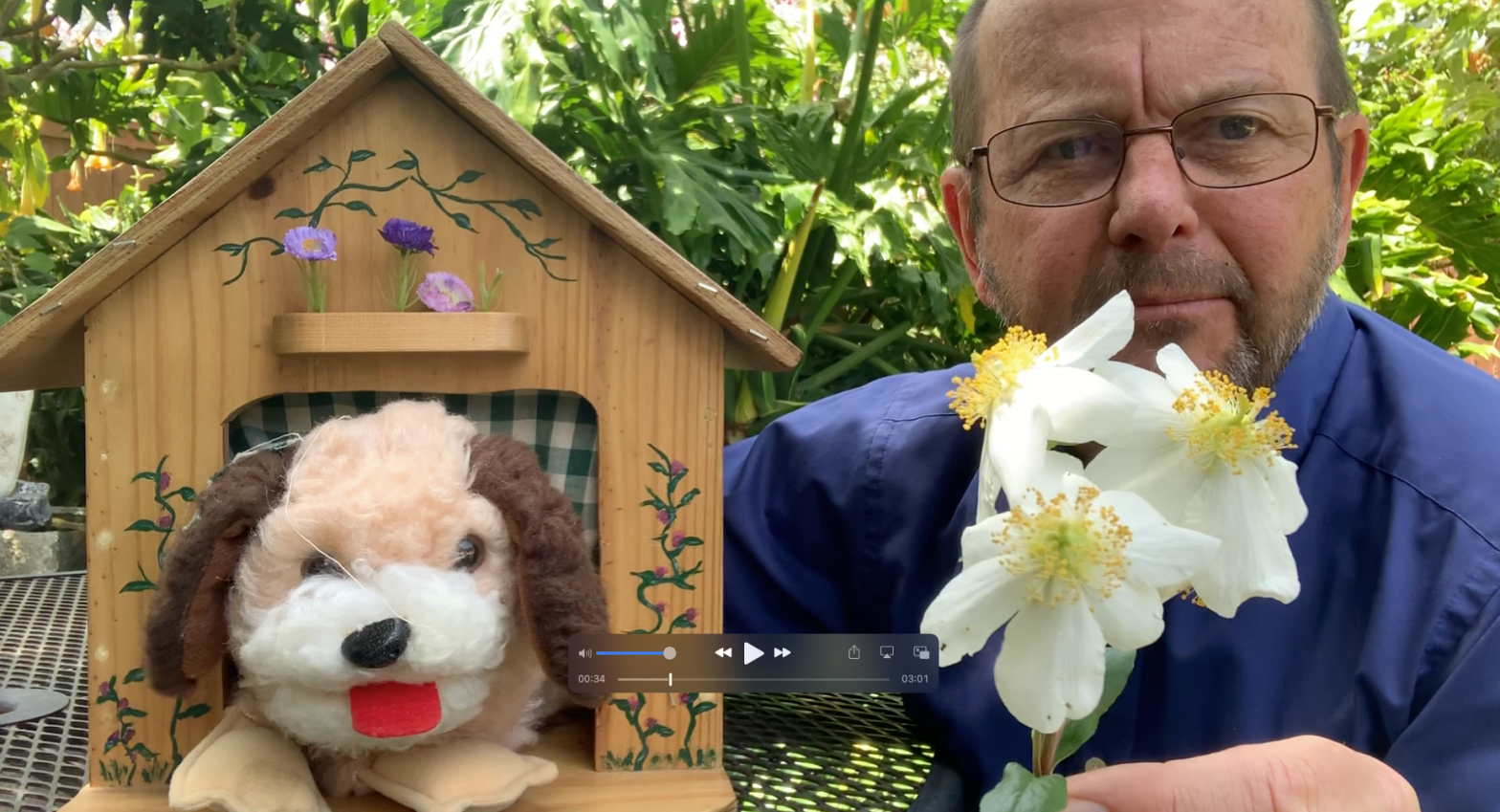
Last May I was serving as interim pastor at St. Andrew’s Presbyterian Church. My mentor and friend, Disciple Dog, shared some personal thoughts with the congregation on Mother’s Day. This week, he gave me permission to share it with you:
DD named some specific people in his spiritual “pack.” On this Mother’s Day weekend, he suggested I encourage all of us to do the same. Who comes to mind for you?
Like many other signposts of maturity, I knew if I lived long enough, my hearing would diminish and I’d need some help. But my male vanity was hesitant. “I can get by without hearing everything,” my inner stubborn voice muttered. But recently I decided to man up. I made an appointment at Costco to have my hearing checked this past Monday.
The technician hooked me up for a series of tests. After 30 minutes, he gave me the assessment.
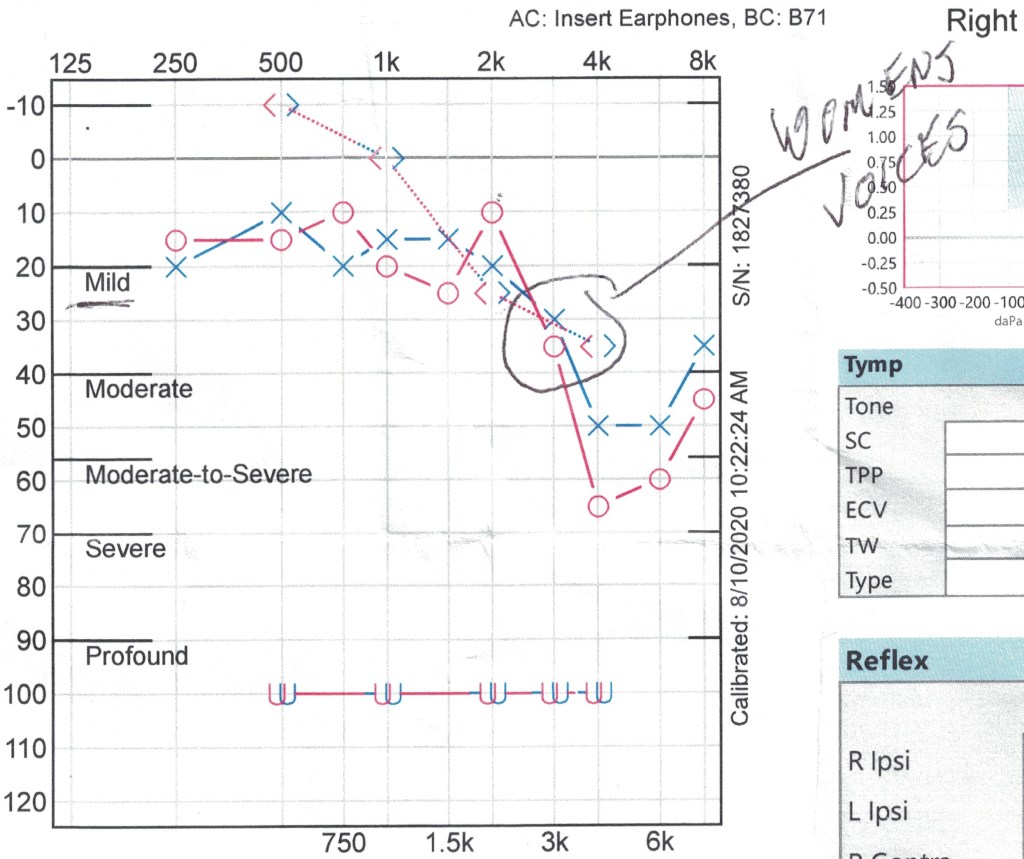
“You do have some hearing loss, but it’s in the mild to moderate range,” he said. “It’s focused on one specific area.” He printed out the graph and wrote a note on it:
“It’s not diminished enough to sell you hearing aids,” he said. “If it gets worse, come back, but otherwise, plan to check back in two or three years.”
As I walked out, I felt relieved.
Later in the day, I was looking at the chart and began imagining the symbolic possibilities in his note. Beyond the physical act of hearing, maybe it’s a useful metaphor for not “listening” to voices in our midst.
Hearing is the physical act of our ears receiving sound vibrations. Listening involves giving conscious attention to what our ears hear.
For instance, we can certainly recognize how much our society has not listened to women’s voices over the centuries. They’ve been there all along, but only recently are they being heard.
Along with women’s voices we could add black voices, a deficiency our institutions are trying to remedy.
I know this selective listening can apply to music and the arts.
In my teenage years, I was hearing plenty of rock music, but the words didn’t mean much, including the sad love songs. But once my teenage heart was broken for the first time, all those “I lost my baby and I’m really sad” songs felt like my songs. Only then did I begin to “hear” their meaning.
And how about hearing voices of what might be a divine spirit?
I’d gone to church occasionally growing up, but I don’t remember a single moment when something was said that meant anything to me. In college, I took it for granted that such perspectives were outdated and irrelevant. I remember being stopped by an evangelistic student on the UCSB campus who wanted to convince me I needed Jesus. The more we talked, the more I was convinced I had no interest in “knowing Jesus” as he wanted me to. The intentional gap in my attention could have been labeled “religion.”
But after an unexpected personal, mystical experience, I became fascinated with the spiritual experiences of others. That became a focus of my attention.
Over time, I found many people of faith who intrigued me. They weren’t trying to convert me or make me into something I didn’t want to be. They were humble, caring people, continuously open to spiritual insight and serving the world.
One thing led to another, and I ended up in seminary, followed by 40 years of ministry. I had my own experiences of “hearing” or sensing a voice addressing me, comforting me, and challenging me. It was not some deep male voice of tight-fisted judgement, but more like a novel idea, a prompting, a whisper.
Movies have captured it well. In Field of Dreams, Ray Kinsella hears a voice in his cornfield, “If you build it, he will come.” No one else can hear it, but his curiosity sets him on a journey of self-discovery. In the end, the journey is not about baseball but about reconciliation with his father. Or when Luke Skywalker hears Obi-wan Kenobi saying “Trust the Force Luke” – it’s a voice he can choose to follow or not. But he’s learned to trust it, because he knows it will lead him to serving the higher good.
Over the years, I’ve never tired of hearing stories from ordinary people who have “heard” in subtle ways a divine voice or prompting. In time, I went beyond my initial boundaries to listen to what people of other spiritual traditions “hear,” which led to my interfaith work. It’s been endlessly fascinating.
I think of one older woman in a congregation I served. Despite many hardships in her life, she was always smiling and ready to help others. One day when she came by my office, I asked what her secret was.
“I was raised Catholic,” she said. “At age 7 I decided I didn’t need to go through a priest anymore but could speak to God directly whenever I wanted. And I’ve been doing that every since.”
“Did you tell any adults?” I asked.
“No, there was no need,” she said.
So at that early age she began tuning in as best she could. Seeing the way she lives her life and the joy in her face, it was clear to me she had been “hearing” something valuable for many years.
It’s possible she was wearing hearing aids from Costco when we had the conversation. Who cares? It wasn’t her hearing that mattered. It’s how she had learned to focus her attention. And listen.
(Image: “Woman With a Lute By the Window,” Vermeer)
A long-time friend who follows this blog has a vacation home on Lopez Island in Washington. He recently sent me a photo and note saying he had just seen a seal on a nearby beach:
He added this comment: “Steve, they call this catastrophic molting where the seal comes up on the beach for 26 days and tries to shed his winter fur. He doesn’t eat but he really stinks. He often looks very uncomfortable and scratches, I suppose like having a bad sunburn. That would be a good title for a Lenten sermon or for one of your Saturday blogs: catastrophic molting.”
…let’s define molting: “Moltingmeans the periodic shedding of feathers, hairs, horns, nails, shells, and skins – any outer layer. Molt is from the Latin mutaremeaning ‘to change'” (Merriam Webster). When we brush our hair, for example, we consider it natural that some hair remains in the brush. We don’t usually shriek in horror, “I’m molting!”—even though we are! The elephant seal catastrophic molt (which simply means that their fur and top layer of skin comes off in large patches) is more dramatic than a few hairs in a hairbrush.
I assume everything I read is ultimately about me, so I thought about my own molting. I was born with a full head of hair. About 15 years ago, I realized a bald spot on the top of my head was spreading. The more it advanced, the more I tried to hide it. When I realized it was permanent, I wanted to lie on a beach and bellow operatically about my fate. I still do. At least the seal gets a new layer of fur and feels renewed. I never will. A catastrophe!
Ms. Mitoh and her team monitored several groups of Elysia marginata and Elysia atroviridis over the course of the creatures’ lives. Not all the sea slugs they monitored decapitated themselves, but many did — one even did it twice. Bodies regenerated from the heads of both species, but the headless bodies stayed headless. However, those dumped bodies reacted to stimuli for as long as months, before decomposing…For most of the sea slugs, the regeneration process took less than three weeks to complete.
The sea slug story stirred envy in me. What would it be like to have this option as we age? Muscle aches, limited motion, dull pains, insomnia, pills arranged in daily reminder bins, skin turning to parchment…wouldn’t it be great to have the Sea Slug Procedure?
“Yup,” we announce to family and friends, “I’ve had enough. I’ve scheduled my auto-decapitation. I’ll have a new body in three weeks. And in the next few months, if you see my old body inching down the neighborhood sidewalk looking lost, ignore it…our relationship is over.”
But my friend in Washington had a more enlightened perspective after reading the article. In a video included in the article, the liberated head bumps into its old body. My friend wrote: He/she/it looks like it is kissing goodbye to that old body that served it so well. I am usually using strong language on my old body for the things it can no longer do or only do it with lots of aches and pains. I need to be more thankful like that sea slug.
And that led me to think about the mini-stroke I experienced in 2011.
It was on the first night of our summer vacation. We’d driven all day to begin a week-long yoga retreat near Mt. Shasta. About an hour after we went to bed, I arose to honor my biology. I realized my left leg was not responding and I was struggling to walk.
“Are you OK?” my wife asked.
“I feel kind of funky,” was what I meant to say, but my speech was garbled, and she couldn’t understand me. At that moment we realized I was having a stroke.
Volunteer EMTs transported me to the local 20-bed hospital. I was alone in my hospital room that night, pondering my future.
By midmorning the next day, my speech was returning, as was the use of my left side. After a series of tests, they consulted my primary care doctor back home. He advised me to continue our vacation at a careful pace and to see him for follow-up when we returned home.
Two days later, I decided to try a few poses in the morning yoga class. In one pose, you put your left leg out in front of you and extend your upper body over it. As I did this, I looked at my left leg. I realized it was once again obeying my command. I was overcome with gratitude. How many times in all my years has that leg done what I asked, day after day without fail? And have I ever noticed? Have I ever expressed my gratitude?
I found myself serenading my left leg with an old country song, “Have I Told You Lately That I Love You?”
Maybe the day will come when a cure for “molting” is found, or we can trade-in our old bodies. Until then, I am going be grateful for all the infinite processes beyond my awareness that support my life day after day, year after year. Instead of lamenting my limitations, I want to always honor the miracle of being alive.
In the late 80s, I was teaching religious studies classes at Heritage College in rural Washington. One of the students was a hospice nurse. During a class discussion, she shared an experience that has fascinated me ever since.
She was recently divorced at the time, but on good terms with her former husband. His father was apparently a cantankerous, ill-tempered fellow few people wanted to be around. The fact that he was dying did not improve his disposition. Her ex-husband asked her if she would be willing to be his nurse. She had always gotten along with her father-in-law despite his behavior, so she agreed.
Two days before he died, he asked her for a favor. His appetite had been diminishing as his body began to shut down, but he asked her if she could possibly fix him a special food.
“I’d be glad to make you anything you want,” she said. “What will it be?” “
“Mashed potatoes.”
“That will be easy,” she said. “Would you like anything special, like extra butter or sour cream?”
“No,” he said, “Nothing special.”
“Ok,” she said. “Just potatoes and a bit of salt for flavor?”
“No salt. Just mashed potatoes.”
She prepared the potatoes as he had requested.
She put a bowlful and a spoon on his tray. He took one bite. He paused and smiled with a calm and radiant appreciation she had never seen before. After a few more bites, he was satisfied and thanked her. It was the last food he ever ate.
I’ve prepared potato dishes many times in my life, and it’s hard to imagine not adding something. I add salt and butter. My wife likes salt, pepper, butter and sour cream. But every time I cook potatoes, I remember this story.
When some people are close to death, the simplest things become sacred.
I’ve known people who are very much alive and have already discovered this secret. I try to be open to those moments when I might taste what they taste, hear what they hear, and know what they know.
Today I want to introduce you to one of my long-time and trusted spiritual guides – Disciple Dog. We’ve been buddies for years.
If I was working on sermons and feeling stuck, I would visit him. He always helped me see things more clearly.
He was much loved by the congregations I served –people often said they got more from him in three minutes than listening to me for twenty. He knew that, but didn’t rub it in.
I’ve been thinking about sharing some of our conversations from our archive on my blog. I asked him how he’d feel about it. He said, “Sure, why not?”
We start this week with a conversation from last April.
At that time, we were all entering a lockdown in response to the COVID pandemic. It was a scary time. It felt like we were in a storm.
One morning, Disciple Dog told me that the night before he’d had a dream about being in a scary storm. He described the dream to me. Here it is:
Pause for personal reflection. When he got past his initial fear, he began reaching out to others. Looking back over your experience over the last year, did any of your relationships become stronger? Did you develop any new relationships in the storm?
DD is napping right now, but he asked me to share with him any comments you may have.
I’ve often heard people say these things when talking about dying. There is often also an unspoken hope: “I hope my life adds up to something.” If these wishes are met, we might hear “Well at least that was a good death.”
What do you think is “a good death”?
During my time at Hospice, one of our partner agencies suggested we do some collective reflection and research around the question, “What do we mean by a good death?” We scheduled an interagency gathering for the discussion. Being familiar with various spiritual traditions, I was asked to present some spiritual perspectives.
I wasn’t interested in doctrines or beliefs. Instead, I decided to simply explore the stories of how central figures in each tradition died. It turned out to be a memorable exercise.
I started with the Abraham.
Abraham:This is the length of Abraham’s life, one hundred seventy-five years. Abraham breathed his last and died in a good old age, an old man and full of years, and was gathered to his people.[1] Abraham lives a long life that becomes inspirational to his descendants. Sounds good!
I turned to his grandson.
Jacob: On his deathbed, Jacob gives each of his twelve sons pointed comments. He tells them where to bury his body.When Jacob ended his charge to his sons, he drew up his feet into the bed, breathed his last, and was gathered to his people[2]. A peaceful death in the presence of loved ones, passing on our best thoughts to each one, knowing our duties have been fulfilled — a “good death” for many.
Moses: After a life full of drama, God lets Moses see the promised land, the culmination of his life’s work. But he is not allowed to enter. And Moses the Lord’s servant, died there in the land of Moab by the word of the Lord.And he was buried in the glen in the land of Moab opposite Beth Peor, and no man has known his burial place to this day.7And Moses was a hundred and twenty years old when he died. His eyes had not grown bleary and his sap had not fled.”[3]Moses dies alone, which is not unusual. He dies knowing he liberated his people from bondage and given them a hopeful future. And His eyes had not grown bleary and his sap had not fled. Dying with clear vision and ample energy suggests his awareness was vivid to the end. Sign me up!
Buddha There are different accounts of Buddha’s death. One popular story is he died at age 80 due to food poisoning. One variant says the meal was lovingly cooked for him by a local villager, who was devastated to learn the gift turned out to be fatal. Buddha assures him there is no need for sorrow — he has been preparing for this transition all his life, and now is finally being released into nirvana. His teachings and example have given humanity a source of wisdom that is still relevant 2,500 years later. Death can be liberation.
Mohammed The prophet was in his early 60s. After completing his last pilgrimage, he was home in Medina with his wife Aisha. His health had been declining and his community was concerned. Near the end, he has a period of increased energy, raising hopes of recovery for those close to him. (This is a common occurrence in the dying process.) But not long after, Aisha felt he was lying more heavily in her lap and that he seemed to be losing consciousness. Still, she did not realize what was happening. She heard him murmur the words, “Nay, the most Exalted Companion in paradise,” and then discovered he was gone[4]. One of the most transformative figures in human history dies peacefully at home in the lap of his spouse.
I was fascinated by these stories. Living a long life, being in the presence of loved ones (or on our own, if that is our wish), avoiding extreme pain, knowing we had accomplished something lasting, full of spiritual peace – again, this is what many would say constitutes a “good death”. Each tradition has an inherent integrity, and I was finding wisdom in each one.
Then I turned to the figure I thought I knew best.
Jesus I took a fresh look at Jesus’ death, comparing it to common hopes. Here’s what I found:
Lived a long life? Died in his early 30s.
Died in a peaceful loving surrounding? Publicly executed in front of his mother and a crowd of strangers.
Died with dignity? The Romans used crucifixion as a way to execute enemies of the state, designed to destroy dignity as well as life.
Pain-free passing? Death by torture.
Died feeling close to God? “My God, my God, why have you forsaken me?” Jesus said before letting out a loud cry and taking the last breath.[5]
Jesus dying on the cross has been a familiar story for centuries. Artists and preachers have tried to outdo each other in portraying it. But until I looked at it from a hospice perspective, I had not realized it represents what most of us fear when we imagine dying.
Yet the more I reflected on it, the more it was strangely comforting. Jesus’ community began to re-experience his presence after he died and concluded that “nothing can separate us from the love of God.”[6] A tragic death loses its sting.
We hope for peaceful, painless and meaningful dying experiences. But that doesn’t always happen. How we die does not have to define the life we’ve lived. It’s the life we’ve lived that counts.
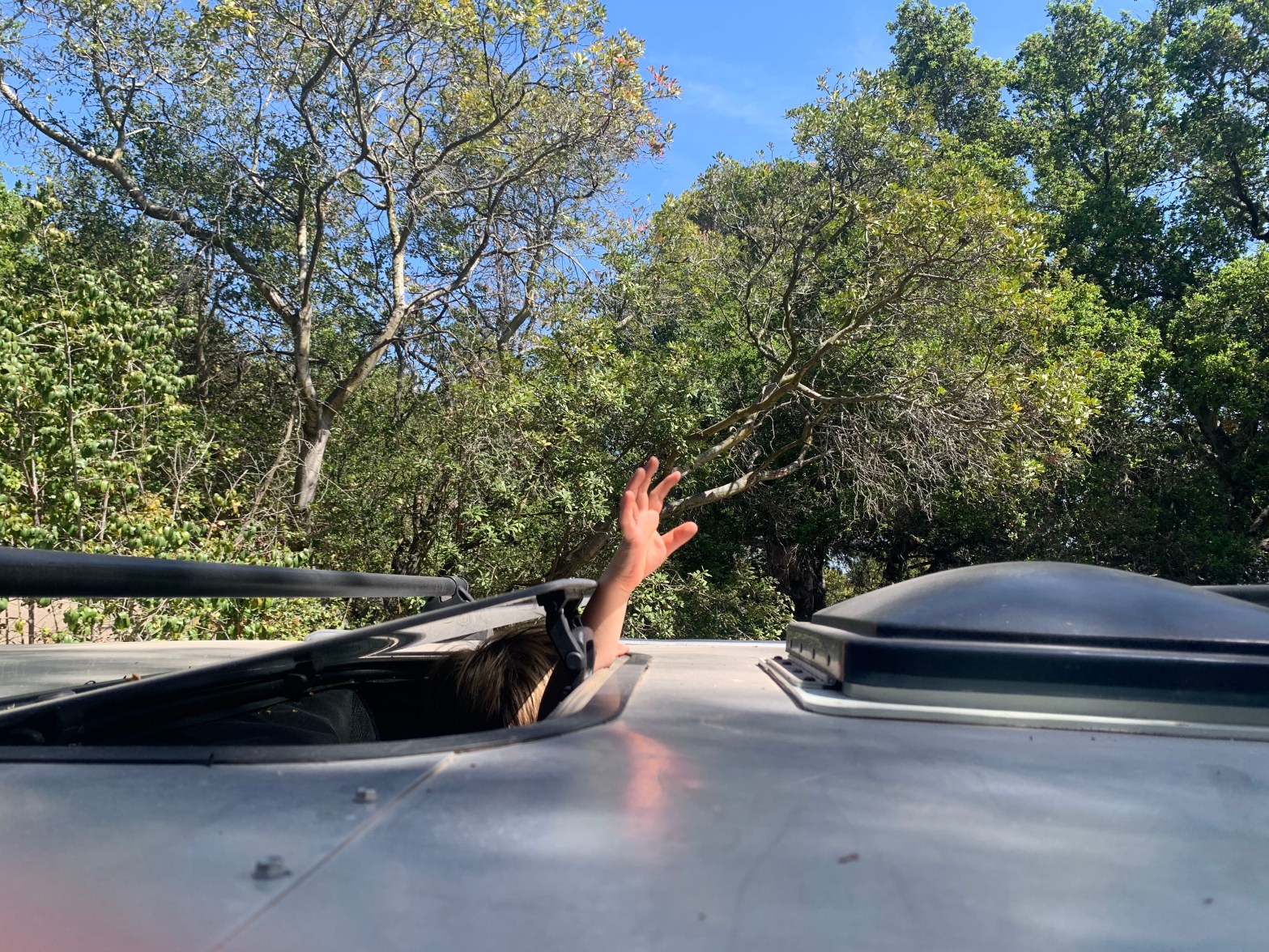
Today’s piece begins with a quiz. This photograph is:
My grandson reaching out of our trailer’s skylight to see what it feels like.
A visual metaphor for prayer.
All the above.
If you answered “c” you are correct.
Last week’s entry on enlightenment included an homage to Huston Smith. No writer or thinker has inspired me more. He consistently drew on a lifetime of scholarship and personal experience to make memorable, useful and simple statements. The statement for today is: “When you find yourself in a difficult place, go vertical.”
Huston believed that spiritual traditions are based on higher truths. We live much of our lives “horizontally” – going through the day with routines, assumptions and interactions that serve us well. But sometimes we run into situations – tragedies, difficult decisions, illnesses, crises — when ordinary ways of thinking don’t help. In those moments we can turn to spiritual truths, passed on to us from people who have transcended ordinary reality to see the bigger picture. That’s going “vertical.”
I’m going to share some experiences of “going vertical,” but first I will address concerns thoughtful people may have about “going vertical.”
“’Isn’t this an outmoded way of thinking with the divine being “up there” and us “down here?’” It’s a reasonable question. Many ancient people did believe the divine was too pure or holy to be down in the muck with us. God must be up at the top of that mountain, far away and safely removed. Most of us would agree that’s not the way we think anymore.
If someone asks me, “Where is God?” I would say “everywhere.” Within each cell of every living creature, as well as all creation, as well as far beyond what we can see or know. As Psalm 139 puts it:
Where can I go from your spirit? Or where can I flee from your presence? 8 If I ascend to heaven, you are there; if I make my bed in Sheol, you are there. 9 If I take the wings of the morning and settle at the farthest limits of the sea, 10 even there your hand shall lead me, and your right hand shall hold me fast. 11 If I say, “Surely the darkness shall cover me, and the light around me become night,” 12 even the darkness is not dark to you; the night is as bright as the day, for darkness is as light to you. (New Revised Standard Version)
Jesus taught that the kingdom of God is not far away, but within us and amongst us. People experienced his stunning presence right where they lived – they did not have to ascend a mountain. Buddha was asked where the authority for his teaching came from; he touched the ground and said, “Let the earth be my witness.” Muhammed taught that Allah is closer to us than our own jugular vein.
So, we don’t have to go up a mountain to find the divine.
But I believe it’s still useful to use metaphors that suggest we “go up” for spiritual truth.
When your airplane lifts off and you see your town from a higher altitude, you can see where you live with greater perspective.
“Inspiration Point “is a favorite hiking destination in Santa Barbara. When you get to the top you have a stunning vista over the town and coastline. It’s in-spir-ing, as in “in-Spirit-ing.”
So, it’s useful to consider spiritual truths as “Higher” because when we grasp them, many other things come into perspective.
The trajectory of my life was changed in my early 20s when I was in a personal crisis. I’d been self-absorbed, skeptical of any truth beyond my own reasoning. But at a moment when I felt my life was going to pieces, I reached out into the unknown and “went vertical:” I prayed for the first time. I’m not even sure what I said. But metaphorically my hand was reaching out into the unknown hoping something “up there” or “out there” might help me. Three days later, I realized something had changed – at my very center, instead of darkness and fear, there seemed to be a tangible point of light. I was stunned. I was grateful. It took me a long time to integrate the experience, but my life was literally saved when I “went vertical.” It was my first experience of grace.
Ministry is all about helping people “go vertical.”
For example, people would make an appointment with me and say, “I think my wife is having an affair with someone at work and I’m worried our marriage may be in danger.”
I would ask for more background. If appropriate, I would say:
“One of the most important things you can do is to deepen your spiritual life. This will make you stronger for whatever happens. If reconciliation is possible, you will have a better sense of who you are and how to repair the relationship. And if your partner does leave, faith will be a lifeline to take with you into the unknown.”
In January of 2020, I flew to Vienna on my own for two weeks. For the first several nights, jet lag kept me awake for hours. I “went vertical,” spending much of the time reciting the 23rd Psalm in a careful, contemplative way. I not only got through the night but sensed a kinship with all the people I know who live alone.
When COVID came, prayer and meditation became even more important. The divine presence is not threatened by a virus. I am grateful for the daily renewal I felt in those early months, “going vertical” instead of being shut in by fear.
There are many issues to explore regarding how we pray and what to expect. But I never regret a moment when I find myself afraid or uncertain and “go vertical,” reaching out for what I cannot see.
Have you had such experiences?
“The winds of grace are always blowing, but it is you who must raise the sails.” (Tagore)
I first encountered him in the 80s. I was teaching comparative religion in a small college and used his book, The Religions of the World, which students from diverse backgrounds always found engaging. In 1996, PBS broadcast a series of interviews of Huston with Bill Moyers, The Wisdom of Faith. I saw him speak in Santa Barbara several times at the Lobero Theater and always left with a clear mind and full heart.
If you lined up to have him sign a book, he’d ask you to write down your name on a piece of paper because he was wanted to spell it correctly. He would carefully inscribe a greeting and hand you the book. Then he’d look into your eyes and smile. A bright, warm light illuminated his face.
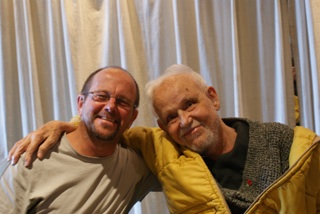
In 2010, I spent four days with him and a group of 30 retreatants at Esalen Institute in Big Sur (where this photo was taken.) He’d been teaching there for 50 years, and this turned out to be his last retreat.
He was 90. He entered the small seminar room slowly on the arm of his daughter, who helped him to his seat. His clothes were well-worn, and his yellow windbreaker was stained around the cuffs; it must have been a favorite.
After he was seated, his daughter welcomed us. She noted her father was now very hard of hearing, so we should direct questions to her and she would relay them through his good ear.
She nodded to him that we were ready.
When he began to speak, the wide smile emerged, and that light came to the surface. His told us his plan for the week was to tell stories about the people he had met over his life: Aldous Huxley, the Dalai Lama (before he was known in the West), Martin Luther King, Jr., Timothy Leary, Ram Dass, Bishop Tutu, Suzuki Roshi, Native American elders, Joseph Campbell and a long list of writers, thinkers and spiritual leaders. He encouraged us to ask questions at any time.
In my blog I’ll be sharing memorable statements Huston Smith made. The first one has to do with enlightenment.
“How do you know if someone is enlightened?” a woman asked, and his daughter conveyed the question to him.
He paused for a moment.
“If they tell you they are enlightened, they are not,” he said with a grin. “Truly enlightened people don’t think about it; they don’t care.” He illustrated the point with a story of his first meeting with the Dalai Lama.
Over my career people have asked me who my favorite theologians are. I’ve often named Wendell Berry, Bach and Rembrandt. But I also point to the older people I’ve known in my congregations. They have lived through many hardships but are at peace with who they are and always looking for quiet ways to serve others.
I remember one such man, Walt Eby. Walt was a retired engineer from the Midwest who had come to Santa Barbara as part of a job transfer from Wisconsin. Walt was soft-spoken. He never served on a committee or spoke at an event. But at coffee hour, he would stand on the patio and scan for any new people who might benefit from a word of welcome. He would walk towards them holding his Styrofoam cup of coffee and introduce himself. Soon you’d see the visitor smiling, relaxing and conversing. If appropriate, Walt might introduce them to someone else on the patio with a similar interest or background. He did this every Sunday. His ability of sensing who might need such care was uncanny.
Walt had a particular gift for connecting with teenagers. One young man appeared with his mom at our service. Walt went over and introduced himself and began a conversation. When they came back the next Sunday, Walt was there again with his friendly, low-key presence. In time he discovered the family was going through a divorce and took a special interest in the young man. Walt would call and invite the young man to hit some golf balls or perform some simple job around the church, like mowing the lawn. He took him to serve the homeless at a soup kitchen. Later, the young man joined our youth group and helped build houses for the poor. Walt showed him how to serve others and had a profound influence on the young man’s life as he did on many of us.
The young man’s mother later told me how much Walt’s care and concern meant to both her and her son…it was a steady, loving connection in a difficult time.
This was his way of being.
If I had said, “Walt I think you are enlightened,” he would not know what I was talking about. Such words were irrelevant to him. It was just the way he was.
When I was Director at La Casa de Maria, we annually hosted 200 groups from every spiritual path imaginable, as well as many nonprofits. I was asked to review the application of a group that had come before. They were a growing group from LA focused on a charismatic leader. I asked the staff for any comments concerning their previous visit. I was told the leader had once become frustrated, and publicly berated a staff member. I gave instructions to deny the request.
“If they tell you they are enlightened, they are not.”
This past Monday, I was driving past our neighborhood school at lunch time and saw something I had not seen in a year: children playing. Outdoors. On the school property. Lots of them. On their own. They were chasing balls and chasing each other. Some were sitting in pairs on the grass, some were walking around on their own, and some were involved with games on the blacktop. In the 27 years we have lived in our neighborhood, I’ve gone by the school almost every day, but it’s been a year since I’ve seen children playing at noon recess.
Tears came to my eyes.
The wonder of seeing children at play brought to my mind my experience in Vienna last January. In the Kunsthistorisches Museum, I entered a room and saw “Children’s Games” by Pieter Bruegel the Elder, painted in 1560. It looked mildly interesting at first. Then I read it depicts children playing 80 different games. I was transfixed. 461 years later, are any of these games familiar to you?
Playing with dolls
Shooting water guns
Wearing masks
Climbing a fence
Doing a handstand or somersault
Blind Man’s Bluff
Making soap bubbles
Walking on stilts
Riding a hobby horse made from a stick
Rolling a hoop (now, thanks to Whamo, a hula hoop)
Balloons (before latex, made from a pig’s bladder)
Tiddlywinks or Mumblety-peg
Pulling hair
Playing marbles
Catching insects
Riding piggyback or on a broom
Putting on a play
Climbing a tree, swimming or diving
Running a gauntlet
And as Brueghel was committed to portraying life as it is lived, he also includes:
“Stirring excrement with a stick” (!) and “urinating.”
Some of the games in the painting are not as familiar, including imitating the religious rituals of the time. And as we know, kids around the world are making new games every day.
I’m still struck by the joy and ingenuity of the children in the painting. I remember similar delights I experienced in my youth, and the enthusiasm of the children I saw playing freely at their school on Monday after a year of Zooming and confinement.
Video games have become a huge attraction in our time. But leave kids on their own outdoors, and their imagination flourishes.
I recall a church family weekend campout some years ago. Kids who already were becoming hooked on digital entertainment were in nature for the weekend with unstructured time and only their imagination to draw on. I remember watching two of them spend 40 minutes with a half-full plastic water bottle. They were tossing it, kicking it, watching it tumble and laughing time after time…no screens or batteries required.
In Proverbs 8 the poet is speaking of the presence of wisdom and creativity at the center of the natural world:
The Lord created me at the beginning of his work, the first of his acts of long ago….
When he established the heavens, I was there, when he drew a circle on the face of the deep, when he made firm the skies above, when he established the fountains of the deep, when he assigned to the sea its limit, so that the waters might not transgress his command, when he marked out the foundations of the earth, then I was beside him, like a little child (or “master worker”) and I was daily God’s delight, rejoicing before him always, rejoicing in his inhabited world and delighting in the human race. (Proverbs 8: 22, 27-31)
As we gradually emerge from the COVID pandemic, I hope we will never take for granted the creativity at the center of life, visible in all its splendor when we see children at play.
There often comes a time when a family is told their loved one has just a few hours or days left before dying. It can be an agonizing time of not knowing what to do other than wait. The loved one may still be able to communicate or, more often, is sleeping much of time. What do you do when “there’s nothing more to be done”?
Ira Byock, a leading physician in contemporary hospice and palliative medicine, came up with a helpful resource for such times. He would take his prescription notepad and write four phrases: “Please forgive me. I forgive you. I love you. Thank you.” He would give that to a family member and invite them to consider if any of those statements would be appropriate to say. He wrote an influential book on the transformative and healing experiences he witnessed arising from people using these simple statements. As the book became popular, two more were added: “Goodbye” and “I am proud of you.”
The values represented in these statements — forgiveness, love, gratitude, and acknowledging the cycles of life — are universally present in the great spiritual traditions.
When I was at Hospice of Santa Barbara, we took those six statements and had them printed on business cards. Our staff and volunteers could then give them to families when appropriate. I began to carry some in my wallet, a practice I’ve continued for more than a decade.
I was grateful to have the card when my father was dying.
He was in his last days at a nursing home. My two sisters and I used the list as a prompt for talking to him. He was no longer responsive, but it felt like the right thing to do. Maybe he heard us or maybe not. Maybe he could sense what we meant through tone or feeling. Or maybe it was just for us.
“Dad, please forgive me for the sleepless nights I gave you as a teenager.”
“There were times when I was growing up I was afraid of your anger. I knew you were under a lot of pressure and loved us, but it was still scary. I forgive you.”
“Thank you for providing for us, encouraging us and believing in us.”
“For the way you worked so hard to honor mom and provide for us, for the integrity and honesty with which you lived your life, and for your service to our country during the war – we are proud of you.”
Dad wasn’t from a generation when many men would say “I love you.” But we knew he loved us. It was easy to say, “I love you, Dad.”
The “Goodbye” statement can be tricky. It can be tempting to say it to have some closure, but it may be too early. (I remember one family had asked a harpist to play in the room; the patient woke up and said, “Get that music out of here…I’m not ready for the angels yet!”) But if, say, a family member is leaving town or death is clearly imminent, then “Goodbye” can be fitting.
As I did presentations on hospice in the community, I would pass these cards out. People would later tell me how helpful they were.
But I also knew what everyone who works in hospice knows…the work is not just about the dying, but also about the living. Whether dad was fully aware of what we were saying, it gave us closure.
The list can also be helpful after a death when we didn’t have an opportunity to speak the words in person. We can write a letter to the person using the list as possible prompts. We can then save the letter just for ourselves. Or we can take it to a place we associate with the person, including a gravesite, and read it. When it’s served its purpose, we can keep it or create a simple ritual and burn it.
“Six Things” can also be valuable when death is not on the horizon. Roughly half of Americans die with some form of hospice care, which means there may be time for meaningful bedside moments. It also means the other half of us will die without such an opportunity – heart attacks, strokes, accidents, etc. If these are the six things that matter most, why wait for a moment that we may never have? Why not use them when we are alive and well?
Once, I was doing a daylong retreat on this theme. I gave the background and handed out the cards. Then I said, “But let’s not wait. I encourage us all to think if there is anyone we want to say any of these statements to now.” I gave everyone 45 minutes. I’d brought stationery and envelopes if people wanted to write letters, and also encouraged people to make a phone call, send an email or text a message.
When we regathered, I asked for people to share experiences. One woman said she had called her daughter. The call went to voicemail and mom left a message, “I just want to say I love you!” The daughter called back a few minutes later sounding frantic: “What’s wrong mom?! Are you OK??” Mom laughed and reassured her she was fine, but was doing this as part of a retreat. So, giving a little background can help when we are conveying such deep feelings.
As time went on, I’ve found the “Six Things” a good way to take inventory from time to time in my own life on occasions like anniversaries and birthdays. Is there someone I want to say these words to now, since there’s no guarantee I’ll have a chance in the future? Why not just do it? Once we do, there is a sense of freedom.





#/media/File:Pieter_Bruegel_the_Elder_-_Children’s_Games_-_Google_Art_Project.jpg)


 Steve Jacobsen, Ed.D