The Art of “Living in the Tragic Gap,” Part Two: The American Dream

I’ve been wondering what the 4th of July could mean this year, given all we’ve been through. I decided to do some reading.

         I started with First Principles: What America’s Founders Learned from the Greeks and Romans and How That Shaped Our Country, by Thomas E. Hicks.  After the presidential election of 2016, Hicks, a military historian, sensed our core values were being challenged.  He decided to take a fresh look at our origins.  The book gave me new appreciation for the character, complexities and contributions of Washington, Adams, Jefferson and Madison.  But it also added complexity to the story.
         While praising the virtues of our founders, he lists issues where, in retrospect, they fell short: “Third, and most troubling, was their acceptance of human bondage, which would prove disastrous to the nation they designed.  Often seeing it as part of the natural order, they wrote it into the fundamental law of the nation, so sustained a system that was deeply inhumane and rested on a foundation of physical and sexual abuse, including torture.”[i]

         “Some of George Washington’s “famous false teeth,” notes the historian Henry Wieneck, came from enslaved humans, and had been pulled from their living jaws.”[ii]

         At Jefferson’s Monticello, “A small boy being horsewhipped by a visitor was just part of the background of the bustling plantation scene.”[iii]

         In late 1775, Lord Dunmore was the British Royal Governor of Virginia.  Knowing the colonists were getting close to rebellion, he “…issued a royal proclamation declaring martial law and promising freedom to slaves who joined the royal forces.  This concern about freeing the slaves, concludes the historian Jill Lepore, was the factor that, more than issues of taxation and representation, or the fighting in Massachusetts, tipped the scales in favor of American Independence.”[iv]

         Of the four founders, three were slaveholders, and only George Washington freed as many as he could in his will.

         When I finished First Principles, I wanted to learn more about the experience of slavery.

         I read Underground Railroad, by Colson Whitehead.  It portrays the struggle for freedom of a young woman born into bondage. It’s a compelling story describing the brutality, torture, sexual abuse, degradation, daily fear, and family chaos of her life, and the casual disregard shown by most whites. And it also illustrates the tenacity and courage of someone knowing they deserve to be free.

         I have always felt deep respect for my own ancestors and what they endured as immigrants, and I always will.  This book made me realize how the challenges they faced, while very real, were a world apart from the suffering of African Americans.

         Now I’ve started Frederick Douglas, Prophet of Freedom by David Blight.  I’ve always heard about Douglas, but never took the time to discover his story.  His father was most likely the white overseer at his childhood plantation who routinely raped and beat slave women, including his mother, who was taken from him at an early age. But he learned how to read – a dangerous thing for slaves – and his brilliant mind began grappling with the cruel paradoxes of America. In a church in Baltimore, he heard a message of faith that he realized applied to all human beings, not just whites. He escaped and became one of the most eloquent and impactful figures in American history.

         Our history is a harsh reality. How do we deal with it?

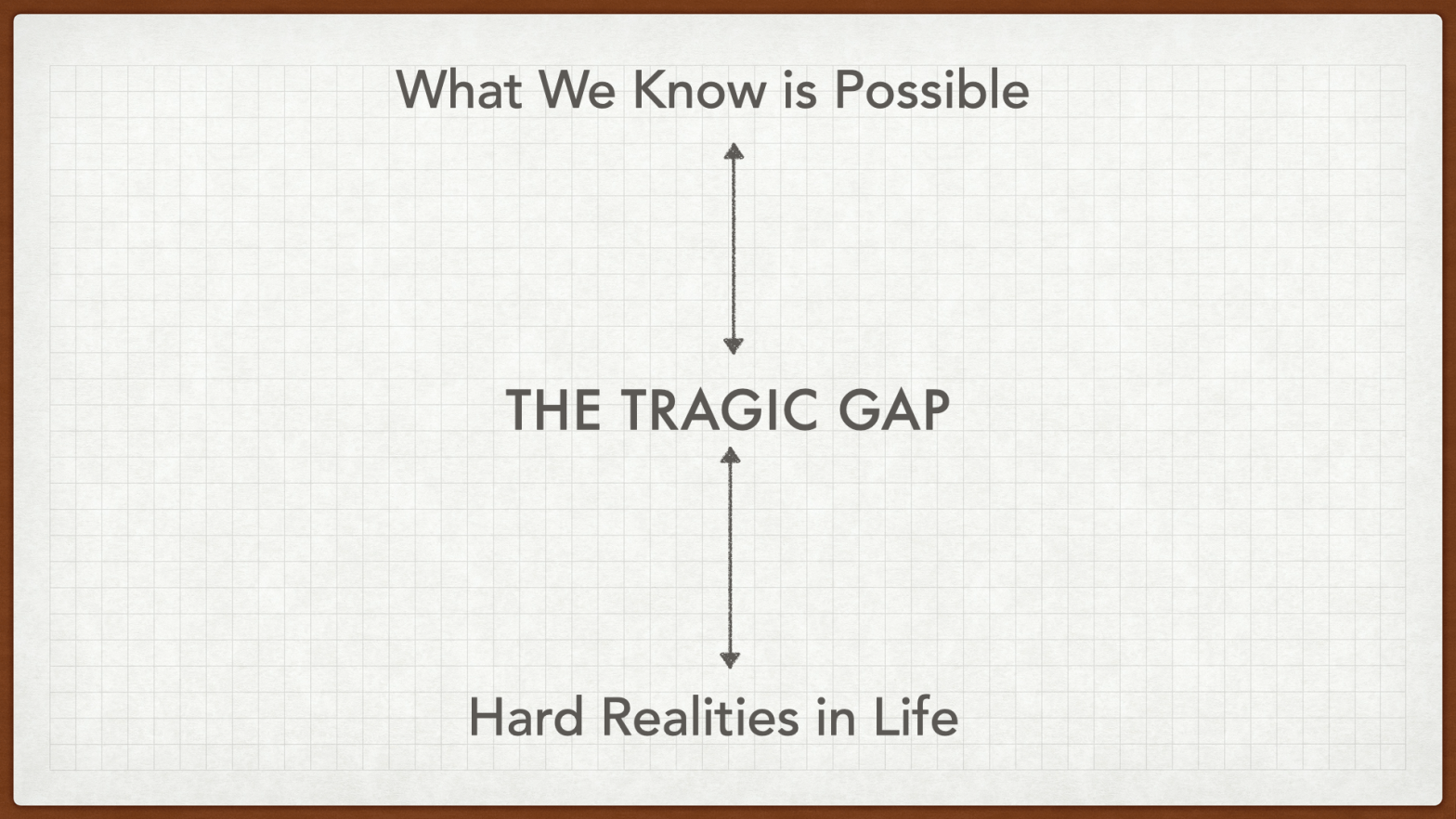
         Last week I introduced Parker Palmer’s concept of the “Tragic Gap,” and how it can apply to our personal lives.  I believe it’s also a helpful way to look at our shared American experience.

         America certainly began with high ideals, truly revolutionary for the time. But our story has been complicated from the beginning.  We make some progress, but then discover new reminders of how we fall short.

         We can experience two temptations.  One temptation is to become so defensive of the ideals that we don’t want to acknowledge anything that challenges them, a state he calls “irrelevant idealism.” On the other hand, we can become so discouraged we descend into “corrosive cynicism,” giving up on the hope for any progress.

         But we can find that third way by learning to stand in the “Tragic Gap.”

         Standing in the tragic gap means we are still devoted to the ideals but have the patience and fortitude to deal with hard realities as they emerge.

         It helps to remember times in which we have seen light come out of darkness.

         We can see the harsh realities of war in every generation.  But we also know that war and conflict can be followed by peace and reconciliation.

         We regularly see examples of personal greed and exploitation. But we also see examples of generosity and sharing.

         The COVID pandemic revealed a “harsh reality” of life around the world, creating great suffering.  But it has also been a time when nations, communities and neighborhoods have learned how to cooperate in new and profound ways.

         This spring I participated in a writing seminar on Zoom.  One class member was an African American woman, recently retired as a Navy chaplain.  At one point in a discussion, she said she has a quote from the writer bel hooks at the top of her computer screen: “How do we hold people accountable for wrongdoing and yet at the same time remain in touch with their humanity enough to believe in their capacity to be transformed?”  She said this helps her persevere.

         The harsh reality of racism continues to create seen and unseen suffering every day.  But the dream of freedom and justice based on the inherent dignity of all human beings is alive.  Living in the “Tragic Gap,” we can face the realities while holding on to the dream. John Lewis never gave up. Barack and Michelle Obama are not giving up.  The many women and men of color elected to office are not giving up.

         The dream lives and is worth celebrating.


[i] Hicks, pg. 11

[ii] Pg. .11

[iii] Pg. 11

[iv] Pg. 119

The Art of “Living in the Tragic Gap”

         There are two stages of life: the first is when we are aspiring to perfection, the second is when that is no longer viable, and we begin to look within.  — David Brooks

         Commencement speakers often encourage young people to dream big.  I don’t remember who spoke when I graduated from UCSB years ago, but I had big dreams.  My plan was to work six months and save enough money to travel in Europe, where I had a connection for a job.  After a year I’d come back and begin law school.  By age 40 I was going to be a millionaire — then retire and travel more.

         I knew it was possible.  I’d heard stories about people who had done things like that.  If it happens for some people, why not me?

         It didn’t work out that way.

         It took me a year to earn the money I needed. My time in Europe was cut short when I was denied a work permit.  I completed one year of law school and then withdrew, got married and became a father.

         I thought marriage and parenting would be easy.

         It didn’t work out that way.

         Marriage, it turns out, is a lot of work.  Parenting as well.  “Perfection” turned out to be elusive.

         By my late 30s I was depressed. My net worth was zero and my professional path seemed empty. I had friends who seemed to be thriving, which made it worse. I’d been living with unrealistic expectations and was now painfully coming to terms with the harsh facts of life.        

This polarity is something the writer Parker Palmer knows well.  Having gone through his own journey, he learned how to live with the tension between high hopes and hard realities.  It’s a life skill he calls, “Living in the Tragic Gap.” Here’s how it works.

       Many of us start out with lofty hopes and naïve expectations, but eventually encounter disappointments and dead ends. 

         When this happens, we can be faced with two temptations.

         One temptation is to keep chasing those hopes at all costs.

         “Look at that guy making a lot of money – he seems happy. I am going to keep pushing to succeed, no matter the cost.”

         “I deserve to be happy and satisfied every day.  If I’m not, it’s clearly somebody else’s fault, not mine.”

         “As a parent, I’m going to read all the books and do the right things. If I do that, my kids – and I – will live a worry-free life.”

         “Aging will never happen to me. I’ll find a program, a surgery, a diet or a guru that will keep me looking and feeling young.”

         We can become completely absorbed by unrealistic ideals of how life “should” be. Parker Palmer calls this, “irrelevant idealism.”

         The second temptation goes to the other extreme. 

         When the realities of work, marriage, and family life fall short of what we thought we deserved, we can become bitter. We lash out at other people, society, God or ourselves.  Or we feel broken and ashamed and withdraw into depression and resentment.  This is the temptation Palmer calls “corrosive cynicism.”

         But there is a third path, one that avoids the two temptations: “Living in the Tragic Gap.” The “gap” can feel “tragic,” as we must accept the fact our ideals may be impossible to fully realize.  But accepting the gap and negotiating life within it is the beginning of wisdom.  We don’t give up hopes and ideals but begin to balance them in the context of life’s realities.  As David Brooks said, once we are done “aspiring for perfection,” we “begin to look within.”

         Little is really known of Jesus’ life before he was 30.  But it was probably after a long period of looking within that he emerged with his compelling vision of the kingdom of God.  He encountered ordinary people struggling with life. Through him they experienced a new, grace-based way of seeing themselves and the world. This was not an escape from the realities of life but instead gave clarity and meaning to life as it is.

         The classic story of Buddha’s life is similar.  He was rich and healthy. He was carefully protected from suffering, living the first part of his life in the equivalent of a privileged, gated community. But he sensed something was missing.  He went out to see the real world and found the harsh realities of sickness, aging, and death.  But he kept pressing for a realistic way to make sense of it all.  In time, he experienced enlightenment and passed his insights on to countless others; “problems” will never stop arising in life, but we can develop an awareness that keeps us from being absorbed by them and instead find a boundless source of compassion within.

         In my work, I’ve met many people who became aware that perfection was no longer an option and were hungry for an alternative. I met them in my role as a pastor over the years. I met many when I was Director at La Casa de Maria Retreat Center. People were looking for something more, some way to stand between high hopes and hard realities. And when they’d find their footing, it was as if real life began.  They became humble, but also caring.  They took responsibility for their life choices and learned from their losses.  They found a certain kind of quiet courage to go on.

         Hospice of Santa Barbara has a long history of supporting people of all ages in the grief process.  When I was serving there, I was particularly struck by the work with children and teenagers who’d lost a parent.  One group support session ended with a time for the participants to create a work of art that expressed how they felt and what they’d learned.  A 15-year-old boy painted a picture of a heart broken open with blotches of red coming out of the broken space, growing larger as they emerged.  He wrote: “Death is like a broken heart.  It hurts and is sad, but you get through it.  Your heart is twice as strong.”

Disciple Dog’s “Bow-Attitudes”

         Last year I was preparing a sermon on the “Beatitudes” (Matthew 5: 3-12).  I shared some thoughts with Disciple Dog on our morning walks. Next thing I know, he told me he’d created his own list. He called them his “Bow Attitudes.”  Here they are:

Disciple Dog Shares His List of “Bow-Attitudes”

         DD came up with 7 things worthy of “bows” in his life that day.  Since then, he’s been regularly creating fresh lists as a spiritual exercise.  He’s taught me it’s a great way to start or end our day, and can help when we can’t sleep or are feeling anxious.  It actually is a practice that is useful in all kinds of situations.  “Tell them to give it a try,” he told me.  I said I would.

They Survived a Pandemic and Built a Cathedral –How Will We Remember COVID?

A great plague struck Vienna in the early 1700s.  Rulers often left the cities during such times, but Charles VI remained, joining the inhabitants to pray for deliverance. They particularly prayed to St. Charles Borromeo, who had been canonized out of admiration for the way he cared for victims of a plague in the 1570s.  When in 1712 the plague finally subsided, the Emperor, filled with gratitude, pledged to build a great cathedral. Construction began in 1716 and was completed in 1737. It was called Karlskirche, or St. Charles Church.  It became an architectural landmark in Vienna; people married in the chapel include Mozart, Mahler and Hedy Lamar.  It continues to be a popular sight.

            When I arrived in Vienna in January 2020, Karlskirche was not on my list of places to see. But it was close to my hotel and became one of the first places I visited.  Initially I was put off by the overly ornate architecture – way too frilly and overdone for my tastes. And the paintings of the saint caring for plague victims seemed to portray events of a distant past. But something kept drawing me back.  On a cold Saturday night – you were given a wool blanket when you entered — I attended a performance of the Mozart Requiem there.  I visited again two days later.  And on my last night in the city, I was on my way to a concert. It was foggy as I passed Karlskirche and its bells were ringing; I realized I had become enamored.

            I returned from Europe in early February.  A short time later, COVID-19 began shutting down Europe and the world. So far, 3.8 million people have died —  614,000 in America alone – and it is still threatening many people in the world.  It is finally subsiding in America, and California is scheduled to lift most restrictions on June 15.

            As life begins to return to normal, I’ve been wondering: Will we do what the Austrians did? Will we take time to be grateful for those who helped us survive the COVID plague?  Will we find a way to remember what lessons we have learned?  We have memorials for many painful experiences, including the Vietnam Memorial in D.C. and the 9/11 Memorial in Manhattan.  The art and themes of Karlskirche focus on the spiritual figures and beliefs that were prominent in 18th century Vienna.  What themes might we include for our COVID experience?

            If I was on the design committee, here are some themes I would suggest:

  • Healthcare workers We need to honor the healthcare workers who lived every day on the edges of this invisible and deadly biological disaster, and who, like St. Charles, cared for the sick and dying at mortal risk to themselves.  How about a simulated balcony where, below you, images of nurses, doctors, and hospital workers pass by hour after hour?  Your job is to pick up kitchen pans and create a cacophony of gratitude.
  • Frontline workers We need to honor the countless people who could not cocoon at home with Zoom, but worked on farms and in grocery stores keeping us fed. And for post office, FedEx and UPS workers who became human lifelines.  Peggy Noonan, longtime conservative columnist for the Wall Street Journal, was in the middle of the COVID apocalypse in New York.  She wrote: “We know who kept America going during the pandemic—the stackers, counter clerks and others, some of whom were here illegally. When this is over, give them full U.S. citizenship, no questions or penalties.”[i]
  • Scientists We need to honor the scientists who created the vaccine that saved our lives and our world.  Maybe create a life-size model of the labs where Moderna, Pfizer and J&J employees worked around the clock to develop the vaccine?  And testimonies about what it was like to do this critical work?
  • Nursing homes We need to remember the unique human toll COVID took in nursing homes. This suffering was largely invisible.  Millions of elderly and medically vulnerable people had to live as if they were under house arrest, unable to see or hug loved ones. Low-income caregivers kept showing up, often returning to cramped housing to care for their own families. We should not let this be forgotten.
  • Volunteer networks.  Around the country, countless individuals stepped up to organize help for neighbors and people in need.  In the parish I was serving, members created a food distribution network that fed thousands of people over several months.  Similar efforts blossomed everywhere.  We need to remember this display of what it looks like to love your neighbor, no matter who that neighbor is.
  • Our political failures.  When I’ve heard stories of hard times in American history, such as the depression and World War 2, there has often been a common perspective: “It was hard.  But we came together. We shared the burdens.  We united as a nation to face a common threat.”  I don’t think we will hear that about COVID.  Politics often took precedence over the clear and present danger.  It was a mess.  We need to find a way to remind future generations of the cost of personal and political pettiness.

            If COVID had never happened, my memory of visiting Karlskirche would be simply one more positive experience in a trip that had many.  But it’s become more than that. It’s an example of how one culture expressed gratitude for surviving a plague. We need to create memorials that insure the profound lessons learned during COVID will not be forgotten.


[i] https://www.wsj.com/articles/a-look-back-at-the-pandemic-year-11608847540?mod=article_inline

(Photo: High Altar Apotheosis of Saint Charles Borromeo, by Alberto Camesina.jpg)

Honey and Other Things: Exploring Our Inner Selves

            Years ago, I heard a presentation by Tom Boyd, a philosophy professor from the University of Oklahoma. As a boy he spent summers with his grandfather on a ranch in Texas. One chore was to help harvest honey.   After collecting, they would filter it and pour it into jars, then apply a label, “Pure Honey.” 

            One time a particle had gotten past the filter.  Young Tom didn’t want to put it through the filter again. He told his grandfather they shouldn’t worry about it and sell it as is.

            “We can’t do that, Tom,” he said.  “Because then we’d have to make a new label: “Honey and Other Things.” 

            Tom said he never forgot that.

            Years ago, I was driving downtown on my way to volunteer at the local soup kitchen.  As I was driving, I remember a voice saying, “You know, going to serve the poor means you are a really good person. Other people will think that when they see you. It will add to your reputation.” 

            Another voice was shocked. “How self-centered can you get? That’s not why you’re doing it. You’re doing it because it’s the right thing to do. It’s not at all about showing off.”

            It was only me in the car, so I had to own both voices.

            The genuine voice within me I’m going to think of as the honey. And the self-centered voice will be “other things.”  

            There are endless ideas about how many “selves” or personas we have within us.  Philosophy, theology, and psychology have all explored this question.  I’m going to work with just these two.

            Honey can be the divine presence in us that goes by many names: soul, higher self, inner light, Self, divine spark, etc.  And “other things” can represent our less-than-lofty aspect: the ego, self-centeredness, etc.

            Until my early 20s, I don’t think I was aware of two voices within.  I went day by day reacting to the world as I encountered it.

            After a mystical, transformative experience, I realized how incredibly self-centered I’d been. It had been all about me, and I’d made a mess of my life. But my soul had woken up.  There was now a small drop of honey within, not of my creation. It was a divine gift, it was grace and it became a guiding light.

            As I began to explore Christian spirituality, I often heard the assumption that we must be relentlessly focused on our “sinful nature.”  “You are selfish through and through. You don’t deserve grace. You’ve got to beg for it every day,” was the idea.

            I tried to extinguish that selfishness; I wanted to be pure honey. But in time I realized it was futile.  I concluded my ego wasn’t bad…it was simply trying to protect me. 

            Sometime after that, I was on a long drive on the freeway (apparently a good place for epiphanies).  I visualized standing apart from my ego self.  It was alone and cringing, frightened at being exposed. I walked over, put my arm around it, and said, “Hey, I know you are trying to do the best for me.  I appreciate how hard you work.  But I don’t want you to be in control all the time; you’re a better servant than master. Let’s collaborate instead of compete.” My ego passively accepted my embrace.


            I believe selfishness is a product of our evolutionary past. We do many things to survive, protect ourselves, get what we need, etc.  The “other things” are our biological inheritance. But if we are on a spiritual journey, we’ve decided we don’t want to be stuck there. We want to find something more, a higher good for ourselves and others.

            When I was at Hospice, a group of us attended a 5-day training at the Metta Institute in Marin County on “Cultivating Presence.”  We practiced Zen meditation several times a day, discussed how to care for the dying and heard a variety of speakers.  One of them was Ram Dass, a popular figure from the 60s who had turned from drugs to an Eastern spiritual practice. I’d read some of his work and seen him in person once, but never felt a connection.  One afternoon at the retreat, we had a video linkup with Ram Dass from his home in Maui.  He was talking in general terms and responding to questions in a relaxed and light-hearted way. But at one point, he paused, looked very serious — almost like he was in a trance — and said to us, “You are not a collection of your thoughts. You are loving awareness.”  Then his face relaxed and he continued his talk.

            I’m not sure what was going on, but I honestly felt a pulse of energy at that moment. I have not forgotten that feeling or those words.  Maybe deep within, beyond all the “other things,” we are pure honey … pure loving awareness.

            I don’t know what young Tom and his grandfather saw in that jar…was it a twig? A piece of grass?  Whatever it was, it came from the same blessed earth as the honey. It wasn’t inherently bad. It was just out of place.

            I have been blessed to know some people who seem like they are “Pure Honey.”  But I think most of us are “Honey and Other Things.” And that’s ok. We can accept the “other things” as part of who we are.  We can keep a filter handy. And we can be grateful for any “honey” we find as we go on our way.

Images of Our Lives: Resumes, Eulogies, Compost

            PBS and New York Times commentator David Brooks has experienced a major spiritual transformation in recent years.  One of his epiphanies is that many of us live with two sets of virtues in play.   As he wrote in a column entitled “The Moral Bucket List”:

            It occurred to me that there were two sets of virtues, the résumé virtues and the eulogy virtues. The résumé virtues are the skills you bring to the marketplace. The eulogy virtues are the ones that are talked about at your funeral — whether you were kind, brave, honest or faithful. Were you capable of deep love?

            We all know that the eulogy virtues are more important than the résumé ones. But our culture and our educational systems spend more time teaching the skills and strategies you need for career success than the qualities you need to radiate that sort of inner light. Many of us are clearer on how to build an external career than on how to build inner character.[i]

            From the first time I read this column, I appreciated this distinction and its implications. In this post, I’m going to comment on my own experience with resumes and eulogies, then add an additional thought.

Resumes: Much of my career was spent building my resume, and it was always interesting to read the resumes of others. Earning degrees, seeking accomplishments that I could quantify, publishing articles and serving on boards were all facts to add to the resume. This is what it takes to create a meaningful work life in a competitive society. It’s part of life in the modern world. But a resume does not a life make.

            Eulogies: One of the activities I treasured as a pastor was participating in memorial services.  I was always keen to hear what would be said about the person being remembered, and how the stories would cause each of us to pause and reflect on our own lives.

            If I was organizing the service, I would work with the family to create a simple outline of the person’s life: where they were born, what they did, and what they accomplished – something like their resume.  But that just set the stage for the stories people would share about the person: how they treated other people, and what moments friends and family look back on with appreciation. As David Brooks noted, in eulogies we often hear examples of the virtues of kindness, bravery, honesty or faithfulness – many ways in which people manifest “deep love.” 

            So far, so good.  I like identifying these two important aspects of our lives.

            But as I’ve been thinking of this distinction, I kept feeling like there was something missing, and only recently felt like I knew what it is.

            Resumes exist in print and are plain for all to see.  The “eulogy virtues” may be affirmed as part of a memorial service or obituary.  But what if the person lives a very long life, and dies when there is no one left to hear the eulogy?

            I think of my own father.  He lived to be 91, and almost all of those years were lived in Redlands and San Bernardino. He was active in many civic organizations and a well-known man in his day. In his last few years, my sister and I brought him to a retirement home in Santa Barbara so we could see him more often.  When he died, we arranged for a service back in San Bernardino.  We published an obituary in his hometown paper and spread the word as well as we could. But on the day of the service, only 3 or 4 people showed up besides family.  It was understandable – he had outlived most of the people he knew – but it was also disappointing.

            I’ve done services for people who die in relative obscurity. There’s no one there to describe and affirm the virtues and integrity they saw in the person. It doesn’t seem right.

            A similar thought arises when I’m with my young grandsons.  We share meaningful and fun times.   I find myself hoping they’ll remember our time together when they are older.  But what if I die before the memories take root? Will the time we share “count?”

            It reminds me of the familiar riddle, “If a tree falls in a forest and no one is around to hear it, does it make a sound?” We could rephrase it: “If someone dies and no one is there to give a eulogy, is the life a waste?” 

            Ruminating on this question has led me to think of compost.

            Compost  Many years ago in seminary a preaching and communications professor challenged us to think about how we envision the preaching task.

            “You might tend to think of your sermons as roses,” he said. “A masterpiece that you cultivate it until it’s a thing of beauty.  Then you carefully cut it, and bring it to display before the congregation on a Sunday morning . As people leave the service, you hope people will tell you what a beautiful rose you created.  Well, I invite you to not think of preaching that way.  Think of your sermons as compost.  Compost you work into the soil of peoples’ lives you are serving. The beauty comes from what flowers in their life.”

            The purpose of compost is to disappear into the soil, freely giving itself to produce new life.  It doesn’t need to be named to be real and everlasting.  So it is with our lives.  The good we do for others may not be quantified on a resume or be lauded in a eulogy, but that doesn’t mean it’s of no value. It’s a gift we can give, and then let it go.


[i] https://www.nytimes.com/2015/04/12/opinion/sunday/david-brooks-the-moral-bucket-list.html

The Gift of Disillusionment

            It’s a hard word to hear…disillusionment.

            In our relationships: Someone we’ve trusted does something that hurts or disappoints us.  We feel deflated, confused, betrayed.  

            At work: The organization we are working for makes a decision that shocks or upsets us. We realize we’ve been trusting the organization to act a certain way, but it makes a decision that betrays its stated values.  

            In politics and public life:   A leader or group performs in a way that seems to be counter to basic principles we thought everyone shared.

            In our spiritual journeys: Something happens in our life we thought would not happen if we are being faithful, responsible and caring. 

            “I’ve become so disillusioned…” someone says and describes what’s happened.  And we hear tones of sadness, detachment or even depression.

            But there’s another way to hear it.

            Parker Palmer, a writer who has been a mentor for me and many others over the years, has a surprising perspective on this word.  As he said in an interview with Krista Tippet:

            When a friend says, “I’m so disillusioned!” about this or that, why do we say, “I’m so sorry! How can I help?” We ought to say, “Congratulations! You’ve just lost an illusion! That means you’ve moved that much closer to reality, the only place where it’s safe to stand!”[i]

            This insight has been very useful for me. 

            Let’s start with personal relationships.

            I remember hearing a radio program with a noted marriage and family therapist.  He was talking about the need for all couples to use marital counseling to truly get to know each other.

            “But we got to know each other when we were dating,” people had told him.

            “No, dating is about deception,” he said. “It’s about you wanting to see the best in the other person, just as you are working hard to show them your best side. But after a while, you might start to see each other as you really are.  That’s a good time to begin to really get to know each other.”

            Instead of dis-illusionment leading to despair, it can lead to increased clarity.

            In the workplace, I’ve been on both sides of disillusionment.

            As a nonprofit executive director, from time to time I had to terminate employees. I was restricted by labor law and HR policies from giving a satisfying explanation to the other employees.  We’d talked often about “being a family” together, and abrupt terminations led people to say, “What’s going on? I thought we were a family. Are we just a heartless business?” 

            When that happened at Hospice of Santa Barbara, I thought about it for several weeks, trying to figure out how to describe what kind of entity we were.  I had an idea and made a presentation at a staff meeting. First, I listed the ways in which we were a business – our financial practices, our legal limitations, etc.  Then I listed ways in which we could be caring and supportive of each other within those boundaries.

            “Without meeting the requirements of a good business,” I said, “We would not exist.  But within those restrictions, we will try to be like a family when we can. So, let’s think of ourselves as a “Biz-imly” – a business first, and like a family when possible.”  That seemed to reframe it in a way that people found useful, and employees would quote that back to me as time went on.

            I’ve also been on the employee side – seeing “upper management” make decisions that to me were clearly contrary to their espoused values.  It helped for me to say to myself, “The idea that they would live up to their values has been an illusion.  It’s been “dissed. I won’t make that mistake again.”

            Disillusionment is something we can easily experience in political life. That what George Washington felt when he left office. He had hoped the leaders of the new country would be dedicated to personal humility and public virtue, which he had modeled so well. He was disheartened to see them falling into factions and cynical politics.  But James Madison was more realistic about human nature. He helped shape the constitution in a way that would accommodate selfish partisanship by a series of checks and balances.  Washington’s (hopeful) illusion led to his despair; Madison’s clarity led to a constitution that has, for the most part, endured.  I see leaders like Barack Obama and John Lewis as people who have always held on to the highest hopes and ideals, but also had a realistic understanding of human behavior and political realities.

            Disillusionment in our spiritual journeys can take many forms and are almost always a result of assumptions we have made.

            In Buddhism, it’s a given that our human nature is prone to see permanence where there is no permanence.  The path, then, is to be always vigilant about our illusions with the goal of seeing how things “really are.”  A well-known quote from the Japanese poet Mizuta Masahide captures how truth can follow loss: “Barn’s burnt down / Now I can see the moon.”

            In the Biblical traditions, it can be complicated.  There are passages that suggest people of faith will be protected from harm and disappointment.  Other verses are more realistic. Jesus staked his life on the belief that the one enduring reality is the love and justice of God.  “Blessed are the poor in spirit” – meaning those who have been emptied of false hopes and illusions — “for theirs is the kingdom of heaven.” 

            One qualification: I don’t offer this perspective on disillusionment as some glib, “tea-bag wisdom” that assumes dealing with disappointments is easy. There are losses in life that cut very deep into our souls and won’t vanish with a clever word play.

            But I invite you to give it a try. Next time you feel “disillusioned,” ask yourself if you’ve come closer to reality.  And don’t give up.


[i] (https://onbeing.org/blog/losing-our-illusions)

“Barns Burnt Down,” fiber art by Rebecca Mezoff

Love As Care and Confrontation

Years ago, a wise therapist said: “Steve, remember– love is a combination of care and confrontation.” That came as a shock. I had assumed “love” only meant “care.” But over the years I’ve reflected on this insight many times.

         This week I will explore how this perspective on love is reflected in our spiritual journeys. I am going to let Rembrandt’s understanding of Jesus do most of the work by considering one of his masterpieces, “The Hundred Guilder Print” from 1650.

         If you look at the full picture, what do you see? At first glance, it may look like just a pleasant portrayal of Jesus amid a crowd.  It’s easy to identify him – he’s at the center, with rays of light shining from his face.  But a closer look reveals it’s a not just a visual dose of religious saccharine, but a multifaceted masterpiece.

         Rembrandt took Chapter 19 from the Gospel of Matthew and imagined how Jesus was interacting with each character in the story.

People Seeking Healing

         Let’s start with the right half of the picture, illustrating verses 1-2: “…large crowds followed him, and he cured them there.”  Rembrandt imagines the various sicknesses and disabilities of the time and uses a variety of facial expressions and postures to show each person as they hope for healing.  The compassion he showed such people is what I think of as “caring.”

Pharisees

         But the mood changes as we shift to the left side. In verses 3-12, Pharisees pose a hard question about marriage and divorce.  Jesus gives them a provocative response and they are discussing it.  Loving these people meant challenging their beliefs.

Peter, Women, Children

         In verses 13-15, a woman brings her child for a blessing. The disciples “speak sternly to her” implying a woman with a child shouldn’t bother Jesus.  But he contradicts his disciples, putting his right hand in front of Peter (personifying the disciples) to silence him.  Peter gets “the back of his hand,” but the palm of that same hand opens to welcome the woman.  Behind her is a woman who has a baby in her arms; a second child is tugging on her sleeve, encouraging her to also accept the invitation.  In this one hand gesture, Jesus is rebutting Peter and welcoming the women and children – confronting and caring at the same time.  (As one feminist scholar has pointed out, this is a common dynamic in the Gospels – in scenes where both women and men are present, Jesus often speaks and acts in a way that humbles men and affirms women.)

The Rich Young Man

         We now focus on a character described as a “rich young man” (verses 16-22).  He asks what he needs to do to deepen his spiritual life.   Jesus first cites the Ten Commandments, assuming that is sufficient. The young man says he has done that but still feels something is lacking. I imagine Jesus pauses and looks more deeply into the man’s eyes before telling him he needs to sell all he has, give the proceeds to the poor, and follow him.  “He went away grieving, for he had many possessions.”  Rembrandt pictures the young man in deep introspection before leaving. His conversation with this young man – confrontation? Or care?  Or both?

         In many traditional religious paintings, every character is depicted as being in adoring rapture, surrounded by heavenly shafts of light. Not for Rembrandt.  Other people in the scene are doing things ordinary people do. Some are listening to him, but others aren’t paying attention at all and are talking among themselves.  A scrawny dog is hoping for scraps of food at the feet of the woman with children.  On the far right, a camel driver looks bored and tired as he rests his head on the camel.  The point: sometimes when a gifted teacher is speaking, some people are paying attention, but others are not.

         Coming back to our theme: if Jesus channels the “love of God,” it’s not a one-size-fits-all warm and gentle feeling, like we have when we see a photo of a puppy. Far from it.  For the characters in this etching, the love of God is customized for each person, directed at what they need in that moment in their life. For some it’s healing, comfort and blessing. For others, it’s challenging righteous assumptions, posing provocative questions, or causing them to discern their true motivations.   

         Looking back on my life, this expresses how I’ve experienced divine love and leading.  

         Many times, I’ve reached out in a time of need and been given “a peace that surpasses all understanding.”  Sometimes that came right away, sometimes it came later in the day, sometimes several days later. But when it came, I felt cared for.  I know many others have this experience.

         Other times I’ve reached out for guidance, I was really hoping I’d find some pleasant reassurance or an easy way out.  And instead, I was given something better.  

         In 1986, my wife and I had spent a year as volunteers at The Campbell Farm, an apple farm and retreat center within the Yakima Reservation in rural Washington. I had never lived in an area with a high poverty rate. I thought we’d be there for a short time, then move on to some setting where life was easier. The local church had offered me a position as pastor, but I was reluctant to stay. I prayed for guidance.  One afternoon, I was out in the alfalfa field changing irrigation lines.  These words appeared in my awareness: “Instead of being served, think of serving.”  After a moment of reflection, I knew what that meant.  I didn’t like it. But I sensed I needed to trust that message.  I accepted the call. We ended up staying for six years. It was not an easy time, but a rich and rewarding time as I learned about myself and rural communities and served as best I could. I’m forever grateful my ego was confronted rather than appeased.  Looking back, it was a message I needed to hear.

         Divine love can be a combination of care and confrontation. That’s one of the many reasons grace is amazing.

— Steve

(For a full view of the 100 Guilder Print, go to https://upload.wikimedia.org/wikipedia/commons/thumb/b/b8/Rembrandt_The_Hundred_Guilder_Print.jpg/1280px-Rembrandt_The_Hundred_Guilder_Print.jpg)

Disciple Dog’s Mother’s Day Card

         In my life and career, I’ve listened to many people describe their family life.  I learned many people have had deeply nurturing relationships with their mothers.  I know others whose relationships have been painful.  And I know the experience can also be a complicated mix.

         I can affirm being a parent is not an easy task.

         Over the years, I also learned to appreciate the power of being in spiritual communities, where people of many ages and life experiences come together to care for and support one another.  These spiritual families can become like an extended family.

         Last May I was serving as interim pastor at St. Andrew’s Presbyterian Church.  My mentor and friend, Disciple Dog, shared some personal thoughts with the congregation on Mother’s Day. This week, he gave me permission to share it with you:

         DD named some specific people in his spiritual “pack.”  On this Mother’s Day weekend, he suggested I encourage all of us to do the same.  Who comes to mind for you?

My Costco Hearing Test: A Spiritual Perspective

            Like many other signposts of maturity, I knew if I lived long enough, my hearing would diminish and I’d need some help. But my male vanity was hesitant. “I can get by without hearing everything,” my inner stubborn voice muttered.  But recently I decided to man up.  I made an appointment at Costco to have my hearing checked this past Monday.

            The technician hooked me up for a series of tests.  After 30 minutes, he gave me the assessment.

            “You do have some hearing loss, but it’s in the mild to moderate range,” he said. “It’s focused on one specific area.”  He printed out the graph and wrote a note on it:

            “It’s not diminished enough to sell you hearing aids,” he said.  “If it gets worse, come back, but otherwise, plan to check back in two or three years.”

            As I walked out, I felt relieved.  

            Later in the day, I was looking at the chart and began imagining the symbolic possibilities in his note.  Beyond the physical act of hearing, maybe it’s a useful metaphor for not “listening” to voices in our midst.

            Hearing is the physical act of our ears receiving sound vibrations.  Listening involves giving conscious attention to what our ears hear. 

            For instance, we can certainly recognize how much our society has not listened to women’s voices over the centuries. They’ve been there all along, but only recently are they being heard.

            Along with women’s voices we could add black voices, a deficiency our institutions are trying to remedy.

            I know this selective listening can apply to music and the arts. 

            In my teenage years, I was hearing plenty of rock music, but the words didn’t mean much, including the sad love songs.  But once my teenage heart was broken for the first time, all those “I lost my baby and I’m really sad” songs felt like my songs.  Only then did I begin to “hear” their meaning.

            And how about hearing voices of what might be a divine spirit?

            I’d gone to church occasionally growing up, but I don’t remember a single moment when something was said that meant anything to me. In college, I took it for granted that such perspectives were outdated and irrelevant. I remember being stopped by an evangelistic student on the UCSB campus who wanted to convince me I needed Jesus. The more we talked, the more I was convinced I had no interest in “knowing Jesus” as he wanted me to.  The intentional gap in my attention could have been labeled “religion.”

            But after an unexpected personal, mystical experience, I became fascinated with the spiritual experiences of others. That became a focus of my attention. 

            Over time, I found many people of faith who intrigued me.  They weren’t trying to convert me or make me into something I didn’t want to be.  They were humble, caring people, continuously open to spiritual insight and serving the world.

            One thing led to another, and I ended up in seminary, followed by 40 years of ministry.  I had my own experiences of “hearing” or sensing a voice addressing me, comforting me, and challenging me.  It was not some deep male voice of tight-fisted judgement, but more like a novel idea, a prompting, a whisper.  

            Movies have captured it well.  In Field of Dreams, Ray Kinsella hears a voice in his cornfield, “If you build it, he will come.” No one else can hear it, but his curiosity sets him on a journey of self-discovery.  In the end, the journey is not about baseball but about reconciliation with his father.  Or when Luke Skywalker hears Obi-wan Kenobi saying “Trust the Force Luke” – it’s a voice he can choose to follow or not. But he’s learned to trust it, because he knows it will lead him to serving the higher good.

            Over the years, I’ve never tired of hearing stories from ordinary people who have “heard” in subtle ways a divine voice or prompting.  In time, I went beyond my initial boundaries to listen to what people of other spiritual traditions “hear,” which led to my interfaith work.  It’s been endlessly fascinating.

            I think of one older woman in a congregation I served.  Despite many hardships in her life, she was always smiling and ready to help others.  One day when she came by my office, I asked what her secret was. 

            “I was raised Catholic,” she said. “At age 7 I decided I didn’t need to go through a priest anymore but could speak to God directly whenever I wanted.  And I’ve been doing that every since.”

            “Did you tell any adults?” I asked.

            “No, there was no need,” she said. 

            So at that early age she began tuning in as best she could. Seeing the way she lives her life and the joy in her face, it was clear to me she had been “hearing” something valuable for many years.

            It’s possible she was wearing hearing aids from Costco when we had the conversation. Who cares?  It wasn’t her hearing that mattered. It’s how she had learned to focus her attention.  And listen.

(Image: “Woman With a Lute By the Window,” Vermeer)