He Thanked 46 Coworkers in Ten Minutes — Now It’s Up to You

Think of how much of your life you’ve spent at work.  Some of the people we work with make it enjoyable and meaningful, while others have the opposite effect.  Do we ever take time to recall those who have employed us, mentored us, labored alongside us, and who have made going to work a positive experience?

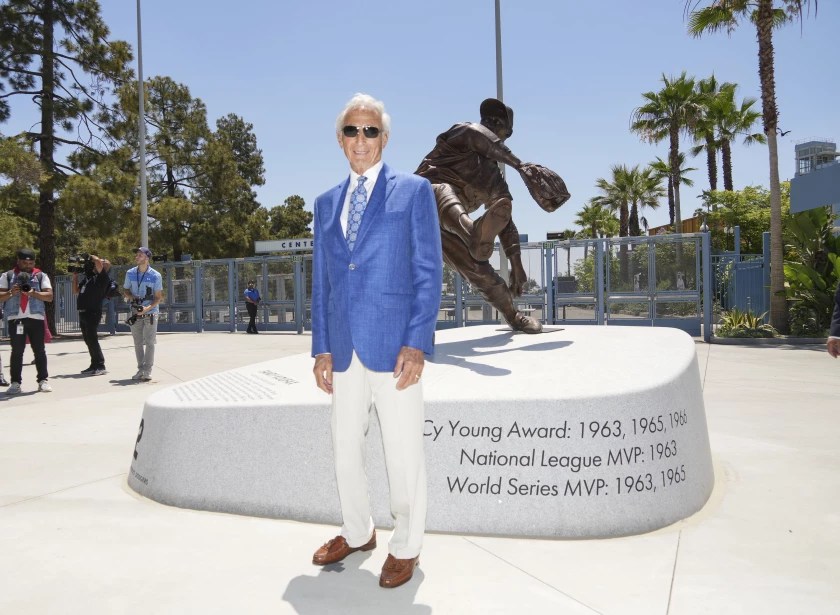
            On June 18 I took some family to a Dodger game — “Sandy Koufax Day.”  Like many southern California kids who grew up in the 60s, Sandy Koufax was a superhero to me.   Besides his accomplishments and awards, one of the things he’s famous for is his privacy – he doesn’t endorse products, appear on sports shows, or sell autographed baseballs.  This would be a rare chance to see him in person.

            Bill Plashke wrote an account of what Koufax said that day:

Standing behind his newly unveiled statue in the center-field plaza Saturday morning, Sandy Koufax was winding up to grace Dodger Stadium with one last pitch.

It was, appropriately, a breathtaking curveball.

It was, stunningly, a 10-minute speech from a man who hasn’t publicly spoken that much in 50 years.

It was, wondrously, the humanizing of Los Angeles’ phantom legend, a rare public pulse from a pitcher whose greatness has mostly existed in Dodgers mythology.

It turns out, at age 86, he just wanted to say thank you.

Plashke notes … he thanked 46 people during the span of 10 minutes, surely a record for inclusion and gratitude.[i]

            After I read the article, I thought, “I’m going to do what Sandy did.  I’m going to identify 46 people that I worked with that have had a positive influence on my life.”

            I soon found 46 to be a lofty target. I reset my goal at 23:

  1. Bill and Norma Schy, who gave me my first real job when I was 16 at Swensen’s Ice Cream paying $1.40/hour.  I learned how to interact with customers, clean kitchen equipment and balance out the cash drawer at closing.
  2. Tom Childress, the first painting contractor I worked for, who taught me how to paint a room efficiently and modeled how a good boss treats employees with respect.
  3. San Gorgonio High School English teacher Mr. Kenley, who taught me how to write a structured essay.
  4. UCSB Professor Al Lindemann, who challenged me to do independent research and showed me how.
  5. Bob Hibbs, my supervisor at McBride Realty in Sacramento, who patiently mentored me in the real estate business for a year before I realized it wasn’t for me.
  6. Seminary preaching Professor Randy Nichols, whose insights have guided me for 41 years.
  7. The congregation in Santa Paula who gave me my first job as an Assistant Pastor.
  8. Barb and Cragg Gilbert, who invited us to leave the California suburbs and become volunteers at the Campbell Farm in Wapato, Washington.
  9. Ed and Mary Ellen Hanks, fellow volunteers at the Campbell Farm.  Ed was raised on a ranch in Nevada and had been an agriculture extension agent, and he taught me how to drive a tractor, prune an apple tree, and care for livestock.
  10. The congregation in Wapato, Washington who took a chance on me as a solo pastor and taught me the virtutes of rural life.
  11. Sr. Kathleen Ross, SNJM, the visionary founder and president of Heritage College, who invited me to be her intern for a semester and shared her insights on leadership.
  12. John Gardner, my doctoral advisor at Seattle University, who encouraged me to pursue a dissertation topic that arose from inner passion rather than playing it safe with a less risky topic.
  13. The congregation of the Goleta church, who moved us to Santa Barbara, helped us buy our first house and raise our daughters and employed me for 16 years.
  14. Wade Clark Roof, Professor of Religious Studies at UCSB, who helped me get research grants and encouraged my academic research and writing.
  15. Rabbi Steve Cohen, dear friend and gifted teacher, who, with members of his congregation, introduced me to the depths and richness of Judaism.
  16. Muhktar Kahn, Afaf Turjoman and Hussam Moussa, who introduced me to Muslim faith, traditions, and culture.
  17. Gail Rink, Executive Director at Hospice of Santa Barbara: a fearless, compassionate rebel who changed the way our community approached death and dying. She told me I had what it takes to take her place when she retired in 2008.
  18. The staff at Hospice of Santa Barbara – people like Mary, Michael, and Magdalena — who exemplified compassionate, professional care for those facing death and grieving the loss of a loved one – and were a joy to work with.
  19. Steph Glatt, IHM, and Juliet-Spohn Twomey, IHM, long-time leaders of La Casa de Maria Retreat Center, who invited me to become Director in 2013.
  20. The staff at La Casa de Maria – groundskeepers, housekeepers, hosts, kitchen staff — who showed me what the practice of genuine hospitality looks like.
  21. Jay Grigsby, fundraising consultant at La Casa and other places, who has spent a decade mentoring me in the hard but satisfying work of raising money for good causes.
  22. The St. Andrew’s congregation, who coaxed me out of retirement to serve as their interim, proving “I’m not dead yet.”
  23. Marilyn McEntyre, English professor, poet, writer, master teacher, and friend, who has challenged me and so many others to write from the soul and not just the head.

There are many things to be despondent about in the world these days. But it’s a good practice to take time to remember those who have made our workplaces positive environments for labor and learning.  We can make a list of 5, 10, 23, or — if we are aspiring to the Gratitude Hall of Fame — 46.


[i] https://www.latimes.com/sports/dodgers/story/2022-06-18/sandy-koufax-statue-unveiling-time-of-gratitude-inclusion

Sandy Koufax, 86 years old. Photo taken by 69-year-old pensioner from Reserved Section 7, Row T, Seat 9; June 18, 2022

Tasting the Magic Waters

            For more than a decade, I’ve been entranced by the great three-part medieval poem, Dante’s Divine Comedy.  There are many spiritual and psychological insights Dante shares in this work that speak to me. In this posting, I want to share his concept of two symbolic rivers we might sample in our life journey. The description occurs near the end of the second volume, Purgatorio.

By this point Dante’s been given a tour of hell (Inferno) and all its custom-made torments. It’s impressive to see how he imagines the bad guys “get what’s coming to them,” as they used to say in the Westerns.  But Inferno is not as meaningful to me as what follows.

In Purgatorio, he imagines hiking up a mountain to see how all kinds of people are completing their personal soul-work as they prepare for Paradiso.  (Does he – or anyone these days — really believe in a place like purgatory, you might ask? Don’t worry about it, dear reader; let’s just follow what he imagined.)

As he gets to the top of the mountain, he travels through an enchanted forest and, among other experiences, comes to two rivers.  He also encounters a guide, Mathilda.  The first river Mathilda leads him to is the Lethe, which was known in Greek mythology as the river of forgetfulness we pass through after we die.  Dante interprets it in a positive way:

“She plunged me, up to my throat, in the river

And, drawing me behind her, she now crossed

Light as a gondola, near the blessed shore, I heard

“Asperges me,” so sweetly sung that I

Cannot remember or, much less, describe it.” (Canto 31: 94-99)

“Asperges me” means “thou shalt sprinkle me.”  After guiding him across the river, she invites him to take a drink.   All the memories of the mistakes he’s made in life – the poor decisions, the times when he’s hurt someone else or disappointed himself – all are washed away in the Lethe. Think about your regrets in life – what would it feel like to have the painful memory of them disappear?

“The River Lethe,” John Flaxman, 1807

            After more encounters and reflections, he comes to the second river – one Dante created out of his own imagination — the Eunoe.  Matilda is joined by a group of guides and invites Dante and a fellow pilgrim to drink from it.  After he does, he says:

If, reader, I had ample space in which

To write, I’d sing – though incompletely – that

Sweet draft for which my thirst was limitless…(Canto 33: 136-138)

Where the effect of drinking from the Lethe was to allow him to forget all his failings, drinking from the Eunoe allows him to recall all the good deeds he’s done in life, both large and small.  (The word he created, eunoe, combines eu(new) – and noe(mind) – a new, fresh mind.)

The River Eunoë, John Flaxman, 1807

            Think about it. Sure, you’ve made mistakes in life. But you’ve also done many good things – small kindnesses, acts of love and duty, promises kept, hope given, and friendships honored. Imagine what it would be like towards the end of life to forget all the bad stuff you’ve done and remember all the good?

            From the first time I read about these two mythic rivers, I was entranced by imagining what such an experience would feel like.  In the years since, I’ve come to wonder if sometimes people actually experience something similar.

            My father outlived my mother by 19 years.  We knew they loved each other all the years they were married. But we also remember their life together was not free from the stresses and strains of many long-term relationships.  Yet in his last years, whenever dad reflected on their time together, all he talked about were the joys they’d shared — no mention of the hardships.  At first, I was tempted to kindly point out it wasn’t all milk and honey. But something told me to be quiet.  It was as if dad had dipped first into the Lethe, then the Eunoe, and the combination filled him with pure gratitude.

            Recently I visited a former parishioner who had decided to stop receiving life-prolonging treatments. She’d been through many challenges in her life, including years of concern for her children and the obstacles they faced. But, she told me, they were both doing well now and didn’t need her as they had before.  She was tired of the complications her body was having to endure every day and she wanted to be free.  When I came, she was going through a box of old family photos.  After I sat down, she showed me some of her favorites. Each memory had become a delight.  Before I left, I asked her if there was anything she’d like me to pray for. She told me, “Somebody said, If the only prayer we ever offer is thank you, that would be enough.  Just say how grateful I am.’

            Remembering our mistakes helps us to stay humble and keep learning how to do better. Focusing only on the good we’ve done may seem selfish.  But maybe, once in a while, we can close our eyes and imagine sampling those waters – tasting what it’s like to have our regrets washed away, then savoring a pint of gratitude for the good things we’ve done.  Maybe we shouldn’t wait until late in life to see what these magic waters can teach us. 

Painting: “Along the River Lethe,” Kyle Thomas

“Beholding” as a Spritual Practice

            Last week I attended a leadership conference featuring David Brooks, PBS commentator and columnist for the New York Times.  He covered many issues in his three talks, and one I want to share with you concerns the attention we give other people.

David said he recently was working alone at home one evening when his wife came in the front door. He looked up to see her and realized she hadn’t yet noticed him sitting at his desk in the adjacent room.  He decided to simply watch her for a minute.  After she closed the door behind her, she put her things down, and paused.  The house was quiet. She then turned and walked into the kitchen.  In that unplanned moment of simply observing her, he realized how much he loved her. He said the experience of seeing her this way was not just a visual act, but something more: he felt as if he was beholding her.

He contrasted this moment with what we experience often in modern life — looking at each other without really seeing each other.  When we meet someone, we quickly form assumptions about them before they even speak and filter whatever they say through our assumptions.  When someone we know is talking – even someone we know well – our busy mind often isn’t listening carefully to them, but instead preparing what we are going to say in response.  “We are not good at “reading” others,” he said, which has created “an epidemic of social blindness.”  The quality of attention we bring to someone else is a moral act.  If we are truly paying attention with humility and genuine respect, we are granting that person dignity.   We are beholding them.

I looked up the origin of the word.  In Old English, the word bihaldan meant “give regard to, hold in view.”  Modern definitions include, “To hold by, keep, observe, regard, look” and “To look upon, view, consider as (something); to consider or hold in a certain capacity.” If I was to add my own definition, it would be “to give reverent attention to a particular person or experience.” I kept turning the word around in my imagination and was intrigued with the possibility that to “behold” someone could be to “hold” that person’s “being” with a particular sense of awe and care.  We are not looking at them with our “busy mind” but opening ourselves to the mystery and wonder of their living presence.

            In Leaving Church: A Memoir of Faith, Episcopal priest Barbara Brown Taylor described the factors that led her to leave parish ministry. One reason was that she had become weary of people wanting her to tell them what they were supposed to believe.  She said her spiritual journey had not been so much about believing the right thing but inviting others into experiences of beholding —“beholding life on earth in all its glorious and terrible reality.”

            Being with someone when they die can often evoke a feeling there’s something sacred in the room. I remember my sisters and I spending time at our deceased father’s bedside before the mortuary arrived.  We weren’t just looking at dad, we were beholding him.

            And I recall what it’s like raising young children.  You’re busy all day long with them – talking, listening, dressing, negotiating, feeding, bathing, reading a story — and it’s a big accomplishment to finally get them into bed. A little while later you come back to their room to check on them.  You carefully, quietly open the door and see if they’ve fallen asleep. Seeing they are, you sometimes stand there and keep looking at them. You now “see” them for the miracles they are. You may even think, “When they are asleep they look like angels.” In those moments, you’re not just looking at them – you are beholding them

            Maybe we can try beholding one person today and see what we experience.

Imgage: Sleeping Child Covered With a Blanket, Henry Moore, 1942

Status and Community: A Tale of Two Lives

            Dr. Charity Dean lived in our neighborhood before she became famous, and I was looking forward to hearing her speak this week as part of the annual “Lead Where You Stand” conference at Westmont College. I was familiar with her amazing career and legendary grit but, until Wednesday, had never heard about a personal challenge she faced.

Born and raised in a low-income family in rural Oregon, at age 7 she felt a call to become a physician and tropical disease specialist. After earning her medical degrees, she became a resident at Cottage Hospital here in Santa Barbara.  She was brilliant at analyzing data. But she also received invaluable training from Dr. Stephen Hosea who taught her the importance of looking beyond the data and test results to see each patient as a unique person. He also emphasized the importance of physically touching them before making a diagnosis, encouraging her to trust her “sixth sense” to discover what was going on; “I sense and feel things,” she told us.

She became the Public Health Officer for Santa Barbara County, which had traditionally been a largely bureaucratic position.  But she didn’t stay in her office or wait for patients to be brought to her. Instead, she went out to see them wherever they were — homeless shelters, farm worker sites, parks, anywhere.  She observed them, listened to their stories, always using touch as part of her interactions.  She soon gained a reputation as a fearless and formidable public servant who wasn’t afraid of upsetting other officials in serving the public good.

In the summer of 2019, her training and “sixth sense” told her COVID was coming.  She began a relentless struggle to alert and prepare others.  By April 2020, she was Co-chair of the California COVID-19 testing task force in Sacramento and serving on the White House Coronavirus Task Force. She was featured on ABC News and 60 Minutes and is a central figure in Michael Lewis’ The Premonition: A Pandemic Story.

It was fascinating to hear an account of her professional ascent.  But I was impressed in another way when she talked about a personal issue.

Apparently, alcohol had been problematic for her. She did not drink daily, but when she did, she had a hard time stopping. She went to Oregon to visit her mother and asked about the family history.  She was told alcoholism had been pervasive, which she hadn’t know.  She returned home and decided she needed to go to an AA meeting.

When she walked in, she was surprised to see someone who knew her — one of her homeless patients.

“Hello, Dr. Dean,” he said. 

She became a regular.  A year later she received a pin marking her first “birthday” of sobriety.  As she came forward to receive it, the man who followed her was receiving his ten-year pin – another former homeless patient who was living with HIV and had become a friend and supporter.

            As a physician, she said it was humbling to go to that first meeting.  But she discovered everyone in the group had something to teach her about life.

            This brought to mind a story from my time at Hospice of Santa Barbara.

            HSB is a rare form of hospice – one which does not provide direct medical services, but instead offers psychological, social, and spiritual help to anyone facing a life-threatening illness or grieving the death of a loved one.  Thanks to a $40 million bequest we received and community support, we were able to have a staff of 30 skilled and compassionate professionals. Part of HSB’s charter is that all our services are free, with no reliance on government or insurance funding.  When I was there (2008-2013), we were serving hundreds of people of all ages and backgrounds.

            One staff member told me the following story.

A wealthy woman had come for grief counseling. When the first session was completed, she took out her checkbook and asked how much the fee was.  The therapist told her HSB did not accept payment; if she wished she could make a donation when her therapy was completed. She was flustered and uncomfortable at the thought of not being able to pay for the services.  But she kept coming to her appointments.

            Our staff knew that, for many people, being in a group of others who had suffered a similar loss can be helpful.  Our therapist told this client that she had gotten to a point where being part of such a group would be a good next step.  The woman was very resistant — she didn’t think she’d have much in common with a group of ordinary people.

But she agreed to try it. Soon she became a dedicated member.

            When she completed her time with us, she told the therapist that she had never realized how much she had in common with other people.  Sharing this difficult journey with others, she said, was one of the best experiences of her life.

            We seem wired to create and maintain identities for ourselves that can make us think some people are “better’ than others. But in my experience, beneath the facades, we are all human beings trying to find our way in life. On that journey, humility, friendship, and community are priceless gifts.

Your Membership Card for the Spiritual Gymnasium

            Speaking at the Lobero Theater fifteen years ago was the great scholar of world religion, Huston Smith. Almost 90 years old, he had difficulty walking on stage. 

Once he reached the lectern and stabilized himself, he looked out at the audience, smiled, and said, “I’m going to make five statements tonight that I think you will disagree with.”  People shifted a bit in their seats. 

There’s no such thing as progress” was one of them. 

            He acknowledged that, of course, there have been significant improvements in our lives over the centuries.  Plumbing, for instance. Or scientific advances in many fields, including those that have improved health care, eliminated many deadly diseases, and reduced mortality rates.  Not many of us would argue with that.

            There’s been some progress in human rights, particularly regarding race and the status of women.

            But with all our material advances, have we resolved the problems that create human suffering?

            He finished by saying:

            “If you go through life feeling you must solve the problems facing humanity before you die, you are going to come to the end frustrated and discouraged.  But if instead you see life as a spiritual gymnasium – a place designed to learn timeless truths – you will find it’s perfectly equipped.”

In my twenties I realized how deeply embedded the illusion of progress is in our society – that every generation will make things “better.”   Clearly there’s been great material advances.  But would we say there has been “progress” in the arts? Has anyone “improved” on Bach, Mozart, Beethoven, Shakespeare, Ella Fitzgerald, Elvis, the Beatles, Van Gogh, Aretha, Bruce Springsteen, or Bob Marley?  New artists come along and delight us with their creativity, but that’s not “progress,” that’s just new expressions.  There is a timelessness to great art that is very different from a new washing machine model or a television with higher resolution.

            The same can be said about great spiritual teachings.  New insights and interpretations emerge, but core teachings endure. The importance of awe, wonder and gratitude.  The call to love and serve your neighbor and guard the inherent dignity of others.  To participate in a caring community. To treat the earth as a sacred gift.  These values are ageless, and life offers us endless opportunities to practice them.

I find this helpful to remember when events challenge my assumptions of how we should be able to “fix” things.

            When Barack Obama was elected in 2008, many of us thought America might be entering a “post-racial” America.  We were wrong.

            Until the 2020 election, we took it for granted that a president who had clearly lost an election would never call it a “big lie” and encourage a violent attack on the Capitol. We were mistaken.

            Europe has  not seen large-scale armed conflict in 77 years and it seemed we were beyond such events. But Russia attacked Ukraine in February and millions of people have become refugees.

            Ten years ago, after the Sandy Hook shootings, many Americans were determined to do whatever it would take to prevent further tragedies.  Now we have this unfathomable event in Texas just days after the shootings in Buffalo.

            Human behavior, it seems, is not as easy to upgrade as a cell phone.

            But do we give up and disengage?  Absolutely not.

            First, we realize not everything that comes to us can be permanently solved, particularly when it involves human behavior and motivation.  But everything can be addressed and engaged with a desire to make a difference and sometimes advances are made.  That’s how social progress happen.s And it’s always a chance for a work-out in the spiritual gym. 

            One year I worked in inner city Philadelphia with an African American pastor who had grown up in the neighborhood. I once asked her how she kept going.  “We just keep on keeping on,” she said.

            Maybe it’s like practicing medicine.  You can be a faithful physician or nurse without believing every disease will be eliminated in your lifetime.  You just keep bringing your best efforts to every patient while hoping for new advances and better treatments.

At La Casa de Maria Retreat Center, we regularly welcomed people who were striving to make the world a better place. They often arrived discouraged, depleted, and burnt out.  They unplugged and spent a few days resting and reflecting amid the 26-acre natural sanctuary. They’d leave renewed. Father Richard Rohr describes the dynamic:

One of the reasons I founded the Center for Action and Contemplation was to give activists some grounding in spirituality so they could continue working for social change, but from a stance much different than vengeance, ideology, or willpower pressing against willpower. Most activists I knew loved Gandhi’s and Martin Luther King, Jr.’s teachings on nonviolence. But it became clear to me that many of them had only an intellectual appreciation rather than a participation in the much deeper mystery. The ego was still in charge, and I often saw people creating victims of others who were not like them. It was still a power game, not the science of love as Jesus taught it.

            When we begin by connecting with our inner experience of communion rather than separation, our actions can become pure, clear, and firm. This kind of action, rooted in one’s True Self, comes from a deeper knowing of what is real, good, true, and beautiful, beyond labels and dualistic judgments of right or wrong. From this place, our energy is positive and has the most potential to create change for the good.[i]

Welcome to the spiritual gymnasium.  There’s no enrollment payment or monthly fees, and it’s open 24 hours, seven days a week. 

“Where do I get my membership card?” you might ask.

You’ve already got it – it was given to you at birth.

Photo: Huston Smith and me at Esalen, October 2010.  He was born May 31, 1919, in China and died in Berkeley in 2016 at age 97.  He continues to be an abiding inspiration in my life.


[i] Richard Rohr’s Daily Meditations, “The Root of Violence,” May 1, 2022:  https://mail.google.com/mail/u/0/ – search/jspohntwomey%40gmail.com/FMfcgzGpFgwXkxtbHMLVmRqMDsRphSGf.  Thank you to my long-time friend and La Casa colleague Juliet Spohn-Twomey for calling attention to this post.

What?? No WI-FI??

                      In my first college class, “Introduction to Psychology,” I was introduced to a popular concept of that era, “Maslow’s Hierarchy of Needs”:

                      The idea is simple. For human beings to become “self-actualized,” we first need to satisfy our basic needs. Each level going “up” assumes you’ve fulfilled the need that precedes it.  This can help explain why, for instance, it’s difficult to manage life if we’re experiencing hunger, trauma, or deprivation. It has a certain logic to it: what factors need to be in place for you to become your “best self”?[i]

                      Several years ago, I saw a cartoon in the New Yorker that suggested Maslow’s hierarchy needs to be updated. I couldn’t find the actual cartoon this week, but found a graphic that displays the cartoonist’s point[ii]:

                      What’s it like these days if your power is out?  Or your internet is down? Or your cellphone dies?

                      A few years ago, we were staying at a modest, funky hotel on Highway 1 south of Big Sur.  It was in a remote area where cell service was either spotty or nonexistent.  If you were a registered guest, you were given the WIFI password. But they had a policy of not giving the password to anyone who was just passing by because their small parking lot would become full of people stopping only to use their limited system.  I remember an anxious European couple coming into the tiny reception office and being told they would not be given the password since they were not registered guests.  They were aghast.  How does one travel without WIFI or cell service?

                      About the same time, I made a trip to New York to see some baseball games, music concerts and art exhibits. I was walking down a busy street in Manhattan when, out of habit, I checked to be sure my wallet was secure.  It was. But then it hit me — what would I do if I lost my iPhone? That was how I was communicating with my Airbnb hosts, hailing Uber rides, showing my tickets at events, finding my way through the city, checking on my flight details, and keeping in touch with my wife.  

                      Twenty years ago, I had a sabbatical to study how digital technology was beginning to reshape our lives.  My research included interviewing people in Silicon Valley and India and surveying a broad range of experts. I became acutely aware of how our lives and expectations were rapidly changing, often imperceptibly.[iii]

                      The science fiction writer Arthur C Clarke wrote, “Any sufficiently advanced technology is indistinguishable from magic.” 

When the first films were first made and shown, people could not believe images of real people could move across a flat surface.  Then came radio – voices traveling invisibly through the air for many miles – which seemed like another miracle. Black and white TV followed – now people speaking in real time could be seen in the privacy of our homes. Something better was always around the corner.  Color TV and The Wonderful World of Disney! Then VCRs — you can record The Wizard of Oz and watch it anytime you want! Then DVDs — you don’t have to rewind the movie when you’re done! Then unlimited channels with streaming content on the internet — including YouTube with 2 billion users, where you can watch some guy in his kitchen in Tennessee showing you how to unclog a drain in four minutes!  Each new stage truly seems like “magic.”

Then a few years later the miraculous device — the TV, the monitor, the laptop, the smartphone, the modem, or the router — is lying on a card table at a garage sale with a $5 price tag; when it doesn’t sell, it’s dropped off at an “E-waste” site.

                      In Sapiens, Yuval Noah Harari offers an overview of human history from the beginning of time to the present. He points that each time there is an “advance,” there is also some kind of loss. For instance, when our ancestors were hunters and gatherers they were highly attuned to their environment and lived entirely off what nature provided.  When they settled down to become farmers, they were able to create greater quantities of food but soon lost the subtle and detailed environmental knowledge that had taken their ancestors many generations to acquire.  When people moved from farms to cities, they lost the connection to the earth even more and, for many, the practical know-how of how to grow food, as well as create and fix things on their own.  We’ve now moved into the digital age and gained a whole new range of capabilities — but at what cost?  Are we more “self-actualized” or any wiser?

                      Cell phones, digital devices, the internet and WIFI have, in some ways, become as essential to modern life as food, water, warmth and rest. I appreciate all their beneficial uses.  But I’m concerned about how dependent we’ve become.

Featured image: Masaccio, Expulsion of Adam and Eve from Eden, 1427


[i] There have been critiques of this concept, noting it’s very Western, male, and individualistic in its assumptions and completely ignores any spiritual dimensions.  But we’ll save that discussion for another day.

[ii] https://images.techhive.com/images/article/2014/11/wifi-maslow-100530169-large.idge.png

[iii] I published articles based on my research, including “Soul-Keeping in a Digital Age: The Role of Spiritual Practices and Traditions in a High-Tech World,’ which I presented at the “UNESCO Conference on Religious Pluralism” in Seattle in January 2005.  The paper is available at https://drjsb.com/wp-content/uploads/2021/01/soul-keeping-in-the-digital-age-1.pdf

Taken Your “Life-House” Out For A Walk Lately?

         Taken your life-house out for a walk lately?

         Hard to resist if it’s a nice spring day with a bright heaven-candle in the sky.

         Who knows? You might come upon a fresh masterpiece by a weaver-walker.

         Life-house, heaven-candle and weaver-walker are examples of “kenning,” a practice in OId English in which a “figurative phrase or compound noun stands in for a familiar word.”[i] Such words were created by our linguistic ancestors between 500 and 1200 AD. Life-house is a word for “body,” heaven-candle for “sun,” and weaver-walker for a “spider”.

         I think these words are delightful.

         “Body” is a boring word — one definition is simply “the physical aspect of a person.”[ii]  It doesn’t suggest what this “aspect” is really for.  But life-house tells me so much more. This is the “house” I received when I was born and where “I” have resided all these years.  It’s got some deferred maintenance issues, to be sure, and the older we get there are longer lists of things that need to cleaned, replaced, spruced up, covered up, and repainted, not to mention the possibility of discovering leaks as the pipes wear out. But there’s no down payment or mortgage to pay, no crazy real estate market to contend with – it’s a gift we’ve each been given.  Our body is where we live – our one and only life-house.

         “Sun” is defined by NASA as a “a hot ball of glowing gases at the heart of our solar system.”[iii]  Possible digestive and political jokes aside, that’s obviously a scientifically accurate way to put it.  But how much better a word is heaven-candle?  That glowing orb that illuminates the day is like a generous candle that fills the sky with welcome light every day, without which we would bump into all kinds of things.  Our heaven-candle never drips wax on the carpet and is expected to last for another two billion years without being replaced.

         “Spider”: “An eight-legged predatory arachnid with an unsegmented body consisting of a fused head and thorax and a rounded abdomen.”[iv]  Yuck.  “Unsegmented” sounds like somebody needs to make an appointment with an orthopedic surgeon; “fused head and thorax” sounds like they’ve already had at least one such procedure.  As to “rounded abdomen” – not sure what’s polite to say there. But as a description, it sounds depressing.  How much better is weaver-walker?  Doesn’t this word capture the miracle that this creature actually weaves while it walks?  (In spite of all its surgeries?) I’ve known some great knitters in my time, but not one that can do that while strolling down the sidewalk, let alone suspended in mid-air generating its own thread.

         These examples of “kenning” bring to mind words created when our children were young. 

I remember watching Monday Night Football once and a daughter walked in and said, “What are you watching, Daddy?  Catch-the-man?”  Sounds more accurate than “football,” a word which should be permanently released to the custody of soccer.

         Another time, one of the girls was very angry at someone and passionately declared, “They are a Dumbo-airplane!”  Years later, I’m still pondering how to visualize that, but have always appreciated the emotional force behind the phrase.

         Less poetic but similarly useful was a word we created, “birthday-cereal.”  The origins can be traced to taking young kids to the market and walking down the cereal aisle.  Attracted by the graphic images for Fruit Loops, Sugar Crisp, and Cap’n Crunch, they’d constantly beg me to buy one of these nutritional disasters.  It was exasperating.  One day I issued the following edict: they could have any cereal they wanted on their birthday, but on all other days, we would only buy cereal with less than 10 grams of sugar in it per serving.  Not only did the haggling disappear, but it improved their literary and math competency as they became experts at silently rushing from box to box down the aisle, carefully examining the chart of nutritional data on every one like Sherlock Holmes.

         So “catch-the-man,” “Dumbo-airplane,” and “birthday-cereal” were “kenning” creations in our family – I’m guessing every family has their own.

         Let’s turn back one more time to savor a few more of these Old English gems.

         After we’ve taken our life-house out for a walk under the heaven-candle while keeping an eye out for weaver-walkers, we could take a trip to gaze at the wave-path. You know, the sail-road? Ok, I’ll try one more word for it: the whale-way.  Got it? The ocean! “The entire body of salt water that covers more than 70 percent of the earth’s surface”[v] is the dull way to put it.  Wave-path, sail-road, and whale-way are words that help me see movement and life on the sea.

         Finally, after our enlightened walk and time spent gazing from the shore, we should have a dust-viewing.  That’s the Old English description for “visit to a grave.”  After all, that’s where our life-houses will end up.  But we’re not there yet.  And right now, today, we have this divine opportunity to give thanks for the miracles of the heaven-candle, the weaver-walkers, and the endless creativity of our species.  Let’s not let that opportunity dissolve into the dust just yet.

Image: “Spider Web Glowing in the Morning Sun,” Erica Maxine Price

Got some “kenning” examples of your own? Share them in the “Comments” section.


[i] “Here Be Dragons,” book review of The Wordhord, by Hana Videen, WSJ, May 9,2022

[ii] Wordnik.com

[iii] https://www.nasa.gov/sun

[iv] https://www.lexico.com/en/definition/spider

[v] The American Heritage® Dictionary of the English Language, 5th Edition.

One reader, who is not able to post comments on this site, writes this:

Hi Steve,

I so enjoyed your sharing of, “Life-House.” Once again, since my comments are not possible to add on-line, I will share them with via email.

When my children were young they very disliked eating broccoli. We changed the name to “Green Trees” which they took pride in that they were eating a tree.

One of my granddaughters would only eat chicken when she was young. I told her that salmon was pink chicken, she ate it, and even likes it to this day, but embarrassed if I tell anybody she use to call it pink chicken.

In my classroom, I had a small picture frame with a label at the top, “HOT NEWS.” If a child came to school with a heavy or joyful heart from something that recently happened in his life, he/she would have troubling focusing on the work or verbal exchange during the day. Some examples would be, “my goldfish died last night, Grandma & Grandpa are coming today, Mom is going to have a baby, my dog/cat is in the hospital, etc” The advantage of the HOT NEWS is that once the child shared with his friends in the classroom and teacher he/she had the ability to have better focusing skills. The disadvantage is that the Hot News might be information being shared which was a family secret. Examples, Dad said mom is not with her girlfriends this week, but is having nose surgery. The child’s comment “I don’t know if she is getting a shorter or longer nose, but I will tell you later when she comes back home.” Now 25 children know the mom is having a nose job, which they will share with their mom, a top secret the Mom did not want to advertise.

One of my son’s said his teacher was as “dumb as a rock.”

I always told my children and students that they were responsible for answering their body telephone and no one else can. This might mean they need to use the restroom soon, they were not feeling well and needed to go home from school, etc.

To discount the different colors of people, I told my granddaughters and sons when they were young that how they looked was just God’s wrapping paper, but inside we are all the same, except how we share from our heart.

Thank you for letting me share with you some of my favorite examples of words with unique meaning.

I always appreciate and enjoy your words of wisdom and interpretations of life’s experiences.

What Jayber Crow Understood

            For the first 25 years of my life, the idea of becoming a pastor was inconceivable to me.  I had not been raised in a church and had no interest in organized religion.  But life has a way of surprising us, it seems, and here I am, 41 years after my ordination. 

            It’s hard to explain why I have found it so meaningful; I often feel like I have never really fit in.  But one day I picked up Jayber Crow, a novel by Wendell Berry.  Jayber is a seeker, a barber, a grave-digger, and a church custodian in the fictional town of Port William, Kentucky.  I came across this passage, where he is sitting at the rear of the sanctuary on a Sunday morning:

            The sermons mostly were preached on the same theme I had heard over and over… we must lay up treasures in heaven and not be lured and seduced by this world’s pretty and tasty things that do not last but are like the flower that is cut down. The preachers were always young students from the seminary who wore, you might say, the mantle of power but not the mantle of knowledge.  They wouldn’t stay long enough to know where they were, for one thing.  Some were wise and some were foolish, but none, so far as Port William knew, was ever old. They seemed to have come from some never Never-Never Land where the professionally devout were forever young. They were not going to school to learn where they were, let alone the pleasures and the pains of being there, or what ought to be said there. You couldn’t learn those things in a school.  They went to school, apparently, to learn to say over and over again, regardless of where they were, what had already been said too often. They learned to have a very high opinion of God and a very low opinion of His works — although they could tell you that this world had been made by God Himself.

            What they didn’t see was that it is beautiful, and that some of the greatest beauties are the briefest. They had imagined the church, which is an organization, but not the world which is an order and a mystery. To them the church did not exist in the world where people earn their living and have their being, but rather in the world where they fear death and Hell, which is not much of a world.  To them, the soul was something dark and musty, stuck away for later. In their brief passage through or over it, most of the young preachers knew Port William only as it theoretically was (“lost”) and as it theoretically might be (“saved”) and they wanted us all to do our part to spread this bad news to others who had not heard it — the Catholics, the Hindus, the Muslims, the Buddhists, and others — or else they (and maybe we) would go to Hell. I did not believe it. They made me see how cut off I was. Even when I was sitting in the church, I was a man outside.

            In Port William, more than any place I had ever been, this religion that scorned the beauty and goodness of this world was a puzzle to me. To begin with, I don’t think anybody believed it. I still don’t think so. Those world condemning sermons were preached to people who, on Sunday mornings, would be wearing their prettiest clothes. Even the old widows in their dark dresses would be pleasing to look at. By dressing up on the one day when most of them had leisure to do it, they signified their wish to present themselves to one another and to Heaven looking their best. The people who heard those sermons loved good crops, good gardens, good livestock and work animals and dogs; they loved flowers and the shade of trees, and laughter and music; most of them could make you a fair speech on the pleasures of a good drink of water or a patch of wild raspberries. While the wickedness of the flesh was preached from the pulpit, the young husbands and wives and the courting couple sat thigh to thigh, full of yearning and joy, and the old people thought of the beauty of the children. And when church was over they would go home to Heavenly dinners of fried chicken, it might be, and creamed new potatoes and creamed new peas and hot biscuits and butter and cherry pie and sweet milk and buttermilk. And their preacher and his family would always be invited to eat with somebody and they would always go, and the preacher, having just foresworn on behalf of everybody the joys of the flesh, would eat with unconsecrated relish.

            “I declare Miss Pauline,” said Brother Preston, who was having Sunday dinner with the Gibbses, “those certainly are good biscuits. I can’t remember how many I’ve eaten.”

            “Preacher,” said Uncle Stanley, “That’s making eight.” (160-161)

            …The people didn’t really want to be saints of self-deprivation and hatred of the world. They knew that sooner or later the world would deprive them of all it had given them, but they still liked it.  What they came together for was to acknowledge, just by coming, their losses and failures and sorrows, their need for comfort, their faith always needing to be greater, their wish (in spite of all words and acts to the contrary) to love one another and to forgive and be forgiven, their need for one another’s help and company and divine gifts, their hope and experience of love surpassing death, and their gratitude. (162-163)

            I thought of the people and congregations I’ve served.  Like Jayber, I never believed those kinds of sermons. I do believe in the “beauty and goodness of this world,” the sanctity of the ordinary people I’ve known, “cherry pie,” “good biscuits,” our “wish…to love one another and to forgive and be forgiven,” the “hope and experience of love surpassing death,” and gratitude.

            “…. for behold, the kingdom of God is in the midst of you.” (Luke 17:21, RSV)

Wendell Berry, age 88; Credit: New Yorker Magazine

Notes

  1. For a recent profile of Wendell Berry in the New Yorker, go to https://www.newyorker.com/magazine/2022/02/28/wendell-berrys-advice-for-a-cataclysmic-age
  2. I had the privilege of seeing Wendell Berry in person twice in my life. The first was in the 1980s at the Campbell Farm in Wapato, Washington, where he spoke on land stewardship and rural values. The second was at Campbell Hall at UCSB in the 90s, as part of an “Environmental Poets” series. A very shy man, he was wearing overalls and a John Deere hat that night – clothing one doesn’t often see in Santa Barbara. That night he read from Jayber Crow. In the Q and A, someone asked him if, given his lifelong advocacy for sustainable agriculture, he would endorse requiring a gardening class in high schools.  After a long pause, he said, “No, I think young people should be required to read Homer and the Bible, so they will know the problems they are facing are not new.” The “educated” crowd seemed bewildered by his statement.

Hasn’t Life Been Given to Us to Become Rich in Our Hearts?


  A friend of Van Gogh’s asked if he thought this piece was “beautiful:”

Jean Alexandre Joseph Falguiere, Phyrene

He wrote to his brother:

My dear Theo,

C.M. asked me if I didn’t find the Phryné by Gérôme  beautiful, and I said I would much rather see an ugly woman by Israëls or Millet or a little old woman by E. Frère, for what does a beautiful body such as Phryné’s really matter? Animals have that too, perhaps more so than people…hasn’t life been given to us to become rich in our hearts, even if our appearance suffers from it?  — Letter from Van Gogh to his brother, Amsterdam, January 9, 1878

         Here in Santa Barbara our local museum currently has a very popular exhibit, “Through Vincent’s Eyes: Van Gogh and His Sources.”  The focus is not so much on any one work of his, but examples of the art works and writings of others that influenced him.  The passage from the letter was displayed on the plaque next to “Phryné, and these words intrigued me: “…hasn’t life been given to us to become rich in our hearts, even if our appearance suffers from it?”

         Adjacent to “Phryné” is a piece Van Gogh admired, The Miner by a graphic artist named Matthew Ridley:

Ridley, The Miner

The plaque for “The Miner” notes Van Gogh owned this exact print.

         Which of these two works expresses “beauty” for you?

         Our brains seem wired to quickly assess others by their outward appearance, comparing what we see to whatever standards our culture has created for us.  As we know, print and digital media draws on this tendency to capture our attention and motivate us to feel an ongoing need to modify or improve our appearance.  

         When I see “fashion” magazines, I’m often puzzled why the models’ facial expressions often reflect boredom.  When I see the people Van Gogh paints, they seem much more interesting.

          “…hasn’t life been given to us to become rich in our hearts…?”

         Two stories come to mind.

         I had a parishioner, K., who was very conscious and diligent about her fitness and appearance. She and her husband attended a niece’s wedding in Ohio.  She hadn’t seen her niece for several years When she first saw her at the wedding, she was taken aback by how much weight her niece had gained.  The groom was “big” as well, and K. confessed their appearance made her uneasy. At the reception, the time came for the bride and groom to dance.  As they did, K saw how much in love they were and was transfixed by their deep mutual affection.  She saw beyond the surface to the reality that was within.

         I heard the second story at a week-long seminar I attended years ago with the Biblical scholar Marcus Borg in Berkeley.  Borg was an excellent writer and presenter…well-organized, calm, reasonable, always writing and speaking with humility and conviction. Towards the end of the week one of the students asked him if he had ever had a “spiritual” experience. He seemed reluctant to share. But the student pressed him, and he recounted what he’d experienced once on an airplane flight.

         He and his wife were returning from Israel. As they boarded the plane, Marcus remembered settling into his assigned seat and assessing his surroundings.  He noticed how sterile the plane’s interior seemed.  He looked at the back of the seat in front of him and thought how lifeless the plastic fabric appeared.  He watched people stepping into the aisle and noticed one man who had particularly unattractive facial features.  All these observations seemed routine and trivial.

         The plane took off and passengers settled into their activities. 

         A little later, something unusual began happening. Light began filling the airplane cabin. In this light, everything was transformed.  The back of the seat in front of him now looked beautiful in its sheer existence.  The same was true for the entire interior of the plane. Ordinary people were illuminated with a light that made them fascinating to look at.  And the man whose appearance had caught his attention earlier happened to stand up: the man was radiating an inner dignity that made his outer appearance irrelevant.

         Marcus’s wife noticed something was happening to him and asked if he was Ok. He nodded to assure her but didn’t speak. A few minutes later, the experience began to fade, and everything appeared as it had before.  But he never forgot what he saw.

         We might say “he came back to reality.” But which “reality”? The one we create based on surface appearances, cultural standards, and personal prejudices?  Or something deep, mysterious, and grand that lies all around us, particularly within the faces of people whose appearance may not reflect some sterile “perfection” but that of living souls which have endured great hardship?   

         There are many kinds of beauty in this life, and we can celebrate all of them.  But I want to remember Van Gogh’s question:

         “Hasn’t life been given to us to become rich in our hearts?”

Grandpa and the Wooden Bowl

            There once was a family that lived in a cabin: a man and his wife, their son and daughter, and the man’s father.  They ate dinner together every night.

            As grandfather got older, he had difficulty at the table. Some of his food would fall to the floor and he’d occasionally break a dish. The father grew frustrated, and admonished grandpa to be more careful.  Grandpa continued to struggle.

            One day the boy went into the work shed and noticed his father was carving something out of wood.  He asked his father what he was making.

            “A bowl and a spoon for grandfather,” he said.  “I’m tired of him making a mess at the table.  I’m going to have him sit in the corner to eat his dinner, using these.”

            That night, the man told grandpa the new arrangement. He showed him the bowl and spoon, put his dinner portion in the bowl, and led him over to the corner of the room where he’d set a small table and chair.  The family ate dinner that night in peace.

            A few days later, the father noticed his son in the work shed. He walked in and saw the son with the carving knife working on a piece of wood. 

            “What are you making?” he asked.

            “A bowl and spoon for you when you are older,” the son said.

_______

            I heard this story decades ago and I’ve never forgotten it.

            Clearly, the story illustrates how caring for older people can become a challenge, testing our patience as we focus on our own lives.  And if we live long enough, what will it feel like to be a burden and potentially be placed “out of the way?”

            For me the story raises complicated issues that I think many of us encounter.

            My mother had a severe stroke at age 75.  She lingered for ten days. Her sudden death was a shock. But we all knew she would have preferred it to spending months or years being frail and confined.

            Dad lived to be 91.  He spent 89 of those years in Redlands and San Bernardino.  When he was no longer able to live on his own, we were able to get him into an Assisted Living unit in Redlands for several years. At first it worked well, as friends and former associates would stop by to visit. But in time they became infirm themselves, or forgot about him, or died. 

            I drove down one day to visit him. They told me he was in the dining room finishing his lunch. I went and saw he was the last one there, sitting by himself and using a fork as best he could to eat two fish sticks.

            My sisters and I transferred him to a well-respected nursing home in Santa Barbara so we could all be closer. He endeared himself to the staff with his wit, irreverence, and stories from World War 2. He appreciated seeing us more often.  But he had always been an independent man, propelling his Oldsmobile 88 around town and favoring restaurants where waitresses greeted him by name as he came through the door.  He never wanted to live a restricted life or be a burden to anyone. He had been a “somebody”, and now that identity was gone, and he was dependent on others.

            We brought him to our houses for meals and holidays.  But it became harder and harder to transfer him in and out of a car. 

            One Sunday I was leaving after a visit.  He looked at me and said, “Get me out of here.”  I told him I couldn’t.  He followed me down the hall in his wheelchair, and after I closed the glass door behind me, he kicked it several times.  I will always remember that sound.

            As death approached, we took turns at this bedside.  He died knowing we loved him and were proud of him.

            We had his memorial service back in San Bernardino, where he’d been a prominent and active citizen.  If he’d died ten or fifteen years earlier, there might have been a big crowd. But, outside of family, there were less than a dozen people.

            Does this sound like anything you’ve experienced or are facing?

            Did I, at some point, hand dad his wooden bowl and spoon?  Is that what our society does to our seniors?  Is that will happen to us if we live that long?

            While longevity is something to be prized, we know it often comes with some serious challenges.  So many parishioners I’ve known make it to old age and are publicly celebrated.  But in private, they confide they are “done,” and “don’t know why the Lord is keeping me here.”

            I’m haunted by the loneliness I’ve seen.

            So, what do we do?

            I’m guessing we all are inclined to honor and show respect to “older people” wherever we encounter them — in our neighborhoods, in stores, in public gatherings – anywhere our paths cross.  They deserve it. 

            I have the privilege of leading a monthly worship service at a local retirement home. As has always been my experience, the people I meet there have lived amazing lives.

            No one wants to become a burden to their family, and there are many steps we can take to insure that doesn’t happen – estate planning, honest discussions with our family about what we want and don’t want and being realistic about our hopes and limitations.

            I searched the internet for any other versions of this story and found one. It has a different ending. After the son tells the father what he is carving, the father brings grandpa back to the table, and they live happily ever after. Nicer ending. Too nice, I think. I believe the story I remember stuck with me because the challenge it poses is what I need to hear.

            What thoughts and feelings arise for you when you read “Grandpa and the Wooden Bowl?”

Image: “Wooden Bowl and Spoon,” folksy.com

Two prior blog posts are related to today’s theme: , a) for a simple list of meaningful themes to talk about with someone nearing the end of their life — “Six Things that Matter Most,” go to: https://wordpress.com/post/drjsb.com/357; b) for a Buddhist perspective on visiting nursing homes, go to https://drjsb.com/2020/12/17/siddhartha-visits-a-nursing-home/