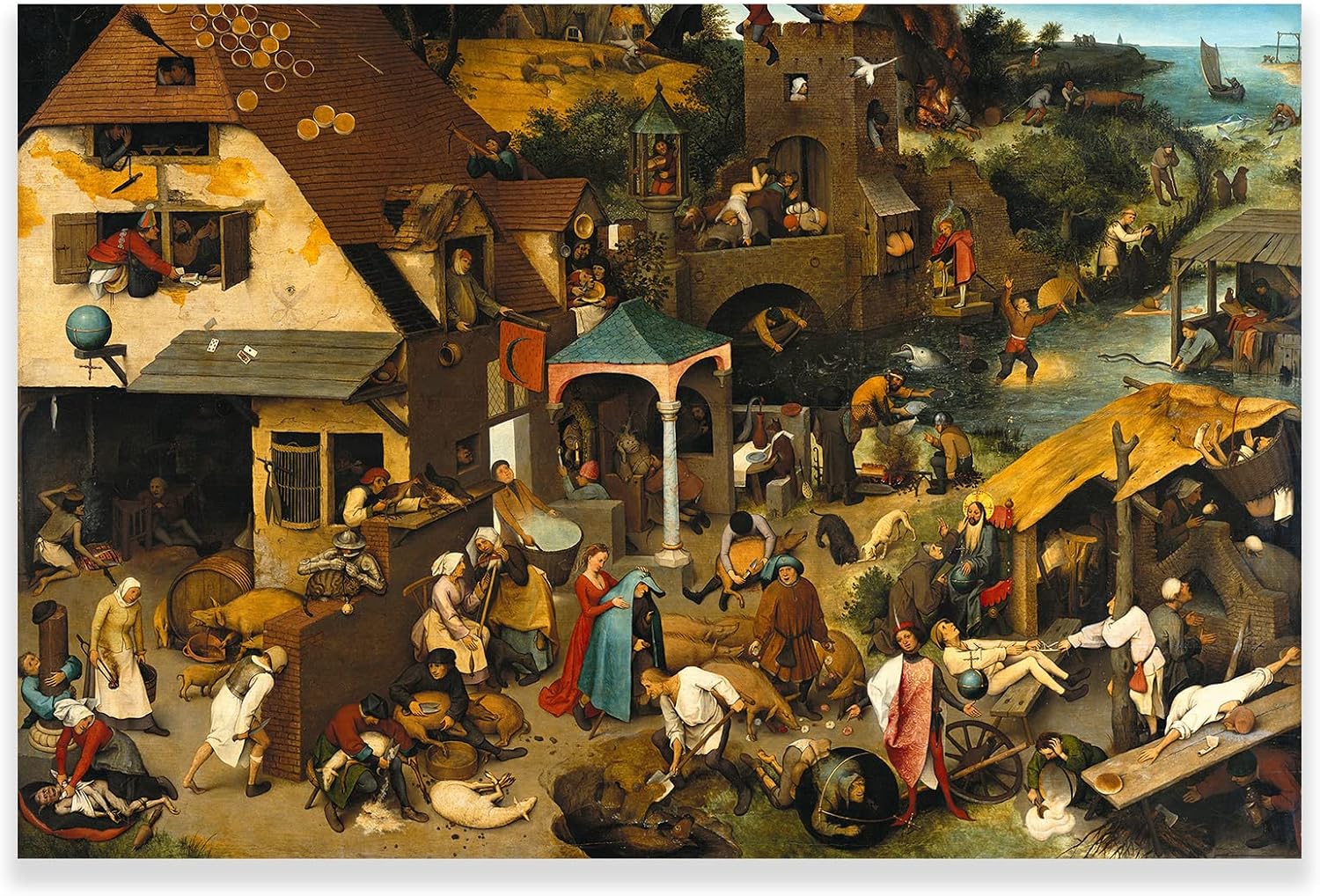
Before A. I. meant “Artificial Intelligence,” it could have stood for something even more amazing: “Artistic Imagination.” This appears when human beings feel a desire to express something important and use their natural creative abilities and skills to bring into being a song, an image, or a story. Sometimes such creations are meant to be divine offerings. Sometimes they are meant for human entertainment or amusement. And sometimes they may be a combination of the two.
I have written before about the famous Flemish painter from the 1550s, Pieter Bruegel the Elder. Recently I came across one of his works that I had never paid attention to: “Flemish Proverbs.” Flemish was the dialect of Dutch spoken in Flanders, the northern region that is now part of Belgium. Bruegel gathered 126 folk sayings about everyday life that were popular in his time and painted a simple illustration of each one, then arranged them in an imaginary village scene. He didn’t share a list of what sayings he was illustrating, leaving it to viewers to try to figure it out. (Perhaps a forerunner of “Where’s Waldo.”) Fortunately, scholars who know the language, culture and history of that time have decoded the images and matched them to the sayings.
Some of those incorporated in the painting are still in popular use: “Swimming against the tide,” “Banging one’s head against a brick wall,” and “Armed to the teeth.” Most have faded away. But I find pleasure in reading the list of sayings and seeing how Bruegel illustrated each one. I’ve chosen ten to share. I’ll introduce each one with an imaginary situation we could be in where the particular proverb might be fun to use.
Let’s say you know someone who planned to get something done, but it’s not working out as they expected. You could say, “That sure didn’t work.” Or you could say, “Well, you know the old Flemish proverb: ‘The herring does not fry here.'”
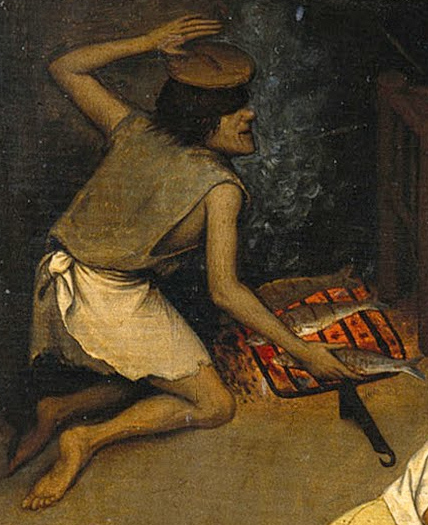
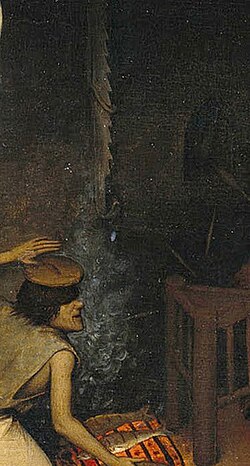
How about when you see someone trying to change a situation and you can tell they don’t have the resources they need? You could say, “You don’t have what it takes.” Or you can pose a question: “What can smoke do to iron?” (Both sayings refer to the same scene with smoke rising from the grill.)
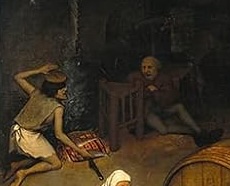
What if you were invited to dinner but arrived late and discovered all the food was gone? “Well,” you could report, “By the time I got there, I found the dog in the pot.” (The dog is hard to see…he’s behind the man on the right…being sneaky, as smart dogs are.)
Maybe you know someone who always wants to talk about the same topic every time you are with them. Instead of telling a mutual friend, “Can’t he talk about anything else?” you could say, “He’s always gnawing on a single bone.”
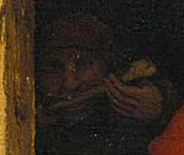
Someone is aging and experiencing a decline in their ability to do everyday tasks. They tell you they can’t imagine why this is happening to them. You could say, “Of course this is what’s happening…you’re getting old! Get used to it!” But that’s a bit harsh. Instead, you could smile, put your hand gently on their shoulder, and say, “An old roof needs lots of patching up.”
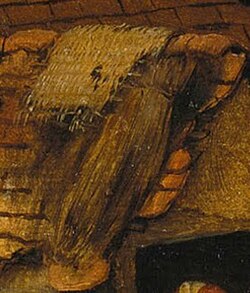
Somebody is experiencing changes in their life which they think no one notices. You might say to them, “Don’t you know we can all see what’s going on?” But a nice way might be to mention the change that is occurring and say, “Well, you know, some things grow out the window.”
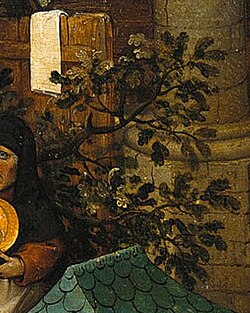
A person is having good things come their way, but you have a friend who resents this person’s good fortune. You could say, “What’s wrong — Are you jealous?” A Flemish option might be, “Are you unable to see the sun shine on the water?”
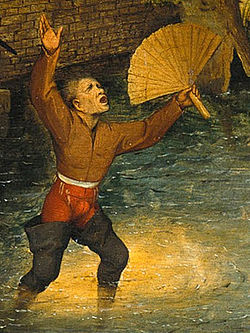
What if you are talking about someone who has taken on a venture or action most people know was very risky, and now that person is having serious problems? You could say, “They should have known better.” But if you’re speaking to someone who doesn’t mind off-color language, you could shake your head and comment, “Well, you know the old saying: ‘He who eats fire, craps sparks.'”
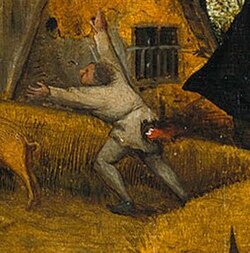
Let’s say someone is excited about something or someone after a first impression, and you are concerned they are going too fast. You want to caution them to be careful. You could say, “Slow down!” Or you could pass on some more colorful words of caution: “Remember, ‘horse droppings are not figs.'”
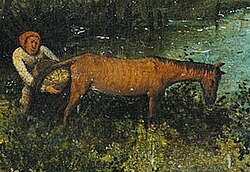
A final example. Perhaps you know someone who delights in sharing personal information about others. You could say, “That person is a real gossip.” But if you’re feeling a bit Flemish, you could phrase it more artfully: “There is someone who likes to blow in the ear.”
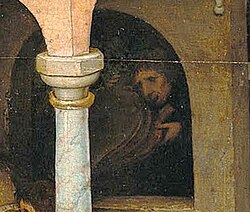
These are ten of 126 sayings that Bruegel heard in his day-to-day life, found amusing, and illustrated. He arranged them all into one large canvas which we are able to appreciate centuries later. We can see ourselves and people we know in what he has given us. We can also savor the entire scene as it portrays everyday life in all its absurdity, creativity, and delight. Not many would call this “religious art.” But if spirituality involves seeing life with reverence, how can we view “Flemish Proverbs” and not have a soft spot for humanity?
Notes: 1) Sometimes this painting is referred to as “Netherlandish Proverbs;” 2) To see an article that gives historic background, an index of all 126 proverbs and where to find each one in the painting, you can go to the Wikipedia site “Netherlandish Proverbs;” 3) To see a high-resolution image of the painting, you can go to Netherlandish Proverbs HIRes

 Steve Jacobsen, Ed.D
