I am continuing to read and reflect on Awe: The New Science of Everyday Wonder and How It Can Transform Your Life, by Dacher Keltner. Like many of us, I seek out and welcome experiences of awe wherever I can find them. But I am only now realizing the different ways in which those moments can arise. This week I had two very different experiences that, thanks to Keltner’s work, add to my understanding.
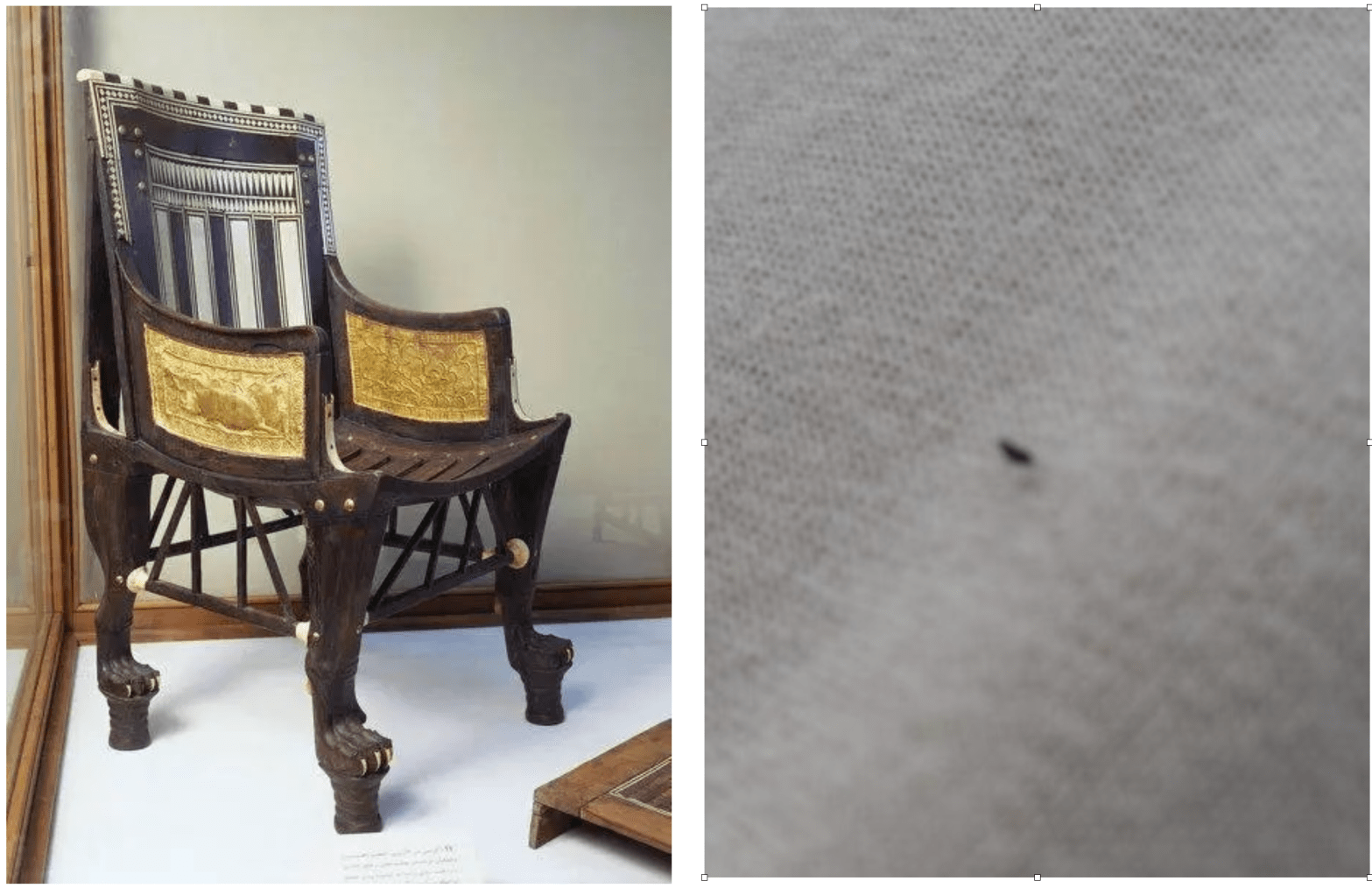
The first was remembering a piece of furniture I saw in 2008 at the “King Tut” traveling exhibit in Los Angeles. I vaguely recall studying Egypt in grammar school; a more vivid association is seeing Steve Martin’s perform “King Tut” (“Born in Arizona, moved to Babylonia… King Tut”). We came into a room which had just one object: in the center, a child’s chair. The description explained that this was the actual chair the 9-year-old Tut sat in when he was first crowned Pharoah. I had to take time to absorb what I was seeing: “This is the exact chair the little guy sat in 1332 BC where he was hailed as a god and Egypt’s ruler? And here I am in Los Angeles in 2008 close enough to touch it?” I tried to fathom how much time had passed between now and then. I tried to imagine what might have been going through the 9-year old’s mind as he sat here for the first time looking at all the people worshipping him. I was in awe.
The next morning, I was sitting in my backyard, waiting for my first cup of coffee to take effect. The sun had just appeared on the horizon and light was coming through our neighbor’s sycamore tree. A few feet away I noticed a single spider web thread waving in the morning air currents; stretching from an oak tree branch to the ground, it must have been 7 feet long. Two feet in front of me was a piece of patio furniture with a vinyl cover. Suddenly a small clump dropped onto it. I wasn’t wearing my glasses — I leaned forward, squinted and wondered “What is that?” A tiny little creature began scurrying away, no bigger than a pencil point. The horizontal rays of the morning sun cast a shadow behind it three times larger than its actual body. Then another little bug emerged from the fallen object and began running in another direction. Then three more. They all took off in opposite directions, hurrying like they were late for work. My best guess was this was a group of just-hatched gnats. I thought about what I was seeing. Until a few moments ago, these little specks of life were all huddled together is a gnat-clump. They all landed like a spaceship on the vinyl cover and now were rushing away from each other to begin their individual lives of adventure. How small their busy brains must be. How fast their mini-hearts must be beating. How strong is their will. I was in awe.
In Keltner’s research, beholding King Tut’s childhood chair in a museum is an example of cultural awe. Being mesmerized by a group of newborn gnats rushing off to start their lives is an example of awe found in nature.
Keltner believes we can find awe in many places. They don’t have to be dramatic events, but can be simple experiences in the midst of our daily life. What such experiences have in common is the emergence of a particular emotion in the face of mysteries we don’t understand. That emotion liberates us from the constant absorption in ourselves and opens us to the fascinating world around us, which becomes a gateway to humility and gratitude. Remembering that decorated little chair and those determined little bugs helped me see my own life in a new perspective. That always feels like a gift.
Lead Image: King Tut’s chair and a solo gnat
This is my third post responding to Keltner’s work. The first was “Rising Above the Phone-Based Culture” (https://drjsb.com/2025/03/01/rising-above-the-phone-based-culture/ and the second was “A Voice in My Mind Said I Feel Awe” (https://drjsb.com/2025/03/29/a-voice-in-my-mind-said-i-feel-awe/


I would have said that I hated gnats, especially a clump of them dispersing. But now I’m not so sure! I am enjoying your interest in awe, it is a noble pursuit!
LikeLike
Thanks for this Steve. I’m interested, and agree that something important happens within us when we stop and pay close attention…to almost anything. On our next walk I will regale you with the some of the Biblical sources for the word yirah, which is the Hebrew word usually translated as “awe.” It is deeply connected with fear…..which raises some interesting questions! My teacher Richard Levy taught that awe is what we feel standing at the edge of the Grand Canyon. We are standing in the presence of something magnificent and beautiful, and it will kill us if we make the wrong move.
LikeLike
Dear Steve,
Thank you for this. Love what your teacher taught. Look forward to our next walk!
Steve J
LikeLike