
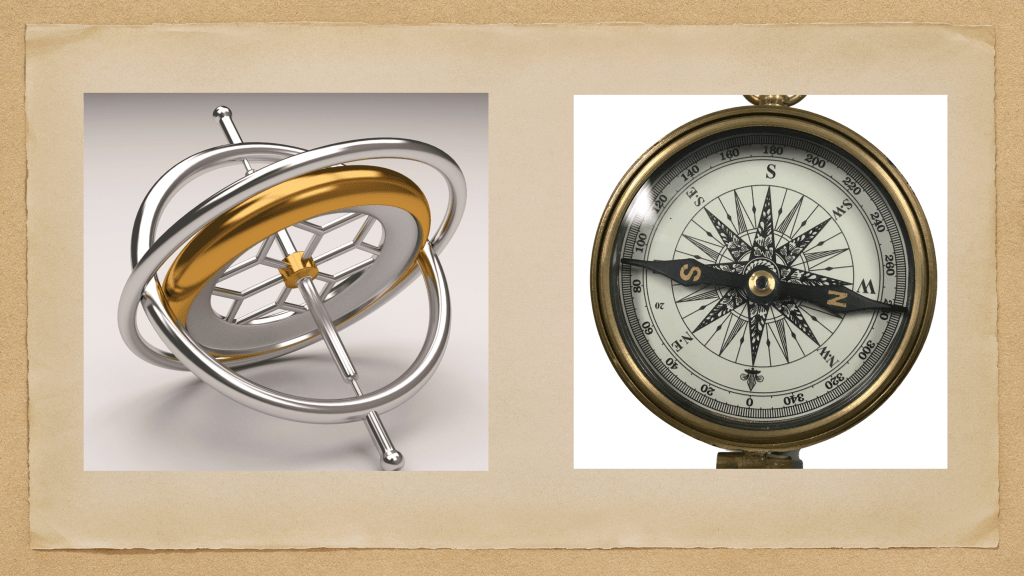
I follow different weekly columnists looking for useful insights. I recently saw a comment by Peggy Noonan giving advice to fellow commentators as we face what might be a chaotic year: “Keep your tools, compass and gyroscope, clean, dry and level.”[i]
I liked this statement. The metaphors weren’t new, but I appreciated putting them together: “Keeping your…compass and gyroscope, clean, dry and level.”
I take our personal gyroscope to be what keeps us balanced when our life gets topsy-turvy – what keeps us in touch with our deepest values and best thinking.
A compass helps locate where we are at any one moment. It gives us trustworthy information with which we can decide on the best direction to go.
It is common for us to start our day, our year and any new chapter in our life with certain assumptions about what’s going to happen and how we will respond. Sometimes things unfold like we expect. But often unforeseen events happen – events that we did not see coming — and we can feel like we’ve been knocked off balance and are lost. Time to check our navigational instruments.
I have previously written about a scene from the movie Lincoln. [ii] In the winter of 1865, Lincoln wants to have Congress pass the 13th amendment (abolishing slavery) before the Civil War ends. He needs the support of Thaddeus Stevens, an abolitionist who wants an amendment that goes beyond just the abolition of slavery to declare the total equality of the races. Lincoln and Stevens have the same inner conviction that equality is the ultimate goal – they share a similar gyroscope. But Lincoln knows Steven’s amendment won’t pass. Lincoln grew up on the frontier and has been in wilderness. He says, “The compass points you true north but does not warn you of obstacles and swamps along the way.” Where we want to end up may be clear but the way to get there may not be; we must forge ahead as best we can. Stevens reluctantly agrees to compromise and with his support the amendment passes.
I’ve performed many weddings in my ministry. Early on, I wanted couples to have a good experience in premarital counseling, but knew I was not equipped to provide it. I found marriage and family counselors whom I trusted and arranged with them to see couples for three sessions. I would tell the couples that an added benefit would be becoming familiar with someone in town they could always go back to for support and advice as time went on – people who could help them get in touch with their “compass and gyroscope” when needed.
One topic I did personally discussed with couples was the vows. Sometimes people wanted to write their own vows, which I could support. But I would also have them consider the traditional vows:
I, ____, take you, ____, to be my lawfully wedded (husband/wife), to have and to hold, from this day forward, for better, for worse, for richer, for poorer, in sickness and in health, until death do us part.
I would tell them to consider the three couplets: “for better/for worse, for richer/for poorer, in sickness/in health.” When events in life are going for the “better,” if we are feeling “richer,” and if we are in good health, loving another person is easy. But consider what might happen when life events are becoming “worse.” Or circumstances mean you are getting “poorer.” Or one person becomes seriously ill. These vows mean that you will not turn away in hard times but promise to dig in and deepen your commitment. “Hollywood movies show how wonderful falling in love is,” I would say, “but over the years I’ve learned to look at the couples who hang together in hard times. They develop a love deeper than just emotions – they create a bond that is lasting and profound.”
I would add that spiritual beliefs and practices become particularly valuable in disorienting times. There is wisdom beyond just ourselves that can be found in prayer and contemplation, in timeless teachings about what makes life worth living, and what our ultimate purpose can be. Calling on these resources is turning to our spiritual gyroscope. Then we can check our compass to see if we are headed in the best direction and not get stuck in an egocentric wilderness.
Sometimes we need to find an environment which helps us tune in to our gyroscope and compass. For three decades, I was involved at the La Casa de Maria Retreat Center as a board member and director. Individuals and groups would come for a day or several days for retreats. There were no televisions or newspapers, and we enjoyed limited cell phone service. People were free to wander our 26-acre oak forest, orchard and spiritual gardens. They could enjoy good food, leisure time and opportunities for meaningful contemplation and conversation. This was our mission statement:
The mission of La Casa de Maria
is to be a sanctuary of peace
Where groups and individuals
Can renew their purpose
Strengthen their community
And increase their effectiveness in the world.
La Casa was a place where 12,000 people every year people could tune into their gyroscopes and compasses. It was inspiring to see what a difference the right environment could make and what it means for people to find a direction in life they know to be right.
In the days to come, may we each make good use of our gyroscopes and compasses.
[i] https://www.wsj.com/opinion/what-is-your-attitude-toward-trump-2-0-f3f8532c
[ii] “Faith and Sight,” Dec 9, 2023, https://wordpress.com/post/drjsb.com/2925
Lead image: La Casa de Maria, givinglistsantabarbara.com;


Ah, yes. We need places like La Casa to stabilize our gyroscopes.
LikeLike