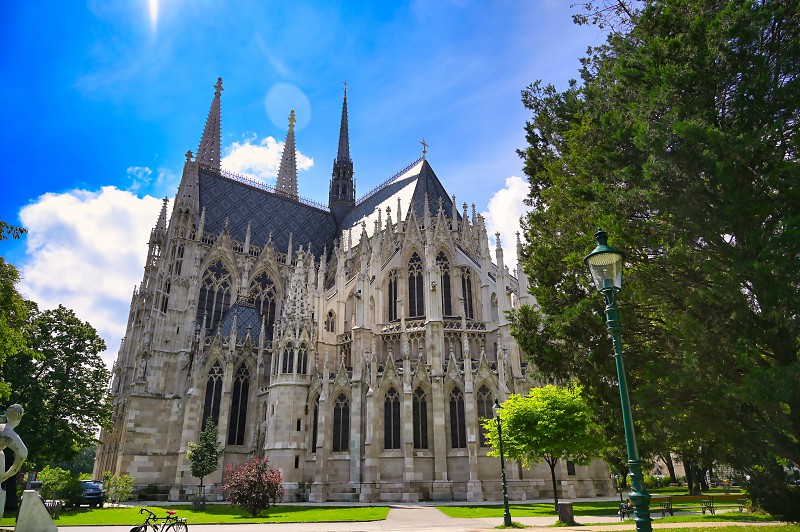
On our last day in Vienna this past September, we decided to visit an impressive sight we had been passing every day: the Votivkirche, or ”Votive Church.”[i] Seeing its tall spires and ornate towers, I assumed it was an ancient Gothic cathedral. Upon entering, we discovered it is less than 150 years old — a “neo-Gothic” structure completed in 1879. The building is 325 feet high (second highest peak in the city) and features 78 stained glass windows; when you enter, it feels vast, mysterious and intriguing.

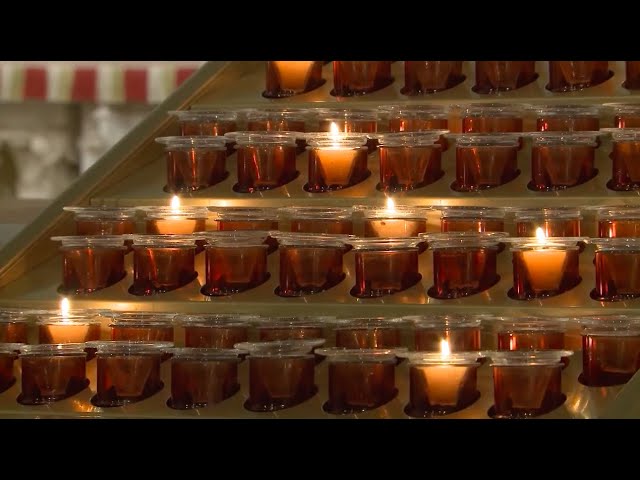
As we explored the interior, I noticed a small plaque on a stone pillar above a votive candle rack. No one else was nearby and only a few candles had been lit. The words were in German, Italian and English. Here is the English version:
God, there is a candle in front of me.
It burns restlessly, sometimes with a small flame, sometimes with a large flame.
God, I too am often restless.
May I become calm in you.
The candle gives me light and warmth.
God, may I also become a light for the world.
A simple prayer focusing on a single candle.
As we wandered and read more about the history of the building, we learned it was built as an expression of gratitude after the Austrian Emperor Franz Joseph survived an assassination attempt. It was expected to be a place where Austrian monarchs would be buried for generations to come. But history happened.
World War 1 began in 1914. The building was damaged, and the military was permitted to melt down parts of the organ and bells for the war effort. The war also led to the collapse of the monarchy. In the 1930s, the Nazis took control of the city and renamed the square outside the church Göring Square after the Nazi General. Following World War 2, the square was renamed Roosevelt Square after FDR. The building was restored in the 1970s.
A recent addition is the Multhausen stained glass window, designed and installed to commemorate the 90,000 who died in the Multhausen Concentration Camp. The window portrays prisoners helping each other up a stairway, supporting each other in their suffering; Christ is leading them at the top of the stairs.
Amid dramatic change and tragedy, the cathedral has been a sanctuary where anyone can enter, light a small candle, reflect, and pray.
I’ve been thinking how the life of a candle is like the life we live:
- Both have a beginning and an end.
- Both are vulnerable to being extinguished.
- Neither needs to understand how it exists in order to exist.
- Neither lights itself. A flame is given to it, which it bears as long as it can.
- Both experience the world from its own point of view, and both affect the world around it.
The winter season is a time when we become more aware of light.
Christian communities observe Advent using a wreath with four candies in a circle and a single candle in the center. On each Sunday before Christmas, one of the outer candles is lit. On Christmas, the Christ candle at the center is lit.
Jewish communities celebrate Hannukah using a menorah of nine candles; the one at the center is always burning. Night after night, that flame is used to light one more of the other eight until all are glowing.
Both rituals assume there is a central flame. Both invite us to behold each candle as it is lit. In both, individuals become a community with the divine light at the center. Both affirm light can endure darkness.
I am paying more attention to candles this season, curious about what they can teach me. I know there are many candles burning. I know there are many people wondering. And here I am. This candle is me, burning as best I can, grateful to bear light as long as I can.
God, there is a candle in front of me.
It burns restlessly, sometimes with a small flame, sometimes with a large flame.
God, I too am often restless.
May I become calm in you.
The candle gives me light and warmth.
God, may I also become a light for the world.
[i] Votive: (adjective): consisting of or expressing a vow, wish, or desire.

 Steve Jacobsen, Ed.D
beautiful Steve. I will use this for Hannukah this year!
LikeLike
I am honored, my friend.
LikeLike