
Earlier this week, I was up early and sitting quietly in my backyard. I’d been asked to speak for a group on spirituality and “wilderness,” and was mentally reviewing what I was planning to say. Then, ten feet away, a leaf from our Eastern Redbud tree floated to the ground. It looked like this:

I had noticed this tree had been shedding its foliage, but I don’t remember being present to witness one leaf actually making the transition.
My life isn’t as busy as it used to be, and I’m grateful I have more time to just observe events like this.
As I thought about this moment, I remembered times when people found meaning in fallen leaves.
In my time at Hospice of Santa Barbara, we had an extensive program dedicated to children and families following the death of a parent. I asked one of the counselors what she did with young ones. In addition to drawing pictures, stories and conversation, a common activity was to go outdoors and observe the natural world. – noticing things that were alive and those were alive no longer. Then they’d bring their treasures back to the room and talk about the fact that all things that live someday will die.
At Hospice we had quarterly art shows. We choose the work not solely on artistic merit, but primarily on the meaning of what the artist was focusing on and how that related to our mission; common themes were healing, transformation, and personal insights.
One of our presenters was a local artist name Jan Clouse with a show called “Fallen Beauty.” Here’s a description:
Clouse’s artwork honors the beauty that comes from aging and the natural cycle of loss. By focusing on leaves, twigs, branches and other bits of vegetation that have been shed or fallen to the ground, she concentrates on life cycles present in nature to draw connections to the regenerative cycle of life.
“While most botanical artists capture the beauties of living blooms, I concentrate on detritus, such as pods, seeds and leaves starting to lose living color and taking on a broad range of subtler shades,” said Clouse.
Clouse’s drawing helped her come to terms with the loss of her mother. After her mother’s death, Clouse found a spiritual connection to her mother through her artwork, as it made her focus on the larger picture of life. While visiting her mother, father and grandparents’ graves, Clouse gathered some oak leaves and other bits of vegetation that had fallen nearby. She began to paint these leaves, and found the experience to be meditative while she came to terms with the loss of her loved ones.*
I am grateful that I am still in relatively good health and hope to be part of the Tree of Life for some years to come. But the older I get, the more I realize what I have strived to accomplish in my life is becoming less and less visible to me or anyone else. But I also understand that doesn’t diminish the value of our labors. I like to think of our lives as having the honor of gradually becoming compost; the fruits of our labor still give us meaning, but it’s more and more about what we have contributed to the life that’s coming after us.
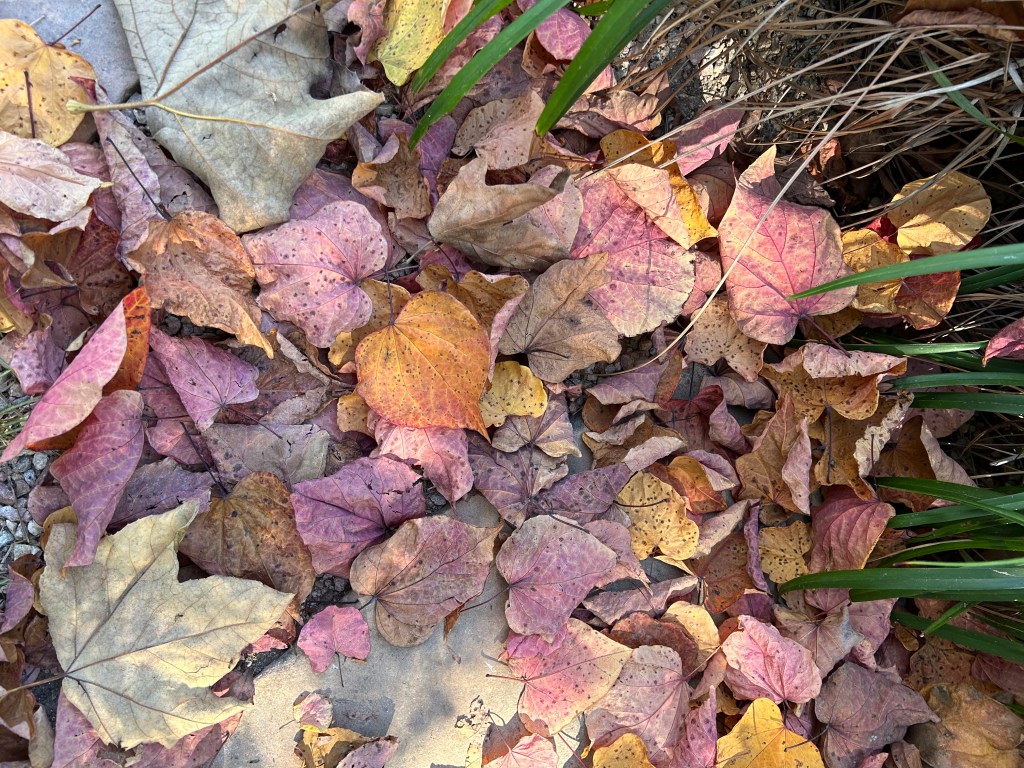
My leaf reunited with its companions.
*Press release: https://www.independent.com/2011/01/21/jan-clouse-featured-artist-hospice-santa-barbara/
Lead image: “Buckeye,” Jan Clouse


“The honor of becoming compost”—yes indeed. What a beautiful and counter-cultural perspective.
LikeLike
beautiful Steve. I also love the idea of becoming compost, and Jan Clouse’s comment about concentrating detritus, and especially the final photo of your leaf reunited with its companions. Reminds me of the biblical phrase “gathered unto his people.”
LikeLike
Thank you. Thank you. Grateful to share our epiphanies
LikeLike