
I remember Huston Smith describing his first meeting with the Dalai Lama in Tibet. In 1964 the Dalai Lama was in his twenties and not well-known. Huston was a young scholar in India studying Buddhism and had been told he should meet this new spiritual leader. After they greeted each other and he agreed to be interviewed, the Dalai Lama turned to escort Huston to the next room; Huston overheard the Dalai Lama say softly to himself, “This may be important. I need to be attentive.”
Fifty-six years later, I was spending five days with Huston Smith and two dozen others at the Esalen Retreat Center in Big Sur. I’d followed his writings for many years and heard him speak in Santa Barbara several times. He’d grown up in China where his parents were Methodist missionaries; the essence of what they taught him was “Be thankful for what you have and bear one another’s burdens.” He grew up speaking English and Mandarin and delighted in Chinese folk culture. He came to the U.S. for college and then spent his life traveling the world learning all he could about the great spiritual traditions. He summarized what he’d learned by writing The World’s Religions, which has sold over 3 million copies.
Huston was not only a learned man but also a humble pilgrim; he wasn’t just smart, he was wise. When he spoke, his face would often break into a wide smile and a bright light shined from his eyes. The chance to be with him for five days of conversation was a dream come true. My notebook is filled with things he said I wanted to remember. This week one phrase came to me: “Mind Proposes, Soul Disposes.”
I take this to describe an experience we all are familiar with. A thought arises within our mental awareness that seems like a suggestion or an impression. It can appear like words on our inner screen or maybe our personal voice speaking to us from within. This is the “mind proposing.” What do we do with this “proposal?” A different kind of awareness comes into play as we consider the suggestion. We ask ourselves: “Is this the way I want to feel?” “Is this suggestion something I really want to do?” “Is this a path I want to follow?” As we decide, it is the “Soul Disposing” – our inner, “Higher self” coming into play, indicating a possible direction like a compass. Then it’s up to us to decide if we go that way or not.
Much of our daily life can be spent without the “soul disposing.” An idea occurs to us, and we act on it without much thought: “Time to get up.” “I’m going to make some coffee.” “I’m going to get the mail.” Such actions don’t require a great deal of careful reflection. But sometimes there are important crossroads we come to when our mind is proposing an action or direction, and we recognize we need to “think about it.” To put it another way, we need our “soul” to help us – we want to make a good choice, the “right” choice. Our soul draws on our deepest values and aspirations. I think this is what the Dalai Lama was reminding himself to do before he sat down for the interview: “I need to be attentive.”
The psychologist and holocaust survivor Victor Frankl famously said it this way: “Between stimulus and response there is a space. In that space is our power to choose our response. In our response lies our growth and our freedom.”
For some of us, this is where spirituality comes into play.
I’ve been reflecting on what “spirituality” means for a long time. One way to define it is a personal sense that there is something greater than us in this world. On the one hand, this humbles us. On the other hand, this inspires us. The great traditions tell us stories that can amaze us with their insight. They teach us to see our life as a divine gift and to embrace the call to serve others. They give us practices to develop and stay in touch with our “souls” – through worship, prayer, music, study, community, time in nature, and acts of service. When we reach moments when our “mind” has “proposed” an important action, we can call on what we’ve learned to “dispose” of the options, helping us recognize which one we want to pursue.
Three weeks ago, a friend called to tell me a wise mentor and treasured friend to both of us had suffered a stroke and was in the ICU. He was 92. When I visited the next day, we had a brief but meaningful conversation. I had recently written him a letter, telling him how much he had meant to me at different times in my career; now I was grateful I had not waited to do that. He knew how much he meant to me.
I asked him if he’d like me to pray with him, and he said yes. Over the years, I’ve learned to ask people what they want me to pray for, rather than assume I know. I asked. He said, “Acceptance.” We prayed for that. I visited him two days later and he died the next day.
Looking back, I realize he always listened to others carefully. And when he spoke, you sensed it was his soul calmly speaking to you, often with a smile.
“Mind Proposes, Soul disposes.”
“This may be important. I need to be attentive.”
“Between stimulus and response there is a space. In that space is our power to choose our response. In our response lies our growth and our freedom.
Our Soul often wants to speak. It’s up to us to take the time to listen.
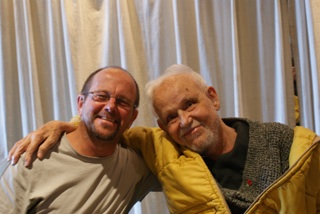
Huston Smith and me, Esalen, 2010; he was 91 at time.
He lived six more years.

 Steve Jacobsen, Ed.D
Steve – I found this reflection particularly helpful. Thanks. Diana Deacon
LikeLike
Great to hear from you, Diana. I’m honored you’re reading them.
LikeLike
Steve
I love this. I never heard this expressed so clearly. I love the photo of Huston with Dalai and then of Huston and you. Both photos capture open hearted open minded people. I just forwarded this to a group of my friends.
Love you brother. KJ
Kristen Jacobsen Mobile 831-818-6573
“It takes courage to be curious”
Sent from my magic IPad
>
LikeLike
I am honored!
LikeLike
Steve, thank you.
LikeLike
Steve, another inspiring piece, thank you. I just ordered Huston Smith’s book and look forward to continue learning!
LikeLike
It’s a great book because it is so readable. Let me know what you think.
LikeLike
There is a lot of good stuff packed in this! Thanks for sharing it. I love the idea of leaving time between stimulus and response to listen to what our soul may have to offer.
LikeLike
Thank you, Brad. I look forward to your next location.
LikeLike
Thank you, Steve.
Cragg
LikeLike
Thank you, dear friend.
LikeLike
Yes Steve. Such wisdom here I like the Frankl quote.Hes right:there’s a space in which we can choose
LikeLiked by 1 person