Sunlight Finds the Opals

LODE

Even underground, sunlight

finds the opals and fills them.

So much beauty embedded

in cavern walls, needing no one

to find it, no human eye to see,

waiting in perfect patience,

in due time, to be revealed.    MCM

The painting is by John McEntyre and the poem by his wife, Marilyn.  John and Marilyn have been friends and colleagues for many years. Marilyn led several online writing classes during COVID which helped me change my writing process — she discourages using an outline or having an endpoint in mind when beginning, and instead “write into the unknown.” 

As I’ve followed this advice, I’ve found myself coming to surprising perspectives.  I don’t know if the insight is there before I start seeking it, or it is formed as the search progresses. But there is “sunlight” “embedded” in us, and often we need patience, curiosity, and courage to find it.  Maybe it’s through painting or writing.  Maybe it’s on a long walk or during an extended conversation with a trusted friend.  Or maybe it’s letting a sacred text or piece of music open our hearts and imagination to something new. 

I’ve seen many people walk through times of darkness and find such light.

I worked at Hospice of Santa Barbara for 5 ½ years. When I told people where I worked, it was common for them to say, “Oh, that must be depressing.” But I would say it was not. Seeing people work through their grief to find some authentic resolution and a way forward was inspiring.  One 15-year-old said: “Death is like a broken heart.  It hurts and is sad but you get through it.  Your heart is twice as strong.”

Solstice and the sacred stories of the season remind us that there are endless points of light waiting to be revealed in “due time.”  As we face periods of uncertainty, may we trust that the light is there, safely residing in “cavern walls,” “waiting in perfect patience, in due time, to be revealed.”

John’s painting and Marilyn’s poem are used by permission. More information about Marilyn, her publications, her classes, and retreats can be found at https://www.marilynmcentyre.com; John’s work can be seen at https://mcentyreart.com.

Ever Experience the Same Thing Twice?

         In my inbox every morning is “The Writer’s Almanac,” which describes significant events in cultural history. A recent article noted it was the birthday of Claude Monet:

He and his friend Auguste Renoir were among the first European painters to take their canvases outside to paint directly from nature. They would often work as quickly as they could, so that their paintings looked like sketches, and that sketchy style became known as Impressionism. Monet spent the rest of his career exploring the idea that you can never really see the same thing twice. In a single day, he would often paint the same subject half a dozen times, from slightly different angles and in slightly different light, spending no more than about an hour on each canvas. In the last 30 years of his life, he painted almost nothing but the water lilies in his garden at Giverny. Monet bought the four-acre property in 1883, built the bridges, dug the lake, and selected all the flowers and plants himself.

It seems he painted 250 scenes in his garden as a way of “exploring the idea that you can never really see the same thing twice.”

Can we ever experience the same thing twice?

We have grandkids that are 7, 5, and 1, and feel blessed to watch them grow and develop.  This week the one-year-old made the evolutionary leap from being a four-legged mammal to two, ending with a smile confirming she knew that she had just taken a “big step.”  In one sense she’s the same wee person she was the week before – but she’s not exactly the same.

A golf teacher once made the point that your body and mind are always changing, and every time you play, you’ll need to adjust to who you have become.

A yoga teacher said that every day we begin our practice, something in our body has shifted. We may be a bit less flexible or a bit more – it’s hard to predict — but it is something we should expect. 

And what tennis, soccer, or baseball player can completely control time after time where the ball will go?

Modern science tells us there is no such thing as solid, unchanging matter — it’s all energy in varying states and forms.

Every day, countless cells in our body are dying and others are being created; biologically we “are not the person we used to be.” (As we get older, looking in the mirror becomes vivid proof).

So maybe this was what fascinated Monet as he created this “Impression” of the lily pond in his garden…

Nymphea, 1905

…and then sometime later he captured the same pond in a different light:

Nymphea, 1905

On the one hand, it’s exciting to think “you can never really see the same thing twice.”

But on the other hand, it can be a bit unsettling.  It makes me feel like I’m being carried away on a river when I’d prefer to have my feet planted on solid ground, at least occasionally.  Where do we find stability?

This is a central question for many spiritual traditions.

Hinduism assumes we all have an “atman” within us, an essence that is rooted in the divine; it’s like a “witness” within ourselves, observing our life as it ebbs and flows and will be the awareness that continues beyond death.  Buddhism disputes that, at least in the most simplistic form.  Western traditions have often spoken of each person having a “soul.”

There’s a beautiful old English hymn that used to be common at memorial services: “Abide with Me, Fast Falls the Eventide.” The English philosopher Alfred North Whitehead once said these words sum up the universal longing of humanity: “Fast falls the eventide” acknowledges that all life is passing, while “Abide with me” is a plea that our connection with the divine will be a constant.

Two stories from my hospice work come to mind.

Serenity House is a beautiful residential hospice here in Santa Barbara. I knew the Executive Director of the organization as it was being designed and built, and she shared with me some of her hopes during that time.  One key theme was integration with nature: every room has a porch where the patient can enjoy the landscaping as well as a view of the city and the nearby mountain range.  Sometime after it opened, she told me that one patient had asked the gardener to not remove the fallen leaves on her porch but let them remain where they had landed.  The patient said looking at the fallen leaves gave her comfort.  

A friend of mine is a longtime volunteer at Serenity House. He has often been with patients as they are dying, and it is common for them to begin to sense there is something “on the other side.”  Never – not once – has he seen people in those moments experiencing fear.  

“We are born in mystery, we live in mystery, and we die in mystery,” Huston Smith said.  Maybe our whole life is just a series of “impressions” as we try to capture important moments in the changing light. What a gift to be doing so.  And what amazing colors the light reveals.

Top Image: Nymphea, 1903

Water Lilly Pond, 1917-1920

Is Life All About Our “Highlight Reels?”

            I sometimes find myself wondering if life is all about creating memorable “highlight reels.”

            Highlight reels are excerpts from sporting events that capture dramatic and decisive moments.  You don’t have to watch the entire World Cup soccer game to find out it ends in a scoreless tie – you just watch a few minutes of compelling footage that an editor has decided will hold your attention.  You don’t have to sit in the stands at a baseball game for 3 ½ hours as it painstakingly unfolds – you just see 5 minutes that include the diving catch, the dramatic home run, and the last guy striking out.  The folks who put the highlight reels together know how the game turned out, so they can create just the right script and a satisfying finish.  The scenes include commentary by a skilled announcer and maybe even a dramatic soundtrack.  Highlight reels can be much more engaging than the actual experience.

            In this digital age, we can make our own “highlight reels” using our smartphone cameras. We can capture stunning sunsets, joyous birthday cake moments, and two friends smiling at the foot of a majestic waterfall — significant moments of inspiration, celebration, and affection.  That’s what we want to remember. Who wants to watch real-time video of the drudgery we felt at work before we got home to see the sunset, the housework we had to do to get ready for the party, or the long hike that got us to the waterfall?

            And in recent years, it’s common for memorial services to include a slideshow of the person’s life, tracing it through the decades with carefully chosen images.  It’s always moving to feel like we are seeing pictures that each tell us a thousand words about someone’s life, especially when we know their life is complete.

            So I sometimes wonder: maybe it’s only life’s highlights that are worth living for.

            But then I consider the oak tree in our backyard.

            The oak tree in our backyard (as seen in the above photo) is a “volunteer,” meaning it came up out of the ground unexpectedly.  I remember first seeing the 18” sprout while doing yard work; I had a pair of pruning loppers, assumed it was unwanted, and was ready to snip it into oblivion.  But my wife saw me and said, “Don’t cut it! That’s a volunteer oak. Leave it alone. Let’s see how it grows.”

            Years later it’s a magnificent living presence.  Our landscape designer is in awe of its structure and vitality. He told me the tap root can go 100’ feet into the earth, and that a wealthy person would pay $50,000 for a tree that looks like this one.

            I find myself gazing at this tree and thinking how undramatic it is, how silent, how steady, how patient.  It’s alive. It grows. It simultaneously knows how to send roots into the earth seeking water while sending branches into the sky seeking light, all the while breathing in carbon dioxide, breathing out oxygen, and manufacturing acorns to provide for future generations.

If I was to make a “highlight reel” of the oak tree, what images would I use? It does all its labor undercover.  Meanwhile, I rush through my days hoping to do something that will qualify for my personal highlight reel. 

            Trees are prominent in spiritual traditions.  The “Oaks of Mamre” is a place of divine encounters for Abraham.[i]  Though they have never met before, Jesus tells Nathaniel he already knows him because “I saw you under the fig tree.”[ii] And, according to one tradition, Buddha sits for 49 days under the Bodhi tree, stands to thank it for its shade – and in that moment receives enlightenment.[iii]

Trees are a common source of shelter and safety, and therefore an ideal place for contemplation.  But maybe there’s more to it than just protection from the sun. Maybe being in the presence of such creations subtly reminds us that life is more than just clips that qualify for a highlight reel.  Maybe they instead teach us what it is like to be quietly immersed, moment-by-moment, in the miracle of life.


[i] Genesis 18:1

[ii] John 1:48

[iii] https://buddhists.org/the-bodhi-tree/

Empathy Means I Don’t Know How You Feel

             “Empathy is not ‘I know how you feel,’ but ‘I don’t know how you feel.’

I recently came across this quote in notes I’d kept from a retreat I attended some years ago. It was credited to Rowan Williams, Archbishop of Canterbury. 

            If we care for people, we want to know how they are feeling.  Making the effort to do so is a genuine act of compassion.  Sometimes we make the connection easily.  But sometimes our assumptions about what another person is feeling can lead us astray.  

            I remember an older woman I visited after she began attending our services. She always dressed more formally than was the norm in California and was always very gracious. When I came to her apartment, she invited me to have a seat in her living room. I noticed the many shelves which were carefully arranged with shiny porcelain figurines and elegant China dishes. It all suggested to me she’d probably led a proper and sheltered life.  I asked her to tell me about herself. She talked briefly about her life before coming to Santa Barbara.  Then she calmly described how her husband had recently died after ten years of dementia. She said for the first five years, she had cared for him by herself in the apartment, needing to be more and more vigilant as his condition deteriorated.  When she could no longer keep him safely, she transferred him to a facility and visited him every day for five years until he died. I was stunned.  Where do people find the strength for such devotion?  

            I once went on a mission trip with teenagers in Mexico.  We’d build homes during the day and return to the campground at night.  I had unconsciously brought with me an assumption – shared with many fellow parents of the time – that teens were becoming so obsessed with digital devices that they must be losing their ability to make genuine connections with others.  But as I sat with them at night around the fire and they talked about their lives, I realized I had misjudged them; they were much better listeners than many adults. 

            I got to know a woman in her 30s who’d been wheelchair-bound her whole life. Once she said something that made me think of Christopher Reeves, the Superman actor who had become paralyzed after a horse-riding accident. “He must be an inspiration,” I said.

            “Not really,” she said. “He’s rich and famous and can pay for 24-hour care and do what he wants. But most of us don’t have his resources. We experience a lot of loneliness and depression.  But no one wants to hear that. People like him because he’s always positive. If he’s feeling down, he can’t talk about it, or he won’t be popular.” 

How little we know about the inner life of others.

            When I began my work at Hospice of Santa Barbara, I attended a workshop focused on caring for families in which the death of a child or parent had occurred.  The speaker had worked for twenty years in hospitals dealing with such situations.  I was hoping for some handy guidelines for such situations. I was surprised when he said what he does before he walks into a room to meet a family: “I get in touch with my helplessness.” That confused me at first.  But the more I thought about it, the more I realized this is a way to set aside that anxious, earnest, “I-want-to -fix-it” impulse within us to become truly open to whatever is present.

            And I remember being at a conference where a prominent nursing educator from the City of Hope was speaking about how easy it is to misjudge people. She said she had once led a support group for women who were dealing with breast cancer.  Each person in the circle was taking a turn describing what emotions they were experiencing.  All the women in the group talked openly about how hard it was, and many shed tears.  One woman, however, seemed unmoved and opted not to share.  The speaker confessed thinking, “This woman is probably repressing her feelings; I’ll speak to her after the session.”  After the session was concluded and the others left, she approached the woman, who agreed to sit down and talk. The leader shared her concern that the woman was perhaps not being forthright and encouraged her to share.  The woman told her what she’d experienced in the last three years. First, her family had lost their home in Hurricane Katrina and couldn’t go back. Then a daughter died. Then she’d lost her husband. “This?” she said, motioning towards her body, “This is just breast cancer.”

            We never can assume we know what someone else is really feeling, or what it’s like to be “in their skin.”

            A seminary teacher once made a reference to a painting that was probably in every Sunday School building in America: “Jesus Blesses The Little Children.”  It’s very simple: Jesus is just sitting in the midst of a group of boys and girls. “You know,” the professor said, “People always assume that he is teaching them something. But maybe he’s just listening.”

Image: Portrait of a Peasant – Patience Escalier, Vincent van Gogh

Our Evolutionary Inheritance: Work, Sleep, and Campfire Wisdom

            Several years ago, I read about an African hunting/gathering community that had virtually no prior contact with “civilization.[i]” For two years an anthropologist recorded daily conversations, coded them, and analyzed them.  Some key findings:

  • Almost all the daytime conversations involved work, with approximately 37% consisting of people complaining others weren’t doing their fair share.
  • Tribal elders did not have much to say or contribute during the day. 
  • At night, everyone gathered around the fire. The focus changed from work to spiritual topics, tribal history, and “subtle psychological insights.”  Elders became central to these conversations. The conversations could last for hours, and the old ones might nod off.  But after a rest, they would often rejoin the circle.

At the time I read the article, I was leading a nonprofit with 30 employees, and these themes resonated with what I was experiencing: 

  • The hardest part of the job was dealing with “HR Issues” – people’s work performance and how people would fret about the performance of others (probably close to 37%).
  • Younger employees often had more energy and could work longer. They also had more skill and less anxiety dealing with IT issues and were invaluable for pointing out cultural changes that were occurring and how we might adapt.
  • While everyone might have insights into our work, it was the older ones who held the “tribal memory” of both the organization and the profession and were particularly helpful in offering long-range perspective.

Later I saw an article about how our evolutionary past might explain the way memory changes over time.[ii]  As we know, older people begin having difficulty with short-term memory (“Where are my glasses?” “What’s my password?”)  But even seniors with dementia can have remarkable recall of past events. When our ancestors were hunting or gathering during the day to survive, they had to rely on mental alertness and physical abilities. But as they became slow, creaky, and sore, their value to the community shifted – they were the ones who carried the valuable stories; short-term memory was less important.

Maybe evolution also explains our sleep patterns. During COVID, I read Why We Sleep[iii]. The author notes that some adults go to bed early and wake up early while a roughly equal number of people go to bed late and sleep late.  He theorizes this may be an inheritance from our past: it would be advantageous to have people awake at different times of the night to act as sentries for the tribe.  So maybe this is one reason older folks wake up more often at odd hours — they’re wired for sentry duty.  (Of course, the seriousness of the danger has changed; instead of “Is that a lion I hear in the forest”? it might be, “Does the dog need to go out?”)

These ideas comfort me.  I like to think some of the changes we experience as we age aren’t because there’s “something wrong” with us, but because of deeply engrained behaviors that were advantageous for our ancestors.

I’ve always been fascinated by how Rembrandt was able to document his aging process.  He portrayed himself close to 100 times, 40 of which are complete paintings.  Here is one from 1632:

This 26-year-old guy is on top of his game – no doubt staying up late, full of energy and confidence, and successfully adapting to the latest trends and techniques.

And here he is 31 years later at age 57:

He may not be not going out as much…probably frustrated with aches and pains…going to bed earlier than he used to and waking up at odd times during the night.  Maybe you wouldn’t ask him to help you move furniture across town. But look into his eyes: wouldn’t you like to hear some of his stories?


[i] I wish had the citation for the article, but I can’t seem to find it.

[ii] I can’t find this article either. Do you remember where I put it? Did you move it?  You didn’t throw it away, did you?

[iii] I found this one!  Why We Sleep: The New Science of Sleep and Dreams, by Matthew Walker.

Top image: “White Mountains Moonlit Campfire,” Getty Images

Waking Up on A Train

“At some point we look out the train window and realize we are in another country.” — David Brooks, commenting on his spiritual journey, “Lead Where You Stand Conference,” June 2022

If you take the Coast Starlight Amtrak from Santa Barbara to Seattle, you’ll board at noon and arrive 30 hours later.  You never know what you’ll see.

Traveling by train is much less stressful than traveling by air.  Seatbelts are not required.  You don’t watch an instructional video telling you what to do if the plane begins falling into the ocean.  You can walk up and down the aisles. You can bring your own food or purchase some onboard. You can choose where to be — the dining car, the café, the observation car – and, if you book a sleeping compartment, you can be in your own private room.

When night comes, the conductor makes your bed.  You get a real pillow and stretch out. Sleeping on a moving train is far easier than having to become a pretzel on a plane.

Unlike driving, you don’t have to stay alert, deal with traffic, or stop for gas.

The scenery on the Coast Starlight route is always changing.  You pass along ocean cliffs, in and out of small towns, by farms and vineyards, and through forests and mountain ranges.

If there are delays, instead of being bound to your seat on the tarmac, you are free to roam; you don’t have to plead for special dispensation to use the facility.

The conductor periodically reminds you where you are and what’s coming next: “Portland. Next stop, 10 minutes. Portland.”

But sometimes you suddenly realize you don’t know where you are.

Maybe it’s in the middle of the night and you wake up because you sense the train is not moving. You pull the curtain aside and wonder, “Where am I?”

During the day you might fall asleep, daydream, or become immersed in a good book or conversation; you find you’re looking at unexpected scenery.

Moving through life can be like being a passenger on a train.  Sometimes you arrive on time at a planned destination. Other times, you are surprised.

         I remember the first day I drove my 1963 Plymouth Valiant to high school by myself. I was short and my father had to install a wooden platform under the drivers’ seat so I could see over the wheel.  But I was licensed and independent.  I pulled out of our driveway, turned on the AM radio, and headed to school.  “I’m really doing this,” I thought.

         In my twenties, I found myself on an unexpected spiritual journey.  The faith tradition I had discounted most of my life was now calling to me, drawing me, along with my doubts and questions, like a force of gravity.  My girlfriend (who became my wife) asked if I wanted to help chaperone the church’s youth group that was going caroling. We got onto the back of a flatbed truck and were handed mimeographed song sheets with “Joy to the World,” “Angels We Have Heard On High,” and all the rest.  As the group started singing, the lyrics that had been routine and familiar to me all my life now seemed vivid, amazing, and inspiring.  In that moment I realized I had crossed from skeptic to “believer.”  “When did that happen?” I wondered.

         A few years ago, I made an appointment at the Social Security office to submit my Medicare paperwork.  I gave it to the clerk who reviewed and approved it.  I walked out wondering, “When did I get to this stage of life?”

         How many times have you looked in the mirror, or at changes in society, or what’s happening to friends and loved ones, and think, “When did I arrive here?”

         Maybe what’s going on “outside” is always going to be changing. In one sense, that’s a bit scary.  But in another sense, what a mystery and privilege to be alive and watching it unfold.

         And I wonder: Will we all, at some point, suddenly find ourselves thinking “I am no longer in my body?”  Will we look out our window and realize we’re headed someplace we’ve never been before?

Top image credit: philly.com

Two Questions, Two Art Works, One Life to Live

         What’s going on inside you?

         What’s going on because of you?

         Last spring, I attended a leadership conference at Westmont College. The president said he often asks students these two questions.  They struck me as excellent questions to ask ourselves from time to time.

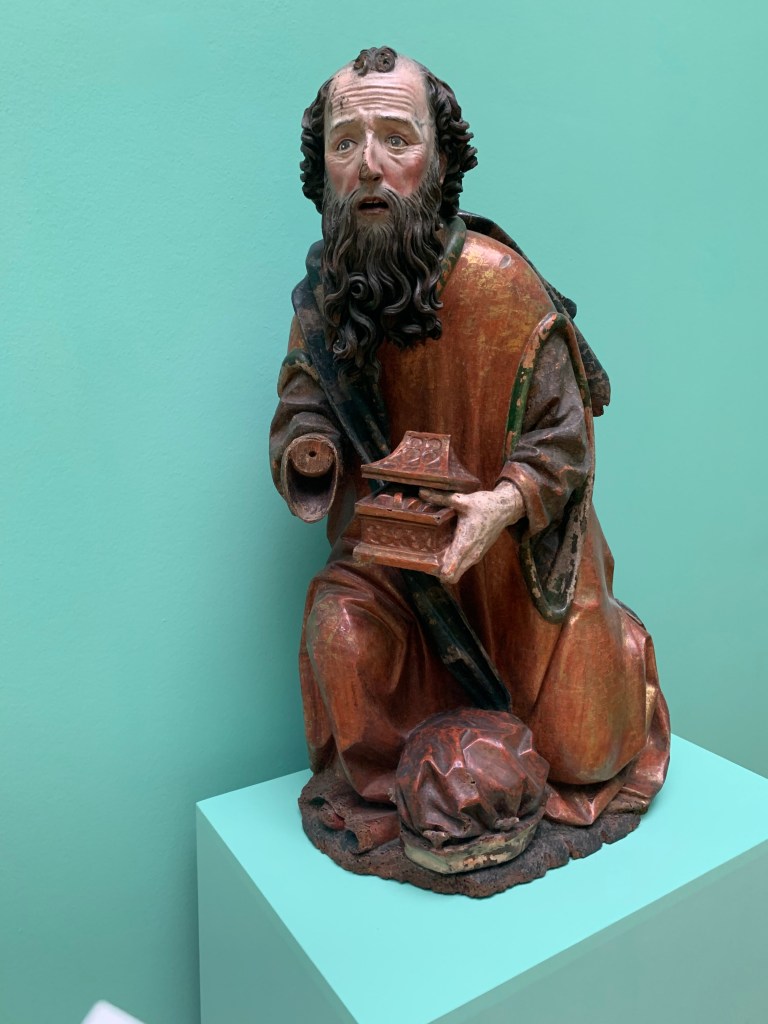
Reflecting on them this week brought to mind two art works I saw in Europe in January 2020.  In Leipzig it was “The Kneeling King,” a wooden sculpture from 1500.  In Vienna, it was “The Large Path” from 1962 by Friedensreich Hundertwasser.  Different eras, different artists, different media, different themes.  But somehow, they help me reflect on how we can view our life through these two questions.  I’m inviting you to look at them with me with the questions in mind.

         Let’s start with the older one, “The Kneeling King.”

Knieender Konig, Michel Erhart, c. 1500, Zentrum Museuem, Leipzig

This is piece of religious art, and the “King” with his opened treasure box is one of the Magi.  He has been on a long journey, led by signs and prophecies to a distant land. He’s come to pay homage to a newborn child who promises to bring peace to the world.  He’s arrived and is kneeling in humility and hope.  But as I look at his facial expression, I sense an inner weariness.  Grateful he got to this point, but not assured his longings will be fulfilled. In my imagination it seems likely he will return home and eventually die without knowing if his hopes will be realized.  But he’s done his best. He’s made the journey and offered something of his own that could be valuable to benefit others.

         What’s going on inside of him?  I sense a desire to help the world become a place of greater compassion and justice. At this late stage in his life, he wants to offer something of personal significance to benefit humanity. 

What is happening because of him?  A poor family is being given a gift to help them raise their child.  His inner journey leads to an outward journey — a giving away rather than just a gathering in.

         Let’s turn to the contemporary piece, “The Large Path” by Hundertwasser.

Der Grosse Weg, Friedensreich Hundterwasser,  1962, Belvedere Palace, Vienna. 

         I don’t know anything about theories of color and design, but this piece made me pause and study it with fascination and curiosity. 

I read the descriptive plaque next to it: Hundertwasser’s art combines Far Eastern philosophy and abstract art, the unconscious and the rational, nature and culture. He discovered Zen Buddhism in the 1950s and traveled subsequently to Japan. He sought to put an end to the lust for money and power and to find inner peace. The spiral represents the long road towards this goal. The center of the picture promises tranquility.

         Our current culture is often described as one in which we are searching for our “authentic self.”  For some, Western spirituality has become dry and dogmatic. Eastern paths offer an opportunity for finding inner peace.  Popular psychology and self-help also reflect this hunger.  Will I ever know who I really am?  Will I ever be able to find peace and tranquility? Like the subject in “The Kneeling King,” the artist went on a long journey.  Looking back, he felt his search had been like a long spiral coming closer and closer to a meaningful center, which he represents as a patch of blue — like a warm and welcoming window to deep inner space. 

What’s going on inside of this him? It seems the answer could be a long search for inner peace. And the painting suggests he found something at one point.

 What’s going because of him? I did not know until I read more about him. 

It turns out Hundertwasser became an early pioneer in environmental activism. He bought land in rural New Zealand and lived self-sufficiently using solar panels, a water wheel, and a biological water purification plant.  He made a trip to Washington, DC, to oppose the growth of nuclear weapons.  It seems his inner search didn’t end with him finding a state of personal illumination but became a path turning outward to make a difference in the world. 

There may have been times in my life when I hoped I’d find some permanent place of inner tranquility within myself. But the older I get, the less I feel a need to find such a place.  I am more curious about what I can offer to the world beyond myself, even if I don’t know how it will turn out.  Maybe the best way to find ourselves is to give ourselves away.

         What’s going on inside you?

         What’s going on because of you?

What do you see in these works of art?

The Invisible People

         I will always remember what it’s like to be invisible. 

         In 1985 we began serving a year as volunteers at The Campbell Farm, a 40-acre apple farm and retreat center in Central Washington.  The property had been left to the Presbyterian Church with the intent that it be used for educational purposes.  It became a self-sustaining, working farm and a place where people could learn about agriculture and land stewardship.  Early guest speakers included the poet and writer Wendell Berry, Wes Jackson (a soil scientist focusing on the recovery of the prairie ecosystem), and theologians who were laying the foundation of the eco-spirituality movement.

A clergy couple who had become friends of ours in seminary were Directors and invited us to join them. Our duties included working in the small kitchen during mealtimes, helping with housekeeping, assisting in the fall harvest and winter pruning, irrigating the alfalfa field, and tending the livestock.  In exchange, we lived rent-free in a mobile home and had a $200/month stipend.

         I was just four years out of seminary.  We were young, idealistic, and excited about this new adventure.

         One weekend, we had a group of 15 retreatants and my job was to help serve the meals and do the dishes on Saturday.  Naturally a friendly and inquisitive person, I delight in starting conversations and getting to know people. But I decided I would not speak to any guests about anything other than the meal unless they initiated it.

I set the table, brought the food, cleared the table, and did the dishes — all the time overhearing their conversations.  It was a church group, so I was familiar with many of the issues they were discussing. Several times I wanted to break into the conversation, introduce myself, and begin interacting.  But I resisted the temptation.  In this situation, my “place” was to simply serve them.  Eventually, they finished their conversations and went on to their next activity.  I dried the dishes and pans and put everything away.

         At some point during the meal, I had a vivid experience of being invisible. I was physically present, of course, but it was the sense of not being “seen” socially.  I wasn’t offended – I was doing my job and they were the guests – but it was a curious feeling.

         Maybe the experience was new to me because I was a young, white male.  In our culture, I unconsciously had always assumed I was a “somebody” worthy of other people’s attention.  I’m guessing many people in service jobs, particularly people of color, are accustomed to not being seen.  Any of you who have worked in food service and hospitality probably know the feeling well.

         This experience often comes back to me at restaurants, hotels, and other public places.  Amid all the guests and customers, there are invisible people taking care of everything.  Sometimes they may be thanked as they perform a task, but often they are not.

         The major spiritual traditions affirm that no human being is invisible.

The Jewish Torah reminds the people of Israel that they were once slaves in Egypt with no worth beyond their physical labor –an experience of being invisible.  But having been liberated, they should not make the same mistake: “The stranger who resides with you shall be to you as the native among you, and you shall love him as yourself, for you were aliens in the land of Egypt; I am the Lord your God.” (Leviticus 19:34)

Jesus taught “… the greatest among you should be like the youngest, and the one who rules like the one who serves. For who is greater, the one who is at the table or the one who serves? Is it not the one who is at the table? But I am among you as one who serves.” (Luke 22: 26-27)

         In the early 1960s, Malcolm X made his first pilgrimage as a Muslim to Mecca.  He described how all the pilgrims arrived at the airport dressed according to their culture, but as they headed for the holy site, everyone put on the same two-piece white garment. “You could be a king or a peasant and no one would know,” he wrote.[i] What was true for social status was also true for race. For the first time in his life, he felt like an equal member of the human family.

         When I was at Hospice of Santa Barbara, twice a year we’d welcome a group of City College students completing their Certified Nursing Assistant program.  In my welcome, I’d say that in my years visiting people in nursing homes and health care facilities, it was the CNAs who were doing most of the care of the patients, and many times I had seen how their compassion was affirming each patient’s dignity.

         And I remember going to the dedication of the new wing of Cottage Hospital here in Santa Barbara.  There were four ribbons cut that day. The first was to be expected – Lady Ridley-Tree, the biggest donor.  Another ribbon was cut by a staff doctor who had been born there, and another by the longest-serving volunteer.  But the moment that meant the most to me was when they introduced their longest-serving employee.  She was a woman who had worked in the basement laundry for more than 50 years.  All that time she would have been invisible.  But at this moment, as she stepped forward to cut the ribbon, she was being seen. 


[i] “The Autobiography of Malcolm X: As Told to Alex Haley,” 1965

Photo: The Pho Hung Restaraunt, Toronto

The Weeds and Wheat Within

            Years ago, I was driving downtown to take my turn as a volunteer at the local soup kitchen.  On the way, I noticed the following thought appearing in my awareness: “You know, volunteering at the soup kitchen shows to you and everyone that you are a really good person.  People will notice and think highly of you.”

            Another voice spoke up, “What a tacky thing to think! You’re not going there today to show off.  You are going because you know in your heart this is simply the right thing to do.”

            Next thought: “What an amusing dialogue you are having, Steve.  Sounds like you got one voice that is selfish and another voice that might be decent.”

            I was tempted to think the second voice is the “real me” and the first is “not me.”  But, you know, I seem to have both voices within me all the time.  The first is always performing to impress my self with my self and hoping other people notice what a good guy I am. The second wants to just do the right thing for the right reason without any fanfare.

            41 years after being awarded a “Master of Divinity” degree, I am far from mastering the relentless and petty voice within.  

            I take heart from reading a recent “Daily Meditation” posting by Fr. Richard Rohr.[i]  He writes about the Gospel parable in which the field workers are concerned that weeds are growing in the same field as good grain.  The owner tells them not to worry – in the final harvest the weeds will be separated out, and the good grain will remain. Rohr says that, growing up, he felt the parable told him to be relentlessly looking for the “weeds” in his life and root them out.  But, over time, he sensed that was impossible and gave up. Then, as he matured, he saw the parable in a new way:

Jesus shows us an absolute realism. He says something that was never said to me when I was a young person: “Let the weeds and the wheat both grow together.” Wow! That’s risky. I can’t pretend to logically understand it, although I know it allows me to be compassionate with myself. After all, I’m also a field of weeds and wheat, just like you are, and just like everything is. Everything is a mixed bag, a combination of good and bad. We are not all weeds, but we are not all wheat, either. We have to learn, even now, to accept and forgive this mixed bag of reality in ourselves and in everybody else. If we don’t, we normally become very angry people. Our world is filled with a lot of angry people because they cannot accept their own weeds.

To accept this teaching doesn’t mean we can say, “It’s okay to be selfish, violent, and evil.” It simply means that we have some realism about ourselves and each other. We have to name the weed as a weed. We can’t just pretend it’s all wheat, all good, because it isn’t. We’re not perfect. Our countries are not perfect…. The project of learning how to love—which is our only life project—is quite simply learning to accept this. If you really love anybody, and I hope you all do, then you have learned to accept a person despite, and sometimes even because of, their faults.

            This has strong parallels with Buddhism, in which we avoid the folly of thinking we can block thoughts we don’t want to have. Instead, we learn to let them come into the open, and to observe and assess them. In that freedom, we become more compassionate with ourselves as “complicated” creatures, as well as more compassionate with our fellow human beings who live the same inner complexity.

            This perspective doesn’t mean we passively accept disappointing behavior in ourselves or others. But it does invite us to be realistic that to be human is to be a mixture of wheat and weeds. Constantly sorting out the inner voices is hard work and, like the peasants in the Brueghel painting, sometimes it’s OK to take a break. But it’s vital work, and I’m grateful to Father Richard for this liberating insight.

Image: The Harvesters, Brueghel, 1656


[i] https://cac.org/daily-meditations/the-weeds-and-the-wheat-2022-08-28/

Starstruck: The Relationship Between Awe and Caring

When we get away from city lights and look up to behold the fullness of the night sky, it’s hard not to feel a sense of awe.  Awe reminds us how “small” we really are, yet, paradoxically, it’s exhilarating.  We feel better having been reminded that there is such an amazing world beyond us.  But I did not know there is a connection between experiences of awe and how we act towards other people.

In a recent column, Cal Berkeley psychology professor Alison Gopnik cites several studies that explore this connection[i]:

One study found this: “When people gaze up at an awesome sight like an eclipse… they become more humble and caring when they look down at their Twitter feed.”

Here’s another: “…people were shown videos of earthbound awe-inspiring sights like a towering tree, a sublime landscape or an erupting volcano. Afterwards they felt less significant themselves and more caring toward others.”

And she cites another that includes spilled pens: “… researchers placed students in front of either the majestic Berkeley Eucalyptus Grove or a tall but boring campus building. A confederate then came by and dropped a bunch of pens on the ground, apparently by accident. The awe-struck students in the grove put more effort into helpfully collecting the dropped pens than did the students by the mundane building.”

Here’s more: “But what about in real life outside the lab and university? In the new study, the researchers cleverly took advantage of a natural experiment—the total solar eclipse of 2017 and the millions of people who tweeted about it. First, they analyzed over eight million tweets and compared people who were in the path of the total eclipse to those who were not. Unsurprisingly, people who experienced the eclipse expressed more awe than those who didn’t, using more words like “amazing” and “transcendent.

But they also used more words expressing social connection, like “care” “love” and “thanks,” and they expressed more humility and tentativeness, saying “maybe” or “perhaps.” They even said “I” less and “we” more than people outside the path. A further analysis showed that how social and humble people were depended on how much awe they expressed.

Isn’t that fascinating? Yet, somehow, it makes sense. 

I regret I have not spent more time at high elevations where the sky is at its most dazzling.  I remember being on a hike a few years ago in the Sierras, and before going into the tent late at night, looking up and being overwhelmed by the sight of the sky.  I long to go back to that spot and simply lie on my back, being absorbed by wonder.  It “humanizes” us – or, perhaps, “spiritualizes us. Or perhaps they are the same thing.

On the terrestrial plane I have felt something surprisingly similar during worship services.  I’ve led and attended many in my life, and some are certainly forgettable.  But some are transformative.  It happens often at a simple memorial service: you hear about some small act of kindnesses the person did, or how a challenge they faced gave someone courage to face their own hardships, or you hear their favorite song sung with care and love.  What’s remembered are moments when the person’s soul seemed to quietly connect with another.  It reminds me of how extraordinary life is. And as I mingle with others at the reception, we’ve been reminded of mortality as well as what endures, and it’s as if I’m seeing each person with more clarity and reverence than I did before the service.

Gopnik comments: These results might help to explain a rather puzzling fact about spiritual experiences in general, whether they are the result of organized religious practice, secular meditation or even psychedelic rituals. On the one hand, these experiences often involve a very personal and private experience of awe, a sense of transcendence. But at the same time, they seem to lead to very real and down-to-earth actions to help other people.

And she concludes: “The mystic’s ecstasy might seem far removed from the homeless shelter or soup kitchen, and marveling at a grove, cathedral or eclipse might seem to have little to do with saying ‘we’ or helping someone pick up their spilled pens. But our minds do link the two. The awesome natural world makes our petty egos seem smaller in comparison and makes our connection to other people loom larger. Gazing at the heavens may help us make a better world on earth.”

Our hard-working ego always wants to be front and center. When that is going on, we see everything, including night skies and other people, as only important insofar as they serve us.  But whenever the ego gets dethroned by something amazing beyond us – beholding the Milky Way, or watching a newborn child sleep, or holding the hand of someone about to take their last breath – the ego’s power dissipates. Out comes our spiritual self, which is always aware of our fundamental connection with nature and others.  Experiencing that connection is one of the greatest gifts we can receive.

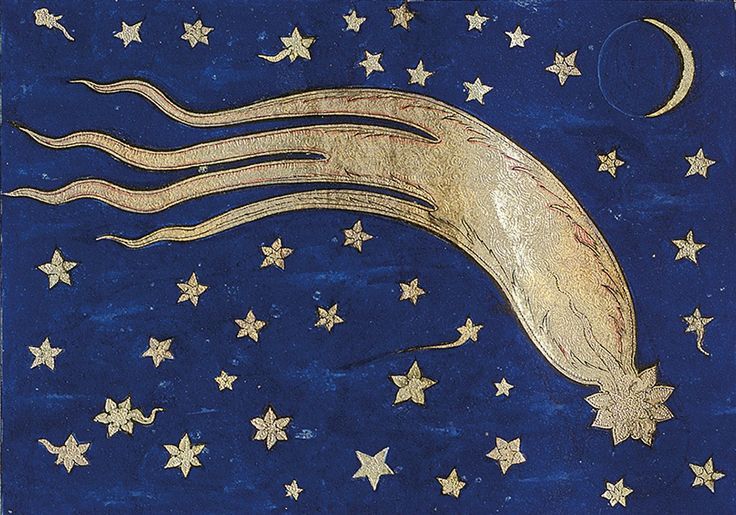
Artwork: Cantique des oiseaux comète


[i] Humbled-by-looking-up-at-the-heavens, WSJ, August 28, 2022