“You Never Know”

If there’s one phrase I’ve come to rely on over the years, it’s “You never know.”  Like a Swiss Army knife, it’s handy in many situations.

         Rachel Naomi Reimen is Professor of Family and Community Medicine at UCSF and creator of a widely used medical school course, “The Healer’s Art.”  I’ve appreciated her books, seen her speak several times, and had a chance to meet her personally. Her grandfather was an Orthodox rabbi and master storyteller. In her medical practice, she learned the importance of listening to patients’ stories and being open to mystery, spirituality and the unknown, while still employing the best medical care. A patient would come to her and report that an oncologist had given them six months to live.  She sensed the patient assumed the doctor was all-knowing. She knew better.  She would offer a different, more open perspective.   “Let’s put it another way.  This diagnosis means you’ve started a new chapter in your life. But no one knows yet how the story will unfold.” This didn’t change the medical facts, but it more accurately describes what happens in life: you never know where things will lead.

         I remember a parishioner named Doug.  When I first came to serve the Goleta congregation, I was told he was facing terminal cancer and I should visit him soon.  I remember meeting Doug and his wife Marge in their mobile home park and thinking, “What a nice older couple.” As they were telling me about their background, they mentioned that when Doug retired, they did something they always wanted to do.  I thought, “They probably went on an Alaskan cruise.” But when I asked, they said they’d gone to Europe, bought a Volkswagen bus and traveled there for two years living each day as it came.  I had totally misjudged them. 

         You never know who a person is or what they’ve experienced until you listen to their stories.

         I asked Doug about his cancer. He told me he’d been through a series of chemo treatments and found them quite debilitating.  Doctors said he would need another round, or his time would be very short.  But he had decided it wasn’t worth it.  He decided to stop treatment so he could spend his remaining time enjoying life as best he could, even if it was just a matter of weeks.  

         Doug did not do any more treatments. He lived two more years.  You never know.

         And then there are the people that are heathy and fit and doing all the right things. They have a heart attack and then they’re gone.  You never know.       

         This certainly applies to politics.  In the 2008 Iowa caucuses, Joe Biden finished fifth with 4% of the vote.  In 2020 he was fourth. Now he is president. You never know.

         I’m a Dodger fan.  The most important game of the year was game 5 in the do-or-die playoff series against the Giants. With the score tied in the 9th inning and a runner at third base, the batter who came to the plate, Cody Bellinger, had the worst batting average on the team.  My fan-heart sank.  But he poked a single into right field and the Dodgers won.  You never know.

         By the 1850s, the philosopher Soren Kierkegaard had become well known in his native Denmark. People approached him asking to write his biography. He refused to cooperate. He believed biographies don’t tell the true story of someone’s life. Everyone knows how the story ends, so everything that happens will be seen in that light. But when we are living day by day, we have no idea how our life will turn out.  “Life can only be understood backward, but it has to be lived forward.”[i] 

         Think of decisions you regret.  Weren’t you making your best judgement at the time?

         Or think of blessings in your life you did not anticipate.  Who could have predicted they’d appear?

         If we draw on a particular spiritual tradition, it certainly helps to reflect on core principles and spend time in prayer and contemplation.  But even then, at some point, we must set a course and hope we made a good choice.[ii]

         In real life, we often must make decisions using the available facts and truest feelings we have at the time.  How will it turn out?  You never know. We just do our best and see what happens.


[i] There is, of course, a long tradition in Western philosophy focusing on the question of what we can really know.  I took three quarters of philosophy in college, working from Plato to Aristotle to Descartes to Hume to Kant and into the modern age.  In the end, I think you never know. Life is too complicated.

[ii] In Buddhism, a core emphasis is becoming aware of how susceptible we are to becoming attached to ideas and expectations about life that are more illusory than certain.  Jesus promises the Spirit can be always present with us, and Paul believes that nothing can separate us from the love of God. These are wonderful reminders, which I live by.  But it still leaves us with the inescapable burden of making decisions about our life with limited knowledge.

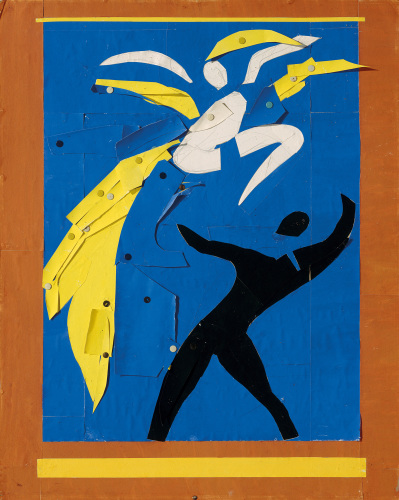
Art Work: “Two Dancers,” Matisse, 1937

Spiritual Lessons from a Disaster: Reflections on the Fourth Anniversary of the Montecito Debris Flow

Shortly after 3 AM on January 9, 2018, an intense downpour fell on the foothills above Montecito.  Just a month before, the Thomas Fire had incinerated the native vegetation.  These factors combined to create a geological force I’d never witnessed: a “debris flow.”

            A debris flow is a fast-moving mass of material — slurries of water, rock, soil, vegetation, and even boulders and trees – that moves downhill by sliding, flowing and/or falling. …Debris flows range from a few square yards to hundreds of acres in area, and from a few inches to 50 feet deep.[i]

            In the hours following the rain burst, the debris flow grew as high as 15 feet as it surged down the canyons at speeds up to 20 miles per hour. It consumed everything in its path. Huge sandstone boulders were swept along like ping pong balls.  It uprooted dozens of oak trees and obliterated buildings.  The fast-moving wall of mud and debris became a liquid battering ram as it headed toward the sea.

            It happened in the darkness of night, so there is no video record of what it looked like. It wasn’t until morning that the extent of the destruction began to be understood.

            As it turned out, 23 people died, 2 were never accounted for, and 163 were hospitalized.  More than 100 homes were destroyed and more than 300 damaged. Highway 101 was closed for two weeks.

            I was Director at La Casa de Maria Retreat and Conference Center at the time. La Casa was on a 26-acre parcel adjacent to the San Ysidro Creek and in the direct path.  14 acres of our historic property were wiped clean by the flow. Nine buildings disappeared, including the two-story administration building that had been designed to withstand floods and earthquakes.  Crushed oak trees were everywhere.

            The flow propelled a large boulder through the wall of the historic chapel, filling it with mud and broken furniture. The crucifix, calm and still as it overlooked the scene, was untouched; photos of it went viral.  For many people the chapel scene became an image of both tragic destruction and transcendence amid suffering.

            It quickly became clear that we would not be able to operate again. Our staff of 45 was cut by two-thirds as we began to assess our future.  More layoffs soon followed. Eventually, a decision was made to completely shut the facility down until a later date.  I retired that summer.

            In the weeks after the event, I walked the property, trying to fathom all that had happened. I looked for lessons I could draw from this experience. I came up with four.

            Embrace Environmental Humility  Modern industrial culture has assumed it can do whatever it pleases, “taming” nature if nature gets in the way. We build homes wherever we want, consume natural resources as quickly as we please, and assume we’ll find technological fixes for any problem.  This arrogance is no longer viable.  We must return to a state of mind where we revere and respect the natural forces and ecosystems we are part of and live our lives accordingly.

            Invest in Friendships and Community  Whether it’s floods, wildfires or COVID, one of the keys to survival is support found in friends, family, neighbors, and communities.  Hundreds of people sent messages of concern and pledges of support to La Casa – never before had we realized how much the property meant to so many. As David Brooks has said, our fragmented digital life shapes us into isolated individuals, but we can resist that trend; instead we can “overinvest in friendships.”  In frightening and challenging times, it’s other people we need — we need each other.  Treasure your friends and neighbors every day.

            Go Deep and Reach for Unity  As a pastor and hospice administrator, I have witnessed ways people face mortality many times.  If people have time to reflect, they often go deep within themselves and discover what really matters in life. This frequently becomes a spiritual quest.  When people do clarify their deepest beliefs and values, they often experience not only a sense of inner peace, but also a new appreciation for both nature and other people.  Sitting alone outside in the afternoon, a slight breeze passes, and it feels like a sign of grace. The person who comes to our door to help can seem like an angel.  What is true for our individual experiences is also true when we face disasters.  When we find our spiritual core, we begin to see other people, including strangers, as members of our human family.

Become Determined to Claim Your Integrity  Several years ago I read a piece by a Navy Seal who helped other vets get through PSTD experiences. He believed we have an option when we face hardship. Do we ask, “How will this affect me?” and passively let circumstances determine who we become?  Or do we say, “Facing these challenges, how can I respond in a way that will help me become the person I want to be?”  After the debris flow, all of us who loved and served La Casa became determined to see it rebuild and reopen because we knew how valuable it was to so many.  I now participate with a group that is working tomake that happen.  We hope La Casa will emerge stronger than ever after enduring so much.

            Embracing environmental humility, investing in friendships and community, going deep and reaching for unity, and a determination to claim our integrity – these are the lessons I learned from the Montecito debris flow.

            We have entered the climate change era, regularly facing wildfires, floods, and disasters of all kinds, as well as the COVID pandemic.  I believe these four lessons can help us find our way through it all.

Sadako Peace Garden, La Casa de Maria, January 2018

Dear Reader: Any thoughts about what helps us get through disasters? Please join the discussion and leave a comment. Always interesting to hear from you! — Steve


[i] https://www.conservation.ca.gov/index/Pages/Fact-sheets/Post-Fire-Debris-Flow-Facts.aspx

Celebrating the Light, Wherever It Appears

            In 2006, I went on a personal pilgrimage to Amsterdam and Paris.  Art had increasingly become a source of inspiration and revelation for me, and I wanted to know more.  I was not disappointed.

            In the Van Gogh Museum bookstore in Amsterdam, a book caught my attention: Van Gogh and Gaugin: The Search for Sacred Art, by Deborah Silverman.  I ordered a copy when I got home and found it fascinating. Silverman explores how both artists sought new ways to experience and portray the presence of the sacred. They came from different backgrounds –Van Gogh from a pious Dutch Reformed tradition, Gaugin schooled in Catholic mysticism – and both created their own style. But they shared a common purpose.

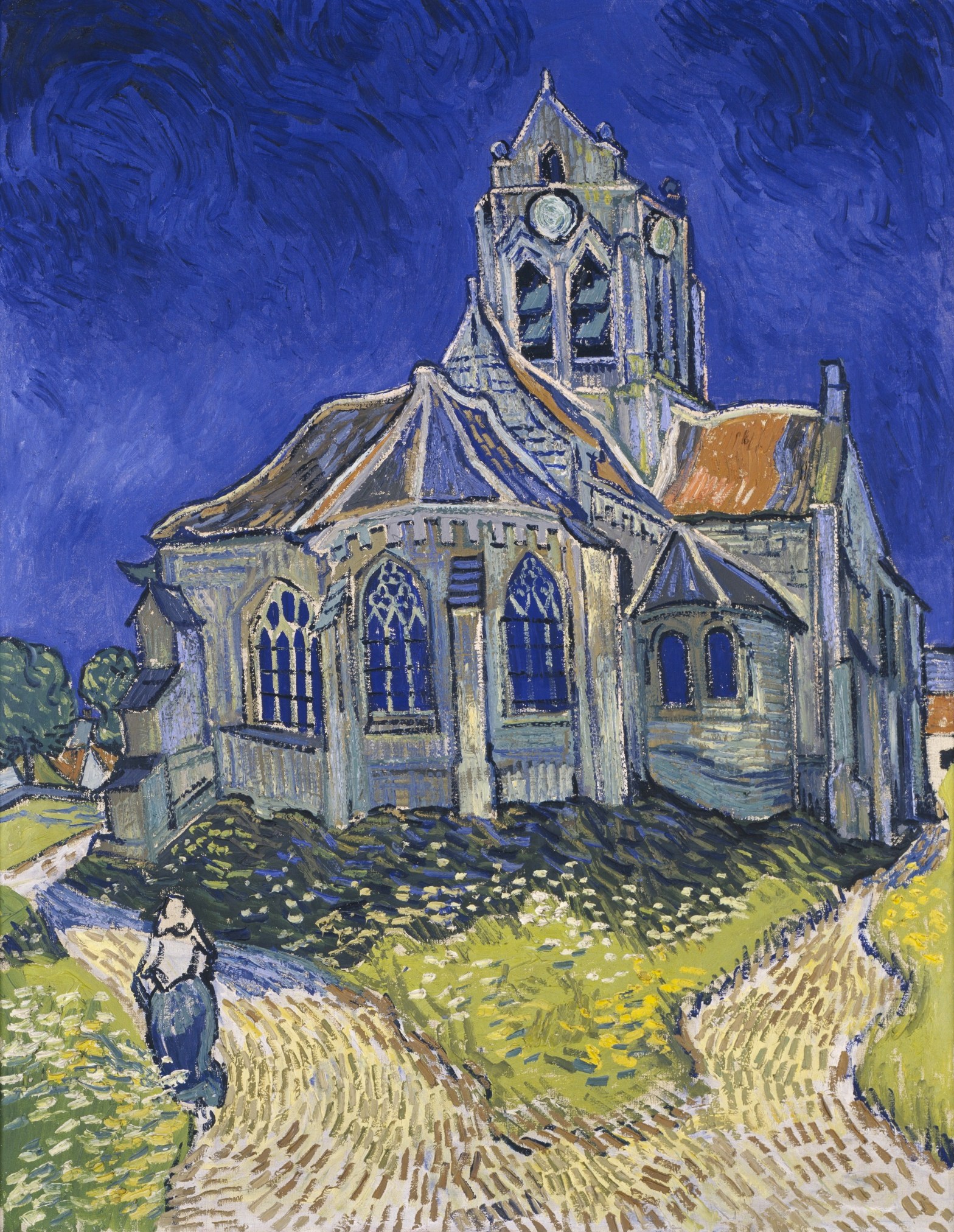
            Van Gogh’s The Church at Auvers is one of his many fascinating works when viewed from this perspective.

            Here’s a common interpretation: “The foreground of The Church at Auvers is brightly lit by the sun, but the church itself sits in its own shadow, and ‘neither reflects nor emanates any light of its own…’”  Van Gogh had become disillusioned by the “empty and unenlightened preaching” he had heard too often. Painting became a way to seek and share spiritual truth and energy found beyond the walls of any religious building — in the light and colors all around us.[i]

            This painting, then, suggests the sacred is best found outside the church and its buildings – in the glory of the blue sky, in the light that illuminates ordinary paths and landscapes, and perhaps even within the private thoughts of the anonymous villager passing by.

            I get the point.  In modern times, religious institutions can often seem irrelevant. Fewer and fewer people participate in worshipping communities.  I’ve attended my share of worship services that left me feeling more discouraged than inspired.  I appreciate seeing what Van Gogh sees, and not being limited in any way in my search for the sacred.

            But as I thought about The Church at Auvers this week, I realized my perspective on it has shifted.  Not everything that occurs behind such walls takes place in dull shadows. 

            I’ve heard some terrific, life-changing sermons in my day. Many times, hymns and songs moved me in ways that words cannot.  Within such walls, I’ve met many ordinary people who carry light within them, who gratefully gather with each other and form strong, vibrant communities.

            And I’m not just talking about experiences in my own tradition.

            I’ve attended Torah studies at my local synagogue where everyone fearlessly wrestles with ancient stories and timeless questions, uncovering fresh insights into contemporary life.

            I’ve listened to and meditated with Buddhist teachers who have helped me see life in new ways. 

            I’ve sat in mosques in Jerusalem, Hebron, and Goleta where I felt a strong, quiet sense of reverence. 

            These experiences happened “inside” institutional walls, but there was nothing dull about them.

            In essence, I don’t feel we have to choose being inside or outside these walls to find spiritual light.

            I remember years ago attending a mass in Yakima, Washington where the priest said, “We don’t come to church to experience God. We can experience God every day of the week. We come to church to celebrate what we’ve found.”

            I’m grateful for all the experiences I’ve had — inside and outside spiritual buildings — that have instructed, inspired, challenged, delighted, and nurtured me.

            May we each find the light we need in this new year, wherever it may be.


[i] https://en.wikipedia.org/wiki/The_Church_at_Auvers

The Nativity: A Hospital Epiphany and Three Works of Art

            In September of 2017, I went to Cottage Hospital to see our newborn grandson.  This was during the first year of our former President’s time in office.  I must have heard some distressing news item as I drove to the hospital — I remember walking down the hallway toward “Labor and Delivery”, feeling despondent.  I came to the nursery.  There were seven or eight newborns snug in their blankets, sleeping in basinets.  I took a moment to look at each one.  I remember hearing these words: “Steve, you may feel discouraged about the world right now, but get over it. These innocent children deserve a chance in this world.  Stop moping and do your part.”

            In a recent post I included a comment from a friend of David Brooks.  As she held her infant for the first time, she realized “I love this child more than evolution can explain.”
            Endless songs, carols, poems, sermons, Christmas cards and works of art have been inspired by the story of the birth of Jesus.  There are three images I want to share with you today – two photographs and a painting. 

            In 2009, the Guardian asked nine artists to reimagine the nativity in contemporary society. The photographer Tom Hunter submitted this piece.  The lighting and pose reflect classic manger scenes, especially from the Renaissance. But Jesus was born in a perilous time, and his parents had to flee their homeland to preserve his life.  Having the mother and child be Somali refugees makes the social context of the birth clear.

“Nativity,” Tom Hunter, 2009

            This “Nativity” was created in 1865 by Julia Margaret Cameron.  She began her artistic career at age 48 when her daughter gave her a camera; she became a pioneer in portrait photography.  Some critics thought she was overly sentimental, but I like her work.  This “Nativity” isn’t staged as a manger scene, but simply portrays a working-class family with an infant.  And who is the mother embracing?  A sibling? A cousin?  Or an angel?

“Nativity,” Julia Margaret Cameron

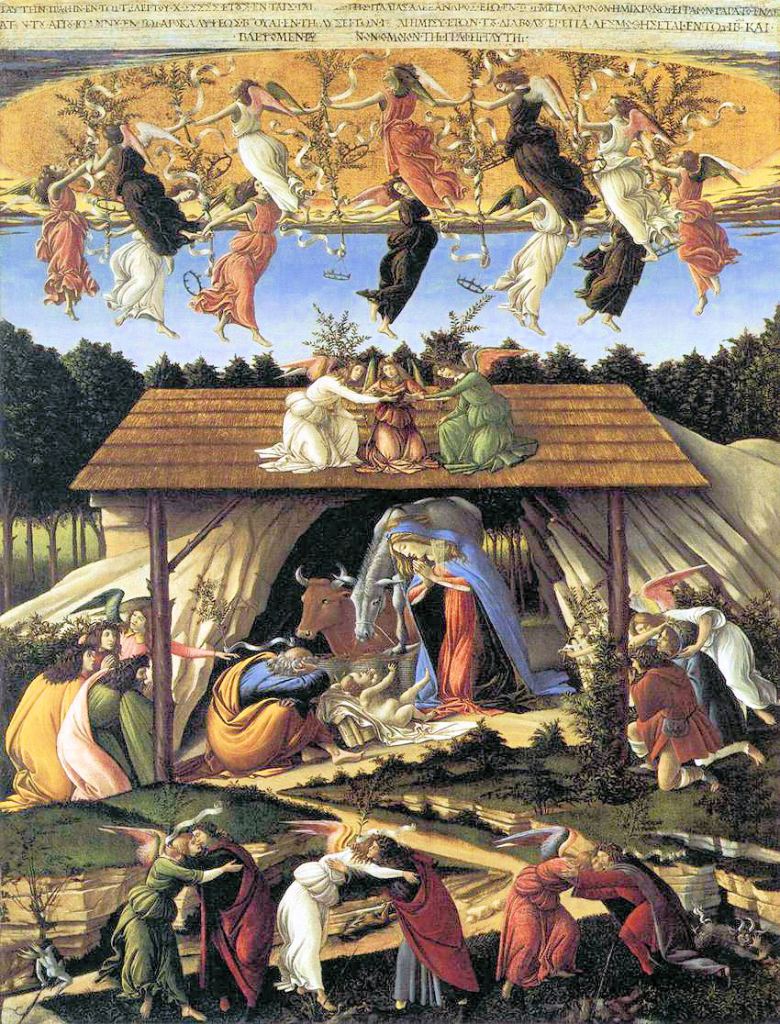
            We close with the visionary “Mystical Nativity” by Botticelli, created in 1501.  Here’s the scene at the center of the canvas:

Boticelli, “Mystical Nativity,” close-up, 1501

Joseph may be sleeping, the baby is reaching for his mother, and Mary is adoring her child as animals stand quietly in the rear.  But Botticelli imagined a scene beyond ordinary sight, where the meaning of the birth is celebrated:

Boticelli, “Mystical Nativity,” 1501

Angels are everywhere…embracing each other at the bottom, drawing close to the manger in the center, and joining hands in a circle dance at the top.  There’s no suggestion that Joseph and Mary can sense their presence in this moment, but, as viewers, we are invited to see it all.

            Botticelli apparently painted this at a time of great anxiety in Florence.  Political leadership was in an upheaval and some prophets proclaimed the end of the world was near.  Perhaps this is the message: no matter what challenges we face in the world, the birth of this child represents the appearance of light amid darkness, and is reason for great rejoicing.

            “The light shines in the darkness, and the darkness shall not overcome it.”

            May we honor the birth of every child as a sacred event, and accept the responsibility of creating a better world on their behalf.  

The Spiritual Point of Conception: Reflections and Images

Is there an invisible “place” within you in which feelings and thoughts appear that seem different from your everyday thoughts?  Something like a “still, small voice” that surprises you at important moments, offering insight, encouragement, or maybe an invitation to do something new?

            I am going to explore this “place” by focusing on a figure whose story is very much a part of the Christmas season: Mary, the mother of Jesus. I’ll share reflections from my journey, a famous passage from Thomas Merton, and six paintings spanning seven centuries which illustrate ways the story has been imagined visually.

            Growing up we had a small plaster nativity set that we unpacked this time of year.  The Mary figurine was painted blue and white; she was kneeling and had acquired a few chips. But she had no personal meaning for me.

            In my mid-twenties, my spiritual journey had begun, and I spent three years earning a Master of Divinity degree at Princeton Theological Seminary.  You’d think if you became a “Master of Divinity” you would learn all the important things.  But that wasn’t the case. 

            After graduation, I became interested in “the inner life”.  I discovered the work of the psychologist Carl Jung and gained an appreciation for truths that come through dreams, visions, myths, and imagination. Biblical stories became richer.  I began practicing meditation, times of silence, and journaling. I went on retreats at monasteries and became curious about the Catholic tradition.

            A new world was opening, and the figure of Mary emerged.  Most of the debates about her had focused on being the “virgin” mother of Jesus.   What fascinated me had nothing to do with sex, biology, miracles, or doctrines, but something else – how Mary can be a rich metaphor for spiritual experience.

            As the story goes, the angel Gabriel appears unexpectedly one day, telling her she is favored by God and chosen to bear Jesus. She is afraid and questions how this could happen.  Gabriel assures her anything is possible for God.  She ponders her choices.  She decides to accept a role she did not seek or imagine, one that will create many challenges for her.  “Let it be to me…” she says.  The angel disappears.  Her life unfolds.

            I know people of good faith who believe the story is completely factual, and others who do not.  My practice over the years is to honor both perspectives and look for the soul meaning of the story, which is more like interpreting a vivid dream than performing scientific or historical research.  I often think of a quote attributed to Black Elk: “This they tell, and whether it happened so or not I do not know, but if you think about it, you can see that it is true.” 

            So what’s the “soul meaning” of Mary’s story?

Imagine this: a thought appears within us that has a different quality than our everyday thoughts. It can feel like a message sent specifically to us.  We consider it. We know we are free to ignore it. But we decide to trust it and change direction in our life.  The change may not make life easier – in fact it may mean taking on challenges and responsibilities we had not sought before.  But as time goes on, we are grateful for the change we made.  We remember the moment we received the message and realize it came with love and wisdom. We feel awe, and we feel gratitude

            Thomas Merton was one of the great spiritual writers of our time.  At one point in his life, he had a profound revelation: Mary’s story is ultimately about how the divine can be born in everyone.  All of us, Merton saw, have within us a pointe vierge, a virgin point:

“At the center of our being is a point of nothingness

which is untouched by sin and by illusion,

a point of pure truth,

a point or spark which belongs entirely to God,

which is never at our disposal,

from which God disposes of our lives,

which is inaccessible to the fantasies of our own mind

or the brutalities of our own will.

This little point of nothingness and of absolute poverty

is the pure glory of God in us …

It is like a pure diamond, blazing with the invisible light of heaven.

It is in everybody,

and if we could see it

we would see these billions of points of light

coming together in the face and blaze of a sun

that would make all the darkness and cruelty of life vanish completely …

I have no program for this seeing.

It is only given.

But the gate of heaven is every- where.”[i]

            I’ve had experiences that lead me to believe Merton is right.  There is something deep within us that is “pure,” an opening to another reality that is “inaccessible to the fantasies of our own mind or the brutalities of our own will.”

             I’ve had promptings that didn’t seem to come from the same inner source that talks to me all day long.   These promptings always surprise me.  They’ve offered me new possibilities I had not imagined or wanted; over time I find I’m being led into a deeper experience of life and service.

            I’ve witnessed such experiences in the lives of many parishioners over the years who, after long periods of struggle and uncertainty, find a peace, calling or insight that surpasses their understanding. 

            In hospice work, I’ve seen people discover unexpected clarity about life that has nothing to do with what they are supposed to believe, but is fresh and authentic.   

            Working at the La Casa de Maria Retreat Center (“The House of Mary”), I saw people of many backgrounds find healing, hope, and courage when they left distractions behind and settled into a calmer, more receptive and reverent state of awareness. The new directions did not come from personal fantasies or restless will, but something deeper, an inner light that is subtle and wondrous and real.

            We can’t control or predict when such points of light appear.  As Merton says, “I have no program for this seeing. It is only given.  But the gate of heaven is every- where.”

            Hail, Mary, full of grace.


[i] Thomas Merton, Conjectures of a Guilty Bystander

Imagining The Annunciation: A Sampling from Art History

Van Eyck, 1434 Notice the colors in the angel wings; Mary does not “see” the messenger directly, but experiences it during a private moment of devotion.
Boticelli, 1485: The spiritual rays of light seem to be driving the angel forward.
Hitchcock, 1887 I first saw this at the Art Institute of Chicago and found it fascinating. Mary is alone in a field of white lillies.
Henry Ossawa Tanner, 1898 The “angel” is a column of light
Salvador Dali, 1947 — perplexing to me…what do you see?
Imagining the story in an African context

Reflections on Grief, Gratitude, and Maturity

            My dear friend Father Larry Gosselin recently posted a quote from Francis Ward Weller, a therapist and grief counselor. I want to share it and a few of my own reflections.

            The work of the mature person

            Is to carry grief in one hand

            And gratitude in the other

            And to be stretched large by them.

            How much sorrow can I hold?

            That’s how much gratitude I can give.

            If I carry only grief, I’ll bend toward cynicism and despair.

            If I have only gratitude, I’ll become saccharine

            And won’t develop much compassion for other people’s suffering.

            Grief keeps the heart fluid and soft,

            Which makes compassion possible.

            At times in my life, I’ve been asked who my “spiritual heroes” are.  My response: the many older people I’ve known in my congregations.  They’ve lived through hard times and personal tragedies, but somehow have become calm, thoughtful, and caring.

            To this I’d add Hospice volunteers who’ve experienced the loss of people they loved, then followed a calling to simply be present with others living in times of fear and unknowing.

            Of course, maturity doesn’t always come with the accumulation of age; some young people have unusual wisdom and insight. We call them “old souls.”

            I’m wary of simplistic formulas for life. I distrust promises that we can be happy all the time if we just make the right effort. 

            I’ve known people who have lost loved ones in ways that will always haunt me, and I don’t know how they bear it.

            I do not believe there is a divine pain manager who sends suffering our way to improve our character.

            Eleven years ago, I participated in a retreat at Esalen with the great mystic and global spirituality scholar, Huston Smith.  He was 91 and physically frail.  I remember him saying, “We are born in mystery, we live in mystery, we die in mystery.” He said those words with a full smile and clear light in his eyes.

            Something is here that holds us.

____

Image: Close-up of “Return of the Prodigal” by Rembrandt

Mom, Apple Pie, Technology and the Holidays

My mother had her share of hardships in life. Her first husband died only a few years after they married, leaving her with a young son and pregnant with my older sister. Not long after, her mother died suddenly.  She met and married my father; I was born a few years later, my younger sister five years after that.  Raising a noisy, blended family of four children while carrying within her the emotional burdens of trauma and grief made it hard for her to be “present” with us individually.

         Except when she made apple pie.

         I remember watching her from an early age. In time, I became old enough to participate.  I learned how to peel, core, and slice the green Pippin apples with a paring knife.  The peels were kept in a separate bowl and I would snack on them while we worked.  She added sugar and cinnamon to the sliced apples and gave them time to absorb the flavors. She’d make the crust with Crisco, flour, and a few drops of water.  She’d roll the dough and create the pie crusts she needed, pressing them into the pie plates. She’d add the apples, dot them with butter and a few drops of lemon juice, then seal them with the top crust. She taught me how to flute the edges of the crust with my fingers before the pie was put into the oven and to use a fork to poke venting holes on the top.  The leftover dough was rolled out on the cutting board.  She’d add sugar, cinnamon, and butter to it, then cut the dough into strips.  She’d roll the strips into “pinwheels,” which would bake along with the pie. Pinwheels only took 10-12 minutes to bake. We’d take them out and let them cool, then enjoy them as the pie continued to bake.  The kitchen filled with the smell of a baking apple pie.

         My mom wasn’t a great cook, but she was a master at making pies. They were always a highlight of birthday and holiday dinners.

         But as I got older, and especially after she died in 1993, I realized what I valued most was not the pies themselves, but the quality of time we shared during the process. Focusing on the manual labor allowed us to become calm and reflective.  We listened to each other, laughed together, and simply enjoyed being together.  I didn’t realize until I was older how rare and wonderful those times were. What a gift for a child to have such time with a parent!

         Eventually, I found a word to describe such activities: “focal practices.”  This is a term coined by Albert Borgman, a philosopher who has spent much of his career exploring the role of technology in our lives. The root of the word “focal” is focuser, a Latin word meaning hearth. In Roman families, everything was centered on the hearth. It was location of the family shrine, as it was where symbols of ancestors were carefully arranged and displayed.  It’s where food was cooked, and where the family ate together.  As Borgmann says, the hearth was where the family gathered to be present with each other and share what they most deeply valued.  In our own times, focal practices can include preparing and sharing meals, going on walks and hikes, camping, playing games, crafts, fishing, building things, gardening, and sharing skills of all kinds. Engaging in such activities, we experience life at a deeper level. As Borgman says, focal practices both gather and radiate meaning.

         Technological devices are a threat to such practices, he believes.  Devices are objects that promise to give us what we want in a more effective way and with less effort.  They always promise to save us time and labor. But something is lost when they displace focal practices.

         Let’s imagine a device that makes perfect apple pies, like bread-makers make bread. You simply add the ingredients and push a button, and – voilà – a pie as good as mom’s appears.  So effortless and convenient. But if we had that when I was a kid, I would have never learned the art of what she did, the satisfaction that came from doing it, or experienced the quality time we spent together.  Pie-making was a focal practice.  It did “take time”.  But time is not an adversary to be conquered. Time is a gift to be received with gratitude.

         As we approach the holidays, we can be grateful for memories of “focal practices” we’ve experienced in our past and seek opportunities to share such activities with family and friends this season. 

         As for me — I’m looking forward to the aroma of homemade pies baking in the oven.

         “Taste and see that the Lord is good.”

_______

Borgman, Albert, Technology and the Character of Contemporary Life: A Philosophical Inquiry, University of Chicago Press, 1984; Crossing the Postmodern Divide, University of Chicago Press, 19

Three Insights from David Brooks

         This past week I came across notes I had taken while attending two leadership conferences featuring New York Times columnist David Brooks. I’ve always respected David’s insights into culture and politics. But at these two events, David reflected on his personal journey. He said he had achieved everything he ever wanted in his professional life but felt his life had become increasingly empty.  He began searching for clues as to what he was missing and shared with us some of his reflections.   Here are three I want to share with you today

         “Our culture treats us like brains on a stick.” As we spend more time in a digital world, enticed and tracked by Big Tech, we become disconnected and disembodied from nature and neighbors.

         But, he noted, two of his friends had experiences that remind us there is another dimension of life.

         One such moment happened in his friend’s kitchen. The friend had come downstairs and glanced out the kitchen window. Outside was a falcon on a branch.  They looked into each other’s eyes – and kept looking –and it felt as if they were seeing into each other’s depths.  Finally, the falcon flew away.  The encounter changed his friend’s life.

         Another friend told David a thought that surprised her. As she was holding her newborn daughter these words came to her: “I love this child more than evolution can explain.” Science and evolution explain so much about the world we live in. But there are moments, mystical moments, when we realize there is something more, something wonderful, something holy, and we are in the midst of it every day.

         We are not meant to live “like brains on a stick.” Looking into the eyes of our fellow creatures and each other, we can wake up to the great mystery of life, which is tangible, unfathomable, and glorious.

         Thank you, David, for sharing thoughts from your journey.

Two Lasting Lessons from My Rock-Climbing Career

            Some years ago, I was at a wedding in the Sierras.  Guests stayed at a resort for the weekend.  The groom was a well-known mountain and rock-climbing guide and offered to teach any guests the basics of rock-climbing.

            I remember my lesson well. I was on a safety rope, and slowly made my way up the rock face with Doug coaching from below. I was maybe 20 feet up the rock face when I looked back down.  Even though I logically knew I was safe, the adrenaline began to flow, and I envisioned falling. My brain offered a vision of my head hitting the granite below like a dropped watermelon.

            “Ok,” I said. “I’m experiencing some fear right now.  Should I just ignore it and keep focusing on the next move?”

            Doug smiled. “No, your fear has important information to give you.  You want to take in the information, but not let fear control you.”

            Acting brave, I continued to climb for another ten minutes or so before I slowly made my way back to the ground. I thanked him for his patience.

            I learned two lasting truths that day:

  1. I don’t like rock climbing. I’ve never tried it again.
  2. “Your fear has important information to give you.  You want to take in the information without letting fear control you.”

            I’ve thought of this insight often over the years. It’s come to mind as I’m dealing with unexpected family medical situations, occasional crises at work, financial decisions and even when responding to political events.

            I know there are times when fear and adrenalin may save us from danger and there’s no time for thoughtful contemplation.

            And I know many people live with phobias, panic attacks, and chronic anxiety – those complex issues are not solved by remembering a simple principle.  (In such situations, I’ve seen impressive results from skilled practitioners using Cognitive-Behavior Therapy.)

            But I continue to value the basic insight.

            It reminds me of one of the five principles taught by Frank Ostateski as he applies Zen mindfulness principles to end-of-life care: “Welcome Everything, Push Away Nothing.” If we can find a still center within, we can observe thoughts and feelings as they arise in us and deal with them calmly and wisely, rather than in a state of fear.

            I’m grateful for that lesson: “…your fear has important information to give you.  You want to take in the information, but not let fear control you.”

            And I’m also grateful I don’t have to pretend I’m calm while I’m clinging to the side of a boulder.

Appreciating What You Have Been Through

            Several years ago, I attended a workshop led by a gifted poet, writer, teacher, friend and mentor, Marilyn McEntyre.  Among her many books is Make A List: How A Simple Practice Can Change Our Lives And Open Our Hearts.  Marilyn discovered that the value of making lists goes far beyond detailing what we need at the store – making lists can uncover important aspects of our inner life and creativity that may be hidden from us.

            One exercise we did at the workshop really hit home for me, and I later put it to good use when my wife and I observed our 40th wedding anniversary.  I’m sharing it in this post and encouraging you to try it.

            Let’s start with what we did at the workshop.

            We were asked to make two lists of ten items each.

            The first was to list difficult situations we’ve faced.  

            When we finished, she had us review what we’d written and share impressions. It was sobering to remember what it felt like to live through those challenges.

            Then she asked us to make a second list: significant blessings we’ve experienced.

            When finished, we again shared reactions.  It was a revelation.  I thought, “I’ve faced some hardships in my life,” I thought, “But look at all the graces I’ve received!”

            By doing the list of hardships first, the list of blessings became much more than pleasant memories of just positive thoughts.  Instead, it became a testimony to the fact that we can find blessings in the hardest of times.

            A few months later I decided to adapt the idea for our 40th anniversary and share them with our daughters at dinner.  (The original list included specific details about our personal lives known to our family, which I’m omitting here.)

First, I listed 40 challenges my wife and I have lived through. Here’s a sampling:

  1. Getting married when we were naïve and unprepared.
  2. At one point realizing we didn’t have $74 for a dentist visit for our five-year old.
  3. Experiencing my own depression at age 38 when I saw all my friends “getting ahead” – buying houses, vacationing in Hawaii, and going skiing when we could not afford any of that — and feeling I was a total failure.
  4. Raising kids and you realizing you can’t save them from potential harm. The many sleepless nights and ardent prayers. And realizing it doesn’t end when they turn 18.
  5. The sudden death of my mother and brothers.
  6. Caring for our aging and dying parents.
  7. 🚴‍♂️Family medical emergencies that involved ambulances and times in the ICU when we felt helpless and afraid.
  8. Several crises and conflicts in my career.
  9. The tragic death of people we loved over the years, including young mothers and teenagers.
  10. Watching our bodies age and how we could no longer do activities we had taken for granted.

Then I read my list of ”40 Graces.”  Here’s a sample:

  1. The amazing discovery of God in our lives.
  2. The way we were embraced and supported by the Point Loma, Santa Paula, Wapato, and Goleta congregations through 30 years.
  3. Looking into the eyes of each of our daughters when they were born and seeing them grow.
  4. The excitement of moving to New Jersey for seminary, even though all we arrived with was a rocking chair and Hoover vacuum cleaner.
  5. Moving to the Campbell Farm in rural Washington and discovering the richness of rural life.
  6. The abiding friendships we’ve developed every place we lived.
  7. The positive impact of the teen “Love Of God” program on each of our daughters.
  8. Holding each of our three grandsons in our arms and seeing them grow.
  9. The love and support we received from friends during emergencies and crises.
  10. The care our parents received at nursing homes from nurses and aides.

            Making a list like this is easier than you might think.  I encourage you to do something similar for special events, or as a simple way to review your life.  You can just start with lists of ten. Like I said, it’s a profound way to appreciate what you’ve gone through and the gifts you’ve received. And when you find yourself once again facing a serious challenge, it can be a reminder that grace is already close and waiting for you.

Photo credit: “Inspiration Point, Santa Barbara,” Brianne from Everyday Runaway