Waking Up on A Train

“At some point we look out the train window and realize we are in another country.” — David Brooks, commenting on his spiritual journey, “Lead Where You Stand Conference,” June 2022

If you take the Coast Starlight Amtrak from Santa Barbara to Seattle, you’ll board at noon and arrive 30 hours later.  You never know what you’ll see.

Traveling by train is much less stressful than traveling by air.  Seatbelts are not required.  You don’t watch an instructional video telling you what to do if the plane begins falling into the ocean.  You can walk up and down the aisles. You can bring your own food or purchase some onboard. You can choose where to be — the dining car, the café, the observation car – and, if you book a sleeping compartment, you can be in your own private room.

When night comes, the conductor makes your bed.  You get a real pillow and stretch out. Sleeping on a moving train is far easier than having to become a pretzel on a plane.

Unlike driving, you don’t have to stay alert, deal with traffic, or stop for gas.

The scenery on the Coast Starlight route is always changing.  You pass along ocean cliffs, in and out of small towns, by farms and vineyards, and through forests and mountain ranges.

If there are delays, instead of being bound to your seat on the tarmac, you are free to roam; you don’t have to plead for special dispensation to use the facility.

The conductor periodically reminds you where you are and what’s coming next: “Portland. Next stop, 10 minutes. Portland.”

But sometimes you suddenly realize you don’t know where you are.

Maybe it’s in the middle of the night and you wake up because you sense the train is not moving. You pull the curtain aside and wonder, “Where am I?”

During the day you might fall asleep, daydream, or become immersed in a good book or conversation; you find you’re looking at unexpected scenery.

Moving through life can be like being a passenger on a train.  Sometimes you arrive on time at a planned destination. Other times, you are surprised.

         I remember the first day I drove my 1963 Plymouth Valiant to high school by myself. I was short and my father had to install a wooden platform under the drivers’ seat so I could see over the wheel.  But I was licensed and independent.  I pulled out of our driveway, turned on the AM radio, and headed to school.  “I’m really doing this,” I thought.

         In my twenties, I found myself on an unexpected spiritual journey.  The faith tradition I had discounted most of my life was now calling to me, drawing me, along with my doubts and questions, like a force of gravity.  My girlfriend (who became my wife) asked if I wanted to help chaperone the church’s youth group that was going caroling. We got onto the back of a flatbed truck and were handed mimeographed song sheets with “Joy to the World,” “Angels We Have Heard On High,” and all the rest.  As the group started singing, the lyrics that had been routine and familiar to me all my life now seemed vivid, amazing, and inspiring.  In that moment I realized I had crossed from skeptic to “believer.”  “When did that happen?” I wondered.

         A few years ago, I made an appointment at the Social Security office to submit my Medicare paperwork.  I gave it to the clerk who reviewed and approved it.  I walked out wondering, “When did I get to this stage of life?”

         How many times have you looked in the mirror, or at changes in society, or what’s happening to friends and loved ones, and think, “When did I arrive here?”

         Maybe what’s going on “outside” is always going to be changing. In one sense, that’s a bit scary.  But in another sense, what a mystery and privilege to be alive and watching it unfold.

         And I wonder: Will we all, at some point, suddenly find ourselves thinking “I am no longer in my body?”  Will we look out our window and realize we’re headed someplace we’ve never been before?

Top image credit: philly.com

Two Questions, Two Art Works, One Life to Live

         What’s going on inside you?

         What’s going on because of you?

         Last spring, I attended a leadership conference at Westmont College. The president said he often asks students these two questions.  They struck me as excellent questions to ask ourselves from time to time.

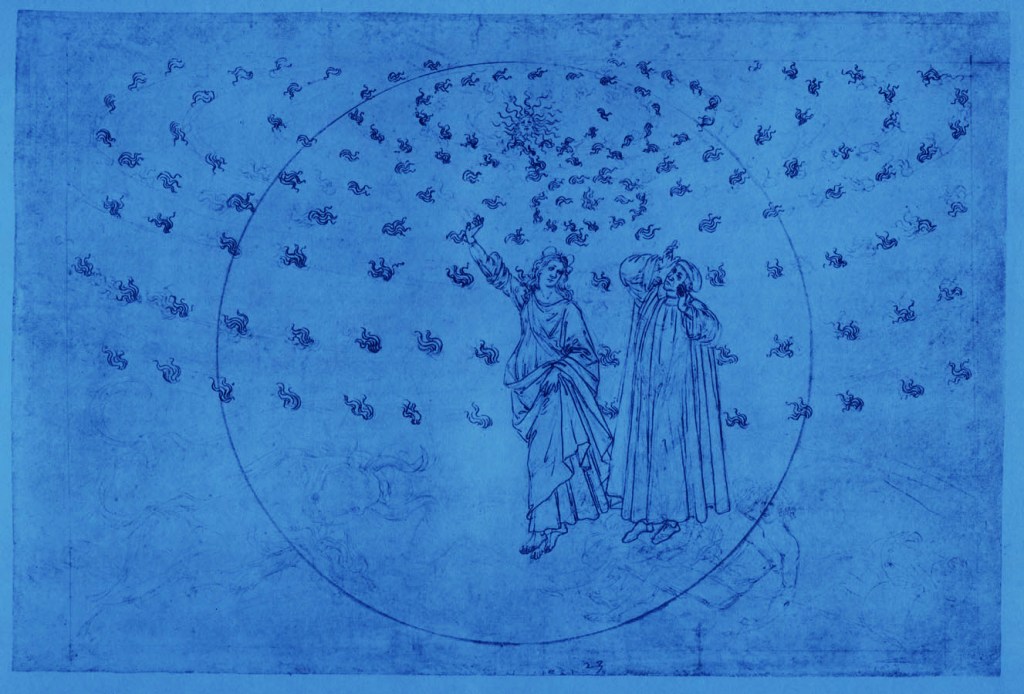
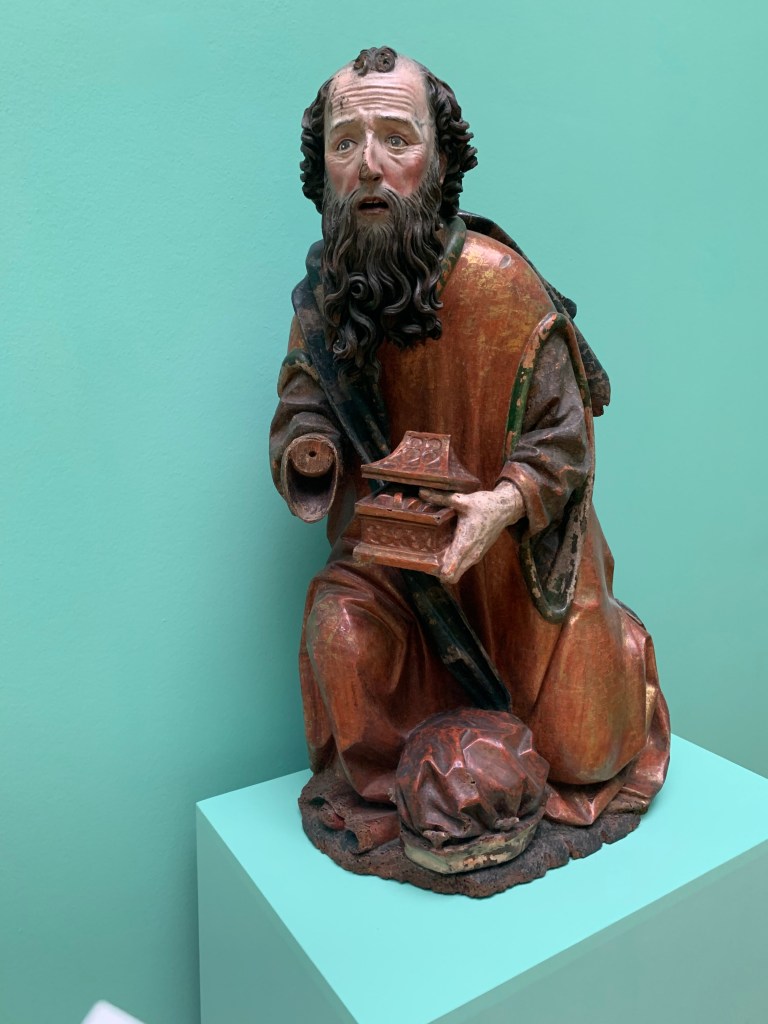
Reflecting on them this week brought to mind two art works I saw in Europe in January 2020.  In Leipzig it was “The Kneeling King,” a wooden sculpture from 1500.  In Vienna, it was “The Large Path” from 1962 by Friedensreich Hundertwasser.  Different eras, different artists, different media, different themes.  But somehow, they help me reflect on how we can view our life through these two questions.  I’m inviting you to look at them with me with the questions in mind.

         Let’s start with the older one, “The Kneeling King.”

Knieender Konig, Michel Erhart, c. 1500, Zentrum Museuem, Leipzig

This is piece of religious art, and the “King” with his opened treasure box is one of the Magi.  He has been on a long journey, led by signs and prophecies to a distant land. He’s come to pay homage to a newborn child who promises to bring peace to the world.  He’s arrived and is kneeling in humility and hope.  But as I look at his facial expression, I sense an inner weariness.  Grateful he got to this point, but not assured his longings will be fulfilled. In my imagination it seems likely he will return home and eventually die without knowing if his hopes will be realized.  But he’s done his best. He’s made the journey and offered something of his own that could be valuable to benefit others.

         What’s going on inside of him?  I sense a desire to help the world become a place of greater compassion and justice. At this late stage in his life, he wants to offer something of personal significance to benefit humanity. 

What is happening because of him?  A poor family is being given a gift to help them raise their child.  His inner journey leads to an outward journey — a giving away rather than just a gathering in.

         Let’s turn to the contemporary piece, “The Large Path” by Hundertwasser.

Der Grosse Weg, Friedensreich Hundterwasser,  1962, Belvedere Palace, Vienna. 

         I don’t know anything about theories of color and design, but this piece made me pause and study it with fascination and curiosity. 

I read the descriptive plaque next to it: Hundertwasser’s art combines Far Eastern philosophy and abstract art, the unconscious and the rational, nature and culture. He discovered Zen Buddhism in the 1950s and traveled subsequently to Japan. He sought to put an end to the lust for money and power and to find inner peace. The spiral represents the long road towards this goal. The center of the picture promises tranquility.

         Our current culture is often described as one in which we are searching for our “authentic self.”  For some, Western spirituality has become dry and dogmatic. Eastern paths offer an opportunity for finding inner peace.  Popular psychology and self-help also reflect this hunger.  Will I ever know who I really am?  Will I ever be able to find peace and tranquility? Like the subject in “The Kneeling King,” the artist went on a long journey.  Looking back, he felt his search had been like a long spiral coming closer and closer to a meaningful center, which he represents as a patch of blue — like a warm and welcoming window to deep inner space. 

What’s going on inside of this him? It seems the answer could be a long search for inner peace. And the painting suggests he found something at one point.

 What’s going because of him? I did not know until I read more about him. 

It turns out Hundertwasser became an early pioneer in environmental activism. He bought land in rural New Zealand and lived self-sufficiently using solar panels, a water wheel, and a biological water purification plant.  He made a trip to Washington, DC, to oppose the growth of nuclear weapons.  It seems his inner search didn’t end with him finding a state of personal illumination but became a path turning outward to make a difference in the world. 

There may have been times in my life when I hoped I’d find some permanent place of inner tranquility within myself. But the older I get, the less I feel a need to find such a place.  I am more curious about what I can offer to the world beyond myself, even if I don’t know how it will turn out.  Maybe the best way to find ourselves is to give ourselves away.

         What’s going on inside you?

         What’s going on because of you?

What do you see in these works of art?

Ritual, Power, and Spirituality

            I love spectacles.

            In 2017, I took $1,200 out of my savings to buy a ticket to the 7th game of the World Series at Dodger Stadium.  I’d been a fan all my life but had never been to a World Series game.  The mood of the crowd, the pregame ceremonies, and the singing of the national anthem were all thrilling.  The Dodgers were favored to win.  They lost.

            In January 2020, I flew to Vienna to begin a two-week pilgrimage focused on music, art, and history. A few hours after my plane landed, I entered the historic Vienna Opera House to see Richard Strauss’ Salome.  I had bought a seat in one of the side balconies so I could be close to the stage.  The music began and I thought, “I am at the opera in Vienna!”  As it turned out, there was a pillar on the side of the balcony that blocked my view of the right side of the stage where the climactic final scene took place.  Oh well.

            In September I joined over 4 billion people who watched the funeral of Queen Elizabeth.  The pageantry!  The precision!  The history! The crowds!  I was totally engaged.  I watched the coffin brought into Westminster Cathedral and was in awe.  But when the elaborately dressed archbishop began eloquently reciting a passage from the Gospel, I felt uneasy.  I wasn’t sure why.  And then it occurred to me: He’s reading the words of a Palestinian peasant and prophet who spurned any signs of status, constantly challenged authority, and identified with people at the margins of society. 

            Later in the day, the coffin was taken to the chapel at Windsor Castle.  On the coffin were the crown, an orb, and a scepter.  I was fascinated as I watched each item carefully transferred from the coffin to the altar, signifying the Queen’s time of authority and service was completed.  I looked for information about these items:

  • “The crown is made of gold and set with 2,868 diamonds, 269 pearls, 17 sapphires, 11 emeralds, and four rubies.”[i]
  • “…. the orb is a 30cm-wide hollow gold sphere, mounted with nine emeralds, 18 rubies, nine sapphires, 365 diamonds, 375 pearls, one amethyst and one glass stone.”[ii]
  • “The scepter is “comprised of three sections, with the magnificent Cullinan stone atop, supported in an enameled heart-shaped structure. This structure is surmounted by enameled brackets mounted with step-cut emeralds, and by a faceted amethyst monde…set with table and rose-cut diamonds, rubies, spinels and emeralds, with a cross above set with further diamonds, with a table-cut diamond on the front, and an emerald on the reverse.”[iii]

Historically, these items are reminders that the monarch is God’s chosen instrument on earth. I couldn’t help but think, “Is this the same God that chose to identify with the slaves of Egypt?  The same God who, Jesus taught, comes to us in the faces of people in need?”

            Don’t get me wrong.  I have complete respect for Queen Elizabeth.  She served her country for 70 years with grace, forbearance, and dignity. I remember well when the COVID pandemic was threatening us all.  While the American head-of-state was generating confusion and discord, she delivered a wonderful message encouraging all the people of the UK to come together in mutual support and caring.  An honorable person, an amazing Queen.

            And I know my history. I know that the “divine right of kings” has been a principle accepted by many societies throughout human history.   None of us are perfect, and to be in a position of great authority and responsibility, always in the public eye, is a formidable task.

            I’m still trying to figure this out.

            In 1982, we were living in Santa Paula and heard that Mother Theresa was coming to give the commencement address at nearby St. Thomas Aquinas College.  A friend got us tickets.  We were sitting on folding chairs when the opening procession came down the center aisle, 50 feet from where we were.  The first prominent person visible was a cardinal from somewhere, dressed to the hilt.  A bit behind him was the barely visible bobbing head of this small nun, dressed in a simple habit.  When it was his turn to speak, he invoked his status to encourage everyone to respect the authority of the church. When she spoke, she said what counts in life is love and prayer.

            I remember as a kid watching President Kennedy’s coffin being carried on a horse-drawn caisson down Pennsylvania avenue with nothing on it but an American flag:

Courtesy JFK Library

            A few years later, Dr. King’s coffin lay on a share-croppers wagon drawn by two mules:  

            I am a fan of spectacles and rituals and theater. The British do it well.  But the older I get, the less impressed I am by mansions, palaces, and jewels.

There was a remarkable priest here in Santa Barbara who served the local Mission and greater community for more than 50 years – Father Virgil Cordano.  He was “beloved by the community as a whole for his humanity, humor, erudition, and readiness to reach out his hand in friendship to all.”[iv]  When Queen Elizabeth visited Santa Barbara in 1983, it was Father Virgil who gave her a personal tour of the Mission.  I was privileged to serve alongside him on the boards of Hospice of Santa Barbara and La Casa de Maria Retreat Center, and we became friends.  At meetings, I’d often sit next to him so I could ask him what’s on his mind.  One time he answered, “I read something by a theologian that I keep thinking about.  When we see God, what will we be most amazed by?  God’s humility.”  And he smiled.

Lead image: BBC American


[i] https://inews.co.uk/news/orb-sceptre-what-meaning-queen-royal-jewels-what-happens-after-funeral-1866599

[ii] The Crown Chronicles

[iii] The Crown Chronicles

[iv] https://www.independent.com/2008/05/22/father-virgil-cordano-dead-89/

The Invisible People

         I will always remember what it’s like to be invisible. 

         In 1985 we began serving a year as volunteers at The Campbell Farm, a 40-acre apple farm and retreat center in Central Washington.  The property had been left to the Presbyterian Church with the intent that it be used for educational purposes.  It became a self-sustaining, working farm and a place where people could learn about agriculture and land stewardship.  Early guest speakers included the poet and writer Wendell Berry, Wes Jackson (a soil scientist focusing on the recovery of the prairie ecosystem), and theologians who were laying the foundation of the eco-spirituality movement.

A clergy couple who had become friends of ours in seminary were Directors and invited us to join them. Our duties included working in the small kitchen during mealtimes, helping with housekeeping, assisting in the fall harvest and winter pruning, irrigating the alfalfa field, and tending the livestock.  In exchange, we lived rent-free in a mobile home and had a $200/month stipend.

         I was just four years out of seminary.  We were young, idealistic, and excited about this new adventure.

         One weekend, we had a group of 15 retreatants and my job was to help serve the meals and do the dishes on Saturday.  Naturally a friendly and inquisitive person, I delight in starting conversations and getting to know people. But I decided I would not speak to any guests about anything other than the meal unless they initiated it.

I set the table, brought the food, cleared the table, and did the dishes — all the time overhearing their conversations.  It was a church group, so I was familiar with many of the issues they were discussing. Several times I wanted to break into the conversation, introduce myself, and begin interacting.  But I resisted the temptation.  In this situation, my “place” was to simply serve them.  Eventually, they finished their conversations and went on to their next activity.  I dried the dishes and pans and put everything away.

         At some point during the meal, I had a vivid experience of being invisible. I was physically present, of course, but it was the sense of not being “seen” socially.  I wasn’t offended – I was doing my job and they were the guests – but it was a curious feeling.

         Maybe the experience was new to me because I was a young, white male.  In our culture, I unconsciously had always assumed I was a “somebody” worthy of other people’s attention.  I’m guessing many people in service jobs, particularly people of color, are accustomed to not being seen.  Any of you who have worked in food service and hospitality probably know the feeling well.

         This experience often comes back to me at restaurants, hotels, and other public places.  Amid all the guests and customers, there are invisible people taking care of everything.  Sometimes they may be thanked as they perform a task, but often they are not.

         The major spiritual traditions affirm that no human being is invisible.

The Jewish Torah reminds the people of Israel that they were once slaves in Egypt with no worth beyond their physical labor –an experience of being invisible.  But having been liberated, they should not make the same mistake: “The stranger who resides with you shall be to you as the native among you, and you shall love him as yourself, for you were aliens in the land of Egypt; I am the Lord your God.” (Leviticus 19:34)

Jesus taught “… the greatest among you should be like the youngest, and the one who rules like the one who serves. For who is greater, the one who is at the table or the one who serves? Is it not the one who is at the table? But I am among you as one who serves.” (Luke 22: 26-27)

         In the early 1960s, Malcolm X made his first pilgrimage as a Muslim to Mecca.  He described how all the pilgrims arrived at the airport dressed according to their culture, but as they headed for the holy site, everyone put on the same two-piece white garment. “You could be a king or a peasant and no one would know,” he wrote.[i] What was true for social status was also true for race. For the first time in his life, he felt like an equal member of the human family.

         When I was at Hospice of Santa Barbara, twice a year we’d welcome a group of City College students completing their Certified Nursing Assistant program.  In my welcome, I’d say that in my years visiting people in nursing homes and health care facilities, it was the CNAs who were doing most of the care of the patients, and many times I had seen how their compassion was affirming each patient’s dignity.

         And I remember going to the dedication of the new wing of Cottage Hospital here in Santa Barbara.  There were four ribbons cut that day. The first was to be expected – Lady Ridley-Tree, the biggest donor.  Another ribbon was cut by a staff doctor who had been born there, and another by the longest-serving volunteer.  But the moment that meant the most to me was when they introduced their longest-serving employee.  She was a woman who had worked in the basement laundry for more than 50 years.  All that time she would have been invisible.  But at this moment, as she stepped forward to cut the ribbon, she was being seen. 


[i] “The Autobiography of Malcolm X: As Told to Alex Haley,” 1965

Photo: The Pho Hung Restaraunt, Toronto

What Is Your Attention Worth?

A book that has changed the way I understand contemporary life is The Attention Merchants: The Epic Scramble to Get Inside Our Heads, by Tim Wu. We all know that advertising is designed to motivate us to buy things, and over the years has become more and more clever at doing that, but I had never understood how it emerged and evolved over time.

He starts in the 19th century when newspapers discovered they could sell more copies by publishing scandalous and outrageous stories. Soon, publishing entrepreneurs also figured out that, instead of earning income by customers just paying for each printed copy, they could make more on selling space to advertisers to promote their sometimes dubious products.

            Aided by innovations in printing technology, the billboard soon appeared:

            Posters had been around since 1796. But no one had ever seen the likes of those that began to appear in Paris in the late 1860s, some of them seven-feet high, with beautiful, half-dressed women gamboling over fields of vibrant color…’Luminous, brilliant, even blinding,’ one journalist wrote…For despite being static, the Parisian posters evoked a sense of frantic energy…elements that made them nearly impossible to ignore.”[i]

            Wu takes through us through the boom in propaganda during World War 1, as nations used methods borrowed from advertising and adapted it on a mass scale; the Nazi Party capitalized on this to bewitch an entire nation.

            In the late 1920s, the technology of radio emerged. A toothpaste manufacturer, Pepsodent, was looking for a program that could attract a loyal following and boost their flagging product sales.  They created “Amos n’ Andy,” a radio sitcom that drew on all the racist stereotypes of African Americans to tell a light-hearted tale of two men making sense of everyday life in Harlem.  They hit gold:

The audiences, astounding at the time, are still impressive by today’s standards…by 1931, Amos n Andy is believed to have attracted 40 million listeners each and every evening – with some episodes reaching 50 million – this out of a population that was then 122 million….the equivalent of having today’s Super Bowl audiences each and every evening – and with just one advertiserHotels, restaurants and movie theaters would broadcast the show for their patrons. Fearing displacement, movie theaters advertised the installation of radios to broadcast “Amos n’ Andy” at 7 PM before the newsreels and features.[ii] Many people gathered around a radio in their living room — now advertising was in the center of family life.

Then came television. At first, many people dimmed the lights in their living room and refrained from talking to simulate being in a theater. And with every program, advertising was becoming more and more skillful with catchy songs and memorable slogans. I Love Lucy premiered in 1952 and, by 1953, “attracted an astonishing 71.3 percent of audiences, and as an average for an entire season, this figure remains unsurpassed.”[iii] The company that sponsored the show and benefitted from all this attention: Phillip Morris Tobacco, which contributed to our collective imagination in many ways, including the creation of the “Marlboro Man.”

The story continues decade after decade, with advertisers adapting quickly to social changes and technological innovations. Wu takes us through the arrival of personal computers, email, AOL (“You’ve got mail!”), Oprah, reality shows, Apple, the Web, Google, click-bait, Facebook, and all social media. As we know, the “attention merchants” are relentlessly coming up with new methods to get our attention, track us, and create complex algorithms to target us so they can sell us products and try to shape our political and social sentiments.

            Your attention is worth a lot to advertisers.  What’s it worth to you?

 The great psychologist and religious experience scholar William James said, “My experience is what I agree to attend to.” [iv]

I’m not a purist or a saint. I have fond memories of watching the television version of “Amos n’ Andy” as a kid, oblivious to the racial stereotyping it conveyed. My family loved “I Love Lucy,” and when I tried smoking cigarettes as a teenager, I bought Marlboros more than once, subconsciously hoping it would make me ride a bit taller in my saddle. I own four different Apple devices that I use every day, loving both the engineering quality and the brand identity of being “a creative.” I rely on Gmail and Facebook to stay in touch with friends and family, adding filters as I can figure them out, but knowing what they offer is free because of the economic value of analyzing and predicting what interests me.

All the more reason to commit ourselves to using attention to experience life as it really is, free from the reach of the “Attention Merchants.”

We can remember that each breath we take is not a commodity, but a divine gift.

We can look carefully at trees and pause to wonder how they’re always growing and responding to their environment without making a sound.

We can play with children as people have done long before the first ad or device was sold.

We can notice that our pets aren’t devoted to us because there’s profit to be made, but because we share genuine bonds of life.

We can sing, paint, write, sculpt, garden, cook, and build things as a way to experience and appreciate the gift of creativity we possess free of charge.

We can engage in spiritual, social and physical practices that allow our distractable mind to rest, and the deeper voice within to speak to us through sensations, intuitions, and feelings, instead of manipulated responses.

Our attention is our life. Let’s treat it with intelligence and care.


[i] The Attention Merchants: The Epic Scramble to Get Inside Our Heads, Tim Wu, 2016, page 18-19

[ii] Wu, pages 90-91

[iii] Wu, page 123

[iv] Wu, dedication page

Image: Tree of Faith, La Casa de Maria

The Weeds and Wheat Within

            Years ago, I was driving downtown to take my turn as a volunteer at the local soup kitchen.  On the way, I noticed the following thought appearing in my awareness: “You know, volunteering at the soup kitchen shows to you and everyone that you are a really good person.  People will notice and think highly of you.”

            Another voice spoke up, “What a tacky thing to think! You’re not going there today to show off.  You are going because you know in your heart this is simply the right thing to do.”

            Next thought: “What an amusing dialogue you are having, Steve.  Sounds like you got one voice that is selfish and another voice that might be decent.”

            I was tempted to think the second voice is the “real me” and the first is “not me.”  But, you know, I seem to have both voices within me all the time.  The first is always performing to impress my self with my self and hoping other people notice what a good guy I am. The second wants to just do the right thing for the right reason without any fanfare.

            41 years after being awarded a “Master of Divinity” degree, I am far from mastering the relentless and petty voice within.  

            I take heart from reading a recent “Daily Meditation” posting by Fr. Richard Rohr.[i]  He writes about the Gospel parable in which the field workers are concerned that weeds are growing in the same field as good grain.  The owner tells them not to worry – in the final harvest the weeds will be separated out, and the good grain will remain. Rohr says that, growing up, he felt the parable told him to be relentlessly looking for the “weeds” in his life and root them out.  But, over time, he sensed that was impossible and gave up. Then, as he matured, he saw the parable in a new way:

Jesus shows us an absolute realism. He says something that was never said to me when I was a young person: “Let the weeds and the wheat both grow together.” Wow! That’s risky. I can’t pretend to logically understand it, although I know it allows me to be compassionate with myself. After all, I’m also a field of weeds and wheat, just like you are, and just like everything is. Everything is a mixed bag, a combination of good and bad. We are not all weeds, but we are not all wheat, either. We have to learn, even now, to accept and forgive this mixed bag of reality in ourselves and in everybody else. If we don’t, we normally become very angry people. Our world is filled with a lot of angry people because they cannot accept their own weeds.

To accept this teaching doesn’t mean we can say, “It’s okay to be selfish, violent, and evil.” It simply means that we have some realism about ourselves and each other. We have to name the weed as a weed. We can’t just pretend it’s all wheat, all good, because it isn’t. We’re not perfect. Our countries are not perfect…. The project of learning how to love—which is our only life project—is quite simply learning to accept this. If you really love anybody, and I hope you all do, then you have learned to accept a person despite, and sometimes even because of, their faults.

            This has strong parallels with Buddhism, in which we avoid the folly of thinking we can block thoughts we don’t want to have. Instead, we learn to let them come into the open, and to observe and assess them. In that freedom, we become more compassionate with ourselves as “complicated” creatures, as well as more compassionate with our fellow human beings who live the same inner complexity.

            This perspective doesn’t mean we passively accept disappointing behavior in ourselves or others. But it does invite us to be realistic that to be human is to be a mixture of wheat and weeds. Constantly sorting out the inner voices is hard work and, like the peasants in the Brueghel painting, sometimes it’s OK to take a break. But it’s vital work, and I’m grateful to Father Richard for this liberating insight.

Image: The Harvesters, Brueghel, 1656


[i] https://cac.org/daily-meditations/the-weeds-and-the-wheat-2022-08-28/

“Whole Lotta Umwelt Going On”

            When I first saw this cover of the New Yorker last September, I took a quick glance and simply thought, “…people in the summer thinking about food.” I opened the magazine and began looking for the cartoons.

            But a few days later, I looked at it again and started studying it with more care.

            At first, I assumed every being is imaging what they want to eat at this moment.  The toddler is thinking of ice cream. The woman at her computer is thinking of pizza.  The bird is hoping for a dropped donut.

            Then I noticed some people are already eating or drinking something but are wishing for something else.  The hot dog vendor is fantasizing about fresh vegetables.  The woman walking with what might be iced tea is wishing it was a martini. The guy selling ice cream is imagining the taste of a cold beer.

            And then I thought more about the animals in the scene.  I counted two birds, two dogs, a parade of ants, and a cat. Just like us humans, they’ve got an idea of what might make life a little better in the moment.  There are more than two dozen living beings depicted in the scene.  I liked the idea of us sharing similar moments of imaginative thought with our fellow creatures.

            Then this past June, I came across, “How Animals See Themselves” by Ed Yong.[i]  Yong notes how popular animal documentaries are these days, and says the following:

“But in the process, they have also shoved the square peg of animal life into the round hole of human narratives. When animals become easier to film, it is no longer enough to simply film them; they must have stories. They must struggle and overcome. They must have quests, conflicts, even character arcs. An elephant family searches for water amid a drought. A lonely sloth swims in search of a mate. A cheeky penguin steals rocks from a rival’s nest.

“Nature shows have always prized the dramatic: David Attenborough himself once told me, after filming a series on reptiles and amphibians, frogs “really don’t do very much until they breed, and snakes don’t do very much until they kill.” Such thinking has now become all-consuming, and nature’s dramas have become melodramas. The result is a subtle form of anthropomorphism, in which animals are of interest only if they satisfy familiar human tropes of violence, sex, companionship and perseverance. They’re worth viewing only when we’re secretly viewing a reflection of ourselves.

“We could, instead, try to view them through their own eyes. In 1909, the biologist Jakob von Uexküll noted that every animal exists in its own unique perceptual world — a smorgasbord of sights, smells, sounds and textures that it can sense but that other species might not. These stimuli defined what von Uexküll called the Umwelt — an animal’s bespoke sliver of reality. (In German, “welt” is “world” and “um” means “around.”) A tick’s Umwelt is limited to the touch of hair, the odor that emanates from skin and the heat of warm blood. A human’s Umwelt is far wider but doesn’t include the electric fields that sharks and platypuses are privy to, the infrared radiation that rattlesnakes and vampire bats track or the ultraviolet light that most sighted animals can see…

“… By thinking about our surroundings through other Umwelten, we gain fresh appreciation not just for our fellow creatures, but also for the world we share with them. Through the nose of an albatross, a flat ocean becomes a rolling odorscape, full of scented mountains and valleys that hint at the presence of food. To the whiskers of a seal, seemingly featureless water roils with turbulent currents left behind by swimming fish — invisible tracks that the seal can follow. To a bee, a plain yellow sunflower has an ultraviolet bull’s-eye at its center, and a distinctive electric field around its petals. To the sensitive eyes of an elephant hawk moth, the night isn’t black, but full of colors.”

I had never known how vastly different the perceptual worlds of other creatures are.

I’m looking again at the magazine cover. I like the idea that we share some similar perceptions and feelings with animals, whether it’s involves a donut, hot dog, or ice cream. And I love the idea that each one of our fellow species have all kinds of ways of experiencing the world that are far beyond my ability to conceive.  “There’s a whole lotta umwelt going on.”

And as I am using my senses and imagination to write this piece, I’m also keeping an eye on Sita, our almost-12-year-old Golden Retriever. She’s in the process of dying.  She has not eaten in 5 days and barely able to get up the few times a day she tries. There’s seems to be no pain at this point, and the vet cannot detect anything other than old age.  We keep doing things to keep her comfortable, tell her we love her, and just let her lie at our feet.  I’ve seen members of my own species go through “natural death,” and it feels similar.  I don’t know what thoughts she might be having, or if she’s remembering how good a bit of grilled meat that’s fallen off the bar-b-q tastes.  I’m grateful I can be at home with her most days, and that we have shared this unlikely miracle of life together.

Image: “Food for Thought,” Tom Weld, New Yorker, September 6, 2021


[i] https://www.nytimes.com/2022/06/20/opinion/how-animals-see-themselves.html

Starstruck: The Relationship Between Awe and Caring

When we get away from city lights and look up to behold the fullness of the night sky, it’s hard not to feel a sense of awe.  Awe reminds us how “small” we really are, yet, paradoxically, it’s exhilarating.  We feel better having been reminded that there is such an amazing world beyond us.  But I did not know there is a connection between experiences of awe and how we act towards other people.

In a recent column, Cal Berkeley psychology professor Alison Gopnik cites several studies that explore this connection[i]:

One study found this: “When people gaze up at an awesome sight like an eclipse… they become more humble and caring when they look down at their Twitter feed.”

Here’s another: “…people were shown videos of earthbound awe-inspiring sights like a towering tree, a sublime landscape or an erupting volcano. Afterwards they felt less significant themselves and more caring toward others.”

And she cites another that includes spilled pens: “… researchers placed students in front of either the majestic Berkeley Eucalyptus Grove or a tall but boring campus building. A confederate then came by and dropped a bunch of pens on the ground, apparently by accident. The awe-struck students in the grove put more effort into helpfully collecting the dropped pens than did the students by the mundane building.”

Here’s more: “But what about in real life outside the lab and university? In the new study, the researchers cleverly took advantage of a natural experiment—the total solar eclipse of 2017 and the millions of people who tweeted about it. First, they analyzed over eight million tweets and compared people who were in the path of the total eclipse to those who were not. Unsurprisingly, people who experienced the eclipse expressed more awe than those who didn’t, using more words like “amazing” and “transcendent.

But they also used more words expressing social connection, like “care” “love” and “thanks,” and they expressed more humility and tentativeness, saying “maybe” or “perhaps.” They even said “I” less and “we” more than people outside the path. A further analysis showed that how social and humble people were depended on how much awe they expressed.

Isn’t that fascinating? Yet, somehow, it makes sense. 

I regret I have not spent more time at high elevations where the sky is at its most dazzling.  I remember being on a hike a few years ago in the Sierras, and before going into the tent late at night, looking up and being overwhelmed by the sight of the sky.  I long to go back to that spot and simply lie on my back, being absorbed by wonder.  It “humanizes” us – or, perhaps, “spiritualizes us. Or perhaps they are the same thing.

On the terrestrial plane I have felt something surprisingly similar during worship services.  I’ve led and attended many in my life, and some are certainly forgettable.  But some are transformative.  It happens often at a simple memorial service: you hear about some small act of kindnesses the person did, or how a challenge they faced gave someone courage to face their own hardships, or you hear their favorite song sung with care and love.  What’s remembered are moments when the person’s soul seemed to quietly connect with another.  It reminds me of how extraordinary life is. And as I mingle with others at the reception, we’ve been reminded of mortality as well as what endures, and it’s as if I’m seeing each person with more clarity and reverence than I did before the service.

Gopnik comments: These results might help to explain a rather puzzling fact about spiritual experiences in general, whether they are the result of organized religious practice, secular meditation or even psychedelic rituals. On the one hand, these experiences often involve a very personal and private experience of awe, a sense of transcendence. But at the same time, they seem to lead to very real and down-to-earth actions to help other people.

And she concludes: “The mystic’s ecstasy might seem far removed from the homeless shelter or soup kitchen, and marveling at a grove, cathedral or eclipse might seem to have little to do with saying ‘we’ or helping someone pick up their spilled pens. But our minds do link the two. The awesome natural world makes our petty egos seem smaller in comparison and makes our connection to other people loom larger. Gazing at the heavens may help us make a better world on earth.”

Our hard-working ego always wants to be front and center. When that is going on, we see everything, including night skies and other people, as only important insofar as they serve us.  But whenever the ego gets dethroned by something amazing beyond us – beholding the Milky Way, or watching a newborn child sleep, or holding the hand of someone about to take their last breath – the ego’s power dissipates. Out comes our spiritual self, which is always aware of our fundamental connection with nature and others.  Experiencing that connection is one of the greatest gifts we can receive.

Artwork: Cantique des oiseaux comète


[i] Humbled-by-looking-up-at-the-heavens, WSJ, August 28, 2022

Alert: Beware of Sneezing Sponges

Dear Reader,

Each week I try to offer an insight or story that I have found valuable, hoping it will be useful to you.  I’m not sure if this week’s piece qualifies.  But I am going to go ahead and share a few reflections on an article from the August 10 “Science” section of the New York Times:

“Sneeze by Sneeze, Sponges Fill the Seas With Their Mucus”

Here’s the key thought: The researchers came across sponges sneezing snot while working on a project investigating the role played by sponges in moving nutrients through a reef ecosystem.

I wasn’t sure if I wanted to know more, but I kept reading.  Apparently, the sponges absorb needed nutrients as the sea passes by, take what they need, and in a slow spasm, eject what they don’t want back into the ocean.  A variety of organisms find this “contribution” exactly what their dietician recommended.

Sounds like an exciting discovery. But such knowledge did not come easily: The work required Niklas Kornder, another marine ecologist at Amsterdam, to spend a lot of time with sponges. “I would spend entire days just looking at the surface of them; it was quite boring,” he recalled.

I’ve heard of monks who spend years in silent meditation, hoping for great insights.  I had never imagined scientists spending their days staring at the surface of sea sponges.  But as many contemplatives know, enlightenment can come in a flash and with time-lapse photography they documented the slow sneezing.

The sponge has been around for at least 600 million years. “It’s the most successful animal that I know of, because it’s so old, and it’s everywhere,” said Jasper de Goeij, a marine ecologist at the University of Amsterdam

This is impressive. I know as I get older, it’s harder for me to go all the places I used to.  I can’t imagine being 600 million years old and able to be “everywhere.” Hopefully there will be carbon-free min-buses with ramps.

“This could give us hints of how early life evolved from these squishy brainless things into these complex organisms building spaceships,” Dr. Ushijima said.

In recent years, I’ve done my share of genealogical research on Ancestry.com.  Beyond my traceable human ancestors, I have always felt some deep connection with certain creatures. For instance, I was mesmerized by the old Johnny Weissmuller Tarzan movies as a kid and instinctively knew I had a deep kinship with Cheetah and all chimpanzees.  Growing up with dogs, I felt a personal bond with Lassie and Rin-Tin-Tin.  Loving to swim in the ocean, it was not hard to explain the sense of connection I felt with Flipper. But I never imagined I should include sneezing sponges in my lineage (although it explains why some Saturday mornings I feel like a “squishy brainless thing.”)  I doubt I have much to offer building spaceships. All I know is the next time I go to the beach I’m going to pack plenty of Kleenex.

Comments aside, isn’t the creativity and efficiency of the natural world amazing?

For the complete article, including time-lapse video of actual sponge sneezes, go to sea-sponges-sneezing.html

According to the article, “All three of these marine sponge species are probably sneezing right now. Credit…Benjamin Müller”

Old Haunts, New Rivers

            In late July, my wife and I traveled north to Sacramento to visit cousins, then on to the Oregon Coast to visit friends.  I was surprised with what perceptions arose in each place, and how the two impressions ended up blending together.

            I had lived in Sacramento in the mid-70s after college, trying my hand at selling real estate.  I made many friends, and grew to appreciate the river, the parks, the Victorian houses, and the neighborhood I lived near the Capitol.  I had not been back since. As we drove up the I-5, a lot of fond memories came back to me.  

We had booked a hotel in Rancho Cordova to be close to where we were going to meet for dinner.  As we came into the city and headed east on Highway 50, I was amazed at how much the city has sprawled and grown.  Logically, I knew the population had tripled since I had lived and worked there and there would be changes. But I was surprised at how out of place I felt.  

Memories kept coming as I thought of the people I knew back then and I wondered if I could trace them down.  But as I remembered each person, I realized I’d lost touch with them and that most of them, no doubt, had died.  It became clear that the life I had known was gone.

            The next day we headed north to Oregon.

Our friends’ home is on the banks of the Siletz River at a point where the river flows into the sea.  It’s a large, impressive river.  I realized that, growing up in southern California, I was familiar with seasonal creeks but no real rivers

Soon I was mesmerized as I sat quietly and watched the river flow.  I thought of our countless ancestors who have watched rivers over the centuries, and who sensed they were watching the unending movement of time. Day-to-day, we live as if our lives are stable. But days, months, and years pass, and we realize life has always been quietly moving all around us, and our lives are part of that constant movement and change.  

            The melancholy feeling of loss I had visiting Sacramento came back, but I saw it in a new light. I understood it was just another example of life’s river flowing.

            A verse from a 3-century old hymn began singing itself in my mind: “Time like an ever-rolling stream bears all its sons away; they fly forgotten, as a dream dies at the opening day.”  The hymn is based on a song of Israel, Psalm 90, which is itself 2,500 years old.  That sense of being part of “an ever-flowing stream” is an ancient awareness.

            A new thought arose: my time in Sacramento may have passed long ago, but many new people have come into that community with most of their lives are in front of them.  New lives have replaced mine and all who are no longer there.  And this is good.

            I kept watching the Siletz River. I could look eastward and imagine, at the headwaters of every tributary, the water’s journey just beginning. Then I could look westward and see the waters finding their way to the sea. The waters will evaporate, form clouds, and bring rain, and the river will replenish itself.  And this is good.

            I’m grateful for what I have seen and what I can still see. And knowing what endures is not me but the river itself.

Top Image: Siletz River looking eastward; image below: the river as it merges with the sea. Photo credit: R. Ellsworth