I remember reading Great Expectations by Charles Dickens in Junior High. I recently thought I would read it again. I am still early in the story but was struck by one scene.
Young Pip has been raised by his irritable older sister and apprenticed to her husband Joe, a humble blacksmith. As Pip goes through his days, we see village life through his young eyes. He has some curious adventures and encounters. A few years pass and he is an adolescent. A lawyer from London comes to see him and tells him an anonymous benefactor has chosen him to be a person of “Great Expectations.” He will become educated as a gentleman and well-financed for life. He is given a generous sum of money to outfit himself with clothes befitting his new status before going to London.
He goes to the shop of Mr. Trabb, the village tailor. Mr. Trabb calls Pip into his kitchen to talk while he is having his breakfast.
“Mr. Trabb,” said I, “It’s an unpleasant thing to have to mention because it looks like boasting; but I have come into a handsome property.”
Mr. Trabb immediately gets up from his meal and begins treating Pip with great care. He also begins ordering his “boy” (his young assistant) around in a loud voice.
When he had at last done and had appointed to send the articles to Mr. Pumblechook’s on the Thursday evening, he said, with his hands upon the parlor lock, “I know, sir, that London gentleman cannot be expected to patronize local work, as a rule; but if you would give me a turn now and then in the quality of a townsman, I should greatly esteem it. Good morning, sir, much obliged –- Door!
The last word was flung at the boy who had not at least notion what it meant. But I saw him collapse as his master rubbed me out of his hands, and my first decided experience of this stupendous power of money, was, that it had morally laid upon his back, Trabb’s boy.[i]
“The stupendous power of money” creates an entirely new world for Pip. His status is instantly elevated by people who paid him little mind the day before. In contrast, the tailor’s “boy” is treated with public disdain by his master; he “collapses” as his low status is “laid upon his back.” Pip sees what money can do: elevate some while demeaning others.
Our youngest daughter once worked for the Santa Barbara International Film Festival. As a staff member, she received a “Platinum Pass.” This not only permitted the holder to attend all events, but to enter the theater before everyone else, walking up a Red Carpet separated by a rope and security guards from excited fans and photographers. She knew there was one particular night I wanted to attend. She said, “Dad, I have to work that night, but you can have my Platinum Pass. And I can escort you into the theater.”
I did not have a personal tailor but dressed up as best I could. We met on the sidewalk outside the theater. She put her arm under mine and we walked onto the Red Carpet. I noticed peoples’ faces as we approached – at first they looked at me with excitement, thinking, “Maybe this guy is important!” But they quickly realized I was not; the facial expressions of joyful anticipation dissolved and they began looking beyond us, hoping for someone worth seeing.
It was my one glimpse of stardom.
But I have had experiences of being in the presence of true greatness.
I once did a graveside service for a woman I did not know well. I met her years before when a mutual friend had asked me to visit her after husband had died; since then we had occasionally seen each other around town. She owned and managed two local dry-cleaning businesses. As I prepared for the service, I spoke to a few of her friends. They told me she had been dedicated to caring for her employees — providing them with full health care coverage when she wasn’t required to and always treating them like family. It was a small gathering. The friends stood closest to the casket. Behind them were the employees, huddled together and weeping quietly. When I finished my part, I invited those who wished to approach the casket to pay their final regards. The employees waited until others had passed by. Then they came one by one, pausing to gently touch the casket in silent reverence.
In moments like these, no one is exalted and no one is demeaned. Everyone is on the same level, united by love and respect.
[i] Great Expectations, Charles Dickens, Vintage Classics, 2012, pg 142
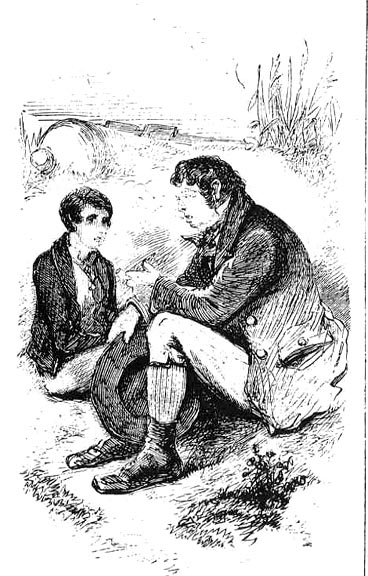
Illustration: “Pip and Joe on the Marshes,” Victorianweb.org
 Steve Jacobsen, Ed.D