Parts Wear Out

                  A good friend of mine shared words of wisdom he often heard from his father, a cardiologist. When patients would wonder why their heart needed work, he’d simply say, “Miles on the vehicle.”  And I’ve heard a similar response at the office of an orthopedist, “Parts wear out.”

                  We know this is true with cars.  With our Honda CRV, we faithfully follow the service schedule, and often it needs nothing more than an oil change and lube.  But there are times of “major service” when key parts need to be carefully inspected and possibly replaced. Our mechanic says if we stick to the maintenance schedule, the car can easily reach 200,000 miles and beyond.

The same is true for furnace filters, water filtration systems, and roofs.  We want them to last as long as possible but know they will eventually need to be replaced.

What’s true in the realm of mechanics is true of our bodies.

                  One of the joys of childhood was losing baby teeth.  That meant you were getting older.  It also meant you could exchange a worn-out part for some hard currency by depositing the tooth under your pillow.  (This may be the last time we will show a profit from having parts replaced.)

                  Life goes on … parts wear out.

For several years, I had pain in my right arm that increased over time. I went through the usual exams and X-rays, and eventually an MRI.  I met with a surgeon.  He recited a list of what was causing my problem: bone fragments, torn tendons, arthritis, etc.  I was surprised at how much wear and tear there was under the surface.  But I also thought, “It’s pretty amazing all these moving parts have been functioning without complaint day after day for 70 years.”  We scheduled the surgery. He made the repairs.  I wore a sling for a month and went through the usual physical therapy. Now I’m pain-free. I can pick up our granddaughter with ease.  Parts were wearing out, and I’m grateful for the repairs.

                  In the meantime, what of our spirit?  Does our spirit wear out like our bodies?

One theory is that our inner awareness dies with our body.  That may be the case.

Many spiritual traditions assume that the awareness that dwells within us does not die when the body dies.  Neither does it wear out.  It’s not a part we ever replace. 

                  St. Paul was not only a scholar but also practiced an important trade in the first century: tentmaking. Roman armies required canvas tents, and all the ships that sailed the Mediterranean used canvas sails.  Paul earned his income making and repairing them.  As he cut and sewed, he must have had plenty of time to think about what wears out and what endures.  In one of his letters, he wrote:

16 So we do not lose heart. Even though our outer nature is wasting away, our inner nature is being renewed day by day. 17 For our slight, momentary affliction is producing for us an eternal weight of glory beyond all measure, 18 because we look not at what can be seen but at what cannot be seen, for what can be seen is temporary, but what cannot be seen is eternal.  For we know that, if the earthly tent we live in is destroyed, we have a building from God, a house not made with hands, eternal in the heavens…The one who has prepared us for this very thing is God, who has given us the Spirit as a down payment.

I’m not quite sure if there are heavenly houses for us out there somewhere.  But I get the point: we live in our “tents,” but are not limited by them.  Our true essence is this mysterious presence we call spirit or soul which is not subject to the same wear and tear as our bodies.

                  Native cultures assume that the spirit outlasts our “parts” and is fundamentally connected to our ancestors.  In some schools of Buddhism, the practice of meditation can lead us into the limitless field of “open awareness” that is untouched by death.  This field can absorb all our fears and pain and give us a sense of profound peace. 

As I think about these teachings, I think of the concept of “agape,” a divine love that underlies all life.  Our everyday emotional “loves” may ebb and flow, but “agape” is timeless.  We do not create it or possess it; we access it through an open heart and mind and can experience a “peace that passes understanding.”

I bought a Prius in 2008.  Five years later I used it as a trade-in for the CRV.  When it was time to drop it off, I took all my personal possessions out and drove it to the dealer.  We finished the paperwork, and I handed the salesman the keys. I started to walk away, then paused and looked back.  I thought of how much life I had lived in that car, and now I was leaving it behind. I was struck by how worn and empty it looked.  I wondered, ‘Is this what it’s like when we die?”

                  Parts wear out.  But we are not just our parts or the sum of our parts.  We are not our thoughts, fears, or feelings.  We are something more.  Something subtle. Mysterious.  Wondrous. And beautiful.

The Platinum Rule

         One spiritual principle our mother taught us was the Golden Rule: “Do unto others as you would have them do unto you.”  It’s a simple concept, and some say it’s an almost universal teaching in global spiritual traditions.

But I once took a leadership class where the professor encouraged us to think of a variation, the “Platinum Rule:” “Treat others the way they want to be treated.”

         I don’t know who first coined the phrase.  Searching around, it seems to be a common notion in psychology and leadership material.  Whatever its origin, the point is easy to grasp: if I follow the Golden Rule, I may assume someone else would want the same thing I would want.  In broad terms that may be true: all people would like to be treated with respect, for example.  But when it comes down to specifics, what someone else prefers may be very different than me.

         When I was Director at La Casa de Maria, our much-loved gardener Francisco was going to retire after years of faithful service. I asked our Office Manager to come up with some ideas for a special staff event. She suggested a luncheon in the dining room, followed by playing some games we could all enjoy.  We announced that plan to the staff. Later that day, the Landscape Supervisor asked to speak to me.  He politely suggested that what we were planning may not be the ideal event for Francisco.  He offered to organize an outdoor bar-b-q by the pool with some of Francisco’s favorite dishes.  He also wanted to schedule a mariachi band to make a surprise appearance.  That’s what we did.  We were all visiting with each other as the meal was being prepared, and an amazing mariachi band suddenly appeared, singing a popular song in Spanish that referred to someone retiring.  It was wonderful.  I am grateful that we had changed our plans.

         Two stories come to mind from my days at Hospice.

         I was at a national conference and one of the breakout sessions was on the spiritual care of the dying.  While the presenter reviewed some of the common principles in helping people share their spiritual concerns, he said the topic isn’t for everybody.  When his dad was in his last days, he had no interest in talking about spiritual issues. He just wanted to have his son come so they could read the daily newspaper together and discuss sports and the news.  That’s what he did. His father died in peace.

         Our staff was very creative finding ways to do whatever was meaningful for the patients.  One man said he had always enjoyed driving around town in an open convertible smoking a cigar.  We had a volunteer who was happy to do that.  Once a once a week the volunteer picked him up and they cruised around town puffing.  The man was very grateful.

         There are endless stories of how different cultures show respect in different ways. 

In 2000 I was in India on a sabbatical project, interviewing tech people and academics about how digital technology was beginning to reshape personal lives.  I was careful to call ahead to make appointments with whoever I was going to interview, which I took for granted was the proper thing to do. But one of my hosts took me aside and said that was not necessary.  He said calling ahead to make an appointment suggested that the person would not welcome me if just showed up, when in fact, welcoming an unannounced visitor was an honored practice of a good host.

         My congregation established a partnership with a congregation in Ghana. Five of us traveled there first and were warmly welcomed wherever we went.  The next year a group of Ghanaians came to Santa Barbara.  We had arranged for members to host guests in their houses.  One of our hosts had two spare bedrooms, and she welcomed two women to her house, showing each of them the room they would be staying in. After a while, one of the women approached the hostess and – very respectfully – asked if she and her friend could share a room instead of being alone.  Not everyone wants to be by themselves like Americans often do.

         I think of relationships. A colleague recently gave a sermon on marriage. He said that marriages often begin following the idea that “opposites attract.”  We fall in love with someone different than us and make our commitment. Then we spend the rest of our marriage trying to make the person like us.  An alternative, he said, was to ask, “How can I support my partner in becoming not who I want them to be, but who God wants them to be?”  Relationships are often an endless journey in finding the balance between meeting our own needs and that of our partner. I have great respect for my therapist friends who help couples negotiate that journey.

         Applying the Platinum Rule begins with our desire to serve, honor, or support someone else. It requires an open mind and careful attention to discover what the other person truly values.  When someone treats us that way, we feel both valued and respected.

Private Thoughts

A dear friend died last week at age 96.  I’d been visiting her for eleven years. Her health had been declining and she recently went on hospice care, so it was not a surprise.  But it’s hard to accept.

In my visits with her, we explored a wide range of topics: timeless spiritual questions,  great works of art, music (Bach, Mozart, old hymns, and popular songs), politics, and her rich personal history, among others. We’d often jump from one topic to another and lose track of time.  We were frequently surprised at how quickly the time passed and exhilarated by all the ground we’d cover.

I know she is “gone.” I simply can’t believe I’ll never have a chance to visit her again. I can’t believe a light that burned so brightly in my life has disappeared from my sight. 

I play hide-and-seek with our two-year-old granddaughter.  One of us disappears around a corner in the house, and the other comes searching. When the seeker finds the hider, we share an exclamation of delight.  I want to go looking for my departed friend, but I know I will not be able to find her.  Where did she go?

And every time we go out in public, how many people do we pass by who are having similar thoughts as they go thorugh their day?

When will it be time for me to disappear?  Will I see it coming?

(Top photo: Night sky over our house; lower photo: UCSB Lagoon at sunset)

“Mind Proposes, Soul Disposes”

         I remember Huston Smith describing his first meeting with the Dalai Lama in Tibet. In 1964 the Dalai Lama was in his twenties and not well-known.  Huston was a young scholar in India studying Buddhism and had been told he should meet this new spiritual leader. After they greeted each other and he agreed to be interviewed, the Dalai Lama turned to escort Huston to the next room; Huston overheard the Dalai Lama say softly to himself, “This may be important. I need to be attentive.” 

Fifty-six years later, I was spending five days with Huston Smith and two dozen others at the Esalen Retreat Center in Big Sur.  I’d followed his writings for many years and heard him speak in Santa Barbara several times. He’d grown up in China where his parents were Methodist missionaries; the essence of what they taught him was “Be thankful for what you have and bear one another’s burdens.” He grew up speaking English and Mandarin and delighted in Chinese folk culture. He came to the U.S. for college and then spent his life traveling the world learning all he could about the great spiritual traditions. He summarized what he’d learned by writing The World’s Religions, which has sold over 3 million copies.  

Huston was not only a learned man but also a humble pilgrim; he wasn’t just smart, he was wise.  When he spoke, his face would often break into a wide smile and a bright light shined from his eyes.  The chance to be with him for five days of conversation was a dream come true.  My notebook is filled with things he said I wanted to remember.  This week one phrase came to me: “Mind Proposes, Soul Disposes.”

I take this to describe an experience we all are familiar with.  A thought arises within our mental awareness that seems like a suggestion or an impression. It can appear like words on our inner screen or maybe our personal voice speaking to us from within.  This is the “mind proposing.”  What do we do with this “proposal?”  A different kind of awareness comes into play as we consider the suggestion.  We ask ourselves: “Is this the way I want to feel?” “Is this suggestion something I really want to do?”  “Is this a path I want to follow?” As we decide, it is the “Soul Disposing” – our inner, “Higher self” coming into play, indicating a possible direction like a compass.  Then it’s up to us to decide if we go that way or not.

Much of our daily life can be spent without the “soul disposing.”  An idea occurs to us, and we act on it without much thought: “Time to get up.” “I’m going to make some coffee.” “I’m going to get the mail.”  Such actions don’t require a great deal of careful reflection.  But sometimes there are important crossroads we come to when our mind is proposing an action or direction, and we recognize we need to “think about it.”  To put it another way, we need our “soul” to help us – we want to make a good choice, the “right” choice.  Our soul draws on our deepest values and aspirations.  I think this is what the Dalai Lama was reminding himself to do before he sat down for the interview: “I need to be attentive.”

         The psychologist and holocaust survivor Victor Frankl famously said it this way: “Between stimulus and response there is a space. In that space is our power to choose our response. In our response lies our growth and our freedom.”

         For some of us, this is where spirituality comes into play.

         I’ve been reflecting on what “spirituality” means for a long time.  One way to define it is a personal sense that there is something greater than us in this world. On the one hand, this humbles us. On the other hand, this inspires us.  The great traditions tell us stories that can amaze us with their insight.  They teach us to see our life as a divine gift and to embrace the call to serve others. They give us practices to develop and stay in touch with our “souls” – through worship, prayer, music, study, community, time in nature, and acts of service.  When we reach moments when our “mind” has “proposed” an important action, we can call on what we’ve learned to “dispose” of the options, helping us recognize which one we want to pursue. 

Three weeks ago, a friend called to tell me a wise mentor and treasured friend to both of us had suffered a stroke and was in the ICU. He was 92. When I visited the next day, we had a brief but meaningful conversation.  I had recently written him a letter, telling him how much he had meant to me at different times in my career; now I was grateful I had not waited to do that.  He knew how much he meant to me.         

I asked him if he’d like me to pray with him, and he said yes. Over the years, I’ve learned to ask people what they want me to pray for, rather than assume I know.  I asked. He said, “Acceptance.”  We prayed for that. I visited him two days later and he died the next day.

Looking back, I realize he always listened to others carefully.  And when he spoke, you sensed it was his soul calmly speaking to you, often with a smile.

 “Mind Proposes, Soul disposes.” 

This may be important. I need to be attentive.”

Between stimulus and response there is a space. In that space is our power to choose our response. In our response lies our growth and our freedom.

Our Soul often wants to speak.  It’s up to us to take the time to listen.

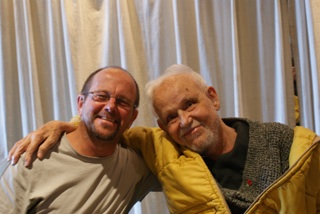
Huston Smith and me, Esalen, 2010; he was 91 at time.

He lived six more years.

Clayton Kershaw Is A Hero of Mine

         (Dear Readers: I posted this piece on my Facebook page early last week. It focuses on a baseball player. You may or may not have ever heard of him. You may have no interest in baseball or sports of any kind. But this reflection is about much more than one particular sports figure — it’s about how we tend to judge prominent public figures in any field, and even other people in our own lives. So I hope it has some value for anyone who reads it.)

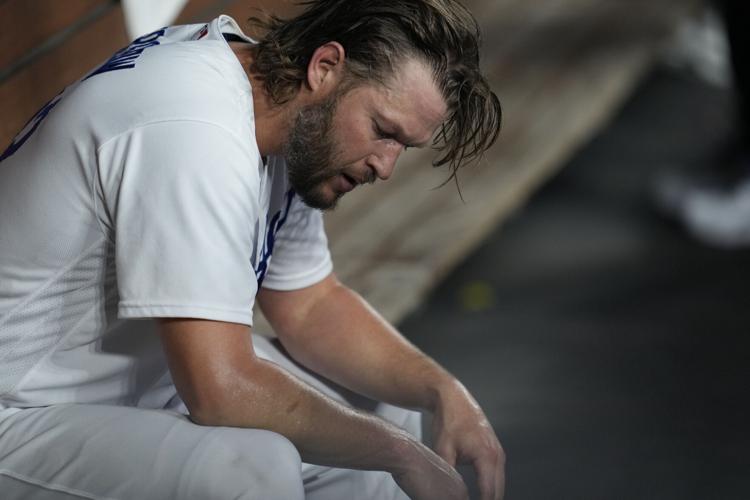
This past Saturday, we saw Clayton Kershaw have the worst outing of his career.  In the first inning in a playoff series-opening game, he got just one out while giving up six runs. To many of us fans, the game – and the Dodgers playoff hopes – seemed already lost, or at least in peril.

         It is a well-known and often-cited fact that, over the years, he has had one of the greatest careers for a pitcher in the modern era. It is equally well-known that he’s struggled in the postseason. If the Dodgers lose and Kershaw retires, this may have been his last appearance.  Many writers are ready to call this a tragic end to his extraordinary career.  In post-game interviews, Kershaw himself was despondent.

         But Clayton Kershaw will forever be a hero of mine.

         We all hope for a glorious ending to our professional careers and our lives.  And what a blessing it is if we can achieve that.

         Baseball fans will forever hear about the storybook ending to Ted Williams’ career, one of the greatest hitters of all time.  In his last at-bat in his last game for the Boston Red Sox, he hit a home run into the right field bleachers at Fenway. He circled the bases and ran off the field through the dugout to the amazement and adoration of the crowd – as he ignored them.

         Ted Williams was an isolated individual obsessed with nothing but succeeding in the sport. He was alienated from his family, uncaring towards his teammates, cold and distant towards the fans. 

         I’d love to have that kind of finish, but not that kind of life.

         By contrast, Clayton Kershaw has never wavered from being a person of integrity, dignity, and class. He’s devoted to his family. He’s always supportive of his teammates a leader for his team. He respects the game, its history, and the mentors he’s had along the way.  He and his wife have done extensive charitable work in Los Angeles and in Africa, even though his home is back in Texas.

         Maybe yesterday was his last outing and it will always be remembered as the tragic end of an incredible career.  But his indelible legacy will include not only his on-field successes but also the way he has conducted himself.

         In my professional life, I have had experiences that have both filled my heart and broken it.  I would have liked to go out like Ted Williams, but I’d rather live a life like Mr. Kershaw.  It is not our last public act that should define us. It’s our life in its entirety.

         Clayton Kershaw will always be a hero of mine. 

A Time to Reset and Renew

            In 2008, I started a new chapter in my professional life when I became Executive Director of Hospice of Santa Barbara. One of my new duties was to build relationships with various groups, organizations, and spiritual communities to let them know about our mission and services.

            Another responsibility was to make presentations that would encourage people to discuss and complete their Advanced Directives for Healthcare.   This not only makes it easier for our families in case of an emergency but also helps us reflect on what is important in life. That is not always an easy conversation to enter – it brings up thoughts that we often tend to avoid.

            During my second year, a rabbi who led a small Jewish congregation in nearby Montecito invited me to attend their Rosh Hashana services.  As the service unfolded, I was stunned by the ancient prayers and readings – they were calling us to ponder the fact that any one of us might die in the coming year and, if that is true, how should we reorder our life in the time remaining?  I thought, “This is exactly what those of us in hospice work try to do.”

            This experience came to mind as I read an article this week in the New York Times, “Rosh Hashana Can Change Your Life (Even if You’re Not Jewish).”[i]  The author is a professor of psychology, Dave DeSteno, who teaches at Northeastern University.  Here’s it is:

Celebrating a new year — as Jews the world over will do this week, when Rosh Hashana begins on Friday at sunset — is all about making changes. It’s a time for new beginnings, for wiping the slate clean and starting over from scratch. In that spirit, on Rosh Hashana Jews say prayers and listen to readings that celebrate the creation of the world and of human life.

But Rosh Hashana also strikes a different, seemingly discordant note. Unlike so many other New Year’s traditions, the Jewish holiday asks those who observe it to contemplate death. The liturgy includes the recitation of a poem, the Unetaneh Tokef, part of which is meant to remind Jews that their lives might not last as long as they’d hope or expect. “Who will live and who will die?” the poem asks. “Who will live out their allotted time and who will depart before their time?”[ii]

And we’re not talking about a gentle death at the end of a reasonably long life; we’re talking about misfortunes and tragedies that can cut any of our lives short. “Who shall perish by water and who by fire,” the poem continues, “Who by sword and who by wild beast / Who by famine and who by thirst / Who by earthquake and who by plague?”

This focus on death might seem misplaced, bringing gloom to the party. But as a research scientist who studies the psychological effects of spiritual practices, I believe there is a good reason for it: Contemplating death helps people make decisions about their future that bring them more happiness. This is an insight about human nature that the rites of Rosh Hashana capture especially well, but it’s one that people of any faith (or no faith at all) can benefit from.

When planning for the future, people typically focus on things that they think will make them happy. But there’s a problem: Most people don’t usually know what will truly make them happy — at least not until they are older. Across the globe, research shows, people’s happiness tends to follow a U-shaped pattern through life: Happiness starts decreasing in one’s 20s, hits its nadir around age 50 and then slowly rises through one’s 70s and 80s, until and unless significant health issues set in.

Why the turnaround at 50? That’s when people typically start to feel their mortality. Bones and joints begin to creak. Skin starts to sag. And visits to the doctor become more frequent and pressing. Death, hopefully, is still a good ways off, but it’s visible on the horizon.

You might think this morbid prospect would further decrease contentment, but it ends up having the opposite effect. Why? Because it forces us to focus on the things in life that actually bring us more happiness. Research by the Stanford psychologist Laura Carstensen has shown that as we age, we move from caring most about our careers, status and material possessions to caring most about connecting with those we love, finding meaning in life and performing service to others.

That’s a wise move. When people in the Western world want to be happier, research shows, they tend to focus on individual pursuits. But that same research confirms that this strategy doesn’t work well: Pursuing happiness through social connection and service to others is a more reliable route.

Of course, you don’t have to be old to confront death. During the SARS outbreak and the Covid pandemic, younger adults changed what they valued, research showed. When death suddenly seemed possible for anyone, even those in the prime of their lives, younger people’s opinions about how best to live suddenly began to look like those of seniors: They turned toward family and friends, finding purpose in social connection and helping others.

You don’t even need to face something as drastic as a pandemic to experience some version of these changes. Research shows that simply asking people to imagine that they have less time left, as congregants do on Rosh Hashana, is sufficient.

Rosh Hashana hardly has a monopoly on this insight. Christian thinkers such as Thomas à Kempis and St. Ignatius of Loyola urged people to contemplate death before making important choices. Stoics like Marcus Aurelius argued that meditating on mortality helped people find more joy in daily life.

But the particular brilliance of Rosh Hashana is that it combines thoughts of death with a new year’s focus on a fresh start. As work by the behavioral scientist Katy Milkman and her colleagues has shown, temporal landmarks like New Year’s Day offer an effective opportunity for a psychological reset. They allow us to separate ourselves from past failures and imperfections — a break that not only prods us to consider new directions in life but also helps us make any changes more effectively.

There is a lesson and an opportunity here for everyone. Contemplate death next Jan. 1 (or whenever you celebrate the start of a new year). Any brief moments of unease will be well worth the payoff.

           If you took such a time of reflection now, what would you leave behind and what new direction would you set?

Art work by Marc Chagall


[i] https://www.nytimes.com/2023/09/13/opinion/rosh-hashana-death.html

[ii] Leonard Cohen created a very moving contemporary version of the poem, “Who By Fire?”, which can be found at https://youtu.be/251Blni2AE4?feature=shared

Portals

         Portal (1): Door, entrance; especially, a grand or imposing one.  (Merriam-Webster Dictionary)

         Recently I’ve found myself thinking about portals.

         Our youngest daughter was married this past March.  At the beginning of the ceremony, we walked her down the aisle to the altar.  We hugged her, greeted the groom, and went to our seats, illustrating the social reality that we had released her into her new life. The two of them stepped into the sacred space together and exchanged the vows that made them “husband and wife.” 

         The wedding ritual is a kind of “portal” – a passageway — in which you go in with one identity and come out with another.  There was no visible arch in that sanctuary — the ceremony itself was the portal.

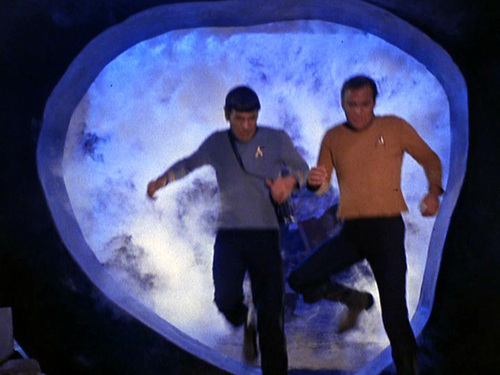
         Portals have been a favorite device in science fiction.  I remember Star Trek episodes where the crew would encounter a time portal — they’d leap into a vortex and disappear, then find themselves in a different place and era.

Spock and Kirk were the same people after passing through the portal, but they had experienced a different world. 

The same idea was used for the Outlander series, where people could go from 1945 Britain to 1743 Scotland by placing themselves amid the “standing stones” of Callanish.

In both shows, the main characters always had a choice — if they wanted, they could always go back through the portal to return to the life they had come from.

         In January 2020, I went to Europe by myself for a two-week personal pilgrimage.  Before booking the trip, I had many sleepless nights wondering if it was wise to travel by myself at my age.  But eventually, I decided to do it.   I remember waiting at the terminal in San Francisco and hearing the announcement that it was time to board.  I went through the check-in gate and walked down the covered passageway to the plane thinking, “Well, here I go.”  It was a portal.  20 hours later, I would be stepping out the door in Vienna. I would be the same person I was in California, but I’d be a long way from home — and I did not know what might happen to me before I returned. 

         I think of people who have major surgeries.  They arrive at the hospital and are prepped. Then they’re on a gurney being wheeled down a hospital hallway wondering what their life will be like after the procedure.  They’re passing through a portal.

         Many cultures and spiritual traditions have rituals to perform as people approach the end of their life. I often recite the 23rd Psalm in those situations, anointing the person with oil and laying my hand gently on their forehead, pausing, and praying they will have a sense of peace.  They are approaching the great portal we all will face someday.

         I’ve been speculating recently on when I will arrive at that portal. It’s not out of fear but curiosity.  Will it come after a long illness when I’ve had time to prepare myself for the transition? Or will it come suddenly and take me by surprise?  Every day I go out the same front door I’ve passed through for 30 years.  But I won’t be stepping over that threshold forever; there will be a time when someone else lives in this house and I will not be here.

         So lately I’ve been trying to pay a little extra attention to the details of my life as I experience them.  I leave my iPhone at home and just walk.  I try to notice and be grateful for what I observe and the ability I still have to be aware of it all.  It’s strange to know that many things we can see and take for granted today will be here long after we are gone, and our passing will not matter.

         We choose to pass through some portals in life, like getting married and boarding a long-distance flight. But others will come upon us — we know not when.

When Facing A Serious Decision, Will You Follow Hercules or Chiron?

         Years ago, I heard a presentation from a hospice physician who was also a student of Greek mythology.  He said there will be times when we will have to choose between two paths.  The first path is the path of Hercules, who used his strength to overcome major obstacles and defeat mighty opponents.  The second path can be represented by Chiron, a figure I knew little about.

As the story goes, Chiron (pronounced Ki-ron) was a centaur (half-man, half-horse) and a revered teacher of many subjects, including medicine. Hercules had come to study with him. One day a poisoned arrow accidentally wounded Chiron.  The pain was intense, and Chiron wanted to die. But because he was partly immortal, it was not possible. Out of devotion to his teacher, Hercules made a deal with Zeus that allowed Chiron to die, leaving the medical wisdom he had acquired for the benefit of humanity. His willingness to give up his immortality made him a noble and heroic figure:

          Chiron embodies the spirit of compassion and selfless service that all good physicians must have to master and practice the medical art. Through his supreme sacrifice, willingly given, Chiron gave mankind the art of healing.
            Chiron’s agonizing wound symbolizes the transformative power of illness and affliction. Through pain and suffering, our personal wounds, both psychic and physical, can transform themselves into sources of great moral and spiritual strength.[i]

         These figures can represent two options we have when facing serious challenges: shall we be like Hercules and fight to overcome the obstacles? Or shall we be like Chiron, accepting that the obstacle cannot be defeated and instead adapting to it, integrating its meaning into our lives?

         The presenter noted that, as a physician who deals with life-threatening illnesses, he sees people every day having to make such a choice.  Do they gather up every resource available and fight like a Hercules to overcome the disease? Or do they accept the serious diagnosis, acknowledge that mortality is part of the human condition, and live their remaining time appreciating what they’ve been given?

         I have seen many people making such choices. Some with serious medical challenges engage the fight with a determined will and, against great odds and the skepticism of medical professionals, triumph over the illness, living longer than anyone had expected. I have seen others with similar challenges summon a determination to “beat the odds” and are not successful, bringing great physical and emotional suffering to themselves and their loved ones. I have seen people worn out by chemotherapy elect to stop treatment so they can appreciate their last few months, then go on to enjoy two more years.  And I have seen people decide they are done with the struggle, accept the fact of their death, and live their last days with peace, gratitude, and contentment.

         You never know how it will turn out.

         It’s like aging.  Some obstacles we can overcome.  We have a knee, shoulder, or hip that is worn out.  Do we accept the challenges and uncertainties of surgery and physical therapy?  Many take on that challenge and come through the ordeal with renewed optimism for life.  I’ve also seen people who try anything and everything to deny or disguise the aging process.

I remember working out in a gym several years ago.  As I looked around at the people of different ages working out, it seemed you could divide everyone into two groups. The younger people were on the Hercules Path, grunting and grinding to become fitter and fitter with no limits in sight. Then there were we older people who weren’t so much ascending the Mountain of Fitness as trying to slow the inevitable descent: “I’m not dead yet, and I’m going to be in as good a shape as possible” we seemed to be saying as we did our best.

In the summer of 2011, we began our vacation by driving all day from Southern California to McCloud, a small town at the foot of Mt. Shasta near the Oregon border. About 9 PM that night, I got up from bed and realized my left side was largely paralyzed and my speech was garbled.  My wife called 911.  The local volunteer fire department got me to the closest hospital, which had a small ER and 20 beds.  They stabilized me, ran some tests, put me on oxygen and hoped for the best. That night I was awake wondering if I was going to die. I thought, “Well, you are a hospice guy…you should prepare yourself if that is what is going to happen.”  I began silently reciting a favorite prayer, “Serene Light.”[ii]  I was in the middle of the prayer, feeling quite peaceful, when suddenly the image of my three daughters thrust into my awareness, interrupting and putting an end to my meditation.  I did not hear any voices, but I felt I got a message: “Stop it. You’re not dying.”  I was ready to follow Chiron, but a wiser force tossed me into Hercules’ way.  Or maybe it was some combination of the two.  By noon the next day, most of my normal functioning had returned. My experience was labeled a TIA (transient ischemic attack).  Since then, I’ve felt a deep and abiding gratitude for the fragility, mystery, and wonder of being alive, as well as a fascination with that voice within us that chooses our paths.


[i] http://www.greekmedicine.net/mythology/chiron.htmlhttps://wordpress.com/post/drjsb.com/1278

[ii] “Turning Toward the Serene Light,”


“The Six Things that Matter Most”

(Dear Reader: I’ve been involved in a situation recently that reminded me of this post I published two years ago. I’ve revised it a bit and am sharing it with you now in the hope you find it useful.)

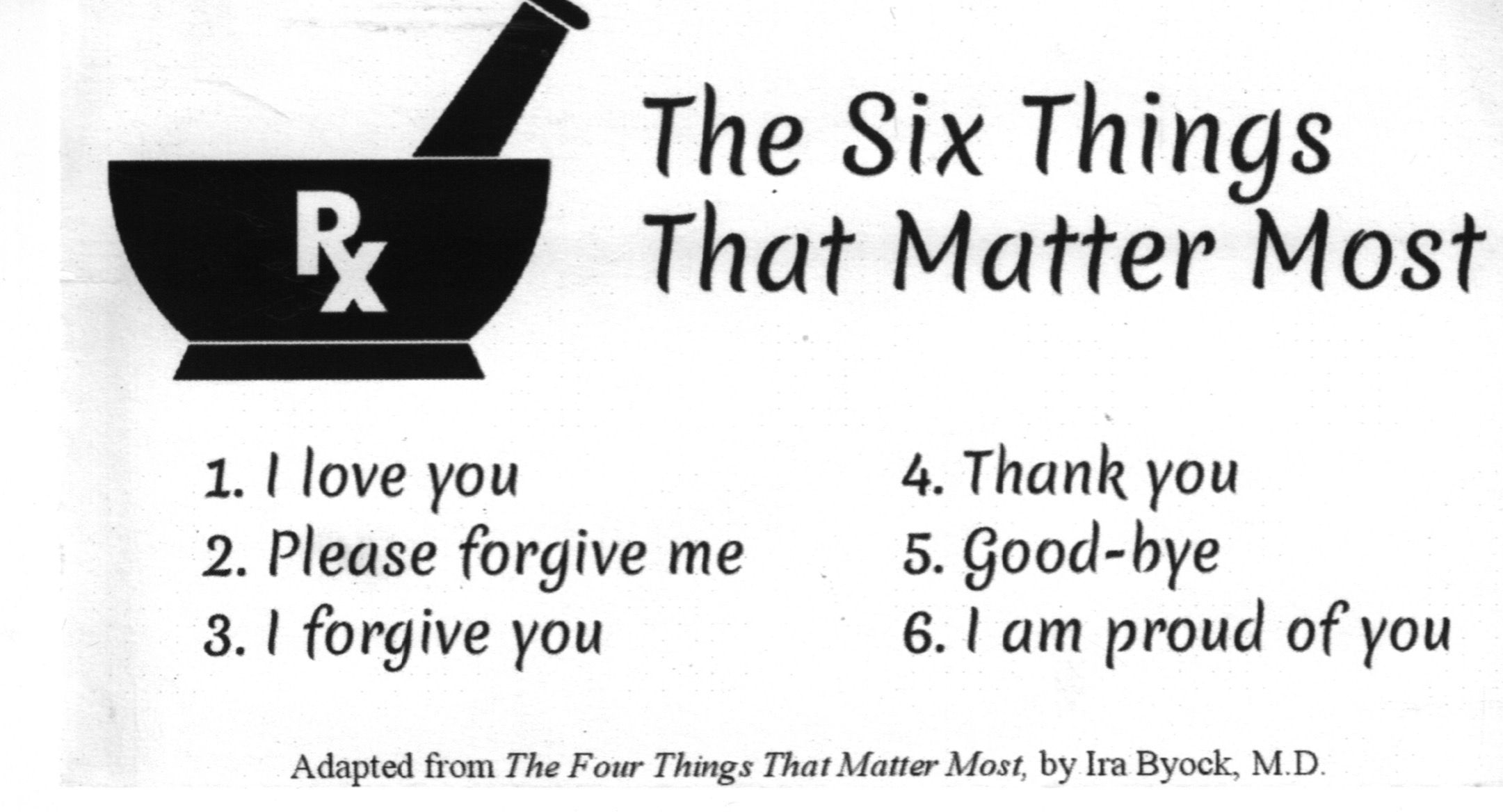
There often comes a time when a family is told their loved one has just a few hours or days left before dying.  It can be an agonizing time of not knowing what to do other than wait.   The loved one may still be able to communicate or, more often, is sleeping much of time.  What do you do when “there’s nothing more to be done”? Ira Byock, a leading physician in contemporary hospice and palliative medicine, came up with a helpful resource for such times.  He would take his prescription notepad and write four phrases: “Please forgive me. I forgive you. I love you. Thank you.” He would give that to a family member and invite them to consider if any of those statements would be appropriate to say to their loved one.  He wrote an influential book on the transformative and healing experiences he witnessed arising from people using these simple statements.  As the book became popular, two more were added: “Goodbye” and “I am proud of you.” The values represented in these statements — forgiveness, love, gratitude, and acknowledging the cycles of life — are universally present in the great spiritual traditions. When I was at Hospice of Santa Barbara, we took those six statements and had them printed on business cards.  Our staff and volunteers could then give them to families when appropriate.  I began to carry some in my wallet, a practice I’ve continued for more than a decade. Six Things I was grateful to have the card when my father was dying. He was in his last days at a nursing home. My two sisters and I used the list as a prompt for talking to him. He was no longer responsive, but it felt like the right thing to do. Maybe he heard us or maybe not.  Maybe he could sense what we meant through tone or feeling. Or maybe it was just for us. “Dad, please forgive me for the sleepless nights I gave you as a teenager.” “There were times when I was growing up when I was afraid of your anger.  I knew you were under a lot of pressure and loved us, but it was still scary. I forgive you.” “Thank you for providing for us, encouraging us and believing in us.” “For the way you worked so hard to honor mom and provide for us, for the integrity and honesty with which you lived your life, and for your service to our country during the war – we are proud of you.”  Dad wasn’t from a generation when many men would say “I love you.”  But we knew he loved us.  It was easy for each of us to say, “I love you, Dad.” The “Goodbye” statement can be tricky.  It can be tempting to say it to have some closure, but it may be too early.  (I remember one family had asked a harpist to play in the room; the patient woke up and said, “Get that music out of here…I’m not ready for the angels yet!”) But if, say, a family member is leaving town or death is clearly imminent, then “Goodbye” can be fitting. As I did presentations on hospice in the community, I would pass these cards out.  People would later tell me how helpful they were. But I also knew what everyone who works in hospice knows…the work is not just about the dying, but also about the living.  Whether dad was fully aware of what we were saying, it gave us closure. The list can also be helpful after a death when we didn’t have an opportunity to speak the words in person. We can write a letter to the person using the list as possible prompts.  We can then save the letter just for ourselves. Or we can take it to a place we associate with the person, including a gravesite, and read it.  When it’s served its purpose, we can keep it or create a simple ritual and burn it. “Six Things” can also be valuable when death is not on the horizon. Roughly half of Americans die with some form of hospice care, which means there may be time for meaningful bedside moments.  It also means the other half of us will die without such an opportunity – heart attacks, strokes, accidents, etc.  If these are the six things that matter most, why wait for a moment that we may never have?  Why not use them when we are alive and well? As time went on, I’ve found the “Six Things” a good way to take inventory from time to time in my own life on occasions like anniversaries and birthdays. Is there someone I want to say these words to now since there’s no guarantee I’ll have a chance in the future?  Or maybe take one each day, and say it to someone during the day if the time feels right? It doesn’t have to be a dramatic act, just a sincere one.  What do we have to lose? Once we do it, we often experience a sense of freedom.

Photo: UCSB lagoon

.

Seeing People Like Trees

Dr. Michael Kearney is a skilled hospice physician, gifted writer, former colleague, and treasured friend.[i]  He recently posted this:

“Answering a question about how we can judge ourselves less harshly, Ram Dass writes:  Part of it is observing oneself more impersonally… When you go into the woods and look at trees, you see all these different trees. And some of them are bent, and some are straight, and some of them are evergreens, and some of them are whatever. And you look at the tree and you allow it. You see why it is the way it is. You sort of understand that it didn’t get enough light, and so it turned that way. And you don’t get all emotional about it. You just allow it. You appreciate the tree.

The minute you get near humans, you lose all that. And you are constantly saying, “ You’re too this, or I’m too this.” That judging mind comes in.  And so I practice turning people into trees. Which means appreciating them just the way they are.”

I find this a helpful metaphor.  It is common to look at how someone appears, how they present themselves, and how they behave and put them in categories of good or bad, respectable or not.  We do this to ourselves as well. Our inner critic can be fierce in judging who we are, what we’ve done, and what we should have done.

Thinking of people like trees can give us an alternative.

Look at this Eastern Redbud tree in our backyard:

Somebody looking at it will assume that the trunk is curved to the right because that is the direction in which the sun shines into our yard.  That is correct. But I know more about its history.   

We planted it ten years ago and it had a hard time getting established. The top of the trunk was often bending so far following the sun that it was in danger of falling over and having its roots upended. We tried bracing with different methods — vertical stakes and ground anchors — but the growing center branch was always veering perilously to the right.  One day a gardener pointed out that the bracing was no longer helping. The tree had become dependent on external support and was not developing its own root system. We removed the bracing.  After one strong windstorm, the tree bent completely over, and the tip was touching the ground – we didn’t know if it would recover. But it did.  In time, the roots became established and created the strong support it needed. It now reaches in two directions: one continues orienting toward the sun while the other grows vertically, adding balance to the whole. It may not win “Best of Show” in a horticultural contest, but when I look at it, I see a living presence that has had to struggle to survive and has succeeded.

So it is with many of our fellow human beings.

Early in my ministry, I felt a calling to do memorial services, regardless of whether I had known the person or if they had any religious affiliation. 

We were living in the small, rural community of Wapato, Washington, when I got a call from the local mortician.  He asked me to do a graveside service for a man who had no known family and just a few friends.   I agreed.  I met with the friends to gain a sense of the man’s life, chose a few relevant Scripture passages, then led the service.  A half-dozen people were present.  No impressive obituaries were published, nor were any soaring eulogies given. But like a tree that had faced many challenges, this man had endured a great deal.  I remember feeling a sacred presence as we honored him.

We know trees benefit from skillful pruning.  A good arborist sees each tree in its unique environment and shapes it to help it flourish.  The same is true for loving parents, dedicated teachers, insightful mentors, and caring friends.

Following a spiritual path can be an act in which we open ourselves to being pruned by the wisdom and practices that a tradition gives us. As the saying goes, “God meets us where we are but doesn’t leave us there.” 

A friend of mine is a retired police captain.  He told me that a turning point in his career was when he began seeing people with compassion instead of judgment.  And his life was profoundly influenced by Father Gregory Boyle, the founder of Homeboy Industries, who has spent decades working with at-risk youth, convicted felons, gang members, and their families.[ii]  Father Boyle has said, “I choose to stand in awe at the burdens carried by the poor rather than standing in judgment about how they carry them.”

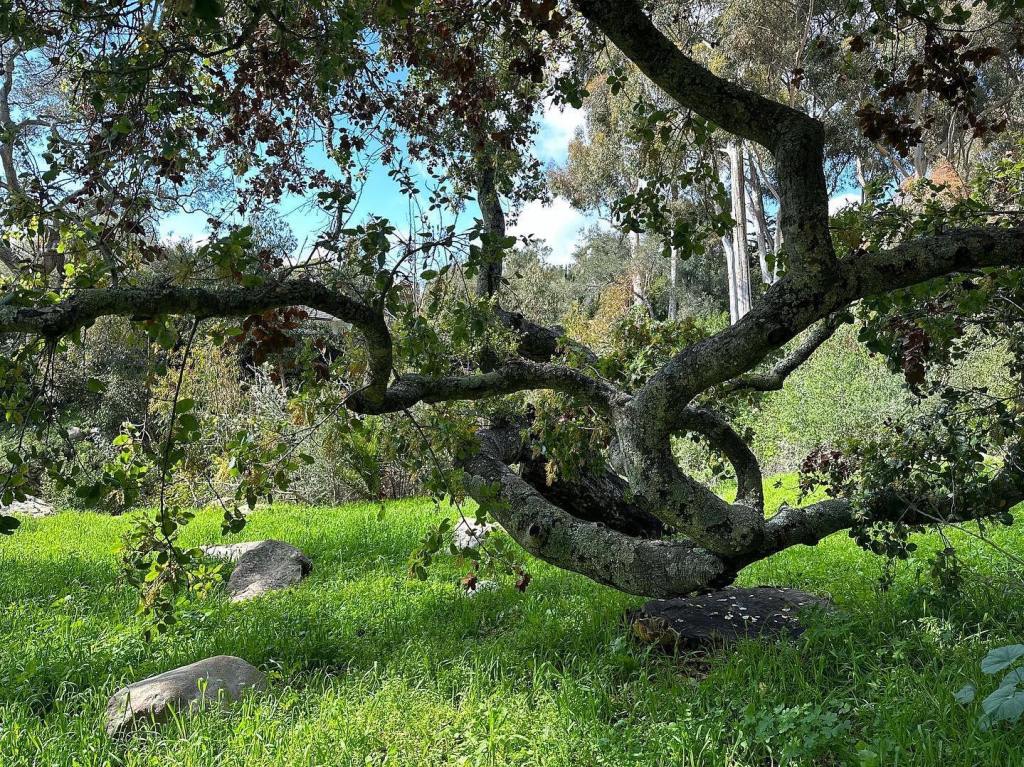
Take a close look at the oak that Michael photographed while hiking the San Ysidro Creek:

How many twists and turns has it made while seeking the life-giving sun?  What a story it could tell.

Oak Photo: Dr. Kearney


[i] To see Michael’s writings and meditations, go to https://www.michaelkearneymd.com  Michael’s wife, Radhule Weineger, is a popular mindfulness teacher whose work can be seen at https://www.radhuleweiningerphd.com

[ii] https://homeboyindustries.org