Reflections on Grief, Gratitude, and Maturity

           (Dear Friends: I did not have the time this week to create a new piece, but went back a few yeas and found this, which I have edited.)

My dear friend Father Larry Gosselin recently posted a quote from Francis Ward Weller, a therapist and grief counselor. I want to share it and a few reflections.

            The work of the mature person

            Is to carry grief in one hand

            And gratitude in the other

            And to be stretched large by them.

            How much sorrow can I hold?

            That’s how much gratitude I can give.

            If I carry only grief, I’ll bend toward cynicism and despair.

            If I have only gratitude, I’ll become saccharine

            And won’t develop much compassion for other people’s suffering.

            Grief keeps the heart fluid and soft,

            Which makes compassion possible.

            At times in my life, I’ve been asked who my “spiritual heroes” are.  My response: the many older people I’ve known in my congregations.  They’ve lived through hard times and personal tragedies, but somehow have become calm, thoughtful, and caring.

            To this I’d add Hospice volunteers who’ve experienced the loss of people they loved, then followed a calling to simply be present with others living in times of fear and unknowing.

            Of course, maturity doesn’t always come with the accumulation of age; some young people have unusual wisdom and insight. We call them “old souls.”

            I’m wary of simplistic formulas for life. I distrust promises that we can be happy all the time if we just make the right effort. 

            I’ve known people who have lost loved ones in ways that will always haunt me, and I don’t know how they bear it.

            I do not believe there is a divine pain manager who sends suffering our way to improve our character. But something is here that can hold us.

____

Image: Close-up of “Return of the Prodigal” by Rembrandt
He Thanked 46 Coworkers in Ten Minutes — Now It’s Up to You

Think of how much of your life you’ve spent at work.  Some of the people we work with make it enjoyable and meaningful, while others have the opposite effect.  Do we ever take time to recall those who have employed us, mentored us, labored alongside us, and who have made going to work a positive experience?

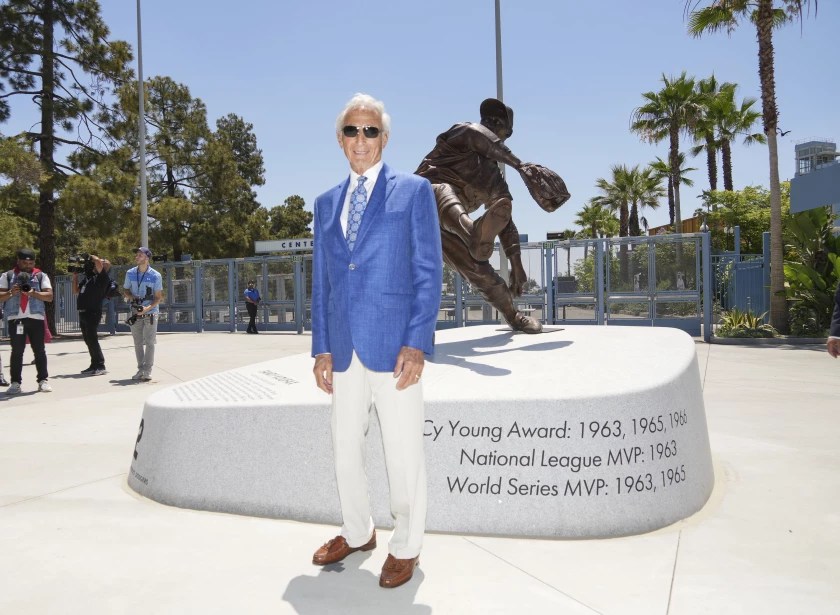
            On June 18 I took some family to a Dodger game — “Sandy Koufax Day.”  Like many southern California kids who grew up in the 60s, Sandy Koufax was a superhero to me.   Besides his accomplishments and awards, one of the things he’s famous for is his privacy – he doesn’t endorse products, appear on sports shows, or sell autographed baseballs.  This would be a rare chance to see him in person.

            Bill Plashke wrote an account of what Koufax said that day:

Standing behind his newly unveiled statue in the center-field plaza Saturday morning, Sandy Koufax was winding up to grace Dodger Stadium with one last pitch.

It was, appropriately, a breathtaking curveball.

It was, stunningly, a 10-minute speech from a man who hasn’t publicly spoken that much in 50 years.

It was, wondrously, the humanizing of Los Angeles’ phantom legend, a rare public pulse from a pitcher whose greatness has mostly existed in Dodgers mythology.

It turns out, at age 86, he just wanted to say thank you.

Plashke notes … he thanked 46 people during the span of 10 minutes, surely a record for inclusion and gratitude.[i]

            After I read the article, I thought, “I’m going to do what Sandy did.  I’m going to identify 46 people that I worked with that have had a positive influence on my life.”

            I soon found 46 to be a lofty target. I reset my goal at 23:

  1. Bill and Norma Schy, who gave me my first real job when I was 16 at Swensen’s Ice Cream paying $1.40/hour.  I learned how to interact with customers, clean kitchen equipment and balance out the cash drawer at closing.
  2. Tom Childress, the first painting contractor I worked for, who taught me how to paint a room efficiently and modeled how a good boss treats employees with respect.
  3. San Gorgonio High School English teacher Mr. Kenley, who taught me how to write a structured essay.
  4. UCSB Professor Al Lindemann, who challenged me to do independent research and showed me how.
  5. Bob Hibbs, my supervisor at McBride Realty in Sacramento, who patiently mentored me in the real estate business for a year before I realized it wasn’t for me.
  6. Seminary preaching Professor Randy Nichols, whose insights have guided me for 41 years.
  7. The congregation in Santa Paula who gave me my first job as an Assistant Pastor.
  8. Barb and Cragg Gilbert, who invited us to leave the California suburbs and become volunteers at the Campbell Farm in Wapato, Washington.
  9. Ed and Mary Ellen Hanks, fellow volunteers at the Campbell Farm.  Ed was raised on a ranch in Nevada and had been an agriculture extension agent, and he taught me how to drive a tractor, prune an apple tree, and care for livestock.
  10. The congregation in Wapato, Washington who took a chance on me as a solo pastor and taught me the virtutes of rural life.
  11. Sr. Kathleen Ross, SNJM, the visionary founder and president of Heritage College, who invited me to be her intern for a semester and shared her insights on leadership.
  12. John Gardner, my doctoral advisor at Seattle University, who encouraged me to pursue a dissertation topic that arose from inner passion rather than playing it safe with a less risky topic.
  13. The congregation of the Goleta church, who moved us to Santa Barbara, helped us buy our first house and raise our daughters and employed me for 16 years.
  14. Wade Clark Roof, Professor of Religious Studies at UCSB, who helped me get research grants and encouraged my academic research and writing.
  15. Rabbi Steve Cohen, dear friend and gifted teacher, who, with members of his congregation, introduced me to the depths and richness of Judaism.
  16. Muhktar Kahn, Afaf Turjoman and Hussam Moussa, who introduced me to Muslim faith, traditions, and culture.
  17. Gail Rink, Executive Director at Hospice of Santa Barbara: a fearless, compassionate rebel who changed the way our community approached death and dying. She told me I had what it takes to take her place when she retired in 2008.
  18. The staff at Hospice of Santa Barbara – people like Mary, Michael, and Magdalena — who exemplified compassionate, professional care for those facing death and grieving the loss of a loved one – and were a joy to work with.
  19. Steph Glatt, IHM, and Juliet-Spohn Twomey, IHM, long-time leaders of La Casa de Maria Retreat Center, who invited me to become Director in 2013.
  20. The staff at La Casa de Maria – groundskeepers, housekeepers, hosts, kitchen staff — who showed me what the practice of genuine hospitality looks like.
  21. Jay Grigsby, fundraising consultant at La Casa and other places, who has spent a decade mentoring me in the hard but satisfying work of raising money for good causes.
  22. The St. Andrew’s congregation, who coaxed me out of retirement to serve as their interim, proving “I’m not dead yet.”
  23. Marilyn McEntyre, English professor, poet, writer, master teacher, and friend, who has challenged me and so many others to write from the soul and not just the head.

There are many things to be despondent about in the world these days. But it’s a good practice to take time to remember those who have made our workplaces positive environments for labor and learning.  We can make a list of 5, 10, 23, or — if we are aspiring to the Gratitude Hall of Fame — 46.


[i] https://www.latimes.com/sports/dodgers/story/2022-06-18/sandy-koufax-statue-unveiling-time-of-gratitude-inclusion

Sandy Koufax, 86 years old. Photo taken by 69-year-old pensioner from Reserved Section 7, Row T, Seat 9; June 18, 2022

Reflections on Grief, Gratitude, and Maturity

            My dear friend Father Larry Gosselin recently posted a quote from Francis Ward Weller, a therapist and grief counselor. I want to share it and a few of my own reflections.

            The work of the mature person

            Is to carry grief in one hand

            And gratitude in the other

            And to be stretched large by them.

            How much sorrow can I hold?

            That’s how much gratitude I can give.

            If I carry only grief, I’ll bend toward cynicism and despair.

            If I have only gratitude, I’ll become saccharine

            And won’t develop much compassion for other people’s suffering.

            Grief keeps the heart fluid and soft,

            Which makes compassion possible.

            At times in my life, I’ve been asked who my “spiritual heroes” are.  My response: the many older people I’ve known in my congregations.  They’ve lived through hard times and personal tragedies, but somehow have become calm, thoughtful, and caring.

            To this I’d add Hospice volunteers who’ve experienced the loss of people they loved, then followed a calling to simply be present with others living in times of fear and unknowing.

            Of course, maturity doesn’t always come with the accumulation of age; some young people have unusual wisdom and insight. We call them “old souls.”

            I’m wary of simplistic formulas for life. I distrust promises that we can be happy all the time if we just make the right effort. 

            I’ve known people who have lost loved ones in ways that will always haunt me, and I don’t know how they bear it.

            I do not believe there is a divine pain manager who sends suffering our way to improve our character.

            Eleven years ago, I participated in a retreat at Esalen with the great mystic and global spirituality scholar, Huston Smith.  He was 91 and physically frail.  I remember him saying, “We are born in mystery, we live in mystery, we die in mystery.” He said those words with a full smile and clear light in his eyes.

            Something is here that holds us.

____

Image: Close-up of “Return of the Prodigal” by Rembrandt

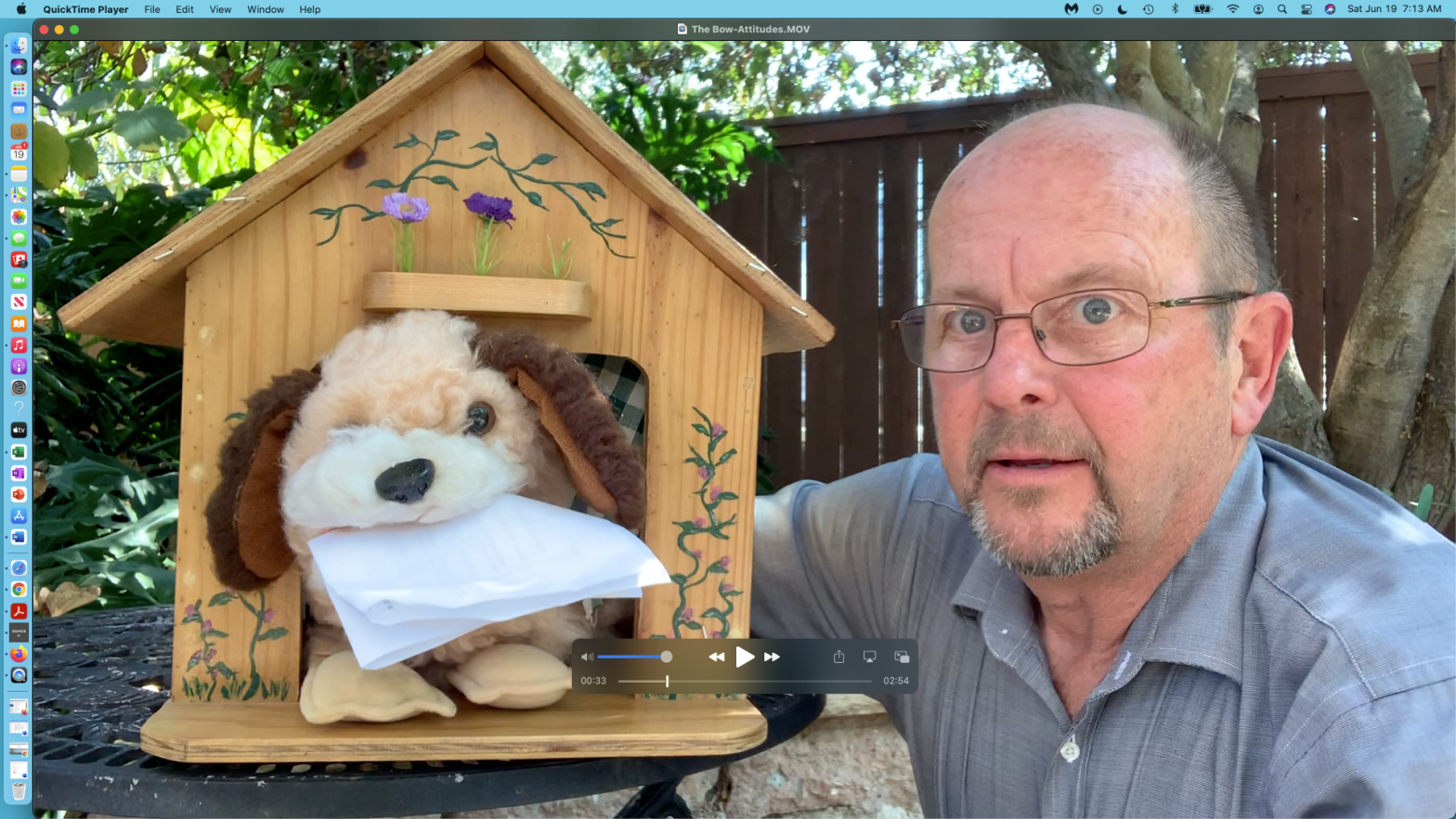
Disciple Dog’s “Bow-Attitudes”

         Last year I was preparing a sermon on the “Beatitudes” (Matthew 5: 3-12).  I shared some thoughts with Disciple Dog on our morning walks. Next thing I know, he told me he’d created his own list. He called them his “Bow Attitudes.”  Here they are:

Disciple Dog Shares His List of “Bow-Attitudes”

         DD came up with 7 things worthy of “bows” in his life that day.  Since then, he’s been regularly creating fresh lists as a spiritual exercise.  He’s taught me it’s a great way to start or end our day, and can help when we can’t sleep or are feeling anxious.  It actually is a practice that is useful in all kinds of situations.  “Tell them to give it a try,” he told me.  I said I would.