
Eleven years ago, we went to visit friends on the “Big Island” of Hawaii. One afternoon we visited a black sand beach; only a handful of other people were there. I went in for a swim. The water was warm. I was floating about 100 yards out, looking back at the beach, when a soft rain began to fall. The raindrops were also warm and made a barely audible sound as they met the surface of the ocean before dissolving. My body was in the ocean and my head was just above the surface, so I was floating on the boundary between the sea and sky. I was also on a boundary of awareness – focusing not on any immediate concerns but simply being aware. I’ll never forget the feeling.
Moments of awe and wonder are a common human experience, and the words we use to describe such experiences include “magical,” “mystical,” and “timeless.”
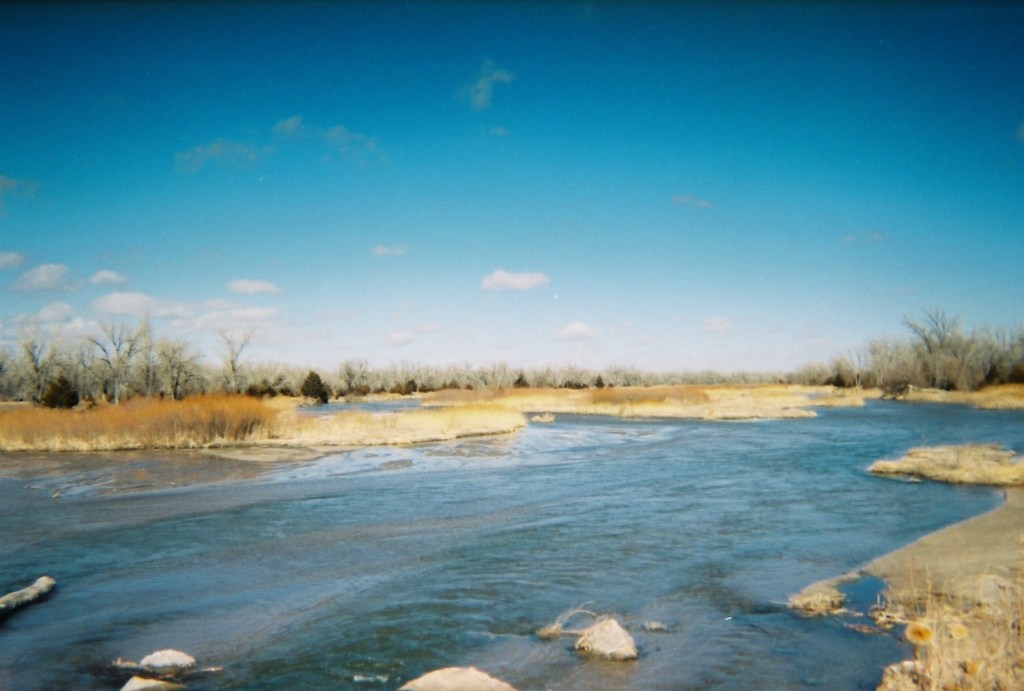
I was at a conference recently where a speaker shared a passage about floating in a river. It was written by Loren Eisley, a popular science writer in the mid-20th Century. He grew up in Nebraska and spent much of his childhood wandering the countryside. One day he was at the bank of the wide and shallow Platte River and followed an impulse to not just observe the river but become part of it. His experience integrates his scientific knowledge, physical sensations, and receptive imagination:
I thought of all this, standing quietly in the water, feeling the sand shifting away under my toes. Then I lay back in the floating position that left my face to the sky, and shoved off. The sky wheeled over me. For an instant, as I bobbed into the main channel, I had the sensation of sliding down the vast tilted face of the continent. It was then that I felt the cold needles of the alpine springs at my fingertips, and the warmth of the Gulf pulling me southward.
Moving with me, leaving its taste upon my mouth and spouting under me in dancing springs of sand, was the immense body of the continent itself, flowing like the river was flowing, grain by grain, mountain by mountain, down to the sea. I was streaming over ancient seabeds thrust aloft where giant reptiles had once sported; I was wearing down the face of time and trundling cloud-wreathed ranges into oblivion. I touched my margins with the delicacy of a crayfish’s antennae, and felt great fishes glide about their work.
I drifted by stranded timber cut by beaver in mountain fastnesses; I slid over shallows that had buried the broken axles of prairie schooners and the mired bones of mammoth.
I was streaming alive through the hot and working ferment of the sun, or oozing secretively through shady thickets. I was water and the unspeakable alchemies that gestate and take shape in water, the slimy jellies that under the enormous magnification of the sun writhe and whip upward as great barbeled fish mouths, or sink indistinctly back into the murk out of which they arose.
Turtle and fish and the pinpoint chirpings of individual frogs are all watery projections, concentrations–as man himself is a concentration–of that indescribable and liquid brew which is compounded in varying proportions of salt and sun and time.
It has appearances, but at its heart lies water, and as I was finally edged gently against a sand bar and dropped like any log, I tottered as I rose.
I knew once more the body’s revolt against emergence into the harsh and unsupporting air, its reluctance to break contact with that mother element which still, at this late point in time, shelters and brings into being nine-tenths of everything alive[i].
Spirituality has a great deal to do with how we live our day-to-day life, but it also includes an underlying sense that there is a seamless unity in the natural world, and we are only a small part of it. Eisley was an evolutionary scientist who did not consider himself religious but had a profound reverence for the mystery and wonder of life.
2500 years ago, an anonymous observer composed a poem known as Psalm 104. It would be centuries before science would begin to comprehend evolution and the biological basis for life. But the writer had seen, felt, and intuitively understood what is important. It’s 35 verses long, and only five of those verses refer to human beings. The rest focus on the interplay of water, oceans, streams, clouds, and the many life forms with whom we share the earth.
Psalm 104 found new relevance in the 1970s during the dawn of the environmental and eco-spirituality movements. It describes a world in which humanity’s task is not to dominate the natural world but to revere it.
I was once on a hike with my friend Rabbi Cohen. I mentioned how I had recently been reading Psalm 104 with new appreciation. He told me a great poet and philosopher, Johann Gottfried Herder, wrote “It is worth studying the Hebrew language for ten years in order to read Psalm 104 in the original.”
Water is something more than what comes out of a tap.
“If there is magic in this planet, it is contained in water.”[ii]
[i] Loren Eisley, The Immense Journey: An Imaginative Naturalist Explores the Mysteries of Man and Nature,” pgs. 18-20, 1957.
[ii] Eisley, pg. 15
Photo credits: “Black Sand Beach Along the Road to Hana, Nancy Schretter; “Platte River:” Platte River Resilience Fund, Nebraska Community Foundation
 Steve Jacobsen, Ed.D