What Gets Your Ghost?

This is a season of ghosts and spirits. Let’s imagine your “ghost” is out and about for a few hours. You find yourself walking in a neighborhood you’ve never been in before.  You notice there are three houses side by side. As you approach the first one, the door opens. You enter.  

  1. House #1: You find yourself descending into an underground complex, and the door shuts behind you. You walk through an ancient gate, are ferried across a river, and are assigned a place on one of the nine floors.  You realize this is a place where you will never have to pretend to care about anyone else.  Instead, you have unlimited time to proclaim to anyone within earshot how other people and forces were responsible for all the disappointments in your life.  There are other “ghosts” on the floor with you, but no one seems to even know you are there. But you don’t care.  You start ranting about divine injustice, the influence of the stars, your terrible family, and all the people you encountered who did you wrong. Occasionally one of the other ghosts floats your way and pours out their own misery and outrage, but you don’t even pretend to listen to them – you just continue your diatribe.
  • House #2: In the blink of an eye, you find you have left the first house and are in front of the door of the second. You enter and join a group of fellow spirits.  You are all standing at the base of a mountain.  Everyone seems glad to have arrived, and they sing a song of gratitude.  The group begins a long hike up a mountain.  You can’t travel alone – you must stay with your group and support each other.  From time to time, someone will start singing a familiar song and everyone joins in.  You have a guide who seems very knowledgeable and ready to answer any questions you might have.  You find yourself taking time to make a personal review of your life.  As each important experience comes up, you take responsibility for your actions and learn something new.  As you do this, you feel burdens of regret that you’ve been carrying for a very long time being lifted. You get to the summit and enter an enchanted garden; personal guides come to welcome you.  In an instant, you find yourself back on the street in front of the third house.
  • House #3: As you walk through this door, you feel weightless and buoyant, and realize you are ascending through the atmosphere toward the heavens.  You find yourself on the moon. You feel refreshed and renewed.  You realize you can remember details of your life, but you’re no longer preoccupied with yourself.  Instead, you are fascinated by the other people you are meeting along the way – some you know from your life, and some are new acquaintances.  You can’t help but marvel at their essential goodness.  You’re also enraptured by seeing the moon, planets, and stars with amazing clarity. You notice that some people are positioned above you, closer to the source of light.  But you don’t care because you are no longer comparing yourself with others, and you know that to be anywhere in this dimension is to be filled with wonder, appreciation, and freedom.  Then, suddenly, you’re back on the street.

These are, very roughly speaking, characteristics of the three dimensions of the afterlife described by Dante in 1300 in his masterwork, The Divine Comedy.  It reflects his personal understanding of the universe, human behavior, and spiritual truth. It arises out of his own beliefs and biases and is a product of its time.  But, like all great imaginative works of literature, it contains great insights into human behavior.  House #1 is a sample of what it’s like to be in Inferno, where you are endlessly immersed in your own self and your prejudices and don’t give a damn about anyone else. Destination #2 is “Purgatorio,” where you have the chance to work through whatever has burdened you, aided by being in community with others.  And Destination #3 is an imaginative glimpse of Paradiso.

I don’t know exactly what happens when we die.

What I do know is that Dante captures what we can experience in the here and now.

To be constantly engulfed and isolated in anger and resentment is like existing in a living hell.

To be on a spiritual journey is like being on a long trek where we learn more and more about ourselves and life every day and, as we make the journey, we learn the importance of friendship and caring for one another.

And having moments when we forget ourselves and, instead, catch glimpses of the beauty of the natural world and other people is like finding heaven on earth.

Image above: “Piccarda Donati meets Dante and Beatrice on the Circle of the Moon,” Canto 3 Paradisio; Salvador Dali

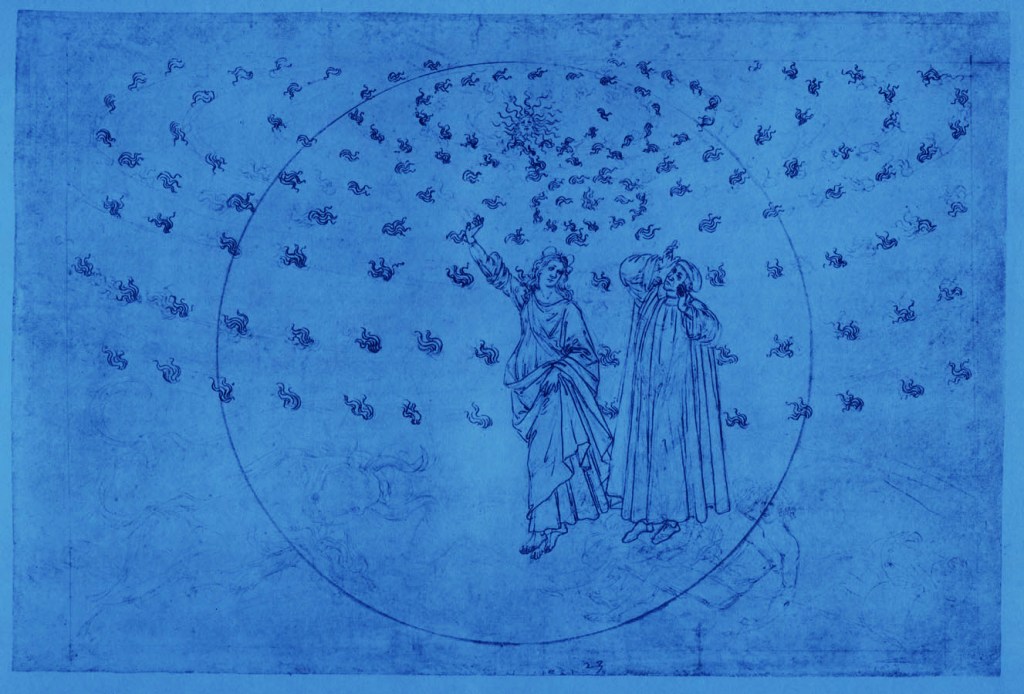
Image below: “Beatrice Shows Dante the Fixed Stars,” Boticelli
Tasting the Magic Waters

            For more than a decade, I’ve been entranced by the great three-part medieval poem, Dante’s Divine Comedy.  There are many spiritual and psychological insights Dante shares in this work that speak to me. In this posting, I want to share his concept of two symbolic rivers we might sample in our life journey. The description occurs near the end of the second volume, Purgatorio.

By this point Dante’s been given a tour of hell (Inferno) and all its custom-made torments. It’s impressive to see how he imagines the bad guys “get what’s coming to them,” as they used to say in the Westerns.  But Inferno is not as meaningful to me as what follows.

In Purgatorio, he imagines hiking up a mountain to see how all kinds of people are completing their personal soul-work as they prepare for Paradiso.  (Does he – or anyone these days — really believe in a place like purgatory, you might ask? Don’t worry about it, dear reader; let’s just follow what he imagined.)

As he gets to the top of the mountain, he travels through an enchanted forest and, among other experiences, comes to two rivers.  He also encounters a guide, Mathilda.  The first river Mathilda leads him to is the Lethe, which was known in Greek mythology as the river of forgetfulness we pass through after we die.  Dante interprets it in a positive way:

“She plunged me, up to my throat, in the river

And, drawing me behind her, she now crossed

Light as a gondola, near the blessed shore, I heard

“Asperges me,” so sweetly sung that I

Cannot remember or, much less, describe it.” (Canto 31: 94-99)

“Asperges me” means “thou shalt sprinkle me.”  After guiding him across the river, she invites him to take a drink.   All the memories of the mistakes he’s made in life – the poor decisions, the times when he’s hurt someone else or disappointed himself – all are washed away in the Lethe. Think about your regrets in life – what would it feel like to have the painful memory of them disappear?

“The River Lethe,” John Flaxman, 1807

            After more encounters and reflections, he comes to the second river – one Dante created out of his own imagination — the Eunoe.  Matilda is joined by a group of guides and invites Dante and a fellow pilgrim to drink from it.  After he does, he says:

If, reader, I had ample space in which

To write, I’d sing – though incompletely – that

Sweet draft for which my thirst was limitless…(Canto 33: 136-138)

Where the effect of drinking from the Lethe was to allow him to forget all his failings, drinking from the Eunoe allows him to recall all the good deeds he’s done in life, both large and small.  (The word he created, eunoe, combines eu(new) – and noe(mind) – a new, fresh mind.)

The River Eunoë, John Flaxman, 1807

            Think about it. Sure, you’ve made mistakes in life. But you’ve also done many good things – small kindnesses, acts of love and duty, promises kept, hope given, and friendships honored. Imagine what it would be like towards the end of life to forget all the bad stuff you’ve done and remember all the good?

            From the first time I read about these two mythic rivers, I was entranced by imagining what such an experience would feel like.  In the years since, I’ve come to wonder if sometimes people actually experience something similar.

            My father outlived my mother by 19 years.  We knew they loved each other all the years they were married. But we also remember their life together was not free from the stresses and strains of many long-term relationships.  Yet in his last years, whenever dad reflected on their time together, all he talked about were the joys they’d shared — no mention of the hardships.  At first, I was tempted to kindly point out it wasn’t all milk and honey. But something told me to be quiet.  It was as if dad had dipped first into the Lethe, then the Eunoe, and the combination filled him with pure gratitude.

            Recently I visited a former parishioner who had decided to stop receiving life-prolonging treatments. She’d been through many challenges in her life, including years of concern for her children and the obstacles they faced. But, she told me, they were both doing well now and didn’t need her as they had before.  She was tired of the complications her body was having to endure every day and she wanted to be free.  When I came, she was going through a box of old family photos.  After I sat down, she showed me some of her favorites. Each memory had become a delight.  Before I left, I asked her if there was anything she’d like me to pray for. She told me, “Somebody said, If the only prayer we ever offer is thank you, that would be enough.  Just say how grateful I am.’

            Remembering our mistakes helps us to stay humble and keep learning how to do better. Focusing only on the good we’ve done may seem selfish.  But maybe, once in a while, we can close our eyes and imagine sampling those waters – tasting what it’s like to have our regrets washed away, then savoring a pint of gratitude for the good things we’ve done.  Maybe we shouldn’t wait until late in life to see what these magic waters can teach us. 

Painting: “Along the River Lethe,” Kyle Thomas

Silver Keys, Mean Moms and Compassion in the Workplace

…and from beneath his robe he drew two keys; the one was made of gold, the other of silver; first with the white, then with the yellow key, he plied the gate as so to satisfy me.     

 “Whenever one of these keys fails, not turning appropriately in the lock,” he said to us, “This gate of entry does not open…”

            “One is more precious, but the other needs much art and skill before it will unlock – that is the key that must undo the knot.”

                 Dante, The Divine Comedy, Puragatorio, Canto 9:115 – 126

            I first began exploring Dante’s The Divine Comedy fifteen years ago.  It’s an imaginary journey through the afterlife, drawing on the scientific and religious knowledge current in 1300 AD, formed by and filled with Dante’s extraordinary imagination.  Despite being written long ago, I’ve found it contains fascinating spiritual and psychological insights.  I’m currently in a year-long Dante study group meeting on Zoom every Monday afternoon.  I want to share with you a brief passage we read recently.

            Dante is being led through different stages of the afterlife by his guide, Virgil. At this point he has passed through the underworld (Inferno) and is at the foot of Mount Purgatory. If we want to get to paradise, we need to make this trek — a final chance to overcome our personal shortcomings.  

            Dante and Virgil come to the entry at the base of the mountain. They meet an angel who guards the gate, possessing two keys given by St. Peter.

            As seen in the passage above, the angel pulls them out from his robe: one is gold and one silver.  He says the gold one is “more precious.”  The silver key is not as valuable, but you can’t open the gate without it, and using it takes “much art and skill.”  Scholars have long believed the gold key represents the pure gift of divine love; the silver symbolizes how that love is actually applied in the real world.

            I love this distinction.  Here’s why.

            Last week my posting was “Uncover the Love,” which focused on a personal experience I had in a sweat lodge.  I saw how love is always present in our lives, even if we don’t recognize it.  I linked that to the Buddhist concept of “metta” (compassion) and the Christian concept of “agape.”  In light of the Dante passage, these are represented by the “gold key” — love, grace, and compassion in their purest form. 

            It’s one thing to receive this gift. But how do we apply it in the complex situations we face in everyday life, including family and work? For that we need the silver key: the art and skill of applying love and grace in the here and now.

            Reflecting on this theme, I was reminded of a Mother’s Day sermon about being a “mean mom” I once heard from my long-time friend, LuAnn Miller. I contacted LuAnn this week to help me remember what she said that day.  She replied with a summary:

            “Thanks for checking! Sometimes I needed to be the “mean mom” and set boundaries. Nobody gets to do everything or get everything they want! Possible short-term scowls usually lead to long term steps to being a responsible, kind, loving citizen of the world.

            She has always loved her boys. But sometimes loving them meant not letting them do what they wanted. Compared to lenient moms they knew, she was “mean.” She gladly accepted the label, knowing she was doing what was best in the long run.

            This is an example of using the “silver key.”  You love your kids, and you don’t want to disappoint them. But the art and skill of being a loving parent includes setting boundaries and expectations kids may not appreciate at the time.  Your love for them is good as gold, but to make it real you need to be a silversmith.

            I also thought of a story I heard at a business and spirituality conference.  The speaker affirmed that many of us want to be compassionate, but that’s not always easy in the workplace. 

            There was a woman in his company who loved to make conversation. The problem was that she shared a work room with six others. Her constant talking made it hard for them to get their work done, and they asked him to do something.

            He noticed another company had an opening for a front office receptionist.  He encouraged his employee to apply for it and he put in a good word on her behalf. She got the job.  Two months later, he visited that office and she greeted him. She thanked him for helping her get a job she loved. And her former coworkers were relieved they could work in peace.

            The right thing to do was not to simply feel compassion for everyone involved, but to find a solution to the problem. That took “art and skill.”  

            My friend LuAnn added a bit more about what she had said: “The other part of my talk, as I recall, was the importance of having other adult people in our kids’ lives. Teacher, neighbor, auntie or uncle, grandparent, LOG (Love Of God, our youth program) …I believe each person has the opportunity to be “that person” to make a small difference for someone. With a smile, word of encouragement or a loving reminder of a boundary.” 

            Love, grace and compassion are divine gifts, I believe. But it takes “much art and skill” to apply them in life.  We benefit from any “silversmiths” we may know:  teachers, neighbors, friends, and family when we are raising kids, and wise colleagues when the challenge is at work. 

            “One is more precious, but the other needs much art and skill before it will unlock – that is the key that must undo the knot.”

Top image: William Blake, Dante, Divine Comedy, Purgatorio, Canto 9, c 1827

Dante, Purgatorio, Canto 9, Bodelian Library, Oxford, c. 1350
Dante, Purgatorio, Canto 9, Franz von Bayros, Vienna, 1921
The gold/yellow and silver/white “keys” on the Papal flag. In Dante’s time, the gold represented the “supernatural powers to administer God’s grace” while the silver represented the church’s power in political affairs, as well as issues like excommunicaiton.