The other day I was doing my physical therapy exercises. I was bored. My restless brain began looking for something to distract itself. I thought about the different stages of life we can go through and came up with my own scheme.
Stage 1:I want to be amazing. This stage begins in infancy when we start to walk, entertain adults and throw tantrums. It continues in school when we try to figure out what we might be good at so other kids and adults respect us: Sports? Academics? Flirting? Gossip? Making money? This stage can continue for a long time.
Stage 2: I seem to be losing ground – but I bet I can be as good as I used to be if I put my mind to it! This stage can begin in our 40s, 50s, or 60s. There are some activities we realize we cannot do, but we believe we can reverse this process if we put our mind to it. We buy self-help books, lots of supplements and find encouraging podcasts. Maybe we join a gym or try online fitness classes. In the beginning, we feel great and become optimistic. We imagine a whole new chapter in our life — we will be one of those people who are told, “Wow, you look great for your age!” Maybe that fantasy comes true. But for most people, not much changes. One day we realize our youthful ship has sailed.
Stage 3:I’ll never be as good as I used to be, but maybe I can slow the decline. We stay active not to become “Comeback Player of the Year” but to adapt as well as we can. At first it may feel like a defeat, but it can also bring a sense of relief. We look at younger people and are amazed at how effortlessly they go through their day. We look at our own body and our thoughts can change from “Why have you failed me?” to “I’m going to do what I can to honor you in the time we have left.”
Stage 4: Loss and Wonder. We grieve what we’ve lost and are losing. But we realize it’s amazing we’ve made it this far, seen what we’ve seen, and done what we’ve done. We don’t know how much time we have left but we’re not dead yet. We try to be useful to others and enjoy simple pleasures. In quiet moments, we witness the mystery and miracle of being alive.
“As a lifelong traveler, I felt in my bones how home is not where you happen to live so much as what lives inside you…my inner savings account…the Sufis say that you truly possess only what you cannot lose in a shipwreck.”[i]
I spent five months backpacking in Europe in 1975. One summer day I was hitchhiking in Bavaria from the mountain village of Lindenberg towards Munich. There were few cars on the country road, so I was walking more than riding. I saw a thunderstorm approaching. I noticed a 2-story farmhouse up ahead and realized it might offer some shelter. I got there and huddled under the eaves as the rain began to fall. A few minutes later, the door opened. A woman stepped out and offered me a black umbrella with a wooden handle. I could not speak German well enough to converse with her, but we nodded and smiled at each other. She went back inside. I opened the umbrella and stood under it. Fifteen minutes later, the rain stopped. I shook it off, folded it, fastened the fabric strap around it, and knocked on the door to return it. She opened the door and I handed it to her, bowing my head in gratitude. But she smiled and motioned to me to keep it. Surprised, I thanked her and resumed my trek.
I kept that umbrella with me for the rest of my trip. I took it with me on the flight home. I kept it for years afterward, even as it got frayed. Every time I would pick it up, I was taken back to that moment and the gracious kindness the woman had shown me. I’ve kept the memory all these years. It’s part of my “inner savings account.”
What lives inside us? Memories of many kinds.
How often do you hear a song that takes you back to a time when you first heard it as it was “deposited” into your memory account? How often does a food remind you of your childhood? How valuable are our spiritual expereinces and beliefs? How vividly do we remember the unexpected kindness of strangers?
Isn’t it the case that, the older we get, the more likely we are to draw something from that account and share it with others while we still can? Unlike monetary bank accounts, withdrawing a memory doesn’t mean you lose it; instead, you are keeping it alive.
I have always appreciated listening to peoples’ stories and keen to know what those experiences have taught them about life. I add them to my storehouse of significant experiences, even though they did not happen to me. Learning from the memoires of others is like investing in a communal “mutual fund.” Sharing stories with family, long-time friends, and in spiritual communities is like having shares in “Mutual Memory Funds” from which we all benefit.
As years go on, our ability to access memories in our own personal account may diminish, which is all the more reason to claim them while we can.
Our “Inner Savings Accounts” and “Mutual Memory Funds” are lifetime investments that don’t get lost in shipwrecks, wildfires, floods or fluctuations in the stock market. They are “high yield accounts.” They live with us and with those with whom we share them. I no longer have that umbrella, but what it means to me will never be lost.
[i] My notes tell me this is attributable to the writer and world traveler Emily Hahn.
Several years ago, I read about an African hunting/gathering community that had virtually no prior contact with “civilization.[i]” For two years an anthropologist recorded daily conversations, coded them, and analyzed them. Some key findings:
Almost all the daytime conversations involved work, with approximately 37% consisting of people complaining others weren’t doing their fair share.
Tribal elders did not have much to say or contribute during the day.
At night, everyone gathered around the fire. The focus changed from work to spiritual topics, tribal history, and “subtle psychological insights.” Elders became central to these conversations. The conversations could last for hours, and the old ones might nod off. But after a rest, they would often rejoin the circle.
At the time I read the article, I was leading a nonprofit with 30 employees, and these themes resonated with what I was experiencing:
The hardest part of the job was dealing with “HR Issues” – people’s work performance and how people would fret about the performance of others (probably close to 37%).
Younger employees often had more energy and could work longer. They also had more skill and less anxiety dealing with IT issues and were invaluable for pointing out cultural changes that were occurring and how we might adapt.
While everyone might have insights into our work, it was the older ones who held the “tribal memory” of both the organization and the profession and were particularly helpful in offering long-range perspective.
Later I saw an article about how our evolutionary past might explain the way memory changes over time.[ii] As we know, older people begin having difficulty with short-term memory (“Where are my glasses?” “What’s my password?”) But even seniors with dementia can have remarkable recall of past events. When our ancestors were hunting or gathering during the day to survive, they had to rely on mental alertness and physical abilities. But as they became slow, creaky, and sore, their value to the community shifted – they were the ones who carried the valuable stories; short-term memory was less important.
Maybe evolution also explains our sleep patterns. During COVID, I read Why We Sleep[iii]. The author notes that some adults go to bed early and wake up early while a roughly equal number of people go to bed late and sleep late. He theorizes this may be an inheritance from our past: it would be advantageous to have people awake at different times of the night to act as sentries for the tribe. So maybe this is one reason older folks wake up more often at odd hours — they’re wired for sentry duty. (Of course, the seriousness of the danger has changed; instead of “Is that a lion I hear in the forest”? it might be, “Does the dog need to go out?”)
These ideas comfort me. I like to think some of the changes we experience as we age aren’t because there’s “something wrong” with us, but because of deeply engrained behaviors that were advantageous for our ancestors.
I’ve always been fascinated by how Rembrandt was able to document his aging process. He portrayed himself close to 100 times, 40 of which are complete paintings. Here is one from 1632:
This 26-year-old guy is on top of his game – no doubt staying up late, full of energy and confidence, and successfully adapting to the latest trends and techniques.
And here he is 31 years later at age 57:
He may not be not going out as much…probably frustrated with aches and pains…going to bed earlier than he used to and waking up at odd times during the night. Maybe you wouldn’t ask him to help you move furniture across town. But look into his eyes: wouldn’t you like to hear some of his stories?
[i] I wish had the citation for the article, but I can’t seem to find it.
[ii] I can’t find this article either. Do you remember where I put it? Did you move it? You didn’t throw it away, did you?
[iii] I found this one! Why We Sleep: The New Science of Sleep and Dreams, by Matthew Walker.
Top image: “White Mountains Moonlit Campfire,” Getty Images
She was named after a character in The Hunger Games and sometimes goes by the alias, “Rue-Rue.” She 11 years old and weighs 8 pounds, 2 ounces. As she’s gotten older, she’s had seven teeth pulled. She also has a “collapsing larynx,” meaning she often snores. But she doesn’t seem to lament her fate, or question why she’s here. She makes the best of each day.
This is Sita:
Aliases include “Sita-Ram” and “Ram-Stine.” She’s 12 years old and weighs 69 pounds, 8 ounces. She now struggles when she gets up in the morning due to arthritis, and her right eye is partially closed. But she doesn’t seem to lament her fate, or question why she is here. She makes the best of each day.
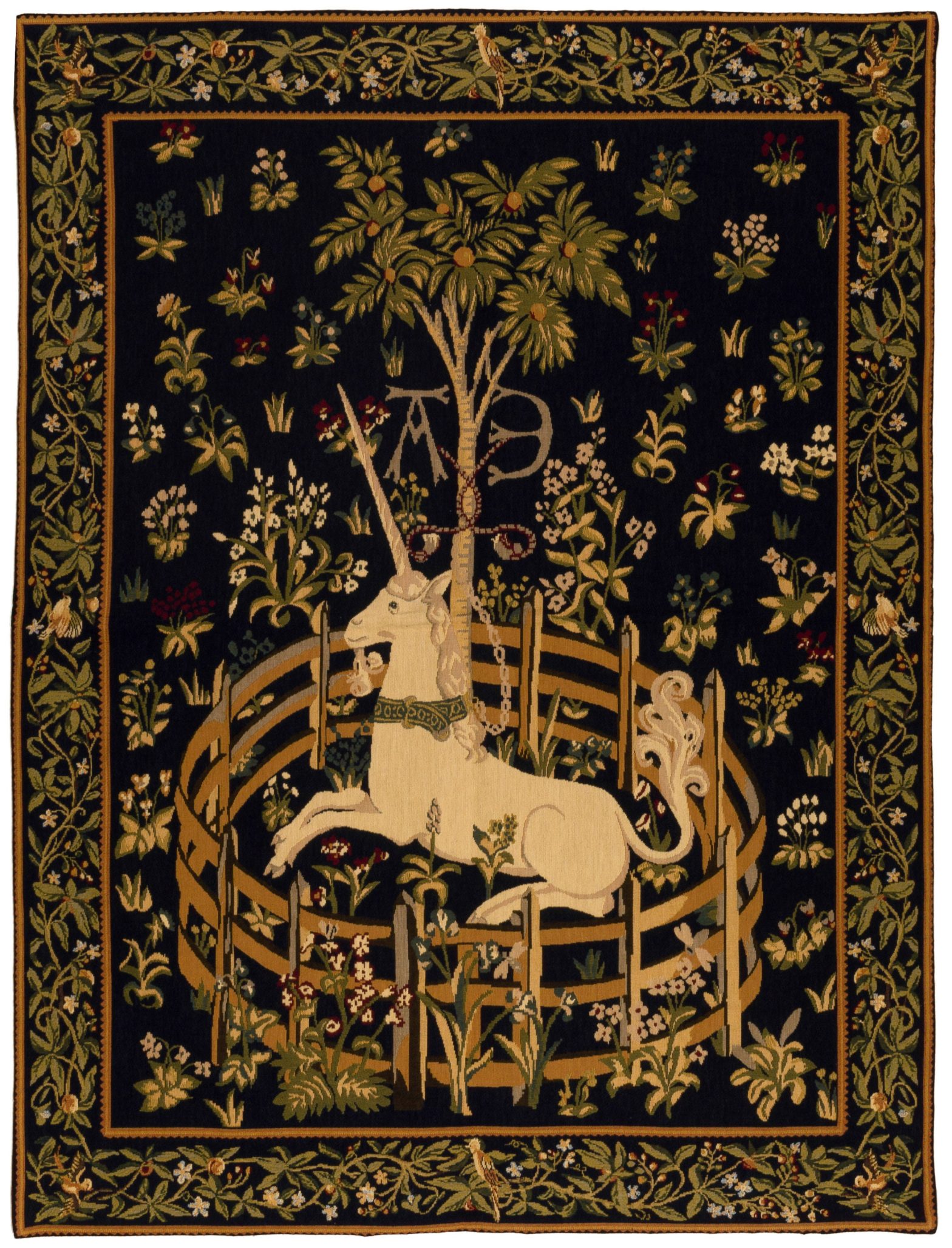
This is one of the “Unicorn Tapestries”:
It’s about 520 years old, and currently lives in New York at the Cloisters Museum. I don’t know how much it weighs. There are many opinions about what it means.
The first time I saw it was in the office of a long-time friend and Jungian therapist whom I would visit when facing important decisions. We’d explore my dreams to understand what was going on within me, and we shared an appreciation for spirituality, myths, symbols and metaphors.
Her office was in downtown Santa Barbara. One day I came for my appointment, saw her door was open, and went in. She was busy finishing something at her desk and invited me to take a seat. As I sat there, I looked around her office. I noticed the print of the unicorn tapestry on her wall. I was curious why it was there.
She finished making her notes and came to sit across from me. I asked her about it.
“It’s a famous image from the Middle Ages,” she said. “Some say the unicorn represents the experience of being alive. Our soul instinctively feels like we are magical creatures and should be free to travel anywhere and do anything. But the corral keeps us constrained in a space that seems too small, like the limitations of our physical body. The question is: do we resent the limitation? Or do we accept it as part of being an incarnated spirit?”
I purchased my own copy of the “Unicorn Tapestry” and had it framed. It was on the wall of my office at La Casa de Maria Retreat Center when the 2018 debris flow swept it away, along with the entire building. But I still think about it.
Do you ever feel like the unicorn? Within yourself you sense your soul, your spirit — an awareness of being alive and unique that you first felt in childhood? At times you delight in the freedom your spirit has to dream, to explore, to create – to be like a magical creature.
But then there’s this body, and the limitations of life. Sometimes this body is a delight of its own as we experience so many wonderful things through our senses. But other times our body seems to work against us. We get sick. We get injured. We age. We don’t belong in this corral!
There have been at least two ways to look at this in spiritual traditions.
Some have held that physical existence is a curse. We are born into “original sin,” and deserve to suffer whatever befalls us. Years ago, there was a funeral in our town for a young man who had died tragically. The priest said, “God could have saved him. But why? Who wants to live in this world of sin?”
Other traditions hold that suffering and limitations are not a form of divine punishment, but simply a natural aspect of being biological creatures. Why we are here, where our awareness comes from, and where we are ultimately headed is a great mystery. But if we try to fathom all the amazing processes which make it possible to simply be alive, how can we not say life is “a marvelous work and a wonder?”
This is me:
I’m 69 years old and decline to give my weight. On my bathroom shelf are two 7-day pill containers – one for the morning, one for the night – to help me remember to take my medications. I sometimes don’t recognize myself in the mirror. I often wish I was younger and could do activities I used to take for granted. I’ve seen some terrible tragedies in my life that still haunt me, and have abiding respect for people who have endured great heartbreaks, limitations and loss.
This is me with our new granddaughter, Selah Rose:
I’m holding her in my lap on Christmas day. She’s 3 weeks old. She weighed 6 pounds, 6 ounces when she was born.
I don’t know how I’ve made it this far, and don’t know how much longer I’ve got. But when she held my finger as she slept, I was reminded what a miracle it is for all of us to be alive. And to make the best of each day.






 Steve Jacobsen, Ed.D