Last month I attended a hospice event featuring David Kessler, a leading educator and author specializing in grief work. He shared one of his guiding principles: “What we run from pursues us. What we face transforms us.”
It resonated with a comment I recently read in The Tears of Things by Fr. Richard Rohr: “Remember, if you do not transform your pain and egoic anger, you will always transmit it in another form. This transformation is the supreme work of all true spirituality and spiritual communities.”[i]
Rohr gave an example of this in a recent YouTube interview with Oprah Winfrey. Over the years, he has done a great deal of work with men’s groups. Early on, he learned many of them had fathers who were often angry. Midway through the retreat and when a sense of mutual trust had been established, Rohr would tell the men that the source of such anger is often unexpressed sorrow. If we don’t express the sorrow, it builds up and becomes anger. When the men at his retreat heard this, their feelings towards their fathers often shifted from resentment to compassion.
Sometimes we need to be in the right environment – like a retreat center or in the presence of a caring person — to let the pain surface.
When I was at Hospice of Santa Barbara, we obtained funding to initiate a community spiritual care program. Believing there is a great deal of hidden pain and grief in nursing homes and retirement communities, we offered weekly visits from our staff to several nearby facilities. One of our counselors was asked by the social services director at one facility to visit a new resident who had become reclusive since moving in. He went for the first visit and was politely received. She told him her adult children had wanted her to make the move from the East Coast so she would be closer to them. She appreciated their intent, but moving cross-country meant she had to leave her long-time community and friends. After an hour of cordial conversation, he offered to come back the next week for a second visit, which she accepted.
During the next visit, she talked more openly about her sense of dislocation and loss.
He came back the next week, and after some brief conversation, she began weeping, then sobbing. Then, he said, emotion came out so strongly that she was physically shaking; he had rarely seen someone break down so intensely. Eventually she became calm and composed. Their time was up, and she thanked him for the visit.
When he returned the next week, she suggested instead of staying in her apartment she show him the nearby rose gardens.
When we can face and bear the pain that pursues us, we find not only a sense of release and relief but also greater awareness of the blessings around us.
I’m reminded of the last verse of the 23rd Psalm. After alluding to times when the writer needed rest and renewal, as well having passed through the “valley of the shadow of death,” the imagery shifts to a sense of gratitude: “Surely goodness and mercy shall follow me all the days of my life…” Years ago I read a commentary on the Psalm by Rabbi Harold Kushner. He posed the question: What does it mean that goodness and mercy follow me? Aren’t they with me all the time? They are, he says, but we are often too distracted and are running out ahead of them. But when we take time to stop and be present with our life, they can catch up with us and come sit in our lap.
[i] Rohr, The Tears of Things, pg.6
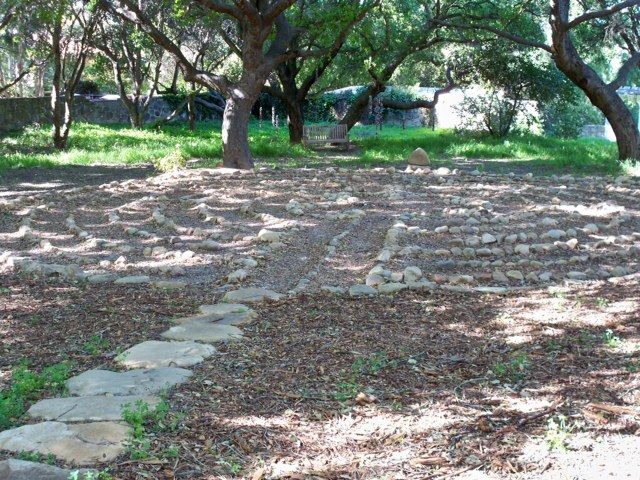
Lead Image: Outdoor labyrinth, La Casa de Maria


 Steve Jacobsen, Ed.D