Five Tips for Everyday Living

Last year, David Brooks wrote a column in which he shared a list of 38 “life hacks” created by a tech writer he admires, Kevin Kelly[i].  They may not be profound spiritual insights or revelations – they’re more like practical suggestions on how to manage everyday situations.  Here are five that spoke to me:

  1. … over the last few years I have embraced, almost as a religious mantra, the idea that if you’re not sure you can carry it all, take two trips.  Many times in my life I’ve parked my car… looked at the various items I want to take in… recognized it was going to be a challenge to get them all in one trip…, and then heard a voice saying “Yeah, it’s a lot, but you can do it!”  I awkwardly fill up my arms with all the items…try to shut the car door with a foot…and something spills on the sidewalk. Or maybe I get as far as the front door, discover it’s locked, and as I try to get my keys out of my pocket, disaster strikes.  Since reading this, I am catching myself in that moment of decision between foolish optimism and sober realism.  Choosing the Calm-and-Practical-Me in such moments makes me feel like a Zen master.  Less spillage, less embarrassment, and a glimmer of maturity.  Low-cost liberation!
  2. Something does not need to be perfect to be wonderful, especially weddings.  I’ve participated in many weddings over the years, and, to tell you the truth, they often make me nervous.  Expectations can be high in terms of the flowers, the decorations, the timing, the participants, the food, the guest list, and the schedule of events.  The most expensive formal wedding I ever presided at started late because the bride and groom were arguing with lawyers about the prenuptial agreement; the marriage itself lasted only a few years.  I contrast that experience with the ceremonies I’ve been part of that have had a mood of ease, quiet joy, humor, reverence, and genuine affection.  These ceremonies may not reach Martha Stewart’s standards, but they are experiences where love and wonder met.
  3. The biggest lie we tell ourselves is, “I don’t need to write this down because I will remember it.”  It’s amazing how many things we think we will remember but forget. Of course, the older we get, the more this occurs. I’m trying to be more intentional about writing things down on notecards or with the memo app on my phone.
  4. If you can’t make up your mind between two options, flip a coin. Don’t decide based on which side of the coin came up. Decide based on your emotional reaction to which side came up.  I’ve often quoted David Brooks’ comment “Our culture assumes we are brains on a stick.”  The truth is we have many ways of knowing including feeling, intuition, and “somatic intelligence” – the idea that our bodies sometimes know truths hidden from our conscious thinking. I have a variety of different routes I walk in our neighborhood. In the last year or two, if I get to a familiar intersection and receive a prompting like, “How about turning left today instead of right and going down a street you rarely go?” I follow it.  I like to think it’s helping me tune in to that hidden way of knowing, which may better access our natural creativity.
  5. Don’t try to figure out what your life is about. It’s too big a question. Just figure out what the next three years are about.  I’ve been trying to figure out what life is about since I was a teenager and I am not giving up.  I intend to stay curious about spiritual insights, new scientific knowledge, and the practical wisdom conveyed by people I meet.  But I like this idea of making a three-year plan for the practical things in life.  It’s manageable.

The original article included 38 such suggestions. That’s way too many for me.  I’m thinking I can hold five at a time without dropping any. I also hope writing them down like this will help – if I remember where I put the list.

Here’s my summary:


[i] David Brooks, The Greatest Life Hacks in the World (for Now); June 2, 2022

Top image: “Monk Writing,” Carl Schleicher, 1903

Learning from the Redwoods

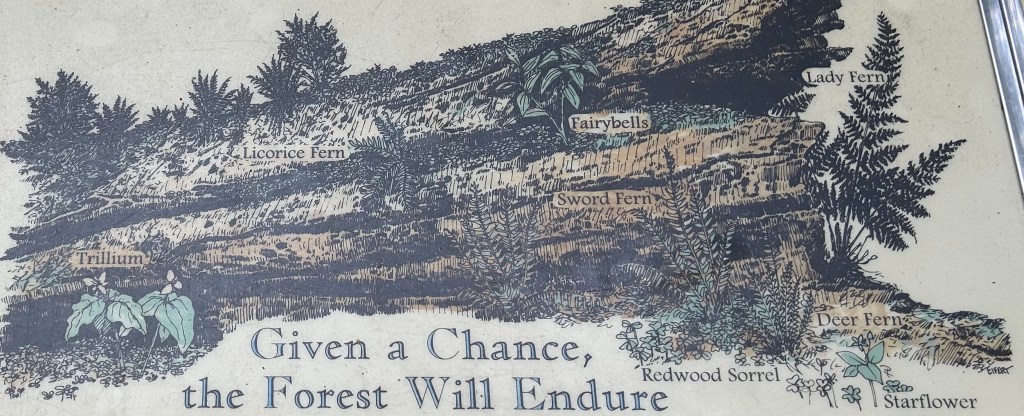
This summer we were driving south on the 101 along the coast of Oregon and Northern California. We were passing through the “Avenue of the Giants” in the Humboldt Redwoods State Park and decided to stop for a break and view the trees.  We came across this plaque:

Given a Chance, the Forest Will Endure

A natural coast Redwood forest is preserving itself through a nearly perfect recycling system. Most of the nutrients in the forest consist of living, then decaying plant and animal material.

As this material decomposes it provides nutrients for other living organisms.

Fallen trees account for as much as 40% of all organic material on the forest floor and many plants benefit from growing on these decaying nurse logs. Because redwood is an extremely long-lasting wood, the decay process may take centuries before all of a nurse log’s nutrients have re-entered the forest system.

Today this enduring forest will continue only if we as good land stewards allow it to.

Being uneducated in the way of forests, I never knew that fallen trees are a critical part of the redwood “nursery,” and that some trees may take centuries to patiently pass on the organic material that made their lives possible.  The more I thought about it, the more I thought of parallels to our own human life cycle.

 When we are young, we are nourished by those who are caring for us in the way of food, shelter, love, and guidance.  We are unaware of our dependence on the “nursery” that supports us.

 We grow into our teen years.  We may find ourselves looking up at the adult trees around us and become determined to find our own way upward.  We may think it will be easy to do. 

We launch out on our own, finding a path to the sunlight that’s not blocked by the older trees. There’s lots of sap flowing, and we can be fearless in our ambitions and expectations.

Adulthood comes.  We find times of satisfaction and accomplishment.  We also experience storms or fires; we learn life is not without risk.  At some point, we may begin to be as concerned about the younger saplings below us as the unconquered space above us.

Years pass.  We realize we are approaching the age and height of our ancestors.  We appreciate for the first time the hard work of becoming an elder.  We now identify with all those older trees that were invisible to us when we were young.  We are now one of them.

Maybe we survive and thrive for a long time.  But at some point, we will fall to the forest floor.  We’ve lost the lofty, open-sky perspective that we took for granted and now lie close to the ground where our life began.  We realize we are part of a life cycle and our role is shifting – now it’s more about releasing our energy to the next generations than holding it just for ourselves.  We may wonder: Will the saplings remember what we are doing for them, or will they, like us when we were young, take it all for granted?

A long period of time has passed, but it can seem like an instant.  Did we appreciate it while we were living it?

We worry about the future of the forest.  Will it survive the challenges to come?

Older redwoods pass on their organic material.  Humans don’t have much carbon and nitrogen to offer.  We can be nurtured by the lives and stories of our parents, mentors, and ancestors. We in turn try to pass on our awareness, hard-learned lessons, and love to the emerging generations.  We want the best for the forest and are grateful to play our part, yet we also realize we are not masters of its fate.

            “For everything, there is a season, and a time for every matter under heaven…” (Ecclesiastes 3:1)

Photo from Dreamstime.com

Is Spiritual Discernment Like Listening to a Crystal Radio?

            Recently I was in our backyard taking some early morning quiet time.  In such moments, I try to be attentive to whatever may arise.  At one point a phrase appeared unexpectedly: “crystal radios.”  My first thought was images of ads from my childhood where someone is wearing antique headphones connected to a little device on a table — leaning forward and listening carefully.

            I turned to Wikipedia and found this description:

A crystal radio receiver, also called a crystal set, is a simple radio receiver, popular in the early days of radio. It uses only the power of the received radio signal to produce sound, needing no external power. It is named for its most important component, a crystal detector, originally made from a piece of crystalline mineral such as galena. This component is now called a diode.

Crystal radios are the simplest type of radio receiver and can be made with a few inexpensive parts, such as a wire for an antenna, a coil of wire, a capacitor, a crystal detector, and earphones (because a crystal set has insufficient power for a loudspeaker). However, they are passive receivers, while other radios use an amplifier powered by current from a battery or wall outlet to make the radio signal louder. Thus, crystal sets produce rather weak sound and must be listened to with sensitive earphones, and can receive stations only within a limited range of the transmitter.[4][i]

            As I pondered this, I wondered if listening to a crystal radio is a metaphor for spiritual discernment…times when we are hoping for some guidance in a situation we are facing.  I came up with some similarities:

  • You are seeking something that is present in the environment but invisible.
  • You don’t need external power.  A crystal radio doesn’t depend on batteries, electrical power in your house, or your Wi-Fi router.  With spiritual direction, it’s all within you and in your environment.
  • The most important element is the detector. When I am seeking inner guidance, I’m like a detective, searching for clues and hints.
  • A crystal radio doesn’t require expensive parts.  When we are seeking out spiritual direction, we don’t need anything but humility, curiosity and awareness.
  • You need to listen carefully because the sound is faint.  The nudges and hints we find when we are looking for answers in life require a calm and receptive mind.
  • In the beginning, you need instructions on how to build and use the radio.  In the spiritual journey, friends or guides help us learn how to listen and interpret what we may experience.

Other ideas came to mind…

I’ve always appreciated Parker Palmer’s idea that your soul is shy, like a wild animal.  If you want to encounter a deer in a forest and go crashing through the brush, the deer will flee. But if you find a place to be still where you can wait patiently, like sitting on the porch of a cabin in the woods, deer may come to you.  For most of us, everyday life can include a lot of noise and commotion – from our devices, or others, or our busy inner life with its impulses, anxieties, and chatter. We need to do something like waiting respectfully in a forest.

I thought of the story involving the prophet Elijah.  In a time of personal crisis, he retreated to a cave.  After 40 days, he sensed the divine voice would speak to him. His initial expectation was that he would hear it as part of some dramatic events: a great wind, an earthquake, a fire.  But instead, it came to him – as described by different translators — as “a still small voice,” “a sound of minute stillness,” “the sound of sheer silence,” or “a gentle and quiet whisper.”  I love each variation.  A voice that is small and still.  A sound that is very close to silence.  Silence all by itself that nevertheless communicates something.  Or a barely audible whisper.  I know many people who have experienced moments like this.[ii]

I also thought of my years at La Casa de Maria retreat center.  People would come looking for personal guidance.  But epiphanies and insights rarely came right away.  It often took several days of being unplugged, resting, relaxing, and seeking out contemplative settings — on a solo hike, browsing our library, sitting under an oak tree, or meditating in one of the chapels.

I was also reminded of Paul Simon’s new album Seven Psalms, which originated several years ago when he was awakened at 3:30 in the morning feeling as if he was being summoned.  He describes his creative process as more like receiving prompts from beyond his awareness than coming from his own intentions.[iii]

If our crystal set picks up a local radio station, we can expect it to identify itself from time to time.  With spiritual direction, how do we know any message we receive might have a divine origin?  We may never know for certain.  But a simple test is this: is it pointing us in a direction of ethical action, personal responsibility, and loving our neighbor?  That may be a positive indicator.

I recently went online and bought a crystal radio kit for $12. It’s being shipped to me. I’m uncertain whether I’ll be able to build it – concentrating carefully on building small mechanical things has never been my gift.  But I’ll give it a try.  In the meantime, I plan to keep taking that morning quiet time and listen carefully for any message that may be coming my way.

A devout seeker.

“A Family Listening to a Crystal Radio in the 20s”[iv] Possibly an early example of crystal aided group spiritual direction


[i] https://en.wikipedia.org/wiki/Crystal_radio

[ii] 1 Kings 19:12; translations from The King James Bible, Robert Alter’s The Prophets, the NRSV, and The Message

[iii] My blog post on his album is at https://drjsb.com/2023/07/08/paul-simons-seven-psalms/

[iv] https://en.wikipedia.org/wiki/Crystal_radio

The “Barbie” Movie and Our Search for Meaning in Life

            When I first heard there was a “Barbie” movie coming this summer, I had zero interest in seeing it. But then I started reading reviews and heard positive reports from friends. My wife and I saw it yesterday.

We raised three daughters with a 13-year span between the oldest and the youngest.  We experienced different fads in toys: Beanie Babies, My Little Pony, and Cabbage Patch dolls among others.  Each of these had a season of popularity.  But one doll held pride of place over time: Barbie.  Our oldest daughter passed down her collection to the younger two, and they added to it.  We ended up with an extensive collection.  As our youngest went off to college, we stored the “Barbie Box” in the garage.  Several times we debated giving them away.  But hearing the news we were going to have a granddaughter led us to keep it.  

            When we got home from the theater, I went to the garage to retrieve the Barbie Box.  I brought it in, dusted it off, and opened it.  Then I arranged the full cast of characters for a group reunion portrait.  I sent it to our daughters — now 45, 36, and 33 years old.  A string of text messages sharing memories followed.

            While our girls enjoyed dressing the dolls, having Barbies was more than that. They would spend hours improvising stories involving the characters, and sometimes I would eavesdrop.  I was struck by how therapeutic it was. These plastic figures became actors in real-life situations.  They would say something like, “Barbie got mad at Ken and they divorced,” then pop Ken’s head off of his beach-ready body and toss it across the room. (“When I used to ask Dad to put Ken’s head back on his body, Dad would say, ‘Did Ken lose his head over Barbie again?’” one of our girls recalled.) One day I was doing yard work and unearthed a Ken-head beneath a hedge.  I took a picture and reunited him with his body and friends, much to the acclaim of his former caretakers.

            Which brings me back to the movie.

            I hope I’m not revealing too much to say it is about Barbies and Kens becoming aware that they are something more than their surface identities. They embark on a journey of enlightenment to discover who they really are.

            Watching the movie, I was struck with how its theme resonates with some daily meditations I happened to be reading this week from Richard Rohr’s The Immortal Diamond: The Search for Our True Self:

“Various false selves (temporary costumes) are necessary to get us all started, and they show their limitations when they stay around too long. If a person keeps growing, their various false selves usually die in exposure to greater light.

Our false self, which we might also call our “small self” or “separate self,” is our launching pad: our body image, our job, our education, our clothes, our money, our car, our success, and so on. These are the functional trappings of ego that we all use to get through an ordinary day. They are largely projections of our self-image and our attachment to it.

When we are able to move beyond our separate or false self—as we are invited to do over the course of our lives – it will eventually feel as if we have lost nothing. In fact, it will feel like freedom and liberation. When we are connected to the Whole, we no longer need to protect or defend the mere part. We no longer need to compare and compete. We are now connected to something inexhaustible.”[i]

Can it be that Barbie has a spiritual message?

            A recent article about the movie and its creator, Greta Gerwig, ends with this:

It’s a testament to Gerwig’s singular earnestness — a level of sincerity unavailable to many of us — that using Barbie to affirm the worth of ordinary women feels, to her, quasi religious. She told me that when she was growing up, her Christian family’s closest friends were observant Jews; they vacationed together and constantly tore around each other’s homes. She would also eat with them on Friday nights for Shabbat dinner, where blessings were sung in Hebrew, including over the children at the table. May God bless you and protect you. May God show you favor and be gracious to you. May God show you kindness and grant you peace. Every Friday the family’s father would rest his hand on Gerwig’s head, just as he did on his own children’s, and bless her too.

“I remember feeling the sense of, ‘Whatever your wins and losses were for the week, whatever you did or you didn’t do, when you come to this table, your value has nothing to do with that,’” Gerwig told me. “‘You are a child of God. I put my hand over you, and I bless you as a child of God at this table. And that’s your value.” I remember feeling so safe in that and feeling so, like, enough.” She imagines people going to the temple of the movies to see “Barbie” on a hot summer day, sitting in the air-conditioned dark, feeling transported, laughing, maybe crying, and then coming out into the bright heat. “I want people to feel like I did at Shabbat dinner,” she said. “I want them to get blessed.”[ii]

Today I stood before our recently liberated collection of Barbies and Kens on our couch. I expressed gratitude for what they had endured.  I encourage all of us to find the blessing that arises from being connected to something “inexhaustible.”


[i] Richard Rohr, Letting Go of the False Self

[ii] Greta Gerwig’s ‘Barbie’ Dream Job, New York Times Magazine, July 11, 2023

Making Good Time

“We want to make good time, but for us now this is measured with the emphasis on “good” rather than on “time”….”
― Robert M. Pirsig, Zen and the Art of Motorcycle Maintenance: An Inquiry Into Values

            We are just finishing a two-week road trip through Northern California and Oregon, which brings to mind the term, “making good time.”

            When I first saw people reading Zen and the Art of Motorcycle Maintenance in the 70s, I wasn’t interested.  Zen meant little to me, and I was not born to be a motorcycle enthusiast, let alone a mechanic. But eventually I decided to read it and found it to be insightful.  The author sets out on a cross-country motorcycle trip with a friend and their adventures provide a setting for reflections on how we live our life.

            One instance is his sense of how we use the term “good time.”  If we ask someone who has just completed a trip how long it took and they give us a number — e.g., “Four hours” — and if we think that suggests they completed the trip in a relatively short   amount of time, we might say, “Oh, so you made good time.”

I remember a Dutch farmer I knew as a parishioner. His wife once told me that the family dreaded going on long car trips with him, because he was often unwilling to make rest room stops when asked — he was determined to get to the destination as fast as possible. Things became worse when he announced he had installed a reserve gas tank on the vehicle so he would be able to make even fewer stops. The family did not share his enthusiasm.

Pirsig has his own take for the word “good time.” We may have reached our destination quickly, but did we enjoy it? Did we experience something new? Did we find ourselves being grateful for something we saw? Or did we become completely focused on our goal, put the pedal to the metal, and rush to our destination?

That, to Pirsig, sounds like time used poorly.

As a result, he would avoid the freeways and interstates. Instead he looked for older highways, country roads, and routes that would still get him to his destination. On these byways he’d be attentive to his surroundings and appreciative of passing through communities and open land he had not experienced before. This may take longer, but it was “good time” because he was present and open as he traveled, instead of narrowly focused on the beating the clock.

May we find which mindset opens us to the valuable experiences of life.


“The Field Is Tilled and Left to Grace


The Potato Harvest, Millet

A poem by Wendell Berry, “Whatever Is Forseen In Joy”:

Whatever is foreseen in joy
Must be lived out from day to day.
Vision held open in the dark
By our ten thousand days of work.
Harvest will fill the barn; for that
The hand must ache, the face must sweat.
And yet no leaf or grain is filled
By work of ours; the field is tilled
And left to grace. That we may reap,
Great work is done while we’re asleep.

When we work well, a Sabbath mood
Rests on our day, and finds it good.

Wendell Berry works his own plot of land in a community that has sustained his family and neighbors for generations. They know the weariness that comes from “ten thousand days of work” but are sustained by having the vision of a plentiful harvest that has been “forseen in joy.”

I have known farmers and their families and have come to appreciate the skill and tenacity they bring to their labors. After all their best efforts, they are always subject to unexpected events, severe weather, and price fluctuations.

            But most of the people I know are not farmers — we are people who have worked in education, health care, businesses and religious organizations.  For us, it can be hard to see or measure the harvest of our labors that we hope will “fill our barns.”

            Over the 30 years of being a parish pastor, I worked hard to develop healthy spiritual communities.  Of the 3 congregations I served, every one has declined in membership in recent years.  I sometimes have asked myself, “What was it all for?”

            I once attended a clergy retreat where the leader said he has found many pastors will privately acknowledge that they experience depression.  He felt it arose from the feeling that you have failed to achieve what you had envisioned when you started.  But, he said, clergy accomplish more good than they realize — the results are not easily measured, but are present in peoples’ lives.

            So I look back at the “fields” I have labored in and can see how many relationships were nurtured, how much hope, joy and mutual support was shared, and how much grace was experienced. The buildings may have emptied, but not the lives of those of the people who were part of it all.

And what of your work? Does it feel as if your “ten thousand days of work” filled the barn?

            And what of our personal lives — our families and relationships?  Lives we have been responsible for may or may not have met our expectations when we began parenting. We may have planted and watered as best we can, but we are not the ones who create the growth.

            My mother used to say, “I want to live until I’m a hundred and see how it all turns out.” But she died suddenly at age 75, and all our stories were still unfolding.  Thirty years later, they still are.  I would love to know what happens to our kids and grandkids in the years to come, but I know my time will be completed when their lives are still being made.

So “the field is tilled and left to grace.” All the people we love and care for are seeking to do their best in this life. We may not know what the ultimate harvest will be of our life’s work, but “when we work well, a Sabbath mood rests on our day, and finds it good.”

            May we be grateful for the opportunity to labor in the fields of our lives, as well as the grace that will outlive us.


Clarifying Our Intentions: Fear or Curiosity? Worrying or Caring?

I’m skeptical about self-help books. They always sound like they are going to lead us to endless happiness if we just set the right goals and remember a few principles, but over time life turns out to be more complicated. 

I remember reading a bestseller in 1989: Do What You Love, The Money Will Follow.  I tried following the advice. It didn’t work.   I think many poets, musicians, athletes, spiritual seekers, and artists eventually realize they need to find a real job to pay the bills while making time to do the creative and imaginative things that bring joy and satisfaction.  I’m a skeptic when it comes to simplistic formulas for negotiating life.

            However, I have found two suggestions that seem to be worth sharing.

            The first comes from my hospice experience: “The opposite of fear is curiosity.”   When faced with unwelcome news or unwanted challenges, we may naturally respond with fear.  We may choose to be defiant or in denial about whatever is happening.  When we are fearful, our ability to think creatively shrinks.  (I have a friend and professional leadership coach who tells his clients and his teenagers, “Remember, when you get angry or emotional, your IQ shrinks.”) It’s interesting to consider choosing curiosity instead. Becoming curious feels different. We become calm.  Our mind is open.  Our mental state and awareness expand rather than contract.

            I remember Hank, a parishioner and mentor. He had a Ph.D. in chemistry and spent his career in higher ed and international education. He was also a strong Mennonite, a tradition that seeks to live out the Sermon on the Mount including the principle of nonviolence.   He contracted a serious form of cancer that began in his lower spine.  He decided to learn all he could and employ multiple approaches toward healing.  He worked with his oncologist in planning his chemotherapy and radiation treatments.  He asked people he knew who were gifted in prayer to visualize his healing.  He began to practice a form of meditation in which he saw the chemotherapy chemicals as bottom-feeding catfish, slowly gobbling up the unwanted cancer cells in his bloodstream.

            Hank’s cancer went into remission, and he lived another 25 years.  His spine was damaged, and his walking was impaired, but his spirit was not.  Even if he had not had such a good outcome, I believe he would have died with a calm mind and strong heart.  He chose curiosity over fear. 

            The second insight comes from a book on golf:

“Dave, an instructor at a golf school, asked me for advice about his own game. He wanted to know how to ‘putt without caring.’ He said, ‘How do I not care? I do care! Otherwise I wouldn’t be out there playing golf.’ I told him his problem was with the word ‘care.’ Of course you care about making the putt. The point is not to worry about whether you will make it or not. I then asked him to pay close attention to how each of the next sentences made him feel:‘Dave, I care about you.’…’Dave, I worry about you.’”

                   — Dr Joe Parent, Zen Golf: Mastering the Mental Game, 2002

            We don’t have to have any interest in golf to get the point.  So much of our time is spent wanting life to meet our expectations.  We press, fret, strategize, and — loaded with anxiety — act. If we don’t get what we want, we blame others or ourselves. 

            Joe’s point is instead of worrying about an upcoming action, we focus on caring about it.  That feels different.  He also believes shifting our approach to caring increases our chances of being effective.

Imagine standing in front of a mirror and making an expression that conveys worry.  Our brow wrinkles. Our eyes narrow.  Our breathing may become shorter. We tense up.  It’s a drag.

Then imagine shifting your expression to one expressing care.  Our face relaxes, our eyes open.  Our pulse probably slows down.  It’s a nice way to be in these bodies of ours. 

Would you rather have someone worry about you or care about you?

Would you rather be afraid or curious?

Spiritual traditions offer us alternatives to fear and worry.

Buddhism teaches we can live more compassionately and freely when we let go of rigid expectations.  We still formulate clear intentions with whatever we are facing – including being present and compassionate with ourselves and others – but that is different from giving into anxiety.

In the Sermon on the Mount, Jesus says, “Therefore do not worry about tomorrow, for tomorrow will worry about itself. Each day has enough trouble of its own.”  As an adult who’s personally and economically responsible for myself and others, I need to be vigilant, informed, and careful as I manage our resources and plan for the future. But I try to do so from a place of caring, not worry.

In 1999 I visited the “Tomb of the Patriarchs” mosque in Hebron, Israel. I remember seeing two people. One man was sitting on the floor with his back to a wall, reading.  Another was lying on the floor taking a nap.  While there was tension at the security checkpoints we passed through on our way there, the mood inside the mosque was spacious and peaceful. 

When we are in challenging situations, we may want to observe how we are approaching them. Are we being driven by fear or curiosity?  And do we want to be filled with worry, or instead, focus on simply caring for ourselves and others?

Image:

“Feeling Light Within, I Walk,” Navajo Night Chant/Native American sculpture, Vancouver, The Quiet Eye: A Way of Looking at Pictures

Note: in a prior post, I shared a similar reflection drawn from training sessions I used to lead, and included some points from a grief counselor about how “companioning” can be a distinct form of caring:  “Is Your Intention to Cure or to Care?”

The Intrinsic Power of Veriditas


Early this past Monday morning, I set out for a short round of golf. When I play on my own I use it as a form of walking meditation.

I went to ”Twin Lakes,” a modest 9-hole course five minutes from my house. Some private country clubs in Santa Barbara charge $250,000 to join and $1,000/monthly dues; Twin Lakes has no joining fee and I pay $59/month. Of course, it’s not quite the same feel. Where some local courses are set alongside coastal bluffs with stunning views of the Pacific Ocean, Twin Lakes is bounded by a tire store, a lumber yard, a drainage ditch, and railroad tracks. That may be why you do not see photos of Twin Lakes on Santa Barbara tourism websites.

            However, wherever we are, there can be wonders to behold.


            The 8th hole is bounded on the north by a rickety fence running parallel to the train tracks.  As I was walking down the fairway, I sensed something bright to my left.  I turned to see what it was. I was surprised to see the moist leaf of a nasturtium plant reflecting the morning sun more brightly than I have ever witnessed.  Like Moses at the burning bush, I turned aside to look more closely. I’ve always admired nasturtiums for their flowers, but had never appreciated how a leaf can hold and reflect sunlight like this one.

            As I stood there, an ancient word came to mind: “veriditas.”  This Latin word was a favorite of Hildegard of Bingen, the 12TH century abbess, mystic, prophet, philosopher, composer, and expert in the medical practices of her time.  In her last major writing, “Book of Divine Works,” she begins with a vision of divine love wearing a robe as bright as the sun, speaking with the voice of nature:

“I am the supreme and fiery force who sets all living sparks alight and breathes forth no mortal things, but judges them as they are.

Circling above the circumscribing circle with my superior wings, which is to say circling with wisdom, I have ordered the cosmos rightly.

But I am also the fiery life of divine essence: I blaze above the beauty of the fields, I shine in the waters, I burn in the sun and the moon and the stars. And with the airy wind I quicken all things to life, as with an invisible life that sustains them all.

For the air lives in viriditas and in the flowers, and the waters flow as if alive, and the sun lives within its own light, and when the moon has waned it is rekindled by the light of the sun and thereby lives anew, and the stars shine forth in their own light as though alive.

Exploring how “viriditas” is being newly appreciated in our time, I came across a reference to a 2003 dissertation by physician Victoria Sweet in the History of Health Sciences Department at UCSF:

“… Sweet draws special attention to Hildegard’s use of the word viriditas. It comes from the Latin word for “green,” and was used to refer to the color of plants, as well as meaning “vigor” and “youthfulness.” Sweet points out how Hildegard also used the word viriditas in the broader sense of the power of plants to put forth leaves and fruit, and the analogous intrinsic power of human beings to grow and to heal. Inspired by Hildegard, Sweet began to ask herself as she was treating her patients whether anything was interfering with the viriditas or the intrinsic power to heal—to relate to healing like being a gardener who removes impediments and nourishes, in a sanctuary-like setting.

All this may seem a long way from the illuminated nasturtium leaf that stopped me in my tracks on the 8th hole at Twin Lakes. But it’s not. What I saw was a glimpse of the viriditas that permeates and surrounds us, an inner force we share. “Veriditas” — it’s a great word — take it with you as you go through your day.


Paul Simon’s “Seven Psalms”

            When I saw a review of a new Paul Simon album in a recent New Yorker, I was mildly interested.  But then I began reading:

            “On January 15th, 2019, Paul Simon dreamed that he was working on a piece called “Seven Psalms.”  He got out of bed and scribbled the phrase — alliterative, ancient feeling — into a spiral notebook. From then on Simon periodically woke between 3:30 and 5:00 AM to jot down bits of language. Songwriters often speak about their work as a kind of channeling- the job is to be a steady antenna prepared to receive strange signals. Some messages are more urgent than others. Simon started trying to make sense of what he was being told.

This month, Simon, who is 81, released “Seven Psalms,” his 15th solo album. It’s a beautiful mysterious record composed of a single thirty-three-minute acoustic track divided into seven movements…”[i]

            The article itself is so well-written – and full of fascinating comments about Paul Simon’s lifelong spiritual journey – that I’ve reread it several times. (“Pleasant Sorrows’ review) I ordered the CD, and when it came, began listening. (Streaming options can be found on PaulSimon.com)  There is that unmistakable voice – a voice many of us have known for decades. At 81, it sounds strong and humble, quiet and clear; he’s not trying to get us up dancing or score a #1 hit, but simply sharing the evocative thoughts, phrases, and questions that have come to him.

            I alerted several friends.  After repeated listening, one described it as “mesmerizing.”  Another sent a link to a recent interview with Simon on CBS Sunday Morning.[ii]

It begins:

I’ve been thinking about the great migration
Noon and night, they leave the flock
And I imagine their destination
Nettle grass, jagged rock

He’s exploring this great mystery of life and death and what might lie beyond.

 He begins to sing about “the Lord:” 

The Lord is my engineer
The Lord is the earth I ride on
The Lord is a face in the atmosphere
The path I slip and I slide on

And a bit later:

The Lord is a virgin forest
The Lord is a forest ranger
The Lord is a meal for the poorest of the poor
A welcome door to the stranger

Some verses echo familiar religious images, while others are contemporary:

The Covid virus is The Lord
The Lord is the ocean rising
The Lord is a terrible swift sword
A simple truth, surviving

“The Lord” is one of the most common titles for God in English – it is used 6,753 times in the King James Bible.  There are dozens of names for God in Hebrew, and “the Lord” has been used to cover many of them; no doubt English translators wanted to convey a sense of higher authority, and “Lord” fit.  But the most evocative definition is found in Exodus 3.  Moses is alone in the wilderness and is addressed by a voice from a “bush that was blazing, but not consumed.”  A dialogue with this mysterious voice ensues, and at one point Moses asks what name he should use for this one who is speaking to him. He’s given a name that is also a riddle; it has been translated as “I am that I am,” or “I will be who I will be,” or “He who brings things into being.”[iii]  This sense of “the Lord” comes to my mind as I listen to Seven Psalms – the name for a presence that goes beyond everyday language and expectations; close enough to whisper to us, but forever elusive.

Simon describes a turning point in his own “migration:”

I lived a life of pleasant sorrows
Until the real deal came
Broke me like a twig in a winter gale
Call me by my name
And in that time of prayer and waiting
Where doubt and reason dwell
A jury sat deliberating
All is lost
Or all is well

He refers to one who, 3,000 years ago, also shaped feelings into sounds:

The sacred harp
That David played to make his songs of praise
We long to hear those strains
That set his heart ablaze

Toward the end, he sings:
Life is a meteor
Let your eyes roam
Heaven is beautiful
It’s almost like home
Children, get ready
It’s time to come home

When asked, Simon refuses to let his current perspective be defined by any particular religious tradition or spiritual identity. He is simply passing on what he was given.

As I listen to Seven Psalms, I keep thinking about that first dream that woke him, and the times before daybreak when he was “receiving” these prompts and words.  Where were they coming from? What is on the other side of our ordinary awareness?  Just our personal unconscious, always stirring and searching?  Or a shared, collective unconscious, where, like a grove of aspen trees, we are all connected in ways we can’t conceive and from which we create art for the benefit of one another?  What is that spiritual force that seems to exist within and beyond all of it, which, at unexpected times, offers us gifts of insight and mysteries to ponder? 


[i] “Pleasant Sorrows: The mysticism of Paul Simon,” Amanda Petrusich, New Yorker, June 5, 2023, (“Pleasant Sorrows’ review)

[ii] https://www.cbsnews.com/video/paul-simon-on-seven-psalms-and-dreams/

[iii] The JPS Torah Commentary: Exodus, Jewish Publication Society, pg. 17; The Hebrew Bible, Volume 1: The Five Books of Moses, pg. 222, translated and commentary by Robert Alter.

Lead image: Paul Simon, Seven Psalms

Lower image: David a la Harpe, Marc Chagall, 1stdibs.com

Songs of America

            I’ve been thinking about songs that focus on the meaning of America.  I decided to do some modest research into the history of five compositions that reflect particular themes in our history as well as our collective aspirations.  I then asked myself a question: If you look at them together, what do they tell us about who we are?

As we are often reminded, the words to the ‘Star Spangled Banner” were written by an amateur poet, Francis Scott Key, after seeing an American flag over Fort McHenry survive a night of bombardment by the British navy in 1814.  It’s a difficult tune for an average person to sing.  At every baseball game I’ve attended over the years, everyone listens closely to the brave soul who will perform it – will they stay within the melody as it is written, or will they do something surprising and amazing when they get to “O! say does that star-spangled Banner yet wave, O’er the Land of the free and the home of the brave?” The best performance I ever heard was a 12-year-old girl at a spring training game in Arizona…she hit every note with a beautiful tone and powerful volume, but didn’t overdo it; when she finished she smiled as if to say, ‘Yea, I could do this all day long.” The crowd went nuts.

“America the Beautiful” began as a poem written by an English professor, Katharine Lee Bates, in 1882. She had made a train trip from the East Coast through Chicago, across the Great Plains, and up to Pike’s Peak in Colorado. Thinking of all she had seen, she penned a poem describing the “alabaster cities,” “amber waves of grain,” and “purple mountain majesties” and blended those with themes from American history. I appreciate the way this song both celebrates America and also recognizes we are always going to be a work in progress: “America! America! God mend thine ev’ry flaw, Confirm thy soul in self-control, Thy liberty in law.”

Not long after Ms. Bates was inspired at Pike’s Peak, a lawyer and poet, James Weldon Johnson, was serving as Chair of the Florida Baptist Academy in Jacksonville, Florida and began to compose a poem to honor Abraham Lincoln’s birthday.  But then he felt drawn to commemorate the long struggle for equality by African-Americans.  Drawing on the Exodus story, “Lift Every Voice and Sing” was set to music by his brother. It soon gained popularity and became known as the Black National Anthem. I find it particularly stirring and inspiring.  If you don’t know it, here’s the second stanza:

Stony the road we trod,
Bitter the chastening rod,
Felt in the days when hope unborn had died;
Yet with a steady beat,
Have not our weary feet
Come to the place For which our fathers died.
We have come, over a way that with tears has been watered,
We have come, treading our path through the blood of the slaughtered,
Out from the gloomy past,
’Til now we stand at last
Where the white gleam of our bright star is cast.

I did not know this song when I was growing up, but I became familiar with it as it began appearing in many church hymnals.  More than once I thought about including it in a worship service.  But my congregations consisted entirely of white folk; we had not traveled the same “stony road” or experienced how “bitter” the “chastening rod” had been, and it felt inappropriate to sing of that experience.  But what a powerful testimony it always is.

            In 1918, a musically gifted Jewish Russian immigrant was stationed at an army base in New York and felt inspired to write a song he called “God Bless America.”  Twenty years later, as the second world war was drawing close in Europe, Irving Berlin revised it and had it sung by the powerhouse entertainer, Kate Smith. “God Bless America” took on new meaning when members of both parties of Congress gathered on the steps of the capital on the evening after the 9/11 attacks and spontaneously sang it together.  After that, it was sung during the seventh-inning stretch at baseball games across the country.  In those early days following 9/11, it was often sung by a NY Fire Department member or police officer, and it became a way to honor all those who died in the terrorist attacks.

            But not everyone took a liking to Kate Smith’s “God Bless America.” Woody Guthrie felt it was too easily used to venerate the status quo of American life, which, especially during the depression, included glaring inequalities.  In 1944, he recorded his own American anthem: “This Land Is Your Land, This Land is My Land.” The message and the spirit of “This Land Is Your Land” affirms that the vision of America is a nation for all people, not just those in power.  “This Land Is Your Land” found new popularity in the Sixties and has remained popular ever since.

            This is my list of five “patriotic” songs.  If you consider them as a group, a certain composite image of our country emerges.  America is a nation that celebrates bravery and freedom. It’s a country of great natural beauty that has been blessed by the sacrifice of many people but will always be in the process of improving itself.  It’s a society in which formerly enslaved people have endured generations of severe hardship yet are resolutely moving toward a better future.  This is a much-loved land that needs divine blessing to fulfill its promises.  And it’s that rare place where people of all backgrounds and identities are meant to share in its bounty and its possibilities.

Here’s a sampling of performances of three of the songs:

Kate Smith, “God Bless America”

Woodie Guthrie, “This Land Is Your Land”

Kirk Franklin, “Lift Every Voice and Sing”

And one loyal reader suggested I add these to the list:

Lead image: “Latino Nurses’ Choir Ring in 4th of July,” July 5, 2021, https://aldianews.com/en/culture/heritage-and-history/our-heroes-sing-4th